Lenovo launched a bunch of smart home products

Lenovo’s got its hands in basically everything else at this point, so why not extend that reach into smart home devices? Today at IFA, the company announced the upcoming release of a smart light bulb, plug and connected security camera, all tied together by the company’s new Link app.

The play here is pretty clear, honestly. The company recently released the first (and best looking) Google Smart Display last month, and now it’s looking to provide even more of that connected smart home tissue. You’ve already got a Lenovo product in your home, so why not go all in, right?

After all, fragmentation has been an issue with smart home early adopters. The idea of a different app for every single new device in the home is a bit of a headache, though the likes of Apple, Amazon and Google are all working to close the loop with their own solutions.

Lenovo’s trying to circumvent that a bit here with Link, while providing users “the ultimate starter pack for a smart home,” which can be controlled with Alexa or through Google Assistant, if you’ve got the new Smart Display.

There’s probably something to the sentiment of lowering the barrier of entry for users, but for most of us, the idea of mixing and matching across brands, while using a catchall software solution like the Apple Home app, is a bit more appealing.

Whatever the case, the Smart Plug and Smart Bulb will both be available in November for $30, while the Smart Camera is shipping early next year, priced at $100. No word yet on bundles with the Smart Display, though that’s probably a no-brainer.

Firefox will soon start blocking trackers by default

Mozilla today announced that its Firefox browser will soon by default automatically block all attempts at cross-site tracking.

There are three parts to this strategy. Starting with version 63, which is currently in testing in the browser’s nightly release channel, Firefox will block all slow-loading trackers (with ads being the biggest offender here). Those are trackers that take more than five seconds to load. Starting with Firefox 65, the browser will also strip all cookies and block all storage access from third-party trackers. In addition, Mozilla is also working on blocking cryptomining scripts and trackers that fingerprint users. As usual, the timeline could still change, depending on how these first tests work out.

“In the physical world, users wouldn’t expect hundreds of vendors to follow them from store to store, spying on the products they look at or purchase,” Mozilla’s Nick Nguyen writes today. “Users have the same expectations of privacy on the web, and yet in reality, they are tracked wherever they go. Most web browsers fail to help users get the level of privacy they expect and deserve.”

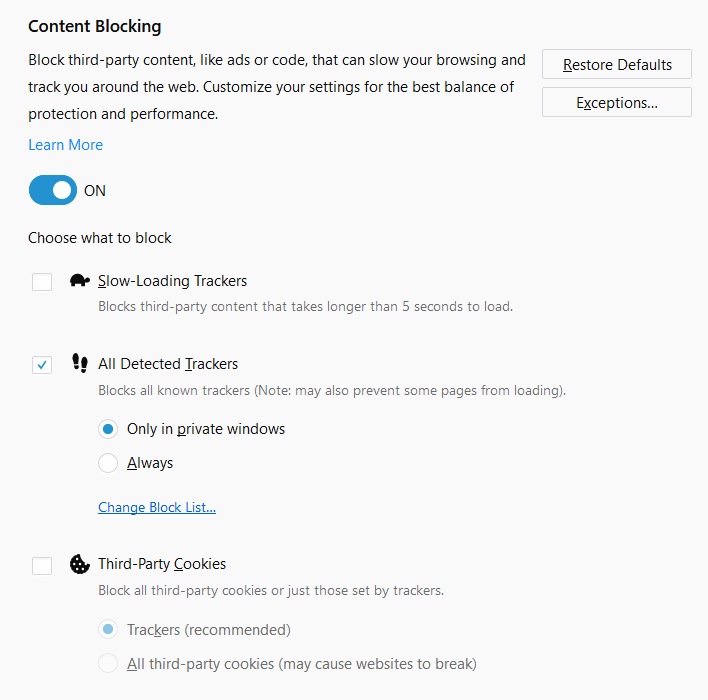
If you want to give these new features a try today, all you have to do is install the unstable Firefox Nightly release. There, in the privacy settings, you’ll find the new tracker blocking features under the “Content Blocking” header. Once you’ve turned that on, the browser will also walk you through how all of this works and highlight that some of the more aggressive settings may break a few sites.

In addition, Firefox’s private mode uses the same kind of tracking protection already, as does Firefox for iOS.

Safari users, too, will have likely yawned while reading this. Apple, after all, already announced similar privacy features for its browser last year. The approach here is different, with Apple betting on machine learning and Firefox using more traditional block lists, but the intent is the same.

As Mozilla notes, the idea here is to give users choice. Sites can still ask for a user’s data but they’ll have to ask for consent before they get it. “Blocking pop-up ads in the original Firefox release was the right move in 2004, because it didn’t just make Firefox users happier, it gave the advertising platforms of the time a reason to care about their users’ experience. In 2018, we hope that our efforts to empower our users will have the same effect,” writes Nguyen.

OpenStack’s latest release focuses on bare metal clouds and easier upgrades

The OpenStack Foundation today released the 18th version of its namesake open-source cloud infrastructure software. The project has had its ups and downs, but it remains the de facto standard for running and managing large private clouds.

What’s been interesting to watch over the years is how the project’s releases have mirrored what’s been happening in the wider world of enterprise software. The core features of the platform (compute, storage, networking) are very much in place at this point, allowing the project to look forward and to add new features that enterprises are now requesting.

The new release, dubbed Rocky, puts an emphasis on bare metal clouds, for example. While the majority of enterprises still run their workloads in virtual machines, a lot of them are now looking at containers as an alternative with less overhead and the promise of faster development cycles. Many of these enterprises want to run those containers on bare metal clouds and the project is reacting to this with its “Ironic” project that offers all of the management and automation features necessary to run these kinds of deployments.

“There’s a couple of big features that landed in Ironic in the Rocky release cycle that we think really set it up well for OpenStack bare metal clouds to be the foundation for both running VMs and containers,” OpenStack Foundation VP of marketing and community Lauren Sell told me. 

Ironic itself isn’t new, but in today’s update, Ironic gets user-managed BIOS settings (to configure power management, for example) and RAM disk support for high-performance computing workloads. Magnum, OpenStack’s service for using container engines like Docker Swarm, Apache Mesos and Kubernetes, is now also a Kubernetes certified installer, meaning that users can be confident that OpenStack and Kubernetes work together just like a user would expect.

Another trend that’s becoming quite apparent is that many enterprises that build their own private clouds do so because they have very specific hardware needs. Often, that includes GPUs and FPGAs, for example, for machine learning workloads. To make it easier for these businesses to use OpenStack, the project now includes a lifecycle management service for these kinds of accelerators.

“Specialized hardware is getting a lot of traction right now,” OpenStack CTO Mark Collier noted. “And what’s interesting is that FPGAs have been around for a long time but people are finding out that they are really useful for certain types of AI, because they’re really good at doing the relatively simple math that you need to repeat over and over again millions of times. It’s kind of interesting to see this kind of resurgence of certain types of hardware that maybe was seen as going to be disrupted by cloud and now it’s making a roaring comeback.”

With this update, the OpenStack project is also enabling easier upgrades, something that was long a daunting process for enterprises. Because it was so hard, many chose to simply not update to the latest releases and often stayed a few releases behind. Now, the so-called Fast Forward Upgrade feature allows these users to get on new releases faster, even if they are well behind the project’s own cycle. Oath, which owns TechCrunch, runs a massive OpenStack cloud, for example, and the team recently upgraded a 20,000-core deployment from Juno (the 10th OpenStack release) to Ocata (the 15th release).

The fact that Vexxhost, a Canadian cloud provider, is already offering support for the Rocky release in its new Silicon Valley cloud today is yet another sign that updates are getting a bit easier (and the whole public cloud side of OpenStack, too, often gets overlooked, but continues to grow).

YouTube launches a suite of fundraising tools

YouTube today announced a suite of new features designed to offer creators and their fans new ways to contribute to charitable causes. This includes beta versions of new fundraising and campaign matching tools, as well as a variation of YouTube’s Super Chat service, called “Super Chat for Good.”

Explains the company, YouTube creators have already been using its video platform to raise awareness about causes they care about, and bring their communities together. The launch of YouTube Giving, as this combined toolset is called, will now allow them to do more by making it easier for fans to donate to over 1 million nonprofits.

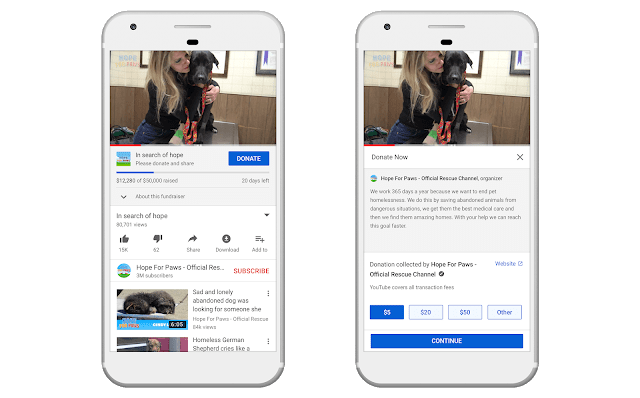
With Fundraisers, YouTube creators and qualifying U.S. nonprofits (registered 501(c)(3) nonprofits) will be able to create fundraising campaigns that are embedded next to their YouTube videos.

Directly beneath the video, viewers will see a “Donate” button that will allow them contribute to the campaign. YouTube says it will handle the logistics and payment processing.

This is rolling out now to a small group of U.S. and Canadian creators during this beta. One example, live now, is a Hope for Paws Fundraiser that’s raising funds towards animal rescue and recovery.

During the beta, YouTube will cover all transaction fees, allowing 100% of donations to reach the nonprofits.

Community Fundraisers, now launching in beta to U.S. creators, will allow YouTubers to team up together to co-host the same fundraiser. The feature set here is similar to regular fundraisers, but is designed so the fundraiser appears at the same time across all participants’ videos. It will also display how much money all communities have raised together.

This is being kicked off with a group fundraiser by a dozen gaming creators who will raise money from their 37 million subscribers for St. Jude Children’s Research Hospital.

Campaign Matching has yet to launch, but will soon allow creators to organize fundraisers where they can receive matching pledges from other creators, brands, and businesses to increase how much they’re able to raise.

The matching pledges and who they’re from will also be displayed as part of this feature. This is expected to arrive in the weeks ahead, says YouTube.

Another new addition leverages YouTube’s existing Super Chat system, which allows fans to pay to have their comments highlighted. In Super Chat for Good, 100% of viewers’ Super Chat purchases will go towards the nonprofit the creator is supporting.

YouTube says it will take in feedback from the community and expand the features to more creators over the next few months.

Online fundraising is a popular activity today across sites like GoFundMe, Kickstarter, Indiegogo, and Patreon. Facebook also entered the market a couple of years ago. In mid-2016 it rolled out the ability for its users to raise funds for nonprofits they support, before later expanding this fundraising toolset set to live video, and broadening the types of fundraisers people could host.

Facebook charges platform fees on some of these fundraisers, except for those for charitable organizations.

YouTube says it also won’t charge fees during the beta, but declined to tell us what its plans for fees are when the beta period wraps.

The company this year has been expanding the types of things creators can do with their videos, in the face of increased competition from Facebook Watch and Amazon’s Twitch. Earlier this summer, YouTube introduced a suite of other features like channel memberships, merchandise shelves, marketing partnerships via FameBit and the launch of “Premieres,” to offer creators a middle ground between live streaming and pre-recorded video.

Twitter announces new policy and certification process for ‘issue ads’

Twitter continues to roll out new policies aimed at increasing transparency, particularly around political advertising.

Amidst ongoing concerns about Russian election interference and misinformation on social media, the company recently announced political ad guidelines and launched an Ads Transparency Center where you can find more information about advertisers.

Initially, however, Twitter’s stricter standards were limited to ads for U.S. federal election candidates and campaigns. Now it’s announced a policy around the broader category of “issue ads.”

In a blog post, Twitter’s vice president of trust and safety Del Harvey and its general manager of revenue product Bruce Falck said the policy affects two categories:

* Ads that refer to an election or a clearly identified candidate, or
* Ads that advocate for legislative issues of national importance

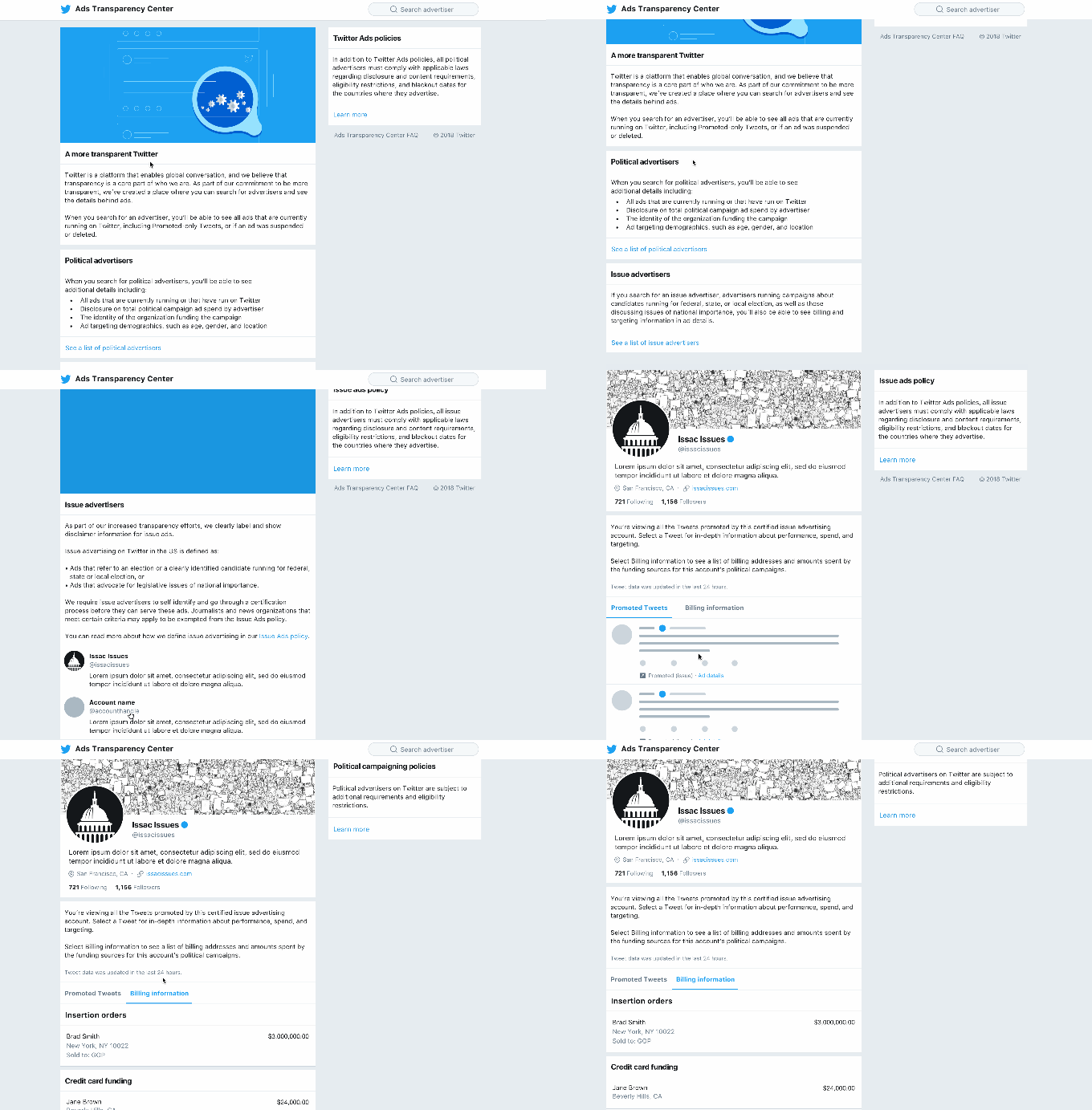
In both cases, advertisers will need to apply for certification, which involves verifying their identity and location in the United States. Like election ads, issue ads will be labeled as such in the Twitter timeline, and they’ll allow users to click through and learn more about the advertiser. They’ll also be included in the Ads Transparency center.

Twitter Issue Ads

As examples of the kinds of issues that would be covered, Harvey and Falck cited “abortion, civil rights, climate change, guns, healthcare, immigration, national security, social security, taxes, and trade,” though they also said that list will likely evolve over time.

News organizations that want to run ads around their political coverage can apply for an exemption. (Since the definition of what is and isn’t a news organization can be blurry, there are specific criteria that they’d need to meet, like providing editorial staff information online and not being “dedicated to advocating on a single issue.”)

“We don’t believe that news organizations running ads on Twitter that report on these issues, rather than advocate for or against them, should be subject to this policy,” Harvey and Falck wrote.

Twitter says it will start enforcing the policy (which, to be clear, is currently U.S.-only) on September 30.

The Google Assistant is now bilingual 

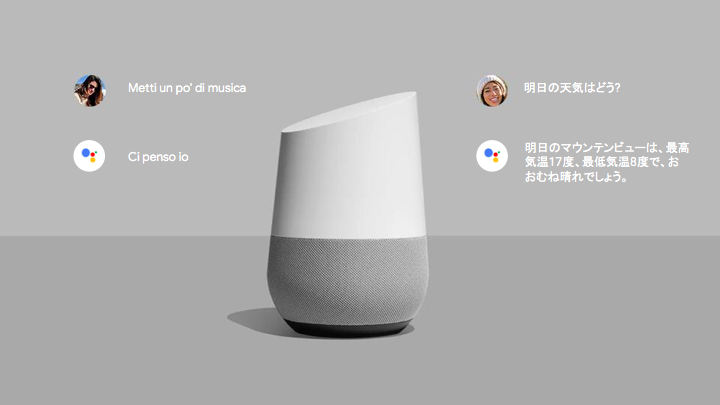
The Google Assistant just got more useful for multilingual families. Starting today, you’ll be able to set up two languages in the Google Home app and the Assistant on your phone and Google Home will then happily react to your commands in both English and Spanish, for example.

Today’s announcement doesn’t exactly come as a surprise, given that Google announced at its I/O developer conference earlier this year that it was working on this feature. It’s nice to see that this year, Google is rolling out its I/O announcements well before next year’s event. That hasn’t always been the case in the past.

Currently, the Assistant is only bilingual and it still has a few languages to learn. But for the time being, you’ll be able to set up any language pair that includes English, German, French, Spanish, Italian and Japanese. More pairs are coming in the future and Google also says it is working on trilingual support, too.

Google tells me this feature will work with all Assistant surfaces that support the languages you have selected. That’s basically all phones and smart speakers with the Assistant, but not the new smart displays, as they only support English right now.

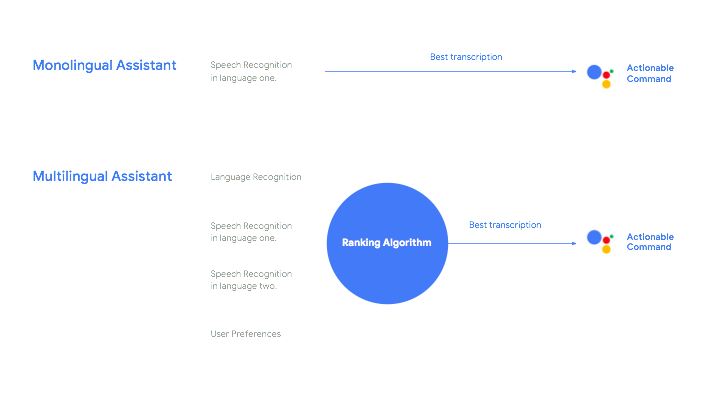
While this may sound like an easy feature to implement, Google notes this was a multi-year effort. To build a system like this, you have to be able to identify multiple languages, understand them and then make sure you present the right experience to the user. And you have to do all of this within a few seconds.

Google says its language identification model (LangID) can now distinguish between 2,000 language pairs. With that in place, the company’s researchers then had to build a system that could turn spoken queries into actionable results in all supported languages. “When the user stops speaking, the model has not only determined what language was being spoken, but also what was said,” Google’s VP Johan Schalkwyk and Google Speech engineer Lopez Moreno write in today’s announcement. “Of course, this process requires a sophisticated architecture that comes with an increased processing cost and the possibility of introducing unnecessary latency.”

If you are in Germany, France or the U.K., you’ll now also be able to use the bilingual assistant on a Google Home Max. That high-end version of the Google Home family is going on sale in those countries today.

In addition, Google also today announced that a number of new devices will soon support the Assistant, including the tado° thermostats, a number of new security and smart home hubs (though not, of course, Amazon’s own Ring Alarm), smart bulbs and appliances, including the iRobot Roomba 980, 896 and 676 vacuums. Who wants to have to push a button on a vacuum, after all.

Twitter suspends more accounts for “engaging in coordinated manipulation”

Following last week’s suspension of 284 accounts for “engaging in coordinated manipulation,” Twitter announced today that it’s kicked an additional 486 accounts off the platform for the same reason, bringing the total to 770 accounts.

While many of the accounts removed last week appeared to originate from Iran, Twitter said this time that about 100 of the latest batch to be suspended claimed to be in the United States. Many of these were less than a year old and shared “divisive commentary.” These 100 accounts tweeted a total of 867 times and had 1,268 followers between them.

Since our initial suspensions last Tuesday, we have continued our investigation, further building our understanding of these networks. In addition, we suspended an additional 486 accounts for violating the policies outlined last week. This brings the total suspended to 770.

— Twitter Safety (@TwitterSafety) August 27, 2018

As examples of the “divisive commentary” tweeted, Twitter shared screenshots from several suspended accounts that showed anti-Trump rhetoric, counter to the conservative narrative that the platform unfairly targets Republican accounts.

Fewer than 100 of the 770 suspended accounts claimed to be located in the U.S. and many of these were sharing divisive social commentary. On average, these 100 Tweeted 867 times, were followed by 1, 268 accounts, and were less than a year old. Examples below. pic.twitter.com/LQhbvFjxSo

— Twitter Safety (@TwitterSafety) August 27, 2018

Twitter also said that the suspended accounts included one advertiser that spent $30 on Twitter ads last year, but added those ads did not target the U.S. and that the billing address was outside of Iran.

“As with prior investigations, we are committed to engaging with other companies and relevant law enforcement entities. Our goal is to assist investigations into these activities and where possible, we will provide the public with transparency and context on our efforts,” Twitter said on its Safety account.

After years of accusations that it doesn’t enforce its own policies about bullying, bots and other abuses, Twitter has taken a much harder line on problematic accounts in the past few months. Despite stalling user growth, especially in the United States, Twitter has been aggressively suspending accounts, including ones that were created by users to evade prior suspensions.

Twitter announced a drop of one million monthly users in the second quarter, causing investors to panic even though it posted a $100 million profit. In its earnings call, Twitter said that its efforts don’t impact user numbers because many of the “tens of millions” of removed accounts were too new or had been inactive for more than a month and were therefore not counted in active user numbers. The company did admit, however, that it’s anti-spam measures had caused it to lose three million monthly active users.

Whatever its impact on user numbers, Twitter’s anti-abuse measures may help it save face during a Senate Intelligence Committee hearing on September 5. Executives from Twitter, Facebook and Google are expected to be grilled by Sen. Mark Warner and other politicians about the use of their platforms by other countries to influence U.S. politics.

China’s Byton is sending its electric SUV prototypes to the U.S.

Byton, the new China-based automaker founded by former BMW and Infiniti executives, has produced the first 10 prototypes of its tech-centric all-electric SUV and some of them will be in the U.S. before the end of the year, company president and co-founder Daniel Kirchert told TechCrunch.

Byton plans to produce another 100 prototypes of the SUV, which the automaker calls the M Byte, by the end of 2018, Kirchert said in recent interview during Monterey Car Week.  Some of these vehicles will be shipped to the U.S., where self-driving vehicle technology startup Aurora will take over.

Aurora, a startup founded by self-driving tech stars Chris Urmson, Sterling Anderson, and Drew Bagnell, will begin testing its Level 4 autonomous driving systems on the Byton SUV prototype before the end of 2018, according to Kirchert. The two companies announced a partnership in January at the big tech trade show CES.

Byton will continue with its own tests such as vehicle reliability and cold-weather testing at its Nanjing prototype manufacturing plant. The plant is built on the site of Byton’s future factory, which is already under construction.

The prototype production milestone comes on the heels of $500 million in fresh funding that was announced in June. The Series B round included investors FAW Group, Tus-Holdings and CATL, which TechCrunch has learned will supply Byton with batteries.

A production version of the M Byte is targeted for the end of 2019, with the first vehicles to be sold in China. Sales will then move to the U.S. and Europe in mid-2020, Kirchert said.

Back when Byton first revealed its SUV concept at CES this January, founders Kirchert and CEO Carsten Breitfeld said it was close to what the final production version would look like. It’s about 80% complete, Kirchert said recently, adding that the prototype has modest changes from the concept, including a slight changes to the height and headlights as well as improvements to the door latches.

The rest, including a massive touchscreen that takes up the entire dashboard, is largely unchanged. the M Byte also has another touchscreen on the steering wheel and a variety of “smart” connected features that lets customers use hand gestures and voice commands via Amazon’s Alexa assistant to control aspects of the car. The vehicle also monitors the driver’s heart rate, weight, oxygen saturation, or blood pressure.

The SUV, which Byton likes to call an SIV or or “smart intuitive vehicle, will come in a base model featuring a 70-kilowatt-hour battery pack that can travel 250 miles on a single charge. A pricier version with a 90-kwH pack will be able to travel about 325 miles on a single charge.

The M Byte SUV will not come equipped with a Level 4 system, a designation by SAE International that means the car takes over all of the driving in certain conditions. Instead, it will have come out with Level 2 capabilities, which means the vehicle has combined automated features such as steering and acceleration, but still requires the human driver to remain and ultimately responsible.

Kirchert explained that the company is using its SUV prototypes to ensure a Level 4 self-driving system, can be properly integrated in future vehicles such as the K Byte, a new concept from Byton that was on display Sunday at Pebble Beach Concours d’Elegance. The sedan will be the second vehicle in Byton’s portfolio and is expected to have a global market launch.

What I learned from Flipkart

Oliver Rippel
Contributor

Oliver Rippel is the chief executive officer of Naspers’ global business to consumer subsidiaries and investments.

Two weeks ago, Walmart concluded its investments to acquire a majority stake in Flipkart.

This is one of the largest transactions in e-commerce and in the internet space globally, with Walmart deploying US$16 billion to obtain an approximate 77 percent shareholding at closing. As part of this transaction, my company, Naspers, exited fully, selling our 11.18 percent stake for $2.2 billion.

In addition to the obvious financial success — a 3.6x or $1.6 billion absolute return in six years — being part of one of the greatest success stories of the Indian and global e-commerce market led to countless insights for Naspers.

Our journey with Flipkart will help us to further shape how we partner with entrepreneurs to build leading technology companies in the future.

I was fortunate enough to have had a front-row seat at Flipkart for the past six years, leading our various investment rounds and being Naspers’ appointed board director. Here are some of the key lessons that I will remember moving forward.

Pursue big market opportunities and solve big problems

E-commerce is a global trend that manifests in every market around the world. The potential of Indian e-commerce is beyond any doubt, with a total retail market of more than $500 billion. Before Flipkart, Indian e-commerce customers were repeatedly disappointed by mediocre selection, low product quality, little flexibility in payment options and a lengthy delivery experience.

Flipkart was the first player to solve these issues at scale, opening up the marketplace to more categories (starting with media and then rapidly expanding into electronics, lifestyle, etc.), offering warehouse services, and introducing its own courier network, Ekart, that ensured customer delight and cash on delivery. Other players eventually offered similar services, but Flipkart was the pioneer.

Market leadership is key to sustainable success, even in e-commerce, which tends to have “winner takes most” as opposed to “winner takes all” characteristics. Leaders enjoy attention from sellers, buyers, as well as existing and prospective employees. They continue to innovate while laggards are trying to catch up. Throughout our six-year journey with Flipkart, the company was in a market leadership position against strong competition from global and local online players.

Given the rapid growth of the Indian e-commerce market, Flipkart had to scale its tech platforms while also scaling its business model and organization. This is hard to do, and we’ve seen many businesses fail to scale. Flipkart was not one of them.

As a market leader and pioneer in the Indian e-commerce market, Flipkart had to sail unchartered waters. Experimenting while increasing in scale carried significant risk for the organization and had consequences for the market — Flipkart made many bold decisions over the years. Many of these worked out beautifully, such as acquiring Myntra in May 2014 to obtain a strong position in the strategic fashion and apparel category, or establishing Big Billion Day as the marquee sales event of the year.

There were others that did not work out, like trialing app-only shopping, but these failures never deterred the team from taking chances and changing course if needed, while always capturing the lessons. In the end, the app-only move allowed the company to become mobile-centric and a clear innovation leader in this area.

Think globally, but act locally

Flipkart is focused on the Indian market, but the competitive battle for sellers, buyers and talent is fought globally. The team adopted global best practices like Big Billion Day, which was inspired by ideas from the U.S., China and Romania.

They also measure success based on KPIs constantly drawing comparison with global market leaders. Most importantly though, Flipkart always innovated for the local market, taking local tastes into account (as serviced by the multitude of private label brands at Flipkart and Myntra), as well as bandwidth and affordability constraints on the customer side, leading to super-light mobile sites and apps, as well as various trade-in and financing programs.

Play the long game

Despite multi-billion-dollar trading volumes, the current e-commerce market in India is still mostly driven by affluent metro city dwellers in places like Mumbai, Delhi and Bangalore. This is not dissimilar to what we’ve seen in other countries around the world at a similar development stage as e-commerce in India.

However, to really unlock the potential of Indian e-commerce, one has to reach the hundreds of millions of customers that live in tier-two or -three cities, or in the countryside.

This will require a very unique approach in terms of selection, price points and delivery and payment mechanisms. Flipkart management spends a considerable amount of time strategizing about these challenges.
The common thread in all of these lessons is that you need to have strong, inspiring leaders who come from the local market and have the vision and desire to scale their platforms responsibly and skillfully. Whether it was Binny and Sachin as co-founders of the business, or Kalyan, Ananth and Sameer in leading the respective Flipkart, Myntra and PhonePe business units, without these leaders it would have not been possible for Flipkart to grow to what it is today. I’m very grateful for my time with Flipkart and wish the team and Walmart all the best in continuing this incredible journey… a journey made in India.

Eventbrite just made some pricing changes as it moves toward an IPO

Reaching event organizers to help them sell tickets isn’t cheap. Eventbrite — the 12-year-old, San Francisco-based ticketing company that announced plans last week to go public and sell $200 million worth of shares on the NYSE — has been losing money since 2016, posting losses of $40.4 million in 2016, $38.5 million for 2017 and $15.6 million so far this year.

Now the company is trying to make up for some of those losses by announcing a new pricing scheme. Today, it sent customers a note explaining that for those using its “Essentials” package (unlike its “Professional” package, whose bells and whistles include customer support, customer questions for attendees and more), reduced prices are coming for many of its customers. Specifically, payment processing fees are dropping from 3 percent to 2.5 percent. Fees for ticket are falling from .99 cents to .70 cents.

The moves don’t really mean that Eventbrite is charging less. In fact, instead of charging one percent of every ticket price as a service fee, Eventbrite will now take a 2 percent cut, which should add up for organizers that use the service for bigger events. It’s also removing a service fee cap of $19.99 that it used to institute no matter how much an event organizer was charging.

Asked about the pricing changes, a spokesperson sent us a fairly bland statement: “At Eventbrite we have always been committed to enabling event creators to deliver a diverse range of live experiences by offering a superior product at a fair price. The changes we announced today will mean lower ticket fees for the vast majority of our creators, and the millions of people that attend the events they plan, promote and produce each year. We succeed when our creators succeed and this change is indicative of a focus on ensuring we make the best decisions for the majority of our customers.”

It isn’t surprising that Eventbrite is looking for ways to fight rising acquisition costs owing to the competition it faces from all corners. In addition to platforms for smaller get-togethers like Paperless Post and competition for bigger events like Ticketmaster (which owns Live Nation), Eventbrite acknowledged in its S-1 filing that it could face competition from large internet companies like Facebook, Google and Twitter, too.

Eventbrite had reportedly filed confidentially for an IPO back in July. As noted on TechCrunch’s “Equity” podcast last week by Susan Mac Cormac, a partner at the global law firm Morrison Foerster, companies often file confidentially first if they are exploring other options, including, most notably, M&A.

“These unicorns,” says Mac Cormac, “it’s difficult for them to go public because they have such a huge valuation to begin with that M&A is often a better option. You don’t want to go out and have your stock fall 30, 40, 50 percent as sometimes happens.”

Partly through acquisitions, Eventbrite saw its revenue rise from $133 million in 2016 to $201 million last year. Last year, for example, Eventbrite acquired Ticketfly, a ticketing company that focused largely on the live entertainment industry and which had sold to the streaming music company Pandora in 2015 for a reported $335 million but Eventbrite was able to nab last year at the discounted price of $200 million.

Eventbrite has also made a broader international push in recent years, acquiring Ticketea, one of Spain’s leading ticketing providers, back in April, and acquiring Amsterdam-based Ticketscript back in January of last year. And those deals followed roughly half a dozen others.

Over the years, the company has raised roughly $330 million from investors, according to Crunchbase. Its biggest shareholders, shows its S-1, are Tiger Global Management, Sequoia Capital and T. Rowe Price. Collectively, the three entities own roughly half of Eventbrite’s pre-IPO shares.

Graphika visualizes Twitter’s filter bubbles in the US

It’s no surprise that political discourse in America is divided — especially online. And last week in MIT Technology Review, data visualization company Graphika brought those divides to life with 3D, colored depictions of the kind of filter bubbles found on Twitter in the U.S.

Co-written by Graphika’s CEO John Kelly and the company’s research director Camille François, the graphics imagine Twitter users as colored orbs (larger or smaller depending on their follower sizes) and groups them depending on who follows whom.

The authors told TechCrunch that to create these particular data visualizations they used data from about 13,500 of the best connected accounts following members of Congress and national-level official political party accounts. Other starting places, such as singular states or grassroots parties, also illustrated these looming national echo chambers, the authors said.

The visuals help bring into stark realization some predictable trends. For example, there is essentially zero crossover in followers between extreme Trump supporters and people who are extremely anti-Trump. The progressive movement is strongest in its connections between Democrats and left-wing journalists, but has some connections on the conservative sphere, as well.

Progressive Data

One interesting point that the graphic does bring into focus is that, despite our preconceptions of either the entire left or the entire right representing a singular ideology, in fact it’s primarily accounts on the far edge of these groups who do most of the talking. The authors point out that for some of these accounts, the high and identical numbers of tweets point toward a bot instead of an actual user.

This kind of polarization is exactly what makes it possible for bad outside actors (like Russia) to influence political discourse and action in a social sphere. Instead of targeting the middle of the spectrum — where users are generally quieter and generally less strictly partisan in their views — these actors can engage with polarized communities, gain their trust and introduce new or exacerbating ideologies.

“It’s the digital equivalent of moving to an isolated and tight-knit community, using its own language quirks and catering to its obsessions, running for mayor, and then using that position to influence national politics,” the authors write.

If these data point to anything, it’s that it’s time we begin to value listening over talking.

“The extremes are screaming while the center whispers,” the authors told TechCrunch.

It’s human nature to want to confirm your beliefs with those who agree with you, especially in times of uncertainty or fear. However, by retreating to echo chambers that are being infiltrated with bad actors, we’re doing nobody a favor, least of all ourselves.

Toyota invests $500 million into Uber

Toyota and Uber are partnering to bring an on-demand autonomous ride-hailing service to market, a deal that includes a $500 million investment from the Japanese automaker.

Under the agreement, Toyota Sienna minivans will be equipped with Uber’s self-driving technology and then deployed on the ride-hailing company’s network, the companies said.

The deal, which was first reported by the WSJ and later confirmed with new details by TechCrunch, is unusual because a third—and yet unnamed fleet operator—would own and operate the mass-produced autonomous vehicles. Pilot-scale deployments will begin on the Uber ride-sharing network in 2021, the companies said.

It’s a first of its kind deal for Uber, CEO Dara Khosrowshahi noted in a statement released Monday afternoon. It’s also one that should help further improve Uber’s image as a reckless do-now-ask-for-forgiveness startup, particularly in the wake of the fatal self-driving vehicle accident in March.

“Uber’s advanced technology and Toyota’s commitment to safety and its renowned manufacturing prowess make this partnership a natural fit,” Khosrowshahi. “I look forward to seeing what our teams accomplish together.”

The companies are calling this a “Autono-MaaS” fleet, a jargon term meant to mean autonomous-mobility as a service.

Toyota (and its research arm the Toyota Research Institute) has a different deployment strategy for autonomous vehicles than its competitors. The company has previously said it plans to take a dual approach to autonomy that it calls “Guardian” and “Chauffeur,” both of which use the same technology stack.

Toyota’s idea is to develop fully autonomous cars to serve an aging population and the disabled as well as work on technology for regular production cars that could switch between assisted and full autonomy. This “guardian” technology would operate silently in the background.

TRI debuted its first-generation autonomous vehicle in March 2017. Its Platform 2.1 vehicle, revealed just a few months later, features light ranging and detection radar developed by Silicon Valley startup Luminar.

Under this new agreement, Uber’s autonomous driving system and the Toyota “guardian” automated safety support system would both be integrated into these Autono-MaaS vehicles.

Toyota will also use its core information infrastructure for connected vehicles—something is calls a mobility services platform, or MSPF.

“Uber’s automated driving system and Toyota’s guardian system will independently monitor the vehicle environment and real-time situation, enhancing overall vehicle safety for both the automated driver and the vehicle,” said Dr. Gill Pratt, Toyota Research Institute CEO.

Toyota already had a relationship with Uber, albeit not as close as it will under this new arrangement. Toyota announced at CES in January that it is working with Amazon, ride-hailing companies Uber and Didi, automaker Mazda and Pizza Hut to develop an electric autonomous shuttle that can be used to deliver people or packages. The business alliances were created to focus on the development of the new e-Palette Concept Vehicle in the near term.

Facebook comms VP Rachel Whetstone is heading to Netflix

In Facebook’s latest highprofile departure, corporate communications lead Rachel Whetstone will leave for a top PR role at Netflix. Whetstone joined Facebook about a year ago after leaving a similar position running communications at Uber during some of the company’s most fraught days. Prior to Uber, Whetstone worked for Google as its SVP of communications and public policy.

Facebook confirmed Whetstone’s departure, which was first reported by Recode. “It’s been amazing to be able to learn from one of the best over this last year,” FB Comms VP Caryn Marooney said in a statement provided to TechCrunch. “We are grateful for what Rachel has brought to our team and we know she will have continued success at Netflix.”

Whetstone won’t be leaving Facebook for another few months still as the company prepares for the transition. After her departure, Caryn Marooney will return to leading Facebook’s global communications team, a role she shared during Whetstone’s time with the company.

In a separate statement today, Netflix welcomed its new hire. “Rachel is a proven communications leader and a strong addition to the Netflix team,” said Netflix CEO Reed Hastings in a statement. “Her deep knowledge and international expertise will be invaluable as we bring Netflix and its expanding lineup of original content to an increasingly global audience.”

At Netflix, Whetstone will replace former PR head Jonathan Friedland, who created his own PR crisis at the company earlier this summer when he was fired for his use of a racial slur.

HP is ‘printing’ drugs for the CDC to speed up antibiotic testing

At least 2 million people in the U.S. become infected with so-called “super bugs” and at least 23,000 people die as a direct result of these infections each year, according to the Centers for Disease Control (CDC). Now, HP’s Biohacker technology is working with the CDC on a pilot program to “print” and test antibiotics in an effort to catch these antimicrobial resistant strains from spreading faster.

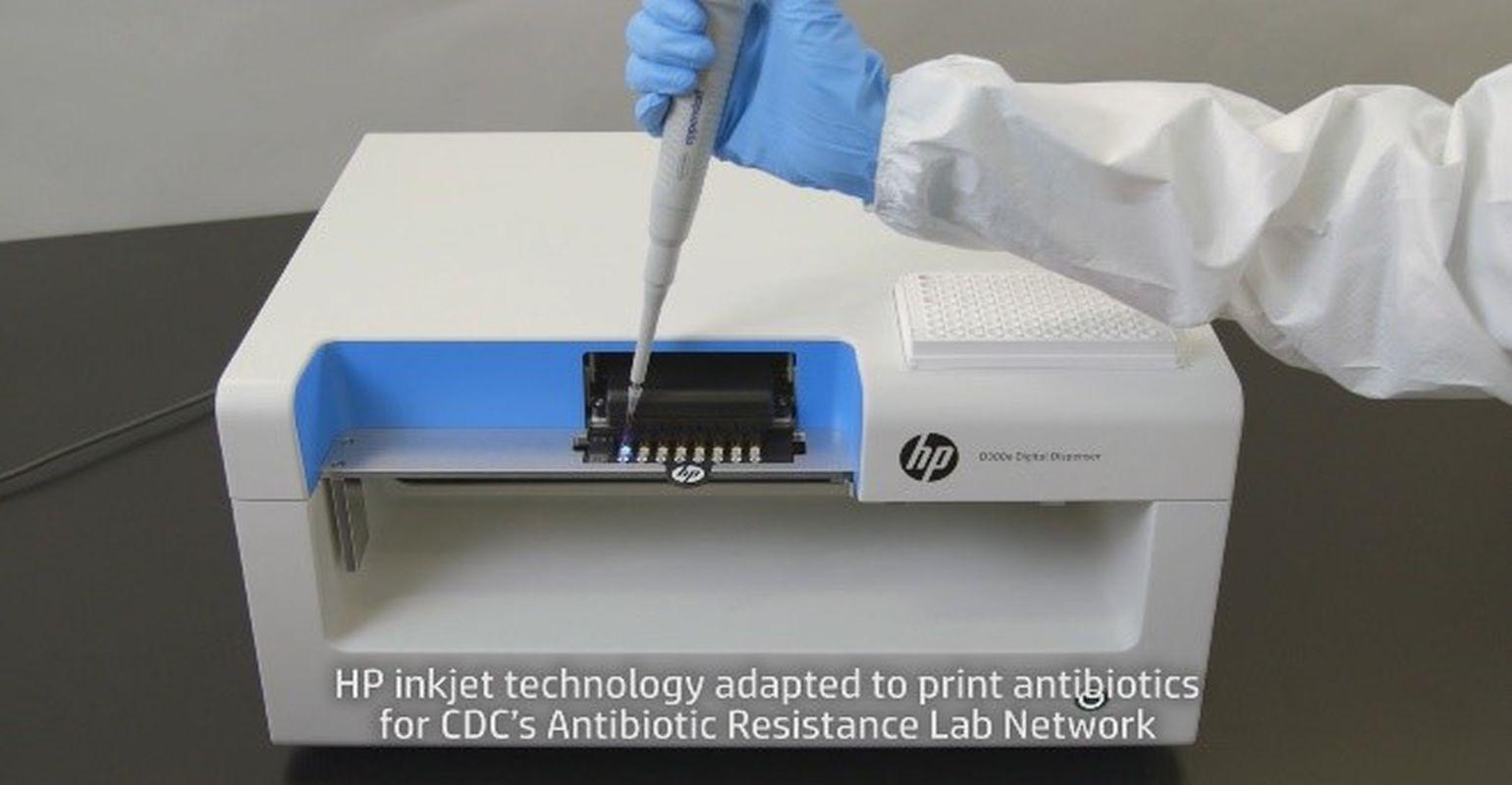
The HP D300e Digital Dispenser BioPrinter technology works by using the same set up as a regular ink printer, but instead dispenses any combination of drugs in volumes from picoliters to microliters to be used for research purposes.

Part of the reason these bugs spread so rapidly often comes down to mis-use of antibiotics, leading the bacteria to develop a resistance to the drugs available. The CDC hopes to give hospital providers access to the technology nationwide to cut down on the problem.

“Once a drug is approved for use, the countdown begins until resistance emerges,” Jean Patel, PhD, D (ABMM), Science Team Lead, Antibiotic Resistance Coordination and Strategy Unit at CDC said in a statement. “To save lives and protect people, it is vital to make technology accessible to hospital labs nationwide. We hope this pilot will help ensure our newest drugs last longer and put gold-standard lab results in healthcare providers’ hands faster.”

The 3D bioprinting sector has been experiencing rapid growth over the last few years and will continue on pace through the next decade, mainly due to R&D, according to market researchers. Innovation in the space includes printing of organs and human tissue and drug research and development.

Further, this potentially valuable antibiotic resistance research could help patient care teams stem a grim future where we experience a regression in health and life spans due to no longer having the ability to treat currently curable diseases.

The HP BioPrinter is currently used by labs and pharmaceutical companies such as Gilead, which tests for drugs used against the Ebola virus. It is also being used in various CRISPR applications. The CDC will use these printers in four regional areas spread throughout the U.S. within the Antibiotic Resistance (AR) Lab Network to develop antimicrobial susceptibility test methods for new drugs, according to HP.