Google’s newest app Blog Compass helps bloggers in India manage their sites

Google has been heavily focused on serving the needs of Indian web users with the recent launch of apps like Tez for payments, Areo for food ordering, Neighbourly for communities, data-friendly versions of apps like Search and YouTube, and others. Now, the company is launching an app to serve the need of Indian bloggers with an app called “Blog Compass.”

The new app, now in beta, quietly popped up in the Google Play Store this week with a note that’s it’s “only available in India.”

According to its Play Store description, Blog Compass helps bloggers manage their sites and find topics to write about based on Google’s trending topics. These suggestions will also be based on the bloggers’ interests and posting history, it says.
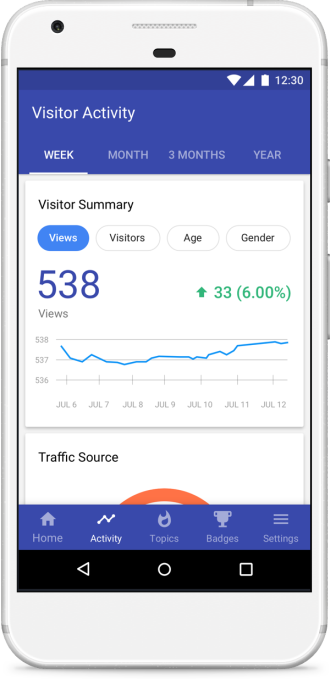
The app also helps bloggers manage their sites by tracking their site stats, approving comments and reading through tips for how to make their blogs more successful.

It works with both Google’s own Blogger.com blogs as well as with WordPress sites. These are two of the largest platforms used by bloggers around the world. WordPress alone powers around 30 percent of websites, in fact.

Blog Compass feels something like an introductory app for those who aren’t as familiar with how the web or blogging works. That may be appropriate for an emerging market like India, where many are coming online for the first time by way of mobile devices, having skipped the PC era of internet connectivity.

However, as any old-school blogger would tell you, writing posts simply to cater to whatever is currently trending on Google is something of a traffic hack — and not necessarily how you want to build an audience for your site. Sure, it may bring you clicks as you chase one hot topic after another — but it’s better to develop your own voice and write what you’re passionate about if you really want to develop a relationship with readers.

On the Blog Compass website, screenshots show some of the sample teachings the app will contain. These include courses on things like getting started with SEO and analytics, for example. And, of course, getting your website listed on Google.

The app is simply designed, with navigation via tabs at the bottom of the screen for moving through sections like Home, Activity, Topics and Badges.

It seems the idea is to centralize a lot of the topic research and blog management overhead in a central place — something you can’t necessarily do with WordPress or Blogger’s own mobile apps, where the focus is more on using those apps’ publishing tools.

We’ve reached out to Google to ask for more information about its intentions with Blog Compass, including whether it intends to roll it out to more markets in the future, or if it’s been developed specifically for India.


Kinta AI uses artificial intelligence to make factories more efficient

Kinta AI aims to make manufacturers smarter about how they deploy their equipment and other factory resources.

The company, which is presenting today at TechCrunch’s Startup Battlefield in San Francisco, was founded by a team with plenty of experience in finance, tech and AI.

CEO Steven Glinert has held management and AI roles at fintech startups, CTO Rob Donnelly is studying the intersection of machine learning and economics as a Ph.D. candidate at Stanford and VP of Engineering Ben Zax has worked at both Facebook and Google.

Glinert told me that when factory owners are making production decisions, they’re usually relying on “dumb software” to decide which machines should be used when, which can result in machines being deployed at the wrong time or in the wrong sequence, or sitting idle when they shouldn’t be. As a result, he said that scheduling errors account for 45 percent of late manufacturing orders.

So Kinta AI tries to solve this problem with artificial intelligence, specifically reinforcement learning. Glinert said the company will run “millions and millions of factory simulations,” where the system gains “a statistical understanding of how your factory works and learning what actions you do to get what result” — and it can then use those simulations to choose the best schedule.

“We run through, not every possible scenario, but we try to go through some of those,” he said.

Glinert added that Kinta AI works with its customers to understand the nuances of each factory. He also compared the technology to Google’s AlphaGo AI and OpenAI’s Dota 2 neural networks — except that instead of using AI to play Go or Dota 2, Gilnert said Kinta AI is utilizing it “to do these detailed production planning decisions that are being made on the factory floor.”

“Not all factories are that dissimilar from each other,” he said — similar to how “if you learned how to play Go, you can easily teach that neural net how to play chess or other game of that type.”

And Kinta AI already has some customers, including chemical manufacturer BASF and a medical device manufacturer.

Ultimately, Glinert said Kinta AI could become a crucial part of the manufacturing process. He predicted that “in the factory of the future, there will be fewer people and more automation, with a vast environment of Internet of Things devices.”

In that environment, he wants Kinta AI to be “the manufacturer execution system.”

Mira launches a device for more accurate fertility testing in the home

Mira, launching today at TechCrunch Disrupt SF 2018, is a new device that aims to help women who are struggling to conceive. The Mira Fertility system offers personalized cycle prediction by measuring fertility hormone concentrations in urine samples, telling women which days they’re fertile. The system is more advanced and accurate than the existing home test kits, the company claims, which can be hard to read and aren’t personalized to the individual.

The company behind Mira, Quanovate, was founded in late 2015 by a group of scientists, engineers, OBGYN doctors, and business execs to solve the problem of the unavailability of advanced home health testing.

“I have a lot of friends who, like me, [prioritized] their career advancement and higher education, and they tended to delay their maternal age,” explains Mira co-founder and CEO Sylvia Kang. “But there’s no education for them about when to try for a baby, and they have no awareness about their fertility health,” she says.

Kang received an MBA at Cornell Johnson, went to Columbia for an MS in Biomedical engineering and received at PhD in Biophysics from University of Pittsburgh, before working as a Business Director at Corning where she was responsible for $100 million in global P&L, which she left to start Mira.

She says that women’s hormones are changing daily, and everyone’s profiles differ due to their lifestyle, stress levels and other factors. The only way to accurately track fertile days, then, is through continuous testing – something that’s been difficult to do at home.

To solve this problem, the team worked to develop the Mira system, which includes a small home analyzer, urine test strips, and an accompanying mobile application. The home analyzer miniaturizes lab equipment for home use, and brings down the cost.

To use the system, the woman places the test strip into the device which then uses immunofluorescence technology to read the results. Currently, the device tests for the presence of luteinizing hormone (LH), which is an indicator of ovulation. However, the company has already has plans to update the device so it can test for other hormones in the near future. (It’s FDA-cleared to detect estrogen, for example, but that won’t be available at launch.)

The system instead is $199 and ships with 10 test strips. After analyzing the strip, information about the hormone levels is displayed on the screen and sent to the Mira app via Bluetooth.

The app offers women more information about what this data means – like whether they should attempt to conceive today or wait. A subscription service will also offer them access to doctors so they can ask questions, but this will be free at launch.

“This technology is completely different from all the test strips on the market. It’s more accurate, but more importantly, this one is quantitative – that means we give you your actual, formal concentrations,” says Kang. “The [existing] tests strips only give you positive or negative. Since we have your numbers, our A.I. can do pattern recognition. Our algorithm prediction is based on your pattern specifically, not the average of all the population.”

What this means, in practice, is that women struggling to conceive will have more accurate, more actionable, and more personalized results with Mira. During a clinical trial with 400 patient samples, Mira reached 99 percent accuracy, compared with lab equipment, the company says. They also have 18 IPs covering hardware, software, database management and more, including utility patents and models, design patents, trademarks and copyrights.

The company is now working on a portal for doctors, so they could access their own patients’ data for further analysis. Mira may also eventually make its collected data, once anonymized, available to researchers, as well. But Kang says no formal decisions have been made on that front yet.

Longer-term, Kang explains that the same system can be adapted to track pregnancy and menopause, and eventually similar technology could be put to use for analyzing other conditions, like those related to kidney problems or the thyroid.

The Pleasanton, Calif.-based company, is currently a team of 36 and has raised $4.5 million from investors including Gopher Ventures, and two other cross-border investors Mira doesn’t want to disclose publicly.

At Disrupt, the company announced the Mira device is now available for pre-order and will begin shipping in October 2018.

It’s sold online via the Mira website, but is in discussions with doctors and retailers to broaden its availability going forward.

Crossing Minds would like to recommend a few entertainment options

Crossing Minds, which is launching in our Disrupt SF 2018 Battlefield today, is an AI startup that focuses on recommendations. The company’s app, Hai, provides you with a wide range of entertainment recommendations, including books, music, shows, video games and restaurants, based on the data it can gather about you from services like Spotify, Netflix, Hulu and your Xbox.

The company’s co-founders Alexandre Robicquet (CEO) and Emile Contal (CTO) tell me that they want Hai, which is available for iOS and on the web, to become people’s central hub for their entertainment needs. Both founders have extensive experience in machine learning and also managed to bring Sebastian Thrun on as an advisor. The team describes Hai as the “first pure cross-domain recommendation engine truly focused on the user.”

Ahead of its launch, Crossing Minds raised $3.5 million from Index Ventures, Sound Ventures and You & Mr Jones Brandtech Ventures.

As the team told me, the idea for Crossing Minds and Hai came from their own need of wanting a smart recommendation engine that went beyond a single domain. To get started, they downloaded a few data sets and started experimenting. That was 2016. Those first experiments were successful, but to build a full-scale product, the team needed more data and cleaner data sets. That’s what Crossing Minds focused on over the course of the last year or so, which really isn’t a surprise, given that we’re dealing with rather messy data here, yet there’s no way to build a machine learning-based recommendation system without a lot of data.

Then, using techniques like transfer learning and other modern machine learning approaches, the team is able to take what it knows about you and apply that to other domains as well. “For example, when you read a biography of a band’s member, we can extract information that we can then relate to a movie or restaurants and so on,” Contal explained.

The app itself is organized around three tabs: A discovery tab that surfaces its recommendations; the “Ask me” tab for when you are looking for very specific recommendations (a movie on Netflix, maybe); and the training tab that allows you to train Hai’s algorithm. For movies and other content that’s immediately accessible on your phone or on the web, Hai will also show a “Watch Now” button.

On the technical side, Crossing Minds uses all of the usual machine learning frameworks, but one interesting twist here is that the team decided to build its own hardware infrastructure with off-the-shelf GPUs to train its models and for inference. In part that’s because renting GPUs from a major cloud provider by the hour can quickly get expensive, but the team also noted that owning the hardware allows them to have full control over it and also offers security benefits (though I’m sure the cloud providers would disagree with that last part).

Over the course of the last few months, the team tested Hai with about 1,000 beta testers. The company isn’t quite ready to launch Hai to everybody, but it’s now taking beta sign-ups and plans to open the service to a wider audience over time.

Unbound makes pleasure fashionable

Unbound founders Polly Rodriguez and Sarah Jayne Kinney have long and varied careers. Rodriguez worked for U.S. Senator Claire McCaskill on Capitol Hill before heading to Deloitte Consulting and dating startup Grouper. Kinney was a graduate of University of Cincinnati worked at Puma and then at Esquire and O, Oprah’s magazine. She worked shooting products for fashion houses in New York.

The duo met in 2014.

Now they make fashion-forward vibrators. Their latest, the Palma, is the most fashion-forward yet and it just launched at TechCrunch Disrupt.

“Unbound is closing the very real orgasm gap by putting knowledge and product in the hands of women all over the world,” said Rodriguez. “Unbound is the first brand taking sexual wellness mainstream through elevated design and accessible pricing.”

The new device masquerades as a ring, offers multiple speeds, and is completely waterproof. It’s made of surgical grade steel and comes in silver or gold. Further, the team plans to add accelerometer features to the device. It will ship in 2019.

The team has raised $3.3 million in seed funding to date and are on track to hit $4 million in revenue in 2018.

They’ve been working on improving the state of the art when it comes to vibrators. They are, it seems, tired of the status quo.

“It’s important to note that vibrators are used in one of the most absorbent parts of the body and not regulated by the FDA. The lack of regulation results in manufacturers using carcinogens in their materials like parabens and phthalates. Unbound only uses medical grade silicone,” said Rodriguez.

Rodriguez’s message is simple: she wants to destroy the negative stereotypes around sex and health. And she has good reason.

“Each of us is motivated to change the stigmas associated with sexual health for different reasons. For me, it was going through menopause at 21 as a result of radiation treatment for cancer and ending up at a seedy shop on the side of the highway trying to buy lube and a vibrator. My doctors didn’t tell me I was going through menopause, only that I wouldn’t have children. As I got older, I realized that had I been a man, that conversation would have gone very differently… because we view male sexuality has a health need and female sexuality as a vice,” she said. “To put it in perspective, think about the fact that Bob Dole, a former presidential candidate was the spokesperson for Viagra. Can you imagine Hillary Clinton being the spokesperson for a vibrator brand? That’s the difference in how we view male vs. female (cis, femme, non-gender identifying) sexuality.”

“Our dream at Unbound is for female sexual health to be viewed through the same lens as male sexuality — as a part of our overall health that deserves a conversation, platform, and shopping experience that doesn’t feel like a flaming pile of garbage,” she said.

Former Facebook security chief says creating election chaos is still easy

As someone who’s had a years-long front-row seat to Russia’s efforts to influence U.S. politics, former Facebook Chief Security Officer Alex Stamos has a pretty solid read on what we can expect from the 2018 midterms. Stamos left the company last month to work on cybersecurity education at Stanford.

“If there’s no foreign interference during the midterms, it’s not because we did a great job,” Stamos said in an interview with TechCrunch at Disrupt SF on Thursday. “It’s because our adversaries decided to [show] a little forbearance, which is unfortunate.”

As Stamos sees it, there is an alternative reality in which the U.S. electorate would be better off heading into its next major nationwide voting day, but critical steps haven’t been taken.

“As a society, we have not responded to the 2016 election in the way that would’ve been necessary to have a more trustworthy midterms,” he said. “There have been positive changes, but overall security of campaigns [is] not that much better, and the actual election infrastructure isn’t much better.”

Stamos believes that it’s important to remember that foreign adversaries can’t dictate the outcome of an election with any kind of guarantee. What they can do — and what he calls his “big fear” — is that they can still mess everything up in a way that calls the entire system into question.

“In most cases, throwing an election one way or another is going to be very difficult for a foreign adversary, but throwing any election into chaos is totally doable right now,” he said. “That’s where we haven’t moved forwards. ”

Stamos gave examples of attacks on voter registration sites that lose voter data or denial-of-service attacks on the day of elections.

“With a disinformation campaign at the same time, you can make it so that you have half the country that thinks the election was thrown,” he said.

To a foreign adversary seeking to undermine U.S. democracy, creating that kind of doubt isn’t very technically difficult. Even with no votes changed and no voting systems breached, a little doubt goes a very long way toward accomplishing the same goals as a more sophisticated hacking campaign.

Stamos cites new ad funding disclosures as one substantive change that will help make U.S. democracy healthier, but more efforts need to be taken.

“Russian interference or not, we do not want a future where campaigns and candidates are cutting up the electorate into smaller and smaller pieces — so I think ad transparency is the first step there,” he said.

In some cases, those efforts will require a major shift in the way both the U.S. government and private social media companies have conducted themselves. For one, as he wrote in Lawfare, the U.S. needs “an independent, defense-only cybersecurity agency with no intelligence, military or law enforcement responsibility” rather than a patchwork of agencies each partially responsible for cybersecurity defense.

The news may not be great for 2018, but a strong dose of realism now will amplify the clarion call to do better before 2020.

Slack is having connection issues again (Update: It’s back)

This is officially a trend. This afternoon, Slack reported connectivity issues through its official status channel. We can confirm. Roughly half of our messages are going through. And yes, it’s super duper annoying.

We're very sorry for the interruption. We're currently investigating connectivity problems, and we're working as quickly as we can to get everything back to normal. Thanks for bearing with us. https://t.co/57xBUk3XdT

Slack (@SlackHQ) September 6, 2018

“We’re investigating problems with connectivity at this time,” the company writes. “We’re sorry for the interruption and will keep you posted as soon as we have an update”

This is the third large connection issue the popular chat service has experienced in roughly a month or so. We’ll report back as we hear more.

Update: Seems things are back to normal, at least according to Slack’s internal monitors. Still. we’ll see if we can get more information about what’s been making the chat service unreliable of late. Here’s what Slack has to say,

Things should be back to normal now. Thanks for your patience, and we’re extremely sorry for the disruption to your day. Our team is continuing to investigate this issue to ensure it doesn’t happen again.

Huawei caught cheating performance test for new phones

UL, the company behind the tablet and phone performance benchmark app 3DMark, has delisted new Huawei phones from its “Best Smartphone” leaderboard after AnandTech discovered the phone maker was boosting its performance to ace the app’s test.

The phones delisted were the P20, P20 Pro, Nova 3 and the Honor Play.

“After testing the devices in our own lab and confirming that they breach our rules, we have decided to delist the affected models and remove them from our performance rankings,” the company said in a statement.

For the Huawei case, the rules are actually a little fuzzy. Phones are permitted to adjust performance based on workload, which results in peaks or dips in performance for different apps, but they are not permitted to hard-code peaks in performance specifically for the benchmark app. Huawei reportedly claimed that the peak in performance seen during the run of the benchmark app was an intuitive jump determined by AI; however, when an unlabeled version of the benchmark test was run, the phones were unable to recognize it and, as a result, displayed lower performances.

In other words, the phones aren’t so smart after all.

Huawei is not the first company caught overstepping these rules. Samsung did as well in 2013, and ironically the results of these benchmark tests actually mean little in terms of overall general performance of the phone.

While they can point to how a phone may perform during heavy stress, average performance is still best discovered through individual testing.

Huawei did not immediately return a request for comment.

JUST’s plant-based eggs are coming to a grocery store near you

Vegans, rejoice! JUST’s sustainable egg alternative is set to arrive in stores this fall.

The vegan foods company, formerly known as Hampton Creek, will sell the egg-free and dairy-free “egg” in certain grocery store chains across the U.S. 

JUST co-founder and CEO Josh Tetrick, whose company was valued at $1.1 billion last year, says fans of JUST have long-awaited this day.

“Launching JUST Egg is a major milestone and we’re excited for it to become a favorite part of families’ meals far into the future,” Tetrick said in a statement. “Fans of JUST have been looking forward to this moment for some time and we’re eager to hear customers’ feedback when they try it at home or in their favorite restaurants.”

JUST’s “egg” product is among its growing line of vegan foods. It also carries salad dressing, cookie dough and mayo, most of which you can buy on Amazon and in grocery stores. The company also runs a clean meat lab, where it’s competing against Impossible Foods, Memphis Meats and other startups to conquer the lab-grown meat market.

If you’re unfamiliar with JUST, you may remember Hampton Creek. The company dropped that title 2017 after major scandals and poor business decisions led it down a bad, bad road.

Founded in 2011, JUST was a VC darling, raising capital from Facebook co-founder Eduardo Saverin, Salesforce founder and CEO Marc Benioff and Khosla Ventures, among others. But in 2016, reports emerged that employees were buying products off the shelves to increase sales figures, a move that resulted in an SEC investigation.

The company went on to lose several executives amid other reports it was blasting through $10 million per month —  though the company says those were reports were “unsubstantiated and untrue.” The final blow, however, was last July, when every member of the company’s board stepped down, except for CEO Josh Tetrick, who remains at the helm.

After a couple of months, Tetrick hit the ground running again with new board members and patents signaling a new direction for JUST.

JUST Egg will be available in Hy-Vee, Fresh Thyme, Gelson’s, Nugget, Mollie Stone’s, New Seasons, Lunardi’s, Mariano’s, Haggen, Metropolitan Market, Acme Fresh Markets and others.

Twitter brings Bookmarks to the web with a new design, now in testing

Twitter is testing a new experience for web users, the company announced in a tweet on Thursday. A small number of Twitter users will see the updated version of Twitter for web, which will include access to Twitter’s Bookmarks feature, and scrolling through Twitter’s Explore section, the tweet said and a spokesperson confirmed.

However, Business Insider grabbed screenshots of the opt-in pop-up that appears when you’re invited to test the revamped website, which promises other features like night mode, data saver and more.

These are not necessarily “new” features though — Twitter rolled out its dark-themed “Night Mode” to the web client a year ago.

The differences appear to be more subtle, as it turns out. For example, Night Mode is now a toggle switch, as is Data Saver, instead of an option to click on from your settings menu.

Trends also shifted from one side of the home page to the other, underneath the “Who to follow” suggestions, which gives the interface a cleaner, more organized appearance.

Love to use Bookmarks and want it on web? Into scrolling through Explore to see what's happening?

We are testing out a new Twitter for web, which a small number of people will see today. Love it? Missing something? Reply and tell us. Don't have the new experience? Stay tuned. pic.twitter.com/w4TiRrVFHU

— Twitter (@Twitter) September 6, 2018

The “Compose Tweet” pop-up looks different as well. Instead of a boxed-in rectangular area to write in, it’s more of an open space with an underline. The “Location” button is missing on Compose, too, and the “Tweet” button has moved to the top.

The addition of Bookmarks to the web client is the biggest and most welcome change. The feature publicly launched in February of this year on mobile platforms, but had not yet made it to the web. None of the other tweaks seem to be radical changes, though — not like the update that turned Twitter’s stars into hearts, for instance, or the one that introduced threads.

Twitter declined to say how many users were being opted in at present, or when the experience would roll out more broadly. But if you’re being offered the opt-in, you’ll see it.

Popbase helps YouTube stars build closer relationships with their fans

Entertainment has changed. New platforms led by YouTube have emerged to change the dynamic of broadcast media — once dominated by the rigid programming of TV — while the internet has enabled new media stars to engage with their audiences in new, high-touch ways. Developments like live streaming, social media and more have made the stars of today more relatable and more easily reachable than those of yesteryear.

The easiest example to grasp is arguably the Kardashian family.

They dominate the media, have accrued millions of fans on social networks and have branched into retail, fashion, production and more. Their relationship with fans is 24/7 and, regardless of how you feel about the family, their popularity is a clear indicator of this new always-on connection between public figures and their fans.

A new startup is seizing on an opportunity to help up-and-coming online entertainers take a leaf out of that book and grow their relationships with fans.

Popbase is an app that operates almost like an interactive forum for new media.

The app is designed to take the relationship beyond videos and encourage a more interactive experience. Initially, that means trivia quizzes, exclusive content and news snippets — i.e. exclusive content clips for members — but the plan to go beyond that and enable games, augmented reality, collectibles and more.

While the primary goal is to help grow the fan-creator relationship, Popbase is also aimed at enabling YouTubers to monetize their brand through in-app purchases and advertising around content. Creators take a 60 percent cut of all revenue with the remainder going to Binary Bubbles, the Los Angeles-based startup behind the service. However, that revenue split can rise as high as 70 percent for creators when they “start doing really well,” according to Binary Bubbles CEO Lisa Wong.

In addition, there are incentives for referring others to the platform.

“YouTubers who aren’t as huge as PewDiePie [the star with 65 million subscribers] work very hard,” Wong told TechCrunch in an interview. “With Popbase, we are giving them a chance to gamify and monetize their YouTube content and personality.”

If you recall the once-wildly popular ‘The Kim Kardashian: Hollywood’ app — which was reportedly grossing $200 million per year — Popbase’s strategy is to allow influencers with a more modest budget to tap its platform and offer some of those customized experiences for their audiences.

So far, Binary Bubbles has signed up five YouTubers — with a collective fan base of one million followers — and it is looking for more influencers with a following that sits between 10,000 and one million fans.

Popbase users can watch content with a virtual avatar of the YouTube creator

Wong, who spent over 25 years working in the video game industry for companies like Sony PlayStation and Activision, started Binary Bubbles in January 2017 alongside CTO Richard Weeks and CBDO Amit Tishler. Wong reconnected with Weeks — a programmer whose past employers include Lucas Art — when they both worked on an AR project, and the addition of Tishler, who is an artist/animator, rounded out the founding team.

The startup has raised around $145,000 to date, and it is targeting a total pre-seed round of $500,000.

Look out US main-street banks, the Revolut is coming

Revolut, the new-generation smartphone-based bank which is blowing up Europe right now, has confirmed its intention launch in the United States and Canada later this year, taking its interesting combination of personal banking, crypto wallet and fee-free stocks trading app to main-street North America. Co-founder and CEO Nik Storonsky said the company now has a 60,000 person waiting list for U.S customers for when it launches.

Onstage at TechCrunch Disrupt San Francisco today Storonsky, said the startup, which has already passed the ‘unicorn’ stage of a billion dollar valuation, would be launching some time between October and December this year.

Revolut’s app-based checking account and debit card offers customers payment notifications, built-in budgeting controls and the ability to spend and transfer money globally using the real exchange rate, thus bypassing forex fees.

In the last six months, Revolut has launched a feature allowing customers to buy, hold and sell cryptocurrencies, although these are held within the app’s wallet, and can’t be traded on exchanges. The crypto currencies the company uses to provide this service is also held offline in ‘cold storage’, Storonsky told me on stage. He wouldn’t say where.

Last week, the company launched a fully contactless metal card that gives customers up to 1% cashback on spending in either fiat or cryptocurrency, overseas travel insurance and a personal concierge for booking everything from restaurant tables to festival tickets.

Revolut is also actively working on a commission-free trading platform. This will put it at logger-heads with the US-based Robinhood, which bills itself as a disruptive force in the online brokerage industry, by allowing customers to buy and sell stocks and exchange-traded funds (ETFs) without paying a commission. Why? Because Robinhood has announced its intention to expanding into the personal banking space, while Revolut (a bank) is expanding into Robinhood’s space. It should make for an interesting battle-to-come.

Launched three years ago, London-based Revolut has grown very quickly in Europe. The company has a total of three million customers and claims it is opening over 7,000 new accounts every day. Revolut has raised over $336 million in funding from VCs including Index Ventures, Ribbit Capital and DST Global, and unusually originally crowd-funded its startup capital.

Incumbent US banks would do well to sit up and take notice. They are about to have a very aggressive challenger bank appear on their doorstep which appeals to the many millennials who run their lives via a smartphone.