Back in April we saw that eporta, a London-based B2B interiors marketplace startup, had raised $8 million in a Series A funding round led by US investor Canvas Ventures. Eport has digitized the catalogues of furnishing manufacturers and allowed businesses to order direct, cutting out the middle-men.
Now London is continuing its obsession with interior decoration startups with the news that Clippings has raised a Series B round of funding, raising $15.4 million. Advance Venture Partners (AVP) lead the round and existing investor C4Ventures also participated.
Founded in 2014 by architecture-trained entrepreneurs Adel Zakout and Tom Mallory, Clippings now plans to grow in the US.
Currently, the furniture industry is worth €9.6 billion in Europe, and around $120 billion in the US, but only 6% of this spend is online.
Clippings aggregates data on over 7 million products from over a thousand brands to simplify discovery and combines that with interactive mood boards that replace Pinterest to identify and buy a product. Then it throws in collaboration tools for teams, multiple quote requests, orders, invoices and timelines into one place.
It now claims to have about 50,000 people – including teams designing for WeWork, Citroe?n and British Land – using Clippings.
Adel Zakout, co-founder and CEO of Clippings told me “We’ve built software that enables full management of an interior project, offer a layer of service and logistics so that when you do buy, we manage it all for you vs Eporta where it’s fully self-serve. This doesn’t fix major pain point of customer.”
He also says they have full pricing control, meaning “we can take a view of a whole project value / customer spend and offer optimal prices vs Eporta who can’t do that as the seller controls price.”
He says a typical large co-working space project may have a budget in the £100k range and will have products from 40-50 different vendors, “so you need to be able to consolidate pricing, service, logistics and offer tech to manage it all.”
Other players in the industry (but not competitors) include Houzz and made.com.
It’s been a strong year for tech IPOs so far, and it looks like today’s debut of Farfetch — a UK-based shopping site for luxury fashion — is on trend, so to speak. The company opened trading today — on NYSE under the ticker FTCH — at $27, making for a decent pop of 35 percent. The opening followed the company announcing late Thursday evening that it had priced its IPO at $20/share to raise $885 million from the sale of 44,243,749 Class A shares. This was above the expected range of $17 to $19, and gives the company a market cap of $5.8 billion.
The stock went as high as $30.58/share during the day before closing at the end of the day at $28.45.
This is generally a strong showing for Farfetch, for e-commerce, and also for those who are working in the area of online sales focused not on bargains and the middle-to-lower end of the market, but the higher-priced end aimed at luxury goods — a market that was estimated to be worth $307 billion in 2017 and projected to reach $446 billion by 2025 (according to Bain, and cited in the original IPO filing).
Notably, in that filing, the company had put in a provisional marker for raising $100 million, which in the end was much lower than what it raised. At the time it was speculated that Farfetch would reach a valuation of anywhere between $6 billion and $8.37 billion — but it fell short of that.
As we have noted before, Farfetch was an early mover in the area of building e-commerce marketplaces specifically catering to the luxury fashion and other luxury goods industries. This end of the market was somewhat slow to embrace digital shopping: the belief was that for higher-end goods, you needed higher-end, more personalised and in-person service at beautiful boutiques.
With that backdrop, Farfetch started out by working with boutiques and fashion houses that had yet to establish any kind of online commerce profile of their own. “These sellers have been cautious in their adoption of emerging commerce technologies,” as Farfetch puts it in their IPO filing.
By pooling them together, Farfetch was able to create a high-end experience that was bolstered by its scale and reach. In the meantime, the average shopper for luxury goods has come a long way: at the younger end they are digital natives and expect to buy online (some even bypass sites altogether and only do so through messaging platforms), and there are a lot more of them, coming from cities far from fashion centers like London, Paris and New York. They may not always be able to fly instantly to buy pieces, but they can always click a mouse or tap their smartphone screens.
It’s still a relatively nascent market all the same.
“The luxury market is such a massive market, and so under-penetrated online. Only nine percent of sales happen online, and it’s a $100 billion opportunity,” said Danny Rimer, a partner at Index, one of Farfetch’s biggest investors.
“Farfetch is the leading technology platform for the global luxury fashion industry,” it notes in the prospectus. “We operate the only truly global luxury digital marketplace at scale, seamlessly connecting brands, retailers and consumers. We are redefining how fashion is bought and sold through technology, data and innovation. We were founded ten years ago, and through significant investments in technology, infrastructure, people and relationships, we have become a trusted partner to luxury brands and retailers alike.”
The company has turned into one of the leaders of the turn that the luxury fashion world has made to e-commerce. Farfetch had nearly 1 million (935,772) active consumers as of December 31, 2017, with that figure growing 43.6 percent over the year, making it the world’s largest marketplace for luxury goods.
But growth is somewhat slowing: in December 31, 2016, it had 651,674 active consumers, which was up 56.8 percent in the previous year.
In terms of its financials, in 2017 Farfetch had revenues of was $386 million, up 59.4 percent versus 2016; and $242.1 million in 2016, up 70.1 percent versus 2015.
The company says that it made an operating profit of $136.9 million for the first six months of this year (vs $94.4 million the year before in the same period), but it is also making a net loss (after deducting tax etc.): $68.4 million for the first six months of this year, up from $29.3 million in the same period a year before.
Gross merchandise value is growing. GMV in 2017 was $909.8 million, 55.3 percent up on 2016. The previous year it grew 53.4 percent ($585.8 million in 2016).
It’s also still early days for Farfetch and other companies (Matches is one big competitor) that are targeting the luxury fashion sector.
CapitalG, the growth equity arm of Alphabet, has led the $185 million round in Convoy, its first investment in the Seattle-based, tech-enabled trucking network.
The round brings Convoy’s total raised to $265 million and values the company at $1 billion. New investors T. Rowe Price and Lone Pine Capital participated in the financing alongside existing investors.
Convoy has long been backed by Greylock Partners, which led the startup’s Series A in 2015. Y Combinator is also a backer. In an unusual move last year, Y Combinator led a $62 million round in Convoy in what was the first time the accelerator deployed capital from its continuity fund into a late-stage company that was not a YC graduate.
Founded by a pair of former Amazonians, Dan Lewis and Grant Goodale, Convoy is trying to transform the $800 billion trucking industry, which is no easy feat. Dubbed the ‘Uber for trucks,’ Convoy’s app connects truckers with people who need freight moved. With the new funding, it’ll expand nationwide and move beyond just freight matching.
“Trucks run empty 40% of the time, and they often sit idle due to inefficient scheduling,” Convoy CEO Dan Lewis said in a statement. “This is a drag on the economy, the environment, and the bottom lines of shippers and carriers alike.”
According to GeekWire, Convoy is working on a new suite of tools to help truckers combine tasks so they waste less time. And it’s working to provide shippers access to tracking and pricing data through its platform.
As part of the deal, CapitalG partner David Lawee will join Convoy’s board of directors.
The Trump administration’s new cyber strategy out this week isn’t much more than a stringing together of previously considered ideas.
In the 40-page document, the government set out its plans to improve cybersecurity, incentivizing change, and reforming computer hacking laws. Election security about a quarter of a page, second only to “space cybersecurity.”
The difference was the tone. Although the document had no mention of “offensive” action against actors and states that attack the US, the imposition of “consequences” was repeated.
“Our presidential directive effectively reversed those restraints, effectively enabling offensive cyber-operations through the relevant departments,” said John Bolton, national security advisor, to reporters.
“Our hands are not tied as they were in the Obama administration,” said Bolton, throwing shade on the previous government.
The big change, beyond the rehashing of old policies and principles, was the tearing up of an Obama-era presidential directive, known as PPD-20, which put restrictions on the government’s cyberweapons. Those classified rules were removed a month ago, the Wall Street Journal reported, described at the time as an “offensive step forward” by an administration official briefed on the plan.
In other words, it’ll give the government greater authority to hit back at targets seen as active cyberattackers — like Russia, North Korea, and Iran — all of which have been implicated in cyberattacks against the US in the recent past.
Any rhetoric that ramps up the threat of military action or considers use of force — whether in the real world or in cyberspace — is all too often is met with criticism, amid concerns of rising tensions. This time, not everyone hated it. Even ardent critics like Sen. Mark Warner of the Trump administration said the new cyber strategy contained “important and well-established cyber priorities.”
The Obama administration was long criticized for being too slow and timid after recent threats — like North Korea’s use of the WannaCry and Russian disinformation campaigns. Some former officials pushed back, saying the obstacle to responding aggressively to a foreign cyberattack was not the policy, but the inability of agencies to deliver a forceful response.
Kate Charlet, a former government cyber policy chief, said that policy’s “chest-thumping” rhetoric is forgivable so long as it doesn’t mark an escalation in tactics.
“I felt keenly the Department’s frustration over the challenges in taking even reasonable actions to defend itself and the United States in cyberspace,” she said. “I have since worried that the pendulum would swing too far in the other direction, increasing the risk of ill-considered operations, borne more of frustration than sensibility.”
Trump’s new cyber strategy, although a change in tone, ratchets up the rhetoric but doesn’t mean the government will suddenly become trigger-happy overnight. While the government now has greater powers to strike back, it may not have to if the policy serves as the deterrent it’s meant to be.
There was a healthy blizzard of news to get through, so Connie and Jamie plowed ahead.
Up top, the Eventbrite IPO was big news. After a long path to going public, Eventbrite reported interesting revenue growth acceleration, attached to a standard set of GAAP net losses. (Standard in that most tech IPOs these days do not feature profitable companies.)
But Eventbrite’s IPO was just one thing going on the IPO front. X Financial also went public this week after a somewhat muted pricing event. But even that wasn’t all the IPO news. There was one more tidbit to hang our hat on: NIO’s recent IPO price see-saw.
Moving along, Uber may be going on a shopping spree, picking up either Careem (a rival car-sharing service) or Deliveroo (a competing food-delivery service), or both. Or neither! We’ll have to see when all the dust comes to rest.
23andMe, IBM and now uBiome is the next tech company to jump into the lucrative multi-billion dollar drug discovery market.
The company started out with a consumer gut health test to check whether your intestines carry the right kind of bacteria for healthy digestion but has since expanded to include over 250,000 samples for everything from the microbes on your skin to vaginal health — the largest data set in the world for these types of samples, according to the company.
Founder Jessica Richman now says there’s a wider opportunity to use this data to create value in therapeutics.
To support its new drug discovery efforts, the San Francisco-based startup will be moving its therapeutics unit into new Cambridge, Massachusetts headquarters and appointing former Novartis CEO Joseph Jimenez to the board of directors as well.
The company has a healthy pile of cash to help build out that new HQ, too, with a fresh $83 million Series C, lead by OS Fund and in participation with 8VC, Y Combinator, Dentsu Ventures and others.
The drug discovery market is slated to be worth nearly $86 billion by 2022, according to BCC Research numbers. New technologies — those that solve logistics issues and shorten the time between research and getting a drug to market in particular — are driving the growth and that’s where uBiome thinks it can get into the game.
“This financing allows us to expand our product portfolio, increase our focus on patent assets and further raise our clinical profile, especially as we begin to focus on commercialization of drug discovery and development of our patent assets,” Richman said.
Though its unclear at this time which drug maker the company might partner up with, Richman did say there would be plenty to announce later on that front.
So far, the company has published over 30 peer-reviewed papers on microbiome research, has entered into research partnerships with the likes of the Center for Disease Control (CDC) and leading research institutions such as Harvard, MIT and Stanford and has previously raised $22 million in funding. The additional VC cash puts the total amount raised to $105 million to date.
Eight Roads Ventures, the investment arm of financial giant Fidelity International, is moving into Southeast Asia where it sees the potential to plug the later stage investment gap.
The firm has funds across the world including the U.S, China and Europe, and it has invested nearly $6 billion in deals over the past decade. The firm has been active lately — it launched a new $375 million fund for Europe and Israeli earlier this year — and now it has opened an office in Singapore, where its managing partner for Asia, Raj Dugar, has relocated to from India.
The firm said it plans to make early-growth and growth stage investments of up to $30 million, predominantly around Series B, Series C and Series D deals. The focus of those checks will be startups in the technology, healthcare, consumer and financial services spaces. Already, it has three investments across Southeast Asia — including virtual credit card startup Akulaku, Eywa Pharma and fintech company Silot.
There’s a huge amount of optimism around technology and startups in Southeast Asia, where there’s an emerging middle-class and access to the internet is growing. A report from Google and Singapore sovereign fund Temasek forecasted that the region’s ‘online economy’ will grow to reach more than $200 billion. It was estimated to have hit $49.5 billion in 2017, up from $30.8 million the previous year.
Despite a growing market, investment has focused on early stages. A number of VC firms have launched newer and larger funds that cover Series B deals — including Openspace Ventures and Golden Gate Ventures — but there remains a gap further down the funding line and Eight Roads could be a firm that can help fill it.
“Southeast Asia has several early-stage and late-stage funds that cater well to the start-ups and more mature companies. The growth-stage companies, looking at raising Series B/C/D rounds have had limited access to capital given the lack of global funds operating in the region. We see phenomenal opportunity in this segment, and look forward to helping entrepreneurs as they scale their business, providing access to our global network of expertise and contacts,” Eight Roads’ Dugar said in a statement.
The U.S. e-commerce giant is buying up 49 percent of More in a deal that sees Amazon partner and PE firm Samara Capital pick up the remaining 51 percent. Amazon and Samara have created an entity called Witzig Advisory Services Private Limited which will hold the ownership stake through the deal, which is reportedly worth around $585 million according to Indian media. Regulation prevents Amazon from owning the business entirely, hence it requires a local partner to take a majority stake.
The deal is significant because it represents a major move for Amazon in brick and mortar retail in India, which is one of the up-and-coming global markets. It did, of course, jumped into offline sales in the U.S. when it gobbled up Whole Foods for some $16 billion last year and this India-based acquisition is similarly strategic.
Amazon is battling Flipkart for dominance in India’s e-commerce market, which is tipped to grow four-fold to reach $150 billion by 2022, according to a recent report from PWC. The India rival got a huge boost when it was bought by Walmart, Amazon’s chief rival in the U.S, in a $17 billion deal earlier this year.
Now, this More deal gives Amazon a strong position in Walmart’s core business — to date, Amazon operates a limited number of fulfilment centers in India. It also comes hot on the heels of another investment which saw Amazon take control of fintech startup Tapzo in a move that boosts its own payment service in India.
Popular ad-blocker AdGuard has forcibly reset all of its users’ passwords after it detected hackers trying to break into accounts.
The company said it “detected continuous attempts to login to AdGuard accounts from suspicious IP addresses which belong to various servers across the globe,” in what appeared to be a credential stuffing attack. That’s when hackers take lists of stolen usernames and passwords and try them on other sites.
AdGuard said that the hacking attempts were slowed thanks to rate limiting — preventing the attackers from trying too many passwords in one go. But, the effort was “not enough” when the attackers know the passwords, a blog post said.
“As a precautionary measure, we have reset passwords to all AdGuard accounts,” said Andrey Meshkov, AdGuard’s co-founder and chief technology officer.
AdGuard has about five million users worldwide, and is one of the most prominent ad-blockers available.
Although the company said that some accounts were improperly accessed, there wasn’t a direct breach of its systems. It’s not known how many accounts were affected. Meshkov told TechCrunch in an email that the number of affected accounts was likely in the low hundreds.
It’s not clear why attackers targeted AdGuard users, but the company’s response was swift and effective.
AdGuard also said that it will implement two-factor authentication — a far stronger protection against credential stuffing attacks — but that it’s a “next step” as it “physically can’t implement it in one day.”
When Cleo, the London-based “digital assistant” that wants to replace your banking apps, quietly entered the U.S., the company couldn’t have expected to be an instant hit. Many better-funded British startups have failed to “break America.” However, just four months later, the fintech upstart counts 350,000 users across the pond — claiming more than 600,000 active users in the U.K., U.S. and Canada in total — and says it is adding 30,000 new signups each week. All of which hasn’t gone unnoticed by investors.
Already backed by some of the biggest VC names in the London tech scene — including Entrepreneur First, Moonfruit co-founders Wendy Tan White and Joe White, Skype founder Niklas Zennström, Wonga founder Errol Damelin, TransferWise founder Taavet Hinrikus and LocalGlobe — Cleo is adding Balderton Capital to the list.
The European venture capital firm, which has previously invested in fintech unicorn Revolut and the well-established GoCardless, has led Cleo’s $10 million Series A round, in which I understand most early backers, including Zennström, also followed on. One source told me the Series A gives the hot London startup a post-money valuation of around £30 million (~$39.7m), although Cleo declined to comment.
In a call with co-founder and CEO Barney Hussey-Yeo, he explained that the new capital will be used to continue scaling the company, with further international expansion the name of the game. Hussey-Yeo says Cleo will be targeting Western Europe, the Americas and Australasia, aiming to launch in a whopping 22 countries in the next 12 months, as Cleo bids to become the “default interface” for millennials interacting with and managing their money.
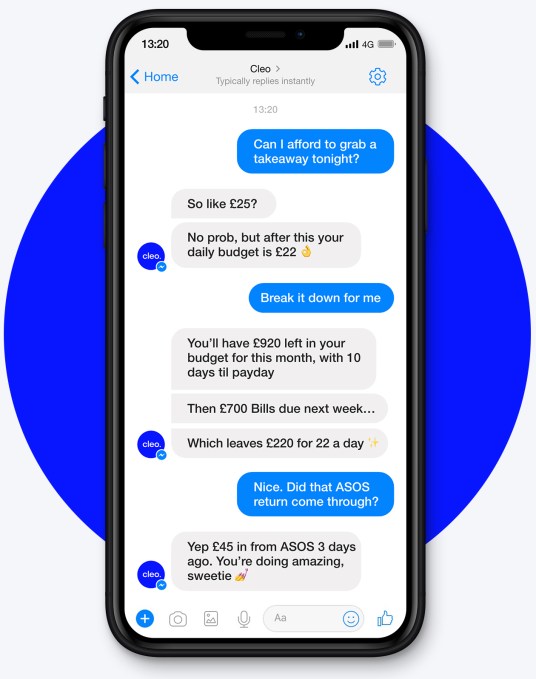
Primarily accessed via Facebook Messenger, the AI-powered chatbot gives insights into your spending across multiple accounts and credit cards, broken down by transaction, category or merchant. In addition, Cleo lets you take a number of actions based on the financial data it has gleaned. You can choose to put money aside for a rainy day or specific goal, send money to your Facebook Messenger contacts, donate to charity, set spending alerts and more.
However, in the context of traction and Cleo’s broader global ambitions, it is the decision not to become a bank in its own right that Hussey-Yeo feels is really beginning to bear fruit. His argument has always been that you don’t need to be a bank to become the primary way users interface with their finances, and that without the regulatory and capital burden that becoming a fully licensed bank brings, you can scale much more quickly. I have a feeling that strategy — and its pros and cons — has a long way to play out just yet.
The Tesla Model 3 has had its share of struggles, from CEO Elon Musk’s well-documented production hell to more recent logistic “nightmares” that have slowed deliveries to customers.
There’s one area where the Tesla shines: crash safety tests conducted by the National Highway Traffic Safety Administration. And the Tesla Model 3 is no exception. Check out the videos below to watch the crash tests.
The rear-wheel-drive version of the Tesla Model 3 earned an all-around five-star safety rating from NHTSA, the highest possible issued by the agency. These tests cover frontal, side and rollover crashes. The Model 3 received five stars in each category, as well as sub categories such as side barrier and pole crashes.
Tesla’s crash rating is buoyed by the absence of an internal combustion engine. For instance, without a motor in the hood, there’s more room for a forward crumple zone. Tesla vehicles also tend to be resistant to rollovers because the battery pack is located at the bottom of the vehicle, giving it a low center of gravity. The risk of a rollover in a Tesla Model 3 is 6.6 percent, according to NHTSA.
Tesla Model 3 is not the only vehicle to earn the highest rating. There are other 2018 model year vehicles that have earned a five-star rating from NHTSA, including the Subaru Legacy and Toyota Camry four-door hybrid. It’s also worth noting, as Musk did Thursday, that five-star ratings only mean the vehicle meets a certain threshold. Injury probability stats, which are expected soon, indicate by how much.
.@NHTSAgov will post final safety probability stats soon. Model 3 has a shot at being safest car ever tested.
The Insurance Institute for Highway Safety also conducts crash tests on vehicles to determine safety ratings. The IIHS, which represents automobile insurers, has not published ratings on the Model 3.
Didn’t get your fill of Amazon news among the 70 or so announcements at today’s Alexa event? Good news, Audible’s got something to add to the deluge. The Amazon-owned audiobook site just announced the availability of its Apple Watch app.
The offering brings pretty much what you’d expect. You can listen to audiobooks and manage your library directly from the small screen. It’s a pretty logical next step for the service, given the focus Apple has put on smartwatch audio, between last year’s addition of an LTE version of the watch and the recent announcement of a native podcasting app for the platform.
This also goes a ways toward justifying the recent addition of Aaptiv fitness routines, which Audible added a few weeks back. The offering made some sense on the phone, but bringing the course directly to a fitness/health-focused product like the Apple Watch helps complete that vision. Those workout and meditation offerings are free to Audible users through September of next year.
Below are excerpts from the most recent episode of the Flux podcast hosted by RRE Ventures principal Alice Lloyd George.
AMLG: Welcome back to the pod. I’m excited to be here with Dr. Assaf Glazer. He is the co-founder and CEO of Nanit a leading human analytics company that uses computer vision to help parents navigate their child’s sleep.
Essentially it’s a baby data collector that every sleep-deprived geek parent has dreamed of. A little background on Assaf: He got his Ph.D. at the Technion in Israel and was previously at Applied Materials as well as Wales where he worked on solutions for missile defense systems. Nanit was born here in New York at Cornell Tech [disclosure?—?RRE is a long-standing investor in the company.] Welcome Assaf it’s great to have you.
AG: Thank you for having me.
AMLG: I’ve got a stat here, that on average parents lose 44 days of sleep during the first year of their baby’s life and nearly 3 in 10 babies have problems sleeping at night. Those numbers sum up the nature of what you’re trying to solve, but can you lay out how you identified this problem and started the company?
AG: It started for me as a parent. You have your baby, you arrive home and you see that your life has changed. Pretty quickly you understand what your number one concern is?—?sleep. You’re tired, you’re sleep deprived. You wake up during the night and do everything necessary to go back to sleep. You’re going to Google and going to friends. This is where Nanit comes in. We are giving you the information that will allow you to make better decisions for your child. Six years ago I had my first child, Udi. He was born when I was at the Technion. I’m a computer vision guy. Before I was at the Technion I worked at Applied Materials in the semiconductor industry, on a camera that you put above the silicon slices, to see them from a bird’s eye perspective.
AMLG: So you were doing computer vision for chip manufacturing?—?on the assembly lines, you’d look for errors in the chips?
AG: Yes. And when my son was born I said, OK let’s do process control for my baby.
AMLG: As if the baby was on an assembly line like a chip, just run some computer vision on it.
AG: Yeah. So I wrote a paper on background subtraction algorithms?—?how to find a foreground object differentiated from the background?—?and applied those algorithms to my baby. I went to my advisors at the Technion and told them, you know, I’ve found that my baby is moving 134 times on average at night. But what can you do with that? I was looking at this data and I said sleep, sleep is what we need to solve here. I went to sleeping labs to try to understand sleep science. Then I moved as a postdoc to Cornell University where I joined the Runway Program, which aims to commercialize science.
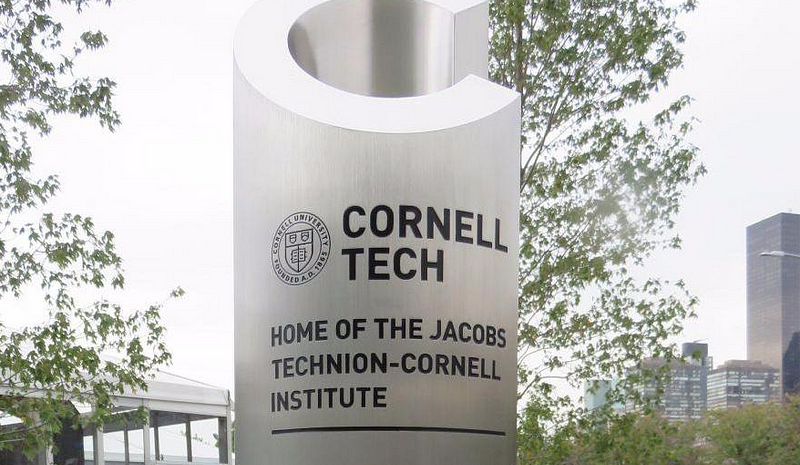
The Jacobs institute is a joint venture between Cornell and the Technion-Israel Institute of Technology, operating as an independent entity within Cornell Tech. The Institute emphasizes a trans-disciplinary view of science and encourages translational research to serves the common good, through a set of industry-focused “hubs” that address contemporary needs.
AMLG: So you moved from Israel.
AG: I moved from Israel to where the customers are, which is New York.
AMLG: We also have the most anxious parents on the planet.
AG: Haha yes. I would say that New York is very inspiring. In terms of the culture, the diversity, it’s a great place to be.
AMLG: Tell me about the program at Cornell.
AG: It’s a joint venture for Cornell and Technion University. We were six postdocs that started in this program. They really helped me. Peretz Lavie the president of the Technion, he’s a sleep expert, a sleep guru I would say. He helped us reach out to experts around the world in sleep development and cognitive development. Then we developed Nanit with them.
Dr Peretz Lavie is a world-renowned sleep expert and has been President of the Technion since 2009. Watch his interview on sleep research here.
AMLG: Sleep science?—?as you got into that field, what did you discover and what were you surprised by as you engaged with the science for the first time?—?I imagine people have focused more on adults than babies?
AG: The development of infant sleep is fascinating. How we move between stages. How to differentiate between awake, asleep, deep sleep, REM sleep.
AMLG: Do babies have deep sleep and REM sleep as well?
AG: When they are born it’s a bit of a mix. They have two states, awake and asleep. And over time?—
AMLG: Like an on off switch.
AG: Haha it’s a bit more, but I’m not sure that we fully understand all the processes during the first few weeks. They dream much more than adults. And you see their architecture developing. One of the first experts that I worked with is Professor Avi Sadeh. I reached out to him through Peretz Lavie, as he developed the gold standard of how to measure sleep. The hypothesis is that movement is an indication of asleep and awake states, and with a camera you know much more. You draw the silhouette of the baby, you can detect the eyes. You can track the different parts of the body and you have better resolution. Today we measure sleep better than the state of the art medical devices. When you do it with a camera it’s powerful because you can capture a lot of things around the sleep architecture. You build a picture. In our case we track the parent. When you look at this behavior?—?sleep and parent intervention patterns?—?you can give tips and recommendations for parents on how to improve, how to teach their baby to sleep on its own.
AMLG: As your user base gets bigger you’re going to have a lot of anonymized metadata that will give you insights—such as the more times you interrupt the baby’s sleep or the more times you leave it alone, this is the effect. So is it the parent-child insights that you’re looking to get?
AG: If you look at studies on sleep, we’re talking about hundreds top. With Nanit you are exposed to thousands of babies sleeping in their natural environment. By looking at their behavior over time we learn new things. Sleep training is awareness and education. You’re building awareness with the data and the videos. We give parents information about how their week was in comparison to other babies of that age. There are no secrets?—?if you have the data you can use triggers to give tips to parents. For instance, I saw that your baby is capable of putting himself back to sleep during the night. Why don’t you wait one or two minutes before you enter the room.
AMLG: On the hardware side, can you share the journey there. You used to do manufacturing in the U.S. and you’ve moved that to China. What have you learned?—?how have margins improved? How did you scale up volume? What are your learnings about manufacturing?
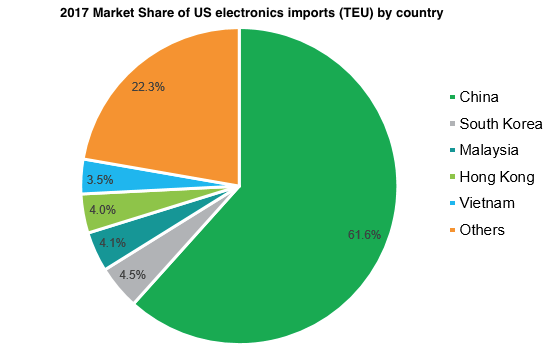
China continues to dominate U.S. electronics imports. Source: IHS Mark
AG: I’ll try to make it short. It’s really hard to build mass production lines in the U.S. for commodity consumer goods. From a labor perspective, prices in the U.S. are high. Over time it won’t exist in the U.S. as there is strong competition from China. But because it is a consumer product, having your designer, engineers and even the line close to you geographically is much more convenient. If you’re looking at the U.S. market, the engineers are also parents, which helps you explain the value proposition of your product. It’s important that even the engineer who designs the circuit board understands what it means to have an LED that is strong enough above the bed. In general every engineer needs to have the product in mind when he does the design. Once we reached a stage that we had a line in the right yield and capacity, we did the transition to China. But it is expensive to work in this way, to start in the U.S. then move to China. There is no one recipe. Nanit also has an R&D center in Israel. Which means that now I’m working in three time zones. It is crazy. Most of our R&D is on the software side and on the hardware side we try to outsource when possible. If I had to choose I would choose Israel and the U.S.
AMLG: How have you found pulling those resources together and acquiring talent. You’ve obviously got a strategic advantage with the connection to Israel, but any insights on how you attract and retain the top talent, especially in machine learning?
AG: Finding the right talent for your company is a search problem. The world is big and in different parts of the world there are different types of talent. In Israel there is great talent for backend engineers and computer vision, and we hire those people in Israel. In the U.S. there’s great talent in marketing, sales, business development, brand development, human centric design?—?for those, New York is a great place to be. In China you find talent related to manufacturing and they are very good at it. In the past it was hard to build a company in this way. But the world changed. The world changed in the sense of how we communicate. The only thing that hasn’t been solved yet is time zones. If everyone slept at the same time that would help. But besides the time zones, technology today can solve a lot of problems. Nanit couldn’t exist a couple of years ago when we didn’t have this.
AMLG: Right you wouldn’t have been able to do it all in Israel or all in New York or all in China. What about on the machine learning side?—?what is going on on a more macro level there?
AG: Deep learning and convolutional neural networks are amazing tools that help us do things we weren’t able to do before. Thanks to deep learning, today I can tell you the baby’s position in the crib better than the human eye. But what happened is that it was so disruptive that many other parts of the computer vision field, you started seeing them less and less at conferences. Add to this the fact that it generates lots of value for companies like Google, Amazon, Microsoft?—
AMLG: So machine learning has become dominated by big platforms like Google and Apple, and perhaps research for research’s sake is a valuable thing and not just having it all steered towards revenue or commercial applications. You’re saying it’s important to have pure research?
AG: This is what research is about. It should be pure.
AMLG: Do you know Gary Marcus? He came on this podcast last year, and his point about these companies is that when you’re a hammer everything looks like a nail. When you have a ton of data?—?you’re Google or Facebook?—?everything looks like you should apply deep learning to it. But that’s their bias and perhaps it skews out other approaches to machine learning.
AG: Also I would say it becomes a commodity over time. I believe the next innovation will be around behavioral analysis, which is the next level of computer vision. We are working on research collaborations that study small twitches of a baby, which could be an indicator of neurological disorders. There is a next level of behavioral neuroscience, it’s a fascinating field that is going to develop over the next couple of years.
AMLG: So you have this background in Israeli defense where you worked on missile defense systems. Can you share anything about that or how it’s informed what you’re doing now? Working in that environment is quite different than having a startup in New York.
AG: I was in a foundational team in the Nineties for a new defense system. It took me a couple of years to understand that I was a beta tester. They used me to understand the human factor. How to communicate between operators, how to design the screens. I cannot explain how much this experience has helped me to go through the design phase for Nanit. How to do design sprints with parents, how to design the screens. The army is an amazing human resource filter that allocates hundreds of thousands of teenagers to specific positions and trains them in a short time and gives them practical experience. They are doing an amazing job. There are mistakes of course, but they took me and others and decided this is what you are going to do. They gave me tools for things that in the future were of great benefit to me.
AMLG: How does working on missile defense UX or chip manufacturing compare to baby monitoring?
AG: Ha well I continue to serve as a major in reserve. But in life I decided that I wanted to make a shift to deal with more human problems. What is nice about semiconductors is that they are designed by humans not by nature. Babies were designed by nature, which is more complex. When you have a blueprint you know exactly what you’re looking for, what kind of patterns. Then you can reach a level of analysis, of process control that is much higher. But the challenges with babies you know is?—
AMLG: They’re more of a mystery.
AG: It’s a lot of mystery. But my philosophy is to build the scientific fundamentals, the building blocks, and on top of that you think about how to make it approachable for the consumer space and how to build a value proposition. You start with science not marketing statements. This is where you start.
AMLG: A world of more ambient data capture where you’re continually monitored. Which feeds into preventative medicine. Obviously there’s a lot of people that get nervous about that, though it’s the way the whole world is going, we’re going to more data and it’s going to serve us. But as you push that conversation forward, do you feel like there’s challenges in terms of getting people used to the idea?
AG: You need to do it in a responsible way. But we can live a much better life. We will have better parenting experiences, sleep better at night. Even know things about ourselves that we didn’t know before.
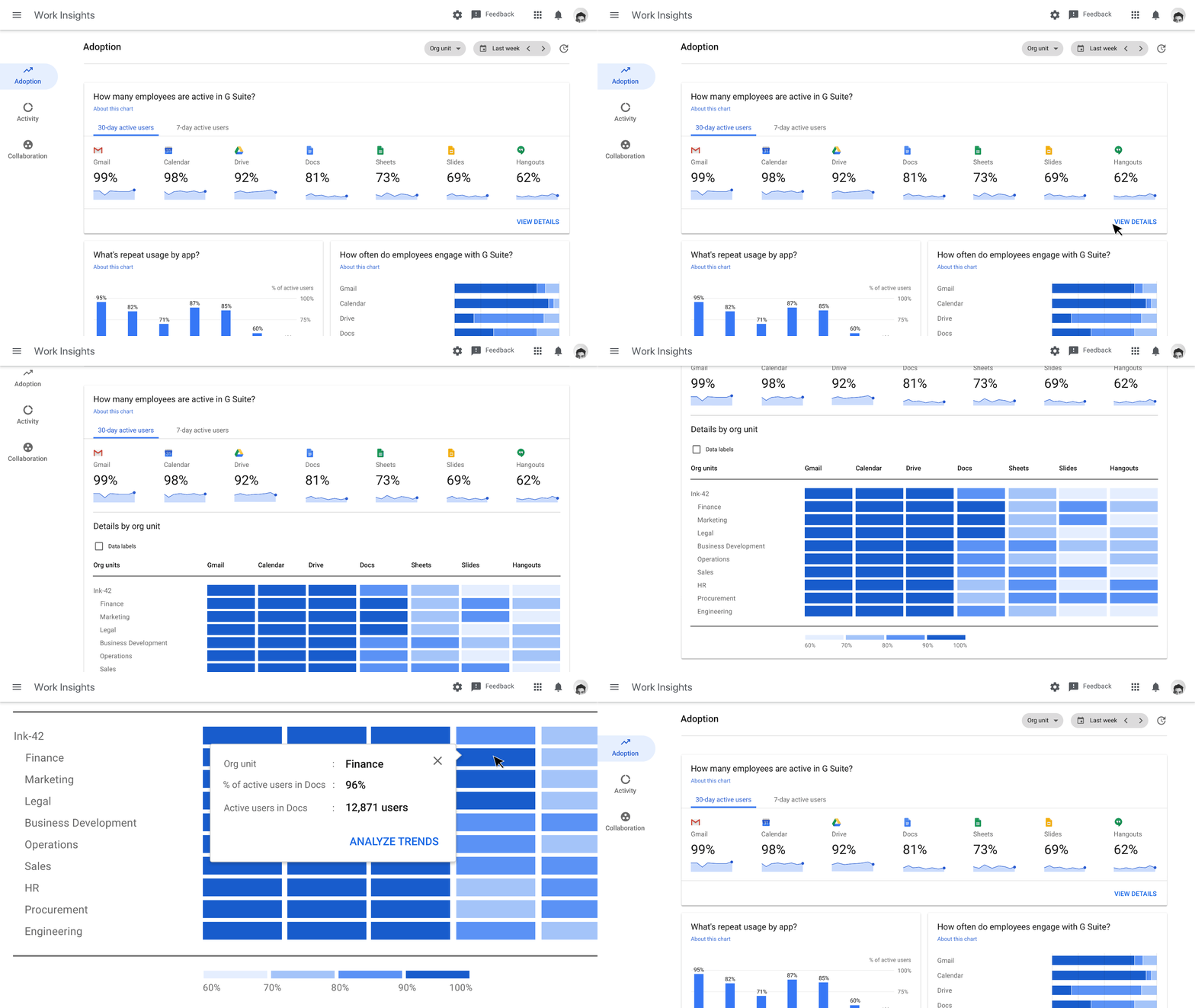
At an event in Tokyo, Google today announced the launch of Work Insights, a new tool that gives businesses more insights into how their employees use the company’s G Suite productivity tools and how teams collaborate using those tools.
In addition, Google is also launching its investigation tool for helping business better secure their data in G Suite into general availability.
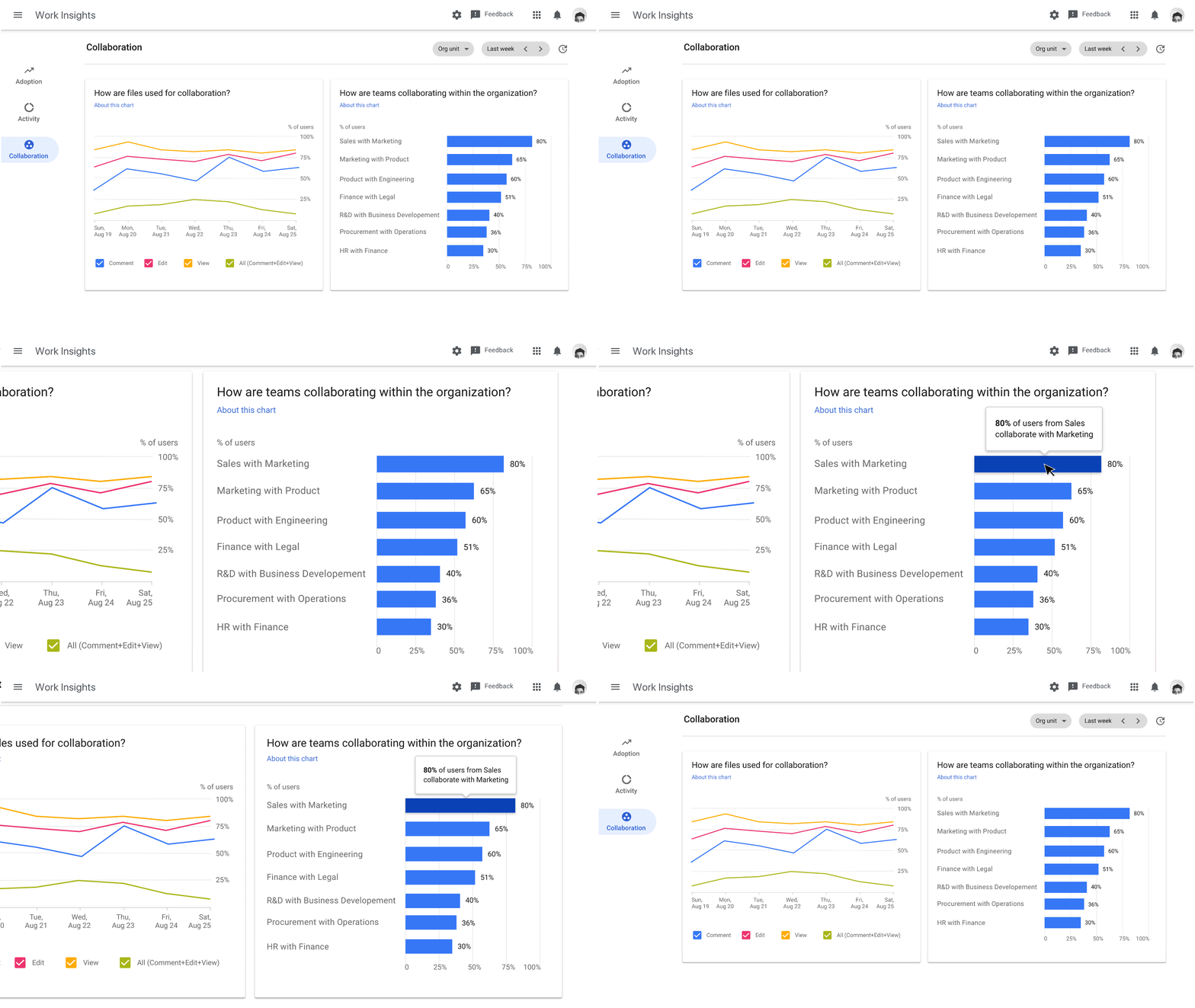
“Work Insights is a tool built specifically to help businesses measure and understand the impact of digital transformation within their organizations, driven by G Suite,” Reena Nadkarni, a group product manager for G Suite, explains in today’s announcement. Data is aggregated at the team level (where a team needs to have 10 people or more) to help businesses understand how their employees are adapting G Suite apps.
As enterprises bet on one vendor or the other, there’s always a bit of a transition period and not everybody makes the move quite as quickly as others. Most of these tools, though, only really work when the whole company adopts them. That’s especially true for communication tools like Slack, Hangouts Chat/Meet or Microsoft Teams, but also for productivity tools like G Suite.
The other use cases here, though, is actually far more interesting. Work Insights will also give companies a view of how users on different teams interact with each other (think the marketing and sales teams). If they are working on documents together, then they are probably working well together, too (or just leaving acerbic comments on marketing presentations, but you get the general idea here).
“This insight can help executives identify opportunities to strengthen collaboration and reduce siloes,” Nadkarni writes. Since few executives ever say that they want less collaboration and more siloes, chances are we’ll see quite a few companies adopt these tools.
It’s no surprise that Google used its Cloud Next 2018 event in Tokyo today — one of a number of international Cloud Next events that follow its flagship San Francisco conference — to announce a couple of new initiatives that specifically focus on the Japanese market.
These announcements include a couple of basic updates like translating its Machine Learning with TensorFlow on Google Cloud Platform Coursera specialization, its Associate Cloud Engineer certification and fifty of its hands-on Qwiklabs into Japanese.
In addition, Google is also launching an Advanced Solutions Lab in Tokyo as well. Previously Google opened similar labs in Dublin, Ireland, as well as Sunnyvale and New York. These labs offer a wide range of machine learning-centric training options, collaborative workspaces for teams that are part of the company’s four-week machine learning training program, and access to Google experts.
(Photo by Hitoshi Yamada/NurPhoto via Getty Images)
The company also today announced that it is working with Fast Retailing, the company behind brands like Uniqlo, to help it adopt new technologies. As its name implies, Fast Retailing would like to retail faster, so it’s looking at Google and its G Suite and machine learning tools to help it accelerate its growth. The code name for this project is ‘Ariake.’
“Making information accessible to all our employees is one of the foundations of the Ariake project, because it empowers them to use human traits like logic, judgment, and empathy to make decisions,” says Tadashi Yanai, CEO of Fast Retailing. “We write business plans every season, and we use collaborative tools like G Suite make sure they’re available to all. Our work with Google Cloud has gone well beyond demand forecasting; it’s fundamentally changed the way we work together.”
 The European venture capital firm, which has previously invested in