Alaska Airlines is trying to make VR part of its first-class experience

When it comes to public areas where you are most free to surrender self-awareness and self-consciousness, lounging on a multi-hour airline flight is probably prime territory. Coincidentally, it’s also a venue where virtual reality companies see an opportunity to open people to a world of VR content.

Today, Alaska Airlines announced that it will be partnering with Skylights to bring the startup’s latest hardware to a couple of its routes in a pilot (ha) program.

Skylights launched out of Y Combinator’s accelerator a couple of years ago with the focus of making VR the go-to entertainment choice for airline passengers. This is the startup’s first partnership with an airline in the U.S.; they’ve preciously worked with European airlines including Emirates and XL Airways.

If you’re sitting in coach, sadly the good virtual life is out of reach, as the service is only being rolled out to first-class passengers seated on Alaska Airlines’ Seattle-Boston and Boston-San Diego routes.

The new “Allosky” hardware is pretty compact. It’s designed for watching 2D and 3D movies mostly, though you’ll also be able to watch some 360 content. It’s pretty slick for mobile VR hardware even if it’s still pretty conspicuous. While the last generation looked like a pretty standard Gear VR, the new generation leans into the sunglasses style even if they still fall a bit short of that size.

Just as Bose headphones became a go-to for isolating people from the noise of airplanes, Skylights is hoping its VR hardware can be the go-to for isolating passengers from the sights.

Here’s everything Google announced today at its “Future of Search” event

Google has changed a lot in 20 years. What started as an index of “just” a few million pages is now reaching into the hundreds of billions; what was once a relatively simple (if very clever!) search engine is now an impossibly complex brew of machine learning, computer vision, and data science that finds its way into the daily lives of most of the planet.

Google held a small press event in San Francisco today to discuss what’s next, and what it saw as the “Future of Search”.

Here’s everything they talked about:

Google Discover

The famously minimalist Google.com homepage is about to get a bit more crowded (at least on mobile.)

Google says that 1 in 8 queries in a given month are repeats — a user returning to search on a topic they care about. With that in mind, it’s going to start highlighting these topics for you before you start your search.

Google Feed (the content discovery news feed it’s been building out in the dedicated Google App and on the Android home screen) is being rebranded as “Discover” and will now live underneath the Google.com search bar on all mobile browsers.

Discover will highlight news, video, and information about topics Google thinks you care about — like, say, hiking, or soccer, or the NBA. If you want a certain topic to show up more or less, there’s a slider to adjust accordingly.

It’ll start rolling out “in the next few weeks”

Recalling past queries
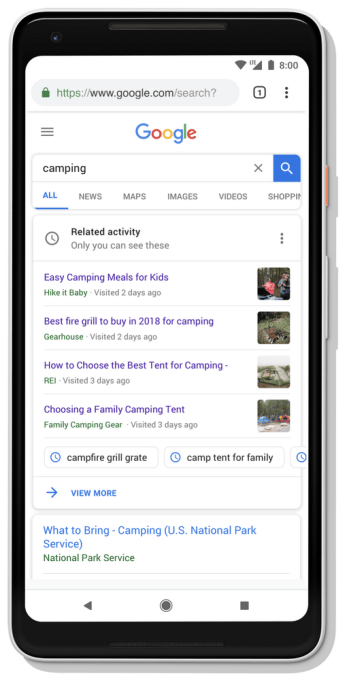
In the same vein: Google will now learn to recognize when you’re returning to a topic you’ve searched for before, and try to start back up where you left off. When returning to a search topic, you’ll now see a card at the top of the results that’ll offer up a list of the pages you clicked through to before, and relevant follow-up queries people tend to search for next.

While Google keeping track of what you searched for is nothing new, finding that info generally meant digging through settings pages to find your history. With this, Google is attempting to play something that otherwise seems a bit creepy into a front page feature.

(And to answer what I imagine will be just about everyone’s first question: Google’s Nick Fox says you can remove the card, or “opt out of seeing it all together”.)

Dynamic Organization

Trillions of searches later, Google knows what you’re probably looking for, and what you’ll be looking for next. And they can get pretty specific about it.

To use their example: if you’re searching for “Pug”, you’re probably looking for characteristics of the breed, or for images of well-known pugs. People searching for a longer haired breed like a Yorkshire Terrier, meanwhile, are often interested in things like grooming details — even if it’s not the first thing they search for.

With this in mind, Google’s knowledge graph will now dynamically generate cards for a given topic and present them at the top of the results page — basically, an all-in-one info packet of everything it thinks you’re looking for, or might look for next.

Collections
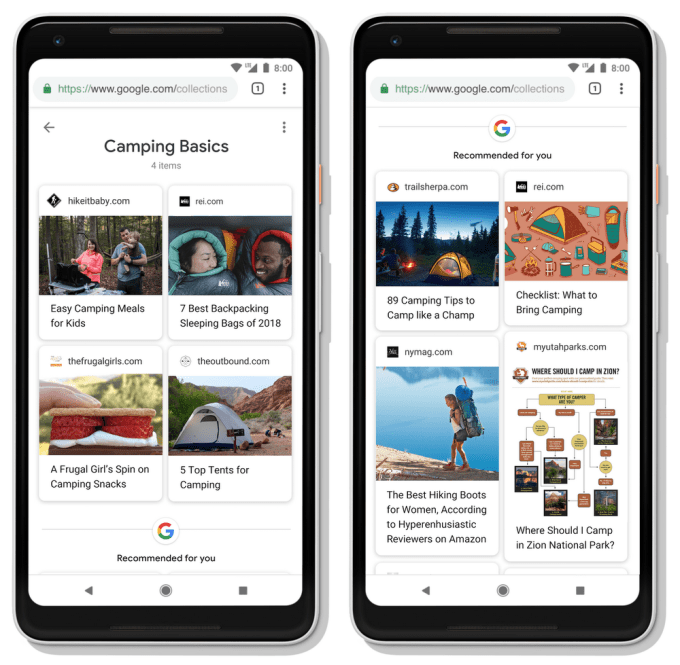
In a move that feels pretty Pinteresty, you’ll now be able to save search results into “collections” for later perusal. Google will look for patterns in your collections, and toss up suggested pages when it finds an overlap.

Stories

Snapchat has its stories. Facebook has stories. Instagram? Stories. Even Skype tried it for a while.

Now Google is “doubling down” (their words) on stories. AI will generate stories built up from articles, images, and videos on a search topic (starting with notable people “like celebrities and athletes) and incorporate them into search results.

Google Images Upgrades
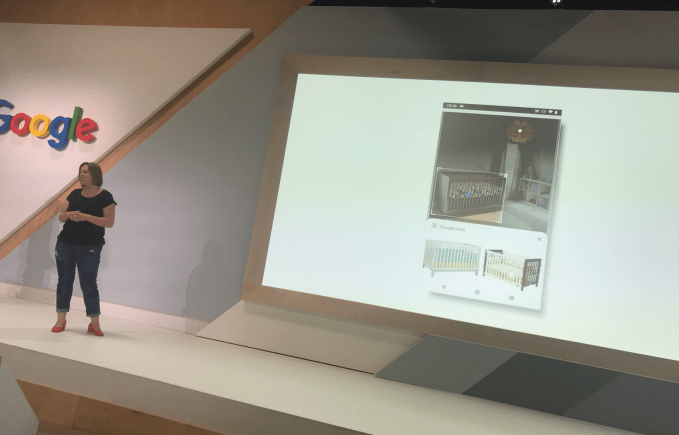
Google Images is picking up support for Google Lens — the company’s computer vision-heavy solution for figuring out exactly what is within an image. Their example: in a search result for “nursery”, Google Lens could help to identify a specific type of crib or bookcase that you’ve highlighted in an image.


China splits the internet while the U.S. dithers

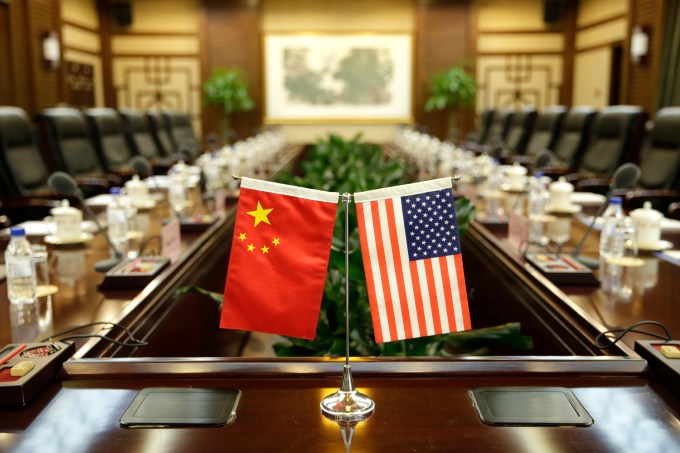
There are few stories as important right now as the internet being ripped asunder by the increasing animosity between the U.S. and China. Eric Schmidt, the former chairman of Alphabet, said last week at a private event in San Francisco that “I think the most likely scenario now is not a splintering, but rather a bifurcation into a Chinese-led internet and a non-Chinese internet led by America.”

He should know: Alphabet and its Google subsidiary are on the front lines of that split, experiencing a massive furor over the company’s Project Dragonfly to launch a censored search engine in the Middle Kingdom. It’s hardly alone though, with Apple facing militant criticism from Chinese netizens over its iPhone presentation and Facebook finding its application for a corporate entity on the mainland being returned and rejected.

At the heart of this split is the death of the internet as we once knew it: a unified layer for the transfer of human knowledge. As the internet has gained more and more power over society and our everyday lives, the need by governments worldwide to tame its engineering to political and moral ends has increased dramatically.

About four years ago, I wrote a piece called “From internet to internets” in which I argued that this sort of split was obvious. As I wrote at the time: “Across the world, it is becoming abundantly clear that the internet is no longer the independent and self-reliant sphere it once was, immune to the peculiarities of individual countries and their laws. Rather, the internet is firmly under the control of every government, simultaneously.”

Yet, the rules that countries like Spain put in place around media and news didn’t split the internet as I had predicted. The economic power of the U.S. and China did. Alibaba, Tencent, and Baidu may have declined in value this year, but their combined market caps is still in the trillions of dollars. WeChat, which is owned by Tencent, has more than a billion users, and while only 10% of its user base is estimated to be outside China, the ties are growing as more countries build economic bridges with the mainland.

Sometimes, those bridges are quite literal. Through the Belt and Road initiative and fledgling institutions like the Asian Infrastructure Investment Bank, China has provided massive outlays to other nations primarily around infrastructure, building partnerships and deepening economic ties.

China and the U.S. are increasingly fighting a global battle for tech legitimacy (Photo by Jason Lee / AFP / Getty Images)

That infrastructure is sometimes roads, but it can also be in areas like telecommunications. Huawei has made massive inroads into Africa, both in smartphones and in core infrastructure. Chinese-owned Transsion, which most Westerners have probably never heard of, is the dominant smartphone manufacturer on the continent.

Chinese-made telecom infrastructure. Chinese handsets. Increasingly Chinese apps. For all of the concerns of Congress and national security officials about Huawei and ZTE equipment entering the American or Australian markets, the real fight for the future of the internet is going to be in precisely these developing regions which have no incumbent technology.

That’s what has made the Trump administration’s strategy toward trade negotiations with China so miserable to watch. The focus has been on repeated rounds of tariffs that will ensure that Chinese goods — particularly in high-tech industries — are more expensive to American consumers, allowing domestic manufacturers to better compete. Yet, the policies have done nothing to ensure that American values around the internet are exported to continents like Africa or South America, or that Cisco’s equipment will be chosen over Huawei’s.

That might be changing at long last. The Financial Times reported yesterday that the Trump administration is preparing to double down on the Overseas Private Investment Corporation, which offers commercial lending facilities to developing countries. It would be merged into another agency and given a much more rich budget (as high as $60 billion) to go and compete with Chinese financing around the world.

Maybe that measure will be successful in closing the strategic distance between the two countries. Maybe rumors that the administration is going to broadly double down on the trade war will lead to a much more comprehensive set of policies.

But along the way, regardless of what happens, these skirmishes will lead to a fracturing of the internet, and along with it, the death of the internet as a bastion and voice of freedom and knowledge for all people everywhere.

Google and Yandex may collaborate on a real-time blacklist of all known pirated works

A meeting on the status of anti-piracy efforts at search engines has produced a collaborative approach to better addressing the issue of pirated works appearing in search results. An international collective of search giants thinking of creating a blacklist of all known pirated works, which will be compared with search results every five minutes and any matches removed.

The meeting, which took place last week, was reported by Russian outlets Vedomosti and RBC; TorrentFreak noted the news soon after. The attendees included Google, Yandex, Mail.ru Group, Gazprom Media, and other local trade associations. The issue at hand: how to return accurate results when someone searches for “download princess bride movie” without also including links to piracy sites.

Yandex in particular has been under threat by regulators for its refusal to take more serious steps to block pirated content — the company argues that it isn’t required by law to do so. The argument is in some ways similar to that of Google, which has resisted pressure to be the first and last line of defense, incurring great cost to protect someone else’s property. But clearly both are open to a more collaborative effort.

The solution proposed by the groups is a shared ledger of links and works known to be pirated. This register would be continually updated and each partner would regularly check it against its index and strike any matches from being displayed in results within six hours.

The list would be curated by the companies themselves and rightsholders who find, as they often do, links to or copies of their copyrighted materials online.

Obviously this isn’t an entirely novel idea: search engines and media companies of course have their own lists and may even share some information, and Russian regulator Roscomnadzor has one that ISPs consult when issuing blocks at their level. But this would be an official, cross-border, cross-industry collaboration, built to minimize both the time and paperwork needed to remove an infringing link.

The difficulties and dangers of such a system are easily imaginable. A mistaken or fraudulent entry could lead to a site being delisted or demoted in search results, and because this system is largely internal to the companies and not part of an official process (like DMCA takedowns, such as they are), the owner of that entry could lack recourse. There’s no shortage of stories of YouTube videos being taken down via fraudulent reports, so the new system would need to be both robust against that threat and responsive to petitions.

There are also plenty of ways that piracy sites can escape the clutches of these systems, which by necessity given the scale of the issue, are largely automated. Futzing with the URL — for instance, generating a new one for every user and deleting them shortly after —  could lead to an inflated and inaccurate register. (That’s just one simple way of throwing a wrench in the machinery; piracy sites are technically adept and legally savvy and their methods may be rather more sophisticated.)

And because the list wouldn’t necessarily be backed by law — this would be an understanding between these organizations based on mutual benefit — it might be respected only when convenient. If, for example, one of the companies faces an ugly lawsuit or challenge regarding a listing, it may choose to slacken its enforcement to avoid such complications.

The war between big web properties and piracy is an ongoing one and no one is likely to strike a killing blow given how advanced things are on both sides of the line of battle. But it’s equally unlikely that either side will stop or slow in its efforts to gain the upper hand, if only temporarily.

It’s unclear what stage this effort is at, but Roskomnadzor and the trade associations confirmed to Vedomosti that work is underway, though Yandex would only say that it was involved. I’ve asked Google for comment and will update this story if I hear back.

Walmart is betting on the blockchain to improve food safety

Walmart has been working with IBM on a food safety blockchain solution and today it announced it’s requiring that all suppliers of leafy green vegetable for Sam’s and Walmart upload their data to the blockchain by September 2019 .

Most supply chains are bogged down in manual processes. This makes it difficult and time consuming to track down an issue should one like the E. coli romaine lettuce problem from last spring rear its head. By placing a supply chain on the blockchain, it makes the process more traceable, transparent and fully digital. Each node on the blockchain could represent an entity that has handled the food on the way to the store, making it much easier and faster to see if one of the affected farms sold infected supply to a particular location with much greater precision.

Walmart has been working with IBM for over a year on using the blockchain to digitize the food supply chain process. In fact, supply chain is one of the premiere business use cases for blockchain (beyond digital currency). Walmart is using the IBM Food Trust Solution, specifically developed for this use case.

“We built the IBM Food Trust solution using IBM Blockchain Platform, which is a tool or capability that IBM has built to help companies build, govern and run blockchain networks. It’s built using Hyperledger Fabric (the open source digital ledger technology) and it runs on IBM Cloud,” Bridget van Kralingen, IBM’s senior VP for Global Industries, Platforms and Blockchain explained.

Before moving the process to the blockchain, it typically took approximately 7 days to trace the source of food. With the blockchain, it’s been reduced to 2.2 seconds. That substantially reduces the likelihood  that infected food will reach the consumer.

Photo:  Shana Novak/Getty Images

One of the issues in a requiring the suppliers to put their information on the blockchain is understanding that there will be a range of approaches from paper to Excel spreadsheets to sophisticated ERP systems all uploading data to the blockchain. Walmart spokesperson Molly Blakeman says that this something they worked hard on with IBM to account for. Suppliers don’t have to be blockchain experts by any means. They simply have to know how to upload data to the blockchain application.

“IBM will offer an onboarding system that orients users with the service easily. Think about when you get a new iPhone – the instructions are easy to understand and you’re quickly up and running. That’s the aim here. Essentially, suppliers will need a smart device and internet to participate,” she said.

After working with it for a year, the company things it’s ready for broader implementation with the goal ultimately being making sure that the food that is sold at Walmart is safe for consumption, and if there is a problem, making auditing the supply chain a trivial activity.

“Our customers deserve a more transparent supply chain. We felt the one-step-up and one-step-back model of food traceability was outdated for the 21st century. This is a smart, technology-supported move that will greatly benefit our customers and transform the food system, benefitting all stakeholders,” Frank Yiannas, vice president of food safety for Walmart said in statement.

In addition to the blockchain requirement, the company is also requiring that suppliers adhere to one of the Global Food Safety Initiative (GFSI), which have been internationally recognized as food safety standards, according to the company.