Shopify brings on team from augmented reality home design app Primer

In Friday acquisition news, Shopify shared today that they’ve acquired the team from augmented reality startup Primer, which makes an app that lets users visualize what tile, wallpaper or paint will look like on surfaces inside their home.

In a blog post, co-founders Adam Debreczeni and Russ Maschmeyer write that Primer’s app and services will be shutting down next month as part of the deal. Primer’s team of eight employees will all be joining Shopify following the acquisition.

Primer had partnered with dozens of tile and textile design brands to allow users to directly visualize what their designs would look like using their iPhone and iPad and Apple’s augmented reality platform ARKit. The app has been highlighted by Apple several times, including this nice write-up by the App Store’s internal editorial team.

? We’ve been working on this one for a while at @primersupply

?Our AR paint intelligently blends in highlights and shadows

??? Props to @ericflo for getting this to the finish line

? Live now: https://t.co/3Tm1TYksQB pic.twitter.com/qMd5JGSWbt

— Adam Debreczeni (@heyadam) March 9, 2021

Terms of the deal weren’t disclosed. Primer’s backers included Slow Ventures, Abstract Ventures, Foundation Capital and Expa.

There’s been a lot of big talk about how augmented reality will impact online shopping, but aside from some of the integrations made in home design, there hasn’t been an awful lot that’s found its way into real consumer use. Shopify has worked on some of their own integrations — allowing sellers to embed 3D models into their storefronts that users can drop into physical space — but it’s clear that there’s much more room left to experiment.

Despite flat growth, ride-hailing colossus Didi’s US IPO could reach $70B

Didi filed to go public in the United States last night, providing a look into the Chinese ride-hailing company’s business. This morning, we’re extending our earlier reporting on the company to dive into its numerical performance, economic health and possible valuation.

Recall that Didi has raised tens of billions worth of private capital from venture capitalists, private equity firms, corporations and other sources. The size of the bet riding on Didi is simply massive.

Didi is approaching the American public markets at a fortuitous moment. While the late-2020 IPO fervor, which sent offerings from DoorDash and others skyrocketing after their debuts, has cooled, valuations for public companies remain high compared to historical norms. And Uber and Lyft, two American ride-hailing companies, have been posting numbers that point to at least a modest recovery in the ride-hailing industry as COVID-19 abates in many parts of the world.

As further grounding, recall that Didi has raised tens of billions worth of private capital from venture capitalists, private equity firms, corporations and other sources. The size of the bet riding on Didi is simply massive. As we explore the company’s finances, then, we’re more than vetting a single company’s performance; we’re examining what sort of returns an ocean of capital may be able to derive from its exit.

In that vein, we’ll consider GMV results, revenue growth, historical profitability, present-day profitability and what Didi may be worth on the American markets, given current comps. Sound good? Into the breach!

Inside Didi’s IPO filing

Starting at the highest level, how quickly has gross transaction volume (GTV) scaled at the company?

GTV

Didi is historically a business that operates in China but has operations today in more than a dozen countries. The impact and recovery of China’s bout with COVID-19 is therefore not the whole picture of the company’s GTV results.

COVID-19 began to affect the company starting in the first quarter of 2020. From the Didi F-1 filing:

Core Platform GTV fell by 32.8% in the first quarter of 2020 as compared to the first quarter of 2019, and then by 16.0% in the second quarter of 2020 as compared to the second quarter of 2019.

The dips were short-lived, however, with Didi quickly returning to growth in the second half of the year:

Our businesses resumed growth in the second half of 2020, which moderated the impact on a year-on-year basis. Our Core Platform GTV for the full year 2020 decreased by 4.8% as compared to the full year 2019. Both our China Mobility and International segments were impacted, but whereas the GTV for our China Mobility segment decreased by 6.6% from 2019 to 2020, the GTV for our International segment increased by 11.4% from 2019 to 2020.

Holding to just the Chinese market, we can see how rapidly Didi managed to pick itself up over the last year. Chinese GTV at Didi grew from 25.7 billion RMB to 54.6 billion RMB from the first quarter of 2020 to the first quarter of 2021; naturally, we’re comparing a more pandemic-impacted quarter at the company to a less-affected period, but the comparison is still useful for showing how the company recovered from early-2020 lows.

The number of transactions that Didi recorded in China during the first quarter of this year was also up more than 2x year over year.

On a whole-company basis, Didi’s “core platform GTV,” or the “sum of GTV for our China Mobility and International segments,” posted numbers that are less impressive in growth terms:

Image Credits: Didi F-1 filing

You can see how quickly and painfully COVID-19 blunted Didi’s global operations. But seeing the company settle back to late-2019 GTV numbers in 2021 is not super bullish.

Takeaway: While Didi managed an impressive GTV recovery in China, its aggregate numbers are flatter, and recent quarterly trends are not incredibly attractive.

Revenue growth

BukuWarung, a fintech for Indonesian MSMEs, scores $60M Series A led by Valar and Goodwater

BukuWarung, a fintech focused on Indonesia’s micro, small and medium enterprises (MSMEs), announced today it has raised a $60 million Series A. The oversubscribed round was led by Valar Ventures, marking the firm’s first investment in Indonesia, and Goodwater Capital. The Jakarta-based startup claims this is the largest Series A round ever raised by a startup focused on services for MSMEs. BukuWarung did not disclose its valuation, but sources tell TechCrunch it is estimated to be between $225 million to $250 million.

Other participants included returning backers and angel investors like Aldi Haryopratomo, former chief executive officer of payment gateway GoPay, Klarna co-founder Victor Jacobsson and partners from SoftBank and Trihill Capital.

Founded in 2019, BukuWarung’s target market is the more than 60 million MSMEs in Indonesia, according to data from the Ministry of Cooperatives and SMEs. These businesses contribute about 61% of the country’s gross domestic product and employ 97% of its workforce.

BukuWarung’s services, including digital payments, inventory management, bulk transactions and a Shopify-like e-commerce platform called Tokoko, are designed to digitize merchants that previously did most of their business offline (many of its clients started taking online orders during the COVID-19 pandemic). It is building what it describes as an “operating system” for MSMEs and currently claims more than 6.5 million registered merchant in 750 Indonesian cities, with most in Tier 2 and Tier 3 areas. It says it has processed about $1.4 billion in annualized payments so far, and is on track to process over $10 billion in annualized payments by 2022.

BukuWarung’s new round brings its total funding to $80 million. The company says its growth in users and payment volumes has been capital efficient, and that more than 90% of its funds raised have not been spent. It plans to add more MSME-focused financial services, including lending, savings and insurance, to its platform.

BukuWarung’s new funding announcement comes four months after its previous one, and less than a month after competitor BukuKas disclosed it had raised a $50 million Series B. Both started out as digital bookkeeping apps for MSMEs before expanding into financial services and e-commerce tools.

When asked how BukuWarung plans to continue differentiating from BukuKas, co-founder and CEO Abhinay Peddisetty told TechCrunch, “We don’t see this space as a winner takes all, our focus is on building the best products for MSMEs as proven by our execution on our payments and accounting, shown by massive growth in payments TPV as we’re 10x bigger than the nearest player in this space.”

He added, “We have already run successful lending experiments with partners in fintech and banks and are on track to monetize our merchants backed by our deep payments, accounting and other data that we collect.”

BukuWarung’s new funding will be used to double its current workforce of 150, located in Indonesia, Singapore and India, to 300 and develop BukuWarung’s accounting, digital payments and commerce products, including a payments infrastructure that will include QR payments and other services.

Motional CEO hints at an autonomous future in logistics

Motional, the $4 billion joint venture between Aptiv and Hyundai, is exploring the company’s potential involvement in autonomous trucking or logistics, its CEO said today during a live session at TechCrunch’s 2021 Mobility Event.

“The beauty of what’s on the other side of the coin is that the same core technology can of course apply to multiple use cases,” said Karl Iagnemma on the panel led by TechCrunch transportation editor Kirsten Korosec, who asked about Motional’s intention to expand its business model into trucking. “It’s similar, it’s not the same, but it’s similar. And so we are actively exploring other use cases. We will have additional activity in this area. We don’t have anything to announce today. But more to come.”

While Motional still believes the biggest economic opportunity comes from solving the hard technological problems of autonomy in the service of moving people, AKA the robotaxi model, Iagnemma recognized the same hard problems — perception, planning, decision making, localization — lie at the core of autonomy, whether that’s moving people or parcels.

“We’re looking for a great business opportunity that has the closest adjacency from a technical perspective to the stack that we’re currently developing,” said Iagnemma, responding to what is most appealing in the delivery and logistics model. “That’s really what it boils down to. These different use cases have, in some cases, quite dramatically different business cases around them, the opportunity looks quite different. And so that helps us score rank order internally. What presents an interesting opportunity? And then again, we tried to align that toward our current technology development path to say, hey, this would be the least incremental effort for the biggest incremental opportunity. That’s how we sort of guide our strategy, internally at Motional.”

For his part, Chris Urmson, co-founder and CEO of autonomous vehicle company Aurora, and the other panelist on the session, admitted that ride-hailing and moving people with automated vehicles will ultimately be both a transformational business and one that surpasses trucking in the long term. Aurora is currently focused on freight applications, rather than robotaxi, for a number of reasons, including the ability to scale now.

“[The robotaxi] market will take time to evolve, whereas the freight and trucking market is here today,” said Urmson.

Both panelists agreed that there’s no low-hanging fruit in the autonomous world. The problem of self-driving vehicles is difficult to solve, but Urmson argues it’s perhaps a bit easier to solve with trucking, where you don’t have to reckon with the amount of variability in the road network of a city. Building an autonomous stack to drive on freeways is easier due to their mostly uniform nature.

“So once you crack the initial nut of having the technology working in that operational defined design domain, the rollout moves from a technological expansion to an operational expansion,” said Urmson. “And that looks more like kind of a conventional business. So we think that’s a way to be scaling the business and operations and generating the revenue stream that allows us to then go and really take that core technology and apply it into ride hailing and build an exciting business in that space as well.”

Does what happens at YC stay at YC?

Community has never felt louder in startupland. Bringing people together over a shared interest is innate to human nature, and coming out of a lonely, draining pandemic, every startup is looking to cultivate community, conversation and camaraderie.

Last week, though, the outside world got a look at how Y Combinator, one of Silicon Valley’s most famed and feared accelerators, deals with the intricacies of a scaled, yet still ultra-exclusive, community after the accelerator kicked out two founders from its internal messaging board, Bookface.

The two founders, Dark CEO Paul Biggar and Prolific CEO and co-founder Katia Damer, say they were removed from YC after publicly critiquing YC — for very different reasons. Biggar had noted on social media back in March that another YC founder was tipping off people on how to cut the vaccine lines to get an early jab, while Damer expressed worry and frustration more recently about the alumni community’s support of a now-controversial alum, Antonio García Martínez.

Y Combinator says that the two founders were removed from Bookface because they broke community guidelines, namely the rule to never externally post any internal information from Bookface.

The now-public ousting of Biggar and Damer, who turned to Twitter to first explain their experiences, is a nuanced situation. Y Combinator says that it has only removed a “dozen or so” founders in its 16 year history for violating YC ethics and Bookface forum guidelines.

Still, YC’s decision to remove these founders, especially in light of a broader reckoning around free speech and dissent within startups, has triggered a series of questions — some by YC founders themselves — around how the accelerator moderates its community, handles negative publicity and draws its own line around what can be openly said by its alumni base without consequence.

Privacy first

The best curated communities allow participants to safely, and freely, share personal experiences, debate, and even disagree. Part of that safety comes from what some see as a common rule within communities: don’t share private information publicly.

Per YC, respecting privacy is a key rule for anyone who joins Bookface, an internal messaging forum that includes some 6,000 founders of the YC community, from alumni to management to current batch companies. Founders log in daily, asking for introductions to a crypto accountant or bringing up a recent job posting for crowdsourced suggestions, among other topics.

“We ask that founders don’t share anything from the forum with anyone outside of YC, as this is a community built on trust and privacy,” Lindsay Wiese-Amos, Y Combinator head of communications, tells TechCrunch.

It’s more than a polite request. Amos said that when a company is accepted into YC, the founders must sign investment documents, one of which is its founder ethics policy. Within the policy, there are guidelines around the Bookface forum, including the language: “Don’t share anything in the Forum, or any links to the content posted to it, with anyone outside of YC.”

YC claims that when a founder breaks the rules, it reaches out to them with a warning, and if the rule is broken multiple times, that individual is removed from the community.

When a startup is removed from the YC community, YC “generally” returns the shares to the company, though it says there are exceptions. In Damer’s case, says Amos, her “co-founder is still actively working on Prolific, and both he and Prolific remain part of the YC community.”

Meanwhile, Biggar’s YC startup closed eight months after graduating from the accelerator, so YC didn’t have to sever financial ties.

Garry Tan, co-founder of Initialized Capital, and a former YC partner who has stakes in alumni companies including Coinbase, thinks there is a difference between a critical discussion and breaking community rules. Tan tells TechCrunch that discussions are fine, but that these “founders violated privacy expectations of other people within the community.”

“I think YC has become an institution, and institutions are viewed with high scrutiny,” he said. “That’s not a bad thing, it’s probably how it should be.”

The “‘too far’ moment is when people try to ascribe specific political viewpoints to an institution when that institution is A) a lot of people not just a few and B) probably innocent of specifically pushing one viewpoint or another,” Tan continues.

YC’s Bookface rules are seemingly cut and dried. However, in light of the actions it took against Biggar and Damer, it’s fair to wonder what happens if someone in the community disparages YC publicly, but not having to do with Bookface. Is that also an offense that would get them kicked out of the organization? And would the organization make an exception for especially promising founders?

Amos suggests that all founders are treated equally and that dissent is welcome. “We believe strongly in free speech and are open to criticism. People are allowed to criticize YC and would not get kicked out of the community for doing so,” she said.

‘I had no faith in Y Combinator doing the right thing’

Biggar went through Y Combinator in 2010. “I was like a Paul Graham acolyte,” he says. “I have a signed copy of Hackers and Painters, read every essay that he put out, and as soon as I finished my PhD, I applied to Y Combinator.”

For over a decade, Biggar says, he has been an active participant in Bookface, recently helping multiple companies with financial and relationship advice on co-founder break-ups.

When the Black Lives Matter movement was growing last summer, Biggar noticed that Bookface was relatively quiet and, as he describes it, “apolitical, but in a derogatory way” around issues such as diversity and police brutality. He compared the tone of Bookface to that of Coinbase, after CEO Brian Armstrong published a memo that banned political discussions at work.

Biggar’s frustration grew, hitting a tipping point in March when he spotted a founder bragging on the forum that he had skipped a vaccine queue and offering tips to help other founders do the same.

Soon after, Biggar tweeted: “For the second time, a @ycombinator founder has posted to the internal YC forum about how they lied to skip the vaccine queue in Oakland, with instructions for other founders to do the same. Absolutely fucking disgusted.”

Biggar left out screenshots of the founder’s post or any identifying material to protect the individual’s anonymity. But within hours of publishing the tweet, Biggar received a direct message on Twitter from Y Combinator co-founder Jessica Livingston, asking him to alert a partner at YC about inappropriate content on Bookface. She added: “You may get a faster and more thorough response than posting to all of Twitter.”

His response to her: “Hey Jessica! Truth be told, I’m so disillusioned with YC that it never even occurred to me.”

Biggar decided to leave up the tweet. Meanwhile, because Biggar was apparently not alone in his view of the content on Bookface — Amos says that “the community made its perspective quite clear in the comments: they were not in agreement with this founder” offering vaccination hacks  — YC says it deleted the post less than 24 hours after it appeared on Bookface.

The episode wasn’t even on his mind, Biggar says, when he received an email from Jon Levy, the managing director of partnerships at YC, asking to chat last week. To Biggar’s surprise, Levy told him that he was being removed from the YC community. That meant he was being removed not just from Bookface, says Biggar, but he is no longer invited to Demo Day or allowed on YC Slack.

lol just got kicked out of @ycombinator

— Paul Biggar (@paulbiggar) June 4, 2021

Notably, Biggar says that YC didn’t give him a warning or the option to take down any posts before ushering him out of the broader YC community, though he suspected it was becoming stricter about its community rules. A week before he was booted, Biggar says that Y Combinator reminded founders about a “no leak” policy within Bookface.

YC offers a different recounting of the events, saying it was only “recently” notified of Biggar’s tweet through someone in the YC community and that all founders are given a warning. YC also states that a founder is removed only after violating its terms “multiple” times, while Biggar maintains that he only once tweeted about Bookface. Asked about other examples of Biggar violating its terms, YC declined to comment further.

Says Biggar now of these recent events: “I got criticized for not posting it internally, which I think is kind of bullshit. But, you know, the reason I didn’t post it internally is just that I had no faith in Y Combinator doing the right thing. I didn’t think that going public would do anything, either. I mean, I’m not someone who actually matters here.”

“This is the smallest way that one could possibly call out YC,” Biggar continues. “A couple of community members did a shitty thing, which I think is reflective of the community. That for them is, like, too much dissent — shut it all down.”

If you are not “the people who have been elevated to part-time partners [or are] tight with the people that matter,” no one “cares what you think. No one ever asks what you think . . .You can’t have dissent internally. There are just too many disciples.”

‘YC is not soul-searching’

Damer’s own removal from Bookface might not have been publicized if not for Biggar sharing on Twitter last week that he’d just been “kicked out.” Soon after, she came forward, tweeting to him that “2 weeks ago, YC kicked me out as well” for her public critique. Specifically, says Damer, she was thrown off Bookface because she called out misogyny and the lack of diversity within the accelerator community.

It began with a memo on Bookface with the title: “Is YC an inclusive organization? If we continue like this, YC will lose its great reputation.”

In her post, Damer explained that she noticed many people defending Antonio García Martínez, the author of Chaos Monkeys who recently was invited to join Apple, then asked to leave Apple, after a petition to investigate his hiring was signed by more than 2,000 Apple employees. They were concerned about specific book passages, including one that reads: “[M]ost women in the Bay Area are soft and weak, cosseted and naive despite their claims of worldliness, and generally full of shit.”

Like the Apple employees who circulated the petition, Damer believes the book is proof that García Martínez is a “misogynist,” writing on Bookface about how “disconcerting” she found the outpouring of support for him on the internal platform.

“I care about YC and that’s why I am writing this,” Damer said. “What is happening right now is not normal, and it looks like YC is soul searching. If this doesn’t get under control, YC will start missing out on some of the best deal flow, especially from women and underrepresented founders.”

Livingston soon responded.

“YC is not ‘soul-searching’,” Livingston wrote. “Antonio participated in YC a decade ago, and I remember him as a decent person…I think if anything the YC community should be the ones defending Antonio, because many of us have first-hand knowledge of him, instead of just cherry picked quotes from a book. And we know from being in the startup world how often people are criticized unfairly by the press and in social media.”

Livingston’s post received hundreds of upvotes, while Damer’s post received a handful. Aggravated, Damer soon went to LinkedIn and Twitter to post screenshots of the interaction, “retracting” any previous praise she’d given to YC’s founders, and advising founders not to give up equity before VCs earn their trust.

Soon, a YC partner e-mailed Damer with an invitation to reach out to group partners or this partner directly about any YC concerns, according to a document shared with TechCrunch by the accelerator. The partner also explained that one of the community rules at Bookface was not to share anything from the forum with anyone outside of YC. The partner asked Damer to take down the Bookface screenshots. Damer did not respond to the email and did not take down the screenshots. 

Less than two weeks later, Damer received a second email from the partner, this time with a clear message: Because she did not delete her posts, Damer had been removed from Bookface and could reach out if she wished to re-engage.

The communication was extensive compared with the organization’s handling of Biggar’s tweet, and suggests that YC did a far better job in following its own protocols in Damer’s case.

Either way, Damer thinks that YC’s guidelines encourage complacency, especially around issues of diversity, and suggests her waning enthusiasm for the organization ties directly to its not “stepping up” for “women when given the chance.” Adds Damer, “I don’t think any one of [the partners] is malicious, I actually think they are good people. It’s more about the complacency — that is what bothers me so much,” she said.

As for whether she regrets airing her exasperation publicly, she suggests she didn’t have a choice. “People use rules when they don’t know what else to do. This is about courage, this is about actually standing up for what is right.”

Community rules can be clear, but enforcement muddy

There is plainly an argument for and against Y Combinator’s deciding to remove founders from its forum. It’s typical of investors to ask portfolio companies to agree to certain terms and conditions. In this case, YC specifically alerts those who join its organization that the privilege of using Bookface comes with its own, additional, terms and conditions.

Still, whether the terms and conditions around its community are fair or reasonable could become a question mark in the minds of founders who haven’t yet applied to the program — as could YC’s different handling of two founders who broke the rules.

Broadly speaking, people within communities who feel like they are not being heard internally — yet who are also being asked not to express their disdain publicly — are pushing back on such limits. Coinbase saw at least 60 employees leave last fall after being told that the company would no longer tolerate internal political dissent or debate. In late May, the company Basecamp reportedly lost a third of its staff following disagreements over the company’s attitude toward internal political debates. Most recently, Medium lost half its staff in July after a strategy shift and an internally criticized culture memo.

Because of its successful track record, YC may be more powerful as an institution than any one company, but rivals are always looking for weaknesses, and asking members not to air their grievances outside of YC could ultimately impair the outfit. A generation of founders and operators is showing it is less and less willing to suppress a viewpoint in the service of others, and the most talented of these individuals have no shortage of options when it comes to both mentorship and capital.

YC, with its extensive network — perhaps even because of it —  may increasingly find it isn’t immune to the trend.

Daily Crunch: A crowded market for exits and acquisitions forecasts a hot AI summer

To get a roundup of TechCrunch’s biggest and most important stories delivered to your inbox every day at 3 p.m. PDT, subscribe here.

Hello and welcome to Daily Crunch for June 9, 2021. Today was TC Sessions: Mobility, a rollicking good time and one that we hoped you enjoyed. Looking ahead, we’re starting to announce some speakers for Disrupt — including Accel’s Arun Mathew. Mark your calendars, Disrupt is going to be epic this year. — Alex

The TechCrunch Top 3

  • Biden tears down Trump’s Chinese app wall: After a very confusing episode in which the former U.S. president demanded that TikTok sell to an American company and that the U.S. government get a cut, things are mostly back to normal today after President Biden “signed an executive order revoking actions targeting TikTok and WeChat,” TechCrunch reports. Biden also signed a “new order requiring the Commerce Department to review apps with ties to ‘jurisdiction of foreign adversaries,’” so this story is not yet finished.
  • Billions for battery tech: Northvolt has raised a $2.75 billion round to build its in-Europe battery manufacturing capacity to 150 GWh by 2030. While 2030 may sound far away, it’s under a decade from now. The news of Northvolt’s round underscores how many regions want to ensure that they can build core technology products like batteries, chips and AI on their own as a way to limit geopolitical risk.
  • Everyone wants to fund AI startups: The era in which every startup claimed to be an AI company is behind us, leaving us with the era in which every VC wants to fund AI startups. That’s the gist of a recent TechCrunch dig into the hot and busy fundraising market for startups leveraging artificial intelligence.

Startups and VC

  • Branch finds more backers for its insurtech service: Bundled home-and-auto insurtech startup Branch has raised a $50 million round led by Anthemis Group. The company’s pitch is that it starts customers off with a bundle, meaning that it doesn’t have to cross-sell them later on. VCs are still more than willing to pour capital into neo-insurance providers, despite some struggles from unicorns in the space after they went public.
  • ShelfLife wants to help you source raw materials: Ever wanted to produce and sell your own version of White Claw? Lillian Cartwright and some fellow Harvard Business School folks had that idea, but ran into supply issues. Cartwright built ShelfLife, which helps brands by providing “a directory and marketplace of raw material suppliers based on what brands actually, specifically need, allowing them to secure quotes quickly.”
  • If you are tired of insurtech rounds, how about an NFT round? Mythical Games announced a $75 million round despite fading near-term momentum in the market for blockchain-specific digital ownership writs. Regardless of what you think about NFTs, it’s clear that VCs are bullish and are willing to pay up to not miss a possible trend.
  • American political luminary Stacey Abrams’ Now raises $9.5M: Now is a fintech company that buys corporate invoices for a fee, allowing companies to unlock revenue before they get paid. Provided that it can properly assess nonpayment risk, it’s a pretty business-friendly model.
  • Behead your CMS: If you are not hip to headless CMS tools, imagine WordPress but without the bits that make it render in your browser. The headless model has attracted backers in a more fractured end-user device world, where users might access content on everything from smartwatches to tablets to desktops to VR helmets. And now Contentstack’s headless CMS service is $57.5 million richer after an investment led by Insight Partners.

To round out our startup news today, two things: The first is that Superhuman CEO Rahul Vohra and his buddy Todd Goldberg, the founder of Eventjoy, have formalized their investing partnership in a new fund called Todd and Rahul’s Angel Fund. That name has big “Bill and Ted’s Excellent Adventure” vibes, albeit with a larger, $24 million budget.

And fresh on the heels of the Equity Podcast diving into hormonal health and the huge startup opportunity that it presents, there’s a new startup working on PCOS on the market. Check out our look at its early form.

Don’t panic: ‘Algorithm updates’ aren’t the end of the world for SEO managers

SEO expert and consultant Eli Schwartz will join Managing Editor Danny Crichton tomorrow to share his advice for everyone who gets nervous each time Google updates its algorithm.

To set a foundation for tomorrow’s chat on Twitter Spaces, Eli shared a guest post that should deflate some myths. For starters: A drop in search traffic isn’t necessarily hurting you.

Instead of chasing the algorithm, he advises companies that rely on organic search results to focus on the user experience instead: “If you are helpful to the user, you have nothing to fear.”

Just like you release product updates based on feedback and analytics, Google’s improving its products to offer a better user experience.

“If you see a drop, in many cases, your site might not have even lost real traffic,” says Eli. “Often, the losses represent only lost impressions already not converting into clicks.”

Tomorrow’s discussion is the latest in a series of chats with top Extra Crunch guest contributors. If you’ve worked with a talented growth marketer, please share a brief recommendation.

(Extra Crunch is our membership program, which helps founders and startup teams get ahead. You can sign up here.)

Big Tech Inc.

  • Google is building a huge fiber trunk to Argentina: Imagine you were a megacorp. And the internet was a bit slow between your headquarters, and, say, Argentina. Do you curse your luck? Stamp your feet? Or do you announce that you are going to “build a new subsea cable that will connect the East Coast of the U.S. and Las Toninas, Argentina — with additional landings in Brazil and Uruguay” as Google did? We hope it’s the final option.
  • Did you know that it’s Facebook’s creator week? It is, as it turns out. Big Blue announced a “native affiliate tool” for Instagram that will allow “creators to recommend products available on checkout, share them with followers and earn commissions for sales their posts drive.” The idea may prove annoying for non-influencers, but for the folks with large followings it could be a boon.
  • $270M for end-point security shop 1E: Rising acceptance of remote work means more and more end points for companies to secure. To see Carlyle pick up 1E for a quarter-billion, then, is not a surprise in substance. Crunchbase has no funding data from the London-based company, so perhaps this was a pretty big exit for its team.

Introducing TechCrunch Experts: Growth Marketing

Illustration montage based on education and knowledge in blue

Image Credits: SEAN GLADWELL (opens in a new window) / Getty Images

TechCrunch is back with our next category for our Experts project: We’re reaching out to startup founders to tell us who they turn to when they want the most up-to-date growth marketing practices.

Fill out the survey here.

We’re excited to share the results we collect in the form of a database. The more responses we receive from our readers, the more robust our editorial coverage will be moving forward. To learn more, visit techcrunch.com/experts.

Community

Join us for a conversation tomorrow at 12:30 p.m. PDT / 3:30 p.m. EDT on Twitter Spaces. Our own Danny Crichton will be discussing growth marketer Eli Schwartz’s guest column Don’t panic: ‘Algorithm updates’ aren’t the end of the world for SEO managers. Bring your questions and comments!


Health clouds are set to play a key role in healthcare innovation

Abhinav Shashank
Contributor

Innovaccer founder and CEO Abhinav Shashank has written more than 300 articles for various international media outlets and has also been listed in Forbes’ “30 Under 30 Asia 2017: Enterprise Tech” and among the “Top 60 rising leaders in U.S. healthcare under 40” in the 2019 Becker’s Hospital Review.

Mike Sutten
Contributor

Mike Sutten, CTO at Innovaccer, has over two decades of prior IT leadership experience with Fortune 500 organizations, including Kaiser Permanente, Royal Caribbean Cruises, and General Electric, and has also served as the CTO and Deputy CIO at the CIA.

The U.S. healthcare industry is amidst one of the biggest transformations any industry has seen since the dot-com boom of the late 1990s. This massive change is being stimulated by federal mandates, technological innovation and the need to improve clinical outcomes and communication between providers, patients and payers.

An aging population, increase in chronic diseases, lower reimbursement rates and a shift to value-based payments — plus the COVID-19 pandemic — have added pressure and highlighted the need for new technology to enhance virtual and value-based care.

Improving medical outcomes now requires processing massive amounts of healthcare data, and the cloud plays a pivotal role in meeting the current needs of healthcare organizations.

Challenges in healthcare

Most of today’s healthcare challenges fall into two broad categories: rapidly rising costs and an increased burden on resources. Rising costs — and the resulting inadequacy of healthcare resources — can stem from:

An aging population: As people age and live longer, healthcare gets more expensive. As medicine improves, people aged 65 and above are expected to account for 20% of the U.S. population by 2030, per the U.S. Census Bureau. And as older people spend more on healthcare, an aging population is expected to contribute to increasing healthcare costs over time.

Prevalence of chronic illnesses: According to a National Center for Biotechnology Information report, chronic disease treatment makes up 85% of healthcare costs, and more than half of all Americans have a chronic illness (diabetes, high blood pressure, depression, lower back and neck pain, etc.)

Higher ambulatory costs: The cost of ambulatory care, including outpatient hospital services and emergency room care, increased the most of all treatment categories covered in a 2017 study in the Journal of the American Medical Association.

Rising healthcare premiums, out-of-pocket costs, and Medicare and Medicaid: Healthcare premiums rose by an estimated 54% between 2009 and 2019. The COVID-19 pandemic has spurred enrollment into government programs like Medicaid and Medicare, which has increased the overall demand for medical services, contributing to rising costs. A 2021 IRS report highlighted that a shift to high-deductible health plans — with out-of-pocket costs of up to $14,000 per family — has also increased the cost of healthcare.

Delayed care and surgeries due to COVID-19: A poll by the Kaiser Family Foundation (KFF) in May 2020 indicated that up to 48% people have avoided or postponed medical care due to concerns about the COVID-19 pandemic. About 11% of those people reported that their medical condition worsened after skipping or postponing care. Non-emergency surgeries were frequently postponed, as resources were set aside for COVID-19 patients. These delays make treatable conditions more costly and increase overall costs.

A lack of pricing transparency: Without transparency, it’s difficult to know the actual cost of healthcare. The fragmented data landscape fails to capture complete details and complex medical bills, and does not give patients a complete view of payments.

Digital transformation across the system can help healthcare organizations connect and aggregate data from disparate sources to support a healthcare intelligence layer.

The need to modernize

To mitigate the impact of increased costs and inadequate resources, healthcare organizations need to replace legacy IT programs and adopt modern systems designed to support rapid innovation for site-agnostic, collaborative, whole-person care — all while being affordable and accessible.

Seoul-based Ringle raises $18M Series A for its one-on-one English tutoring platform

Many of the highest-profile English tutoring platforms focus on children, including VIPKID and Magic Ears. Ringle created a niche for itself by focusing on adults first, with courses like business English and interview preparation. The South Korea-based startup announced today it has raised an $18 million Series A led by returning investor Must Asset Management, at a valuation of $90 million. Ringle is preparing to launch a program for school kids later this year, and also has plans to open offline educational spaces in South Korea and the United States.

Other participants in the round, which brings Ringle’s total raised to $20 million, include returning investors One Asset Management and MoCA Ventures, along with new backer Xolon Invest. Ringle claims its revenue has grown three times every year since it was founded in 2015, and that bookings for lessons have increased by 390% compared to the previous year.

Ringle currently has 700 tutors, who are pre-screened by the company, and 100,000 users. About 30% of its students, who learn through one-on-one live video sessions, are based outside of Korea, including in the U.S., the United Kingdom, Japan, Australia and Singapore.

Ringle’s co-founders are Seunghoon Lee and Sungpah Lee, who both earned MBAs from the Stanford University Graduate School of Business. They developed Ringle based on the challenges they faced as non-native English speakers and graduate students in the U.S. The startup was first created to serve professionals who are already established in their careers or in academia. Its students include people who have worked for companies like Google, Amazon, BCG, McKinsey and Samsung Electronics.

Seunghoon Lee told TechCrunch that Ringle creates proprietary learning materials based on current events to keep its students interested. For example, recent topics have included blockchain NFT tech, how the movie “Parasite” portrayed class conflict and global inequalities in vaccine access.

Ringle’s tutors are recruited from top universities and need to submit proof of education and verify their school emails. The company’s vetting process also includes a mock session with Ringle staff. Lee said applicants are asked to familiarize themselves with some of Ringle’s learning materials and lead a full lesson based on its guidance. Ringle assesses candidates on their teaching skills and ability to lead engaging discussions that also hone their students’ language skills.

Part of Ringle’s new funding is earmarked for its tech platform. It is currently developing a language diagnostics system that tracks the complexity and accuracy of students’ spoken English with researchers at KAIST (Korea Advanced Institute of Science and Technology).

The company already has an AI-based analytics system that uses speech-to-text and measures speech pacing (or words spoken per minute), the amount of filler words and range of words and expressions in lessons. It delivers feedback that allows students to compare their performance with the top 20% of Ringle users in different metrics.

The new language diagnostics system that is currently under development with KAIST will start releasing features over the next few months, including speech fluency scoring, a personalized dictionary and auto-paraphrasing suggestions.

The funding will also be used to create more original learning content, and hire for Ringle’s offices in Seoul and San Mateo, California. Ringle also plans to diversify its revenue sources by providing premium content on a subscription basis, and will launch its junior program for students aged 10 and above later this year.


A revival at the intersection of open source and open standards

Guy Martin
Contributor

Guy Martin is the executive director of OASIS Open, one of the most respected nonprofit standards organizations in the world. He brings more than 25 years of experience as both a software engineer and an open-source strategist to OASIS Open, where he helps the organization realize the tremendous advantage in integrating the best of open-standards and open-source communities.

Our world has big problems to solve, and something desperately needed in that pursuit is the open-source and open-standards communities working together.

Let me give you a stark example, taken from the harsh realities of 2020. Last year, the United States experienced nearly 60,000 wildland fires that burned more than 10 million acres, resulting in more than 9,500 homes destroyed and at least 43 lives lost.

I served as a volunteer firefighter in California for 10 years and witnessed firsthand the critical importance of technology in helping firefighters communicate efficiently and deliver safety-critical information quickly. Typically, multiple agencies show up to fight these fires, bringing with them radios made by different manufacturers that each use proprietary software to set radio frequencies. As a result, reprogramming these radios so that teams could communicate with one another is an unnecessarily slow — and potentially life-threatening — process.

If the radio manufacturers had instead all contributed to an open-source implementation conforming to a standard, the radios could have been quickly aligned to the same frequencies. Radio manufacturers could have provided a valuable, life-saving tool rather than a time-wasting obstacle, and they could have shared the cost of developing such software. In this situation, like so many others, there is no competitive advantage to be gained from proprietary radio-programming software and many priceless benefits to gain by standardizing.

Open source and open standards are obviously different, but the objectives of these communities are the same: interoperability, innovation and choice.

The benefit of coherent standards and corresponding open-source implementations is not unique to safety-critical situations like wildfires. There are many areas of our lives that could significantly benefit from a better integration of standards and open source.

Open source and open standards: What’s the difference?

“Open source” describes software that is publicly accessible and free for anyone to use, modify and share. It also describes a collaborative, community-oriented software development philosophy, with an open exchange of ideas, open participation, rapid prototyping, and open governance and transparency.

By contrast, the term “standard” refers to agreed-upon definitions of functionality. These requirements, specifications and guidelines ensure that products, services and systems perform in an interoperable way with quality, safety and efficiency.

Dozens of organizations exist for the purpose of establishing and maintaining standards. Examples include the International Organization for Standardization (ISO), the European Telecommunications Standards Institute (ETSI), and the World Wide Web Consortium (W3C). OASIS Open belongs in this category as well. A standard is “open” when it is developed via a consensus-building process, guided by organizations that are open, fair and transparent. Most people would agree that the standard-building process is careful and deliberate, ensuring consensus through compromise and resulting in long-lasting specifications and technical boundaries.

Where’s the common ground?

Open source and open standards are obviously different, but the objectives of these communities are the same: interoperability, innovation and choice. The main difference is how they accomplish those goals, and by that I’m referring primarily to culture and pace.

Chris Ferris, an IBM fellow and CTO of Open Technology, recently told me that with standards organizations, it often seems the whole point is to slow things down. Sometimes it’s with good reason, but I’ve seen competition get the best of people, too. Open source seems to be much more collaborative and less contentious or competitive. That doesn’t mean that there aren’t competitive projects out there that are tackling the same domain.

Another culture characteristic that affects pace is that open source is about writing code and standards organizations are about writing prose. Words outlive code with respect to long-term interoperability, so the standards culture is much more deliberate and thoughtful as it develops the prose that defines standards. Although standards are not technically static, the intent with a standard is to arrive at something that will serve without significant change for the long term. Conversely, the open-source community writes code with an iterative mindset, and the code is essentially in a state of continuous evolution. These two cultures sometimes clash when the communities try to move in concert.

If that’s the case, why try to find harmony?

Collaboration between open source and open standards will fuel innovation

The internet is a perfect example of what harmony between the open-source and open-standards communities can achieve. When the internet began as ARPANET, it relied on common shared communications standards that predated TCP/IP. With time, standards and open-source implementations brought us TCP/IP, HTTP, NTP, XML, SAML, JSON and many others, and also enabled the creation of additional key global systems implemented in open standards and code, like disaster warnings (OASIS CAP) and standardized global trade invoicing (OASIS UBL).

The internet has literally transformed our world. That level of technological innovation and transformative power is possible for the future, too, if we re-energize the spirit of collaboration between the open-standards and open-source communities.

Finding harmony and a natural path of integration

With all of the critical open-source projects residing in repositories today, there are many opportunities for collaboration on associated standards to ensure the long-term operability of that software. Part of our mission at OASIS Open is identifying those open-source projects and giving them a collaborative environment and all the scaffolding they need to build a standard without it becoming a difficult process.

Another point Ferris shared with me is the necessity for this path of integration to grow. For instance, this need is particularly prevalent if you want your technology to be used in Asia: If you don’t have an international standard, Asian enterprises don’t even want to hear from you. We’re seeing the European community asserting a strong preference for standards as well. That is certainly a driver for open-source projects that want to play with some of the heavy hitters in the ecosystem.

Another area where you can see a growing need for integration is when an open-source project becomes bigger than itself, meaning it begins to impact a whole lot of other systems, and alignment is needed between them. An example would be a standard for telemetry data, which is now being used for so many different purposes, from observability to security. Another example is the software bill of materials, or SBOM. I know some things are being done in the open-source world to address the challenge of tracking the provenance of software. This is another case where, if we’re going to be successful at all, we need a standard to emerge.

It’s going to take a team effort

Fortunately, the ultimate goals of the open-source and open-standards communities are the same: interoperability, innovation and choice. We also have excellent proof points of how and why we need to work together, from the internet to Topology and Orchestration Specification for Cloud Applications (TOSCA) and more. In addition, major stakeholders are carrying the banner, acknowledging that for certain open-source projects we need to take a strategic, longer-term view that includes standards.

That’s a great start to a team effort. Now it’s time for foundations to step up to the plate and collaborate with each other and with those stakeholders.

“Alzheimer’s is open for business:” Controversial FDA approval could pave the way for future drugs

On Monday, a 17-year drought in the world of Alzheimer’s drugs ended with the FDA approval of Biogen’s Aduhlem (aducanumab). The controversy behind the FDA’s decision was considerable, but it doesn’t seem to be spooking drug developers who are now narrowing in on the degenerative brain disease. 

In a nutshell, the approval of Aduhelm came after conflicting results from clinical trials. In November 2020 an independent FDA advisory board did not recommend that the agency endorse the drug, but in June, the agency approved the drug anyway via an Accelerated Approval Program. 

Aduhelm is now the first novel treatment to address one underlying cause of Alzheimer’s – beta-amyloid plaques that accumulate in the brain. 

The drug received support from patient and industry groups (the FDA also noted that the “need for treatment is urgent”, in a statement explaining the agency’s choice). Still, there have been a number of doctors who have expressed concern. One member of the expert committee that voted not to recommend the approval of Aduhelm back in November has resigned since the announcement.

However, the inconsistency of the science and highly public debate around the approval of Aduhelm doesn’t seem to have halted enthusiasm within the pharmaceutical industry. Rather, it may signal a new wave of additional treatments in the next few years, which will piggyback off of the approval of Aduhelm (however controversial that approval may be).

“This is great news for investors and for drug companies that are working towards new drugs,” says Alison Ward, a research scientist at the USC Schaeffer Center for Health Policy and Economics. 

Historically there have been a few factors that have made the development of a drug for Alzheimer’s an uphill battle. 

The first, is a 17-year history of failure to bring a drug through clinical trials. Even Biogen’s clinical trials for Aduhelm were halted in 2019 because it wasn’t clear that they would reach their clinical endpoints (effectively, the target outcomes of the trial). In fact, Aduhlem was approved based on a “surrogate endpoint,” the decline of beta-amyloid, not the primary endpoint, cognitive function. 

Trials for Alzheimer’s drugs have also historically been expensive. A 2018 paper in Alzheimer’s and Dementia: Translational Research and Clinical Interventions (a journal run by the Alzheimer’s Association) estimated that the cost of developing an Alzheimer’s drug was about $5.6 billion. By comparison, the mean investment needed to bring a new drug to market is about $1.3 billion according to analysis of SEC filings for companies that applied for FDA approval between 2009 and 2018 (though the median cost was about $985 million). Older estimates have put the costs of bringing a drug to market at $2.8 billion

For Alzheimer’s specifically, Phase 3 trials are still largely sponsored by industry, but over the past five years, trials sponsored solely by the industry have decreased. Government grants and funding via public-private partnerships have made up an increasing share of available funds.

Martin Tolar, the founder CEO of Alzheon, another company pursuing an oral treatment for Alzheimer’s (currently in a phase 3 clinical trial), says that attracting other forms of funding was a challenge. 

“It was impossible to finance anything,” he says. “It was impossible to get Wall Street interested because everything was failing one after the other after the other.” 

He expects this recent approval of Aduhelm to change that outlook considerably. Already, we are seeing some increased interest in companies already in phase 3 clinical trials: After the FDA announcement, shares of Eli Lilly, also running a phase 3 clinical trial, surged by 10 percent

“I’ve had probably hundreds of discussions, of calls, from bankers, investors, collaborators, pharma, you name it,” Tolar says. “Alzheimer’s is open for business.”

With renewed interest and what appears like a pathway to approval at the FDA, the environment for the next generation of Alzheimer’s drugs seems to be ripening. Right now, there are about 130 phase 3 clinical trials on Alzheimer’s drugs that are either completed, active or recruiting. 

Tolar sees the FDA decision, based on imperfect data, as a “signal of urgency” to approve new treatments that are imminent arrivals. 

As Ward pointed out in a white paper on in-class drug innovation, “follow on” drugs go on to become leaders in the industry, especially if they demonstrate better safety or efficacy than the drug that was first to market.  That, the paper argues, suggests drug approval may “pave the way” for more effective drugs in the future. 

In the case of Alzheimer’s, it might not be one drug that dominates, even as more get approved, she notes. Rather, a cadre of new, approved drugs may go on to compliment one another.

“The way that the medical community is thinking of AD [Alzheimer’s Disease] now is that it’s likely going to be a combination of drugs or a cocktail of drugs that comes together to have true success at delaying progression,” she says.  

“If we’re looking to treat AD with a cocktail of drugs, history suggests it’s individually approved drugs that come together to make those drug cocktails.” 

There are still some potential pitfalls for future drugs to consider. One argument is that with an approved drug available, it may be more difficult to recruit participants in clinical trials, slowing the pace of drug discovery. In that respect, Ward argues that this will ultimately be dwarfed by patients who will now look into a potential diagnosis for Alzheimer’s now that there’s something to treat it with. 

There’s also the fact that Aduhelm’s costs are high (about $56,000 for a year’s supply, the brunt of which will be borne by Medicare), and the data remains questionable. Those factors may push patients towards other drugs, even if they’re in clinical trials. 

Additionally, there is the question of how well Aduhelm actually performs during the critical followup study mandated by the FDA as a condition of the drug’s approval. Whether Aduhelm can truly slow cognitive decline, as well as help address levels of beta-amyloid from the brain, remains questionable based on current data. 

Still, Tolar doesn’t see the results of that study as particularly relevant because the industry will have moved on. Biogen CEO Michel Vounatsos has said it may not share results of this trial for as many as nine years, though he noted the company would try to deliver data sooner. 

 “There will be better drugs by then,” Tolar predicts. 

Tolar’s phase 3 clinical trial just began dosing this week, and is scheduled to end by 2024

Biogen and Esai will likely also have another drug ready for evaluation by then, as two phase 3 clinical trials for another beta-amyloid antibody treatment called lecanemab are scheduled for completion by 2024 and 2027

The signal sent by Monday’s approval may be a pathway for future drugs, rather than an end itself. The data is imperfect, the costs high, and the controversy considerable, but the band-aid has been ripped off. 

Joby Aviation eyes Asia and Europe as early markets alongside North America

While electric vertical take-off and landing passenger aircraft startup Joby Aviation is targeting North America for its initial commercial launch, founder and CEO JoeBen Bevirt expects the company to have an early presence in Asia and Europe as well.

Bevirt, who joined the TC Sessions: Mobility 2021 on June 9, didn’t give away the first location; although recent announcements suggest it is narrowed down to Los Angeles, Miami, New York and the San Francisco Bay Area. But he did weigh in on what those first cities will look like.

“I imagine that we will have early markets in each of the three regions,” he said. “Our initial launch market will be in North America just for proximity to the nexus of where most of our team is currently. But there are incredible opportunities and cities around the world and we want to provide as much benefit to as many people as quickly as we possibly can. And so that’s why we’re so focused on scaling manufacturing.”

Joby Aviation is expected to begin construction on a 450,000-square-foot manufacturing facility, designed in conjunction with Toyota, later this year. The company has completed a pilot manufacturing facility already.

Joby, once a secretive startup, has had a far more public six months of late. The company reached a deal to merge with special purpose acquisition company Reinvent Technology Partners, formed by well-known investor and LinkedIn co-founder Reid Hoffman, Michael Thompson and Zynga founder Mark Pincus. Hoffman also joined Bevirt at the TC Sessions: Mobility event.

Prior to its SPAC deal, Joby had gained attention and investors over the years as it developed its eVTOL. Toyota became an important backer and partner, leading a $620 million Series C round of funding in January 2020. Nearly a year later, Joby acquired Uber’s air taxi moonshot Elevate as part of a complex deal.

Today, Joby is focused on certification, which it has been working on with the FAA since 2018, as well manufacturing its eVTOL aircraft. The company is also starting to put the pieces together for how and where it will operate. And that’s adding to its size. In the past year, Joby has doubled its workforce, which now sits at about 800.

Earlier this month, Joby Aviation announced a partnership with REEF Technology, one of the country’s largest parking garage operators, and real estate acquisition company Neighborhood Property Group to build out its network of vertiports, with an initial focus on Los Angeles, Miami, New York and the San Francisco Bay Area.

When 2024 arrives, Bevirt anticipates launching in one to two cities in that first year of operation. 

“We do want to provide sufficient depth of coverage that consumers get to experience the transformative experience,” Bevirt said. “There have been cases where if a new service launches, and there’s not enough supply, consumers can be frustrated, right. And so we want to make sure we can, that we can really service, at least a portion of the demand and provide a really gratifying experience to our customers. I think that that’s the piece that we really care about as a company, is making customers into raving fans.”

Spotlight gets more powerful in iOS 15, even lets you install apps

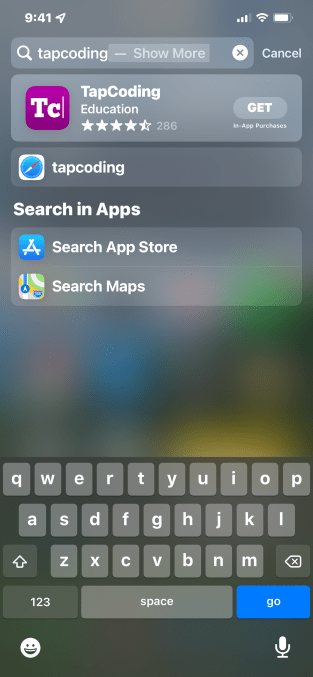
With the upcoming release of iOS 15 for Apple mobile devices, Apple’s built-in search feature known as Spotlight will become a lot more functional. In what may be one of its bigger updates since it introduced Siri Suggestions, the new version of Spotlight is becoming an alternative to Google for several key queries, including web images and information about actors, musicians, TV shows and movies. It will also now be able to search across your photo library, deliver richer results for contacts, and connect you more directly with apps and the information they contain. It even allows you to install apps from the App Store without leaving Spotlight itself.

Spotlight is also more accessible than ever before.

Years ago, Spotlight moved from its location to the left of the Home screen to become available with a swipe down in the middle of any screen in iOS 7, which helped grow user adoption. Now, it’s available with the same swipe-down gesture on the iPhone’s Lock Screen, too.

You can access spotlight from the lock screen #iOS15 (locked or unlocked) pic.twitter.com/rVC1DqvBkA

— Alex Fife (@alextfife) June 9, 2021

Apple showed off a few of Spotlight’s improvements during its keynote address at its Worldwide Developers Conference, including the search feature’s new cards for looking up information on actors, movies and shows, as well as musicians. This change alone could redirect a good portion of web searches away from Google or dedicated apps like IMDb.

For years, Google has been offering quick access to common searches through its Knowledge Graph, a knowledge base that allows it to gather information from across sources and then use that to add informational panels above and the side of its standard search results. Panels on actors, musicians, shows and movies are available as part of that effort.

But now, iPhone users can just pull up this info on their home screen.

The new cards include more than the typical Wikipedia bio and background information you may expect — they also showcase links to where you can listen or watch content from the artist or actor or movie or show in question. They include news articles, social media links, official websites and even direct you to where the searched person or topic may be found inside your own apps (e.g. a search for “Billie Eilish” may direct you to her tour tickets inside SeatGeek, or a podcast where she’s a guest).

Image Credits: Apple

For web image searches, Spotlight also now allows you to search for people, places, animals and more from the web — eating into another search vertical Google today provides.

Image Credits: iOS 15 screenshot

Your personal searches have been upgraded with richer results, too, in iOS 15.

When you search for a contact, you’ll be taken to a card that does more than show their name and how to reach them. You’ll also see their current status (thanks to another iOS 15 feature), as well as their location from FindMy, your recent conversations on Messages, your shared photos, calendar appointments, emails, notes and files. It’s almost like a personal CRM system.

Image Credits: Apple

Personal photo searches have also been improved. Spotlight now uses Siri intelligence to allow you to search your photos by the people, scenes and elements in your photos, as well as by location. And it’s able to leverage the new Live Text feature in iOS 15 to find the text in your photos to return relevant results.

This could make it easier to pull up photos where you’ve screenshot a recipe, a store receipt, or even a handwritten note, Apple said.

Image Credits: Apple

A couple of features related to Spotlight’s integration with apps weren’t mentioned during the keynote.

Spotlight will now display action buttons on the Maps results for businesses that will prompt users to engage with that business’s app. In this case, the feature is leveraging App Clips, which are small parts of a developer’s app that let you quickly perform a task even without downloading or installing the app in question. For example, from Spotlight you may be prompted to pull up a restaurant’s menu, buy tickets, make an appointment, order takeout, join a waitlist, see showtimes, pay for parking, check prices and more.

The feature will require the business to support App Clips in order to work.

Image Credits: iOS 15 screenshot

Another under-the-radar change — but a significant one — is the new ability to install apps from the App Store directly from Spotlight.

This could prompt more app installs, as it reduces the steps from a search to a download, and makes querying the App Store more broadly available across the operating system.

Developers can additionally choose to insert a few lines of code to their app to make data from the app discoverable within Spotlight and customize how it’s presented to users. This means Spotlight can work as a tool for searching content from inside apps — another way Apple is redirecting users away from traditional web searches in favor of apps.

However, unlike Google’s search engine, which relies on crawlers that browse the web to index the data it contains, Spotlight’s in-app search requires developer adoption.

Still, it’s clear Apple sees Spotlight as a potential rival to web search engines, including Google’s.

“Spotlight is the universal place to start all your searches,” said Apple SVP of Software Engineering Craig Federighi during the keynote event.

Spotlight, of course, can’t handle “all” your searches just yet, but it appears to be steadily working towards that goal.

read more about Apple's WWDC 2021 on TechCrunch

Decades-old ASCII adventure NetHack may hint at the future of AI

Machine learning models have already mastered Chess, Go, Atari games and more, but in order for it to ascend to the next level, researchers at Facebook intend for AI to take on a different kind of game: the notoriously difficult and infinitely complex NetHack.

“We wanted to construct what we think is the most accessible ‘grand challenge’ with this game. It won’t solve AI, but it will unlock pathways towards better AI,” said Facebook AI Research’s Edward Grefenstette. “Games are a good domain to find our assumptions about what makes machines intelligent and break them.”

You may not be familiar with NetHack, but it’s one of the most influential games of all time. You’re an adventurer in a fantasy world, delving through the increasingly dangerous depths of a dungeon that’s different every time. You must battle monsters, navigate traps and other hazards, and meanwhile stay on good terms with your god. It’s the first “roguelike” (after Rogue, its immediate and much simpler predecessor) and arguably still the best — almost certainly the hardest.

(It’s free, by the way, and you can download and play it on nearly any platform.)

Its simple ASCII graphics, using a g for a goblin, an @ for the player, lines and dots for the level’s architecture, and so on, belie its incredible complexity. Because Nethack, which made its debut in 1987, has been under active development ever since, with its shifting team of developers expanding its roster of objects and creatures, rules, and the countless, countless interactions between them all.

And this is part of what makes NetHack such a difficult and interesting challenge for AI: It’s so open-ended. Not only is the world different every time, but every object and creature can interact in new ways, most of them hand-coded over decades to cover every possible player choice.

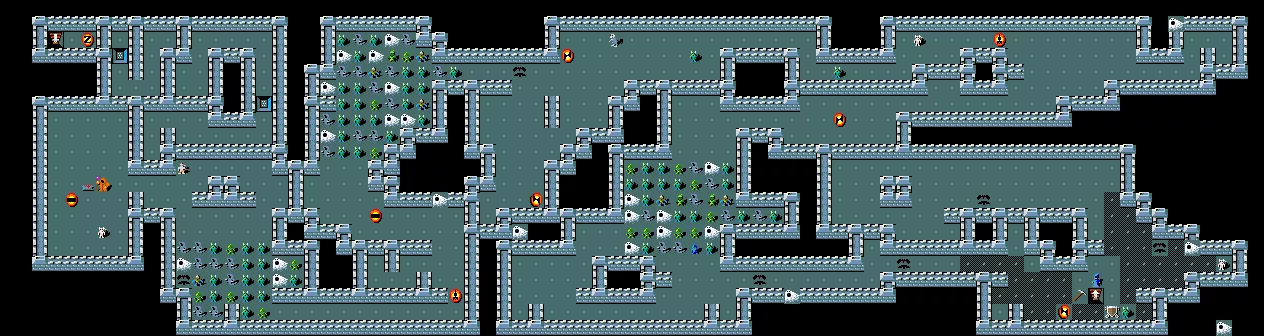
NetHack with a tile-based graphics update – all the information is still available via text.

“Atari, Dota 2, StarCraft 2… the solutions we’ve had to make progress there are very interesting. NetHack just presents different challenges. You have to rely on human knowledge to play the game as a human,” said Grefenstette.

In these other games, there’s a more or less obvious strategy to winning. Of course it’s more complex in a game like Dota 2 than in an Atari 800 game, but the idea is the same — there are pieces the player controls, a game board of environment, and win conditions to pursue. That’s kind of the case in NetHack, but it’s weirder than that. For one thing, the game is different every time, and not just in the details.

“New dungeon, new world, new monsters and items, you don’t have a save point. If you make a mistake and die you don’t get a second shot. It’s a bit like real life,” said Grefenstette. “You have to learn from mistakes and come to new situations armed with that knowledge.”

Drinking a corrosive potion is a bad idea, of course, but what about throwing it at a monster? Coating your weapon with it? Pouring it on the lock of a treasure chest? Diluting it with water? We have intuitive ideas about these actions, but a game-playing AI doesn’t think the way we do.

The depth and complexity of the systems in NetHack are difficult to explain, but that diversity and difficulty make the game a perfect candidate for a competition, according to Grefenstette. “You have to rely on human knowledge to play the game,” he said.

People have been designing bots to play NetHack for many years that rely not on neural networks but decision trees as complex as the game itself. The team at Facebook Research hopes to engender a new approach by building a training environment that people can test machine learning-based game-playing algorithms on.

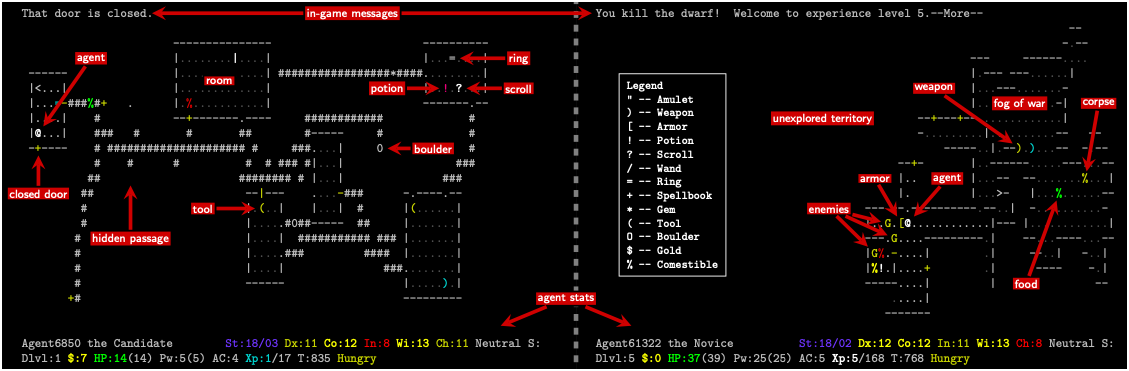
NetHack screens with labels showing what the AI is aware of.

The NetHack Learning Environment was actually put together last year, but the NetHack Challenge is only just now getting started. The NLE is basically a version of the game embedded in a dedicated computing environment that lets an AI interact with it through text commands (directions, actions like attack or quaff)

It’s a tempting target for ambitious AI designers. While games like StarCraft 2 may enjoy a higher profile in some ways, NetHack is legendary and the idea of building a model on completely different lines from those used to dominate other games is an interesting challenge.

It’s also, as Grefenstette explained, a more accessible one than many in the past. If you wanted to build an AI for StarCraft 2, you needed a lot of computing power available to run visual recognition engines on the imagery from the game. But in this case the entire game is transmitted via text, making it extremely efficient to work with. It can be played thousands of times faster than any human could with even the most basic computing setup. That leaves the challenge wide open to individuals and groups who don’t have access to the kind of high-power setups necessary to power other machine learning methods.

“We wanted to create a research environment that had a lot of challenges for the AI community, but not restrict it to only large academic labs,” he said.

For the next few months, NLE will be available for people to test on, and competitors can basically build their bot or AI by whatever means they choose. But when the competition itself starts in earnest on October 15, they’ll be limited to interacting with the game in its controlled environment through standard commands — no special access, no inspecting RAM, etc.

The goal of the competition will be to complete the game, and the Facebook team will track how many times the agent “ascends,” as it’s called in NetHack, in a set amount of time. But “we’re assuming this is going to be zero for everyone,” Grefenstette admitted. After all, this is one of the hardest games ever made, and even humans who have played it for years have trouble winning even once in a lifetime, let alone several times in a row. There will be other scoring metrics to judge winners in a number of categories.

The hope is that this challenge provides the seed of a new approach to AI, one that more fundamentally resembles actual human thinking. Shortcuts, trial and error, score-hacking, and zerging won’t work here — the agent needs to learn systems of logic and apply them flexibly and intelligently, or die horribly at the hands of an enraged centaur or owlbear.

You can check out the rules and other specifics of the NetHack Challenge here. Results will be announced at the NeurIPS conference later this year.

Todd and Rahul’s Angel Fund closes new $24 million fund

After making investments in 57 startups together, Superhuman CEO Rahul Vohra and Eventjoy founder Todd Goldberg are back at it with a new $24 million fund and big ambitions amid a venture capital renaissance with fast-moving deals aplenty.

Todd and Rahul’s Angel Fund” announced their first $7.3 million fund just weeks before the pandemic hit stateside last year and they were soon left with more access to deals than they had funding to support; they went on to raise $3.5 million in a rolling fund designed around making investments in later-stage deals beyond seed and Series A rounds.

“We closed right before COVID hit and we had one plan, but then everything accelerated,” Goldberg tells TechCrunch. “A lot of our companies started raising additional rounds.”

With their latest raise, Vohra and Goldberg are looking to maintain their wide outlook with a single fund, saying they plan to invest three-quarters of the fund in early-stage deals while saving a quarter of the $24 million for later-stage opportunities. Still, the duo know they likely could’ve chosen to raise more.

“A lot of our peers were scaling up into much larger funds,” Vohra says. “For us, we wanted to stay small and collaborative.”

Some of the firm’s investments from their first fund include NBA Top Shot creator Dapper Labs, open source Firebase alternative Supabase, D2C liquor brand Haus, alternative asset platform Alt, biowearable maker Levels and location analytics startup Placer. Their biggest hit was an early investment in audio chat app Clubhouse before Andreessen Horowitz led its buzzy seed round at a $100 million valuation. Clubhouse most recently raised at $4 billion.

The pair say they’ve learned a ton through the past year of navigating increasingly competitive rounds and that fighting for those deals has helped the duo hone how they market themselves to founders.

“You never want to be a passive check,” Goldberg says. “We do three things: we help companies find product/market fit, we help them super-charge distribution… and we help them find the best investors.”

A big part of the firm’s appeal to founders has been the “operator” status of its founders. Goldberg’s startup Eventjoy was acquired by Ticketmaster and Vohra’s Rapportive was bought by LinkedIn while his current startup Superhuman has maintained buzz for its premium email service and has raised $33 million from investors, including Andreessen Horowitz and First Round Capital.

Their new fund has an unusual LP base that’s made up of more than 110 entrepreneurs and investors, including 40 founders that Vohra and Goldberg have previously backed themselves. Backers of their second fund include Plaid’s William Hockey, Behance’s Scott Belsky, Haus’s Helena Price Hambrecht, Lattice’s Jack Altman and Loom’s Shahed Khan.

How to start a company in 4 days

Yin Wu
Contributor

Yin Wu, a three-time YC alum, is founder of Pulley, which offers cap table management tools that help companies better understand and optimize their equity.

Running a startup can be a complicated, difficult process fraught with pitfalls and ample opportunities to make mistakes. But the logistics of setting up a startup should be simple, because over the long run, complicated equity setups and cap tables cost more money in legal fees and administration time.

The logistics of setting up a startup should be simple, because over the long run, complicated equity setups and cap tables cost more money in legal fees and administration time.

My company, Pulley, has helped more than a thousand founders build their cap table and equity structure.

Here’s a tactical guide to get your startup running in just four days.

Day 1: Incorporate

It is now standard to incorporate your company at the seed stage itself. In the U.S., startups incorporate as Delaware C Corporations with 10 million authorized shares. This is the standard setup when you use services like Stripe Atlas or Clerky.

Post incorporation, you need to answer a few questions on how to grant equity to founders and future employees.

First, you should determine how you want to split the equity between the founders. There is no standard for doing so — some founders split shares equally, while others do 49/51 splits for control. Some founders even may have an 80/20 equity split because one founder spent an extra year on the idea.

At the end of the day, a good equity split is one that all founders find fair. If you can’t agree on a structure, you should have a deeper discussion on whether this is the right team to work with for the next decade or more.