Investors in Tesla and other Musk ventures should know that the CEO does not always hew to the literal truth.
Category: Tech news
hacking,system security,protection against hackers,tech-news,gadgets,gaming
Channel Your Inner Fred Flintstone in This Peddle-Powered Car
Yes, someone created a car with bike pedals where the normal pedals should be.
What Instagram users need to know about Facebook’s security breach
Even if you never log into Facebook itself these days, the other apps and services you use might be impacted by Facebook’s latest big, bad news.
In a follow-up call on Friday’s revelation that Facebook has suffered a security breach affecting at least 50 million accounts, the company clarified that Instagram users were not out of the woods — nor were any other third-party services that utilized Facebook Login. Facebook Login is the tool that allows users to sign in with a Facebook account instead of traditional login credentials and many users choose it as a convenient way to sign into a variety of apps and services.
Third-party apps and sites affected too
Due to the nature of the hack, Facebook cannot rule out the fact that attackers may have also accessed any Instagram account linked to an affected Facebook account through Facebook Login. Still, it’s worth remembering that while Facebook can’t rule it out, the company has no evidence (yet) of this kind of activity.
“So the vulnerability was on Facebook, but these access tokens enable someone to use [a connected account] as if they were the account holder themselves — this does mean they could have access other third party apps that were using Facebook login,” Facebook Vice President of Product Management Guy Rosen explained on the call.
“Now that we have reset all of those access tokens as part of protecting the security of people’s accounts, developers who use Facebook login will be able to detect that those access tokens has been reset, identify those users and as a user, you will simply have to log in again into those third party apps.”
Rosen reiterated that there is plenty Facebook does not know about the hack, including the extent to which attackers manipulated the three security bugs in question to obtain access to external accounts through Facebook Login.
“The vulnerability was on Facebook itself and we’ve yet to determine, given the investigation is really early, [what was] the exact nature of misuse and whether there was any access to Instagram accounts, for example,” Rosen said.
Anyone with a Facebook account affected by the breach — you should have been automatically logged out and will receive a notification — will need to unlink and relink their Instagram account to Facebook in order to continue cross-posting content to Facebook.
How to relink your Facebook account and do a security check
To do relink your Instagram account to Facebook, if you choose to, open Instagram Settings > Linked Accounts and select the checkbox next to Facebook. Click Unlink and confirm your selection. If you’d like to reconnect Instagram with Facebook, you’ll need to select Facebook in the Linked Accounts menu and login with your credentials like normal.
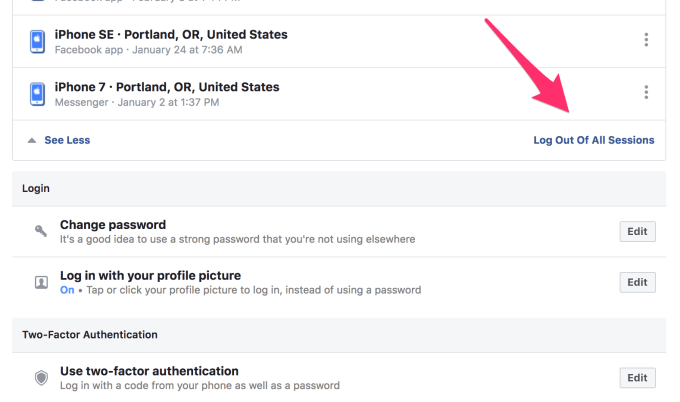
If you know your Facebook account was affected by the breach, it’s wise to check for suspicious activity on your account. You can do this on Facebook through the Security and Login menu.
There, you’ll want to browse the activity listed to make sure you don’t see anything that doesn’t look like you — logins from other countries, for example. If you’re concerned or just want to play it safe, you can always find the link to “Log Out Of All Sessions” by scrolling toward the bottom of the page.
While we know a little bit more now about Facebook’s biggest security breach to date, there’s still a lot that we don’t. Expect plenty of additional information in the coming days and weeks as Facebook surveys the damage and passes that information along to its users. We’ll do the same.
The Facebook Security Meltdown Exposes Way More Sites Than Facebook
The social networking giant confirmed Friday that sites you use Facebook to login to could have been accessed as a result of its massive breach.
Trump’s Auto Emissions Plan Is Full of Faulty Logic
A federal proposal to freeze cars’ emissions standards argues that climate change isn’t worth fighting at the tailpipe, but scientific research suggests otherwise.
Facebook blocked users from posting some stories about its security breach
Some users are reporting that they are unable to post today’s big story about a security breach affecting 50 million Facebook users. The issue appears to only affect particular stories from certain outlets, at this time one story from The Guardian and one from the Associated Press, both reputable press outlets.
Facebook is preventing users from posting The Guardian's report on the Facebook data breach. Ouch. https://t.co/IGU685PjdK pic.twitter.com/GGGrKqBZEc
— Jed Bracy (@JedBracy) September 28, 2018
When going to share the story to their news feed, some users, including members of the staff here at TechCrunch who were able to replicate the bug, were met with the following error message which prevented them from sharing the story.
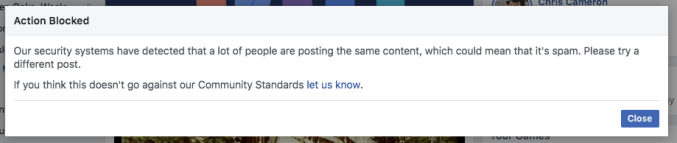
According to the message, Facebook is flagging the stories as spam due to how widely they are being shared or as the message puts it, the system’s observation that “a lot of people are posting the same content.”
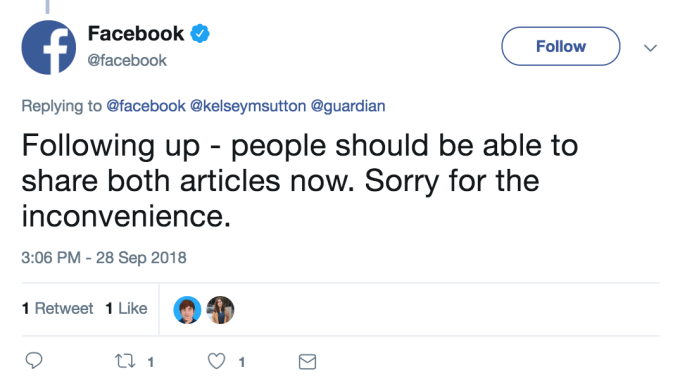
Update: After attention was drawn to it, the bug appears to be resolved, according to updates on Facebook’s Twitter account. We still don’t have more official information about how or why the behavior occurred.
To be clear, this isn’t one Facebook content moderator sitting behind a screen rejecting the link somewhere or the company conspiring against users spreading damning news. The situation is another example of Facebook’s automated content flagging tools marking legitimate content as illegitimate, in this case calling it spam. Still, it’s strange and difficult to understand why such a bug wouldn’t affect many other stories that regularly go viral on the social platform.
This instance is by no means a first for Facebook. The platform’s automated tools — which operate at unprecedented scale for a social network — are well known for at times censoring legitimate posts and flagging benign content while failing to detect harassment and hate speech. We’ve reached out to Facebook for details about how this kind of thing happens but the company appears to have its hands full with the bigger news of the day.
While the incident is nothing particularly new, it’s an odd quirk — and in this instance quite a bad look given that the bad news affects Facebook itself.
Elon Musk Has Finally Picked a Fight He Can’t Win
The Tesla CEO’s decision to refuse an SEC settlement sets him up for battle against the government, and shareholders aren’t happy.
Our 3 favorite startups from Urban-X’s 4th demo day
Urban-X, the urban-tech startup accelerator backed by MINI and early-stage urban-tech fund Urban.Us, hosted a demo day today for its fourth cohort of companies at its Brooklyn HQ. The seven presenting companies offered solutions to issues plaguing modern cities, including toll-road pricing, energy and construction management, and even the inefficiencies of modern cycling helmets.
In a day that offered an impressive display of entrepreneurial talent, here are a few of the companies that really stood out to us:
Rentlogic
In hopes of improving landlord transparency, Rentlogic uses years of city government data to create objective algorithmic letter ratings for apartment buildings. As CEO Yale Fox pointed out, despite city-dwellers spending half our paychecks on rent, urban housing hasn’t seen the same rating systems that we use to guide decisions on where we eat, what car we buy, or what shows we binge. Rentlogic allows apartment hunters to screen buildings before signing a lease and avoid committing to unhealthy conditions or an absentee landlord.
Rentlogic partners with landlords looking to obtain a stamp of quality for potential renters, offering an added inspection feature that allows them to hang a letter rating outside their building. The company’s roster of customers already includes Blackstone and Phipps Houses, the largest for-profit and non-profit landlords in the world, respectively.
What stands out with Rentlogic is its ability to scale. Though currently only in New York City, the same data used in New York presumably exists across all major US markets and Rentlogic has minimized the cost of entering new cities by building out the back-end infrastructure required to ingest and analyze the data. From a demand perspective, as renters defer to Rentlogic for quality assurance and more competitors hang “A” ratings outside their buildings, landlords will face more pressure to maintain the same offering.
The idea hit home for a born-and-bred New Yorker with my own set of landlord horror stories, and the first thing I did when I left was look up my building on Rentlogic.
Campsyte
Most companies wish they had mega-campuses or “motherships” where they could offer employees access to sprawling outdoor working areas. For companies based in urban areas, offering outdoor space can be tough, with many parks often privatized, far from city centers, or void of the amenities needed to be productive.
Campsyte transforms underutilized urban outdoor spaces into productive and fun spaces that customers can book for co-working purposes, corporate off-sites, or events. Similar to WeWork’s approach with buildings, Campsyte takes a parking lot, and adds value by filling it with greenery, furniture, electricity, WiFi, and other services. With its services driving nearly 10x the annual revenue per square foot seen by traditional parking lots, the value proposition for lot owners is convincing.
Given the competition companies are facing when it comes to attracting and retaining talent, providing the same amenities as competitors based outside city centers seems invaluable, with Campsyte boasting an extremely impressive roster of partner companies, including LinkedIn, PayPal, Salesforce, and Airbnb.
ODN (Open Data Nation)
As anyone who has driven in a city knows, car crashes or accidents can often be caused by the built environment around you. Yet insurers, who focus on personal characteristics like credit scores when underwriting a policy, lack the measurement tools to assess the risk of someone’s external environment.
Founded by an MIT-trained city planner, ODN builds risk models using machine learning and public data records to help insurers evaluate risk and mitigate accidents. The resulting analytics eases the selection process for insurers, allowing them to drive more sales with less cost and risk. ODN is already partnered up with some of the world’s largest insurers including Zurich, Travelers, and Hanover Insurance.
The potential use cases for ODN’s technology go far beyond the massive existing insurance market, with the eventual rollout of autonomous cars forcing insurers to ask how they construct policies when human behavior plays no role in accidents. ODN is working with carriers to help answer this question while helping create a more efficient and fair underwriting process today.
Other members of Urban-X Cohort 4 included:
Avvir: “Avvir automates quality assurance for the construction industry, providing real-time insights into the progress and potential defects on a project.”
ClearRoad: “ClearRoad helps government agencies automate toll road pricing for any section of road without the need for traditional proprietary hardware infrastructure.”
Park & Diamond: “Park & Diamond makes biking better by reinventing the bike helmet, using next-generation materials to build a safer, more portable helmet that can roll up into the shape of a water bottle for easier carrying, while looking like a regular hat, cap, or beanie.”
Sapient Industries: “Sapient Industries has developed an autonomous energy management system that senses and learns human behavior in order to eliminate wasted energy in buildings.”
California cops bust crime ring that nabbed $1M worth of devices from Apple Stores
Fear not, citizens — the law enforcement apparatus of California has apprehended or is hot on the trail of more than a dozen hardened criminals who boldly stole from the state’s favorite local business: Apple . Their unconscionable larceny amounted to more than a million dollars’ worth of devices stolen from Apple Stores — the equivalent of hundreds of iPhones.
The alleged thieves would wear hoodies into Apple stores — already suspicious, I know — and there they would snatch products on display and hide them in the ample pockets of those garments. Truly cunning.
These crimes took place in 19 different counties in California, the police forces of which all collaborated to bring the perpetrators to justice, though the San Luis Obispo and Oakland departments led the charge. So far seven of the thieves have been arrested, and nine more have warrants out.
In a press release, California Attorney General Xavier Becerra harangued his state regarding the dangers of the criminal element:
Organized retail thefts cost California business owners millions and expose them to copycat criminals. Ultimately, consumers pay the cost of this merchandise hijacking. We will continue our work with local law enforcement authorities to extinguish this mob mentality and prosecute these criminals to hold them accountable.
You hear that, would-be copycats? You hear that, assembling mob? Xavier’s gonna give it to you… if you don’t fly straight and stop trying to stick ordinary consumers with the costs of your crimes. Not to mention California businesses. With Apple paying that $15 billion in back taxes, it doesn’t have a lot of cash to spare for these shenanigans.
Well, I suppose it’s doing okay.
I’ve asked Apple for comment on this case and whether they participated or cooperated in it. Perhaps Face ID helped.
With his internet cut off, Julian Assange steps down as editor of WikiLeaks
WikiLeaks has a new top dog. Its contentious figurehead and founder, Julian Assange, will step aside, letting former WikiLeaks spokesperson Kristinn Hrafnsson take the reins due to what WikiLeaks calls “extraordinary circumstances” that have seen Assange “held incommunicado.”
ANNOUNCEMENT: Assange appoints Hrafnsson Editor-in-Chief after six months of effective incommunicado detention, remains publisher [background: https://t.co/2jOgvSu5bG] pic.twitter.com/0Fwvf3SrkL
— WikiLeaks (@wikileaks) September 26, 2018
Assange created the organization in 2006 and has served as its editor-in-chief ever since. Hrafnsson, an Icelandic journalist, will take over, though he’s not new to leadership at WikiLeaks. In the past, Hrafnsson has “overseen certain legal projects for WikiLeaks” and it is believed that Assange has had less of a day to day role in its operations over time. Assange will remain involved as the organization’s publisher.
Assange remains holed up in London’s Ecuadorian embassy after first seeking refuge there in 2012 in order to avoid extradition to Sweden over sexual assault allegations. Six months ago, the Ecuadorian government took actions that isolated Assange, cutting off his internet access and disallowing him from seeing visitors.
Assange reportedly has tension with Ecuador’s new president, Lenín Moreno, who apparently views him an unsavory problem inherited from the former administration. Moreno has suggested that he will maintain Assange’s status “as long as we assume his life may be in danger” — a statement that leaves some room for doubt about the WikiLeaks founder’s near future.
Google adds creator credit to Images
Google’s attempting to smooth out its relationship with photo rights holders by bringing some additional contextual data to its Image Search. In a blog post today, Product Manager Ashutosh Agarwal highlighted the company’s plan to associate Creator and Credit metadata with images served up via search.
The company notes that finding out who created a given image — and who owns the rights — has traditionally been tricky online. Google Images hasn’t been particularly useful in this manner, forcing users to hunt down that information themselves.
The information will start showing up on images today when available, and in the next few weeks Google will be adding a copyright notice. Users can find all this by clicking the “Image Credits” link on a given shot.
Google’s partnering with CEPIC (Center of the Picture Industry) and IPTC (International Press Telecommunications Council) to create best practices for attribution moving forward. The company has received pushback regarding Images of late. Back in February, Google dropped the View Images link as part of a settlement with Getty.
Facebook policy head makes a surprising cameo at the Kavanaugh hearing
Facebook might be doing its best to stay out of political scandals in the latter half of 2018, but the company had a presence, front and center, at one of the most contentious Senate hearings in modern history.
Facebook’s vice president of Global Public Policy, Joel Kaplan, was spotted sitting prominently near his wife, Laura Cox Kaplan, in the section for Brett Kavanaugh’s supporters. He is pictured on the left side of the header image, second row, in a blue tie.
For reference, below is an image of Kaplan to the immediate right of Mark Zuckerberg during a Senate Judiciary joint hearing in April of this year.
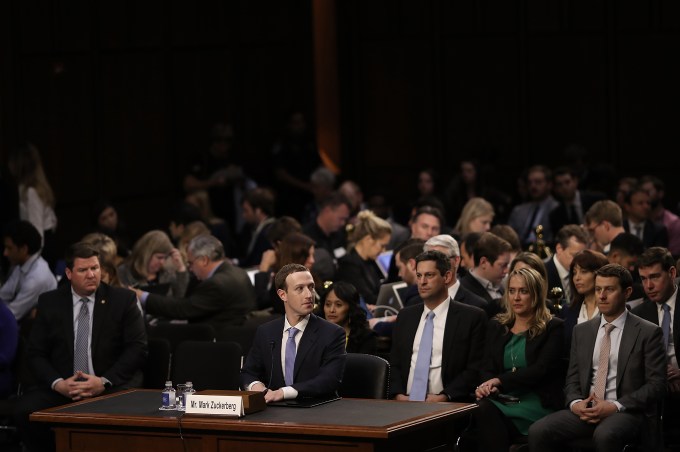
WASHINGTON, DC – APRIL 10: Facebook co-founder, chairman and CEO Mark Zuckerberg concludes his testimony before a combined Senate Judiciary and Commerce committee hearing in the Hart Senate Office Building on Capitol Hill April 10, 2018 in Washington, DC. (Photo by Win McNamee/Getty Images)
Kaplan has not made any public commentary on Twitter or Facebook about his support for the Supreme Court nominee, though, through retweets, Kaplan’s wife appears to be of the mind that the hearing is part of a “smear campaign” against the family friend.
Kaplan is also featured in this viral image, making the rounds on Twitter.
What a photo… pic.twitter.com/OIW5700U8C
— Sam Altman (@sama) September 27, 2018
His appearance during the hearing is a show of personal support, though it still turns heads for such a prominent Facebook employee to make a visible statement during such a politically divisive event. Kaplan is not representing Facebook in a formal capacity.
Kaplan served as a policy adviser on George W. Bush’s 2000 election campaign and went on to serve as a policy assistant to the president and as the deputy director of the Office of Management and Budget (OMB) and a deputy chief of staff. Kavanaugh worked for the Bush administration during the same period, joining the former president’s legal team and going on to work on the nomination of Chief Justice John Roberts to the Supreme Court.
Kaplan joined Facebook in 2011 as its VP of U.S. public policy. Kaplan continues to serve in a heavily influential political role with the company today, leading its Washington D.C. office, which serves as the company’s lobbying arm.
Tesla CEO Elon Musk calls SEC fraud charges an ‘unjustified action’
Tesla CEO Elon Musk described fraud charges filed Thursday by the U.S. Securities and Exchange Commission an “unjustified action” that has left him “deeply saddened and disappointed” in a statement sent to TechCrunch.
The SEC alleges in a complaint filed against the CEO that Musk lied when he tweeted on August 7 that he had “funding secured” for a takeover of the company at $420 per share. The SEC complaint, filed in federal district court in the Southern District of New York, identified the tweets as “false and misleading.”
Here is Musk’s entire statement:
“This unjustified action by the SEC leaves me deeply saddened and disappointed. I have always taken action in the best interests of truth, transparency and investors. Integrity is the most important value in my life and the facts will show I never compromised this in any way.”
In August, Musk sent a tweet that he had secured funding and was considering taking Tesla private. The tweet wasn’t warmly embraced by the Tesla board or many shareholders and it’s what prompted the SEC to investigate.
Musk’s tweets caused Tesla’s stock price to jump by more than 6 percent on August 7, and led to significant market disruption, according to the SEC’s complaint. The SEC alleges that Musk violated antifraud provisions of the federal securities laws, and is seeking a permanent injunction, disgorgement and civil penalties. The commission also wants to bar the billionaire entrepreneur from serving as an officer or director of a public company.
The securities fraud complaint caused shares to plummet more than 13% in after-hours trading.
Am considering taking Tesla private at $420. Funding secured.
— Elon Musk (@elonmusk) August 7, 2018
Several weeks later the company posted a blog announcing that Tesla will remain a public company.
The SEC’s investigation is continuing, according to the organization.
Here is the SEC complaint against Elon Musk and Tesla
Update: There’s a live stream of the SEC press conference detailing the complaint:
The Securities and Exchange Commission lodged a complaint today against Elon Musk following tweets sent last month by the CEO involving a planned private takeover of the electric car company at $420 a share.
The filing from the Southern District of New York identifies the tweets as “false and misleading,” adding:
Musk’s statements, disseminated via Twitter, falsely indicated that, should he so choose, it was virtually certain that he could take Tesla private at a purchase price that reflected a substantial premium over Tesla stock’s then-current share price, that funding for this multi-billion dollar transaction had been secured, and that the only contingency was a shareholder vote. In truth and in fact, Musk had not even discussed, much less confirmed, key deal terms, including price, with any potential funding source.
Am considering taking Tesla private at $420. Funding secured.
— Elon Musk (@elonmusk) August 7, 2018
In addition to the August 7 “funding secured” statement, the document identifies three additional tweets,
- My hope is *all* current investors remain with Tesla even if we’re private. Would create special purpose fund enabling anyone to stay with Tesla.
- Shareholders could either to [sic] sell at 420 or hold shares & go private.”
- Investor support is confirmed. Only reason why this is not certain is that it’s contingent on a shareholder vote.
Musk responded to the complaint, calling it an “unjustified action.” The company’s stock price just took a massive dip on the news.
Tech employees can make up for executives
Jared Moore
Contributor
Contributor
Jared Moore is a research fellow at the Wadhwani Institute for Artificial Intelligence in Mumbai and was recently an instructor of computer ethics at the University of Washington.
Sheryl Sandberg and Jack Dorsey — representing Facebook and Twitter, respectively — recently testified before Congress, this time evading questions about bias on their platforms. We frequently turn to tech executives to answer for such issues because they have the agency to make changes. But they are not alone.
Overlooked are the tech employees — the 10,000 or so at Facebook — that build the platforms executives defend. Tech’s reach makes employees’ agency clear. Consider the two billion active Facebook users — 200,000 per employee. The average U.S. Congressperson serves only three times as many people.
Not only does the reach of employees suggest influence, so do their actions. In the fall of 2017, Mark Zuckerberg said it was “a pretty crazy idea” that fake news on Facebook had an effect on the 2016 general election. Despite widespread public condemnation, Zuckerberg held firm to his position. Through internal complaints, employees led Zuckerberg to change course: the news feed algorithm switched from favoring inflammatory stories — clickbait — to focusing on friends.
The editor of Wired, in his analysis, noted “the place you can put the most pressure on executives comes from the engineers.” So too was it through internal lobbying, prospective employees refusing job offers and protest resignations that Google dropped a contract to help Department of Defense drones better recognize targets.
As a recent instructor on ethics to computer scientists at the University of Washington and a former employee of Microsoft, I know that sometimes what tech employees need is a push. They need a push to realize they are uniquely positioned to act against malfeasance. They need a push that says your bosses hide behind platitudes and your government is checked out, but you can do something.
Still, my students and peers see themselves as limited to only the confines of the tasks given them — as lacking discretion. In class, when faced with a problem without a tangible, let alone code-able, solution, my students moved on. In effect, they said values in the light of profit have no more hope than does a sandcastle in a tide-flat.
Given the dearth of tech talent, tech employees have more agency than they might project.
They too quickly forget the privilege of tech. According to Glassdoor, the average Facebook engineer earns $130,000 a year. Techies are gentrifying neighborhoods in San Francisco, Seattle and Austin. Their products shape our increasingly digital lives. Concerns about employee replaceability are overblown. Given the dearth of tech talent, tech employees have more agency than they might project.
As articles call for regulation from Congress and responsibility from Zuckerberg, they suggest only those well-known have ethical agency. Rarely do we think of employees as we think of executives — as potential agents of change. Just as we recognize the influence of constituents over those whom they elect, we should recognize the sway of tech employees over the devices that begin our days and mediate our lives.
An employee does not singularly have the agency to shape the course of Facebook as does Zuckerberg, but she is not limited to the tasks she is assigned. Her influence extends beyond the code that she writes to the internal memos assailing Zuckerberg for his position on fake news. Her influence extends to the product decisions she makes, like whether to include screen-reader support when designing a website, even if it takes more time.
My students cried foul at suggestions that they make software systems accountable. “There’s no algorithm to solve it!” Students pushed back against the notion that they could consider values tangential to the design of a system. “Not if it reduces ad revenue!” They lay such considerations at the feet of designers, researchers, management and somebody else. “It’s not my job” not only evades responsibility, but also ignores that the most prominent computing society has a code of ethics.
It is through both discretionary opportunities and collaborative action that tech employees — or any worker — can advocate for a system that prioritizes more than profits. This requires appeals to colleagues, conversations with squirms and averted eyes and a rebuke of the abstractions that wash away ethical quandaries.
As we call to make algorithms accountable and executives — Dorsey, Sandberg, Zuckerberg — responsible, we should remember the people who allow those two to exist. I do not suggest a cessation of efforts to regulate free expression, or any other value. Absent regulation, absent executive responsibility, consider the people behind the product. Phone your friend at Facebook or Google. They need the push.