Early-stage SaaS VC slip snaps recovery as public software stocks soar

Jason Rowley
Contributor

Jason Rowley is a venture capital and technology reporter for Crunchbase News.

A few months ago, Crunchbase News reported that a longstanding period of SaaS investment stagnation had come to an end.

However, the investment boom times didn’t necessarily carry over to the seed and early-stage end of the subscription software businesses.

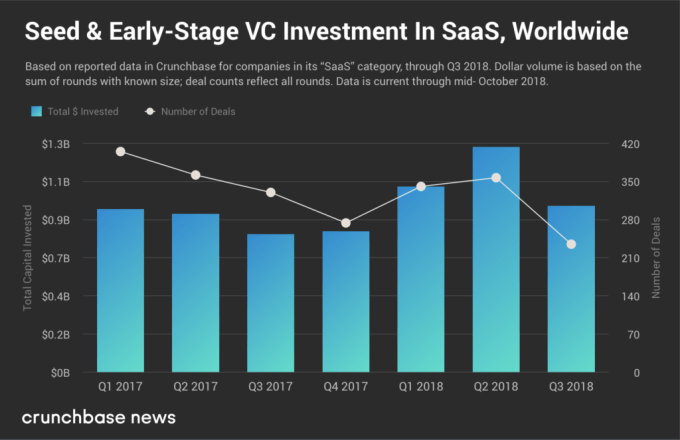
The chart below displays deal and dollar volume of seed and early-stage venture investments1 made into companies from around the world in Crunchbase’s SaaS category. Note that it is subject to historically documented reporting delays, which are most pronounced in seed and early-stage deals.

As can be plainly seen that Q3 2018 took quite a turn in terms of investment into SaaS. And it’s a bit bewildering as to why.

Overall, the venture market in Q3 hit record heights, and nearly every stage of investment saw more dollars and more rounds. Yet, as shown above, SaaS startups don’t appear to be beneficiaries of this influx of cash.

The public comparison

The picture becomes even more distorted when we account for public market SaaS comps, which set the benchmark for private companies. And that benchmark hasn’t been suffering. Public cloud companies have enjoyed a steep run up in asset value over the past several years.

The newly revamped BVP Nasdaq Emerging Cloud Index (formerly known as the Bessemer Cloud Index) tracks a basket of publicly traded SaaS stocks, including the likes of SalesforceAdobe and more recent debuts like DropboxDocuSign and Okta, among others.

Public cloud stocks soar

Public companies in the Bessemer Cloud Index grew their public valuations much faster than more broad-based indices like the Dow Jones Industrial Average and the S&P 500. Carried by the high and still-growing value of recurring revenuewarm reception of SaaS companies new to public markets and (with the exception of the past couple of weeks) generally stable markets overall, public SaaS companies have done well. Despite a pretty absurd rate of growth on the public side, no such consistent growth could be found on the early-stage, private end of the market.

However, rather than viewing Q3 2018 as a disappointment for the early-stage SaaS investment market, it’s more like a reversion to the mean. It’s the first half of the year that’s the outlier, not Q3.

Big deals, slowing pace

The first half of 2018 had some truly huge early-stage deals cross the wires. In March, Robotic process automation software company UiPath raised $153 million in its Series B. (UiPath just raised another $225 million in a Series C round in September.) Collaborative email inbox Front App raised $66 million in its January Series B. Rival Chicago logistics software companies FourKites and project44 each raised $35 million Series B rounds earlier in the year. On a one-off basis, these are big rounds, but collectively they add up to a huge pile of money.

The conclusion we’re drawn to here is that we were perhaps premature in declaring the long-time downtrend snapped to the upside.

  1. On the seed-stage side, that includes pre-seed, seed and angel rounds, as well as smaller convertible notes and proceeds from small equity crowdfunding campaigns. Early-stage deals include Series A and Series B rounds, as well as larger convertible notes and equity crowdfunding campaigns.

Khashoggi’s fate shows the flip side of the surveillance state

It’s been over five years since NSA whistleblower Edward Snowden lifted the lid on government mass surveillance programs, revealing, in unprecedented detail, quite how deep the rabbit hole goes thanks to the spread of commercial software and connectivity enabling a bottomless intelligence-gathering philosophy of ‘bag it all’.

Yet technology’s onward march has hardly broken its stride.

Government spying practices are perhaps more scrutinized, as a result of awkward questions about out-of-date legal oversight regimes. Though whether the resulting legislative updates, putting an official stamp of approval on bulk and/or warrantless collection as a state spying tool, have put Snowden’s ethical concerns to bed seems doubtful — albeit, it depends on who you ask.

The UK’s post-Snowden Investigatory Powers Act continues to face legal challenges. And the government has been forced by the courts to unpick some of the powers it helped itself to vis-à-vis people’s data. But bulk collection, as an official modus operandi, has been both avowed and embraced by the state.

In the US, too, lawmakers elected to push aside controversy over a legal loophole that provides intelligence agencies with a means for the warrantless surveillance of American citizens — re-stamping Section 702 of FISA for another six years. So of course they haven’t cared a fig for non-US citizens’ privacy either.

Increasingly powerful state surveillance is seemingly here to stay, with or without adequately robust oversight. And commercial use of strong encryption remains under attack from governments.

But there’s another end to the surveillance telescope. As I wrote five years ago, those who watch us can expect to be — and indeed are being — increasingly closely watched themselves as the lens gets turned on them:

“Just as our digital interactions and online behaviour can be tracked, parsed and analysed for problematic patterns, pertinent keywords and suspicious connections, so too can the behaviour of governments. Technology is a double-edged sword – which means it’s also capable of lifting the lid on the machinery of power-holding institutions like never before.”

We’re now seeing some of the impacts of this surveillance technology cutting both ways.

Tech-enabled exposés revealing the modus operandi of brutal regimes — e.g. @bellingcat IDing the GRU agents who poisoned the Skripals or Turkish surveillance leaking graphic details of Khashoggi's fate — keep reminding me of this piece I wrote 5yrs ago https://t.co/CTGUf956s7

— Natasha (@riptari) October 18, 2018

With attention to detail, good connections (in all senses) and the application of digital forensics all sorts of discrete data dots can be linked — enabling official narratives to be interrogated and unpicked with technology-fuelled speed.

Witness, for example, how quickly the Kremlin’s official line on the Skripal poisonings unravelled.

After the UK released CCTV of two Russian suspects of the Novichok attack in Salisbury, last month, the speedy counter-claim from Russia, presented most obviously via an ‘interview’ with the two ‘citizens’ conducted by state mouthpiece broadcaster RT, was that the men were just tourists with a special interest in the cultural heritage of the small English town.

Nothing to see here, claimed the Russian state, even though the two unlikely tourists didn’t appear to have done much actual sightseeing on their flying visit to the UK during the tail end of a British winter (unless you count vicarious viewing of Salisbury’s wikipedia page).

But digital forensics outfit Bellingcat, partnering with investigative journalists at The Insider Russia, quickly found plenty to dig up online, and with the help of data-providing tips. (We can only speculate who those whistleblowers might be.)

Their investigation made use of a leaked database of Russian passport documents; passport scans provided by sources; publicly available online videos and selfies of the suspects; and even visual computing expertise to academically cross-match photos taken 15 years apart — to, within a few weeks, credibly unmask the ‘tourists’ as two decorated GRU agents: Anatoliy Chepiga and Dr Alexander Yevgeniyevich Mishkin.

When public opinion is faced with an official narrative already lacking credibility that’s soon set against external investigation able to closely show workings and sources (where possible), and thus demonstrate how reasonably constructed and plausible is the counter narrative, there’s little doubt where the real authority is being shown to lie.

And who the real liars are.

That the Kremlin lies is hardly news, of course. But when its lies are so painstakingly and publicly unpicked, and its veneer of untruth ripped away, there is undoubtedly reputational damage to the authority of Vladimir Putin.

The sheer depth and availability of data in the digital era supports faster-than-ever evidence-based debunking of official fictions, threatening to erode rogue regimes built on lies by pulling away the curtain that invests their leaders with power in the first place — by implying the scope and range of their capacity and competency is unknowable, and letting other players on the world stage accept such a ‘leader’ at face value.

The truth about power is often far more stupid and sordid than the fiction. So a powerful abuser, with their workings revealed, can be reduced to their baser parts — and shown for the thuggish and brutal operator they really are, as well as proved a liar.

On the stupidity front, in another recent and impressive bit of cross-referencing, Bellingcat was able to turn passport data pertaining to another four GRU agents — whose identities had been made public by Dutch and UK intelligence agencies (after they had been caught trying to hack into the network of the Organisation for the Prohibition of Chemical Weapons) — into a long list of 305 suggestively linked individuals also affiliated with the same GRU military unit, and whose personal data had been sitting in a publicly available automobile registration database… Oops.

There’s no doubt certain governments have wised up to the power of public data and are actively releasing key info into the public domain where it can be poured over by journalists and interested citizen investigators — be that CCTV imagery of suspects or actual passport scans of known agents.

A cynic might call this selective leaking. But while the choice of what to release may well be self-serving, the veracity of the data itself is far harder to dispute. Exactly because it can be cross-referenced with so many other publicly available sources and so made to speak for itself.

Right now, we’re in the midst of another fast-unfolding example of surveillance apparatus and public data standing in the way of dubious state claims — in the case of the disappearance of Washington Post journalist Jamal Khashoggi, who went into the Saudi consulate in Istanbul on October 2 for a pre-arranged appointment to collect papers for his wedding and never came out.

Saudi authorities first tried to claim Khashoggi left the consulate the same day, though did not provide any evidence to back up their claim. And CCTV clearly showed him going in.

? VIDEO: CCTV footage shows journalist Jamal Khashoggi walking into the Saudi consulate in Istanbul before he disappeared https://t.co/cHGjwmNT4a pic.twitter.com/ML4aItvOuP

— Irish Times Video (@irishtimesvideo) October 10, 2018

Yesterday they finally admitted he was dead — but are now trying to claim he died quarrelling in a fistfight, attempting to spin another after-the-fact narrative to cover up and blame-shift the targeted slaying of a journalist who had written critically about the Saudi regime.

Since Khashoggi went missing, CCTV and publicly available data has also been pulled and compared to identify a group of Saudi men who flew into Istanbul just prior to his appointment at the consulate; were caught on camera outside it; and left Turkey immediately after he had vanished.

Including naming a leading Saudi forensics doctor, Dr Salah Muhammed al-Tubaigy, as being among the party that Turkish government sources also told journalists had been carrying a bone saw in their luggage.

Men in the group have also been linked to Saudi crown prince Mohammed bin Salman, via cross-referencing travel records and social media data.

“In a 2017 video published by the Saudi-owned Al Ekhbariya on YouTube, a man wearing a uniform name tag bearing the same name can be seen standing next to the crown prince. A user with the same name on the Saudi app Menom3ay is listed as a member of the royal guard,” writes the Guardian, joining the dots on another suspected henchman.

A marked element of the Khashoggi case has been the explicit descriptions of his fate leaked to journalists by Turkish government sources, who have said they have recordings of his interrogation, torture and killing inside the building — presumably via bugs either installed in the consulate itself or via intercepts placed on devices held by the individuals inside.

This surveillance material has reportedly been shared with US officials, where it must be shaping the geopolitical response — making it harder for President Trump to do what he really wants to do, and stick like glue to a regional US ally with which he has his own personal financial ties, because the arms of that state have been recorded in the literal act of cutting off the fingers and head of a critical journalist, and then sawing up and disposing of the rest of his body.

Attempts by the Saudis to construct a plausible narrative to explain what happened to Khashoggi when he stepped over its consulate threshold to pick up papers for his forthcoming wedding have failed in the face of all the contrary data.

Meanwhile, the search for a body goes on.

And attempts by the Saudis to shift blame for the heinous act away from the crown prince himself are also being discredited by the weight of data…

Here is Saud al-Qahtani – advisor to MBS who has been sacked and blamed for the murder of Jamal #Khashoggi – saying a year ago he only acts on the orders of King Salman and the Crown Prince MBS “Do you think I’m acting on my own without guidance?”(correction on date) https://t.co/mN2NEkbihX

— Bel Trew (@Beltrew) October 20, 2018

And while it remains to be seen what sanctions, if any, the Saudis will face from Trump’s conflicted administration, the crown prince is already being hit where it hurts by the global business community withdrawing in horror from the prospect of being tainted by bloody association.

The idea that a company as reputation-sensitive as Apple would be just fine investing billions more alongside the Saudi regime, in SoftBank’s massive Vision Fund vehicle, seems unlikely, to say the least.

Thanks to technology’s surveillance creep the world has been given a close-up view of how horrifyingly brutal the Saudi regime can be — and through the lens of an individual it can empathize with and understand.

Safe to say, supporting second acts for regimes that cut off fingers and sever heads isn’t something any CEO would want to become famous for.

The power of technology to erode privacy is clearer than ever. Down to the very teeth of the bone saw. But what’s also increasingly clear is that powerful and at times terrible capability can be turned around to debase power itself — when authorities themselves become abusers.

So the flip-side of the surveillance state can be seen in the public airing of the bloody colors of abusive regimes.

Turns out, microscopic details can make all the difference to geopolitics.

RIP Jamal Khashoggi

In State Tectonics, an explosive ending for the future of democracy

An omnipotent data infrastructure and knowledge-sharing tech organization has spread across the planet. Global conspiracies to disseminate propaganda and rig elections are ever present. Algorithms determine what people see as objective truth, and terrorist organizations gird to bring down the monopoly on information.

Malka Older faces a problem few speculative science fiction authors face in their lifetimes: having their work become a blueprint for reality. The author, who began formulating her Centenal Cycle series just a few years ago, now finds that her plots have leapt off the page and have become the daily fodder for cable news programs and Congressional investigations. Her universe is set decades into the future, but history is accelerating, and decades into the future can now mean 2019.

So we arrive at the third and final volume of a trilogy that began as a single work called Infomocracy and has proliferated into Null States and now State Tectonics. Ending a trilogy is rarely easy, but State Tectonics does what Older has always done best with her works, smashing together ideas about the future of politics with a medley of thriller styles to deliver an ample helping of thought-provoking nuance.

Older’s world is built on two simple premises. First, through a project called microdemocracy, the world has been subdivided into 100,000 person governing units known as centenals, and every citizen in the world has the right of migration to choose the government they want. This creates strange artifacts — for instance, in dense areas like New York City, citizens can change governments from a corporate-backed libertarian paradise to a leftist environmental oasis in as quick as a subway stop.

Second, to ensure that citizens can make the best choices for themselves, a global organization called Information (a hybrid Google, United Nations, and BBC) tirelessly works to provide objective information to citizens about politics and the world, verifying claims about everything from election promises to the taste of items on a restaurant menu.

Together, they allow Older to explore a world of information manipulation and electoral strategy while meditating on the meaning of objective truth. Across the trilogy, we follow a crew of Information staffers as they uncover political plots and intrigue around a series of global elections. This structure allows Older to create paced thrillers without losing the intellectual spirit of speculative fiction.

While in her last work Null States, the focus was on inequality and lack of access to information, in State Tectonics, Older interrogates the meaning of Information’s monopoly on … information itself. In this microdemocratic world, it is a crime to provide unverified information to people, and yet, Information hardly has infinite knowledge about the world. A shadowy group starts to purvey local information about cities and people outside the normal Information channels, and that raises profound questions — who ultimately “owns” reality? How do we decide what objective truth even is?

In the background of this central question is a trial for an Information staffer accused of the crime of algorithmic bias, of adjusting reality to suit her own ends. Sound familiar?

As a work of speculative fiction — particularly about a subject as complex as the future of democracy — State Tectonics is superlative. Older is striking in her frenetic ability to weave together idea after idea into vignettes that caused this reader to constantly stop and wander in thought. In just this book, we have discussions on the future of politics, mental health, infrastructure finance, transportation, food, nationalism, and identity politics. The dynamic range here is exhilarating.

Unfortunately, that enormous range forces Older to sacrifice depth, not only in the sophistication of some of these topics, which are often only conceived in slight brushstrokes, but also in the characters themselves. After three reasonably hefty books, I still don’t feel as if I truly know the characters I’ve spent so much time with. They are like friends in a transient city such as New York City, people to hang out with on weekends, but not worth a followup once they move on.

More pejoratively, the book feels constantly weighed down by extraneous details that at times can feel more like Wikipedia than assiduous worldbuilding. In this regard, Older has actually matured as a writer from her earlier works, as the detailed digressions are fewer and far between, but they remain as distracting from her core plot, and take time away from the needed work of fleshing out her characters further.

State Tectonics, like its earlier siblings, is the best and worst of fusion cuisine: the brilliant items on the menu can inspire us to think radically beyond our traditional categories and beliefs, but the vast majority of the dishes end up being mishmashes that are ultimately ephemeral and forgotten. The novel is brilliant in discoursing on the future of democracy, and if that is a topic of keen interest, few books will satisfy that urge like this one will.

Hackers breach Healthcare.gov system, taking files on 75,000 people

A government system used by insurance agents and brokers to help customers sign up for healthcare plans was breached, allowing hackers to siphon off sensitive and personal data on 75,000 people.

The Centers for Medicare and Medicaid Services confirmed the breach in a late Friday announcement, but revealed few details about the contents of the files stolen.

The hacked system was connected to the Healthcare.gov website, the front-facing portal for anyone signing up for an insurance plan under former President Obama’s healthcare law, the Affordable Care Act. Hackers targeted the behind-the-scenes system that insurance agents used to help customers directly enroll in new plans, and not the consumer Healthcare.gov site itself. 

In order to sign up for healthcare plans, customers have to give over a ton of personal data — including names, addresses, and their social security number. CMS didn’t say exactly what kind of data was included in the stolen files, nor did it say how the breach happened.

Spokesperson Jonathan Monroe didn’t respond to a request for comment.

CMS said that the Healthcare.gov website was unaffected. Open enrollment in new healthcare plans — set for November 1 — will be unaffected, the statement said. Officials are “working to identify the individuals potentially impacted as quickly as possible so that we can notify them and provide resources such as credit protection.”

Free societies face emerging, existential threats from technology

Bilal Zuberi
Contributor

Bilal Zuberi is a partner at Lux Capital, and is on the boards of Evolv Technology, CyPhy Technologies, and Nozomi Networks, among others.

Silicon Valley is currently, and correctly, under fire for the failure of leading platforms such as Facebook, Google and Twitter to protect against the spread of disinformation, hate speech and efforts to disrupt our elections. I don’t know why these companies behaved as they did.

But whatever the reason – naiveté, excessive focus on near-term profits, or simply a lack of proper attention on mind-numbingly complex problems – it’s clear they have to do a better job of making sure technology makes our world safer, freer and more stable rather than the opposite.

But it’s not just these big companies that need to up their game. As venture capitalists, we need to do more to find, fund and help a new generation of technology companies that build the infrastructure and applications to deal with technology-based threats to stability and security. Yes, Facebook and Twitter must deal with unintended consequences of their massive platforms. But if history is any guide, it will be new companies that come up with the bold new visions and business models to address fundamental, once-in-a-generation challenges.

I don’t use the word fundamental lightly. Just think about all security failures you now take for granted, that once would have been unthinkable. Our PCs and other devices are patched every few hours or days, rather than every few months. We are routinely warned by merchants—sometimes even credit agencies!—to change our passwords because they’ve been hacked. We are relieved, rather than annoyed, when the credit card company calls to verify our recent purchases.

We feel abused when we read how our online identity has been monetized without our knowledge or used to micro-target us with ads by groups seeking to polarize our politics. And there are deeper-seated concerns, like the nagging fear of a terror attack or a lone-wolf gunman when we enter an airport or let our teenage kid go to a concert. Our physical and cyber selves feel threatened on a regular basis. Like it or not, we are too often under attack, as individuals, consumers and as citizens. But like the proverbial frog in a pot, we don’t seem to notice the rising water temperature.

If we stick with the status quo, that water is only going to get hotter. We already know the Russians (and the Iranians, and the North Koreans) are again targeting U.S. voting systems in advance of the midterm elections, and the Russians also have the ability to shut down large parts of our electric grid. It hasn’t happened yet, but will Americans start worrying about congregating in public spaces, whether it is to protest, attend large rallies, or go to concerts? I grew up in Pakistan, where horrific gun and bomb attacks on civilians are more common. I can’t help fear the same scourge will come to our shores.

If this sounds like scare-mongering, so be it. There is no getting around the fact that more people have more ways to do large-scale damage than ever before. Thankfully there are technologists and entrepreneurs working diligently to find ways to defend us from such harm.

Our portfolio company Evolv Technology, for example, is using advanced sensors and AI in weapons detection systems that can screen hundreds of people per hour  without making them slow down or empty their pockets and purses. Companies like ShieldAI, Convexxum, Echodyne and others are using machine vision and advanced radars/lidar technologies to prevent people from being put in harm’s way by drone-type attacks.

A drone flying and filming over Dubai

Funding such companies can be different than the deals Silicon Valley VCs are used to.  In most cases, these firms must collaborate with trusted government actors, intelligence agencies and enforcement organizations–not to mention comply with their regulations. To be successful, they need to share information with other companies, including competitors.

But I’m betting the trouble will be well worth it. History tells us that companies that overcome big obstacles to create new markets often enjoy years of rapid growth, and few competitors.

Most of all, I believe a nervous world is ready to reward companies that make it feel safer. Just as Uber and Airbnb caught the front edge of the sharing economy boom, companies whose mission is aligned with a change in the societal zeitgeist can create huge value.

Investors are already doing their part. DCVC recently invested in Fortem Technologies, and Shasta Ventures in AirSpace, which make Star Wars-ish systems of AI-based drones whose only role is to automatically detect, identify, and slam into drones that wander into unauthorized airspace — say, over a private estate, or a factory.

General Catalyst invested in Mark43, which makes a cloud platform to help police departments and their detectives investigate crimes more quickly and effectively.

While these mission-oriented companies may not provide the fastest or steepest ramp to riches, the best of these mission-oriented companies will create technology that affects each of us every day, and businesses that will be resilient to economic cycles, fads and fashion. For investors, it’s a twofer of enlightened self-interest — both as investors, and as citizens. To paraphrase JFK, we should invest in such companies “not because it is easy, but because it is hard.”

Gearing up to step into virtual reality

Makula Dunbar
Contributor

Makula Dunbar is a writer with Wirecutter.

Editor’s note: This post was done in partnership with Wirecutter. When readers choose to buy Wirecutter’s independently chosen editorial picks, Wirecutter and TechCrunch may earn affiliate commissions.

For the past two years, we’ve been closely following the advances of new VR experiences. Much of this gear is still in development, but if you’re eager to dive in and get a sense of what’s available right now, we’ve put together our current recommendations for mobile, PC, console and budget VR headsets.

The Oculus Go is light enough to wear comfortably, but it’s still a bit front-heavy. (Photo: Signe Brewster)                          

Standalone Headset: Oculus Go

The Oculus Go is a standalone headset  that doesn’t require a PC, game console or mobile phone to run. The Go comes with a sharp built-in screen and a comfortable controller that convincingly puts your hand in whatever virtual world you’re exploring. It’s compatible with Oculus games and shares the Stream VR app library with the Samsung Gear VR, so there are enough games to keep you busy for hours.

You can also watch movies and TV via streaming services. Its straps fit around the sides and over the top of your head and it’s light enough that you’ll forget you’re wearing it. Although its field of view is wider and its lenses are better than Gear VR’s, its screen resolution is lower. While you can move your head from left to right, up and down, and forward and backwards, your view won’t change when you tilt your head.

For what it currently offers, we think the Oculus Go is bit pricey, and some people might want to wait for the Oculus Quest next year. But the Go’s hardware is impressive and it’s the best overall standalone headset for most people right now.

Photo: Signe Brewster

VR Headset for PC: Oculus Rift + Touch

Whether you’re a beginner or seasoned gamer, the Oculus Rift + Touch VR headset for PC provides an enjoyable experience that’s easy to navigate and deeply immersive. The Rift + Touch has three cords, one that’s tethered to your PC — which gives the system more processing power — and two that are connected to its included sensors. It’s the most comfortable headset we tested, fitting to wear over long periods of time, and easy to set up. Playing games with it calls for a bit of space; Rift recommends at least a 5-by-5 box.

We found that gameplay in a larger area (a 5-by-11 space) is even better. You’ll be able to interact within and see different parts of virtual worlds through head movements and by stepping from side to side. We like that its controllers are balanced and that the system comes with its own set of headphones. Like the Oculus Go, the Rift + Touch can be used with Oculus and Stream VR games.

Photo: Signe Brewster                                                                                                                                                   

PS4 Headset: Sony PlayStation VR Bundle

If you already own a PlayStation 4 and want to give virtual reality a try, we recommend doing so with the Sony PlayStation VR. This system’s tracking isn’t as powerful as a high-end PC’s, but it still offers an incredibly immersive experience. Tracked by the PlayStation VR camera, the Move controllers are responsive and one of the system’s best features.

The bundle we recommend comes with two Move controllers, a camera, and the Skyrim VR game — it’s important to note that PlayStation VR bundles are frequently discontinued and the only difference in the newer versions have been the featured game. Unlike our VR headset for PC picks, PlayStation VR does not have separate screens for each eye and it has a higher refresh rate for a high-quality visual experience. The headset fits more like a hard hat as opposed to goggles, but it’s one of the most comfortable headsets we tested.

Photo: Signe Brewster

Mobile Headset: Samsung Gear VR

Samsung Gear VR is the best VR headset made for a phone — but it’s only compatible with Samsung Galaxy and Note smartphones. It can be used with a broad variety of apps and games, and overall offers the best mobile VR experience. We like its UI and that there’s more to explore within its app ecosystem than with than with our runner-up pick, the Google Daydream View.

Its headset has adjustable straps, comfortable padding and a lens adjustment dial. The Gear VR’s controller is intuitive, easy to hold and connects to your phone over Bluetooth. Instead of tracking every hand movement, the remote is primarily limited to pointing and clicking, but its trigger button and trackpad feel natural and still give you a sense of immersion. It’s a bit heavier to wear than other mobile VR headsets we tested, but it fits better to the face for some and is more secure.

Aside from puzzle, shooting and adventure titles, you can download any Oculus games you already own and play them with the Gear VR for free. If you don’t own one of Samsung’s flagship phones, we recommend the Google Daydream View, or the standalone Oculus Go.

Photo: Signe Brewster

Budget VR & AR Headset: Merge VR/AR Goggles

If you don’t need the absolute best experience and want an inexpensive way to try VR for the first time, Merge VR/AR Goggles for Google Cardboard is the best offering. Compared to the other six budget headsets we tested, we preferred its combination of adjustability, price and comfort. It’s an upgrade from Cardboard and is still compatible with Google’s ecosystem of apps.

We like that it doubles as an augmented reality headset that can be paired with the Merge Cube and Merge’s curated VR library. You can play games, go on virtual expeditions, and watch films with the Merge VR/AR Goggles. It works with more phones (including iPhones). But that makes the quality feel a bit lower than experiences tailored for specific mobile systems. So long as you have a smartphone with a large screen and high resolution you’ll get a decent introductory VR experience.

These picks may have been updated by WirecutterWhen readers choose to buy Wirecutter’s independently chosen editorial picks, Wirecutter and TechCrunch may earn affiliate commissions.

Apply for free tickets to Startup Battlefield Latin America 2018

We’re just a few short weeks away from the inaugural Startup Battlefield Latin America 2018 that takes place November 8 at the Tomie Ohtake Institute in São Paulo, Brazil. That’s when up to 15 of Latin America’s exceptional early-stage startup founders will launch their companies to the world as they compete for cash, glory and investor love.

It promises to be a fierce competition, and we want you to come revel in the excitement, the knowledge-sharing, the networking and the opportunities. Best of all, spectator tickets are free — simply apply right here. We’ll select people in the Latin American startup scene on a first-come-first-served basis. We’ll notify all ticket winners via email.

Here’s how the Startup Battlefield format works. During three preliminary rounds, up to five startups per round will each have six minutes to pitch and present their demo before a panel of expert tech and VC judges. The judges have six minutes following each pitch to ask teams probing questions. Five of the competing startups will move on to the finals and pitch again to a new set of judges.

One finalist will be named the first TechCrunch Startup Battlefield Latin America champion and win a $25,000 non-equity cash prize and a trip for two to the next Disrupt, where they can exhibit free of charge in the Startup Alley — and possibly qualify to participate in the Startup Battlefield at Disrupt.

In-between all the fast-paced Startup Battlefield rounds, we’ve gathered an outstanding lineup of speakers to discuss a range of tech topics of interest to the LATAM region. Here’s just a sample:

Read the full Startup Battlefield LATAM 2018 agenda to learn what else we have planned throughout the day.

Don’t miss your opportunity to watch the first Startup Battlefield Latin America competition, hear dynamic speakers discuss tech and investment issues specific to Latin America and enjoy a day of networking and opportunity with like-minded entrepreneurs. It all takes place November 8, 2018, in São Paulo, Brazil. Apply for your free spectator ticket today.

New ‘Dark Ads’ pro-Brexit Facebook campaign may have reached over 10M people, say researchers

A major new campaign of disinformation around Brexit, designed to stir up U.K. ‘Leave’ voters, and distributed via Facebook, may have reached over 10 million people in the U.K., according to new research. The source of the campaign is so far unknown, and will be embarrassing to Facebook, which only this week claimed it was clamping down on “dark” political advertising on its platform.

Researchers for the U.K.-based digital agency 89up allege that Mainstream Network — which looks and reads like a “mainstream” news site but which has no contact details or reporter bylines — is serving hyper-targeted Facebook advertisements aimed at exhorting people in Leave-voting U.K. constituencies to tell their MP to “chuck Chequers.” Chequers is the name given to the U.K. Prime Ministers’s proposed deal with the EU regarding the U.K.’s departure from the EU next year.

89up says it estimates that Mainstream Network, which routinely puts out pro-Brexit “news,” could have spent more than £250,000 on pro-Brexit or anti-Chequers advertising on Facebook in less than a year. The agency calculates that with that level of advertising, the messaging would have been seen by 11 million people. TechCrunch has independently confirmed that Mainstream Network’s domain name was registered in November last year, and began publishing in February of this year.

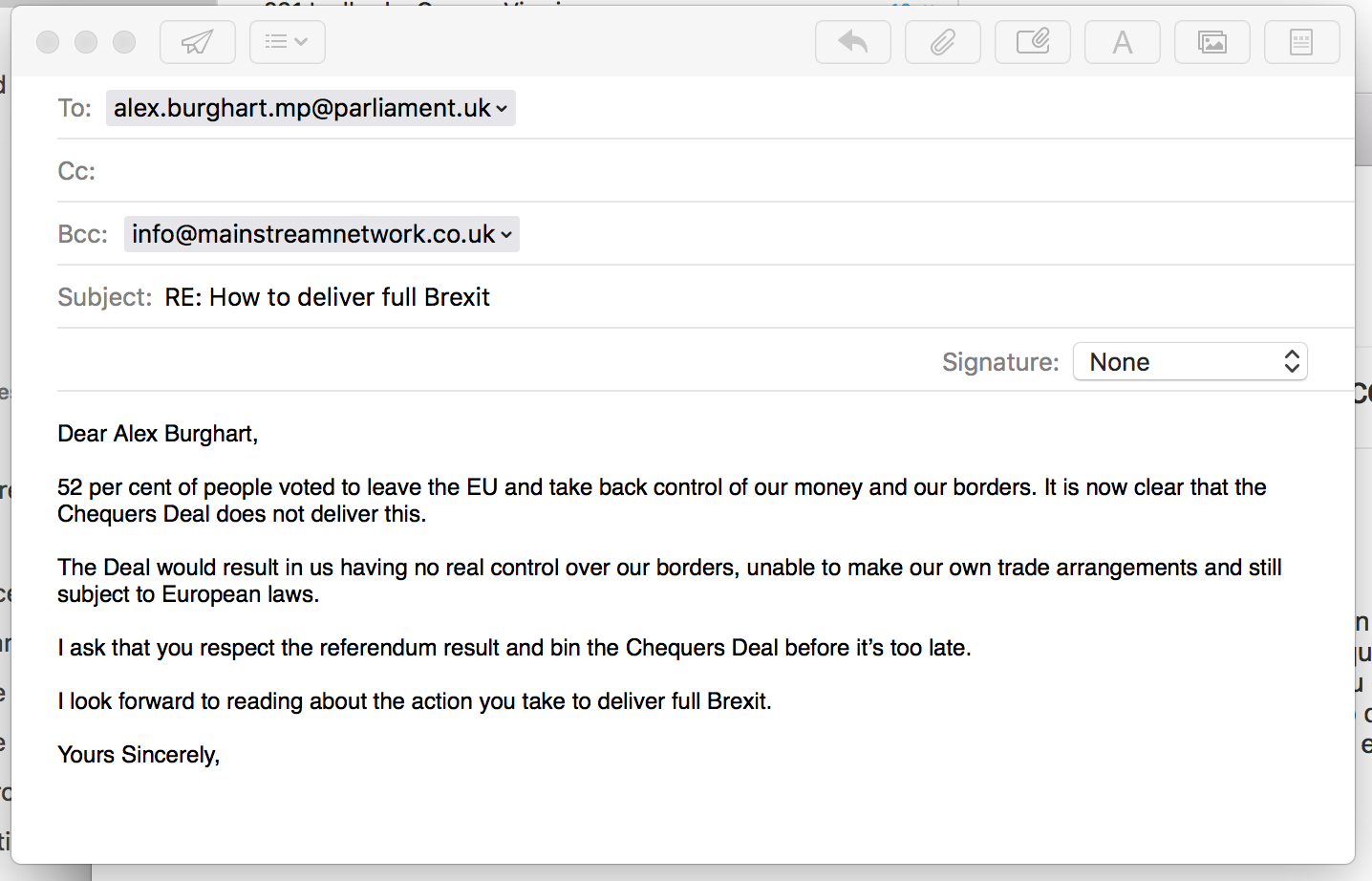
In evidence given to Parliament’s Digital, Culture, Media and Sport Select Committee today, 89up says the website was running dozens of adverts targeted at Facebook users in specific constituencies, suggesting users “Click to tell your local MP to bin Chequers,” along with an image from the constituency, and an email function to drive people to send their MP an anti-Chequers message. This email function carbon-copied an [email protected] email address. This would be a breach of the U.K.’s data protection rules, as the website is not listed as a data controller, says 89up.

The news comes a day after Facebook announced a new clampdown on political advertisement on its platform, and will put further pressure on the social media giant to look again at how it deals with the so-called “dark advertising” its Custom Audiences campaign tools are often accused of spreading.

89up claims Mainstream Network website could be in breach of new GDPR rules because, while collecting users’ data, it does not have a published privacy policy, or contain any contact information whatsoever on the site or the campaigns it runs on Facebook.

The agency says that once users are taken to the respective localized landing pages from ads, they are asked to email their MP. When a user does this, its default email client opens up an email and puts its own email in the BCC field (see below). It is possible, therefore, that the user’s email address is being stored and later used for marketing purposes by Mainstream Network.

TechCrunch has reached out to Mainstream Network for comment on Twitter and email. A WhoIs look-up revealed no information about the owner of the site.

TechCrunch’s own research into the domain reveals that the domain owner has made every possible attempt to remain anonymous. Even before GDPR came in, the domain owners had paid to hide its ownership on GoDaddy, where it is registered. The site is using standard GoDaddy shared hosting to blend in with 400+ websites using the same IP address.

Commenting, Damian Collins MP, the Chair of the Digital, Culture, Media and Sport Committee of the U.K. House of Commons, said: “We do not know who is funding the Mainstream Network, or who is behind its operations, but we can see that they are directing a large scale advertising campaign on Facebook designed to get people to lobby their MP to oppose the Prime Ministers’s Brexit strategy. I have been sent a series of emails from constituents as a result of these adverts, in a deliberate attempt to alter the outcome of the Brexit negotiations.”

“The issue for parliamentarians is we have no idea who is targeting whom via political advertising on Facebook, who is paying for it, and what the purpose of that communication is. Facebook claimed this week that it was working to make political advertising on their platform more transparent, but once again we see potentially hundreds of thousands of pounds being spent to influence the political process and no one knows who is behind this.”

Mike Harris, CEO of 89up said: “A day after Facebook announced it will no longer be taking ‘dark ads’, we see once again evidence of the huge problem the platform is yet to face up to. Facebook has known since the EU referendum that highly targeted political advertising was being placed on its platform by anonymous groups, yet has failed to do anything about it. We have found evidence of yet another anonymous pro-Brexit campaign placing potentially a quarter of a million pounds worth of advertising, without anyone knowing or being able to find out who they are.”

Josh Feldberg, 89up researcher, said: “We have no idea who is funding this campaign. Only Facebook do. For all we know this could be funded by thousands of pounds of foreign money. This case just goes to show that despite Facebook’s claims they’re fighting fake news, anonymous groups are still out there trying to manipulate MPs and public opinion using the platform. It is possible there has been unlawful data collection. Facebook must tell the public who is behind this group.”

There is no suggestion that anything Mainstream Network or its backers have done is illegal, other than a requirement to comply with GDPR rules. Political communications in the UK are mostly unregulated outside election periods, except for registered political parties. There is no requirement to disclose funding sources or to reveal who paid for or promoted an advertisement.

TechCrunch has reached out to both Facebook and Mainstream Network for comment prior to publication and will update this post if either respond to the allegations.

UPDATE: Rob Leathern, director of product management at Facebook, told the Guardian: “On 7 November, all advertisers will have new requirements before they can place political ads in the UK, including Mainstream Network. “These advertisers will need to confirm their identity and location through an authorisations process and accurately represent the organization or person paying for the ad in a disclaimer. These steps must happen or the advertiser will be prevented from running ads related to politics on Facebook.”

Watch BepiColombo’s twin spacecraft launch tonight on a mission to Mercury

Update: BepiColombo launch successful! We should have confirmation that all is well soon.

Humanity is about to return to the hottest planet in the solar system. BepiColombo is a mission to Mercury conducted jointly by the European and Japanese space agencies, due to launch from French Guiana at 6:45 PM Pacific time tonight aboard an Ariane 5 rocket. But while there’s just the one launch, there are two spacecraft.

The broadcast starts at 6:15; you can watch the launch at this link or the bottom of this post.

The last time we visited Mercury wasn’t actually that long ago. NASA’s Messenger mission arrived there in 2011 and spent four years orbiting the planet and collecting data before impacting the surface at nearly 9,000 MPH (don’t worry, they planned that).

BepiColombo is a follow-up to Messenger in a way, but it’s very much its own thing. To start with, there’s the fact that it’s two spacecraft, not one. They’ll launch together and travel to the planet attached to each other and the Mercury Transfer Module, after which point they’ll separate into ESA’s Mercury Planetary Orbiter and JAXA’s Mercury Magnetospheric Orbiter (called MIO).

Having two spacecraft opens up a lot of possibilities. One can emit a signal that bounces off the planet as it is picked up by the other, for instance. Or one can watch the shady side of the planet while the other monitors the sunny (and extremely hot) side.

Speaking of heat, Mercury is of course the closest planet to the sun, so these spacecraft are going to be exposed to some serious radiation. The MPO will use a sun shield to keep the worst of the heat off, using a big radiator for the rest, and the MIO will spin as it travels along, doing a complete revolution every 4 seconds so that no one side is exposed to the sun for too long. Both craft also have highly heat-resistant materials and electronics, many of which are flying for the first time.

MIO and MPO are equipped with a host of scientific instruments, and will be able to look more closely at features of phenomena identified by Messenger. The latter checked out the magnetosphere in the northern hemisphere of the planet, for instance, and BepiColombo will fill that in with readings from the southern one. Messenger also identified some interesting features around the poles, and MPO will have an orbit that takes it right over them — not to mention a better camera.

In order to achieve a stable orbit around Mercury the craft will have to perform a few loops and gravity assists, including two of Venus. The team is taking the opportunity to point their instruments at our neighboring planet; we haven’t visited there in a long time.

The mission isn’t expected to be a very long one — BepiColombo’s spacecraft will not only be exposed to serious radiation and temperature swings, but the proximity to the sun means they’ll constantly be fighting against its gravity, meaning fuel will run out fast.

Still, MIO and MPO are expected to stay in orbit for about one Earth year, which would be four Mercurial years. If they’re still in good shape and there’s still budget for it, the mission could be extended for another year — but by that point it seems likely that fuel reserves will be running low.

BepiColombo has been a long time in the making — it was approved 18 years ago! But it’s launching at last and when it arrives (in seven more years) we should expect to learn a lot more about this weird, boiling hot planet. You can watch the launch live here; broadcast should start at 6:15 Pacific time.

Convene uses landlord partnership model to outclass WeWork

Recent reports that SoftBank may take a majority stake in WeWork has added fuel to the already hot market for startups in the workspace and property tech sectors. One of the more compelling companies that stands to benefit from this trend is New York-based Convene. Started by co-founders Ryan Simonetti (CEO) and Chris Kelly (president), 500-person strong Convene has distinguished itself as a top-tier provider of meeting, event and flexible workspace offerings in its 21 locations.

But unlike freelance-heavy WeWork and other co-working companies that cater to 1-10 person companies, Convene puts owners of Class A office buildings at the center of its business model. The goal is to help these landlords provide tenants with the high-end of amenities of, say a unicorn tech startup.

On the back of the company’s recent $152 million Series D, Simonetti and Kelly were eager to discuss new initiatives, including a co-branded turnkey workplace and amenity solution and their plans to launch additional Convene locations, including London. They also elaborate on how they plan to benefit during the next recession and open up on their differences with category giant WeWork. Finally, they explain why paintings by renowned artists, including Picasso and Calder, are tucked into corners of the company’s first, soon-to-be-opened members club at Club 75, at RXR’s Rockefeller Center.

Gregg Schoenberg: Ryan and Chris. It’s great to see you both. To kick things off, I want to establish that Convene is not a typical startup in that you’ve been around for about nine years.

Ryan Simonetti: Yes, is that called being washed-up in the startup world?

GS: Not necessarily. Tell me about where the idea for Convene came from?

RS: Chris and I met during our freshman year orientation at Villanova University, ended-up pledging the same fraternity and spent a lot of time getting to know each other. From the beginning, we were probably two of the more entrepreneurial guys at Villanova. We sold used textbooks, spring break trips, parties into Philadelphia. If there was a way to monetize something in college, we were the two guys that were trying do it.

GS: Two scrappy guys from Villanova.

RS: Yes, we’ve always joked that we were probably the only kids at Villanova who didn’t have our parents’ credit cards.

GS: So years later, what was that catalyzing moment where you said, “Okay, here’s the idea for Convene”?

Chris Kelly: I remember two phone calls from Ryan that represent the earliest seeds of Convene. The first phone call was in the middle of the financial collapse, and in that phone call, Ryan said, “We’re about to witness the largest shift of wealth that the world has ever seen and we have to figure out how to be on the winning end of that.” Then a few weeks later, Ryan called me up and introduced the crazy idea for Convene.

GS: And what was that specific pitch?

RS: He walked me through the Grand Hyatt in Midtown Manhattan and said, “Look at the way these guys are doing business. This is a $60 million a year catering and meetings operation that was in essence being outsourced to hotels.”

“Just like Airbnb would tell you that their primary stakeholder is the homeowner, or OpenTable would tell you the primary stakeholder is a restaurateur, we view the building owner as our primary stakeholder.”

GS: And you’re saying hotels weren’t doing a great job?

CK: Hotels simply didn’t have the sensibility about what people really need in a business environment. They treated a shareholder meeting like a wedding with a projector. And we saw a huge opportunity to create spaces that met enterprise workplace requirements.

GS: So fast forward to today and tell me exactly what Convene is, because I think sometimes people struggle and just say, “Well you’re a WeWork competitor on the premium end.”

RS: We partner with Class A building owners to design places where people can meet, work and be inspired. It’s not any more complicated than that.

CK: To build on that, you could say that we’re essentially allowing landlords to offer Googleplex-style workplace experiences.

RS: That’s a big challenge for even large organizations. Look at Google, Facebook or JP Morgan. These companies can deliver an amazing experience at their corporate headquarters location. But in their smaller offices, it’s really tough to deliver a corporate HQ experience if you only have five, 10 or 15,000 square feet. You can’t build the kitchen infrastructure, or the gym, or all of those other things. So to Chris’s point, we’re democratizing access to that experience, and doing it with the landlord as the key partner.

GS: So the landlords are the core client?

RS: Just like Airbnb would tell you that their primary stakeholder is the homeowner, or OpenTable would tell you the primary stakeholder is a restaurateur, we view the building owner as our primary stakeholder. And what we’re helping them do is respond to the changing demands of today’s tenant, who want increased flexibility and better agility to adapt to change.

GS: I take it marrying technology infrastructure to the physical spaces is key to that, which is why you recently bought Beco. What exactly do they do?

RS: Beco is a workplace analytics platform that’s using sensor-based technology to help us, our landlord partners and our corporate clients better understand the way that people are actually interacting with space and services.

“But what really differentiates us strategically is that we’re not trying to build our own supply chain or our own inventories.”

GS: As you contemplated that acquisition, were you worried that it might be perceived to some of your traditional clients as Big Brothery?

RS: Look, everyone today is concerned about data privacy, and rightfully so. The way that the technology actually operates is that the actual users are anonymous to us.

GS: So is that data anonymous, or anonymous anonymous?

RS: Anonymous anonymous, meaning all we’re capturing is a random ID assigned to a phone, and that ties back to the sensor and data analytics platform.

GS: Do you have to opt in?

RS: It’s all opt in.

GS: Okay, I want to turn to the big gorilla in the broader flexible workspace category, because right or wrong, everyone, including Convene, gets compared to WeWork.

RS: Look, if we think about the macro trends that are shaping and changing not just the way that we work, but also the way that we live and travel, I would argue that WeWork and us have a similar view of the world and the future. But from a business model perspective, the quality of the product that we’ve built, the level of service that we deliver, the strategic nature of our partnerships with building owners, I don’t view us as directly competitive.

GS: I appreciate that WeWork ultimately caters to smaller-sized end-users than Convene, so in that way you’re different. But it’s also true that even though Red Bull and Coca Cola are different drinks, you’re not going to drink a Coke and a Red Bull at the same time.

RS: From an analogy perspective, there’s a difference between Planet Fitness and Equinox, right? Would you argue that they’re competitive? Maybe. But the way I think about office real estate is Class C, Class B, Class A. Convene is a Class A partner to landlords.

GS: Right, but WeWork, with all that current and possibly future cash from SoftBank, is moving upmarket.

RS: Sure, as they move more into enterprise and upmarket, of course, they’ll be competitive. But what really differentiates us strategically is that we’re not trying to build our own supply chain or our own inventories. We’re partnering with the existing supply chain to create a new category of supply that speaks to the collective demand from our customer demographic.

GS: As a service provider, I get that. But what happens when the next recession comes —

RS: — Yes, by the way, we’re excited for the next one.

GS: Because the knock on WeWork and other companies in the broader sector is that when the recession hits, the blood will hit the fan because of those short-term tenant leases.

RS: Well, right now, you see a lot of capital flowing into the sector and you have platforms that probably shouldn’t be here as well.

GS: Let’s take Brookfield. WeWork has a relationship with Brookfield. You guys have a relationship with Brookfield. But I think the difference is this: If bad things happen in the economy, they have to hope that WeWork is going to effectively manage those short-term lease obligations. From my outsider’s perspective, that looks to me like a counterparty relationship. But in Convene’s case, it looks more like an aligned partnership. After all, Brookfield, as well as Durst and RXR, are on your cap table.

RS: Every deal structure is aligned and even the leases we have are aligned. And when the recession hits, we will use it as an opportunity to deepen our landlord partnerships and take market share.

GS: With whose balance sheet?

RS: We’re using the landlord’s balance sheet to grow our business.

CK: And WeWork is using the SoftBank balance sheet to grow their business.

GS: Could you elaborate?

RS: WeWork did us the greatest favor in the world, because our strategy since day one has been to make the landlord a key partner and stakeholder. Do you want to know who has the cheapest cost of capital? Cheaper than SoftBank’s? It’s the landlord’s balance sheet. Their cost of equity capital is like six to eight percent.

GS: Really?

RS: Yes. If you think about the investor-anticipated yield in asset classes, real estate sits between a fixed income expectation and an equity capital markets expectation.

GS: Okay, but how does using the landlord’s balance sheet enhance your approach strategically?

CK: Because there are elements of the way we structure our deals that allow our performance to be variable. And by using the landlord’s balance sheet to grow our business, it aligns us and the landlord to be able to ride through a recession together.

“Do you want to know who has the cheapest cost of capital? Cheaper than SoftBank’s? It’s the landlord’s balance sheet.”

GS: Have many of the nation’s Class A landlords have bought into your model?

RS: If you look at our current partners that we’re actively working with, I think they globally control over 250 million square feet of Class A office space. So if 10 percent of that moves to flexible consumption, that means Convene could have an addressable market of 25 million square feet of inventory.

GS: So given the way you’re talking, would it be fair to say that your landlord partners have recognized that the flexible workspace trend is here for the long term?

CK: How we consume real estate is undergoing a fundamental shift. This is the same conversation that was happening in the transportation industry 15 years ago. It’s the same thing that was happening in the travel industry when Airbnb was starting. That same conversation is happening today within the existing supply chain. So, yes, it’s a buy, build, partner decision that is being made in every landlord’s office around the country today.

GS: It still sounds odd to hear the phrase, “consume real estate.” Maybe I’m old-school, but you guys are down to earth. Do you find that language odd?

CK: Actually, what we’re seeing is the consumerization of real estate. Real estate was historically very B2B, very financially driven. Today, it’s being driven by human experience, so yes, brands matter, the customer experience matters. And that consumerization of real estate actually is happening.

GS: I take it that’s why you launched this new managed workplace solution that features the services you bring, but enables a client to use its own name?

CK: What makes that platform unique is that it’s co-branded. It’s an endorsed brand model by Convene, which means that the Convene brand standards, the Convene operating model, the Convene staffing model and the Convene university training program comes with it.

GS: So Intel inside?

CK: Yes, which gives clients the best of both worlds. It gives them the brand and reach and expertise of Convene. At the same time, they can now have something that feels more authentic and unique to them as a landlord.

GS: I want to shift to the future of work, which is something you both have spoken about in pretty bold terms. We’re at this amazing Convene members’ club, which sort of feels like a SoHo House except we’re in midtown. And you’ve talked about how an experiential personal life will be closer to a work life. Where is all this going?

RS: From a trend perspective, we believe fundamentally in what we call work/life integration. It used to be that you go to work and at the end of the day that stops and then you move to the rest of your life. That’s not really the way it works anymore. And when we think about some of the services that we’ve launched over the last couple years, it’s been with that idea in mind.

GS: Are you creating future offerings in-house or partnering?

RS: Actually, we’re about to announce a partnership on the wellness side, where we’re taking some of the wellness elements and starting to incorporate them into the broader Convene ecosystem.

GS: Do either of you guys have children?

RS: Yes, we both do.

GS: Because if you want to talk about quality of life and the war for talent, it seems like a natural extension to see if your plan to help the workforce addresses the challenges of working while raising young kids. Are such extensions on your whiteboard?

RS: Yes, they’re definitely on the whiteboard and some of those things are already in process. The difference is partnership. When I think about the way that we’re building our platform and the way that WeWork is building theirs, I think about us as being an open-source platform, Do you think you need to do everything yourself because you’re the best in the world at everything, or do you want to work with best-in-class partners?

GS: So for something like childcare, you’d bring in a partner?

RS: If we decide, which I’m not saying we are, to get into childcare, we’re going to do that with a proven partner that has a track record of delivering that experience and doing it really well.

GS: How does Convene fare in a world where remote work becomes an even bigger trend?

CK: Actually, there’s a difference between remote work and mobility. Remote work is the traditional concept of working from home, and we’re actually seeing some backlash now of companies who are really trying to drive culture, and want more face-to-face interaction.

GS: Does that show up in the design of your spaces?

CK: Yes, the built environments of our offices are changing from looking like cubicle farms where everybody reports to their desk and their computer to operating a lot more like a digitally enabled campus. And the decoupling of people and their work from their desk is opening up an opportunity to build what’s called an activity-based workplace, where there are different types of spaces that are specialized and built for specific uses.

GS: You guys don’t even have offices, right?

CK: Right. None of us have offices.

RS: Also, people used to talk about remote work in magical terms. They’d say, I’m not going to need an office. We don’t believe that this is the case. We think that there are a few things that will continue to matter to organizations. One is brand, two is culture, three is collaboration. And until technology can somehow magically replicate that experience, we think that the best ideas will come from face-to-face interaction.

GS: I have two important last topics to cover. First-off, why on earth, nestled into a semi-remote corner of this club, do you have a Picasso painting hanging on the wall? Because in my experience, usually people like to show off the Picasso if they have one.

RS: Ha, well, the Picasso, as well as all of the other amazing art that you’ve seen at Club 75, is part of the partnership here with the landlord.

GS: Well, it speaks to the confidence they have in you.

RS: Yes, but it also speaks to the experience we’re creating. We think about space as the body language of an organization. Space has the ability to move people and we think that art is a big part of that.

CK: It also demonstrates the extent to which landlords are committed to delivering a great experience.

RS: Right. Having a coffee next to a Calder or a Picasso can put you in a totally different headspace.

“There’s no amount of money in the world that can buy you a partnership with Brookfield or a half a dozen landlords that we’ll be powering next year.”

GS: Well, I’m glad you didn’t use shareholder money to buy these works, which brings me to my last topic. At this point, are you concerned about profitability?

CK: Yes, we are and that’s another one of the differences between us and others. In fact, we’ve been cash flow positive since Day one. And as an organization, profitability has always been something that we think is very important.

GS: It’s because you don’t have enough VCs on your cap table. Speaking of which, you’re obviously aware of the fact that SoftBank and other megafunds may helicopter drop a lot more money into this space, which could change the competitive dynamics.

RS: First of all, the last time I checked, we were the second most capitalized platform in the category, by dollars raised. And if you look at our partnership-driven approach, where the landlord’s balance sheet is funding a lot of our growth, the actual capital that’s being invested in the platform is multiples of the $260 million we’ve raised.

But to your point, our concern isn’t so much about the capital that’s flooding in; there’s no amount of money in the world that can buy you a partnership with Brookfield or a half a dozen landlords that we’ll be powering next year. And money, whether it’s from SoftBank or anyone else, can’t give an organization its corporate culture. And I think one of the reasons we’ve been selected as the partner to some of the most discerning customers in the world is because of the fact that every day, we deliver consistently against a premium experience.

GS: Well, on that note, Chris and Ryan, I’d like to thank you for your kind hospitality.

RS: It’s been our pleasure and thank you.

Domio just raised $12 million in Series A funding to build ‘apart hotels’ across the US

Hotels can be pricey, and travelers are often forced to leave their rooms for basic things, like food that doesn’t come from the minibar. Yet Airbnb accommodations, which have become the go-to alternative for travelers, can be highly inconsistent.

Domio, a two-year-old, New York-based outfit, thinks there’s a third way: apartment hotels, or “apart hotels,” as the company is calling them.

The idea is to build a brand that travelers recognize as upscale yet affordable, more tech friendly than boutique hotels and features plenty of square footage, which it expects will appeal to both families as well as companies that send teams of employees to cities and want to do it more economically.

Domio has a host of competitors, if you’ll forgive the pun. Marriott International earlier this year introduced a branded home-sharing business called Tribute Portfolio Homes wherein it says it vets, outfits and maintains to hotel standards homes of its choosing. And Marriott is among a growing number of hotels to recognize that customers who stay in a hotel for a business trip or a family vacation might prefer a multi-bedroom apartment with hotel-like amenities.

Property management companies have been raising funding left and right for the same reason. Among them: Sonder, a four-year-old, San Francisco-based startup offering “spaces built for travel and life” that, according to Crunchbase, has raised $135 million from investors, much of it this year; TurnKey, a six-year-old, Austin, Tex.-based home rental management company that has raised $72 million from investors, including via a Series D round that closed back in March; and Vacasa, a nine-year-old, Portland, Ore.-based vacation rental management company that manages more than 10,000 properties and which just this week closed on $64 million in fresh financing that brings its total funding to $207.5 million.

That’s saying nothing of Airbnb itself, which has begun opening hotel-like branded apartment complexes that lease units to both long-term renters and short-term visitors in partnership with development partner Niido.

Whether Domio can stand out from competitors remains to be seen, but investors are happy to provide it the financing to try. The company is today announcing it has raised $12 million in Series A equity funding led by Tribeca Venture Partners, with participation from SoftBank Capital NY and Loric Ventures. The round comes on the heels of Domio announcing a $50 million joint venture last month with the private equity firm Upper 90 to exclusively fund the leasing and operations of as many as 25 apartment-style hotels for group travelers.

Indeed, Domio thinks one advantage it may have over other home-share companies is that rather than manage the far-flung properties of different owners, it can shave costs and improve the quality of its offerings by entering five- to 10-year leases with developers and then branding, furnishing and operating entire “apart hotel” properties. (It even has partners in China making its furniture.)

As CEO and former real estate banker Jay Roberts told us earlier this week, the plan is to open 25 of these buildings across the U.S. over the next couple of years. The units will average 1,500 square feet and feature two to three bedrooms, and, if all goes as planned, they’ll cost 10 to 25 percent below hotel prices, too.

And if the go-go property management market turns? Roberts insists that Domio can “slow down growth if necessary.” He also notes that “Airbnb was founded out of the recession, supported by people who were interested in saving money. We’re starting to see companies that want to be more cost-effective, too.”

Domio had earlier raised $5 million in equity and convertible debt from angel investors in the real estate industry; altogether it has now amassed funding of $67 million.

Lessons from building Brex into a billion-dollar startup

Henrique Dubugras
Contributor

Henrique Dubugras is the founder Brex, the billion-dollar corporate credit provider for startups.

When I think about my experience as an immigrant and entrepreneur in Silicon Valley, I remember growing up in Brazil and how we saw tech founders and CEOs as kings. We imagined what it would be like to assume the throne.

But these weren’t just any kings. Silicon Valley was the kingdom of nerds and underdogs. We identified with these guys, they were just like us. We were fed the myth of a Silicon Valley meritocracy, and the illusion that all you needed was ambition, determination, and a good idea to meet the right person and get funded.

What we didn’t understand was that this myth was not completely rooted in reality. Not everyone has access to the American Dream, and those who do have a track record of success before they’re given their moment to prove, or in our case, pitch ourselves.

Part of this disconnect was cultural. In Brazil, when I began my first startup, Pagar.me, a payment processing company, my co-founder Pedro Franceschi and I were two 16 year-old kids who learned how to code before we were ten. While it was hard for people to take us seriously initially—I mean, would you quit your job to work for two 16 year- olds? Being so young also worked to our advantage; it revealed that we were passionate, driven, and invested in tech at an age that we didn’t need to be.

Once we got our start-up off the ground, our employees were as invested in us as we were invested in them and the company. That’s because in Brazil, most of us grew up with parents that stayed their whole lives at the same company. You grew with the company, and that’s the approach we took when it came to hiring for our first company: who did we see sharing our same vision and growing with us?

Coming to the United States was almost a completely opposite experience. The barrier of entry was much higher. You have to go to the right college, graduate from right incubator programs, develop relationships with the right VCs, and have at least one successful startup under your belt before anyone would even consider booking a meeting with you.

Pedro and I had to carefully position ourselves before we even got to the Valley. When we finally did get to the U.S., we had already launched a successful startup and we were accepted to Stanford. Soon after, we were accepted by Y-Combinator, and that’s where we built relationships with the key players that would open up the doors for future meetings.

With our current startup, Brex,  we found that there weren’t just cultural differences at play, but different approaches we needed to take in order for our business to be successful. For example, in Brazil, we bootstrapped our first startup, and as a result, we had to find our product-market fit immediately. When you are so cash-constrained, it also limits how much you can build your company, and you think in terms of short-term wins instead of sustained growth. Your growth strategy is confined and you’re constantly reacting to your immediate client demands.

In the U.S., VCs and angel-investors aren’t interested in the short-term. They’re interested in long-term growth and how you are going to deliver 10x profits over a ten year period. Our strategy could no longer be: plan as we go and grow with our customer. Instead, we needed to deliver a roadmap, and when that roadmap changed or evolved, communicate those changes and adopt a culture of transparency.   

Additionally, we learned how difficult it is to find and retain  talent in the U.S.; it can feel like a Sisyphean task. Millennials for example, spend less than two years on average at a job, and if you spend six years or more at the same company, recruiters will actually ask you: “why?” So how can you build a company for the long-term in an environment where employees are not personally invested in the growth of your company?

We also learned that many successful tech startups offer stock options to their early employees, but as the company evolves and changes over time, those same stock options are not offered to future employees. This creates the exact opposite of a meritocracy. Why would a new employee work harder, longer, and bring more to the table if you are not going to be compensated for it?

Instead of using this broken model, we have invested in paying our team higher wages upfront, and based on performance, we award our team members with stock options. We want to be a company that people are proud of working at longterm, and we want to create a culture that is merit-based.

While some of the myths that we first believed in about Silicon Valley are now laughable looking back, they were also really instructional as to how we wanted to build our company and what pitfalls we wanted to avoid.

Even though nearly half of tech startups are founded by immigrant entrepreneurs, we have a cultural learning curve in order to have the opportunity to be “the next unicorn.” And maybe that’s the point, we’re experiencing a moment in time during which myths and unicorns no longer serve us, and what we need instead is the background, experience, and vision to create a company that is worth the hype.

E-moto startup Alta Motors reportedly powers down

Brisbane, California based e-motorcycle startup Alta Motors has ceased operations, TechCrunch has confirmed. 

Earlier today Asphalt and Rubber — and several subsequent outlets — reported the company stopped operating this morning, fired its staff, and may be looking for a buyer. Alta has yet to comment on the situation.

“As of this morning I no longer represent Alta Motors so I’m not in a position to speak on it,” a former Alta Motors spokesperson told TechCrunch on background when asked about the shutdown. “I forwarded your request for more info to the board, and they’ll have to comment,” said the former comms rep. Alta’s head office has not respond to requests for comment.

The EV company specializes in producing dual-sport and high performance electric powered off-road motorcycles. The startup had raised $45 million and counts Tesla co-founders Marc Tarpenning and Martin Eberhard among its investors.

Alta made news in March when it entered a co-development partnership with Harley Davidson. This aligned with Harley’s EV push, including the debut of a production e-moto by 2019, an expanded electric line-up to follow, and the opening of a Silicon Valley research facility.

Harley Davidson wouldn’t give a solid “no” to reports its partnership with Alta had concluded but their statement TechCrunch seems a pretty strong indication they’re business with the startup is in the past.

“Our collaborative efforts with Alta Motors were productive and we were pleased with the development work we partnered on,” Harley Davidson Communications Director Patricia Sweeney told TechCrunch.  

TechCrunch visited Alta’s facilities, tested its motorcycles, and interviewed co-founder Marc Fenigstein earlier this year. The startup has 70 dealerships nationwide  and our reporting flagged it is a potential acquisition target in a motorcycle industry that could be shifting electric.

On the competition level, Alta has been attempting compete with gas bikes by seeking entrance in American Motorcycle Association sanctioned motocross events. In September, the company became the first e-moto to earn a podium spot in AMA competition in another race class, endurocross.

With Harley Davidson’s EV commitment potentially pushing the motorcycle industry to voltage, Alta could be a discounted acquisition and R&D buy for Indian Motorcycle or  other major gas companies — Honda, Yamaha, BMW — who have been slow to develop production e-motos.

The space pen became the space pen 50 years ago

Everyone knows about the space pen. NASA spent millions on R&D to create the ultimate pen that would work in zero gravity and the result was this incredible machine. Well, no. In fact it was made by a pen manufacturer in 1966 — but it wasn’t until October of 1968 that it went into orbit and fulfilled its space pen destiny.

The pen was created by pen maker (naturally) Paul Fisher, who used $1 million of his own money to create the AG-7 anti-gravity pen. As you may or may not know, the innovation was a pressurized ink cartridge and gel ink that would deploy reliably regardless of orientation, temperature or indeed the presence of gravity.

He sent it to NASA, which was of course the only organization reliably worried about making things work in microgravity, and they loved it. In fact, the Russians started using it shortly afterwards, as well.

Walt Cunningham, Wally Schirra and Donn Eisele took the pens aboard with them for the Apollo 7 mission, which launched on October 11, 1968, and they served them well over the next 11 days in orbit.

A 50th anniversary edition of the pen is now available to people who have a lot of money and love gold stuff. It’s $500, a limited edition of 500, and made of “gold titanium nitride plated brass,” and it comes with a case and commemorative plaque with a quote from Cunningham:

“Fifty years ago, I flew with the first flown Space Pen on Apollo 7. I relied on it then, and it’s still the only pen I rely on here on Earth.”

Okay, that’s pretty cool. Presumably astronauts get a lifetime supply of these things, though.

Here’s to the Fisher space pen, an example of American ingenuity and simple, reliable good design that’s persisted in use and pop culture for half a century.