These are the best instant cameras you can buy this year
Category: Tech news
hacking,system security,protection against hackers,tech-news,gadgets,gaming
Google Is Putting More Privacy Controls Directly in Search
Amid concerns over how much data the company collects, Google will make it easier to understand exactly what it knows about you.
Wayb Pico: How Outdoor Gear Experts Built a Better Car Seat
Children’s car seats are heavy, bulky, and potentially toxic. Wayb wants to fix that.
This Company Wants to Make the Internet Load Faster
Netlify lets customers tap multiple cloud computing providers, and wants to connect cloud services to static webpages.
What It’s Like to Fly the WWII-Era Plane That Crashed on LA’s 101 Freeway
Wondering why someone was flying the decades-old T-6 Texan that crash landed in Agoura Hills? Simply put, it’s a blast.
Don’t Believe Everything You See About the Migrant Caravan
A migrant caravan traveling through Mexico is the latest news event to be weaponized online.
LeBron James Is More Than an All-Time Great—He’s a Mogul
The NBA star’s move to Los Angeles places his late-career basketball prospects squarely behind his cultural legacy.
Addison Lee and Oxbotica ink self-driving deal, will offer autonomous car services in London by 2021
After undertaking a year-long investigation with Ford and four other mobility specialists on how to build self-driving systems that integrate with London’s existing transport infrastructure, Addison Lee today is announcing the next step in its autonomous strategy.
The on-demand ride company — which competes with black cabs, Uber and other car services — announced a deal with self-driving startup Oxbotica to develop autonomous vehicles, with the aim of getting them in service in London by 2021.
No financial details are being revealed about the deal. Addison Lee CEO Andy Boland, in an interview, described it as “purely commercial.” Currently Addison Lee is “unfashionably profitable,” he added, and so it is working on its current self-driving efforts off its own balance sheet. It is also wholly owned by PE firm the Carlyle Group, so it’s likely that this will help with future funding, although Boland did not rule out that when the company gets closer to a commercial launch, that it might need to look for funding to do this.
Meanwhile, Oxbotica — a spin-out from Oxford University — has raised around $18 million to date, with backers including Oxford, Innovate UK, the Ministry of Defence, the IP Group, insurers Axa XL and others.
The deal potentially sets up an interesting new avenue in how we might see autonomous cars being built, rolled out and operated.
Today, a number of transportation-on-demand companies that have roots in the tech world (Uber, Didi and Yandex Taxi are three examples) are trying to build their own self-driving tech. Alongside them, there are also a plethora of car makers who are also intent on building and running that experience.
Now, Addison Lee and Oxbotica are essentially presenting a third option: a system not built by the car service-operator, and not by a car maker, but by a third-party tech company that overlays the tech on top of whatever vehicle the service provider chooses to have.
Oxbotica was the first company to get a green light to start any kind of self-driving car test on a UK road, when it tested its equipment on a modified Renault driving five miles per hour in the town of Milton Keynes in 2016.
That early start was one of the reasons why Addison Lee decided to go with Oxbotica for its own efforts.
“The way they have built their technology and how they are already provisioning it has been impressive,” said Boland. “They have the most tangible capability that we could go with, and we felt that the way they were thinking about it, the business model isn’t just for ride share or car share, it’s across a range of other industry applications, and we like that, too. It’s now getting serious, and real-life-scale operators like Addison Lee are looking to bring this to market.” That would include shuttle services but potentially other kinds of commercial transportation (note that Oxbotica counts a commercial insurer as a backer).
“This represents a huge leap towards bringing autonomous vehicles into mainstream use on the streets of London, and eventually in cities across the United Kingdom and beyond,” said Graeme Smith, CEO of Oxbotica, in a statement. “Our partnership with Addison Lee Group represents another milestone for the commercial deployment of our integrated autonomous vehicle and fleet management software systems in complex urban transport conditions. Together, we are taking a major step in delivering the future of mobility.”
The two will start first with a comprehensive 3D mapping sweep before moving on to other aspects of building the service to prepare a autonomous vehicle service for trials.
For now Addison Lee has not named a vehicle partner, and Boland said that this was intentional.
The initial mapping exercise will be on the company’s existing fleet of vehicles working on autonomous research around London today – those will be the Fords from last year’s deal, he said. “But in terms of future service provision in 2021, that decision is yet to be made. Oxbotica is agnostic to manufacturers, and that was also interesting to us at the moment.”
Although Addison Lee competes with the likes of Uber — which had to appeal for a provisional 15-month right to operate in London after initially losing its license — it is different in that it owns its own fleet of vehicles. That has given the company more of an incentive to try to develop its own technology that it might use across whatever vehicles it chooses to use in its fleet. It’s not clear how this will work alongside the fact that many car makers are also working on their own autonomous technology and subsequent strategy to “own” the self-driving experience — at some point they might even directly conflict — but for now following this route could be Addison Lee’s strongest bet for continuing to keep a close service for its drivers and its fleet, developing it in the way it feels is best for its own business.
“It’s about having a bit more control between us,” Boland said of the deal with Oxbotica, ” and creating and building those services together without the dependencies without the changing priorities of an OEM. So that we can do what we need to do.”
The self-driving car market is expected to be worth some £28 billion in the UK alone by 2035, and car services — versus private ownership — are shaping up to be a large part of how it might play out. Startups like FiveAI are also focusing on building self-driving car systems, specifically so that they can run in their own fleets of vehicles and in a service run by FiveAI: its reasoning is that autonomous vehicles will be too cost prohibitive to own for the majority of people.
As car ownership is predicted to decline as cars become ever-more sophisticated and expensive, car services are already on the rise and are predicted to grow some 21 per cent by 2030.
Egypt and Thailand: When the military turns against free speech
Wael Abbas, a human rights activist focused on police brutality in Egypt has been under arrest since May on charges of spreading fake news and “misusing social media.” Andy Hall, a labor rights researcher, has been fighting charges under Thailand’s computer crime laws because of a report published online that identified abuses of migrant workers.
You wouldn’t normally mention Egypt and Thailand in the same breath. But both countries underwent military coups within the last five years, and even among the many oppressive regimes in the world, they are going to extra lengths today to prosecute free speech.
Abbas and Hall are just two examples of hundreds of recent prosecutions. In 2017 alone, Egyptian security forces arrested at least 240 people based on online posts. Three years after the coup, Thai authorities had charged more than 105 people just for posting comments deemed offensive to the monarchy.
To be clear, neither country has ever been a bastion of free speech. Thailand has been ranked “not free” seven out of the eight years that political-rights nonprofit Freedom House has published its Freedom on the Net Report. Egypt’s score has steadily declined since the height of the Arab Spring, going from “partly free” to “not free” in the last three years.
Sanja Kelly has been with Freedom House for 14 years and has headed its Internet Freedom division since 2010. She tells me that what’s especially alarming is the extent to which authorities in both Egypt and Thailand have gone to silence online dissent. Activists and dissidents may well anticipate persecution around the world, but today housewives, students and even tourists in Egypt and Thailand have become the target of prosecutions for as little as posting a video or responding to a private message on social media.
Over the last five years both Egypt and Thailand have experienced an unprecedented crackdown on internet freedom. “In 2015, the Egyptian government blocked only two websites. Today, they are blocking over 500,” Kelly explained. “The situation in Egypt and Thailand is now among the most repressive in the world.”
Egypt
Since El-Sisi seized power in 2013 in a coup, the Egyptian government has taken drastic steps to clamp down online. In its latest move, the government enacted a law in September that makes any social media user with more than 5,000 followers subject to regulation as a publisher. So now in Egypt, if you have more than 5,000 Twitter followers, for example, you’re subject to the same regulations that the New York Times has on what it publishes.
It wasn’t always like this. Back in 2011, Facebook and Twitter were hailed as drivers behind the Arab Spring. The protests that resulted led to the toppling of Hosni Mubarak who had ruled the country for nearly 30 years. At their height, many journalists even started calling the protests the “Twitter uprising” and the “Facebook revolution.”
Kelly tells me that freedom on the internet in Egypt has been getting progressively worse since Sisi seized power. Even under Mubarak, the authorities were not as concerned with policing speech on the internet. But that has completely changed since 2013.
Kelly adds that the measures Egyptian authorities passed this year were intended to tighten their grip on social media and internet use even further. The result has been more and more Egyptians being arrested, with the authorities using a combination of laws to bring charges.
Thailand
Thailand has long been known for its strict application of its lèse majesté laws under which any criticism of the Thai king or his family can lead to years in jail. But since the 2014 military coup, the enforcement of these laws has gone into overdrive. The ruling military junta in Thailand has also beefed up computer crimes and defamation laws to make it all but impossible to express dissent online.
According to Human Rights Watch, since the coup in 2014, the junta has ramped up arrests under the 2007 Computer-Related Crime Act (CCA). Last year, the military amplified the 2007 law by providing grounds for the government to prosecute anything they designate as “false,” “partially false,” or “distorted” information, a determination that the government itself gets to make.
Even criticism of the changes to the law itself were outlawed, with the Thai Army Cyber Center warning that posting or sharing online commentary that criticizes the law could be considered false information and result in prosecution.
Kelly tells me that, while the CCA and lèse majesté laws have long been used to stifle online dissent, the amendments last year granted Thai authorities even broader powers. They closed down loopholes in earlier versions of the law, including allowing authorities to jail people for critical messages they receive on their phone even if they don’t share them. This means that if you get a Facebook message in Thailand today criticizing the royal family, then you are under an obligation to delete the message or face prosecution.
Andy Hall found himself in the middle of this progression towards heavier handed enforcement. A labor rights activist, Hall conducted research for a report for the group Finnwatch that found that the Natural Fruit Company, Thailand’s largest producer of pineapples, mistreated its workers. Hall then faced criminal prosecution under the CCA and cyber defamation laws for the report’s publication online and for an interview he later gave to Al-Jazeera about the report.
Speaking to me from an undisclosed location, Hall tells me he has spent more than $100,000 defending the criminal charges against him — mainly fundraised from supporters — and the better part of the last five years dealing with the charges and his appeals. He admits things could have been much worse: “If I weren’t a British citizen and my case hadn’t gotten as much attention as it has, then I’m not sure I’d be around today to tell my story. Many Thai citizens have lost their lives doing similar work.”
Hall didn’t set out to be a freedom of speech crusader, he had dropped out of his PhD program in 2005 to move to Southeast Asia to become a labor rights investigator, only to find himself in the crosshairs of the country’s defamation laws in 2013. When he was first charged, the government asked him to make a public apology denouncing his research. When he refused, the prosecution continued with his passport being confiscated at one point to prevent him from leaving the country.
Now having taken refuge in a third country, Hall tells me that the actions of the government — especially its increased enforcement of cyber defamation laws over the last year — has bred fear among activists and has had a chilling effect on the work of human rights advocates in Thailand.
It’s Not Just Activists
According to Kelly, one especially worrying trend about Thailand and Egypt’s increased prosecutions is that authorities have been increasingly willing to go after anyone they deem critical online, not just seasoned activists. Housewives, students and even tourists.
Just in September, a Lebanese tourist was arrested on her way out of Egypt for posting a ten-minute video on Facebook that had gone viral. In the video, she’d complained of sexual harassment she’d experienced while in the country. She was found guilty of deliberately spreading fake news and public indecency for just speaking out about what had been done to her. She now faces an eight year-sentence.
Over in Thailand, a housewife faced up to 15 years in prison for violating lèse-majesté laws because she had responded to a Facebook message critical of the government with one word, “ja” (roughly “yeah” in Thai). While a law student was sentenced to 2.5 years last year under the same laws for sharing a BBC article profiling the new Thai king.
Role of Facebook and Twitter
What role have social media platforms played in all of this? To their credit, companies like Facebook and Twitter have not been silent bystanders who’ve simply applied these draconian laws blindly. To begin with, they enforce global standards for what can and can’t be posted on their platforms, and they don’t modify these standards based on any one country’s repressive defamation laws.
Both Facebook and Twitter also publish periodic transparency reports that aggregate the number of requests they get from governments to take down posts or obtain information on users.
A review of the transparency reports for each of Egypt and Thailand though shows that the number of requests are remarkably low given their respective populations and the wide use of Facebook in each of these countries. Facebook says that in 2017 it only received seven requests from Thai authorities and just one from the Egyptians. In response, Facebook provided 17% of data requested by Thais and did not provide any data to the Egyptian government (compared to 32,000 requests by the US government with an 85% production rate by Facebook over the same period).
So how can the number of prosecutions based on social media posts be reconciled with the low number of requests? Kelly tells me it’s likely because Thai and Egyptian authorities have found ways to circumvent platforms altogether knowing that their requests will not be complied with.
What Freedom House has documented instead is arms of the government dedicated to monitoring what’s posted on social media. In the case of Twitter, Thai and Egyptian governments filter for certain words and then use the publicly available tweets as a basis for prosecution. With private Facebook posts, governments go one step further. They create fake profiles with pictures of attractive men and women, send a friend request to their target and get access to a profile when their friend request is accepted. They then use whatever private posts they find to prosecute.
In one case in Egypt, Kelly tells me the government scanned pictures on Facebook from a concert at which the rainbow flag was displayed. Egyptian authorities then went after the people it could identify from these pictures on the basis of violating morality laws. Using online platforms to entrap members of the LGBTQ community has become a favorite tool of repression by Egyptian authorities. According to the Electronic Frontier Foundation, at least 77 members of the LGBTQ community have been arrested since the coup for their online expression.
Are Egypt and Thailand the Worst Offenders?
Even though Egypt and Thailand have rung alarm bells this year with the sheer number of prosecutions of online speech, they are still not the worst offenders against speech online. Kelly names Saudi Arabia, China, the UAE, North Korea, and Iran as just some examples of worse offenders. The difference, Kelly explains, is that the regimes in those countries have become extremely adept at fighting online dissent.
The fact that there may have been more prosecutions in Egypt and Thailand this year doesn’t tell the whole story. People in the other countries that Kelly names have just given up on the ability to express dissent online. China’s clampdown doesn’t even need to get to the user level – instead they have companies like Baidu and WeChat control and filter messages at the provider level before they’re even published. Egypt and Thailand are operating at a lower level of sophistication and have a strong and active civil society – which means people there still see a bigger opening and haven’t become completely self-censoring.
The question then becomes, how long will it be before Thailand and Egypt turn into the next China or Saudi Arabia? Will dictatorships be converging in their practices to stifle online speech? Social media may have turned the world into a global village, but it seems that village is also enabling dictators on opposite ends of the globe to better learn from each other’s repressive measures.
Super Mario Party is Nintendo Switch’s best game
When I bought the Nintendo Switch a few months ago, my friends told me to buy Super Mario Odyssey, The Legend of Zelda: Breath of the Wild and Mario Kart 8 Deluxe. That’s precisely what I did, but none of those games were enough to get me hooked, which is probably for the best.
But then came Super Mario Party, which Nintendo released earlier this month for the Switch. I grew up gaming, but somehow never played Super Mario Party. Well, it seems as if I’ve been missing out my whole life.
Super Mario Party for Nintendo Switch is a quick, pick-up-and-play kind of game. You set the difficulty level, tell the game how much you want to party (ten, fifteen or twenty turns) and that’s how long you’ll party. But be careful playing with your friends or significant others — because it’s bound to stir up people’s competitive nature.
For those who are unfamiliar with Super Mario Party, it’s a digital board game. The name of the game (well, not literally) is to collect the most stars.

This is my character, Bowser Jr., collecting a star like a boss
To collect these stars, you roll one of two dice — a standard one or one that’s unique to your character. Some characters have dice that roll up to ten (like Donkey Kong and Bowser), but that also comes with the risk of not moving at all or losing coins, which you need to buy stars.
After each round, you play a mini-game, where you’re able to earn some more coins. Depending on the game, you’ll need to put your memory, hand-eye coordination or even sense of touch to work. Thankfully, there’s an opportunity to practice before each mini-game.

Throughout the game, there are opportunities to steal coins and stars from people. During my last party, Luigi stole a star from Yoshi (played by my girlfriend) and it wasn’t pretty. Let’s just say profanities were exclaimed.
There are more than 80 minigames available to play — some of which make great use of the Joy Con, the name for the Switch’s detachable controllers.
The party mode has four game boards. My favorite board (that is, the board on which I tend to perform the best, is Megafruit Paradise. Down the road, maybe through a software update of sorts, it’d be great to have more boards to choose from.

Super Mario Party also features a couple of other modes — river survival, where you control a boat with the Joy-Con paddles, a Sound Stage that reminds me of Dance Dance Revolution and mini-game mode, where you just play mini-games.
 But in my experience, its the most fun to play the standard party mode. I’ve heard the best way to play the game is with four humans, but I’ve only ever played it with my girlfriend. We’re already both pretty intense about it so I could only imagine what it’d be like to play with two other people. Consider this my open invitation to holler at me to get a party started.
Apple Watch Series 4 is the most accessible watch yet
Steven Aquino
Contributor
Contributor
Steven Aquino is a freelance tech writer and iOS accessibility expert.
More posts by this contributor
Every time I ponder the impact Apple Watch has had on my life, my mind always goes to Matthew Panzarino’s piece published prior to the device’s launch in 2015. In it, Panzarino writes about how using Apple Watch saves time; as a “satellite” to your iPhone, the Watch can discreetly deliver messages without you having to disengage from moments to attend to your phone.
In the three years I’ve worn an Apple Watch, I’ve found this to be true. Like anyone nowadays, my iPhone is the foremost computing device in my life, but the addition of the Watch has somewhat deadened the reflex to check my phone so often. What’s more, the advent of Apple Watch turned me into a regular watch-wearer again, period, be it analog or digital. I went without one for several years, instead relying on my cell phone to tell me the time.
To piggyback on Panzarino’s thesis that Apple Watch saves you time, from my perspective as a disabled person, Apple’s smartwatch makes receiving notifications and the like a more accessible experience. As someone with multiple disabilities, Apple Watch not only promotes pro-social behavior, the device’s glanceable nature alleviates the friction of pulling my phone out of my pocket a thousand times an hour. For people with certain physical motor delays, the seemingly unremarkable act of even getting your phone can be quite an adventure. Apple Watch on my wrist eliminates that work, because all my iMessages and VIP emails are right there.
The fourth-generation Apple Watch, “Series 4” in Apple’s parlance, is the best, most accessible Apple Watch to date. The original value proposition for accessibility, to save on physical wear and tear, remains. Yet Series 4’s headlining features — the larger display, haptic-enabled Digital Crown and fall detection — all have enormous ramifications for accessibility. In my testing of a Series 4 model, a review unit provided to me by Apple, I have found it to be delightful to wear and use. This new version has made staying connected more efficient and accessible than ever before.
Big screen, small space
If there were but one banner feature of this year’s Apple Watch, it would indisputably be the bigger screen. I’ve been testing Series 4 for a few weeks and what I tweeted early on holds true: for accessibility, the Series 4’s larger display is today what Retina meant to iPhone 4 eight years ago. Which is to say, it is a highly significant development for the product; a milestone. If you are visually impaired, this should be as exciting as having a 6.5-inch iPhone. Again, the adage that bigger is better is entirely apropos — especially on such a small device as Apple Watch.
What makes Series 4’s larger screen so compelling in practice is just how expansive it is. As with the iPhone XS Max, the watch’s large display makes seeing content easier. As I wrote last month, once I saw the bigger model in the hands-on area following Apple’s presentation, my heart knew it was the size I wanted. The difference between my 42mm Series 3 and my 44mm Series 4 is stark. I’ve never complained about my previous watches being small, screen-wise, but after using the 44mm version for an extended time, the former feels downright minuscule by comparison. It’s funny how quickly and drastically one’s perception can change.
Series 4’s bigger display affects more than just text. Its bigger canvas allows for bigger icons and touch targets for user interface controls. The keypad for entering your passcode and the buttons for replying to iMessages are two standout examples. watchOS 5 has been updated in such a way that buttons have even more definition. They’re more pill-shaped to accommodate the curves of the new display; the Cancel/Pause buttons in the Timer app shows this off well. It aids in tapping, but it also gives them a visual boost that makes it easy to identify them as actionable buttons.
This is one area where watchOS excels over iOS, since Apple Watch’s relatively small display necessitates a more explicit design language. In other words, where iOS leans heavily on buttons that resemble ordinary text, watchOS sits at the polar end of the spectrum. A good rule of thumb for accessible design is that it’s generally better designers aim for concreteness with iconography and the like, rather than be cutesy and abstract because it’s en vogue and “looks cool” (the idea being a visually impaired person can more easily distinguish something that looks like a button as opposed to something that is technically a button but which looks like text).
Apple has course-corrected a lot in the five years since the iOS 7 overhaul; I hope further refinement is something that is addressed with the iOS 13 refresh that Axios’s Ina Fried first reported earlier this year was pushed back until 2019.
Of Series 4’s improvements, the bigger screen is by far my favorite. Apple Watch still isn’t a device you don’t want to interact with more than a minute, but the bigger display allows for another few milliseconds of comfort. As someone with low vision, that little bit of extra time is nice because I can take in more important information; the bigger screen mitigates my concerns over excessive eye strain and fatigue.
The Infograph and Infograph Modular faces
As I wrote in the previous section, the Series 4’s larger display allowed Apple to redesign watchOS such that it would look right given the bigger space. Another way Apple has taken advantage of Series 4’s big screens is the company has created two all-new watch faces that are exclusive to the new hardware: Infograph and Infograph Modular. (There are other cool ones — Breathe, Fire & Water, Liquid Metal and Vapor — that are all available on older Apple Watches that run watchOS 5.)
It’s not hard to understand why Apple chose to showcase Infograph in their marketing images for Series 4; it (and Infograph Modular) look fantastic with all the bright colors and bold San Francisco font. From an accessibility standpoint, however, my experience has been Infograph Modular is far more visually accessible than Infograph. While I appreciate the latter’s beauty (and bevy of complications), the functional downsides boil down to two things: contrast and telling time.
Contrast-wise, it’s disappointing you can’t change the dial to be another color but white and black. White is better here, but it is difficult to read the minute and second markers because they’re in a fainter grayish-black hue. If you choose the black dial, contrast is worse because it blends into the black background of the watch’s OLED display. You can change the color of the minute and second markers, but unless they’re neon yellow or green, readability is compromised.
Which brings us to the major problem with Infograph: it’s really difficult to tell time. This ties into the contrast issue — there are no numerals, and the hands are low contrast, so you have to have memorized the clock in order to see what time it is. Marco Arment articulates the problem well, and I can attest the issue is only made worse if you are visually impaired as I am. It’s a shame because Infograph is pretty and useful overall, but you have to be able to tell time. It makes absolutely no sense to add a digital time complication to what’s effectively an analog watch face. Perhaps Apple will add more customization options for Infograph in the future.
Infograph Modular, which I personally prefer, is not nearly as aesthetically pleasing as Infograph, but it’s far better functionally. Because it’s a digital face, the time is right there for you, and the colorful complications set against the black background is a triumph of high contrast. It is much easier on my eyes, and the face I recommend to anyone interested in trying out Series 4’s new watch faces.
Lastly, a note about the information density of these new faces. Especially on Infograph, it’s plausible that all the complications, in all their color, present an issue for some visually impaired people. This is because there’s a lot of “clutter” on screen and it may be difficult for some to pinpoint, say, the current temperature. Similarly, all the color may look like one washed-out rainbow to some who may have trouble distinguishing colors. It’d be nice if Apple added an option for monochromatic complications with the new faces.
In my usage, neither have been issues for me. I quite like how the colors boost contrast, particularly on Infograph Modular.
Haptics come to the crown
Given Apple’s push in recent years to integrate its so-called Taptic Engine technology — first introduced with the original Watch — across its product lines, it makes perfect sense that the Digital Crown gets it now. Haptics makes it better.
Before Apple Watch launched three years ago, I wrote a story in which I explained why haptic feedback (or “Force Touch,” as Apple coined it then) matters for accessibility. What I wrote then is just as relevant now: the addition of haptic feedback enhances the user experience, particularly for people with disabilities. The key factor is sensory input — as a user, you’re no longer simply watching a list go by. In my usage, the fact that I feel a “tick” as I’m scrolling through a list on the Watch in addition to seeing it move makes it more accessible.
The bi-modal sensory experience is helpful insofar as the secondary cue (the ticks) is another marker that I’m manipulating the device and something is happening. If I only rely on my poor eyesight, there’s a chance I could miss certain movements or animations, so the haptic feedback acts as a “backup,” so to speak. Likewise, I prefer my iPhone to ring and vibrate whenever a call comes in because I suffer from congenital hearing loss (due to my parents being deaf) and could conceivably miss important calls from loved ones or whomever. Thus, that my phone also vibrates while it’s ringing is another signal that someone is trying to reach me and I probably should answer.
Tim Cook made a point during the original Watch’s unveiling to liken the Digital Crown as equally innovative and revolutionary as what the mouse was to the Mac in 1984 and what multi-touch was to the iPhone in 2007. I won’t argue his assertion here, but I will say the Series 4’s crown is the best version of the “dial,” as Cook described it, to date. It’s because of the haptic feedback. It gives the crown even more precision and tactility, making it more of a compelling navigational tool.
Considering fall detection
As I watched from the audience as Apple COO Jeff Williams announced Series 4’s new fall detection feature, I immediately knew it was going to be a big deal. It’s something you hope to never use, as Williams said on stage, but the fact it exists at all is telling for a few reasons — the most important to me being accessibility.
I’ve long maintained accessibility, conceptually, isn’t limited to people with medically recognized disabilities. Accessibility can mean lots of different things, from mundane things like where you put the paper towel dispenser on the kitchen counter to more critical ones like building disabled parking spaces and wheelchair ramps for the general public. Accessibility also is applicable to the elderly who, in the case of fall detection, could benefit immensely from such a feature.
Instead of relying on a dedicated lifeline device, someone who’s even remotely interested in Apple Watch, and who’s also a fall risk, could look at Series 4 and decide the fall detection feature alone is worth the money. That’s exactly what happened to my girlfriend’s mother. She is an epileptic and is a high-risk individual for catastrophic falls. After seeing Ellen DeGeneres talk up the device on a recent episode of her show, she was gung-ho about Series 4 solely for fall detection. She’d considered a lifeline button prior, but after hearing how fall detection works, decided Apple Watch would be the better choice. As of this writing, she’s had her Apple Watch for a week, and can confirm the new software works as advertised.
Personally, my cerebral palsy makes it such that I can be unsteady on my feet at times and could potentially fall. Fortunately, I haven’t needed to test fall detection myself, but I trust the reports from my girlfriend’s mom and The Wall Street Journal’s Joanna Stern, who got a professional stunt woman’s approval.
Problematic packaging
Apple Watch Series 4 is pretty great all around, but there is a problem. One that has nothing to do with the product itself. How Apple has chosen to package Apple Watch Series 4 is bad.
Series 4’s unboxing experience is a regression from all previous models, in my opinion. The issue is Apple’s decision to pack everything “piecemeal” — the Watch case itself comes in an (admittedly cute) pouch that’s reminiscent of iPod Socks, while the band is in its own box. Not to mention the AC adapter and charging puck are located in their own compartment. I understand the operational logistics of changing the packaging this way, but for accessibility, it’s hardly efficient. In many ways, it’s chaotic. There are two reasons for this.
First, the discrete approach adds a lot in terms of cognitive load. While certainly not a dealbreaker for me, unboxing my review unit was jarring at first. Everything felt disjointed until I considered the logic behind doing it this way. But while I can manage to put everything together as if it were a jigsaw puzzle, many people with certain cognitive delays could have real trouble. They would first need to determine where everything is in the box before then determining how to put it all together; this can be frustrating for many. Conversely, the advantage of the “all-in-one” approach of Series past (where the case and band was one entity) meant there was far less mental processing needed to unbox the product. Aside from figuring out how the band works, the old setup was essentially a “grab and go” solution.
Second, the Series 4 packaging is more fiddly than before, quite literally. Instead of the Watch already being put together, now you have to fasten the band to the Watch in order to wear it. I acknowledge the built-in lesson for fastening and removing bands, but it can be inaccessible too. If you have visual and/or fine-motor impairments, you could spend several minutes trying to get your watch together so you can pair it with your iPhone. That time can be taxing, physically and emotionally, which in turn worsens the overall experience. Again, Apple’s previous packaging design alleviated much of this potential stress — whereas Series 4 exacerbates it.
I’ve long admired Apple’s product packaging for its elegance and simplicity, which is why the alarm bells went off as I’ve unboxed a few Series 4 models now. As I said, this year’s design definitely feels regressive, and I hope Apple reconsiders their old ways come Series 5. In fact, they could stand to take notes from Microsoft, which has gone to great lengths to ensure their packaging is as accessible as possible.
The bottom line
Three years in, I can confidently say I could live without my Apple Watch. But I also can confidently say I wouldn’t want to. Apple Watch has made my life better, and that’s not taking into account how it has raised my awareness for my overall health.
My gripes about the packaging and Infograph face aside, Series 4 is an exceptional update. The larger display is worth the price of admission, even from my year-old Series 3. The haptic Digital Crown and fall detection is the proverbial icing on the cake. I believe the arrival of Series 4 is a seminal moment for the product, and it’s the best, most accessible Apple Watch Apple has made yet.
Blood money
Some years ago an investor I met at a TechCrunch event invited me out for a coffee. This happens a lot; as a weekly columnist here I am deemed an official Media Influencer, and people in turn want to influence me, until they realize I’m just going to ignore them and write about whatever weird idea comes into my head instead. I accepted this invitation, though, because this guy’s job was unusually interesting, in a bad way — he represented a venture fund affiliated with the Kremlin.
This was before Russia was the democracy-manipulating enemy it is today, but just after Russia passed its “anti-gay law,” so angry anti-Russian sentiment was exceptionally strong. It was fascinating to me watching this man squirm around the topic: I’m a Bay Area guy, he told me, I’m pro gay rights, pro gay marriage, but we have to accept that every country becomes enlightened at its own speed and its own way, and the best way for us to encourage that, to promote our values, is to engage with them, to show them the right way of doing things.
Needless to say this is a column about Saudi Arabia.
It’s kind of amazing that it’s taken the murder of Jamal Khashoggi to wake people up to that nation’s brutality. For three years now Saudi Arabia has been slaughtering thousands of Yemenis in a needless conflict wherein, to quote Bloomberg quoting the UN, “especially a Saudi Arabian-led coalition and the Yemeni government it backs, have shown a disregard for civilian life possibly amounting to war crimes.” It has long been a totalitarian absolute monarchy allied with what was once a radical interpretation of Islam, Wahhabism, which T.E. Lawrence described a hundred years ago as an obscure “fanatical heresy” — and which has since been mainstreamed with disastrous global consequences as a result of this alliance.
And, of course, it has long been an intimate international ally and partner of the United States. America’s financial / military / consulting / industrial / oil complexes have been in bed with the Saudis for a very, very long time, as have its politicians. Let’s not pretend that Saudi money in the tech industry is in any way exceptionally bad or different. Bad, yes, but as bad as, well, the rest of American society. For a long time the US attitude towards Saudi Arabia seems to have been: “sure, they’re an oppressive dictatorship, but they’re our oppressive dictatorship, and their royal family is very nice and very generous and they control so much oil.”
The KSA is an oppressive heredity dictatorship that has been supported by the American finance, oil and defense industries and a bipartisan coalition of politicians and beltway lobbyists since 1931.
Clearly, Silicon Valley is at fault! Man, is there anything tech can't do? https://t.co/VSF6tvnQms
— Alex Stamos (@alexstamos) October 14, 2018
Now, though, at long last, that attitude seems to be changing. Not that the US is going to stop buying oil from them. Not that the US is going to stop selling weapons to them. But, despite occasional hesitant steps into the twentieth (but definitely not the twenty-first) century, nobody is going to pretend Saudi Arabia is anything other than a brutally oppressive state from here on in. (Shout-out to my homeland for being ahead of the curve on this one.) Which is progress, I guess, of a sort?
"A single journalist is a tragedy; ten thousand Yemenis is a statistic".
Joseph Stalin, 1949— Nassim Nicholas Taleb (@nntaleb) October 18, 2018
You can make a realpolitik case for continuing to engage with Saudi Arabia. Just like my coffee companion five years ago did for continuing to engage with Russia. See how well that turned out, how since then Russia has become so much more enlightened, so progressive, such a glorious contributor to the commonwealth of nations? …Oh. Saudi Arabia is different, yes, but in a worse way; it’s so sensitive to criticism, overreacts so wildly and violently, because it is fundamentally a fragile state. Nassim Taleb, who predicted the collapse of Syria and its civil war before it happened, has predicted a similar fate for Saudi Arabia.
I don’t think the Trump administration is going to continue its support for Saudi Arabia’s new and erratic leadership for fear of the human or economic consequences if they do otherwise. “Trump’s razor:” the stupidest reason is most likely to be correct. Here, that means the administration doesn’t want to walk back their Saudi support because they think that will make them look weak. Similarly, who are we kidding, VCs who take money from Saudi LPs aren’t doing so in order to help prop up the Pax Americana; it’s purely because they want the money, and nobody else is prepared to throw around $45 billion in cash.
Right now, though, and for the foreseeable future, sovereign Saudi money is tainted, poisoned, blood money. If you accept it you have to consider the consequences of publicly contravening our new, post-Khashoggi social morality, and the angry criticism which will follow. Will that last? Who can say? Even if it doesn’t, though, you’ll have to consider the consequences of privately contravening your own ethics, if you have any. That was also true last year, and it will still be true next year, no matter how much money we’re talking about.
Early-bird pricing to Disrupt Berlin 2018 flies away in four days
Die uhr tickt, menschen — the clock is ticking, people. Early-bird pricing on passes to Disrupt Berlin 2018 migrates to parts unknown in just four days. If you want to join us at the Arena Berlin on 29-30 November — and save up to €500 in the process — you need to buy your pass before the 24 October deadline.
Thousands of people across Europe and beyond — founders, investors, marketers, technologists, coders, hackers — arrive ready to dive deep into the subject they love most: tech startups. Disrupt Berlin is always an exciting adventure, and we’re pumped about this year’s lineup of speakers and events.
Here’s just a quick sample of the speakers who will grace the Main Stage to share their stories and perspectives:
- Lucas di Grassi, former F1 driver and current CEO of Roborace, will discuss how his company is merging human driving and artificial intelligence to build a better racing series.
- Pieter van der Does, CEO of payments company Adyen, will share how the startup quietly built its empire and took a profitable company public.
- Anne Kjaer-Riechert, founder of the ReDI School of Digital Integration, and Aline Sara, founder of NaTakallam, discuss using technology to address the world refugee crisis — specifically ReDI’s hugely successful code school for refugees and NaTakallam’s global platform for refugees to teach languages.
You don’t want to miss out on Startup Battlefield — our premier startup-pitch competition is a perennial favorite at every Disrupt event. Watch as 15 of Europe’s exceptional early-stage startup founders compete for $50,000 in non-equity cash, media and investor love and world-class bragging rights.
Over the years, Startup Battlefield alumni have gone on to become big-name tech companies — like Dropbox, Mint, Yammer and Tripit, to name but a few. Will you witness the birth of the next unicorn in Berlin?
There’s so much more to do and see at Disrupt Berlin: Q&A sessions, hands-on workshops, Startup Alley, world-class networking and the ever-popular (and insane) Disrupt After Party.
TechCrunch Disrupt Berlin 2018 goes down on 29-30 November, and the countdown to serious savings is on. Die uhr tickt — the clock is ticking. Buy your early-bird pass before 24 October and save up to €500.
A Twitter employee groomed by the Saudi government prompted 2015 state-sponsored hacking warning
An explosive report in The New York Times this weekend sheds new light on the apparent targeting of Twitter accounts by “state-sponsored actors” three years ago.
It comes in the wake of the confirmed death of Washington Post journalist Jamal Khashoggi on Friday, two weeks after he disappeared in the Saudi consulate in Istanbul. Khashoggi had long been a target of a Saudi troll army, according to the report, which employed hundreds of people to stifle the speech of government critics, like Khashoggi, who left the kingdom to live and work in the United States.
But the troll farm is said to be one part of a wider scheme by the Saudi leadership to surveil critics and dissidents.
According to the report, Western intelligence officials told Twitter that one of its employees, a Saudi national, was asked by the Saudi government to spy on the accounts of dissidents. The employee — an engineer — had access to account data on Twitter users, including phone numbers and IP addresses. Saudi officials are said to have convinced him to snoop on several accounts. Twitter fired the employee, despite finding no evidence that he handed data over to the Saudi government. The employee later returned to the kingdom and now works for its government.
After the dismissal, the Times reports, Twitter sent out warnings a few dozen users that their accounts “may have been targeted by state-sponsored actors.”
“As a precaution, we are alerting you that your Twitter account is one of a small group of accounts that may have been targeted by state-sponsored actors,” said Twitter in the email to affected users. “We believe that these actors (possibly associated with a government) may have been trying to obtain information such as email addresses, IP addresses, and/or phone numbers.”
Twitter didn’t say at the time what was the cause of the email warning, leading some to question what linked the affected accounts.
Around 20 users were affected, including privacy and security researcher Runa Sandvik, human rights activist Michael Carbone, and Austrian communications expert Marco Schreuder.
Several of the affected users also worked for the Tor Project, a non-profit that allows activists and researchers to browse the web anonymously — often to bypass state-level censorship and surveillance.
Facebook and Google also have similar alerts in place in the event of suspected state-sponsored attacks or hacking, though often the companies send out alerts out of an abundance of caution — rather than a solid indicator that an account has been breached.
When reached, a Twitter spokesperson declined to comment.
China is funding the future of American biotech
Silicon Valley is in the midst of a health craze, and it is being driven by “Eastern” medicine.
It’s been a record year for US medical investing, but investors in Beijing and Shanghai are now increasingly leading the largest deals for US life science and biotech companies. In fact, Chinese venture firms have invested more this year into life science and biotech in the US than they have back home, providing financing for over 300 US-based companies, per Pitchbook. That’s the story at Viela Bio, a Maryland-based company exploring treatments for inflammation and autoimmune diseases, which raised a $250 million Series A led by three Chinese firms.
Chinese capital’s newfound appetite also flows into the mainland. Business is booming for Chinese medical startups, who are also seeing the strongest year of venture investment ever, with over one hundred companies receiving $4 billion in investment.
As Chinese investors continue to shift their strategies towards life science and biotech, China is emphatically positioning itself to be a leader in medical investing with a growing influence on the world’s future major health institutions.
Chinese VCs seek healthy returns
We like to talk about things we can interact with or be entertained by. And so as nine-figure checks flow in and out of China with stunning regularity, we fixate on the internet giants, the gaming leaders or the latest media platform backed by Tencent or Alibaba.
However, if we follow the money, it’s clear that the top venture firms in China have actually been turning their focus towards the country’s deficient health system.
A clear leader in China’s strategy shift has been Sequoia Capital China, one of the country’s most heralded venture firms tied to multiple billion-dollar IPOs just this year.
Historically, Sequoia didn’t have much interest in the medical sector. Health was one of the firm’s smallest investment categories, and it participated in only three health-related deals from 2015-16, making up just 4% of its total investing activity.
Recently, however, life sciences have piqued Sequoia’s fascination, confirms a spokesperson with the firm. Sequoia dove into six health-related deals in 2017 and has already participated in 14 in 2018 so far. The firm now sits among the most active health investors in China and the medical sector has become its second biggest investment area, with life science and biotech companies accounting for nearly 30% of its investing activity in recent years.
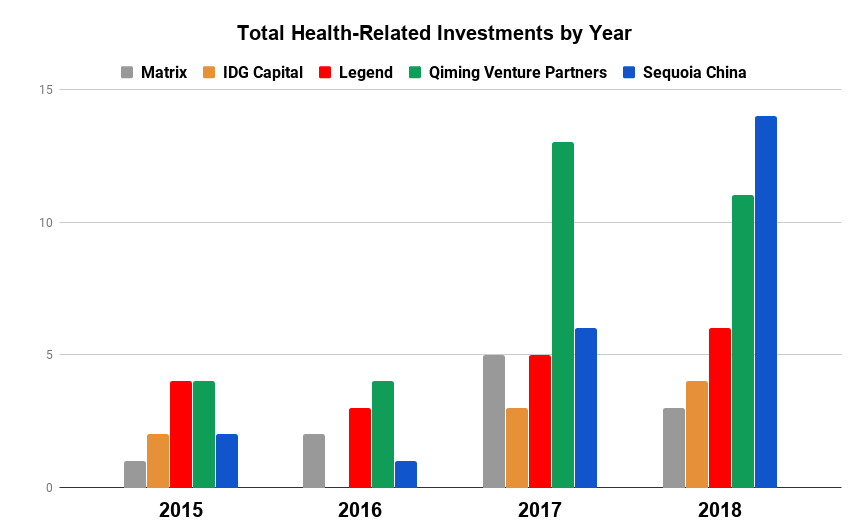
Health-related investment data for 2015-18 compiled from Pitchbook, Crunchbase, and SEC Edgar
There’s no shortage of areas in need of transformation within Chinese medical care, and a wide range of strategies are being employed by China’s VCs. While some investors hope to address influenza, others are focused on innovative treatments for hypertension, diabetes and other chronic diseases.
For instance, according to the Chinese Journal of Cancer, in 2015, 36% of world’s lung cancer diagnoses came from China, yet the country’s cancer survival rate was 17% below the global average. Sequoia has set its sights on tackling China’s high rate of cancer and its low survival rate, with roughly 70% of its deals in the past two years focusing on cancer detection and treatment.
That is driven in part by investments like the firm’s $90 million Series A investment into Shanghai-based JW Therapeutics, a company developing innovative immunotherapy cancer treatments. The company is a quintessential example of how Chinese VCs are building the country’s next set of health startups using their international footprints and learnings from across the globe.
Founded as a joint-venture offshoot between US-based Juno Therapeutics and China’s WuXi AppTec, JW benefits from Juno’s experience as a top developer of cancer immunotherapy drugs, as well as WuXi’s expertise as one of the world’s leading contract research organizations, focusing on all aspects of the drug R&D and development cycle.
Specifically, JW is focused on the next-generation of cell-based immunotherapy cancer treatments using chimeric antigen receptor T-cell (CAR-T) technologies. (Yeah…I know…) For the WebMD warriors and the rest of us with a medical background that stopped at tenth-grade chemistry, CAR-T essentially looks to attack cancer cells by utilizing the body’s own immune system.
Past waves of biotech startups often focused on other immunologic treatments that used genetically-modified antibodies created in animals. The antibodies would effectively act as “police,” identifying and attaching to “bad guy” targets in order to turn off or quiet down malignant cells. CAR-T looks instead to modify the body’s native immune cells to attack and kill the bad guys directly.
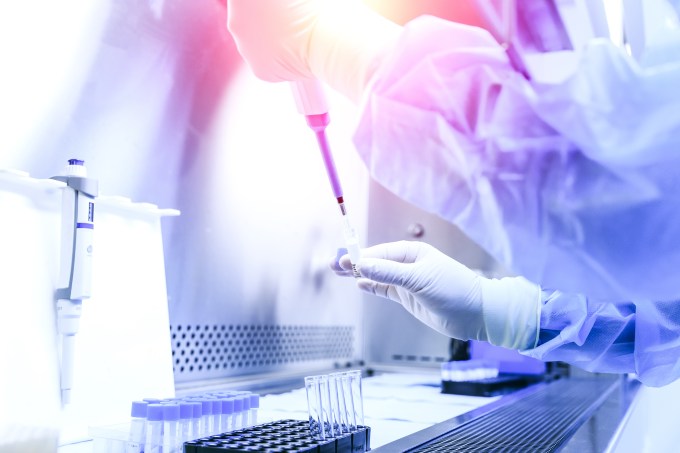
Chinese VCs are investing in a wide range of innovative life science and biotech startups. (Photo by Eugeneonline via Getty Images)
The international and interdisciplinary pedigree of China’s new medical leaders not only applies to the organizations themselves but also to those running the show.
At the helm of JW sits James Li. In a past life, the co-founder and CEO held stints as an executive heading up operations in China for the world’s biggest biopharmaceutical companies including Amgen and Merck. Li was also once a partner at the Silicon Valley brand-name investor, Kleiner Perkins.
JW embodies the benefits that can come from importing insights and expertise, a practice that will come to define the companies leading the medical future as the country’s smartest capital increasingly finds its way overseas.
GV and Founders Fund look to keep the Valley competitive
Despite heavy investment by China’s leading VCs, Silicon Valley is doubling down in the US health sector. (AFP PHOTO / POOL / JASON LEE)
Innovation in medicine transcends borders. Sickness and death are unfortunately universal, and groundbreaking discoveries in one country can save lives in the rest.
The boom in China’s life science industry has left valuations lofty and cross-border investment and import regulations in China have improved.
As such, Chinese venture firms are now increasingly searching for innovation abroad, looking to capitalize on expanding opportunities in the more mature US medical industry that can offer innovative technologies and advanced processes that can be brought back to the East.
In April, Qiming Venture Partners, another Chinese venture titan, closed a $120 million fund focused on early-stage US healthcare. Qiming has been ramping up its participation in the medical space, investing in 24 companies over the 2017-18 period.
New firms diving into the space hasn’t frightened the Bay Area’s notable investors, who have doubled down in the US medical space alongside their Chinese counterparts.
Partner directories for America’s most influential firms are increasingly populated with former doctors and medically-versed VCs who can find the best medical startups and have a growing influence on the flow of venture dollars in the US.
At the top of the list is Krishna Yeshwant, the GV (formerly Google Ventures) general partner leading the firm’s aggressive push into the medical industry.
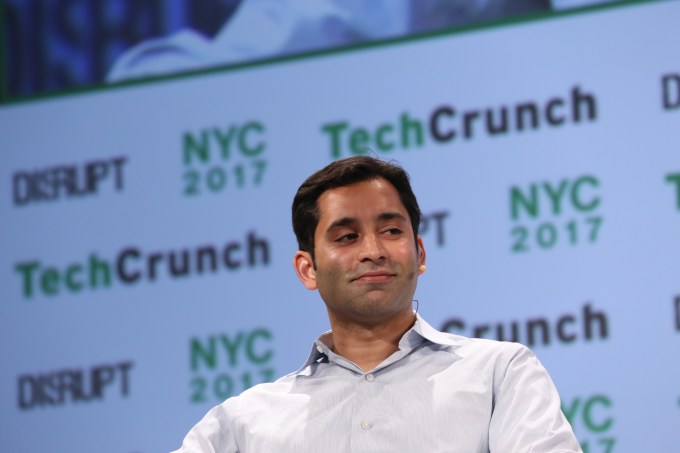
Krishna Yeshwant (GV) at TechCrunch Disrupt NY 2017
A doctor by trade, Yeshwant’s interest runs the gamut of the medical spectrum, leading investments focusing on anything from real-time patient care insights to antibody and therapeutic technologies for cancer and neurodegenerative disorders.
Per data from Pitchbook and Crunchbase, Krishna has been GV’s most active partner over the past two years, participating in deals that total over a billion dollars in aggregate funding.
Backed by the efforts of Yeshwant and select others, the medical industry has become one of the most prominent investment areas for Google’s venture capital arm, driving roughly 30% of its investments in 2017 compared to just under 15% in 2015.
GV’s affinity for medical-investing has found renewed life, but life science is also part of the firm’s DNA. Like many brand-name Valley investors, GV founder Bill Maris has long held a passion for the health startups. After leaving GV in 2016, Maris launched his own fund, Section 32, focused specifically on biotech, healthcare and life sciences.
In the same vein, life science and health investing has been part of the lifeblood for some major US funds including Founders Fund, which has consistently dedicated over 25% of its deployed capital to the space since at least 2015.
The tides may be changing, however, as the recent expansion of oversight for the Committee on Foreign Investment in the United States (CFIUS) may severely impact the flow of Chinese capital into areas of the US health sector.
Under its extended purview, CFIUS will review – and possibly block – any investment or transaction involving a foreign entity related to the production, design or testing of technology that falls under a list of 27 critical industries, including biotech research and development.
The true implications of the expanded rules will depend on how aggressively and how often CFIUS exercises its power. But a lengthy review process and the threat of regulatory blocks may significantly increase the burden on Chinese investors, effectively shutting off the Chinese money spigot.
Regardless of CFIUS, while China’s active presence in the US health markets hasn’t deterred Valley mainstays, with a severely broken health system and an improved investment environment backed by government support, China’s commitment to medical innovation is only getting stronger.
VCs target a disastrous health system
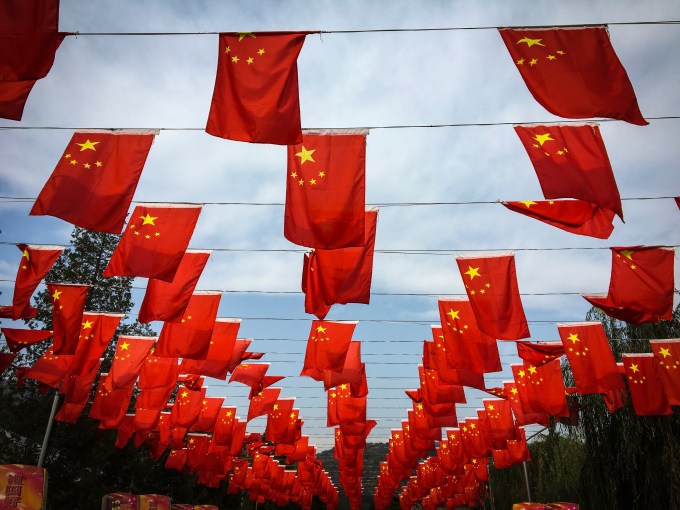
Deficiencies in China’s health sector has historically led to troublesome outcomes. Now the government is jump-starting investment through supportive policy. (Photo by Alexander Tessmer / EyeEm via Getty Images)
They say successful startups identify real problems that need solving. Marred with inefficiencies, poor results, and compounding consumer frustration, China’s health industry has many.
Outside of a wealthy few, citizens are forced to make often lengthy treks to overcrowded and understaffed hospitals in urban centers. Reception areas exist only in concept, as any open space is quickly filled by hordes of the concerned, sick, and fearful settling in for wait times that can last multiple days.
If and when patients are finally seen, they are frequently met by overworked or inexperienced medical staff, rushing to get people in and out in hopes of servicing the endless line behind them.
Historically, when patients were diagnosed, treatment options were limited and ineffective, as import laws and affordability issues made many globally approved drugs unavailable.
As one would assume, poor detection and treatment have led to problematic outcomes. Heart disease, stroke, diabetes and chronic lung disease accounts for 80% of deaths in China, according to a recent report from the World Bank.
Recurring issues of misconduct, deception and dishonesty have amplified the population’s mounting frustration.
After past cases of widespread sickness caused by improperly handled vaccinations, China’s vaccine crisis reached a breaking point earlier this year. It was revealed that 250,000 children had been given defective and fallacious rabies vaccinations, a fact that inspectors had discovered months prior and swept under the rug.
Fracturing public trust around medical treatment has serious, potentially destabilizing effects. And with deficiencies permeating nearly all aspects of China’s health and medical infrastructure, there is a gaping set of opportunities for disruptive change.
In response to these issues, China’s government placed more emphasis on the search for medical innovation by rolling out policies that improve the chances of success for health startups, while reducing costs and risk for investors.
Billions of public investment flooded into the life science sector, and easier approval processes for patents, research grants, and generic drugs, suddenly made the prospect of building a life science or biotech company in China less daunting.
For Chinese venture capitalists, on top of financial incentives and a higher-growth local medical sector, loosening of drug import laws opened up opportunities to improve China’s medical system through innovation abroad.
Liquidity has also improved due to swelling global interest in healthcare. Plus, the Hong Kong Stock Exchange recently announced changes to allow the listing of pre-revenue biotech companies.
The changes implemented across China’s major institutions have effectively provided Chinese health investors with a much broader opportunity set, faster growth companies, faster liquidity, and increased certainty, all at lower cost.
However, while the structural and regulatory changes in China’s healthcare system has led to more medical startups with more growth, it hasn’t necessarily driven quality.
US and Western investors haven’t taken the same cross-border approach as their peers in Beijing. From talking with those in the industry, the laxity of the Chinese system, and others, have made many US investors weary of investing in life science companies overseas.
And with the Valley similarly stepping up its focus on startups that sprout from the strong American university system, bubbling valuations have started to raise concern.
But with China dedicating more and more billions across the globe, the country is determined to patch the massive holes in its medical system and establish itself as the next leader in international health innovation.