Cathay Pacific says 9.4M passenger records affected by data breach

Cathay Pacific, one of the main airlines in Hong Kong, says records on as many as 9.4 million passengers may have been stolen in a data breach.

The airline said in a statement Wednesday that there was “no evidence” that passenger data had been misused, but warned that passenger names, dates of birth, nationalities, phone numbers, email and postal addresses, and passport and identity card numbers may have been taken. Historical travel information and remarks made by customer service was also accessed.

A little over 400 expired credit card numbers were accessed, including 27 credit card numbers without verification numbers.

No passwords were taken in the breach, the company said.

The company said that it first identified unauthorized access to its systems in March, but didn’t say why it took more than six months to reveal the breach publicly. The company didn’t immediately respond to a request for comment outside business hours. That might be a problem for the company in Europe, where the recently introduced General Data Protection Regulation (GDPR) now requires organizations to notify the authorities and customers of a breach within three days. Companies flouting the law can face fines of up to four percent of their global annual revenue.

The company didn’t say if European authorities were notified, but Hong Kong police are investigating the breach.

Chief executive Rupert Hogg apologized for the breach. “We acted immediately to contain the event, commence a thorough investigation with the assistance of a leading cybersecurity firm, and to further strengthen our IT security measures,” he said.

The airline is one of the largest and oldest airlines around, jetting more than 30 million passengers around the world each year.

It’s the second airline security incident this year. British Airways admitted a website and app breach earlier this year, which security researchers later found was caused by credit card skimming malware injected on its site.

The team behind XOXO is taking over Kickstarter’s Drip crowdfunding community

Two years ago, Kickstarter acquired Drip, an indie musician crowdfunding platform, on the eve of the service’s untimely demise. After relaunching Drip last year, Kickstarter is again reinventing the Patreon-like artist platform. This time, by placing it under the stewardship of two guys who love indie creators so much they dreamed up a whole festival about it.

The idea grew out of conversations between Kickstarter principal founder Perry Chen and Andy Baio, Kickstarter’s former (and first) chief technology officer and one half of XOXO Fest, a sometimes annual, very beloved celebration of independent artists and creators. XOXO co-founder Andy McMillan will join Baio on the project, with an undisclosed round of seed funding provided by Kickstarter.

“Andy [McMillan] and I had been thinking about this for some time,” Baio said in an interview with TechCrunch. “The whole thing being about celebrating independent artists, bringing them together to talk about difficult things… So much of what we’ve focused on was that: helping independent artists who use the internet to make a living.”

The two Andys (as they’re known at XOXO) maintain a very active year-round Slack composed of former XOXO attendees, a responsibility that’s seen them grow into their role as stewards of a community that’s taken on a life of its own, both online and off.

For their new project — the evolution of Drip into a yet-to-be-named community and crowdfunding hub — Baio and McMillan have formed a public-benefit corporation to reflect their values and those of Kickstarter, also a public-benefit corporation. Chen clarifies that the new site is separate from Kickstarter and will “not be a subsidiary in any way, wholly its own thing [with] its own leadership.”

It’s too early to say if Baio and McMillan plan to weave the new platform into XOXO Fest, but the two projects are “really closely aligned in mission,” Baio said. Some of Drip’s existing creators are XOXO Fest regulars and the event itself grew out of a successful Kickstarter that raised $175,511 back in 2012. 

“I think we’re all used to seeing at this point how the platforms that we use have failed,” Baio said. “The challenges that independent artists face are so profound already — to then have the tools and the platforms that you’re using work against you has been a painful thing.”

That pain was a central theme at XOXO Fest this year, which I attended. (Full disclosure: I was also an early member of the XOXO Outpost, a year-round creative space that grew out of the festival.) Across genres, writers, musicians and developers alike expressed concerns that unaddressed harassment, racism and misogyny had turned once well-loved social platforms against some of the users who need them most.

“We really hope that we can show people that this platform reflects the values and care we have for the artists that we care about,” Baio said. “We want it to be sustainable and independent for a long time.”

NBC to launch a new streaming network, NBC News Signal

NBC is looking to reach a younger audience with today’s announcement of a new streaming news network, NBC News Signal. Instead of airing on traditional pay TV platforms, Signal will be available through NBC’s news mobile and over-the-top apps, as well as on other services including PlutoTV, YouTube, and Twitter. The focus will be on the “political and social issues in America,” the company says.

The service will include an evening show hosted by Simone Boyce at 7 PM ET on weekdays. At launch, this program is available on Thursdays at 7 PM ET only. Other programming consists of a morning and afternoon show and hourly news updates called “Brieflies,” which launches later this quarter and in early 2019.

There will also be a Steve Kornacki-hosted digital show “218: Race for the House” which will air daily at 12pm ET and on Election Day, November 6th; as well as a Katy Tur-hosted pre-show on the network from 7-9pm ET.

The channel will have 24/7 news coverage starting in mid-2019, NBC says.

“There is a growing segment of people who have never had a cable subscription, but who are just as hungry for smart news as the prior generations of news watchers who have consumed NBC News for decades,” said Nick Ascheim, SVP of digital at NBC News Group, about the launch. “These consumers – who are up-to-date on the headlines but are seeking a deeper understanding of the news of the moment – are increasingly turning to OTT devices for ‘lean back’ news consumption or an on-the-go informative experience and that’s exactly what NBC News Signal will deliver,” he added.

The streaming network isn’t NBC’s only attempt at wooing millennial viewers. The company also operates a Snapchat show called “Stay Tuned.”

However, it is now one of many digital-first initiatives in the news industry, aimed to reach the younger, cord cutter crowd.

CBS last year added streaming news from CBSN to its offering for cord cutters, CBS All Access, which it plans on augmenting with local news from CBS stations.

Fox News will soon launch its own over-the-top streaming service, Fox Nation. ABC’s new streaming network ABC News Live partnered with Roku to be featured on its devices’ free channel.

Meanwhile, Cheddar has been doing deals left-and-right with various streaming TV services for inclusion in their lineups.

There’s also VICE News Tonight on HBO, and others, like Plex’s news service, based on its Watchup acquisition.

Plus, today’s youngest users – like many of us – get a lot of their news from social media sites, like Facebook and Twitter. That means NBC’s Signal will have a lot of competition fresh out of the gate.

Erica Fink and Christine Cataldi are the executive producers for the network. Rashida Jones, SVP of specials for NBC News and MSNBC, is the executive in charge of programming for NBC News Signal.

The service is available here, and across the above-mentioned platforms.

Southeast Asia’s Grab partners with MasterCard to offer virtual debit cards

Ride-hailing firm Grab branched out into payments last year and now the $11 billion-valued company, which acquired Uber’s Southeast Asia business earlier this year, has given its fintech division a major boost after it announced plans to introduce virtual pre-paid debit in partnership with Mastercard.

The move is the largest digital payment push in Southeast Asia to date. The deal will see its Grab Pay business offer Grab’s 110 million registered users the option to use a virtual Mastercard to make payments both online and in-person.

Users will be able to use physical Grab Pay cards or virtual ones — the latter being a card number, expiry date, and other details that are held within the Grab app. Interestingly, TechCrunch understands that Grab had been in contact with Visa over a similar deal but it ultimately chose MasterCard . Grab declined to comment on that when asked.

Regardless of the issuer, the deal instantly gives Grab Pay the potential for serious legs.

Last November, Grab launched its first payment integration by allowing users in Singapore to pay for food at selected restaurants using its app. While it has expanded that support in Singapore and other parts of Southeast Asia, it has needed to onboard merchants to do so. Now, with MasterCard, it is tapping into a vast network of three million retailers across Southeast Asia, with support for worldwide and also via online merchants.

That turns Grab Pay into a serious payment network on paper, but it will also give a large chunk of Southeast Asia’s 650 million population a chance to own a debit card for the first time.

While the region’s middle-class is growing quickly as internet access continues to increase — Southeast Asia’s internet population is larger than the total U.S. population, and growing — few people own credit or debit cards.

Many, in fact, remain unbanked. The World Bank claims 71 percent of the region is paid their salary in cash while just 30 percent own a debit card and only nine percent have a credit card. Many simply don’t qualify to own one. Grab’s effort, which is the largest pre-paid push in the region, could make a difference.

‘Could’ is very much the operative word here. While Grab has made progress with Grab Pay — which also runs an offline merchant network that enables those with limited internet knowledge to take advantage of e-commerce and other online services — the service is intrinsically linked to Grab.

Grab Pay can now exist as a standalone service. The question is whether Grab can market the virtual card service effectively and tap the undoubted potential that it has for its business and consumers in Southeast Asia. To date, no fintech firm has managed to build a regional network that covers over 100 million consumers, although there are plenty of promising challengers that have started out in a single market right. While Grab’s efforts have been periphery and, based on anecdotal evidence, not all users are convinced they need Grab Pay in their life.

Grab though is confident that its raft of non-transportation — which includes food deliveries, grocery deliveries and third-party services on its platform — can make the Mastercard venture work.

“We see Grab Pay as a glue that goes across all the products we offer, and rewards our users for using them,” Reuben Lai, senior managing director at Grab Financial, told TechCrunch in an interview. “Grab Pay users spend two times more than regular users and they stay twice longer on our platform.”

Lai added that those who use Grab Pay are 30 percent more likely to use other Grab services — they, it seems, are the power users — but he added that Grab’s mission, beyond increasing engagement, is to digitize payments in Southeast Asia.

“What we want to do next is democratize payments and access to financial services,” he said. “Many consumers don’t have access to the things we take for granted, we want to make these available to our users, drivers and partners.”

Just as Grab founders Hooi Ling Tan and Anthony Tan have said that street hailing is Grab’s biggest competitor, so Lai suggested that cash is the biggest rival to Grab Pay right now.

That’s certainly true since the deal with Uber removed Grab’s main competitor from the eight markets that it serves in Southeast Asia, but regulators are keen to see increased competition. Singapore fined Uber and Grab a collective $9.5 million from what it deemed to be an “anti-competitive” merger deal while the Philippines followed suit with a far smaller $300,000 wrap on the knuckles.

That shock to the system, coupled with a consumer backlash around more limited choice and a bodged effort to revamp Grab’s loyalty program, has seen Grab admit for the first time that it needs to rebuild ties. The MasterCard deal has the potential to be useful if executed right, but many Grab users will be looking for it to shore up on the basics, with complaints centered around issues like driver reliability and fair pricing.

That’s right, in the absence of Uber, Grab is learning that it isn’t easy being the top dog. But that status does give it the potential to work on major new products and with huge partners like MasterCard. A deal like this was unthinkable when Grab was the scrappy underdog, but now it’s a company that raises billions on a regular basis and is a category leader.


Italian consumer watchdog hands down €15M in fines to Apple and Samsung for slowing devices

Italy’s Autorità garante della concorrenza e del mercato, roughly equivalent to this America’s FTC, has fined Apple and Samsung a total of $15 million for the companies’ practice of forcing updates on consumers that may slow or break their devices. The amount may be a drop in the bucket, but it’s a signal that governments won’t always let this type of behavior fly.

The “unfair commercial practices” are described by the AGCM as follows:

The two companies have induced consumers – by insistently proposing to proceed with the download and also because of the significant information asymmetry of consumers vis-a-vis the producers – to install software updates that are not adequately supported by their devices, without adequately informing them, nor providing them an effective way to recover the full functionality of their devices.

Sounds about right!

In case you don’t remember, essentially Apple was pushing updates to iPhones last year that caused performance issues with older phones. Everyone took this as part of the usual conspiracy theory that Apple slows phones to get you to upgrade, but it turns out to have been more like a lack of testing before they shipped.

Samsung, for its part, was pushing Android Mashmallow updates to a number of its devices, but failed to consider that it would cause serious issues in Galaxy Note 4s — issues it then would charge to repair.

The issue here wasn’t the bad updates exactly, but the fact that consumers were pressured into accepting them, at cost to themselves. It would be one thing if the updates were simply made available and these issues addressed as they came up, but both companies “insistently suggested” that the updates be installed despite the problems.

In addition to this, Apple was found to have “not adequately informed consumers about some essential characteristics of lithium batteries, such as their average duration and deterioration factors, nor about the correct procedures to maintain, verify and replace batteries in order to preserve full functionality of devices.” That would be when Apple revealed to iPhone 6 owners that their batteries were not functioning correctly and that they’d have to pay for a replacement if they wanted full functionality. This information, the AGCM, suggests, ought to have been made plain from the beginning.

Samsung gets €5 million in fines and Apple gets €10 million. Those may not affect either company’s bottom line, but they are the maximum possible fines, so it’s symbolic as well. If a dozen other countries were to come to the same conclusion, the fines would really start to add up. Apple has already made some amends, but if it fell afoul of the law it still has to pay the price.

AT&T’s streaming video device is now in beta testing

AT&T has begun beta testing a streaming device that seems to be something of its own Roku competitor, according to a statement made by John Donovan, CEO of AT&T Communications, during the company’s third quarter earnings call. The device, first scooped a year ago by Variety is an Android TV-based set-top box which integrates other streaming apps and ships with a voice remote, according to an FCC filing.

While AT&T didn’t comment on Variety’s report at the time, it did later confirm the device on an earnings call earlier this year.

The box was then described as a way for customers to watch DirecTV Now or other streaming services from their home. The plan at the time was to have the device launched by the end of 2018, the company had said.

The word today is that timeframe has shifted.

Donovan said the service was in “beta testing” now, but added that AT&T planned to “roll out trials in the first half of next year.”

The thin client-based service – as this product was referred to as by the exec – would be the next step in transitioning traditional pay TV customers to the streaming service, DirecTV Now.

It could also be used to target cord cutters in search of a more traditional TV experience, by offering access to streaming TV without requiring the installation of a satellite dish.

“This will be a more measured roll out,” Donovan said, of the new thin client-based service. “Like our introduction of WatchTV, we expect this service to be EBITDA positive. And over time, it should lower our acquisition cost of our premium video service. And both of these use the common platform we introduced with DirecTV Now,” he noted.

The device’s arrival comes at a time when AT&T’s pay TV business is in decline.

The company reported a 346,000 net loss in traditional TV customers (DirecTV and AT&T Uverse) in the quarter. However, it gained 49,000 for its streaming service, DirecTV Now, which has grown to 1.86 million subscribers.

AT&T said it would also begin evaluating its channel lineups, in order to better “align content costs with the price.” That seems to mean that AT&T may also be thinking about breaking up content into even skinnier bundles – something Hulu says it’s doing, as well.

Oracle’s Larry Ellison keeps poking AWS because he has no choice

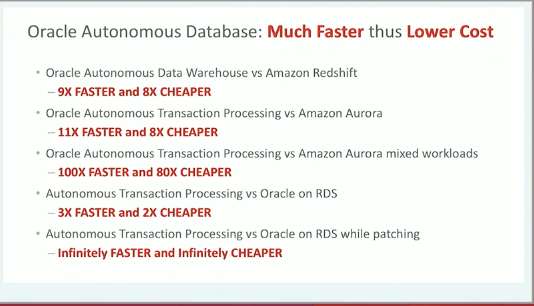
Larry Ellison gave his Oracle Openworld keynote on Monday and of course he took several shots at AWS. In his view, his company’s cloud products were cheaper, better and faster than AWS, but then what would you expect him to say?

He rolled out a slide with all the facts and figures in case you doubted it. He wrapped it up in a neat little marketing package for the world to see. Oracle has an autonomous self-healing database. AWS? Nope. That much he’s right.

Slide: Oracle

He makes claims that his cloud products are faster and cheaper, claims that are hard to substantiate given how hard it is to nail down any vendor’s cloud prices and speeds. He says they have no disaster recovery, when they do. None of it matters.

This was about showmanship. It was about chest beating and it’s about going after the market leader because frankly, the man has little choice. By now, it’s well documented that Oracle was late to the cloud. Larry Ellison was never a fan and he made it clear over the years, but today as the world shifts to a cloud model, his company has had to move with it.

It hasn’t been an easy transition. It required substantial investment on the part of the company to build its infrastructure to support a cloud model. It took a big change in the way their sales people sell the product. The cloud is based on a subscription model, and it requires more of a partnership approach with customers. Oracle doesn’t exactly have a reputation for playing nicely.

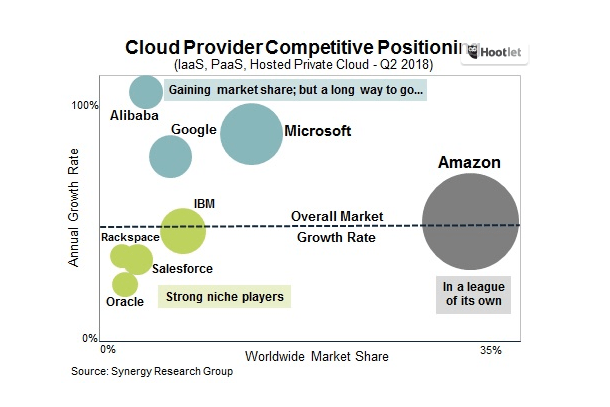
To make matters worse, Oracle’s late start puts it well behind market leader AWS. Hence, Ellison shouting from the rooftops how much better his company’s solutions are and how insecure the competitors are. Synergy Research, which follows the cloud market closely, has pegged Amazon’s cloud market share at around 35 percent. It has Oracle in the single digits in the most recent data from last summer (and the market hasn’t shifted dramatically since it came out with this data).

At the time, Synergy identified the four biggest players as Amazon, Microsoft, Google and IBM with Alibaba coming up fast. Synergy chief analyst John Dinsdale says Oracle is falling behind. “We have seen Oracle losing market share over the last few quarters in IaaS, PaaS and managed private cloud,” he said. “In a market that is growing at 50 percent per year, Microsoft, Google and Alibaba are all gaining market share, while the share of market leader AWS is holding steady,” he added.

To its credit, the company has seen some gains via its SaaS business. “As Oracle works to convert its huge on-premise software client base to SaaS, Oracle grew its share of enterprise SaaS markets in 2016 and 2017. Its market share then held steady in the first half of 2018,” Dinsdale pointed out.

Yet the company stopped breaking out its cloud revenue last June. As I wrote at the time, that isn’t usually a good sign:

That Oracle chose not to break out cloud revenue this quarter can’t be seen as a good sign. To be fair, we haven’t really seen Google break out their cloud revenue either with one exception in February. But when the guys at the top of the market shout about their growth, and the guys further down don’t, you can draw your own conclusions.

Further Oracle has been quite vocal about protesting the Pentagon’s $10 billion JEDI contract, believing that it has been written to favor Amazon over other vendors, a charge the Pentagon has denied. It hasn’t stopped Oracle from filing protests or even bringing their case directly to the president.

At least Ellison might have had some good news yesterday. CNBC reported that the big Amazon Prime outage in July might have been related to a transition away from Oracle databases that Amazon is currently undertaking. (Amazon’s Werner Vogels strongly denied  that assertion on Twitter.)

Regardless, Oracle finds itself in an unfamiliar position. After years of domination, it is stuck behind in the pack. When you find yourself in such a position, you need to have a strong bark and Ellison is going after AWS hard. As the clear market leader, he has few other options right now.