Tesla subpoenaed by SEC over Model 3 production forecasts

Tesla said Friday in a regulatory filing that the U.S. Securities and Exchange Commission and Department of Justice are investigating projections made last year about Model 3 production rates. The SEC has issued subpoenas for information related to Model 3 production estimates. The DOJ, which is running a separate investigation over Model 3 production targets, has stopped short of taking that action.

The information contained in Tesla’s 10Q filing backs up an October 26 article by The Wall Street Journal that reported the FBI was investigating whether the company misstated information about Model 3 production and misled investors. The FBI is the investigating arm of the DOJ.

Tesla issued a statement at the time of the article, acknowledging that it had received a voluntary request for documents from the Department of Justice about its public guidance for the Model 3 ramp. “We were cooperative in responding to it,” the statement issued last week said. “We have not received a subpoena, a request for testimony, or any other formal process, and there have been no additional document requests about this from the Department of Justice for months.”

This latest filing provides further confirmation and clarifies the extent of the investigations. It’s also the first time Tesla has said that the SEC has issued subpoenas to the company for information about the Model 3 production.

Here’s the whole nugget in the SEC filing:

We receive requests for information from regulators and governmental authorities, such as the National Highway Traffic Safety Administration, the National Transportation Safety Board, the SEC, the Department of Justice (“DOJ”) and various state agencies. We routinely cooperate with such regulatory and governmental requests.

In particular, the SEC has issued subpoenas to Tesla in connection with (a) Mr. Musk’s prior statement that he was considering taking Tesla private and (b) certain projections that we made for Model 3 production rates during 2017 and other public statements relating to Model 3 production. The DOJ has also asked us to voluntarily provide it with information about each of these matters and is investigating. Aside from the settlement with the SEC relating to Mr. Musk’s statement that he was considering taking Tesla private, there have not been any developments in these matters that we deem to be material, and to our knowledge no government agency in any ongoing investigation has concluded that any wrongdoing occurred. As is our normal practice, we have been cooperating and will continue to cooperate with government authorities. We cannot predict the outcome or impact of any ongoing matters. Should the government decide to pursue an enforcement action, there exists the possibility of a material adverse impact on our business, results of operation, prospects, cash flows, and financial position.

We are also subject to various other legal proceedings and claims that arise from the normal course of business activities. If an unfavorable ruling or development were to occur, there exists the possibility of a material adverse impact on our business, results of operations, prospects, cash flows, financial position and brand.

This didn’t stop CEO Elon Musk from blasting the WSJ for the report during a lengthy podcast interview released Friday with Recode’s Kara Swisher.

“The amount of untruthful stuff that is written is unbelievable. Take that Wall Street Journal front-page article about, like, ‘The FBI is closing in.’ That is utterly false. That’s absurd. To print such a falsehood on the front page of a major newspaper is outrageous. Like, why are they even journalists? They’re terrible. Terrible people.”

Tesla recently reached a settlement with the SEC, which began with a now infamous “funding secured” tweet by Musk about taking the electric automaker private. A federal judge approved October 16 Musk’s settlement with the SEC over securities fraud allegations. The SEC alleged in a complaint filed in September that Musk lied when he tweeted on August 7 that he had “funding secured” for a private takeover of the company at $420 per share.
Tencent is launching its own version of Snap Spectacles

Some were surprised to see Snap release a second version of its “face-camera” Spectacles gadget, since the original version failed to convert hype into sales.

But those lackluster sales — which dropped to as low as 42,000 per quarter — didn’t only fail to dissuade the U.S. social firm from making more specs, because now Tencent, the Chinese internet giant and Snap investor, has launched its own take on the genre.

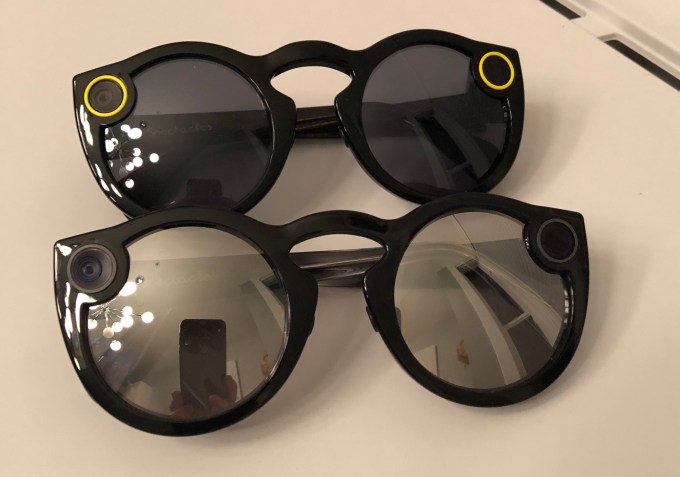
Tencent this week unveiled its answer to the video-recording sunglasses, which, you’ll notice, bear a striking resemblance to Snap’s Spectacles.

Called the Weishi smartglasses, Tencent’s wearable camera sports a lens in the front corner that allows users to film from a first-person perspective. Thankfully, the Chinese gaming and social giant has not made the mistake of Snap’s first-generation Spectacles, which highlighted the camera with a conspicuous yellow ring.

#Tencent's version of Snap Spectacles will go on sale Nov 11th pic.twitter.com/sNuSezdVgS

— Matthew Brennan (@mbrennanchina) November 2, 2018

Tencent, which is best known for operating China’s massively popular WeChat messenger, has been an investor in Snap for some time after backing it long before it went public. But, when others have criticized the company and its share price struggled, Tencent doubled down. It snapped up an additional 12 percent stake one year ago and it is said to have offered counsel to Snap CEO Evan Spiegel on product strategy. We don’t know, however, if the two sides’ discussions have ever covered Spectacles and thus inspired this new Tencent take on then.

The purpose behind Tencent’s new gadget is implicit in its name. Weishi, which means “micro videos” in Chinese, is also the name of the short-video sharing app that Tencent has been aggressively promoting in recent months to catch up with market dominators TikTok and Kuaishou .

TikTok, known as Douyin in China, is part of the entertainment ecosystem that Beijing-based ByteDance is building. ByteDance also runs the popular Chinese news aggregator Toutiao and is poised to overtake Uber as the world’s most-valued tech startup when it closes its mega $3 billion funding round.

Weishi’s other potential rival Kuaishou is, interestingly, backed by Tencent. Kuaishou launched its own video-taking sunglasses in July.

Alongside the smart sunglasses, Tencent has also rolled out a GoPro-like action camera that links to the Weishi app. Time will tell whether the gadgets will catch on and get more people to post on Weishi.

Snap Spectacles V1 (top) and V2

The spectacles will go on sale November 11, a date that coincides with Singles Day, the annual shopping spree run by Tencent’s close rival Alibaba. Tencent does not make the gadget itself and instead has teamed up with Shenzhen-based Tonot, a manufacturer that claims to make “trendy” video-taking glasses. Tonot has also worked with Japan’s Line chat app on camera glasses.

“There isn’t really a demand for video-recording glasses,” says Mi Zou, a Beijing-based entrepreneur working on an AI selfie app. That’s because smartglasses are “not offering that much more to consumers than smartphones do,” she argues. Plus, a lot of people on apps like Douyin and Kuaishou love to take selfies, a need that smartglasses fail to fulfill.

“Tencent will have to work on its marketing. It could perhaps learn a few things from the Apple Watch, which successfully touts a geeky product as a fashionable accessory,” suggests Mi, who points out Snap Spectacles’ so-far dim reception.

Weishi had not responded to TechCrunch’s request for comment at the time of writing, but we’ll update this story with any additional information should the company provide it.

Flickr’s new business model could see works deleted from Creative Commons

Following yesterday’s series of announcements about Flickr’s plans to revamp its site under its new owners, SmugMug, one major concern has been raised: its decision to now limit free accounts to 1,000 photos may impact the number of photos available through Creative Commons.

Creative Commons is a U.S. nonprofit that helps make creative works — like photos — available for legal use through several different types of copyright licenses that respect how creators want to share their work. For example, many creators make their photos freely available under the condition that their name and a link to their profile or to the original work is also cited.

Flickr has been a longtime partner with Creative Commons, and today makes millions of photos available through its site under the various license types.

But with Flickr’s plans to reduce storage, some are concerned what this means for this valuable resource of legally free-to-use photos.

“Many users are concerned such a limit on free account capacity might cause millions of CC images to be deleted from the Commons,” writes Ryan Merkley, CEO at Creative Commons, in a blog post. “A lot of people have reached out to us directly and asked what we can do. I’m confident that together we can find solutions, if we assume goodwill and bring our collective creativity to the problem,” he says.

He says the nonprofit is already working with Flickr and parent company SmugMug to find a way to “protect and preserve” the Commons and help it grow in the future.

“We want to ensure that when users share their works that they are available online in perpetuity and that they have a great experience,” says Merkley.

Like SmugMug’s new owners, he also believes that Flickr’s business model prior to its acquisition was broken. Giving away massive amounts of free storage (and the accompanying bandwidth) at Flickr’s scale — billions of photos — was incredibly expensive. He understands that, for Flickr to continue, it has to explore other options.

That’s exactly what Flickr is doing with its revamped account plans. Users now can store 1,000 photos (or videos) for free, but unlimited storage is $50 per year.

It’s unclear how this change will impact Creative Commons. Merkley says the organization will be the first to step in if works from Creative Commons are being deleted, though.

He also says he met with Flickr’s new owners earlier this year, and believes things will work out.

However, the organization says it’s looking for ideas on how it can help Flickr to continue to support Creative Commons, and hopes to have answers on that front soon.

SmugMug hasn’t yet responded to a request for comment, but we’ll update if they do.

Google finally adds consumer customer support with Google One

You may recall my tale of woe from last year when I recounted how I was locked out of my Google account for a month. It was a tough time, made all the more frustrating because there wasn’t any customer support to contact. That is changing for Google One users though, and it’s about time.

I received an email this week from Google informing me that my paid Google storage had been upgraded to Google One, Google’s freshly designed storage options announced last May. It comes with twice the storage, giving me two terabytes for the same $9.99 per month I was paying for one. It allows me to share my generous storage allotment with my family members, but the thing that really caught my eye was actual customer support.

With Google One, which is available for as little as $1.99 per month for 100 gigs of storage, everyone has access to actual customer support where they can talk to someone, who can (presumably) help them with issues like password recovery.

Brandon Badger, who is Google One product manager, says this is a critical component of the new storage package. “Support is important to us, we want people using our products to have a great experience and get questions or issues addressed in a timely manner,” Badger told TechCrunch. He added that users with paid storage plans often use many other Google products and services and this provides a way for customers to get answers to problems they have across the Google cloud ecosystem.

Photo: Google

Obviously, this is long overdue and something that G Suite customers, the business side of Google’s tools, have had for some time. This ability to contact a customer service organization shows a maturation of consumer cloud products that had been missing previously.

As a journalist, when I got locked out I was forced to use my contacts at Google PR to give me that help. After many attempts I was able to get my account credentials back, but since I wrote that article I have received dozens of emails from other unfortunate souls who faced the same predicament, but lacked the connections I had. Unfortunately, as much as I could empathize with their plight (how could I not?), there wasn’t much I could do other than refer them to Google. I wrote about my level of frustration in my post:

Once you have gone through the recovery protocol, what is a person supposed to do to get Google’s attention? They don’t have customer service, yet I’m paying for storage. They don’t have a reasonable system for navigating this kind of problem and they don’t have a sensible appeals process.

While I hope I never get locked out of my Google account again, I’m happy to know that if I do, I and so many others like me at least have someone to contact about it. That’s no guarantee our problems will be resolved, of course, but it’s at least a path to getting something done that hadn’t previously existed.

Dynamic Yield, which builds Amazon-like personalisation for the rest of us, raises $38M

Amazon, one of the world’s largest companies, has transformed the face of commerce in part because it has managed at once to be “The Everything Store” but still with a route into its sea of products that, for most users, surfaces what they might most want to see (and importantly buy or consume). That kind of personalisation has become a goal not just for e-commerce companies, but for any organization running a digital business: users are constantly distracted, and when their attention is caught, they do not want to spend time figuring out what they most want.

Not every business is Amazon, though, so we are seeing a crop of startups emerging that are working on ways to help the rest of the digital world be just as optimised and personalised as Amazon. Now one of them, an Israeli startup called Dynamic Yield, has raised more money as it continues to expand its business, both to more platforms and to more geographies.

The startup’s Series D has now closed off at $38 million, with the inclusion of a $5 million strategic investment from Naver, Korea’s “Google” (it’s the country’s top search portal) that is also behind messaging apps Line and Snow. The plan is for Naver to help bring Dynamic Yield to Korea and Japan, by incorporating its tech into its own services and those of others that work with Naver.

(Personalisation and aggregators are strong magnets for users in Asia and thus big magnets for funding: ByteDance, which provides news aggregation among other services, was recently valued at $75 billion.)

Naver is not the only search engine that has caught sight of Dynamic Yield over the years. Previous investors include Baidu (“the Google of China”), and we’ve heard that when the startup was younger — it was founded in 2011 — Google had tried to acquire it (Dynamic Yield rejected the offer, and it’s been approached for acquisitions numerous times since then).

Other strategic investors include The New York Times and Deutsche Telekom, alongside other backers like Innovation Endeavors, Bessemer Venture Partners, Marker Capital and more.

Dynamic Yield has raised $85 million to date and is now valued at “hundreds of millions of dollars,” but less than $500 million, a source at the company said, after seeing a strong expansion of its services. 

Dynamic Yield says it works with more than 220 global brands, and its tech reaches 600 million unique users each month, across 10 billion page views and 600 billion “events” on those pages. It claims its AI-based personalisation technology can lift revenues (or other engagement metrics) by 10-15 percent. 

“It makes us an effective tool for surviving in a market where customer acquisition cost keeps getting more expensive,” co-founder and CEO Liad Agmon said in an interview.

Dynamic Yield doesn’t talk about many of its customers on the record — most don’t like to reveal to rivals who they work with, Agmon said.

But they include a number of big brands across e-commerce, travel, finance, media and other segments that use its tech not just to show more targeted products to prospective shoppers, but to help power advertising, recommend content and position the same information to different people in different ways depending on who is viewing it (for example with different headlines).

There are a lot of personalisation and A/B analytics companies in the market today — others include Adobe, Marketo (which is becoming a part of Adobe), Optimizely and many more. Indeed, I’d be very surprised if Amazon is not working on ways of productising its own personalisation tech in a way that is not intrinsically linked to its own marketplace (because some will never want to sell there, and because personalisation can be used for so much more than just e-commerce).

Dynamic Yield, however, claims that it has an edge over these because of how it works.

Agmon says that the tech sits on top of whichever CMS or other backend server that a site is using and is activated by way of a small amount of code. It uses machine learning to both “read” what is in a site, and matches that up against specific visitors and its own trove of experience.

Agmon added that when a business already has information about that visitor, that is the primary data that is used; otherwise it also incorporates other data sources like Acxiom and others — much the way that other marketing tech does — to form a stronger picture of your tastes.

It then runs this data through its own machine learning algorithms both to recommend content and to help a marketing manager figure out better customer segmentation overall. There is an “autopilot” version of the product where everything is automated based on Dynamic Yield’s algorithms; or options to use the data sources to set up specific marketing campaigns; or (as is common) a combination of the two.

Going forward, Agmon said the plan is to work across an increasing number of interfaces where customers are going today to discover and buy goods and services. Indeed, we’ve described how some of the newest e-commerce startups have eschewed any website or app of their own and work exclusively in third-party messaging apps to acquire customers and sell goods.

But it’s not just these new digital platforms that are becoming targets for personalisation startups like Dynamic Yield.

Agmon said that his company is also working with a major retailer that is using its tech at its in-person payment points. When — for example — a customer comes to order a latte, instead of generic upselling to the latest seasonal flavour, the person taking the order will now know if the customer ever orders a sweet injection, or if she/he is more of a savoury snack sort of person. The cashier will then know what to recommend to eat with that drink that is more likely to be purchased.

The mom-and-pop shop with its reputation for knowing the regulars and what they like might have found its dystopian (but useful) heir.

Brex has partnered with WeWork, AWS and more for its new rewards program

Brex, the corporate card built for startups, unveiled its new rewards program today.

The billion-dollar company, which announced its $125 million Series C three weeks ago, has partnered with Amazon Web Services, WeWork, Instacart, Google Ads, SendGrid, Salesforce Essentials, Twilio, Zendesk, Caviar, HubSpot, Orrick, Snap, Clerky and DoorDash to give entrepreneurs the ability to accrue and spend points on services and products they use regularly.

Brex is lead by a pair of 22-year-old serial entrepreneurs who are well aware of the costs associated with building a startup. They’ve been carefully crafting Brex’s list of partners over the last year and say their cardholders will earn roughly 20 percent more rewards on Brex than from any competitor program.

“We didn’t want it to be something that everyone else was doing so we thought, what’s different about startups compared to traditional small businesses?” Brex co-founder and chief executive officer Henrique Dubugras told TechCrunch. “The biggest difference is where they spend money. Most credit card reward systems are designed for personal spend but startups spend a lot more on business.”

Companies that use Brex exclusively will receive 7x points on rideshare, 3x on restaurants, 3x on travel, 2x on recurring software and 1x on all other expenses with no cap on points earned. Brex carriers still using other corporate cards will receive just 1x points on all expenses.

Most corporate cards offer similar benefits for travel and restaurant expenses, but Brex is in a league of its own with the rideshare benefits its offering and especially with the recurring software (SalesForce, HubSpot, etc.) benefits.

San Francisco-based Brex has raised about $200 million to date from investors including Greenoaks Capital, DST Global and IVP.  At the time of its fundraise, the company told TechCrunch it planned to use its latest capital infusion to build out its rewards program, hire engineers and figure out how to grow the business’s client base beyond only tech startups.

“This is going to allow us to compete even more with Amex, Chase and the big banks,” Dubugras said.