The average iPhone sold for nearly $800 in the most recent quarter; if the price keeps climbing at that rate, the average price may soon top $1,000.
Category: Tech news
hacking,system security,protection against hackers,tech-news,gadgets,gaming
Apple Will Keep Throttling iPhones. Here’s How to Stop It
While it seemed like the iPhone 8, 8 Plus, and X might avoid the practice, Apple now says it will throttle them as well.
We Need to Have an Honest Talk About Our Data
VR pioneer Jaron Lanier talks with WIRED about why the original architecture of the internet forced us into a kind of information trickery, and how we can fix it—to everyone’s benefit.
Trump’s ‘Game of Thrones’ Tweet Is Odd, but Trademark-Infringing? Probably Not
Even if HBO wanted to issue a takedown, it’s likely the network wouldn’t have a strong legal claim.
GM is getting into the electric bike business
General Motors said it plans to bring two new electric bikes to market next year — one folding and one compact — as the automaker makes a broader push into electrification and other ideas that try to move beyond its traditional business model of producing and selling gas-power vehicles.
The automaker didn’t have a lot of information to share about the e-bikes or its ultimate plans. For instance, Hannah Parish, director of General Motors Urban Mobility Solutions, wouldn’t say if GM plans to launch a bike-sharing service as a result of these two new products. “I can’t say anything is on or off the table at this point,” she added.
Here’s what is on the menu. The bikes will be “smart” and “connected” and somehow inspired by GM’s OnStar, the company’s subscription-based communications, in-vehicle security and emergency services feature found in cars. Parish wouldn’t elaborate what that might look like. We’ll have to wait until next year.
The bikes are also equipped with safety features including rechargeable front and rear LED lights. And the electric propulsion on the bikes were designed by GM engineers who created a proprietary drive system.
“We know that people who live in urban areas, like myself in downtown Toronto need different opportunities to use different types of transportation when they going and doing different things. We know that congestion in cities is a problem and the e-bikes feed right into our efforts,” Parish, director of General Motors Urban Mobility Solutions told TechCrunch.

GM revealed two eBikes – one folding and one compact.
For now, GM is focused on naming the e-bikes. And it’s turning to the public to help. The company launched a brand-naming campaign Friday as part of its broader e-bike announcement. Folks who want to name the e-bikes can go to www.eBikeBrandChallenge.com. The participant with the winning selection will receive $10,000. Nine other runners-up will each receive $1,000.
Entries will be accepted until November 26. The winning submissions will be announced January 31, 2019.
Twitter removes thousands of accounts that tried to dissuade Democrats from voting
Twitter has deleted thousands of automated accounts posting messages that tried to discourage and dissuade voters from casting their ballot in the upcoming election next week.
Some 10,000 accounts were removed across late September and early October after they were first flagged by staff at the Democratic Party, the company has confirmed.
“We removed a series of accounts for engaging in attempts to share disinformation in an automated fashion – a violation of our policies,” said a Twitter spokesperson in an email to TechCrunch. “We stopped this quickly and at its source.” But the company did not provide examples of the kinds of accounts it removed, or say who or what might have been behind the activity.
The accounts posed as Democrats and try to convince key demographics to stay at home and not vote, likely as an attempt to sway the results in key election battlegrounds, according to Reuters, which first reported the news.
A spokesperson for the Democratic National Committee did not return a request for comment outside its business hours.
The removals are a drop in the ocean to the wider threats that Twitter faces. Earlier this year, the social networking giant deleted 1.2 million accounts for sharing and promoting terrorist content. In May alone, the company deleted just shy of 10 million accounts each week for sending malicious, automated messages.
Twitter had 335 million monthly active users as of its latest earnings report in July.
But the company has faced criticism from lawmakers for not doing more to proactively remove content that violates its rules or spreads disinformation and false news. With just days before Americans are set to vote in the U.S. midterms, this latest batch of takedowns is likely to spark further concern that Twitter did not automatically detect the malicious accounts.
Following the publication of Reuters’ report, Yoel Roth, Twitter’s head of site integrity, said in a tweet thread that public research identifying bots is often “deeply flawed” and that many are identifying bots “based on probability, not certainty,” since “nobody other than Twitter can see non-public, internal account data.”
Twitter does not have a strict policy on the spread of disinformation in the run-up to election season, unlike Facebook, which recently banned content that tried to suppress voters with false and misleading information. Instead, Twitter said last year that its “open and real-time nature” is a “powerful antidote to the spreading of all types of false information.” But researchers have been critical of that approach. Research published last month found that more than 700,000 accounts that were active during the 2016 presidential election are still active to this day — pushing a million tweets each day.
A Twitter spokesperson added that for the election this year, the company has “established open lines of communication and direct, easy escalation paths for state election officials, Homeland Security, and campaign organizations from both major parties to help us enforce our policies vigorously and protect conversational health on our service.”
Don’t Be Duped by Voting Misinformation Before the Midterms
How to find accurate voting information for the midterm elections
Gadget Lab Podcast: How Sonos Will Compete With, But Also Work With, Amazon and Google
An interview with Sonos CEO Patrick Spence, taped at WIRED’s 25th anniversary festival.
Hack Brief: Someone Posted Private Facebook Messages From 81,000 Accounts
The data appears to have been stolen with malicious browser extensions, and not by exploiting an issue with Facebook’s platform.
Sequoia leads $10M round for home improvement negotiator Setter
You probably don’t know how much it should cost to get your home’s windows washed, yard landscaped or countertops replaced. But Setter does. The startup pairs you with a home improvement concierge familiar with all the vendors, prices and common screwups that plague these jobs. Setter finds the best contractors across handiwork, plumbing, electrical, carpentry and more. It researches options, negotiates a bulk rate and, with its added markup, you pay a competitive price with none of the hassle.
One of the most reliable startup investing strategies is looking at where people spend a ton of money but hate the experience. That makes home improvement a prime target for disruption, and attracted a $10 million Series A round for Setter co-led by Sequoia Capital and NFX. “The main issue is that contractors and homeowners speak different languages,” Setter co-founder and CEO Guillaume Laliberté tells me, “which results in unclear scopes of work, frustrated homeowners who don’t know enough to set up the contractors for success, and frustrated contractors who have to come back multiple times.”
Setter is now available in Toronto and San Francisco, with seven-plus jobs booked per customer per year costing an average of over $500 each, with 70 percent repeat customers. With the fresh cash, it can grow into a household name in those cities, expand to new markets and hire up to build new products for clients and contractors.
 I asked Laliberté why he cared to start Setter, and he told me “because human lives are made better when you can make essential human activities invisible.” Growing up, his mom wouldn’t let him buy video games or watch TV so he taught himself to code his own games and build his own toys. “I’d saved money to fix consoles and resell them, make beautiful foam swords for real live-action games, buy and resell headphones — anything that people around me wanted really!” he recalls, teaching him the value of taking the work out of other people’s lives.
Meanwhile, his co-founder David Steckel was building high-end homes for the wealthy when he discovered they often had ‘home managers’ that everyone would want but couldn’t afford. What if a startup let multiple homeowners share a manager? Laliberté says Steckel describes it as “I kid you not, the clouds parted, rays of sunlight began to shine through and angels started to sing.” Four days after getting the pitch from Steckel, Laliberté was moving to Toronto to co-found Setter.
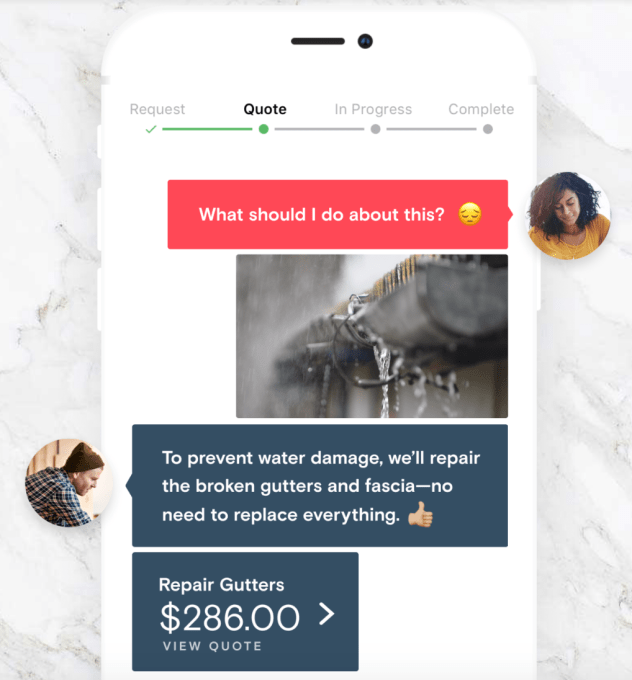
Users fire up the app, browse a list of common services, get connected to a concierge over chat and tell them about their home maintenance needs while sending photos if necessary. The concierge then scours the best vendors and communicates the job in detail so things get done right the first time, on time. They come back in a few minutes with either a full price quote, or a diagnostic quote that gets refined after an in-home visit. Customers can schedule visits through the app, and stay in touch with their concierge to make sure everything is completed to their specifications.
The follow-through is what sets Setter apart from directory-style services like Yelp or Thumbtack . “Other companies either take your request and assign it to the next available contractor or simply share a list of available contractors and you need to complete everything yourself,” a Setter spokesperson tells me. They might start the job quicker, but you don’t always get exactly what you want. Everyone in the space will have to compete to source the best pros.
Though potentially less scalable than Thumbtack’s leaner approach, Setter is hoping for better retention as customers shift off of the Yellow Pages and random web searches. Thumbtack rocketed to a $1.2 billion valuation and had raised $273 million by 2015, some from Sequoia (presenting a curious potential conflict of interest). That same ascent may have lined up the investors behind Setter’s $2 million seed round from Sequoia, Hustle Fund and Avichal Garg last year. Today’s $10 million Series A also included Hustle Fund and Maple VC.
The toughest challenge for Setter will be changing the status quo for how people shop for home improvement away from ruthless bargain hunting. It will have to educate users about the pitfalls and potential long-term costs of getting slapdash service. If Laliberté wants to fulfill his childhood mission, he’ll have to figure out how to make homeowners value satisfaction over the lowest sticker price.
Elon Musk says Tesla won’t make e-scooters, but might consider electric bikes
Tesla won’t be joining the scooter wars. But electric bikes? Yeah, maybe.
During a lengthy podcast with Recode’s Kara Swisher, Tesla CEO Elon Musk talked about everything from AI and his fights on Twitter with journalists to Saudi Arabia and Mars. Even scooters. Of course, scooters.
But don’t get your hopes up for a Tesla scooter. According to Musk, they lack dignity. Swisher’s persistence on the topic wasn’t enough to dissuade him.
Here’s the exchange. You can listen to the entire 80-minute session here.
Kara: Make a scooter. Make a scooter and I’ll go for it. They actually are electric, what am I talking about?
Elon: I don’t know, there was some people in the studio who wanted to make a scooter, but I was like, “Uh, no.”
Kara: I love the scooter, no, get on the scooter.
Elon: It lacks dignity.
Kara: No, it doesn’t lack dignity.
Elon: Yes, they do.
Kara: They don’t lack dignity, what are you talking about?
Elon: Have you tried driving one of those things? They —
Kara: Yes, I do it all the time, I look fantastic.
Elon: They do not, you are laboring under an illusion.
Kara: All right, well, everybody at Lime, don’t worry, Elon Musk is not coming for you.
Elon: Electric bike. I think we might do an electric bike, yeah.
TikTok surpassed Facebook, Instagram, Snapchat & YouTube in downloads last month
Beijing-based ByteDance’s 2017 acquisition of tween and teen-focused social app Musical.ly is paying off. The company this year merged Musical.ly with its own short video app TikTok as a means of entering the U.S. market. Today, the result of that merger is sitting at the top of the U.S. App Store, ahead of Facebook. More importantly, it recently surpassed Facebook, Instagram, YouTube and Snapchat in monthly installs for the first time in September.
According to data from app intelligence firm Sensor Tower, TikTok’s installs were higher than those of Facebook, Instagram, Snapchat and YouTube in the U.S. last month.
It surpassed the four other apps in terms of daily downloads on September 29, with 29.7 percent the downloads from this cohort of apps, the firm says.
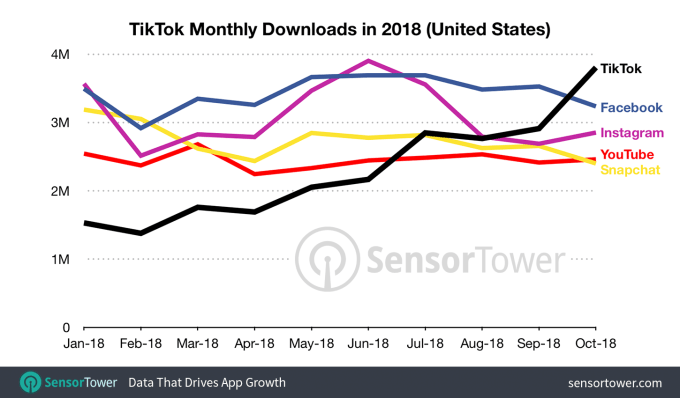
Since then, it has continued to increase its market share among this group of apps, reaching as high as 42.4 percent of downloads among the apps just days ago, on October 30.
In September, TikTok’s installs grew around 31 percent from the prior month to reach approximately 3.81 million on the App Store and Google Play combined. This beat No. 2 Facebook, which had 3.53 million first-time installs.
Year-over-year, TikTok’s U.S. installs were up 237 percent from 1.13 million in October 2017.
As floods of new users join TikTok, the app has also flirted with passing some of these leading social apps in the App Store’s Top Charts, at times, too. Today, it’s ahead of Facebook (No. 7) and Messenger (No. 5) as it sits in the No. 4 position, for example. But it’s behind YouTube (No. 1), Instagram (No. 2) and Snapchat (No. 3).
However, at other times it’s gotten as high as No. 3 in the Overall Free Apps Top Chart, according to App Annie data.

App researcher Apptopia reports similar findings, in terms of TikTok’s surge. However, it noted that the app’s engagement rates (the portion of monthly users who open the app daily) was still behind the rest of the group. Apptopia said TikTok had a 29 percent engagement rate, compared with Facebook’s 96 percent, Instagram’s 95 percent, Snapchat’s 95 percent and YouTube’s 95 percent.
It also noted the app’s gains have come, in part, from increased ad spend across Facebook, Google’s mobile ad platform AdMob, in-app ad platform Vungle and others. Other gains are attributed to the merger.
In June, TikTok (known as Douyin in China) reported reaching a global monthly active user count of 500 million across 150 countries and regions, which is around the time when Instagram reached one billion monthly actives, for comparison’s sake.
Village Global’s accelerator introduces founders to Bill Gates, Reid Hoffman, Eric Schmidt and more
Village Global is leveraging its network of tech luminaries to support the next generation of entrepreneurs.
The $100 million early-stage venture capital firm, which counts as limited partners (LPs) Microsoft’s Bill Gates, Facebook’s Mark Zuckerberg, Alphabet’s Eric Schmidt, Amazon’s Jeff Bezos, LinkedIn’s Reid Hoffman and many other high-profile techies, quietly announced on Friday that the accelerator it piloted earlier this year would become a permanent fixture.
Called Network Catalyst, Village provides formation-stage startups with $150,000 and three-months of programming in exchange for 7 percent equity. Its key offering, however, is access to its impressive roster of LPs.
To formally announce Network Catalyst, Village brought none other than Bill Gates to San Francisco for a fireside chat with Eventbrite CEO Julia Hartz . During the hour-long talk, Gates handed out candid advice on building a successful company, insights on philanthropy and predictions on the future of technology. He later met individually with the founders of Village’s portfolio companies.
“I have a fairly hardcore view that there should be a very large sacrifice made during those early years,” Gates said. “In those early years, you need to have a team that’s pretty maniacal about the company.”
During the Q&A session, Gates regurgitated one of his great anecdotes. In the early days of Microsoft, he would memorize his employee’s license plates so he knew when they were coming and going, quietly noting who was working the longest hours. He admitted, to no one’s surprise, that he struggled with work-life balance.
“I think you can over worship the idea of working extremely hard,” he said. “For my particular makeup, it’s really true I didn’t believe in weekends or vacations … Once I got in my 30s, I could hardly imagine how I’d done that because by then some natural thing inside of me kicked in and I loved weekends and my girlfriend liked vacations and that turned out to be a great thing.”
Gates has been an active investor in Village since it emerged one year ago. VMware founder Diane Greene, Disney CEO Bob Iger and Spanx CEO Sara Blakely are also on the firm’s long list of LPs.
Village is led by four general partners: Erik Torenberg, Product Hunt’s first employee; LinkedIn’s former chief of staff Ben Casnocha; Chegg’s former chief business officer Anne Dwane; and former Canaan partner Ross Fubini. They initially filed to raise a $50 million fund in mid-2017 but ultimately closed on $100 million in March. The firm relies heavily on scouts — angel investors and others knowledgeable of the startup world — to source deals. The scouts, in return, earn a portion of the firm’s returns.

Former Alphabet chairman Eric Schmidt.
An accelerator program has been part of Village’s plan since the beginning.
Pinterest CEO Ben Silbermann, Fidelity CEO Abby Johnson, Hoffman, Iger, Blakely and Schmidt all worked with Network Catalyst’s debut cohort of founders. Village co-founder Anne Dwane said Hoffman and former Twitter CEO Ev Williams have signed on to work with the next cohort.
“It is about contacts, not content,” Dwane told TechCrunch. “The most important thing is who you can meet to help you take your business forward.”
San Francisco-based VeriSIM, a startup building AI-enabled biosimulation models, was among the debut class of companies that participated in Network Catalyst. Jo Varshney, the company’s founder and CEO, said the accelerator’s personalization and customization set it apart from competing options.
“It seemed like I had a team of people working alongside me even though I’m a solo founder,” Varshney told TechCrunch.
After completing the program, Schmidt introduced Varshney to a number of investors. She quickly closed a $1.5 million seed round.
“One year in and I already have a one-on-one meeting with Bill Gates,” she added.
Applications for the accelerator close on December 7 with programming kicking off January 14. Village plans to enroll at least 12 companies across industries.
Twitter hires God-is Rivera as global director of culture and community
Twitter has brought on its first-ever global director of culture and community, God-is Rivera. As global director of culture and community, Rivera will report to Global Head of Culture, Engagement and Experiential Nola Weinstein. Rivera previously led internal diversity and inclusion efforts at VMLY&R, a digital and creative agency.
“As a black woman who has worked in industries in which I have been underrepresented, I feel a great responsibility to amplify and support diverse communities, and they exist in full force on Twitter,” Rivera said in a statement. “The team has shown a passion to serve and spotlight their most active users and I am honored to step into this new role as a part of that commitment.”
For context, 26 percent of U.S. adults who identify as black use Twitter, while 24 percent of white-identified adults and 20 percent of Latinx-identified adults in the U.S. use Twitter, according to a March 2018 survey from Pew Research Center.
At Twitter, the plan is for Rivera to “better serve and engage communities” on Twitter through the company’s brand marketing, campaigns, events and other experiences. Internally, Rivera will be tasked with ensuring Twitter’s campaigns and programs are inclusive and “reflective of the communities we serve,” according to Twitter’s press release. Externally, Rivera will be responsible for developing relationships and programs with content creators, community leaders, brands and more — similar to the one with HBO’s Insecure.
Here’s the internal note Weinstein sent to Twitter employees earlier today:
Team,
I am so excited to welcome @GodisRivera to the team as Twitter’s new Global Director of Culture & Community. She captivated us at #OneTeam with her enlightening presentation on #BlackTwitter and we are thrilled that she will now be bringing her passion and perspective inside.
In this newly created role, God-is will help lead our efforts to better serve and engage the powerful voices and global communities who take to Twitter to share, discover and discuss what matters to them. This will come to life through Twitter’s brand efforts, campaigns, events and experiences. She will help ensure that our programs are connective, inclusive and reflective of the communities we serve. You can imagine more efforts that engage and excite our communities like #HereWeAre, #NBATwitter, thoughtful tweetups, etc.
God-is’ deep expertise in marketing and social strategy, cultural understanding and ability to elevate and connect communities makes for a rare and incredibly powerful combination. She was previously Director, Inclusion and Cultural Resonance at VMLY&R, where she led internal diversity efforts to fuse the importance of internal culture and representation to creative work outputs. In 2018, God-is was named an Ad Age “Woman to Watch” and Adweek “Disruptor” for continuing to fight for representation and equity in the advertising industry. She currently resides in New York, NY with her husband and daughter.
On a personal note, I have had the pleasure of spending time with God-is at #HereWeAre, #Influence, and #OneTeam and her energy, passion and positivity are infectious. I know her presence will make a difference and am excited by all that the culture & experiential team will create together.
God-is will start on November 12th and will be based in NYC reporting to me.
Please join me in welcoming her to the flock!
Thrilled to welcome @GodisRivera to the team as Twitter's new Global Director of Culture & Community. Her deep marketing, cultural, and social expertise makes for a rare and powerful combination that will help us to enhance our connection to the voices and communities we serve. pic.twitter.com/QrffBrnPJh
— Nola Weinstein (@NolaBeth) November 2, 2018
The Minte raises $2.25 million in seed funding to bring hotel-style housekeeping to luxury residences
As an MBA student at the University of Chicago’s Booth school, Kathleen Wilson was struck with an idea while looking at businesses that provided daily housekeeping in one of her classes. Given the density and physical structure of many apartment buildings, she wondered why a housekeeper couldn’t similarly push a cart down the hall and spend an hour or less in each unit.
To test out her theory, Wilson and a classmate started cleaning the apartments of friends, spending 30 minutes to an hour at a time and trying to establish a reasonable price point for the work. Armed with enough data, Wilson then landed at a local real estate tech accelerator, formed her company, and locked down her first property management company client, Waterton — and her efforts have been gaining momentum since.
In fact, her 20-month-old startup, The Minte, which now employs roughly 60 people, is today announcing that it has raised $2.25 million in a round that brings the company’s total seed funding to $4.7 million. Dundee Venture Capital led this newest round; other investors in the company include MATH Venture Partners, Revolution’s Rise of the Rest Seed Fund, Firebrand Ventures, Blue Note Ventures and numerous angel investors. We had a quick chat with Wilson earlier this week to learn more.
TC: Can you tell us a bit more about your customers? Are they all property management companies like Waterton?
KW: We only provide service to apartments and condos, so our clients are currently property management companies such as Greystar, Bozzuto, Lincoln Property Company and CA Ventures. We have just under 70 properties in Chicago, another 20 in D.C. and we’ve been launching six to 10 new properties in each market each month.
TC: The Minte promises to make a housekeeper available to a property full-time, correct?
KW: Yes. A housekeeper is located on site for residents to book cleaning services with them, so that residents are provided with consistency and trust. To be clear, our housekeepers are full-time Minte employees with health benefits and paid time off. We keep our housekeeping cart and supplies at each property, and there’s a place for housekeepers to go if they have a bit of downtime, although that’s rare.
We do have some housekeepers who split their time between properties, either if the property is smaller or if we’re still in the first couple months of service and still building demand.
TC: What makes the company think people would prefer to work with The Minte versus housekeepers they know? These are trust-heavy relationships, a feature that other housecleaning startups have overlooked to their detriment.
KW: Exactly. We bring the personal trust by having the same housekeeper assigned to the property, which allows the housekeeper to get to know the residents, and we bring the corporate side of trust by having insurance, QA by managers and the ability to send a backup housekeeper if someone is out sick. We also have top-notch, live customer service if there is ever an issue.
TC: What does your quality assurance process involve?
KW: It’s a multi-tier process. First, we’ve implemented an eight-day training program for all new housekeepers. Second, housekeepers and housekeeping managers with whom we work almost always have hotel backgrounds, having worked at the Waldorf Astoria, The Conrad and Sofitel, to name a few. Third, housekeeping managers do random spot checks of service. And fourth, users can rate and comment on every service, which we review in real time. It’s company policy to reach out to the resident any time something is less than four stars.
Also worth mentioning: our products are eco-friendly, P&G products, so there’s no compromise on the quality of our supplies.
TC: How do clients pay, and how much do they pay? Is this a subscription model?
KW: They can pay à la carte — paying $30 for a hotel-style service, $90 for a deep clean for a one-bedroom apartment, for example — but over half of our cleans are residents who are on a recurring package. For customers on a package, they can customize how many deep cleans and/or hotel-style cleans they have every four weeks, including which days those cleans occur.
TC: The home services model is more prone to leakage, meaning people form relationships and stop using the platform. Is this a concern?
KW: Our employees are full-time, so this is essentially a non-issue for us. With our housekeepers on our schedule throughout the entire week, it’s not feasible for someone to poach them.
Potentially a resident could do this on a weekend, but in our experience, people want housekeepers to come when they are not home. Furthermore, the property manager would tell us if our housekeeper was getting keys outside of their Minte schedule.
TC: And how are you marketing the company?
KW: Through our partnership with the property managers, primarily.
TC: How will you use your new funding?
KW: We’ll continue to enhance our tech. Our app is out this week, and we’re rolling out our smart home integration in the coming months. We’re making our button — which is physical hardware that goes on the wall inside each unit — more readily available. We’ll also expand more into condos and corporate housing and target our third city in early 2019.