Privacy researchers raise concerns about the planned transfer of a DeepMind project in the UK to corporate sister Google.
Category: Tech news
hacking,system security,protection against hackers,tech-news,gadgets,gaming
Uber joins Linux Foundation, cementing commitment to open-source tools
Uber announced today at the 2018 Uber Open Summit that it was joining the Linux Foundation as a Gold Member, making a firm commitment to using and contributing to open-source tools.
Uber CTO Thuan Pham sees the Linux Foundation as a place for companies like his to nurture and develop open-source projects. “Open source technology is the backbone of many of Uber’s core services and as we continue to mature, these solutions will become ever more important,” he said in a blog post announcing the partnership.
What’s surprising is not that they joined, but that it took so long. Uber has been long known for making use of open source in its core tools, working on over 320 open-source projects and repositories from 1,500 contributors involving over 70,000 commits, according to data provided by the company.
“Uber has made significant investments in shared software development and community collaboration through open source over the years, including contributing the popular open-source project Jaeger, a distributed tracing system, to the Linux Foundation’s Cloud Native Computing Foundation in 2017,” an Uber spokesperson told TechCrunch.
Linux Foundation Executive Director Jim Zemlin was certainly happy to welcome Uber into the fold. “Their expertise will be instrumental for our projects as we continue to advance open solutions for cloud native technologies, deep learning, data visualization and other technologies that are critical to businesses today,” Zemlin said in a statement.
The Linux Foundation is an umbrella group supporting myriad open-source projects and providing an organizational structure for companies like Uber to contribute and maintain open-source projects. It houses sub-organizations like the Cloud Native Computing Foundation, Cloud Foundry Foundation, The Hyperledger Foundation and the Linux operating system, among others.
These open-source projects provide a base on top of which contributing companies and the community of developers can add value if they wish and build a business. Others like Uber, which uses these technologies to fuel their backend systems, won’t sell additional services, but can capitalize on the openness to help fuel their own requirements in the future, while also acting as a contributor to give as well as take.
Apple partners with A24, the studio behind ‘Moonlight’ and ‘Hereditary’
Apple has signed a multi-year agreement with A24, which will see the film studio producing multiple movies for Apple.
Not much else is known about the deal yet — not the number of films, their genres or the talent involved. Still, the deal suggests that Apple is going to be investing seriously in original films, along with TV shows.
Over the past year or so, Apple’s been releasing a steady drumbeat of content announcements, for shows like an adaptation of Isaac Asimov’s “Foundation” novels, a drama set in the world of morning TV starring Jennifer Aniston and Reese Witherspoon and a series from “La La Land” director Damien Chazelle. What’s less clear is how Apple plans to distribute theses shows and movies, though there have been reports that it will give the content away for free to people who own iOS and tvOS devices.
A24, meanwhile, is a relatively new studio launched in 2012. It’s quickly established itself as a home for critically acclaimed films like “Moonlight” (winner of the Oscar for Best Picture) and “Lady Bird.” It’s also released some of the best science fiction and horror movies of the past few years, including “Ex Machina,” “The Lobster” and “Hereditary” (which gave me nightmares for a solid week).
The studio’s films have had a significant presence on streaming, thanks to an early, exclusive deal with Amazon Prime, but A24 has also had success in theaters — particularly noteworthy at a time when ambitious, original films seem increasingly likely to premiere on services like Netflix. In fact, Variety notes that this year has been A24’s most financially successful yet, thanks in large part to “Hereditary.”
Has Silicon Valley Lost Its Soul? The Case for and Against
Intelligence Squared U.S., the long-running debate show, took on the Valley in a recent episode.
All 141 ‘League of Legends’ Champions, Explained
From Aatrox to Zyra, no one knows more about the multiplayer juggernaut than the folks at Riot Games—and they’re here to help.
Facebook will change algorithm to demote “borderline content” that almost violates policies
Facebook will changed its News Feed algorithm to demote content that comes close to violating its policies prohibiting misinformation, hate speech, violence, bullying, clickbait so it’s seen by fewer people even it’s highly engaging. The change could massively reduce the reach of incendiary political groups, fake news peddlers, and more of the worst stuff on Facebook. It allows the company to hide what it doesn’t want on the network without taking a hard stance it must defend about the content breaking the rules.
In a 5000-word letter by Mark Zuckerberg published today, he explained how there’s a “basic incentive problem” that “when left unchecked, people will engage disproportionately with more sensationalist and provocative content. Our research suggests that no matter where we draw the lines for what is allowed, as a piece of content gets close to that line, people will engage with it more on average — even when they tell us afterwards they don’t like the content.”
Without intervention, the engagement with borderline content looks like the graph above, increasing as it gets closer to the policy line. So Facebook is intervening, artificially suppressing the News Feed distribution of this kind of content so engagement looks like the graph below.
[Update: While Zuckerberg refers to the change in the past tense in one case, Facebook tells me borderline content demotion is only in effect in limited instances. The company will continue to repurpose its AI technology for proactively taking down content in violation of its policies to find and demote content that approaches the limits of those policies.]

Facebook will apply penalties to borderline content not just the News Feed but to all of its content, including Groups and Pages themselves to ensure it doesn’t radicalize people by recommending they join communities because they’re highly engaging thanks to toeing the policy line. “Divisive groups and pages can still fuel polarization” Zuckerberg notes.
However, users who purposefully want to view borderline content will be given the chance to opt in. Zuckerberg writes that “For those who want to make these decisions themselves, we believe they should have that choice since this content doesn’t violate our standards.” For example, Facebook might create flexible standards for types of content like nudity where cultural norms vary, like how some coutnries ban women from exposing much skin in photographs while others allow nudity on network television. It may be some time until these opt ins are available, though, as Zuckerber says Facebook must first train its AI to be able to reliably detect content that either crosses the line, or purposefully approaches the borderline.
Facebook had previously changed the algorithm to demote clickbait. Starting in 2014 it downranked links that people clicked on but quickly bounced from without going back to Like the post on Facebook. By 2016, it was analyzing headlines for common clickbait phrases, and this year it banned clickbait rings for inauthentic behavior. But now it’s giving the demotion treatment to other types of sensational content. That could mean posts with violence that stop short of showing physical injury, or lewd images with genitalia barely covered, or posts that suggest people should commit violence for a cause without directly telling them to.
Facebook could end up exposed to criticism, especially from fringe political groups who rely on borderline content to whip up their bases and spread their messages. But with polarization and sensationalism rampant and tearing apart society, Facebook has settled on a policy that it may try to uphold freedom of speech, but users are not entitled to amplification of that speech.
Below is Zuckerberg’s full written statement on the borderline content:
One of the biggest issues social networks face is that, when left unchecked, people will engage disproportionately with more sensationalist and provocative content. This is not a new phenomenon. It is widespread on cable news today and has been a staple of tabloids for more than a century. At scale it can undermine the quality of public discourse and lead to polarization. In our case, it can also degrade the quality of our services.
[ Graph showing line with growing engagement leading up to the policy line, then blocked ]
Our research suggests that no matter where we draw the lines for what is allowed, as a piece of content gets close to that line, people will engage with it more on average — even when they tell us afterwards they don’t like the content.
This is a basic incentive problem that we can address by penalizing borderline content so it gets less distribution and engagement. By making the distribution curve look like the graph below where distribution declines as content gets more sensational, people are disincentivized from creating provocative content that is as close to the line as possible.
[ Graph showing line declining engagement leading up to the policy line, then blocked ]
This process for adjusting this curve is similar to what I described above for proactively identifying harmful content, but is now focused on identifying borderline content instead. We train AI systems to detect borderline content so we can distribute that content less.
The category we’re most focused on is click-bait and misinformation. People consistently tell us these types of content make our services worse — even though they engage with them. As I mentioned above, the most effective way to stop the spread of misinformation is to remove the fake accounts that generate it. The next most effective strategy is reducing its distribution and virality. (I wrote about these approaches in more detail in my note on [Preparing for Elections].)
Interestingly, our research has found that this natural pattern of borderline content getting more engagement applies not only to news but to almost every category of content. For example, photos close to the line of nudity, like with revealing clothing or sexually suggestive positions, got more engagement on average before we changed the distribution curve to discourage this. The same goes for posts that don’t come within our definition of hate speech but are still offensive.
This pattern may apply to the groups people join and pages they follow as well. This is especially important to address because while social networks in general expose people to more diverse views, and while groups in general encourage inclusion and acceptance, divisive groups and pages can still fuel polarization. To manage this, we need to apply these distribution changes not only to feed ranking but to all of our recommendation systems for things you should join.
One common reaction is that rather than reducing distribution, we should simply move the line defining what is acceptable. In some cases this is worth considering, but it’s important to remember that won’t address the underlying incentive problem, which is often the bigger issue. This engagement pattern seems to exist no matter where we draw the lines, so we need to change this incentive and not just remove content.
I believe these efforts on the underlying incentives in our systems are some of the most important work we’re doing across the company. We’ve made significant progress in the last year, but we still have a lot of work ahead.
By fixing this incentive problem in our services, we believe it’ll create a virtuous cycle: by reducing sensationalism of all forms, we’ll create a healthier, less polarized discourse where more people feel safe participating.
‘Fantastic Beasts’ Is About to Make Grindelwads of Cash (and Other Culture News)
Plus: Guillermo del Toro’s Bleak House is fine, directors are rallying to save FilmStruck, and a *Dumbo* trailer dropped.
Zuckerberg denies knowledge of Facebook’s work with GOP opposition research firm
Today in a call with reporters preceded by a frantic if fairly uneventful distraction-pushing media blitz, Facebook responded to a damning New York Times story published yesterday that cited interviews with more than 50 sources privy to Facebook’s decision making.
The call kicked off with the operator’s suggestion that Facebook is “happy to take a couple of questions on yesterday’s news” but would prefer to focus on what it wants to talk about — namely anything but The New York Times story. Amidst the strategic fluff, Zuckerberg did come out strongly on one thing — denying any knowledge of or involvement in Facebook’s hiring of Definers Public Affairs, a Washington, D.C.-based Republican opposition research firm.
“I learned about this reading it in The New York Times yesterday,” Zuckerberg said. “As soon as I read about this… I got on the phone with our team and we’re no longer working with this firm.”
Facebook used Definers Public Affairs to push negative stories about competitors, including plenty to TechCrunch’s own inboxes, including a report on Apple employees’ lopsided Democratic campaign donations and Google’s “lack of cooperation” with the Senate Intelligence Committee hearing. As Recode reported, Definers Public Affairs set up a Silicon Valley shop last year with the explicit goal of courting the Bay Area’s biggest companies for some lucrative “dark arts” mudslinging.
When pressed to answer who at Facebook was aware that the company had hired the oppo research firm:
“Someone on our comms team must have hired them, in general we need to go through and look at all the relations we have and see if there are more like this.”
Zuckerberg revisited the categorical denial a few times:
“I learned about this yesterday.”
“In general, this kind of firm might be normal in Washington…. but it’s not the kind of firm that Facebook should be working with.”
“This is not the type of work that I want us to be doing so we won’t be doing it.”
“The bottom line here is that as soon as we learned about this, we were no longer working with this firm.”
“As soon as I read it, I looked into if this was the type of firm we wanted to be working with.”
And finally, abdication:
“Look I feel like I’ve answered this question a bunch of times… I’m not sure I have much more to say on that here.”
The notion that the company’s founder and chief executive would be unaware of Facebook’s involvement with the company is… suspect, to put it lightly. It’s a natural assumption that Facebook’s upper echelons would have made the call to begin with, though Zuckerberg stopped just short of making it clear that it was someone else up there, just not him. Given Sheryl Sandberg’s considerable political savvy, it’s not a stretch to assume that she initiated the contract, or at least signed off on it with full knowledge.
Update: One hour and 12 minutes into the call, Zuckerberg addressed Sandberg’s implied involvement. “I want to be clear that I’ve mentioned a number of times that I was not in the loop,” he said. “Sheryl was also not involved. She learned about this at the same time that I did.”
As Facebook coalesces around its PR response, at the moment centered around denying that executives at the company interfered with its own investigation into Russian disinformation, Facebook’s leadership returns to a pattern familiar to anyone who so much as glanced at The New York Times report: Delay, Deny and Deflect, indeed.
Citrix pays $200M to acquire Sapho, which connects legacy software with ‘micro apps’
As large organizations grapple with adopting modern work practices without throwing out all of their legacy software, a company that works with them is making an acquisition that it hopes will help with that process. Citrix today is announcing that it has acquired Sapho, a startup that develops “micro apps” for legacy software so that workers could use them as they would more modern applications: in the cloud, on mobile and more.
We understand that the acquisition was for around $200 million in an all-cash deal. It’s a good return: Sapho had raised just under $28 million since 2014 from investors that included AME Cloud Ventures, Louie Alsop, Felicis Ventures and more. Including co-founders Fouad ElNaggar and Peter Yared, the whole team of 90 employees, based mainly in the Bay Area and a development office in Prague, will be joining Citrix.
Citrix, for its part, currently has a market cap of about $14 billion and has been seeing a surge of interest under new CEO David Henshall, who has repositioned it from focusing mainly on virtual private networking services to a more hybrid cloud model, following a wider trend in the world of enterprise IT.
Citrix will be bringing on all of Sapho’s existing business and products. The two companies already have a strong overlap in their customer bases, CEO ElNaggar said, and it was in fact several of those customers asking for more integrations with Citrix services that drove Citrix approaching Sapho for this deal.
“The largest companies in the world are using Citrix and have a massive hybrid environment where they need to provide a more engaging set of experiences for their employees,” Tim Minahan, EVP Business Strategy and CMO of Citrix, said in an interview. “It doesn’t mean they will rip everything out and put in new software, and Sappho provides a great way to leverage that infrastructure and make them more insightful in their decision making. We see it as a way to rethink the role that enterprise apps play in their environment.”
Typical tasks that Sapho today provides integrations for by tapping into legacy software include expense reporting, sales software, IT support tickets and HR tasks. It feeds data from these into services like Microsoft Teams, Microsoft Dynamics, Oracle’s EBS, Salesforce and SAP ERP, Workday, Google Drive and more.
Ahead of Citrix buying Sapho we’d heard that IBM and Microsoft had eyed up the company and entered into early talks, underscoring the work Sapho had done, the deals it was winning and the gap in the market that it was filling.
Wonder Ventures aims to dazzle L.A. startups with its new seed-stage fund
Dustin Rosen thinks L.A. has a problem, aside from its famously car-choked highways. There aren’t enough investors willing to write small checks.
Why not? The way he sees it, most of the so-called micro venture funds have grown their funds to the size of traditional venture firms, and are making bigger bets as a result. Meanwhile, some of the angel investors that Venice-based Snap was expected to produce have not materialized, owing to the company’s disappointing performance on the public market.
It’s a pitch that has resonated with investors, seemingly. Today, Rosen, whose young firm is called Wonder Ventures, is taking the wraps off a $15 million seed fund, including from Cendana Capital, a fund of funds that has backed many of today’s early-stage firms as they’ve gotten off the round, including Forerunner Ventures, Uncork Capital and Lerer Hippeau Ventures.
Some traction with a much smaller proof-of-concept fund surely helped, too.
Among the 30 companies already in Wonder’s portfolio are Tala, an L.A.-based company that provides on-demand financing for the underbanked millions using a mobile-first platform (and has now raised more than $100 million altogether). Another promising regional bet: Clutter, a tech-enabled storage company that lets users store extra stuff without leaving their house and that has raised more than $90 million from investors, including Sequoia Capital, GV and Atomico. Wonder was also the first investor in AirMap, an airspace services platform for unmanned aircraft that has now raised more than $43 million from investors, including General Catalyst, M12 and Bullpen Capital.
When did Rosen first connect with these companies and what is he shopping for going forward? We chatted with him earlier this week to learn more.
TC: Tell us a bit more about your background and how you wound up being an investor in L.A.
DR: I lived here until I was five, then grew up in Princeton, New Jersey, went to Wharton, and worked on Wall Street, but hated it. So I wound up at the mailroom, working for William Morris [the talent agency].
TC: Do you mean the actual mailroom, or the Mail Room Fund [a short-lived joint venture fund established 12 years ago by William Morris, Accel, Venrock and AT&T]?
DR: I mean at first I was literally delivering mail, escorting Scarlett Johansson out of the office, doing coffee runs.
TC: Did you want to be a screenwriter? A talent agent?
DR: I wanted to make deals. In fact, when they announced that they were doing the Mail Room Fund, I was the only person who raised my hand. Now you’d have 100 applications, but a dozen years ago, no one in L.A. knew what VC was.
TC: I can’t remember now how that ended, the Mail Room Fund.
DR. It actually returned money to investors, but William Morris merged with Endeavor and they killed it.
TC: Sorry. So after that, you started a company?
DR: Yes, Pose, which was an early mobile shopping application. Mark Suster of Upfront Ventures led my seed round with a $500,000 check. I was really interested in the iPhone and the power of the App Store and Pose was sort of right between Pinterest and Instagram. I wish I’d chosen one path or the other. [Laughs.] [Editor’s note: Pose merged with another L.A-based company, Little Black Bag, in 2013.]
TC: So you decided to launch this proof-of-concept fund four years ago, with how much?
DR: With a couple million dollars. The idea was to fill the angel gap here in L.A., due to the region lacking some of the IPOs the Bay Area has had. It was also becoming clearer that local funds like Greycroft and Upfront and Crosscut and Mucker and Bonfire were all getting bigger [in terms of assets under management] and couldn’t write small checks anymore.
TC: Things have gone well, judging by some of your investments. What size check were you writing with that very small fund, and what size checks will you be writing now?
DR: I was writing checks starting in size from $50,000. That’s what I invested in Clutter before Sequoia came in to lead the Series A and B rounds for the company. With Wonder Ventures II, we’re writing checks of between $250,000 and $500,000 and leading rounds of up to $1 million.
TC: What’s the mandate, exactly?
DR: The mandate is stage and geography focused. Our investors think that L.A. is interesting and want earlier exposure, but they want exposure to a diversity of ideas and industries, not just fintech or enterprise or chip companies.
TC: What do you personally need to see to pull the trigger? Can it be an idea on a paper napkin or do you need more than that?
DR: Half the time, we’ll invest pre-product if we love a space and love a team and think they can execute. The other half of the time, we’re looking for “micro traction,” which can be thousands of dollars a month in revenue but enough accelerating growth that there could be something there.
TC: Who is a natural partner for a firm of Wonder’s size if there aren’t many of you in L.A.?
DR: One co-lead is Amplify.LA, an accelerator with which we work really well. We also work with a lot of angel investors. Say a startup is looking for $750,000. We can provide the $500,000 check and round up the rest from angels.
TC: From where? L.A.-based companies?
DR: People in the L.A. community who’ve come out of Dollar Shave Club or Tinder or Cornerstone OnDemand or SpaceX.
TC: Or Snap?
DR: I don’t see a lot of capital being redeployed into the ecosystem from Snap. I think a lot of talent came in late and the company [shares were] already marked up.
I am seeing a migration of people from the Bay Area to L.A. — people who are moving for the lifestyle. There’s a community of them, too.
Pictured above: Rosen and associate Abha Nath
Canonical plans to raise its first outside funding as it looks to a future IPO
It’s been 14 years since Mark Shuttleworth first founded and funded Canonical and the Ubuntu project. At the time, it was mostly a Linux distribution. Today, it’s a major enterprise player that offers a variety of products and services. Throughout the years, Shuttleworth self-funded the project and never showed much interest in taking outside money. Now, however, that’s changing.
As Shuttleworth told me, he’s now looking for investors as he looks to get the company on track to an IPO. It’s no secret that the company’s recent re-focusing on the enterprise — and shutting down projects like the Ubuntu phone and the Unity desktop environment — was all about that, after all. Shuttleworth sees raising money as a step in this direction — and as a way of getting the company in shape for going public.
“The first step would be private equity,” he told me. “And really, that’s because having outside investors with outside members of the board essentially starts to get you to have to report and be part of that program. I’ve got a set of things that I think we need to get right. That’s what we’re working towards now. Then there’s a set of things that private investors are looking for and the next set of things is when you’re doing a public offering, there’s a different level of discipline required.”
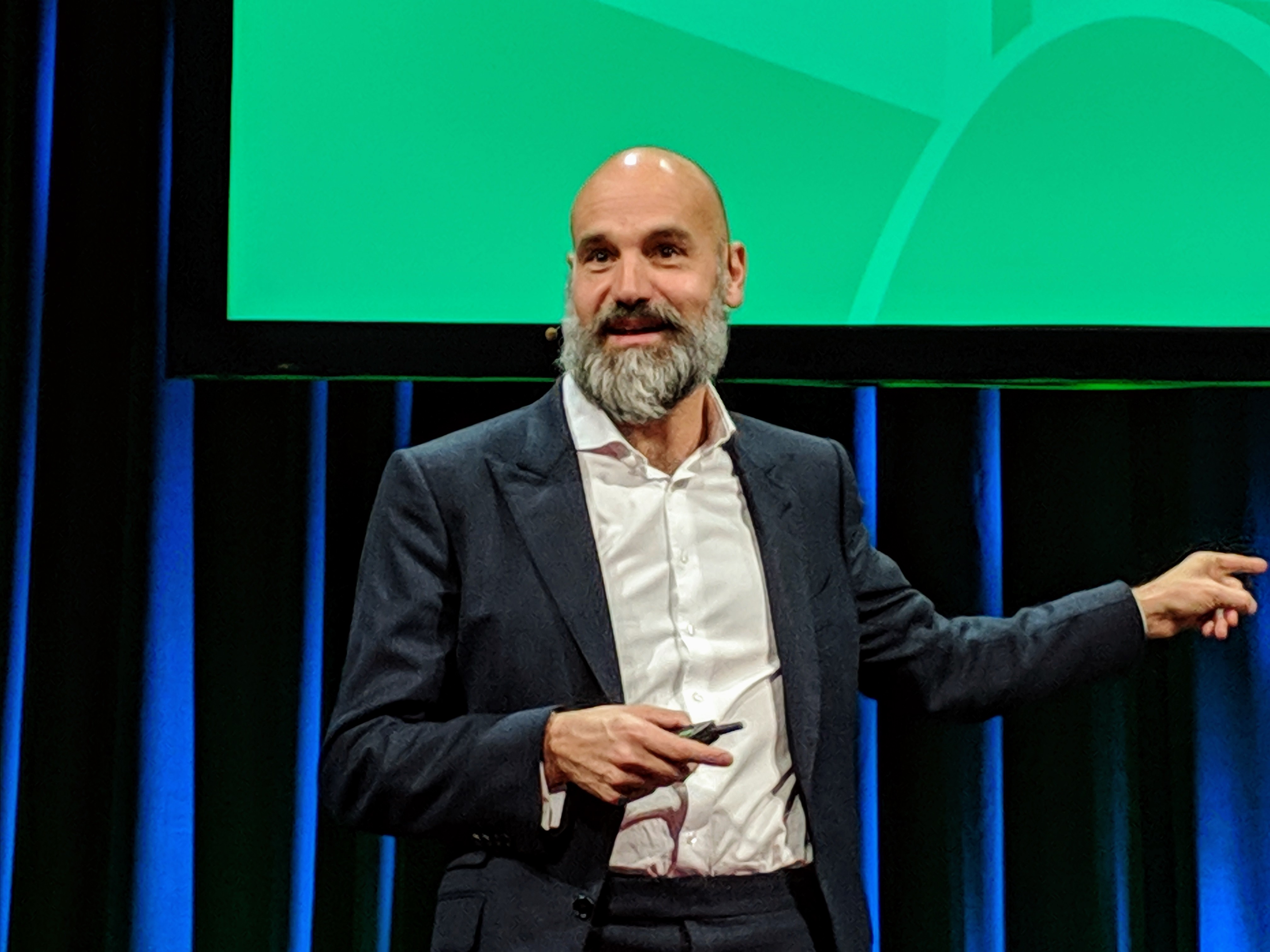
It’s no secret that Shuttleworth, who sports an impressive beard these days, was previously resistant to this, and he acknowledged as much. “I think that’s a fair characterization,” he said. “I enjoy my independence and I enjoy being able to make long-term calls. I still feel like I’ll have the ability to do that, but I do appreciate keenly the responsibility of taking other people’s money. When it’s your money, it’s slightly different.”
Refocusing Canonical on the enterprise business seems to be paying off already. “The numbers are looking good. The business is looking healthy. It’s not a charity. It’s not philanthropy,” he said. “There are some key metrics that I’m watching, which are the gate for me to take the next step, which would be growth equity.” Those metrics, he told me, are the size of the business and how diversified it is.
Shuttleworth likens this program of getting the company ready to IPO to getting fit. “There’s no point in saying: I haven’t done any exercise in the last 10 years but I’m going to sign up for tomorrow’s marathon,” he said.
The move from being a private company to taking outside investment and going public — especially after all these years of being self-funded — is treacherous, though, and Shuttleworth admitted as much, especially in terms of being forced to setting short-term goals to satisfy investors that aren’t necessarily in the best interest of the company in the long term. Shuttleworth thinks he can negotiate those issues, though.
Interestingly, he thinks the real danger is quite a different one. “I think the most dangerous thing in making that shift is the kind of shallowness of the unreasonably big impact that stock price has on people’s mood,” he said. “Today, at Canonical, it’s 600 people. You might have some that are having a really great day and some that are having a shitty day. And they have to figure out what’s real about both of those scenarios. But they can kind of support each other. […] But when you have a stock ticker, everybody thinks they’re having a great day, or everybody thinks they’re having a shitty day in a way that may be completely uncorrelated to how well they’re actually doing.”
Shuttleworth does not believe that IBM’s acquisition of its competitor Red Hat will have any immediate effect on its business, though. What he does think, however, is that this move is making a lot of people rethink for the first time in years the investment they’ve been making in Red Hat and its enterprise Linux distribution. Canonical’s promise is that Ubuntu, as well as its OpenStack tools and services, are not just competitive but also more cost-effective in the long run, and offer enterprises an added degree of agility. And if more businesses start looking at Canonical and Ubuntu, that can only speed up Shuttleworth’s (and his bankers’) schedule for hitting Canonical’s metrics for raising money and going public.
6 Questions From *The New York Times*’ Facebook Bombshell
Facebook has a lot of explaining to do: For starters, there’s Sheryl Sandberg’s next steps and the accusations about George Soros.
SpaceX gets FCC approval to add 7,518 more satellites to its Starlink constellation
SpaceX’s application to add thousands of satellites to its proposed Starlink communications constellation has been approved by the FCC, though it will be some time before the company actually puts those birds in the air.
SpaceX is just one of many companies that the FCC gave the green light to today at its monthly meeting. Kepler, Telesat and LeoSat also got approval for various services, though with 140, 117 and 78 satellites proposed respectively, they aren’t nearly as ambitious in scale. Several others were approved, as well, with smaller proposals.
SpaceX officially applied to put these 7,518 satellites into orbit — alongside the already approved 4,409 — back in March of 2017. Last month the FCC indicated it planned to approve the request by circulating a draft order (PDF) to that effect, which it today made official.
These satellites would orbit at the extremely low (for satellites) altitude of around 340 kilometers — even lower than the 550-kilometer orbit it plans to put 1,584 satellites in from the other group.
Low orbits decay quickly and satellites may only last a couple of years before they burn up. But being closer to the Earth also means that latency and required power for signals is considerably lower. It requires more satellites to cover a given area, but if managed properly it’ll produce a faster, more reliable connection or augment the system in areas where demand is high. Since SpaceX has only launched two test satellites so far, this is more or less theoretical, though.
The satellites would also be using V-band radio rather than the more common Ka/Ku band often employed by this general type of service, which as it points out will keep those popular bands unclogged as satellite numbers multiply.
Launches of the new system should begin some time next year if the new management at Starlink wants to keep their jobs. It would take quite a long time to get enough satellites into orbit that the service would work even in bare-bones fashion, but it isn’t bad going from idea to minimum viable product in a handful of years, when that MVP has to be hundreds of satellites actually in space.
You might be wondering whether this all will produce rather a lot of trash in orbit, since all these launches and the satellites themselves produce waste of various kinds. Well, SpaceX is one of the good ones here, as not only is it pursuing reusable first stages instead of having them float off and break up, but low orbit satellites like these are the least likely to clutter space. Rocket Lab, which just raised $140 million after sending up its own first commercial mission to space, is also very focused on this problem.
The FCC is, for some reason, one of the major authorities on orbital debris, and is currently looking at revising its rules.
“It’s been over a decade since we last reviewed our orbital debris rules, and in that time, the number of satellites in use has increased dramatically,” said FCC Chairman Ajit Pai in a statement accompanying the news. “So it’s high time for the Commission to take up this important topic once again.”
Commissioner Jessica Rosenworcel, one of the driving forces behind the effort, was lukewarm on the current effort.
The agency needs to “do more than just accelerate this problem by rubber stamping every next-generation satellite application that comes our way using yesterday’s orbital debris rules,” she wrote in a statement, and today’s rulemaking proposal is “only a timid start.”
“Moreover, I am concerned it does not set this agency up for success in the future. It misses the forest for the trees. It also muddles the path forward. This is not the leadership we need as we embark on a new era in space. We need clear guidance from this agency.”
The proposed rules are not close to final or complete, but should be public soon — we’ll take a good look at them when that happens and see how the FCC plans to fight the orbital debris problem before it turns into a crisis.
Facebook will pass off content policy appeals to a new independent oversight body
Facebook doesn’t want to be the arbiter of decency when it comes to content policy decisions, similar to how it looked to third-party fact checkers rather than becoming an arbiter of truth. Today on a press call with journalists, Mark Zuckerberg announced that a new external oversight committee would be created in 2019 to handle some of Facebook’s content policy decisions. The body will take appeals and make final decisions. The hope is that beyond the influence of Facebook’s business imperatives or the public’s skepticism about the company’s internal choices, the oversight body can come to the proper conclusions about how to handle false information, calls to violence, hate speech, harassment and other problems that flow through Facebook’s user-generated content network.
“I believe the world is better off when more people have a voice to share their experiences . . . at the same time we have a responsibility to keep people safe,” Zuckerberg said. “When you connect 2 billion people, you’re going to see all the good and bad of humanity. Different cultures have different norms, not only about what content is okay, but also about who should be making those decisions in the first place.” He cites how use of a racial slur could be hate speech or condemning hate speech as the kind of decision Facebook could use help with.
Zuckerberg explained that over the past year he’s come to believe that so much power over free expression should not be concentrated solely in Facebook’s hands. That echoes his sentiment from an interview with Ezra Klein earlier this year when he suggested Facebook may need a “supreme court” to decide on controversial issues. Zuckerberg says he sees Facebook’s role as more akin to how a government is expected to reduce crime but not necessarily eliminate it entirely. “Our goal is to err on the side of giving people a voice while preventing real-world harm,” he writes. “These are not problems you fix, but issues where you continually improve.”
How the independent appeals body will work
Zuckerberg describes that when someone initially reports content, Facebook’s systems will do the first level of review. If a person wants an appeal, Facebook will also handle this second level of review and scale up its systems to handle a lot of cases. Then, he says, “The basic approach is going to be if you’re not happy after getting your appeal answered, you can try to appeal to this broader body. It’s probably not going to review every case like some of the higher courts . . . it might be able to choose which cases it thinks are incredibly important to look at. It will certainly need to be transparent about how it’s making those decisions.
Zuckerberg said Facebook will be working to get the oversight body up and running over the next year. For now, there are plenty of unanswered questions about who will be on the committee, which of the many appeals it will review and what ensures it’s truly independent from Facebook’s power. “One of the biggest questions we need to figure out in the next year is how to do the selection process for this body so that it’s independent . . . while giving people a voice . . . and keeping people safe. If the group ends up too tightly decided by Facebook it won’t feel like it’s independent enough.” Facebook plans to query experts and start running pilots over the next year to determine what approaches to codify.
Facebook launched an internal appeals system this year that let users request a second review when their content is taken now, and Facebook plans to expand that to allow people to appeal responses when they report other people’s content. But the new independent body will serve as the final level of escalation for appeals
[Update: Since we published this report, Zuckerberg has released a 5,000-word letter describing his thoughts on Facebook policy, and the oversight body. You can read it below:]
Posted by Mark Zuckerberg on Thursday, November 15, 2018
Here’s the passage about the oversight committee:
In the next year, we’re planning to create a new way for people to appeal content decisions to an independent body, whose decisions would be transparent and binding. The purpose of this body would be to uphold the principle of giving people a voice while also recognizing the reality of keeping people safe.
I believe independence is important for a few reasons. First, it will prevent the concentration of too much decision-making within our teams. Second, it will create accountability and oversight. Third, it will provide assurance that these decisions are made in the best interests of our community and not for commercial reasons.
This is an incredibly important undertaking — and we’re still in the early stages of defining how this will work in practice. Starting today, we’re beginning a consultation period to address the hardest questions, such as: how are members of the body selected? How do we ensure their independence from Facebook, but also their commitment to the principles they must uphold? How do people petition this body? How does the body pick which cases to hear from potentially millions of requests? As part of this consultation period, we will begin piloting these ideas in different regions of the world in the first half of 2019, with the aim of establishing this independent body by the end of the year.
Over time, I believe this body will play an important role in our overall governance. Just as our board of directors is accountable to our shareholders, this body would be focused only on our community. Both are important, and I believe will help us serve everyone better over the long term.
Avoiding or acknowledging the weight of its decisions?
The past year has seen Facebook criticized for how it handled calls for violence in Myanmar, harassment and fake news by conspiracy theorists like Alex Jones, election interference by Russian, Iranian and other state actors, and more. Most recently, The New York Times published a scathing report about how Facebook tried to distract from or deflect criticism of its myriad problems, including its failure to prevent election interference ahead of the 2016 presidential race.
The oversight committee could both help Facebook make smarter decisions that the world can agree with, and give Facebook a stronger defense to this criticism because it’s not the one making the final policy calls. The approach could be seen as Facebook shirking its responsibility, or as it understanding that the gravity of that responsibility exceeds its own capabilities.
You can listen to the entire press call here (I apologize for the keyboard sounds).
[Update: We’ve updated this story with information from Zuckerberg’s Blueprint letter.]
The Beauty and Danger of Australia’s Salt Lakes
Perth-based photographer Leah Kennedy captures the duality of Australia’s salinization crisis in a series of extraordinary images.