Facebook has poached the DoJ’s Silicon Valley antitrust chief

Facebook has recruited Kate Patchen, a veteran of the U.S. Department of Justice who led its antitrust office in Silicon Valley, to be a director and associate general counsel of litigation.

Patchen takes up her post amid ongoing scandals and reputation crises for her new employer, joining Facebook this month, according to her LinkedIn profile.

The move was spotted earlier by the FT, which reports that Facebook also posted a job listing on LinkedIn for a “lead counsel” in Washington to handle competition issues two weeks ago — suggesting a broader effort to bulk up its in-house expertise.

Patchen brings to her new employer a wealth of experience on the antitrust topic, having spent 16 years at the DoJ, where she began as a trial attorney before becoming an assistant chief in the antitrust division in 2014. Two years later she was made chief.

We reached out to Facebook about the hire and it acknowledged our email but did not immediately provide comment on its decision to recruit a specialist in antitrust enforcement.

The social media giant certainly has plenty playing on its mind on this front.

In 2016 it landed firmly on lawmakers’ radar and in hot political waters when the extent of Kremlin-funded election interference activity on the platform first emerged. Since then a string of security and data misuse scandals have only dialed up the political pressure on Facebook.

Domestic lawmakers are now most actively discussing how to regulate social media. Although competition scrutiny is increasing on big tech in general, with calls from some quarters to break up platform giants as a fix for a range of damaging impacts.

The FT notes, for example, that democratic lawmakers recently introduced legislation to address “the threat of economic concentration.” And the sight of Democrats pushing for tougher competition enforcement suggests the party’s love affair with Silicon Valley tech giants is well and truly over.

In Europe, competition regulators have already moved against big tech, issuing two very large fines in recent years against Google products, with more investigations ongoing.

Amazon is also now on the Commission’s radar. At a national level, EU competition regulators have been paying increasing attention to how the adtech industry is dominated by the duopoly of Google and Facebook.

Patchen, meanwhile, joins Facebook at the same time as some long-serving veterans are headed out the door — including public policy chief Elliot Schrage.

Schrage’s departure has been in train for some months, but a leaked internal memo we obtained this week suggests he’s being packaged up as a convenient fall guy for a freshly cracked public relations scandal.

Last month Facebook announced it was hiring more new blood: Former deputy prime minister of the U.K., Nick Clegg, to be its new head of global policy and comms — with Schrage slated then to be staying on in an advisory capacity.

In other recent senior leadership moves, Facebook CSO Alex Stamos also left the company this summer, while chief legal officer Colin Stretch announced he would leave at the end of the year.

But according to a Recode report this month, Stretch has now put his exit on hold — until at least next summer — apparently deciding to stay to help out with ongoing legal and political crises.
Google Assistant iOS update lets you say ’Hey Siri, OK Google’

Apple probably didn’t intend to let competitors take advantage of Siri Shortcuts this way, but you can now launch Google Assistant on your iPhone by saying “Hey Siri, OK Google .”

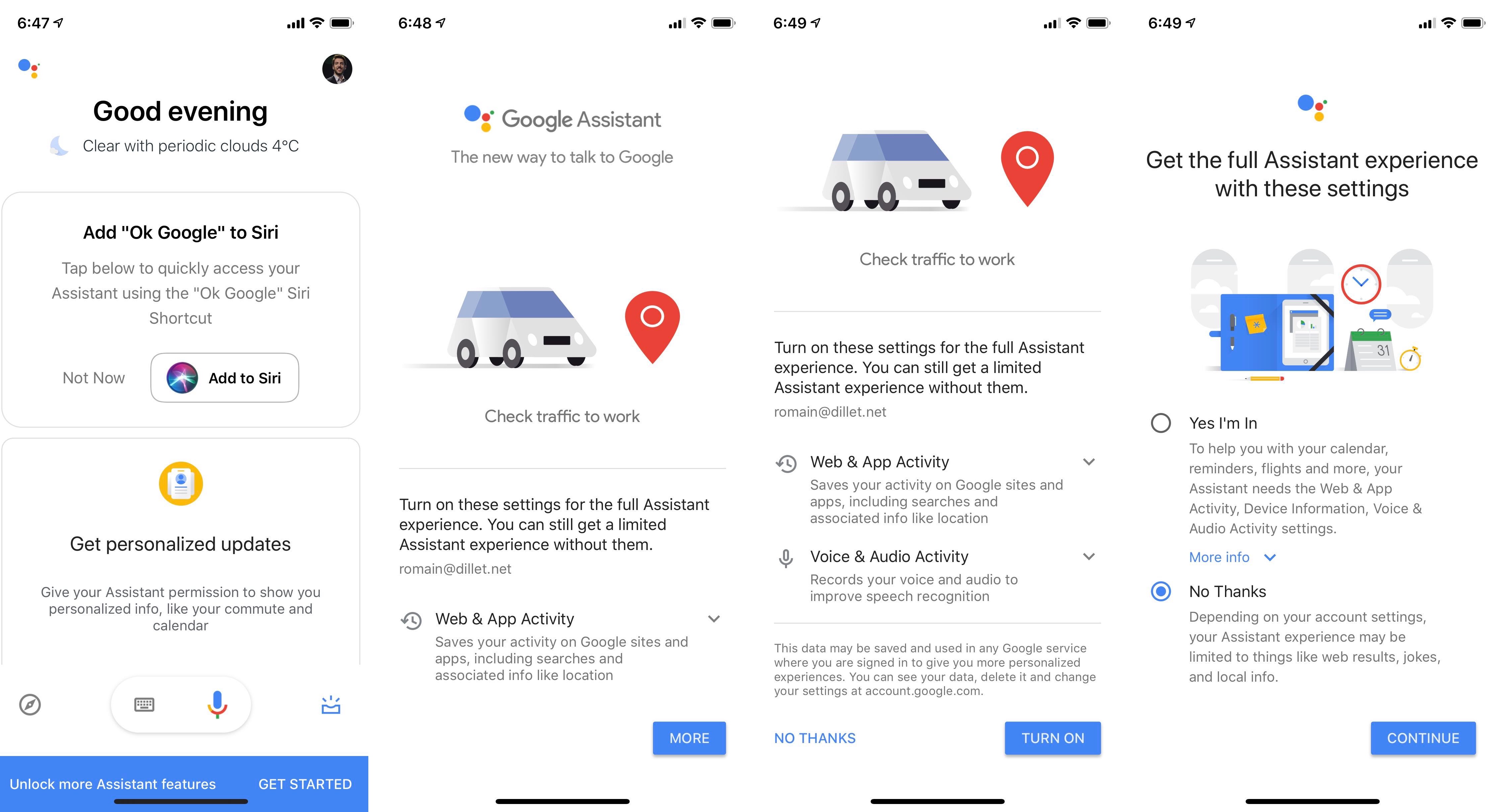
But don’t expect a flawless experience — it takes multiple steps. After updating the Google Assistant app on iOS, you need to open the app to set up a new Siri Shortcut for Google Assistant.

As the name suggests, Siri Shortcuts lets you record custom phrases to launch specific apps or features. For instance, you can create Siri Shortcuts to play your favorite playlist, launch directions to a specific place, text someone and more. If you want to chain multiple actions together, you can even create complicated algorithms using Apple’s Shortcuts app.

By default, Google suggests the phrase “OK Google.” You can choose something shorter, or “Hey Google,” for instance. After setting that up, you can summon Siri and use this custom phrase to launch Google’s app.

You may need to unlock your iPhone or iPad to let iOS open the app. The Google Assistant app then automatically listens to your query. Again, you need to pause and wait for the app to appear before saying your query.

This is quite a cumbersome walk-around and I’m not sure many people are going to use it. But the fact that “Hey Siri, OK Google” exists is still very funny.

On another note, Google Assistant is still the worst when it comes to your privacy. The app pushes you to enable “web & app activity,” the infamous all-encompassing privacy destroyer. If you activate that setting, Google will collect your search history, your Chrome browsing history, your location, your credit card purchases and more.

It’s a great example of dark pattern design. If you haven’t enabled web & app activity, there’s a flashy blue banner at the bottom of the app that tells you that you can “unlock more Assistant features.”

When you tap it, you get a cute little animated drawing to distract you from the text. There’s only one button, which says “More,” If you tap it, the “More” button becomes “Turn on” — many people are not even going to see “No thanks” on the bottom left.

It’s a classic persuasion method. If somebody asks you multiple questions and you say yes every time, you’ll tend to say yes to the last question even if you don’t agree with it. You tapped on “Get started” and “More” so you want to tap on the same button one more time. If you say no, Google asks you one more time if you’re 100 percent sure.

So make sure you read everything and you understand that you’re making a privacy trade-off by using Google Assistant.

Drone.io, Packet team on free continuous delivery service for open-source developers

Drone.io, makers of the open-source Drone continuous integration/continuous delivery tool (CI/CD), announced Drone Cloud today, a new CI/CD cloud service that it’s making available for free to open-source projects. The company is teaming with Packet, which is offering to run the service for free on its servers.

Drone.io co-founder Brad Rydzewski says his company is “a container-native continuous delivery platform, and its goal is to help automate the developer workflow from testing to release.” Continuous delivery is an approach built on cloud-native, the idea that you can manage cloud and on prem with single set of management tools. From a developer standpoint, it relies on containers as a way to continuously deliver application updates as changes happen.

As part of that approach, the newly announced Drone Cloud provides a publicly hosted CI/CD cloud offering. “It’s free for the open-source community. So it’s an open source only offering. There’s no paid plan, and it’s only available to public GitHub repositories,” Rydzewski explained.

Rydzewski says the service was born out of a need for his own project. He found it hard to find publicly hosted solutions that offered a way to test a variety of operating systems and chip architectures. “It’s really something we needed for ourselves. The Drone community wanted to run Drone on Windows on Arm 64 processors. We actually had no way to build and test the software on these platforms because there was just no publicly hosted solution that we could use,” he explained.

When they decided to build this solution for themselves, they figured it was going to be useful to other open-source projects that also want to ship and support multiple operating systems and architectures. They got Packet on board to offer the infrastructure.

Packet offers a variety of server options with different operating systems and chips, and Rydzewski says this was an important consideration for the open-source developers who will take advantage of this service. Packet is making the latest Intel Xeon Scalable, AMD EPYC and Arm-based servers available to users of the Drone Cloud service for free as part of a multi-year donation to support the project.

“As open source software is deployed to increasingly diverse environments, from traditional data centers to cars and even drones, the need for multi-architecture builds has exploded,” Jacob Smith, co-founder and CMO at Packet said in a statement. This is Packet’s way of supporting that effort.

Drone does not intend to establish a paid layer for Drone Cloud, according to Rydzewski, but he hopes it shows what Drone can do, which in turn could attract some developers to the paid version of the product. In addition to supporting the open-source version, the company offers a paid version that can be installed on premises as a part of a private cloud-native development environment.

Facebook appeals UK data watchdog’s £500K Cambridge Analytica fine

Facebook has said it will appeal a £500,000 penalty issued by the U.K.’s data watchdog this summer following a lengthy investigation into the Cambridge Analytica data misuse scandal.

Facebook told the regulator an estimated one million U.K. users were among the 87 million of its users whose private data was harvested by Dr. Aleksandr Kogan and his company Global Science Research back in 2014 — which passed the data to the now defunct political consultancy, Cambridge Analytica.

Their intent had been to build psychographic profiles of U.S. voters. Kogan shared the harvested Facebook data more widely — and the U.K. regulator is still looking into all the places it ended up.

In July, the ICO announced it intended to fine Facebook the maximum possible amount under the U.K.’s old data protection regime — saying it was “clear” the company had contravened the law “by failing to keep users’ data safe” when its systems allowed Kogan’s app to scrape Facebook user data.

It confirmed the penalty a month ago, with commissioner Elizabeth Denham saying then: “Facebook failed to sufficiently protect the privacy of its users before, during and after the unlawful processing of this data. A company of its size and expertise should have known better and it should have done better.”

Although the text of its October decision includes the admission that the ICO had not found evidence that any U.K. Facebook users’ data had actually been passed to Kogan.

“Facebook has asserted that the only individuals whose personal data was used in this way [shared by Kogan with third parties including Cambridge Analytica] were US residents,” it writes on this, before adding that even if Facebook’s assertion is correct some U.S. residents would also have been U.K. users “from time to time” (e.g. if visiting the U.K.) — and thus would fall under its remit.

It also pointed to “serious risk” to U.K. users’ data being material to its decision, writing: “Dr. Kogan and/or GSR were put in a position where they were effectively at liberty (if they so chose) to use the personal data of UK residents for such purposes, or to share such data with persons or companies who would use it for such purposes.”

On that basis, Facebook appears to be resting its appeal against the ICO decision on its own assertion to the ICO that there’s no evidence of U.K. users’ data being used.

Commenting on its decision to appeal against the ICO’s fine in a statement, Anna Benckert, its EMEA VP & associate general counsel, said:

We have said before that we wish we had done more to investigate claims about Cambridge Analytica in 2015. We made major changes to our platform back then and have also significantly restricted the information app developers can access. And we are investigating all historic apps that had access to large amounts of information before we changed our platform policies in 2014.

The ICO’s investigation stemmed from concerns that UK citizens’ data may have been impacted by Cambridge Analytica, yet they now have confirmed that they have found no evidence to suggest that information of Facebook users in the UK was ever shared by Dr Kogan with Cambridge Analytica, or used by its affiliates in the Brexit referendum.

Therefore, the core of the ICO’s argument no longer relates to the events involving Cambridge Analytica. Instead, their reasoning challenges some of the basic principles of how people should be allowed to share information online, with implications which go far beyond just Facebook, which is why we have chosen to appeal.

For example, under ICO’s theory people should not be allowed to forward an email or message without having agreement from each person on the original thread. These are things done by millions of people every day on services across the internet, which is why we believe the ICO’s decision raises important questions of principle for everyone online which should be considered by an impartial court based on all the relevant evidence.

We’ve reached out to the ICO for comment. Update: An ICO spokesperson said: “Any organisation issued with a monetary penalty notice by the Information Commissioner has the right to appeal the decision to the First-tier Tribunal. The progression of any appeal is a matter for the tribunal. We have not yet been notified by the Tribunal that an appeal has been received.”

Last month, Denham explained the decision to impose the maximum penalty on Facebook by saying: “We considered these contraventions to be so serious we imposed the maximum penalty under the previous legislation. The fine would inevitably have been significantly higher under the GDPR. One of our main motivations for taking enforcement action is to drive meaningful change in how organizations handle people’s personal data.”

This summer her office issued its first-ever enforcement notice under the new GDPR data protection regime against Canadian data firm AIQ, which had supplied software and services to the disgraced Cambridge Analytica.

But last month the ICO issued a narrower enforcement notice, replacing the earlier notice, after AIQ appealed.

Affetto is the wild-boy-head robot of your nightmares

Affetto is a robot that can smile at you while it pierces your soul with its endless, dead state. Created by researchers at Osaka University, this crazy baby-head robot can mimic human emotions by scrunching up its nose, smiling and even closing its eyes and frowning. Put it all together and you get a nightmare from which there is no sane awakening!

Android robot faces have persisted in being a black box problem: they have been implemented but have only been judged in vague and general terms,” study first author Hisashi Ishihara says. “Our precise findings will let us effectively control android facial movements to introduce more nuanced expressions, such as smiling and frowning.”

We last saw Affetto in action in 2011 when it was even more frightening than it is now. The researchers have at least added some skin and hair to this cyberdemon, allowing us the briefest moment of solace as we stare into Affetto’s dead eyes and hope it doesn’t gum us to death. Ain’t the future grand?

The goal, obviously, is to lull humans into a state of calm as the rest of Affetto’s body, spiked and bladed, can whir them to pieces. The researchers write:

A trio of researchers at Osaka University has now found a method for identifying and quantitatively evaluating facial movements on their android robot child head. Named Affetto, the android’s first-generation model was reported in a 2011 publication. The researchers have now found a system to make the second-generation Affetto more expressive. Their findings offer a path for androids to express greater ranges of emotion, and ultimately have deeper interaction with humans.

The researchers investigated 116 different facial points on Affetto to measure its three-dimensional movement. Facial points were underpinned by so-called deformation units. Each unit comprises a set of mechanisms that create a distinctive facial contortion, such as lowering or raising of part of a lip or eyelid. Measurements from these were then subjected to a mathematical model to quantify their surface motion patterns.

Pro tip: Just slap one of these on your Roomba and send it around the house. The kids will love it and the cat will probably die of a heart attack.

Amazon admits it exposed customer email addresses, but refuses to give details

Amazon’s renowned secrecy encompasses its response to a new security issue, withholding info that could help victims protect themselves.

Amazon emailed users Tuesday, warning them that it exposed an unknown number of customer email addresses after a “technical error” on its website.

When reached for comment, an Amazon spokesperson told TechCrunch that the issue exposed names as well as email addresses. “We have fixed the issue and informed customers who may have been impacted.” The company emailed all impacted users to be cautious.

In response to a request for specifics, a spokesperson said the company had “nothing to add beyond our statement.” The company denies there was a data breach of its website of any of its systems, and says it’s fixed the issue, but dismissed our request for more info including the cause, scale and circumstances of the error.

Amazon’s reticence here puts those impacted at greater risk. Users don’t know which of Amazon’s sites was impacted, who their email address could have been exposed to, or any ballpark figure of the number of victims. It’s also unclear whether it has or plans to contact any government regulatory bodies.

“We’re contacting you to let you know that our website inadvertently disclosed your email address due to a technical error,” said Amazon in the email with the subject line: “Important Information about your Amazon.com Account.” The only details Amazon provided were that: “The issue has been fixed. This is not a result of anything you have done, and there is no need for you to change your password or take any other action.”

The security lapse comes days ahead of one of the busiest retail days of the year, the post-Thanksgiving holiday sales day, Black Friday. The issue could scare users away from Amazon, which could be problematic for revenue if the issue impacted a wide number of users just before the heavy shopping day.

Amazon’s vague and non-specific email also sparked criticism from users — including security experts — who accused the company of withholding information. Some said that the correspondence looked like a phishing email, used to trick customers into turning over account information.

Customers in the U.S., the U.K. and Europe have reported receiving an email from Amazon.

Amazon's legit been sending out notices saying sorry we exposed your email address. Seems likely related to this https://t.co/21cRB2dHTk… Besides the brevity, what's giving people pause is they sign the email https://t.co/KDiteRFaeR Why cap the "a" and why no https://? Strange pic.twitter.com/mwty3GmCN1

— briankrebs (@briankrebs) November 21, 2018

#AmazonDataBreach #AmazonEmail @amazon @AmazonHelp @AmazonUK Not exactly reassuring and would be interesting to see the extent of the breach and how it relates to GDPR. Think customers need an explanation & if their financial details have been compromised – you have duty of care pic.twitter.com/fk5kSs458D

— Katya von der Goltz King (@KatyavdGK) November 21, 2018

Amazon, as a Washington-based company, is required to inform the state attorney general of data incidents involving 500 state residents or more. Yet, in Europe, where data protection rules are stronger — even in the wake of the recently introduced General Data Protection Regulation (GDPR) — it’s less clear if Amazon needs to disclose the incident.

The U.K.’s data protection regulator, the Information Commissioner’s Office, told TechCrunch: “Under the GDPR, organizations must assess if a breach should be reported to the ICO, or to the equivalent supervisory body if they are not based in the UK.”

“It is always the company’s responsibility to identify when UK citizens have been affected as part of a data breach and take steps to reduce any harm to consumers,” a spokesperson said. “The ICO will however continue to monitor the situation and cooperate with other supervisory authorities where required.”

To continue earning our trust, technology companies need to be forthcoming and transparent when security problems arise. Not only does that provide victims with the maximum amount of information they can use to recover and avoid future problems, but it also gives users confidence that their data is being responsibly managed no matter what happens.

People fear what they don’t understand, and for now, Amazon is failing to help the public understand what happened.

TechCrunch’s Natasha Lomas contributed to this report.

CV Compiler is a robot that fixes your resume to make you more competitive

Machine learning is everywhere now, including recruiting. Take CV Compiler, a new product by Andrew Stetsenko and Alexandra Dosii. This web app uses machine learning to analyze and repair your technical resume, allowing you to shine to recruiters at Google, Yahoo and Facebook.

The founders are marketing and HR experts who have a combined 15 years of experience in making recruiting smarter. Stetsenko founded Relocate.me and GlossaryTech while Dosii worked at a number of marketing firms before settling on CV Compiler.

The app essentially checks your resume and tells you what to fix and where to submit it. It’s been completely bootstrapped thus far and they’re working on new and improved machine learning algorithms while maintaining a library of common CV fixes.

“There are lots of online resume analysis tools, but these services are too generic, meaning they can be used by multiple professionals and the results are poor and very general. After the feedback is received, users are often forced to buy some extra services,” said Stetsenko. “In contrast, the CV Compiler is designed exclusively for tech professionals. The online review technology scans for keywords from the world of programming and how they are used in the resume, relative to the best practices in the industry.”

The product was born out of Stetsenko’s work at GlossaryTech, a Chrome extension that helps users understand tech terms. He used a great deal of natural language processing and keyword taxonomy in that product and, in turn, moved some of that to his CV service.

“We found that many job applications were being rejected without even an interview, because of the resumes. Apparently, 10 seconds is long enough for a recruiter to eliminate many candidates,” he said.

The service is live now and the team expects the corpus of information to grow and improve over time. Until then, why not let a machine learning robot tell you what you’re doing wrong in trying to get a job? That is, before it replaces you completely.

Quantum Machines raises $5.5M to build control and operational layer for quantum computers

Quantum Machines, an Israeli startup launched by three Ph.D. physicists, wants to build the operational and control layer for quantum computing. Today, it announced a $5.5 million seed investment led by TLV Partners with participation from Battery Ventures.

The three principals have been studying quantum computing for a decade and they understand that to commercialize it, it’s going to require a complete solution. Right now the majority of the research is centered on increasing the number of qubits at the processor level. Co-founder and CEO Itamar Sivan says in order to advance the technology, it’s going to take an operational and control layer to make it all work, and that is where the founders decided to concentrate the company’s efforts, he said.

Sivan explained that there is a point where the classical computers we use today and the quantum computers of the future will have to work together to pass data and interpret commands. He described three layers in a quantum computing stack. The first is the quantum processor. Next is a classical computing control layer with classical electronics you would find on any computer today. Finally, there is the software layer where you program a classical algorithm that has to be passed to the quantum processor.

He says that some companies are trying to build full stacks, but the bulk of research as been concentrated on building quantum processors. Quantum Machines decided to focus on one part of the stack. “We have come to the conclusion that there must be a company laser-focused on a vertically integrated control solution that includes the classical hardware and software,” Sivan said.

“The power of quantum computers stems from their complexity and richness, though it is also this complexity which makes them incredibly difficult to control and operate — this is the problem our company is attempting to solve,” he added in a statement.

The company is currently working on prototype hardware to build this layer and is working with several beta customers at the moment. It’s early days for the company, but the seed money should help them accelerate that vision and get a product to market more quickly.