Facebook quietly hired Republican strategy firm Targeted Victory

Facebook is still reeling from the revelation that it hired an opposition research firm with close ties to the Republican party, but its relationship with Definers Public Affairs isn’t the company’s only recent contract work with deeply GOP-linked strategy firms. While that work alone isn’t cause for controversy, Facebook’s work with Republican groups does call into question the ongoing narrative that Facebook operates with an anti-conservative bias.

According to sources familiar with the project, Facebook also contracted with Targeted Victory, described as “the GOP’s go-to technology consultant firm.” Targeted Victory worked with Facebook on the company’s Community Boost roadshow, a tour of U.S. cities meant to stimulate small business interest in Facebook as a business and ad platform. The ongoing Community Boost initiative, announced in late 2017, kicked off earlier this year with stops in cities like and Topeka, Kansas and Albuquerque, New Mexico.

Facebook also worked with Targeted Victory on the company’s ad transparency efforts. Over the last year, Facebook has attempted to ward off regulation from Congress over ad disclosure, even putting forth some self-regulatory efforts to appease legislators. Specifically, it has dedicated considerable lobbying resources to slow any progress from the Honest Ads Act, a piece of legislature that would force the company to make retain copies of election ads, disclose spending and more. Targeted Victory, a digital strategy and marketing firm, is not a registered lobbyist for Facebook on any work relating to ad transparency. 

Targeted Victory

On his company biography page, Targeted Victory founder and CEO Zac Moffatt describes his experience helping companies “enhance their brand and get their message out in the current political and media environment,” mentioning Facebook, FedEx and Gillette as corporate clients. The bio page appears to be one of the only public mentions of his work with Facebook and the company was not mentioned alongside Gillette and FedEx on his Linkedin page.

TechCrunch reached out to Facebook to ask if it also contracted with equivalent left-leaning groups or other political firms it was willing to disclose because information about the many firms a company like Facebook contracts with is generally not openly available. The company declined to comment on its political contract work and on the nature of its work with Targeted Victory.

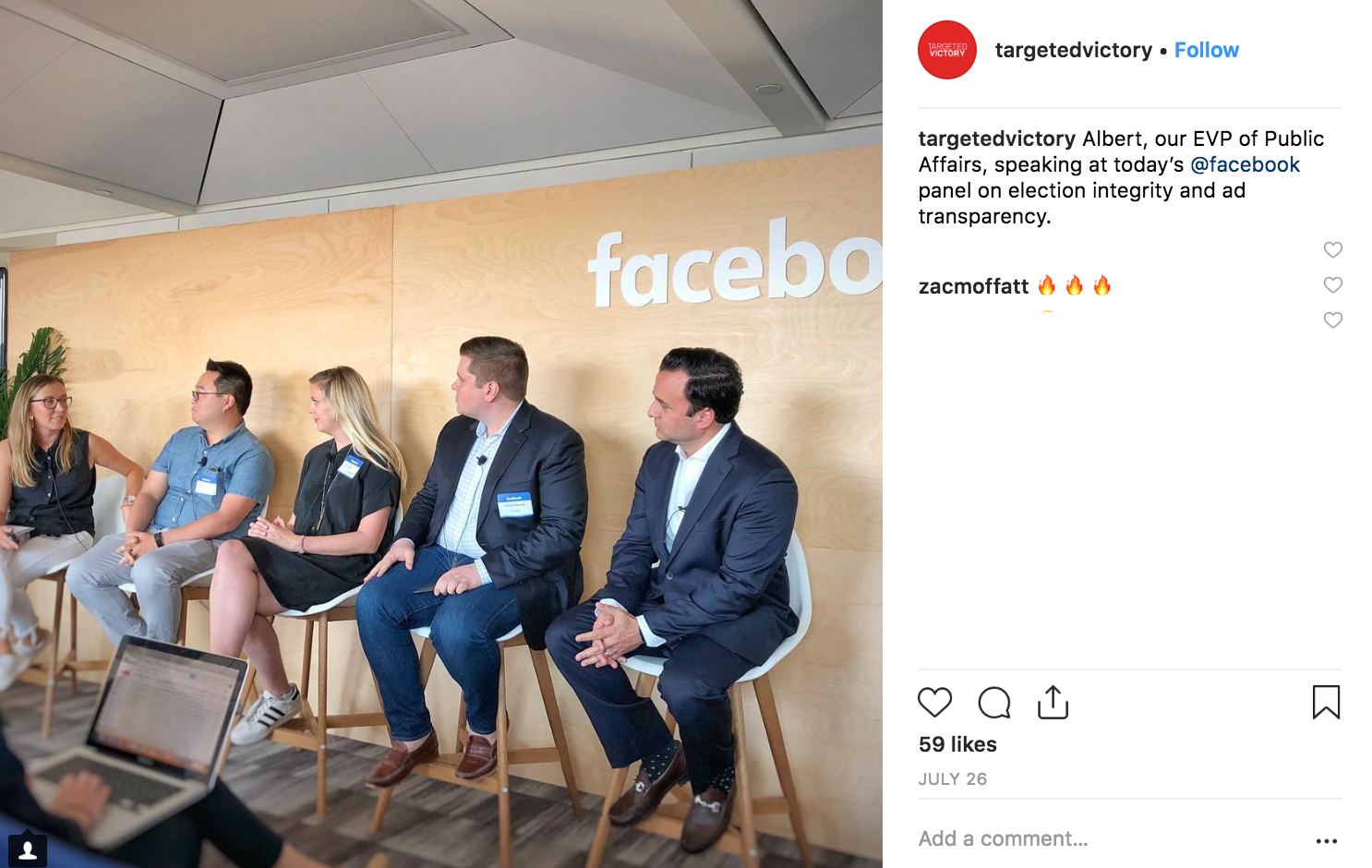
In July and September of this year, Facebook hosted members of Targeted Victory for panels on election integrity and ad transparency, as well as best practices for election season. It’s unclear if Facebook disclosed its financial relationship to the company at the time.
Facebook panel

In March of 2017, a blog post by Targeted Victory mentioned that a new investment would “strengthen [Targeted Victory’s] already unmatched relationships with top teams at Facebook, Google, Twitter and Snapchat” indicating that the company had an established rapport with Facebook and other major tech companies at the time. TechCrunch contacted Targeted Victory about the nature of its work for this story but did not receive a reply.

Like Definers, Targeted Victory was founded by digital team members from Mitt Romney’s 2012 presidential campaign who formed their own companies in the election’s aftermath. As TechCrunch previously reported, Facebook’s communications team has a number of ties to Romney’s campaign. The company’s contract work with Definers arose out of those connections, particularly through Andrea Saul, Facebook’s Director of Policy Communications . Though the depth of Facebook’s work with Targeted Victory is not yet known, TechCrunch will continue to report what it learns. 

Prior to Targeted Victory, Moffatt served as the digital director on the Romney campaign, founding his company after the campaign dissolved. Before working on the campaign, Moffatt worked for the Republican National Committee. 

While the extent of Targeted Victory’s work with Facebook is not clear, Moffatt’s firm provides a range of potentially relevant services. On its website, Targeted Victory advertises “public affairs, advertising, media planning, fundraising and reputation management.” The company also offers services in online political advertising and voter targeting as dual areas of expertise. 

Moffatt’s opposition of regulation efforts targeting online political advertising is well known. In an interview with Axios last year, Moffatt criticized congressional interest in regulating political ads. “No government regulator, and very few members of the media, understand how these mediums are being leveraged by campaigns,” Moffatt said, dismissing potential regulation for tech platforms as “a knee-jerk reaction.”

Late last year, Moffatt suggested that Facebook’s efforts to self regulate could boost the social giant’s profits. Specifically, that Facebook’s decision to ask political groups to publish the ads they buy could generate even more interest in ad buys as firms see what their rivals are up to and ratchet up their spending.

Facebook’s visible political money

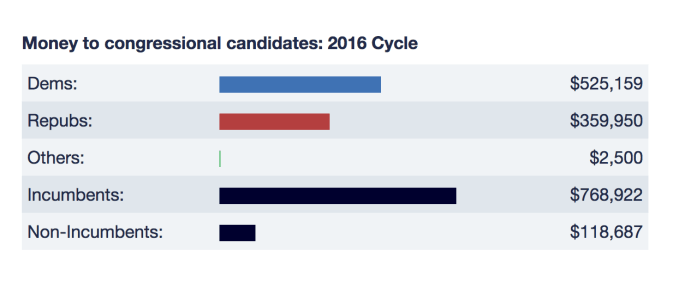
The world’s largest social network might be regarded as a just another liberal Silicon Valley stronghold by critics on the right, but Facebook’s financial disclosures and contract work tell a fairly different story. Facebook’s lobbying and federal political contributions in recent years depict a company with financial heft doled out to both the left and the right. Facebook’s federal lobbyists and political donations are registered in searchable public databases, but, as with any company, that data only reveals the surface layer of political relationships.
Facebook 2016 congressional contributions via OpenSecrets.org

Over the last three years, Facebook’s registered lobbying expenditures were mostly spent on large, uncontroversial bipartisan firms, a few smaller groups with specific partisan ties and a smattering of other issue-specific specialists. For example, Facebook brought on a Democratic former Senate chief of staff for lobbying related to “data security, online privacy, and elections integrity” and a firm called Capitol Tax Partners to lobby around tax reform.
Facebook PAC Contribution Summary via OpenSecrets.org

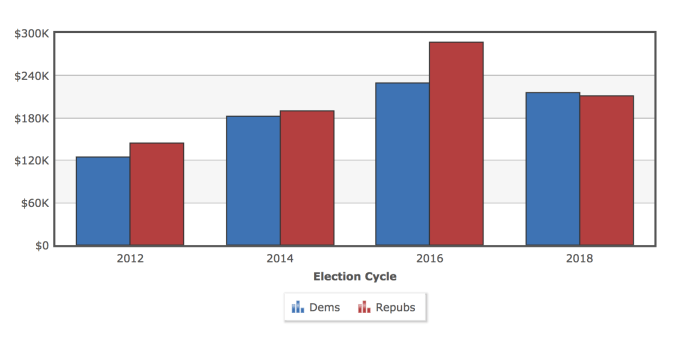
Historically, Facebook’s donations to Democratic candidates outweigh those to Republicans, though the numbers approached parity in the 2012 and 2014 election cycles. On the other hand, Facebook’s PAC, established in 2011, favored Republican candidates in three of the last four national election cycles, tipping Democratic by a margin of 1% in 2018. In 2016 Facebook’s PAC gave 44% of contributions to Democrats and 55% to Republican candidates.

At Facebook, Vice President of Global Public Policy Joel Kaplan “oversees all corporate political activity, including lobbying activities and political contributions.” A prominent Republican, Kaplan also oversees Facebook’s state level contributions, collected here, with the help of members of the company’s Public Policy, Legal and Communications departments. Kaplan made headlines in September when he sat in support of Brett Kavanaugh, the Supreme Court nominee accused of sexual violence and later confirmed. Following the confirmation, Kaplan and his wife hosted a party for Kavanaugh.

Making amends with conservatives

It’s not clear when Facebook’s relationship with Targeted Victory began and whether Facebook has ramped up relationships with conservative consultants in recent years or held them steady.

In May 2016, Moffatt attended a high profile meeting with Mark Zuckerberg, Sheryl Sandberg and 15 other prominent conservatives. Facebook ostensibly organized the meeting to mend fences with Republicans who were criticizing the social giant for a perceived bias against conservatives.

“I know many conservatives don’t trust that our platform surfaces content without a political bias,” Mark Zuckerberg said in a Facebook post following the meeting. “I wanted to hear their concerns personally and have an open conversation about how we can build trust.”

After the meeting, Moffatt remarked that anyone who didn’t see Facebook’s bias against conservative voices, part of a broader perceived trend in left-leaning Silicon Valley, “is completely missing the larger picture.”

In spite of the Facebook’s apparent financial ties to some of the GOP’s most closely held strategic groups, its Republican-helmed D.C. office and its contributions to candidates on both the left and right, criticisms that Facebook operates with a left-leaning bias remain a familiar chorus.

For his part, Moffatt was cautiously optimistic following the 2016 meeting with Sandberg and Zuckerberg, noting that “he would actually commend Facebook for being the only one of the major tech groups in Silicon Valley that’s willing to have conversations like this.”

Know anything about this story and have something to add? Email [email protected]. Secure contact for files and sensitive info: Signal 510.545.3125 or [email protected].

UrbanClap, India’s largest home services startup, raises $50M

UrbanClap, a four-year-old startup that offers home services across India, has closed a $50 million Series D round for expansion.

The round was led by Steadview Capital, a hedge fund with more than $1 billion under management, and existing investor Vy Capital. It takes UrbanClap to $110 million raised to date, according to data from Crunchbase.

Via its platform, UrbanClap matches service people, such as cleaners, repair staff or beauticians, with customers across 10 cities in India. Co-founder and CEO Abhiraj Bhal told TechCrunch that the business supports 15,000 “micro-franchisees” with around 450,000 transactions taking place each month.

“Micro-franchisees” is an interesting term — I’ve not heard it used much, even in the buzzword-heavy world of tech startups — but Bhal explained his vision to enable service workers to earn more and enjoy greater control of their work and, consequently, overall life.

For example, he said, the typical salary for an offline service worker might be in the region of 10-15,000 INR (up to $215) while, for those operating independently, their flow of work would be tied to a middleman, store or word of mouth networks. UrbanClap offers a more direct model, with workers keeping 80 percent of the cost of their jobs. That, Bhal said, means workers can earn multiples more and manage their own working hours.

“The UrbanClap model really allows them to become service entrepreneurs,” he said. “Their earnings will shoot up two or three-fold, and it isn’t uncommon to see it rise as much as 8X — it’s a life-changing experience.”

Beyond helping workers with their job, UrbanClap also provides training, credit, basic banking and more. Bhal said that around 20-25 percent of applicants are accepted into the platform, that’s a decision based on in-person meetings, background and criminal checks, as well as a “skills” test. Workers are encouraged to work exclusively — though it isn’t a requirement — and they wear UrbanClap outfits and represent the brand with customers.

While there is encouragement, there is also a level of monitoring. If a worker’s average review for their last 30/50 jobs (dependent on vertical) drops below 4.0, the system stops sending them work. There is an opportunity to appeal, retrain and return to the platform, except in cases of poor attitude, misconduct and other serious misdemeanors, Bhal said. He declined to provide numbers for dropouts but said that the retention rate is “healthy.”

UrbanClap founders (left to right) Abhiraj Bhal, Raghav Chandra and Varun Khaitan started the business in 2014

UrbanClap expanded to Dubai, the capital of the UAE, six months ago, so it would be logical to think this new capital will go toward further expansions. No so, according to Bhal. The company is instead going after tier-two cities in India and working to deepen its position in its existing locations. In short, there’s no additional overseas plan at this point.

“In many ways, we think about the Dubai move as an extension of India [Dubai has a strong presence of Indian and South Asia nationals] rather than an international expansion — a little like a U.S. company going into Canada,” Bhal explained. “We believe we have enough headroom to grow in India and Dubai; these are fairly unpenetrated markets.”

Elaborating on that thinking, Bhal said that online is just a small component of all local service jobs in India.

“We need to get to double digital penetration of the offline market,” he said. “We think we could grow 10, 20 or 100 times from where we are right now.”

The company isn’t profitable yet and Bhal isn’t sharing revenue details, other than the fairly hazy detail that revenue is growing 3X per year. Rival Housejoy, which includes Amazon among its shareholders, went through some fairly well-publicized issues this year resulting in layoffs and, according to reports, efforts to sell the business.

Bhal didn’t comment directly on those reports, but he did say that if the company did do an acquisition, it would be focused on “adjacent spaces we aren’t in yet” as opposed to a direct competitor for growth.

He was somewhat more forthcoming on the future exit plan for UrbanClap, which did allow some secondary sales within this Series D round. Bhal said he fully intends to take the company public but he said that there’s no firm plan on when, or indeed where, that might happen.

“Eventually we will look to go public,” he said. “But we’re a few years away from that — we need to earn the right, which means being a scalable and profitable company.”

Watch Audi, Italdesign and Airbus design and test an autonomous flying taxi

Germany automaker Audi, Airbus and Italdesign presented Tuesday a scaled-down version of its vision of the future: a drone that can pluck the cab off of an autonomous electric vehicle and then fly off to its intended destination.

The companies showed off the flying taxi concept Tuesday during Drone Week in Amsterdam.

You can watch the whole video below that shows the different steps in the process.

To be clear, what the companies showed was a working prototype and one that isn’t big enough for human being to ride in. The prototype of “Pop.Up Next” was a 1:4 scale model.

Still, the companies provided a bullish vision of the future that they say could be just a decade away.

“Flying taxis are on the way. We at Audi are convinced of that,” Dr. Bernd Martens, Audi board member for sourcing and IT, and president of the Audi subsidiary Italdesign said in a statement. “More and more people are moving to cities. And more and more people will be mobile thanks to automation. In future, senior citizens, children and people without a driver’s license will want to use convenient robot taxis. If we succeed in making a smart allocation of traffic between roads and airspace, people and cities can benefit in equal measure.”

Audi said in a description under the YouTube video, that the flying taxi service could be deployed as “soon as the coming decade.”

To prepare, Audi is conducting tests in South America in cooperation with the Airbus subsidiary Voom to learn what an on-demand flight service might look like. Customers can book helicopter flights in Mexico City or Sao Paulo, while an Audi is at the ready for the journey to or from the landing site.

“Services like this help us to understand our customers’ needs better. Because in the future, flying taxis will appeal to a wide range of city dwellers. With Pop.Up Next we are simultaneously exploring the boundaries of what is technically possible. The next step is for a full-size prototype to fly and drive,” Martens said.

Audi is also supporting the Urban Air Mobility flying taxi project in Ingolstadt, an initiative aimed at preparing test operations for a flying taxi at Audi’s site.

Rivian debuts an electric pickup and SUV designed to look good while getting dirty

Rivian has kept a relatively low profile since the automotive startup with Midwestern roots launched in 2009.

Those days are over.

CEO and founder RJ Scaringe unveiled two all-electric vehicles this week at the LA Auto Show that boast some eye-popping battery ranges as well as some noteworthy performance and capability features.

Rivian kicked off the week with a reveal of the R1T, a robust-looking 5-passenger electric pickup truck. On Tuesday, Scaringe took it up a notch with the introduction of a 7-seater all-electric SUV.

Rivian is expected to start production of the pickup and SUV in 2020.

Rivian_R1S_ electric suv

Nuts and bolts

Customers will be able to pick from different battery pack configurations. But in the beginning, Rivian will produce vehicles with the highest performance level and heftiest range first — a 180 kilowatt-hour capacity battery pack that can travel 410 miles on a single charge. A 135 kWh-pack will be available at launch as well. A base model equipped with a 105 kWh-battery that gets more than 250 miles of range will follow in 2021, the company said.

Both vehicles share the same”skateboard” architecture, which situates the battery in the middle of the vehicle in the floor. This low and central battery placement, similar to Tesla’s setup, provides that low center of gravity that helps deliver stellar handling on curvy roads. The high-performance versions of the vehicles will be able to travel from 0 to 60 miles per hour in 3 seconds and will reach top speeds of about 125 mph.

Rivian_R1S_Interior_Cutaway

The R1T pickup has a base price of $69,000 before the federal tax credit. The R1S SUV starts at $72,500. Customers can preorder the vehicles with a refundable $1,000 deposit. Both vehicles will be produced at Rivian’s manufacturing facility in Normal, Illinois at a former Mitsubishi facility.

The vehicles boast other features meant for the adventurous, including the ability to wade in up to 3 feet of water, lockable storage bins for gear, a gear tunnel (who wouldn’t want that) and a quad-motor all-wheel drive. That last item is worth digging into.

Rivian’s vehicle has two motors per axle. Each motor individually controls the wheel. It’s not a hub loader; these motors are mounted in the body and each one sends torque out to each wheel for precise control. This particular design is meant to provide high-speed agility, particularly on unpaved surfaces.

The gear tunnel in the Rivian truck.

Not a Tesla Killer

Don’t think of these vehicles as Tesla killers — a term slapped on every new electric-powered vehicle or concept that has debuted at an auto show in recent years. Instead, Rivian’s vehicles, with their rugged, sophisticated looks, could end up competing against the Range Rovers of the world.

Rivian doesn’t really want to be a Tesla. Instead, the company is aiming for that Patagonia brand sweet spot.

A lot of the aspirational vehicles tend to be more like an Armani suit,” Scaringe told TechCrunch in a recent interview. “These brands do have things that are more functional, almost like an Armani leisure wear, but there’s no one that has built up and focused on that Patagonia-like brand position.”

Of course, Rivian still has to successfully scale up and produce not one, but two vehicles in two years. The company has raised $450 million in capital and debt financing from investors including Sumitomo Corporation of Americas. (That sounds like a large figure until you try to produce a vehicle.)

The company has grown and changed since it launched almost a decade ago in Florida under the name Mainstream Motors. Rivian, a name it adopted in 2011, is no longer in Florida and it’s much bigger these days. The company has about 600 employees now, split between four development locations in the U.S. and an office in the UK. The bulk of its employees, about 300, are in Michigan to be close to an expansive automotive supply chain.

The company also has operations in San Jose, California and in Irvine, California, where engineers are working on autonomous vehicle technology. Rivian purchased in 2017 the Normal, Ill. factory, which was where Mitsubishi in a joint venture with Chrysler Corporation called Diamond-Star Motors produced the Mitsubishi Eclipse, Plymouth Laser and the Dodge Avenger among others.

About 65 employees work at the 2.4 million-square-foot facility, which is currently being converted to accommodate Rivian’s needs.

“This was a facility that had over 3,000 people working there just a few years back,” Scaringe said, referring to the Illinois plant. “They really understand what it takes to operate so a big part of our time of getting this facility was to access the talent base, this the workforce that’s trained and ready to go.”

Social music app Playlist lets you listen to music with others in real time

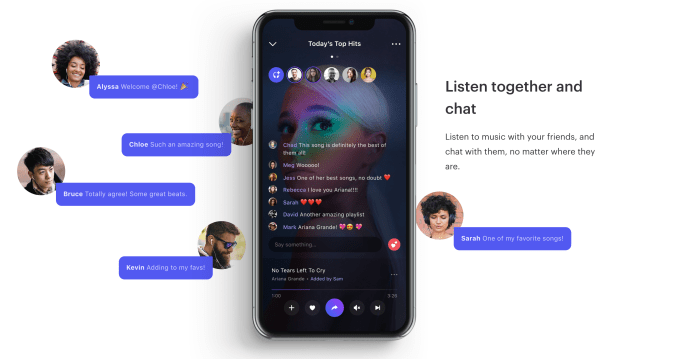
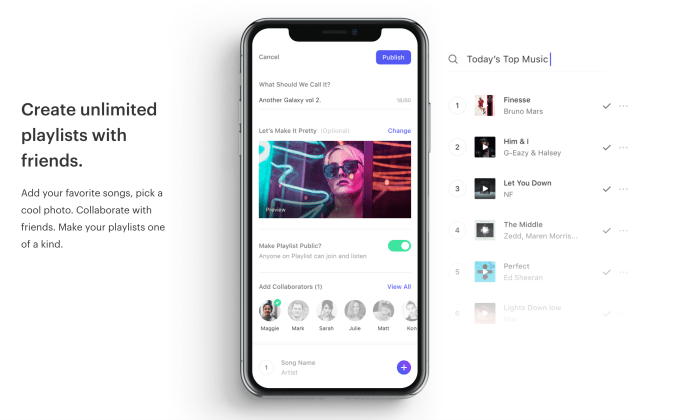
A new app called Playlist aims to make music a more social experience than what’s offered today by the major music platforms like Apple Music, Pandora or Spotify, for example. In Playlist, you can find others who share your musical tastes and join group chats where you listen to playlists together in real time. You can collaborate on playlists, too.

The app, backed by investment from Stanford’s StartX fund, was founded by Karen Katz and Steve Petersen, both Stanford engineers and serial entrepreneurs. Katz previously co-founded AdSpace Networks and another social music platform, Jam Music. She also was a founding executive team member at Photobucket, and founded a company called Project Playlist, which was like a Google search for music back in the Myspace era.

Peterson, meanwhile, has 35 patents and more than a decade of experience in digital music. In the early 2000s he created the software architecture and ran the team at PortalPlayer Inc., which powered the iPod’s music player and was later sold to Nvidia for $357 million. Afterwards, he was CTO at Concert Technology, a technology incubator and intellectual property company with a focus on mobile, social and digital music services.

“The world has gone social, but music has been largely left behind. That’s a real gap,” explains Katz, as to why the founders wanted to build Playlist in the first place.

“Ever since we started listening to music from our mobile phones, it’s become an isolated experience. And music is the number one thing we do on our phones,” she says.

The idea they came up with was to unite music and messaging by synchronizing streams, so people could listen to songs together at the same time and chat while they do so.

During last year’s beta testing period, Playlist (which was listed under a different name on the App Store), saw a huge number of engagements as a result of its real-time nature.

“Out of the gate, we saw 10 times the engagement of Pandora. People have, on average, 60 interactions per hour — like chats, likes, follows, joins, adds and creates,” Katz says. 

Under the hood, the app uses a lot of technology beyond just its synchronized streaming. It also leverages machine learning for its social recommendations, as well as collaborative playlists, large-scale group chat, and behavior-based music programming, and has “Music Match” algorithms to help you find people who listen to the same sort of things you do.

The social aspects of the app involves a following/follower model, and presents playlists from the people you follow in your home feed, much like a music-focused version of Instagram. A separate Discover section lets you find more people to follow or join in other popular listening and chat sessions.

At launch, the app has a catalog of more than 45 million songs and has a music license for the U.S. It plans to monetize through advertising.

The core idea here — real-time music listening and chat — is interesting. It’s like a Turntable.fm for the Instagram age. But the app sometimes overcomplicates things, it seems. For example, importing a playlist from another music app involves switching over to that app, finding the playlist and copying its sharing URL, then switching back to Playlist to paste it in a pop-up box. It then offers a way for you to add your own custom photo to the playlist, which feels a little unnecessary as the default is album art.

Another odd choice is that it’s difficult to figure out how to leave a group chat once you’ve joined. You can mute the playlist that’s streaming or you can minimize the player, but the option to “leave” is tucked away under another menu, making it harder to find.

The player interface also offers a heart, a plus (+), a share button, a mute button and a skip button all on the bottom row. It’s… well… it’s a lot.

But Katz says that the design choices they’ve made here are based on extensive user testing and feedback. Plus, the app’s younger users — often high schoolers, and not much older than 21 — are the ones demanding all the buttons and options.

It’s hard to argue with the results. The beta app acquired more than 500,000 users during last year’s test period, and those users are being switched over to the now publicly available Playlist app, which has some 80K installs as of last week, according to Sensor Tower data.

The company also plans to leverage the assets it acquired from the old Project Playlist, which includes some 30 million emails, 21 million Facebook IDs and 14 million Twitter IDs. A “Throwback Thursday” marketing campaign will reach out to those users to offer them a way to listen to their old playlists.

The startup has raised $5 million in funding (convertible notes) from Stanford StartX Fund, Garage Technology Ventures, Miramar Ventures, IT-Farm, Dixon Doll (DCM founder), Stanford Farmers & Angels, Zapis Capital and Amino Capital.

The Palo Alto-based company is a team of six full-time.

Playlist is a free download for iOS. An Android version is in the works.

The innovation supply chain: How ideas traverse continents and transform economies

Alex Lazarow
Contributor

Alex Lazarow works at the intersection of investing, innovation and economic development across the public, private and social sectors. He is a venture capitalist with Cathay Innovation and an adjunct professor with the Middlebury Institute for International Studies MBA program.

While Westerners often associate the invention of calculus with 17th century European luminaries like Isaac Newton and Gottfried Leibniz, its theoretical foundations actually stretch back millennia. Fundamental theorems appear in ancient Egyptian work from 1820 BC, and later influences sprout from Babylonian, Ancient Greek, Chinese and Middle Eastern texts.

Such is the nature of the world’s biggest ideas — concepts that arise in one corner of the world provide the scaffolding for future advancements. Realizing the true potential of any idea takes time and requires input from diverse cultures and perspectives.

Technological innovation is no exception.

In the tech world today, this is playing out in three important ways:

  • ideas improve when they become global;
  • the best ideas are increasingly starting internationally; and
  • testing globally is a differentiated strategy.

Ideas improve as they scale globally

Like calculus, technological innovation benefits from international iteration.

Ridesharing, for instance, started as an innovation pioneered by Uber and Lyft in San Francisco. Yet startups rapidly exported the model globally. Such evolution reflects local needs. Take Go-Jek, a ridesharing app that is now a dominant local player in Indonesia. Although Go-Jek “replicated” the model, they also took a highly localized approach, applying the Uber/Lyft concept to Jakarta’s existing informal system of motorcycle taxis, “ojeks.”

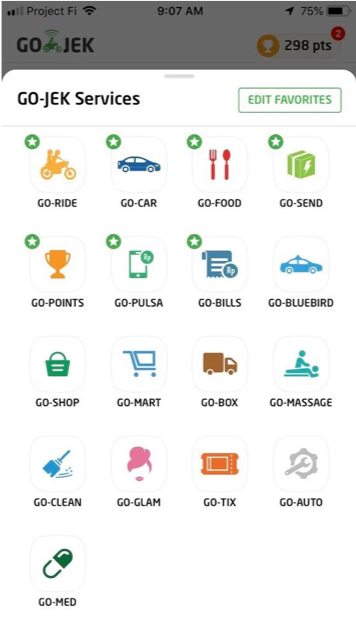
Yet Go-Jek realized that ojek drivers had the potential to do so much more than just move people around. The company aims to maximize driver engagement throughout the day and has built a multi-service app that allows them to not only transport people, but also deliver food, packages and services. As Nadiem Makarim, Go-Jek’s CEO put it, “In the mornings, we drive people from home to work. At lunch, we deliver them meals to the office. In the late afternoon, we drive people back home. In the evenings, we deliver ingredients and meals. And in-between all this, we deliver e-commerce, financial products and other services.”

Silicon Valley used to have a monopoly on the idea, manufacturing and distribution of innovation. No longer.

The model of leveraging a single ridesharing platform to deliver a range of services is undoubtedly different from the Silicon Valley original. In Silicon Valley, an array of companies offering Uber for X have sprung up, yet some of Uber’s latest product categories — like UberEats — seem more akin to the Southeast Asian model.

Tellingly, Go-Jek’s vision incorporates inspiration from another geography: China. In China, platforms like Tencent’s WeChat offer a range of direct and third-party services spanning ride-hailing, shopping, food delivery and, of course, payments. WeChat payment functionality (like Ant’s equivalent) is nearly ubiquitous in major Chinese cities.

Go-Jek, like its competitor Grab, has evolved its model to include a payments platform as part of the app. It is striking to see Uber enter financial services, as well — take, for example, the recent Uber credit card.

These models evolve by learning and combining lessons from other geographies.

The seeds are increasingly global

Historically, entrepreneurs outside Silicon Valley were accused of being replicators — copying and adapting successful models pioneered in San Francisco or Palo Alto.

Times are changing.

Many of the most compelling tech innovations increasingly come from outside of Silicon Valley, and even the United States. Just look at some of 2018’s most successful IPOs — Sweden’s Spotify, Brazil’s Stone and China’s PinDuoDuo (a Cathay Innovation portfolio company).

Entrepreneurs are working to replicate innovations from every corner of the globe. Take mobile payments.  M-Pesa, Kenya’s ubiquitous payments platform that now transacts a remarkable 50 percent of its country’s GDP, has created a global movement. Today, there are more than 275 deployments around the world.

Certain geographies are specializing. Toronto and Montreal are emerging as artificial intelligence hubs. London and Singapore remain leading fintech hubs. Israel is known for its cybersecurity and analytics expertise. And regionally focused initiatives are catalyzing this further. For instance, Rise of the Rest is committed to supporting entrepreneurs across the U.S., and organizations like Endeavor facilitate the development of entrepreneurial hubs worldwide.

The nascent innovation supply chain will see increasing globalization of the generation of new ideas.

Emerging ecosystems can provide optimal testing grounds

Broadway is famous for testing its shows in smaller markets before committing them to the big stage. Similarly, innovators are looking to emerging markets to test models before scaling them.

SkyAlert, which operates an earthquake early warning system, is an illustrative example. In most earthquakes, people do not die from the shakes but rather from getting trapped or crushed under collapsing buildings. Technologically, it is possible to perceive and distribute an early warning, as a quake is first felt near the epicenter and travels outward from there. Through its network of distributed sensors, SkyAlert promises its users a head start to evacuate buildings, and can work with companies to automate security protocols (e.g. gas shutoff).

SkyAlert was not born in San Francisco. Alejandro Cantu, SkyAlert’s founder, began in Mexico City, which he describes as his innovation laboratory. The early versions were focused on R&D rather than commercialization. Developing this in Mexico City was much more affordable for product innovation. Salaries were cheaper. Cost of acquisition was cheaper. The U.S. is now his main target market, but Mexico served as his early base of operations and testing ground.

As a community of innovators, we have an opportunity to take advantage of these trends.

Just as most Silicon Valley techies are familiar with the buzz around Amazon’s home drone deliveries, the majority remain unaware that some of the most interesting drone innovation is happening far away in emerging markets. In developing nations, where infrastructure is far more limited, drones offer lifesaving potential. Startups like Zipline leverage drones to leapfrog broken or nonexistent infrastructure. They deliver time-sensitive drugs and blood across Rwanda through a partnership with the ministry of health. Already, its drones have covered 600,000 km and delivered nearly 14,000 units of blood (one-third of which were in emergency situations).

Entrepreneurs are testing these innovations in markets that are more affordable, and where the need is most acute. Over time, such models will scale and return to developed markets. This is how the innovation supply chain will evolve. 

Where we go from here

The Economist recently predicted a “Techodus” — that innovation will continue to shift away from Silicon Valley. The story is more nuanced.

Silicon Valley used to have a monopoly on the idea, manufacturing and distribution of innovation. No longer. The creative spark is coming from everywhere, innovators are testing ideas in markets where costs are lower and needs are more acute and models are perfected from lessons from around the world.

As a community of innovators, we have an opportunity to take advantage of these trends. You have a new product idea that could be completely transformative? Great. Who else is doing that globally? You want to test a new idea? What are the advantages and disadvantages of various locations? How can the innovations’ lessons from abroad be replicated locally?

Khosla GP launches Bling Capital to help seed-stage startups build products

At Facebook, where he was the first-ever director of platform, they called him Bling. At YouTube the following year, they still called him Bling. At Google in 2010, they continued to call him Bling. Even at Khosla Ventures, where Ben Ling has been a general partner for the past five years, the nickname stuck.

It was only natural that Bling Capital would be the name of his debut venture capital fund, a $60 million seed-stage vehicle backed by Marissa Mayer, Nellie and Max Levchin, Yelp CEO Jeremy Stoppelman and Quora CEO Adam D’Angelo.

We first spotted Bling Capital’s $60 million filing two months back; this week, TechCrunch sat down with Ling, who will officially depart from Khosla next month, to learn more about his investment strategy and why he’s venturing off on his own.

Bling Capital founder Ben Ling

Ling joined Khosla in 2013 to invest in consumer technology, internet, mobile, marketplace, SaaS and consumer health. In his tenure as a general partner and angel investor, he deployed capital to nine “unicorns,” including Lyft, Palantir, Square, Instacart and Zenefits. But he wanted the freedom to invest at a more rapid clip.

“Going out on my own allows me to be more agile; a sole GP can act a lot more quickly and speed matters a lot in seed,” Ling said. “And I love early-stage and product because I think there is a void in the marketplace — there’s a lot of money in seed but there’s not a lot of product builders in seed.”

Ling will invest between $750,000 and $1 million in one to two U.S. companies per month in exchange for 10 percent equity.

The firm is in the process of closing two funds: a $60 million flagship vehicle that will invest in consumer tech, internet and mobile, marketplace, data, fintech, SaaS and automation startups, and a $30 million opportunities fund, per an SEC filing, reserved for follow-on investments.

“It’s pretty much the things that a Google, a Facebook or an Amazon would be interested in,” Ling said, referring to where the fund will invest. “What’s it’s not is crypto, or rockets or enterprise, but it’s pretty much everything else when we think about the world of the internet.”

Given Ling’s experience, the fund will have a particular focus on product. Ling is the sole general partner of Bling, but he’s recruited a team of roughly 60 experts to work with his portfolio company executives as part of what Ling has dubbed his Product CouncilThat includes the heads of product at Square, Instagram, Twitter, YouTube, Google, Nextdoor and Uber, who also are all investors in the fund.

Members of the Product Council will be available to consult with founders and may become advisors, investors or board members, if it’s a good match.

Turo’s new dongle will let customers instantly find and unlock cars

Turo, the peer-to-peer car-sharing company described as the “Airbnb of cars,” is rolling out a new product that will let users locate and unlock cars right from the app.

The new product, called Turo Go, is a dongle and an accompanying service that aims to bolster the number of cars and users on its platform. The product is designed to remove a barrier of entry — the time required to physically exchange keys — that once was a hallmark of the platform. As part of the Turo Go service, owners can opt to allow users to find, book and unlock a vehicle in as little as five minutes. Currently, the app requires a minimum 60-minute lead time before a customer can pick up a vehicle.

“We want to making hosting even easier,” Turo CEO Andre Haddad told TechCrunch. “Easy always wins when it comes to consumer products.”

The company is launching Turo Go in Los Angeles, where it has the biggest penetration of hosts who have multiple vehicles on the platform. Turo Go will expand to additional markets in 2019, he added.

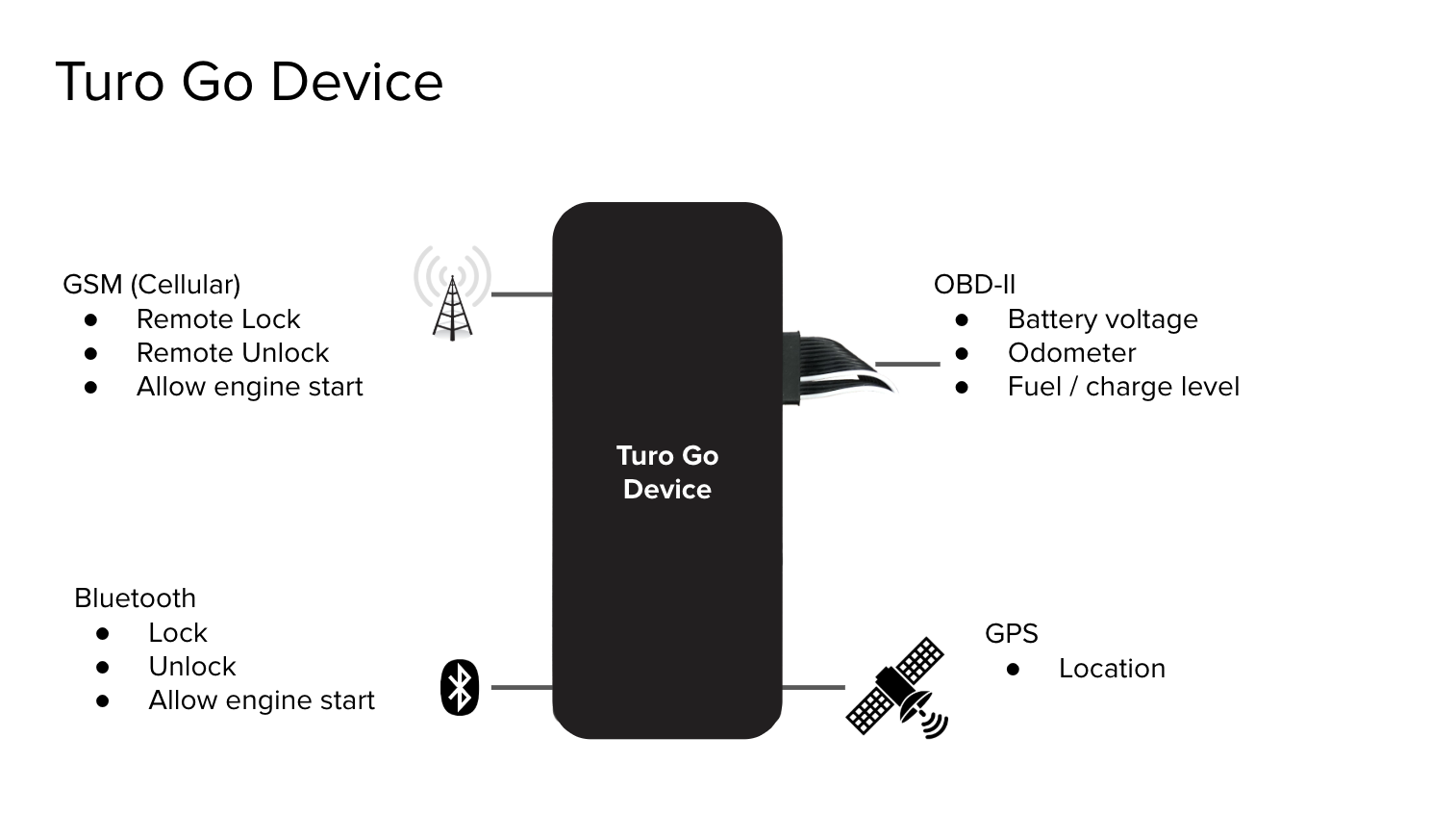
Turo Go uses an aftermarket key-as-a-service entry device from Continental. The device doesn’t require any hardwiring, although it takes about an hour for the install. The device is connected to the OBD-II port (on-board diagnostics) found on modern vehicles. A hidden antenna connects the device to the ignition.

Turo Go costs $20 a month. Turo also charges a $150 installation fee to owners who want to add the device to their vehicle.

Car sharing and on-demand short-term car rental companies like Zipcar also use remote unlock and lock tech. This product is unique because it’s being used on a peer-to-peer car-sharing app.

Turo Go provides a technological upgrade of sorts that is designed for Turo’s experienced hosts, “people who have become comfortable with the notion that a stranger will be in their car,” Haddad said.

Once the device is installed, users will be able to find the vehicle, instantly book it and unlock or lock it via the app. And unlike other car-sharing services, the device uses Bluetooth technology and doesn’t rely on a cellular connection, which can be problematic in parking garages or other remote areas with spotty network coverage.

turo go app

Turo Go also has a digital ID verification step, which uses facial recognition technology to confirm that users have the proper license and are who they claim to be. The tech matches the ID photo to a customer’s face and uses movement tracking to ensure the customer is a real person in front of the camera rather than just a static image that has been printed out.

Once a user has completed a trip, owners of vehicles equipped with Turo Go will be able to locate their car, truck or SUV. Haddad emphasized that owners will not show the location of the vehicle while a customer is using it. Turo Go will also provide other information, such as odometer and fuel levels. Other data features will be added to Turo Go in the future.

AWS launches a base station for satellites as a service

Today at AWS re:Invent in Las Vegas, AWS announced a new service for satellite providers with the launch of AWS Ground Station, the first fully managed ground station as a service.

With this new service, AWS will provide ground antennas through their existing network of worldwide availability zones, as well as data processing services to simplify the entire data retrieval and processing process for satellite companies, or for others who consume the satellite data.

Satellite operators need to get data down from the satellite, process it and then make it available for developers to use in applications. In that regard, it’s not that much different from any IoT device. It just so happens that these are flying around in space.

AWS CEO Andy Jassy pointed out that they hadn’t really considered a service like this until they had customers asking for it. “Customers said that we have so much data in space with so many applications that want to use that data. Why don’t you make it easier,” Jassy said. He said they thought about that and figured they could put their vast worldwide network to bear on the problem.

Prior to this service, companies had to build these base stations themselves to get the data down from the satellites as they passed over the base stations on earth wherever those base stations happened to be. It required that providers buy land and build the hardware, then deal with the data themselves. By offering this as a managed service, it greatly simplifies every aspect of the workflow.

Holger Mueller, an analyst at Constellation Research, says the service will help put the satellite data into the hands of developers faster. “To rule real-world application use cases you need to make maps and real-time spatial data available in an easy-to-consume, real-time and affordable way,” Mueller told TechCrunch. This is precisely the type of data you can get from satellites.

The value proposition of any cloud service has always been about reducing the resource allocation required by a company to achieve a goal. With AWS Ground Station, AWS handles every aspect of the satellite data retrieval and processing operation for the company, greatly reducing the cost and complexity associated with it.

AWS claims it can save up to 80 percent by using an on-demand model over ownership. They are starting with two ground stations today as they launch the service, but plan to expand it to 12 by the middle of next year.

Customers and partners involved in the Ground Station preview included Lockheed Martin, Open Cosmos, HawkEye360 and DigitalGlobe, among others.

more AWS re:Invent 2018 coverage

For a small fee, entrepreneurs can now manage their own fleet of Bird e-scooters

Bird announced today that it will sell its electric scooters to entrepreneurs and small business owners, who can then rent them out as part of a new service called Bird Platform.

The company will provide the independent operators with scooters, which they are given free rein to brand as they please, as well as access to the company’s marketplace of chargers and mechanics, in exchange for 20 percent of the cost of each ride. Bird says fleet managers, which may be independent entrepreneurs or local mom and pop bike rental shops, for example, can also collect and charge the scooters themselves.

There’s no minimum or maximum number of scooters independent operators can purchase, though they have to keep in mind local regulations that, in certain cities, limit the number of scooters permitted on the streets. Bird says the company will initially begin rolling out Bird Platform in December, targeting markets where scooters are already actively used and where regulations are a bit more relaxed. Bird Platform will be irrelevant in San Francisco, for example, where the San Francisco Municipal Transportation Agency has put a cap on the number of e-scooters available and has refused to grant Bird a permit to operate at all.

The company hopes Bird Platform will be a helpful tool as it continues to work its way into new markets around the world.

Bird chief executive officer Travis VanderZanden said they’ve been quietly working on this product for a while and have 300 interested parties waiting to get started with the service.

“In the last year of operating, we kept getting these inbound requests from entrepreneurs that really wanted to take Bird to their cities,” VanderZanden told TechCrunch. “I think there’s been a lot of people passionate about the electric scooter movement and taking cars off the road. There are a lot of entrepreneurs who want to bring Bird to their city.”

Goat, a scooter startup located in Austin, similarly began renting its scooters to micro mobility enthusiasts in the Texas capital. Goat CEO Michael Schramm explained the launch in a company announcement at the time, according to Mashable: “The way we look at it is, why would someone want to be a charger and make $5 a scooter, when they can manage their own fleet and keep all the earnings doing the same task they’re already doing?”

Bird, valued at $2 billion, has raised $415 million in venture capital funding from Greycroft, Sequoia, Accel and others. Since launching about a year ago, it’s clocked in more than 10 million rides and expanded to some 100 cities.