Pandora’s Podcast Genome Project goes live for all

Last month, Pandora announced it would soon be bringing its “Genome” technology to a new space outside of music: it would leverage a similar classification system to make podcast recommendations, too. Initially, the feature was only available to select users on mobile devices, ahead of a broader public launch. Today, Pandora says its Podcast Genome Project has gone live for all users.

Like Pandora’s Music Genome is its music information database capable of classifying songs across 450 different attributes — Pandora’s Podcast Genome Project is a cataloging system designed to evaluate content. But its focus is on audio programs instead of music.

The Podcast Genome Project can currently evaluate content across more than 1,500 attributes, including MPAA ratings, production style, content type, host profile and more, alongside other listener signals, like thumbs, skips, replays and others. It uses a combination of machine learning algorithms, natural language processing and collaborative filtering methods to help determine listener preferences, the company says.

Pandora then combines this data with human curation to make its podcast recommendations.

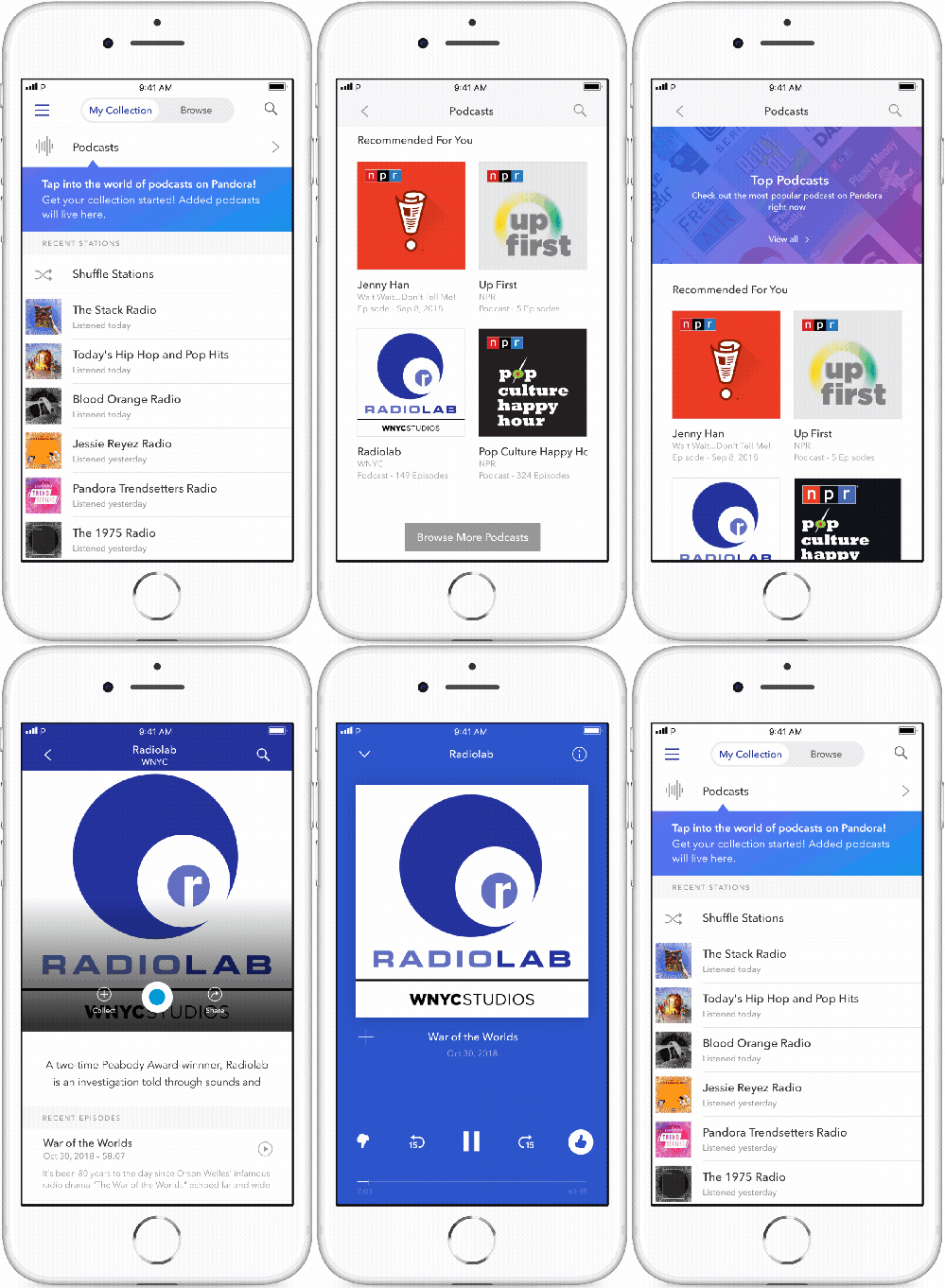
These recommendations are live now in the Pandora app’s “Browse” section, under the banner “Recommended Podcasts For You.” Podcasts will also be discoverable throughout the app in the Now Playing screen, search bar, in the podcast backstage passes and in the episode backstage passes.

At launch, the app is aggregating more than 100,000 podcast episodes in genres like News, True Crime, Sports, Comedy, Music, Business, Technology, Entertainment, Kids, Health and Science, the company adds.

Podcasters can also now ask to be included in Pandora’s app by filling out a form here.

Longer-term, a better recommendation system for podcasts could help Pandora as it becomes more integrated with its acquirer SiriusXM. The deal will likely bring SiriusXM’s exclusive programming to Pandora’s subscribers, which would greatly increase the number of audio programs available on its service. Putting the right programs in front of the most interested customers could then drive more people to upgrade to a paid subscription, impacting Pandora’s bottom line.

Mogu’s long journey: From rejecting Alibaba’s advances to US IPO

Mogu, a Tencent-backed service that offers fashion content and products to young women, has joined a string of Chinese tech companies pressing ahead to sell their shares through initial public offerings in the U.S. before year’s end.

Mogu priced its sale at $14 per share on Wednesday, toward the lower end of a marketed range. That values the unprofitable company at $1.3 billion, a drop from the estimated valuation of $3 billion after Mogujie acquired its chief competitor Meili to form Mogu in 2016.

The firm is poised to raise $66.5 million from the IPO, which will help it fund content and technological development to vie for a piece of China’s $390 billion online fashion market.

While Alibaba has long dominated how people buy clothes online, a few smaller players, including Pinduoduo and Mogu, have managed to carve out a niche.

According to a September report by mobile analytics firm QuestMobile, Mogu controlled an 8.1 percent penetration rate among e-commerce apps targeting women under 24 years old. Alibaba led the game at 98 percent.

Now a formidable rival, Alibaba has played a key role in Mogu’s early-day growth.

Under the giant’s shadow

In 2009, Chen Qi, a former engineer and designer at Alibaba, founded Mogujie — which means “mushroom street” in Chinese — with the aim to create a digital magazine for young women.

The firm’s initial incarnation was a Pinterest -type pinboard that let users share fashion items with links to third-party e-commerce platforms. Back then, a majority of the products on display came from Taobao, Alibaba’s marketplace for small and medium-sized merchants.

“We have to recognize Taobao’s dominance in the retail space. It was inevitable that most of our products came from there,” Chen told TechCrunch.

mogu

Chen Qi, co-founder and CEO of Mogu / Credit: Mogu

As such, Mogujie generated a big chunk of its revenues from Taobao’s referral commissions early on.

In return, Alibaba also benefited from the traffic that the social e-commerce startup sent over to Taobao. It came as no surprise when the titan made an investment offer to Mogujie in hope of adding a community component to its e-commerce business. But Mogujie rejected the advances.

“Our visions were very different. We wanted to be a fashion destination,” Chen said of Mogujie, which allowed all kinds of retailers to promote as a magazine does.

Alibaba, on the other hand, wanted Mogujie to be a vertical e-commerce service that would focus on attracting merchants, touting things and locking users in instead of sending them to third-party platforms.

“If our content creators wanted to share something that happened to be from [Alibaba’s] rivals, we would need to stop them. That clearly ran against our value proposition of a fashion destination,” said Chen.

A new ally

The rejection was soon followed by a ban from Taobao as Alibaba wanted full control of where its traffic came from. Meili, which made money by directing shoppers to Taobao as Mogujie did, also lost the ability to link to Alibaba. Both firms started building their own e-commerce platforms soon after breaking up with their main revenue driver.

Before long, Mogujie got a new partner from its acquisition of Meili, which counted Tencent as an investor. Tencent does not directly manage any e-commerce businesses but has scooped up shares in a few prominent players, including Pinduoduo and JD.com, arming them with tools to take on Alibaba.

Pinduoduo, for instance, has taken off on Tencent’s popular WeChat messenger by letting shoppers arrange group bargains among each other.

Similarly, WeChat has fueled growth for Mogu in recent months. WeChat mini programs — a type of stripped-down apps that run within larger platforms — contributed 31.1 percent of Mogu’s total sales for the six months ended September 30, up from 14.4 percent a year ago, according to a regulatory filing.

Like Alibaba, Tencent strategically chooses which allies it lets into its turf. Links to its rival Alibaba have long been inaccessible on WeChat, which had more than 1 billion monthly active users as of September.

mogu

Mogu has adopted a new live streaming strategy to grow e-commerce sales. / Credit: Mogu

The caveat of having a powerful teammate like Tencent is that an eroding relationship may do harm to the smaller player, as Mogu experienced with Alibaba. But Mogu isn’t worried about its reliance on the gaming and social behemoth.

“Customers who like us will end up downloading our native app, which delivers a much better user experience. As most WeChat partners would agree, mini programs are an effective way to attract new users, rather than a threat,” argued Chen.

By the numbers

Mogu lost $81 million for the year ended March 31, down from $136 million year-over-year. Revenues, however, slipped from $161 million to $142 million. Chen ascribed the drop to the firm’s “particularly strong performance” in 2017 following the merger, which compelled competition between merchants on Meili and Mogujie to double down on marketing expenses.

Meanwhile, total sales for the fashion e-commerce firm grew by 24.6 percent, from $1.71 billion to $2.14 billion.

Marketing services, which consist of display advertisements, accounted for nearly half of Mogu’s revenues, but are fading in favor of e-commerce commissions, which stood at 43 percent of revenues compared to 30 percent a year ago.

The new development signifies Mogu’s shift to growing a community of influencers selling clothes to followers via live streams. This segment brought in 11.8 percent of Mogu’s total sales, compared to only 1.4 percent in 2017.

The appeal of live broadcasting, according to Chen, is that it improves efficiency in apparel manufacturing. A traditional procedural goes like this: Make clothes, sell them, and items that don’t sell get discounted, eating into margins and jacking up retail prices.

Selling through live streams, on the other hand, helps merchants determine how popular a design is in real time.

“The manufacturers won’t even have to make the clothes upfront. Our live broadcast host will show a sample to her audience, aggregate orders, and tell the factory how many to make and in what sizes,” said Chen. “This significantly speeds up the production process and lowers prices for consumers.”

Tencent Music moving ahead with its $1.2B U.S. stock market debut

Tencent Music Entertainment’s initial public offering is back in motion, two months after the company reportedly postponed it amid a global selloff. In a regulatory filing today, the company, China’s largest streaming music service, said it plans to offer 82 million American depositary shares (ADS), representing 164 million Class A ordinary shares, for between $13 to $15 each. That means the IPO will potentially raise up to $1.23 billion.

The company is offering 41.03 million ADS, while selling shareholders will offer the remaining 40.97 million ADS. It will list on the New York Stock Exchange under the ticker symbol TME. According to the filing, Tencent Music’s controlling shareholder, Tencent Holdings, has agreed to buy Class A ordinary shares valued at up to $32 million.

With about 800 million monthly active users, Tencent Music is not only China’s largest online music entertainment platform, but one of the biggest in the world. To put that number in context, Spotify, one of Tencent Music’s shareholders and strategic partners, currently has 170 million monthly active users.

Tencent Music first filed for its stock market debut at the beginning of October, but then the WSJ reported that it had halted its IPO plans because of a selloff in global markets that hit Chinese markets particularly hard. The stock market is currently rallying, however, thanks to a truce in the U.S.-China trade war.

The offering’s lead underwriters are Morgan Stanley, Goldman Sachs, J.P. Morgan, Deutsche Bank Securities, and Bank of America Merrill Lynch.

Quora says 100 million users may have been affected by data breach

Quora said today that a security breach may have compromised data from about 100 million users. In an email sent to users today and a blog post by CEO Adam D’Angelo, the company said a “malicious third party” gained unauthorized access to Quora’s systems on Friday. Its internal security teams and a “leading digital forensics and security form” are currently investigating the breach. Law enforcement officials have also been notified.

The company believes it has identified the root cause of the breach and “taken steps to address the issue, although our investigation is ongoing and we’ll continue to make security improvements.” Quora also added that anonymous questions and answers were not affected by the breach because it does not store the identities of people who make anonymous postings.

The company is currently notifying users whose data was compromised and logging out all Quora users who may have been affected as a security precaution. It is also invalidating their passwords if they used one. A FAQ about the breach has been set up here.

According to Quora, the following user data may have been accessed:

  • Account and user information, e.g. name, email, IP, user ID, encrypted password, user account settings, personalization data

  • Public actions and content including drafts, e.g. questions, answers, comments, blog posts, upvotes

  • Data imported from linked networks when authorized by you, e.g. contacts, demographic information, interests, access tokens (now invalidated)

  • Non-public actions, e.g. answer requests, downvotes, thanks

  • Non-public content, e.g. direct messages, suggested edits

In another article on its help center, Quora said “it is confident that no partner’s financial information has been compromised.” Some access tokens associated with Stripe, the payment processing service used by the company, were “temporarily compromised,” but Quora confirmed with Stripe that no access tokens have been used since the incident and no financial information was breached.

All users with Stripe accounts have also had their access tokens reset. “We are confident that no personal financial information that was accessible through Stripe has been compromised. Furthermore, no personal financial information is currently vulnerable,” Quora said.

Will Uber gobble up Lime or fly off with Bird?

Winter is coming. It’s time for scooter startups to find a cozy, protective blanket to get them through the chilly months.

For Lime and Bird, that could be Uber . The pair of venture capital darlings, which both operate fleets of electric scooters around the world, are said to be in talks with the SoftBank-backed ride-hailing behemoth about a possible acquisition, as first reported by The Information.

The news follows Lyft’s acquisition of bike-rental service Motivate, Ford’s acquisition of dockless bike and e-scooter startup Spin and Uber’s acquisition of JUMP Bikes. The trio of transactions are likely the first of many deals, as M&A activity in the scooter sector will inevitably heat up in the coming months.

Uber, which has scooters available to rent within its mobile app in Los Angeles and Austin courtesy of JUMP, is looking to one of the two startups to beef up its scooter supply, though both companies are denying reports of an impending deal. Bird’s chief executive officer Travis VanderZanden told TechCrunch simply that “Bird is not for sale.” Meanwhile, a spokesperson for Lime told us they are “focused on building an independent company,” or, in other words, “Lime is not interested in Uber’s courtship.”

Uber declined to comment.

Scooter startups don’t come cheap

An acquisition of either Lime or Bird would be quite expensive. Both companies are worth more than $1 billion and would surely hike up their valuations amid M&A talks, especially considering reports that both are currently fundraising at even higher valuations. Bird, for its part, was valued at $2 billion this summer and Lime boasts at least a $1.1 billion price tag. Uber already holds a minority stake in Lime, though, which would cheapen that deal a bit.

An Uber acquisition would surely satisfy their investors, but I’d wager neither Lime nor Bird’s founders are ready to relinquish their independence. Both startups have been working tirelessly to build sustainable businesses and expand beyond bikes and scooters. Bird recently launched Bird Platform, an interesting new service that allows entrepreneurs to buy Bird’s scooters at-cost and rent them out themselves as a side business.

Lime, a couple of weeks prior, released its first fleet of “LimePods,” shareable vehicles that are now available to rent via the Lime app in Seattle, and it’s working on the launch of a line of brick and mortar storefronts in major U.S. and international cities. On top of that, both companies have been racing to tackle new markets around the globe, from Sydney to London, in 2018.

Together, the two companies have raised nearly $1 billion in venture capital funding in about a year’s time. As the two leading brands, they are quickly turning e-scootering into an acceptable mode of last-mile transportation in the U.S. Their recent behavior suggests the companies are eyeing a future where they are a go-to multimodal transportation platform, like Uber, rather than the subsidiary of one.

Investors, however, have a different perspective. Sources tell TechCrunch some of Lime and Bird’s backers are encouraging the companies to continue discussions with Uber. Despite being extremely young companies — some of the youngest to rack up valuations that high ever, actually — Lime and Bird are costly, which seriously limits their exit options. Lime is backed by GV, IVP, Coatue Management, GGV Capital and others. Bird is backed by investors including Accel, CRV, Greycroft, Sound Ventures and Upfront Ventures.

What does Uber want?

When Uber shelled out $200 million to acquire JUMP Bikes earlier this year and made dockless bikes and scooters rentable in select cities, it became clear the ride-hailing giant was doubling down on micro-mobility.

“We see the Uber app as moving from just being about car sharing and car-hailing to really helping the consumer get from A to B in the most affordable, most dependable, most convenient way,” Uber chief executive officer Dara Khosrowshahi told TechCrunch’s Megan Rose Dickey at the time of the deal. “We think e-bikes are just a spectacularly great product.”

He added that he’d been staring at e-scooters “quizzically on the streets” and thought they were in an “odd spot” due to regulatory issues. Well, the latter is still true in many cities, but scooters have certainly become more widely accepted as they’ve invaded neighborhoods in Seattle, San Francisco, Denver, Austin, Paris and beyond.

Now that Uber is serious about scooters, it needs to increase its supply. Lime, given Uber’s existing stake in the company and its lower valuation, is a natural target.

Of course, there are many, many, many other small e-scooter operators Uber could target, like Skip, Scoot and Grin, to name a few. Spin, one of the early entrants to the e-scooter market, however, is no longer an option. The startup had raised about $8 million in venture funding and sold to Ford for around $100 million in a deal confirmed just a few weeks ago.

Uber is expected to go public in early 2019. The company released its third-quarter financial results last month, reporting an increase in revenue of five percent quarter-over-quarter at $2.95 billion — up 38 percent year-over-year. Gross bookings were up six percent QoQ and 34 percent YoY at $12.7 billion. Net losses, however, were up 32 percent QoQ to $939 million on a pro forma basis.

The company says it’s investing heavily in Uber Eats, its bikes and scooters, and Uber Freight as it expects each of those efforts to become even larger contributors to its overall business.

Uber will likely make a move on Lime in Q1 2019, before the company closes yet another fundraising round and prices itself higher than even Uber would be willing to pay.

Google’s call screening transcripts are live and they’re pretty rad

If you’re the proud owner of a Pixel handset you, like 9to5Google, may have spotted this already. The call screening transcripts feature, first noted back in November, are starting to arrive for Pixel users, Google confirmed with TechCrunch.

Making good on the “end of year” promise, the offering has been rolling out for a few days now, bringing with it the ability to read voice transcriptions of voice mails. An addition to the Pixel’s existing call screening feature, the feature answers calls from unknown numbers via Google Assistant and utilizes the company’s solid voice-to-text to offer a transcription of the call.

In spite of the wide rollout, there are still some limitations here. For starters, this particular feature is only available for the Pixel 3 and Pixel 3 XL. And it’s only rolling out to users in the States at the moment, though Google’s promised to bring it to additional countries in additional languages “in the future.”

Don’t worry, ‘Friends’ isn’t leaving Netflix anytime soon

Thousands of internet users were understandably upset this morning when a terrible rumor surfaced that “Friends” would be removed from Netflix on January 1, 2019.

Despite numerous reports confirming the news, Netflix took to Twitter to confirm the beloved slapstick sitcom wouldn’t be going anywhere, at least not in 2019, and fans everywhere breathed a sigh of relief.

The Holiday Armadillo has granted your wish: “Friends” will still be there for you in the US throughout 2019 pic.twitter.com/Yd0VqRzk3r

— Netflix US (@netflix) December 3, 2018

But I’d advise any “Friends” virgins to start binge-watching now because the series is expected to transition to Warner Bros.’ own streaming platform in 2020, according to The Hollywood Reporter. That service is said to be launching at the end of 2019.

We’ve reached out to Netflix to confirm.

As we work to get to the bottom of this, please enjoy this 100-tweet thread on why Rachel Green and Ross Geller were an absolutely awful match.

Credit card stealing malware on Canada’s 1-800-FLOWERS website went undetected for four years

It’s going to take more than a bunch of posies to make up for this one.

The Canadian branch of 1-800-FLOWERS revealed in a filing with the California attorney general’s office that malware on its website had siphoned off customers’ credit cards over a four-year period.

Four years. Let that sink in.

The company said it believes the malware was scraping credit cards between August 15, 2014 to September 15, 2018, but that the company’s main 1-800-FLOWERS.com website was unaffected.

“Findings from the investigation suggest that the information collected included your first and last name, payment card number, expiration date, and card security code,” the filing said.

So, that’s everything that a scammer would need to rinse your credit card dry.

The notification didn’t say how many customers had their data stolen, but California state law says that any hacked company has to inform customers if more than 500 California residents are affected.

As bad as a four-year breach is at the best of times, bizarrely it’s only the second company to admit a security issue dating back to 2014. Marriott on Thursday revealed that 500 million guest reservation records were stolen by unnamed hackers over the four-year period.

You know what they say: Bad news comes in threes. Bets on who’s next?

Apple Music is getting native Android tablet support

Bringing Apple Music to Android tablets probably wasn’t Apple’s biggest priority, but three years after launching support for Android phones, the bigger screens are getting some love.

The update, first spotted by 9to5mac, is only available to Google Group beta testers for now, but should soon be rolling out widely when the 2.7 update goes out. The tablet-friendly design switches up the navigation to make use of the added screen real estate.

Apple added support for Android Auto in the last big update in September. As the company expands its native support for Google products, it does make one wonder where support is for Google Home products. The company announced just last week that Apple Music was coming to Amazon Echo devices so it seems that Apple is growing more open-minded in terms of what platforms it’s interested in bringing Music support to.

Tim Cook addresses white supremacists in ADL address

Apple CEO Tim Cook didn’t mince words when he took to the stage to accept the Anti-Defamation League’s first Courage Against Hate Award at an event in New York City today. The executive used the keynote to address a wide range of issues, from anti-Semitism to LGBTQ rights — in many cases framing them in the context of corporate responsibility.

“I sometimes say that I worry less about computers that think like people and more about people that think like computers—without values or compassion, without concern for consequences,” Cook said, in a copy of the remarks provided to TechCrunch.

.@Tim_Cook embodies ADL's mission of fighting hate, and securing justice and fair treatment to all. His words inspire us to keep up the good fight. #NeverIsNow pic.twitter.com/DisY4Tmffy

— ADL (@ADL_National) December 3, 2018

He also used the platform to address the company’s longstanding stance against providing a platform for hate — a hot-button issue as social networks have attempted to address the online proliferation of hate speech and conspiracy theories.

From the speech:

From the earliest days of iTunes, to Apple Music today, we have always prohibited music with a message of white supremacy. Why… Because it’s the right thing to do. And as we showed this year, we won’t give a platform to violent conspiracy theorists on the App Store. Why… Because it’s the right thing to do. My friends, if we can’t be clear on moral questions like these, then we’ve got big problems. At Apple, we are not afraid to say that our values drive our curation decisions. And why should we be? Doing what’s right — creating experiences free from violence and hate, experiences that empower creativity and new ideas — is what our customers want us to do. Technology should be about human potential. It should be about optimism. And we believe the future should belong to those who use technology to build a better, more inclusive and more hopeful world.

There are no easy answers, as the last several years have proven. But Apple’s certainly taken a much stronger approach around issues of hate speech than many fellow tech giants.

Marriott’s breach response is so bad, security experts are filling in the gaps — at their own expense

Last Friday, Marriott sent out millions of emails warning of a massive data breach — some 500 million guest reservations had been stolen from its Starwood database.

One problem: the email sender’s domain didn’t look like it came from Marriott at all.

Marriott sent its notification email from “email-marriott.com,” which is registered to a third party firm, CSC, on behalf of the hotel chain giant. But there was little else to suggest the email was at all legitimate — the domain doesn’t load or have an identifying HTTPS certificate. In fact, there’s no easy way to check that the domain is real, except a buried note on Marriott’s data breach notification site that confirms the domain as legitimate.

But what makes matters worse is that the email is easily spoofable.

Often what happens after a data breach, scammers will capitalize on the news cycle by tricking users into turning over their private information with their own stream of fake messages and websites. It’s more common than you think. People who think they’re at risk after a breach are more susceptible to being duped.

Companies should host any information on their own websites and verified social media pages to stop bad actors from hijacking victims for their own gain. But once you start setting up your own dedicated, off-site page with its unique domain, you have to consider the cybersquatters — those who register similar-looking domains that look almost the same.

Take “email-marriot.com.” To the untrained eye, it looks like the legitimate domain — but many wouldn’t notice the misspelling. Actually, it belongs to Jake Williams, founder of Rendition Infosec, to warn users not to trust the domain.

“I registered the domains to make sure that scammers didn’t register the domains themselves,” Williams told TechCrunch. “After the Equifax breach, it was obvious this would be an issue, so registering the domains was just a responsible move to keep them out of the hands of criminals.”

Equifax, the biggest breach of last year, made headlines not only for its eye-watering hack, but its shockingly bad response. It, too, set up a dedicated site for victims — “equifaxsecurity2017.com” — but even the company’s own Twitter staff were confused, and inadvertently sent concerned victims to “securityequifax2017.com” — a fake site set up by developer Nick Sweeting to expose the company’s vulnerable incident response.

With the Equifax breach not even a distant memory, Marriott has clearly learned nothing from the response.

Many others have sounded the alarm on Marriott’s lackluster data breach response. Security expert Troy Hunt, who founded data breach notification site Have I Been Pwned, posted a long tweet thread on the hotel chain giant’s use of the problematic domain. As it happens, the domain dates back at least to the start of this year when Marriott used the domain to ask its users to update their passwords.

Williams isn’t the only one who’s resorted to defending Marriott customers from cybercriminals. Nick Carr, who works at security giant FireEye, registered the similarly named “email-mariott.com” on the day of the Marriott breach.

“Please watch where you click,” he wrote on the site. “Hopefully this is one less site used to confuse victims.” Had Marriott just sent the email from its own domain, it wouldn’t be an issue.

A spokesperson for Marriott did not respond to a request for comment.