Nvidia’s limited China connections

Another round of followups on Nvidia, and then some short news analysis.

TechCrunch is experimenting with new content forms. This is a rough draft of something new – provide your feedback directly to the author (Danny at [email protected]) if you like or hate something here.

Nvidia / TSMC questions

Following up on my analyses this week on Nvidia (Part 1, Part 2) , a reader asked in regards to Nvidia’s risk with China tariffs:

but the TSMC impact w.r.t. tariffs doesn’t make sense to me. TSMC is largely not impacted by tariffs and so the supply chain with NVIDIA is also not impacted w.r.t. to TSMC as a supplier. There are many alternate wafer suppliers in Taiwan.

This is a challenging question to definitively answer, since obviously Nvidia doesn’t publicly disclose its supply chain, or more granularly, which factories those supply chain partners utilize for its production. It does, however, list a number of companies in its 10-K form as manufacturing, testing, and packaging partners, including:

To understand how this all fits together, there are essentially three phases for bringing a semiconductor to market:

  1. Design – this is Nvidia’s core specialty
  2. Manufacturing – actually making the chip from silicon and other materials at the precision required for it to be reliable
  3. Testing, packaging and distribution – once chips are made, they need to be tested to prove that manufacturing worked, then packaged properly to protect them and shipped worldwide to wherever they are going to be assembled/integrated

For the highest precision manufacturing required for chips like Nvidia’s, Taiwan, South Korea and the U.S. are the world leaders, with China trying to catch up through programs like Made in China 2025 (which, after caustic pushback from countries around the world, it looks like Beijing is potentially scrapping this week). China is still considered to be one-to-two generations behind in chip manufacturing, though it increasingly owns the low-end of the market.

Where the semiconductor supply chain traditionally gets more entwined with China is around testing and packaging, which are generally considered lower value (albeit critical) tasks that have been increasingly outsourced to the mainland over the years. Taiwan remains the dominant player here as well, with roughly 50% of the global market, but China has been rapidly expanding.

U.S. tariffs on Chinese goods do not apply to Taiwan, and so for the most part, Nvidia’s supply chain should be adept at avoiding most of the brunt of the trade conflict. And while assembly is heavily based in China, electronics assemblers are rapidly adapting their supply chains to mitigate the damage of tariffs by moving factories to Vietnam, India, and elsewhere.

Where it gets tricky is the Chinese market itself, which imports a huge number of semiconductor chips, and represents roughly 20% of Nvidia’s revenues. Even here, many analysts believe that the Chinese will have no choice but to buy Nvidia’s chips, since they are market-leading and substitutes are not easily available.

So the conclusion is that Nvidia likely has maneuvering room in the short-term to weather exogenous trade tariff shocks and mitigate their damage. Medium to long-term though, the company will have to strategically position itself very carefully, since China is quickly becoming a dominant player in exactly the verticals it wants to own (automotive, ML workflows, etc.). In other words, Nvidia needs the Chinese market for growth at the exact moment that door is slamming shut. How it navigates this challenge in the years ahead will determine much of its growth profile in the years ahead.

Rapid fire analysis

Short summaries and analysis of important news stories

Saudi Arabia’s Crown Prince Mohammed bin Salman. FETHI BELAID/AFP/Getty Images

US intelligence community says quantum computing and AI pose an ’emerging threat’ to national security – Our very own Zack Whittaker talks about future challenges to U.S. national security. These technologies are “dual-use,” which means that they can be used for good purposes (autonomous driving, faster processing) and also for nefarious purposes (breaking encryption, autonomous warfare). Expect huge debates and challenges in the next decade about how to keep these technologies on the safe side.

Saudi Arabia Pumps Up Stock Market After Bad News, Including Khashoggi Murder – A WSJ trio of reporters investigates the Saudi government’s aggressive attempts to shore up the value of its stock exchange. Exchange manipulation is hardly novel, either in traditional markets or in blockchain markets. China has been aggressively doing this in its stock exchanges for years. But it is a reminder that in emerging and new exchanges, much of the price signaling is artificial.

A law firm in the trenches against media unions – Andrew McCormick writes in the Columbia Journalism Review how law firm Jones Day has taken a leading role in fighting against the unionization of newsrooms. The challenge of course is that the media business remains mired in cutbacks and weak earnings, and so trying to better divide a rapidly shrinking pie doesn’t make a lot of sense to me. The future — in my view — is entrepreneurial journalists backed up by platforms like Substack where they set their own voice, tone, publishing calendar, and benefits. Having a close relationship with readers is the only way forward for job security.

At least 15 central banks are serious about getting into digital currency – Mike Orcutt at MIT Technology Review notes that there are a bunch of central banks, including China and Canada. What’s interesting is that the trends backing this up including financial inclusion and “diminishing cash usage.” Even though blockchain is in a nuclear winter following the collapse of crypto prices this year, it is exactly these sorts of projects that could be the way forward for the industry.

What’s next

More semiconductors probably. And Arman and I are side glancing at Yelp these days. Any thoughts? Email me at [email protected].

This newsletter is written with the assistance of Arman Tabatabai from New York

Robinhood lacked proper insurance so will change checking & savings feature

Robinhood will rename and revamp its upcoming checking and banking features after encountering problems with its insurance. The company published a blog post this evening explaining “We plan to work closely with regulators as we prepare to launch our cash management program, and we’re revamping our marketing materials, including the name . . . Stay tuned for updates.”

Robinhood’s new high-interest, zero-fee checking and savings feature seemed too good to be true. Users’ money wasn’t slated  to fully protected. The CEO of the Securities Investor Protection Corporation, a nonprofit membership corporation that insures stock brokerages, tells TechCrunch its insurance would not apply to checking and savings accounts the way Robinhood originally claimed. “Robinhood would be buying securities for its account and sharing a portion of the proceeds with their customers, and that’s not what we cover,” says SIPC CEO Stephen Harbeck. “I’ve never seen a single document on this. I haven’t been consulted on this.”

That info directly conflicts with comments from Robinhood’s comms team, which told me yesterday users would be protected because the SIPC insures brokerages and the checking/savings feature is offered via Robinhood’s brokerage that is a member of the SIPC.

If Robinhood checking and savings is indeed ineligible for insurance coverage from the SIPC, and since it doesn’t qualify for FDIC protection like a standard bank, users’ funds would have been at risk. Robinhood co-CEO Baiju Bhatt told me that “Robinhood invests users’ checking and savings money into government-grade assets like U.S. treasuries and we collect yield from those assets and pay that back to customers in the form of 3 percent interest.” But Harbeck tells me that means users would effectively be loaning Robinhood their money, and the SIPC doesn’t cover loans. If a market downturn caused the values of those securities to decline and Robinhood couldn’t cover the losses, the SIPC wouldn’t necessarily help users get their money back. 

Robinhood’s team insisted yesterday that customers would not lose their money in the event that the treasuries in which it invests decline, and that only what users gamble on the stock market would be unprotected, as is standard. But now it appears that because Robinhood is misusing its brokerage classification to operate checking and savings accounts where it says users don’t have to invest in stocks and other securities, SIPC insurance wouldn’t apply. “I have an issue with some of the things on their website about whether these checking and savings accounts would be protected. I referred the issue to the SEC,” Harbeck tells me. TechCrunch got in touch with the SEC, but it declined to comment.

Robinhood planned to start shipping its Mastercard debit cards to customers on December 18th with users being added off the waitlist in January. That may now be delayed due to the insurance problem and it’s announcement that it will change how it works and is positioned.

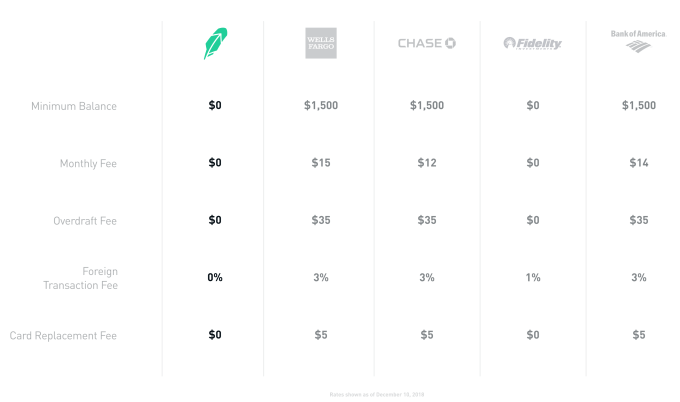
Robinhood touted how its checking and savings features have no minimum account balance, overdraft fees, foreign transaction fees or card replacement fees. It also has 75,000 free-to-use ATMs in its network, which Bhatt claims is more than the top five U.S. banks combined. And its 3 percent interest rate users earn is much higher than the 0.09 percent average interest rate for traditional savings, and beats  most name-brand banks outside of some credit unions.

But for those perks, users must sacrifice brick-and-mortar bank branches that can help them with troubles, and instead rely on a 24/7 live chat customer support feature from Robinhood. The debit card has Mastercard’s zero-liability protection against fraud, and Robinhood partners with Sutton Bank to issue the card. But it’s unclear how the checking and savings accounts would have been protected against other types of attacks or scams.

Robinhood was likely hoping to build a larger user base on top of its existing 6 million accounts by leveraging software scalability to provide such competitive rates. It planned to be profitable from its margin on the interest from investing users’ money and a revenue-sharing agreement with Mastercard on interchange fees charged to merchants when you swipe your card. But long term, Robinhood may use checking and savings as a wedge into the larger financial services market from which it can launch more lucrative products like loans.

That could fall apart if users are scared to move their checking and savings money to Robinhood. Startups can suddenly fold or make too risky of decisions while chasing growth. Robinhood’s valuation went from $1.3 billion last year to $5.6 billion when it raised $363 million this year. That puts intense pressure on the company to grow to justify that massive valuation. In its rush to break into banking, it may have cut corners on becoming properly insured. It’s wise for the company to be rethinking the plan to ensure it doesn’t leave users exposed or hurt its reputation by launching without adequate protection.

[Update 12/14/2018 9:30pm pacific: This article has been significantly updated to include information about Robinhood planning to change its checking and savings feature before launch to ensure users aren’t in danger or losing their money.]

[DIsclosure: The author of this article knows Robinhood co-founders Baiju Bhatt and Vlad Tenev from college 10 years ago.]

Lazada, Alibaba’s Southeast Asia e-commerce business, gets a new CEO

Alibaba has reshuffled the leadership at Lazada, its e-commerce firm in Southeast Asia, after CEO Lucy Peng — an original Alibaba co-founder — stepped down to be replaced by Lazada executive president Pierre Poignant after just nine months in the role.

Alibaba owns more than 90 percent of Lazada but it has been involved in the business since April 2016 when it bought 51 percent of Lazada for $1 billion from Rocket Internet. It invested a further $1 billion last year to increase its equity to around 83 percent and earlier this year it raised its stake even higher with an additional $2 billion injection.

That last investment saw Peng, formerly executive chairman of Ant Financial, become Lazada CEO in place of Max Bittner, who had been installed by former owner Rocket Internet back in 2012. Poignant also arrived at the company in 2012 and he worked alongside Bittner as Lazada’s COO. Since then, he has been head of its logistics division before a brief five-month stint as executive president prior to this new role.

Lazada operates in six countries across Southeast Asia, but there are very few indicators of how the business is performing.

Alibaba’s own financial reports bundle Lazada with the firm’s other international businesses. Collectively, they grossed RMB 4.5 billion ($650 million) in the last quarter. That’s an impressive 55 percent revenue jump but it accounts for a small portion of Alibaba’s total revenue of RMB 85.15 billion ($12.4 billion) in Q2 2019.

Lazada took part in the recent 11/11 Singles’ Day sale mega day. Alibaba as a whole grossed $31 billion in GMV during the 24-hour period but the company did not break out numbers for Lazada. Lazada itself said it broke records, but the only data it provided was that 20 million shoppers were “browsing and grabbing” deals on its site — you’ll note that statement doesn’t explicitly provide sales. We did ask at the time but Lazada declined to give sales or revenue numbers.

Against that backdrop, it is hard to say whether Peng was brought in as a stop-gap while Lazada searched for a new CEO, or whether her original remit was to preside over a revamp of the business. Lazada has certainly gone about installing new executive teams in many local markets, according to sources within the company, but it isn’t clear whether Peng is being recalled as planned or whether things didn’t work out as expected.

The news follows Alibaba’s second investment in Tokopedia, Indonesia’s leading e-commerce platform, yesterday.

Speaking on the rivalry, Tokopedia CEO William Tanuwijaya told TechCrunch that he sees differences between the two.

“We see Lazada having a different business model than us: Lazada is a hybrid of retail and marketplace model, whereas Tokopedia is a pure marketplace. Lazada is [a] regional player, we are a national player in Indonesia,” he said.

Pokémon GO trainer battles are now live (for some players)

Last week we did a deep dive on how Pokémon GO’s new (and long overdue) player-versus-player battle system would work. The only thing we didn’t know at the time was when, exactly, it would actually start rolling out.

The answer: tonight.

Just a few days ago, Niantic started shipping an update to the app that contained everything required for PvP, but they’d yet to actually flip the switch to turn it on. According to a tweet that just went live from the Pokémon GO account, it seems said switches have just been flipped:

Calling all level 40 Trainers. Your time has come to #GOBattle? Trainers of lower levels, please stand by, as we will be rolling Trainer Battles out to more levels soon. pic.twitter.com/Rf6NmFygE6

— Pokémon GO (@PokemonGoApp) December 13, 2018

One catch (but one noted as likely in our initial post) is that it’s not available to everyone right off the bat. As with many of GO’s newer features, it’ll go live for higher level players first. More specifically, only players who’ve hit the level cap of 40 will get access to PvP immediately, with plans to roll it out to others in the coming days. It’s done like this partly to reward the most dedicated players for their efforts… but it’s also an easy way for them to roll things out gradually to double check that nothing explodes.

Update: Well, that was quick. Within an hour of launch, Niantic has opened PvP up to anyone over level 20.

(If you’re a sufficient level and for some reason don’t see the PvP stuff, Niantic says a reset of your app should fix it.)

Waiting for it to be rolled out to your level? Want a refresher on how it’ll all work while you wait? Here’s our breakdown.

Feds like cryptocurrencies and blockchain tech and so should antitrust agencies

Thibault Schrepel
Contributor

Thibault Schrepel is an Assistant Professor in the Department of Public Economic Law at Utrecht University and a reviewer at the Stanford Journal of Blockchain Law & Policy.

While statements and position papers from most central banks were generally skeptical of cryptocurrencies, the times may be changing.

Earlier this year, the Federal Reserve of Saint Louis published a study that relates the positive effects of cryptocurrencies for privacy protection.

Even with the precipitous decline in value of Bitcoin, Ethereum and other currencies, the Federal Reserve author emphasized the new competitive offering these currencies created exactly because of the way they function, and accordingly, why they are here to stay.

And antitrust authorities should welcome cryptocurrencies and blockchain technologies for the same reason.

Fact: crypto-currencies are good for (legitimate) privacy protection

In the July article from Federal Reserve research fellow Charles M. Kahn, cryptocurrencies were held up as an exemplar of a degree of privacy protection that not even the central banks can provide to customers.

Kahn further stressed that “privacy in payments is desired not just for illegal transactions, but also for protection from malfeasance or negligence by counterparties or by the payments system provider itself.”

The act of payment engages the liability of the person who makes it. As a consequence, parties insert numerous contractual clauses to limit their liability. This creates a real issue due to the fact that some “parties to the transaction are no longer able to support the lawyers’ fees necessary to uphold the arrangement.” Smart contracts may address this issue by automating conflict resolution, but for anyone who doesn’t have access to them, crypto-currencies solve the problem differently. They make it possible to make a transaction without revealing your identity.

Above all, crypto-currencies are a reaction to fears of privacy invasion, whether by governments or big companies, according to Kahn. And indeed, following Cambridge Analytica and fake news revelations, we are hearing more and more opinions expressing concerns. The General Data Protection Regulation is set to protect private citizens, but in practice, “more and more individuals will turn to payments technologies for privacy protection in specific transactions.” In this regard, cryptocurrencies provide an alternative solution that competes directly with what the market currently offers.

Consequence: blockchain is good for competition and consumers

Indeed, cryptocurrencies may be the least among many blockchain applications. The diffusion of data among a decentralized network that is independently verified by some or all of the network’s participating stakeholders is precisely the aspect of the technology that provides privacy protection and competes with applications outside the blockchain by offering a different kind of service.

The Fed of St. Louis’ study underlines that “because privacy needs are different in type and degree, we should expect a variety of platforms to emerge for specific purposes, and we should expect continued competition between traditional and start-up providers.”

And how not to love variety? In an era where antitrust authorities are increasingly interested in consumers’ privacy, crypto-currencies (and more generally blockchains) offer a much more effective protection than antitrust law and/or the GDPR combined.

These agencies should be happy about that, but they don’t say a word about it. That silence could lead to flawed judgements, because ignoring the speed of blockchain development — and its increasingly varied use — leads to misjudge the real nature of the competitive field.

And in fact, because they ignore the existence of blockchain (applications), they tend to engage in more and more procedures where privacy is seen as an antitrust concern (see what’s happening in Germany). But blockchain is actually providing an answer to this issue ; it can’t be said accordingly that the market is failing. And without a market failure, antitrust agencies’ intervention is not legitimate.

The roles of the fed and antitrust agencies could change

This new privacy offering from blockchain technologies should also lead to changes in the role of agencies. As the Fed study stressed:

“the future of central banks and payments authorities is no longer in privacy provision but in privacy regulation, in holding the ring as different payments platforms offer solutions appropriate to different niches with different mixes of expenses and safety, and with attention to different parts of the public’s demand for privacy.”

Some constituencies may criticize the expanding role of central banks in enforcing and ensuring privacy online, but those banks would be even harder pressed if they handled the task themselves instead of trying to relinquish it to the network.

The same applies to antitrust authorities. It is not for them to judge what the business model of digital companies should be and what degree of privacy protection they should offer. Their role is to ensure that alternatives exist, here, that blockchain can be deployed without misinformed regulation to slow it down.

Perhaps antitrust agencies should be more vocal about the benefits of cryptocurrencies and blockchain and advise governments not to prevent them.

After all, if even a Fed is now pro-crypto-currencies, antitrust regulators should jump on the wagon without fear. After all, blockchain creates a new alternative by offering real privacy protections, which ultimately put more power in the hands of consumers. If antitrust agencies can’t recognize that, we will soon ask ourselves: who are they really protecting?