Ex-Googlers meld humans & machines at new cobotics startup Formant

Our distinct skill sets and shortcomings mean people and robots will join forces for the next few decades. Robots are tireless, efficient and reliable, but in a millisecond through intuition and situational awareness, humans can make decisions machine can’t. Until workplace robots are truly autonomous and don’t require any human thinking, we’ll need software to supervise them at scale. Formant comes out of stealth today to “help people speak robot,” says co-founder and CEO Jeff Linnell. “What’s really going to move the needle in the innovation economy is using humans as an empowering element in automation.”

Linnell learned the grace of uniting flesh and steel while working on the movie Gravity. “We put cameras and Sandra Bullock on dollies,” he bluntly recalls. Artistic vision and robotic precision combined to create gorgeous zero-gravity scenes that made audiences feel weightless. Google bought his startup Bot & Dolly, and Linnell spent four years there as a director of robotics while forming his thesis.

Now with Formant, he wants to make hybrid workforce cooperation feel frictionless.

The company has raised a $6 million seed round from SignalFire, a data-driven VC fund with software for recruiting engineers. Formant is launching its closed beta that equips businesses with cloud infrastructure for collecting, making sense of and acting on data from fleets of robots. It allows a single human to oversee 10, 20 or 100 machines, stepping in to clear confusion when they aren’t sure what to do.

“The tooling is 10 years behind the web,” Linnell explains. “If you build a data company today, you’ll use AWS or Google Cloud, but that simply doesn’t exist for robotics. We’re building that layer.”

A beautiful marriage

“This is going to sound completely bizarre,” Formant CTO Anthony Jules warns me. “I had a recurring dream [as a child] in which I was a ship captain and I had a little mechanical parrot on my should that would look at situations and help me decide what to do as we’d sail the seas trying to avoid this octopus. Since then I knew that building intelligent machines is what I would do in this world.”

So he went to MIT, left a robotics PhD program to build a startup called Sapient Corporation that he built into a 4,000-employee public company, and worked on the Tony Hawk video games. He too joined Google through an acquisition, meeting Linnell after Redwood Robotics, where he was COO, got acquired. “We came up with some similar beliefs. There are a few places where full autonomy will actually work, but it’s really about creating a beautiful marriage of what machines are good at and what humans are good at,” Jules tells me.
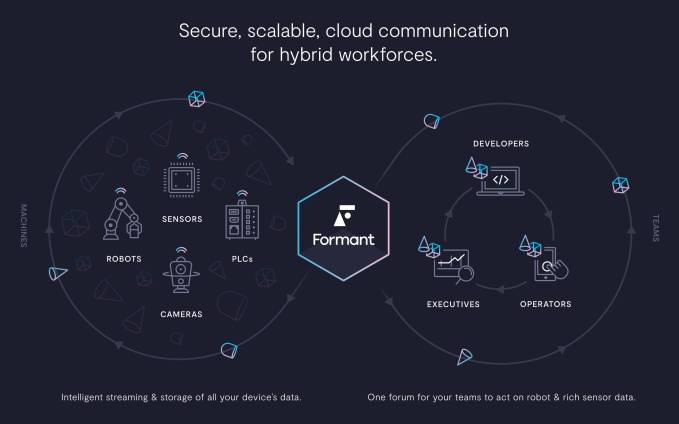
Formant now has SaaS pilots running with businesses in several verticals to make their “robot-shaped data” usable. They range from food manufacturing to heavy infrastructure inspection to construction, and even training animals. Linnell also foresees retail increasingly employing fleets of robots not just in the warehouse but on the showroom floor, and they’ll require precise coordination.

What’s different about Formant is it doesn’t build the bots. Instead, it builds the reins for people to deftly control them.

First, Formant connects to sensors to fill up a cloud with LiDAR, depth imagery, video, photos, log files, metrics, motor torques and scalar values. The software parses that data and when something goes wrong or the system isn’t sure how to move forward, Formant alerts the human “foreman” that they need to intervene. It can monitor the fleet, sniff out the source of errors, and suggest options for what to do next.

For example, “when an autonomous digger encounters an obstacle in the foundation of a construction site, an operator is necessary to evaluate whether it is safe for the robot to proceed or stop,” Linnell writes. “This decision is made in tandem: the rich data gathered by the robot is easily interpreted by a human but difficult or legally questionable for a machine. This choice still depends on the value judgment of the human, and will change depending on if the obstacle is a gas main, a boulder, or an electrical wire.”

Any single data stream alone can’t reveal the mysteries that arise, and people would struggle to juggle the different feeds in their minds. But not only can Formant align the data for humans to act on, it also can turn their choices into valuable training data for artificial intelligence. Formant learns, so next time the machine won’t need assistance.

The industrial revolution, continued

With rock-star talent poached from Google and tides lifting all automated boats, Formant’s biggest threat is competition from tech giants. Old engineering companies like SAP could try to adapt to the new real-time data type, yet Formant hopes to out-code them. Google itself has built reliable cloud scaffolding and has robotics experience from Boston Dynamics, plus buying Linnell’s and Jules’ companies. But the enterprise customization necessary to connect with different clients isn’t typical for the search juggernaut.

Linnell fears that companies that try to build their own robot management software could get hacked. “I worry about people who do homegrown solutions or don’t have the experience we have from being at a place like Google. Putting robots online in an insecure way is a pretty bad problem.” Formant is looking to squash any bugs before it opens its platform to customers in 2019.

With time, humans will become less and less necessary, and that will surface enormous societal challenges for employment and welfare. “It’s in some ways a continuation of the industrial revolution,” Jules opines. “We take some of this for granted but it’s been happening for 100 years. Photographer — that’s a profession that doesn’t exist without the machine that they use. We think that transformation will continue to happen across the workforce.”

See you tomorrow in Warsaw

I’m pleased to announce that I’ll be seeing you Varsovians tomorrow night at our pre-holiday meet-up. The Warsaw event, here, is on the 19th at WeWork in Warsaw. I’ve already chosen folks to pitch, but please come and support your fellow start-uppers.

Special thanks to WeWork Labs in Warsaw for supplying some beer and pizza for the event and, as always, special thanks to Dermot Corr and Ahmad Piraiee for putting these things together. See you soon!

Cydia shuts down purchasing mechanism for its jailbreak app store

Years after becoming one of the go-to destinations for iOS jailbreaks, Cydia’s app store is disabling purchases. Users will be able to access existing downloads through the store and access purchases via third-parties, but beginning this week, they’ll no longer be able to buy apps through the store.

Founder Jay “Saurik “ Freeman revealed the news via a Reddit post this week recommending users remove PayPal accounts from their profile. Freeman notes his initial plan to shut the service down by year’s end, before ultimately opting to close down the purchasing mechanism this weekend over the PayPal issue.

The software engineer cites the toll running the service has taken on his personal life and finances in making the decision. “[T]his service loses me money and is not something I have any passion to maintain: it was a critical component of a healthy ecosystem,” he writes, “and for a while it helped fund a small staff of people to maintain the ecosystem, but it came at great cost to my sanity and led lots of people to irrationally hate me due to what amounted to a purposeful misunderstanding of how profit vs. revenue works.”

Cydia was launched 10 years ago, shortly after the first iPhone was jailbroken. The service has offered users a way to bypass Apple’s own App Store lockdown, building up a rabid fanbase in the process. Ultimately, however, jailbreaking’s popularity has waned in the intervening users.

The exact future of the Cydia community remains unclear, though Freeman has promised a “more formal post” about his plans next week. We’ve reached out for further comment.

The limits of coworking

It feels like there’s a WeWork on every street nowadays. Take a walk through midtown Manhattan (please don’t actually) and it might even seem like there are more WeWorks than office buildings.

Consider this an ongoing discussion about Urban Tech, its intersection with regulation, issues of public service, and other complexities that people have full PHDs on. I’m just a bitter, born-and-bred New Yorker trying to figure out why I’ve been stuck in between subway stops for the last 15 minutes, so please reach out with your take on any of these thoughts: @[email protected].

Co-working has permeated cities around the world at an astronomical rate. The rise has been so remarkable that even the headline-dominating SoftBank seems willing to bet the success of its colossal Vision Fund on the shift continuing, having poured billions into WeWork – including a recent $4.4 billion top-up that saw the co-working king’s valuation spike to $45 billion.

And there are no signs of the trend slowing down. With growing frequency, new startups are popping up across cities looking to turn under-utilized brick-and-mortar or commercial space into low-cost co-working options.

It’s a strategy spreading through every type of business from retail – where companies like Workbar have helped retailers offer up portions of their stores – to more niche verticals like parking lots – where companies like Campsyte are transforming empty lots into spaces for outdoor co-working and corporate off-sites. Restaurants and bars might even prove most popular for co-working, with startups like Spacious and KettleSpace turning restaurants that are closed during the day into private co-working space during their off-hours.

Before you know it, a startup will be strapping an Aeron chair to the top of a telephone pole and calling it “WirelessWorking”.

But is there a limit to how far co-working can go? Are all of the storefronts, restaurants and open spaces that line city streets going to be filled with MacBooks, cappuccinos and Moleskine notebooks? That might be too tall a task, even for the movement taking over skyscrapers.

The co-working of everything

Photo: Vasyl Dolmatov / iStock via Getty Images

So why is everyone trying to turn your favorite neighborhood dinner spot into a part-time WeWork in the first place? Co-working offers a particularly compelling use case for under-utilized space.

First, co-working falls under the same general commercial zoning categories as most independent businesses and very little additional infrastructure – outside of a few extra power outlets and some decent WiFi – is required to turn a space into an effective replacement for the often crowded and distracting coffee shops used by price-sensitive, lean, remote, or nomadic workers that make up a growing portion of the workforce.

Thus, businesses can list their space at little-to-no cost, without having to deal with structural layout changes that are more likely to arise when dealing with pop-up solutions or event rentals.

On the supply side, these co-working networks don’t have to purchase leases or make capital improvements to convert each space, and so they’re able to offer more square footage per member at a much lower rate than traditional co-working spaces. Spacious, for example, charges a monthly membership fee of $99-$129 dollars for access to its network of vetted restaurants, which is cheap compared to a WeWork desk, which can cost anywhere from $300-$800 per month in New York City.

Customers realize more affordable co-working alternatives, while tight-margin businesses facing increasing rents for under-utilized property are able to pool resources into a network and access a completely new revenue stream at very little cost. The value proposition is proving to be seriously convincing in initial cities – Spacious told the New York Times, that so many restaurants were applying to join the network on their own volition that only five percent of total applicants were ultimately getting accepted.

Basically, the business model here checks a lot of the boxes for successful marketplaces: Acquisition and transaction friction is low for both customers and suppliers, with both seeing real value that didn’t exist previously. Unit economics seem strong, and vetting on both sides of the market creates trust and community. Finally, there’s an observable network effect whereby suppliers benefit from higher occupancy as more customers join the network, while customers benefit from added flexibility as more locations join the network.

… Or just the co-working of some things

Photo: Caiaimage / Robert Daly via Getty Images

So is this the way of the future? The strategy is really compelling, with a creative solution that offers tremendous value to businesses and workers in major cities. But concerns around the scalability of demand make it difficult to picture this phenomenon becoming ubiquitous across cities or something that reaches the scale of a WeWork or large conventional co-working player.

All these companies seem to be competing for a similar demographic, not only with one another, but also with coffee shops, free workspaces, and other flexible co-working options like Croissant, which provides members with access to unused desks and offices in traditional co-working spaces. Like Spacious and KettleSpace, the spaces on Croissant own the property leases and are already built for co-working, so Croissant can still offer comparatively attractive rates.

The offer seems most compelling for someone that is able to work without a stable location and without the amenities offered in traditional co-working or office spaces, and is also price sensitive enough where they would trade those benefits for a lower price. Yet at the same time, they can’t be too price sensitive, where they would prefer working out of free – or close to free – coffee shops instead of paying a monthly membership fee to avoid the frictions that can come with them.

And it seems unclear whether the problem or solution is as poignant outside of high-density cities – let alone outside of high-density areas of high-density cities.

Without density, is the competition for space or traffic in coffee shops and free workspaces still high enough where it’s worth paying a membership fee for? Would the desire for a private working environment, or for a working community, be enough to incentivize membership alone? And in less-dense and more-sprawl oriented cities, members could also face the risk of having to travel significant distances if space isn’t available in nearby locations.

While the emerging workforce is trending towards more remote, agile and nomadic workers that can do more with less, it’s less certain how many will actually fit the profile that opts out of both more costly but stable traditional workspaces, as well as potentially frustrating but free alternatives. And if the lack of density does prove to be an issue, how many of those workers will live in hyper-dense areas, especially if they are price-sensitive and can work and live anywhere?

To be clear, I’m not saying the companies won’t see significant growth – in fact, I think they will. But will the trend of monetizing unused space through co-working come to permeate cities everywhere and do so with meaningful occupancy? Maybe not. That said, there is still a sizable and growing demographic that need these solutions and the value proposition is significant in many major urban areas.

The companies are creating real value, creating more efficient use of wasted space, and fixing a supply-demand issue. And the cultural value of even modestly helping independent businesses keep the lights on seems to outweigh the cultural “damage” some may fear in turning them into part-time co-working spaces.

And lastly, some reading while in transit:

California says all city buses have to be emission free by 2040

On the heels of a dire government report published last month about climate change and its devastating impacts, many cities and states are scrambling to find ways to curb the greenhouse gas emissions that threaten their air quality, not to mention their economies.

As is often the case, California is leading the charge, yesterday becoming the first state to mandate that mass transit agencies purchase fully electric buses only beginning in 2029, and that public transit routes be populated by electric buses alone by 2040.

The new rule is expected to require the production and purchase of more than 14,000 new zero-emission buses.

Mary Nichols, chair of the California Air and Resource Board (CARB) that voted unanimously to make California the first state with such a commitment, told the outlet Trucks.com earlier this month that California has “to push standards that are more progressive” than the federal government because of the state’s chronic air pollution, which is linked to asthma and heart disease, among other things.

The move is reportedly the result of several years of CARB’s work with industry and public-health groups, and it flies in the face of moves by the Trump administration to push for lower fuel efficiency standards and to promote the use of fossil fuels.

Indeed, the Trump administration has questioned from the outset how much the U.S. is responsible for cutting back emissions, and the newest government report seemingly didn’t alter anything for the President. Asked last month about the government’s findings that, unchecked, global warming will have catastrophic implications for the U.S. economy, he said, “I don’t believe it.” He added: “People like myself, we have very high levels of intelligence but we’re not necessarily such believers.”

Instead of wait on the administration to change its mind, California’s new Innovative Clean Transit rule will force California’s public bus lines — many of which currently run on natural gas or diesel fuel — to shift to either electric power or hydrogen fuel cells.

The move could be a boon for electric bus companies like Proterra, a 14-year-old, Burlingame, Ca., company that has raised roughly half a billion dollars from investors to build its zero-emission, battery-electric buses. It could also potentially help the publicly traded Chinese automaker giant BYD, which, as TC has reported, has been on a partnership spree with cities across China to electrify their public transportation systems and is now extending its footprint across the globe.

The new ruling is not the only line of attack that California is adopting. As The Hill notes, earlier this year, California also voted to become the first state to mandate new homes be retrofitted with solar panels. In September, Governor Jerry Brown signed a bill that will require the state to transition to a 100 percent renewable energy electric grid by 2045.

CARB has also worked to advise the U.S. Environmental Protection Agency, which last month announced what it called its Cleaner Trucks Initiative. EPA officials say that via the initiative, the agency plans to revise truck pollution standards in a way that lowers their nitrogen oxide emissions while also doing away with requirements that the industry has complained are financially onerous.

As reported by the L.A. Times, despite the announcement, no one yet knows if the EPA is planning more stringent emissions limits or anything as strict as the 90 percent reduction in nitrogen oxide pollution that CARB has said is needed to clean smog to health standards.

Tony Hawk goes mobile

For three years, Tony Hawk has been conspicuously absent from the video store shelves. For most game developers, that’s little more than a blip between titles. When your name and face are attached to 16 titles in 15 years, however, everyone starts to notice when you’re gone.

“It’s usually the first topic of discussion with me,” Hawk laughs. The first, that is, once the world’s most famous skateboarder’s identity has been firmly established.

That question was finally answered this week with the arrival of Skate Jam, the first of Hawk’s titles created exclusively for a mobile platform. The game also marks the skater’s first collaboration with mobile app acquisition group Maple Media — marking a split with longtime publisher Activision.

It was a partnership that ended with a whimper, with the arrival of 2015’s Tony Hawk Pro Skater 5. The final installation of the beloved series was heavily criticized for being uninspired and rushed, and Hawk ultimately opted to move on from a relationship that helped turn his name into a $250 million a year brand at its peak.

The unceremonious end of the Activision deal left the future of the franchise in jeopardy, with Hawk exploring his options. “My contract with Activision ended, and I was exploring a few options, including some VR stuff,” he tells TechCrunch. While he says he’s still open to a future Tony Hawk virtual reality title, the medium ultimately proved too tricky for the first skater to land a 900. “It’s a pretty daunting task to figure out how to make skateboarding work in VR without people getting sick.”

Advances in mobile platforms, on the other hand, have made a smartphone version far more appealing than it would have been at the height of the franchise’s success. “Maple Media came and said they would like to expand on their skate games,” says Hawk. “When I played their most recent engine, I felt there was something there, akin to what I felt when I first played the THPS engine. I felt that, with my input and expertise, we could make something that would be truly authentic for gamers and skaters alike, for a new generation.”

As far as whether Skate Jam’s release portends the rebirth of the franchise, Hawk is ultimately a bit more cagey. He explains that the team is more focused on building out the current title than committing to Pro Skater’s annual release schedule.

“We’re going to see a lot more development in terms of growing this title,” Hawk says. “It’s much more streamlined and we can do it on a regular basis. We’re not planning to develop a new title, per se, but are planning to grow and develop this one.”

Skate Jam is now available for Android and iOS.

Workers protest outside Minnesota Amazon warehouse

Yesterday afternoon, Somali-American workers marched outside of Amazon’s Shakopee, Minnesota fulfillment center, chanting “hear our voice.” Estimates of the exact number of marches vary from source to source, but The Minneapolis Star Tribune puts it at around 100.

It’s a fairly familiar refrain for the company, after years of reports about questionable working conditions. Some of that came to a head earlier this year when pressure from Vermont Senator Bernie Sanders led the company to adopt a $15 minimum wage for warehouse workers.

The protesters cited unfair working conditions and the insensitive treatment of a local workforce that’s approximately 40 percent East African. “We needed secured jobs, we are not robots,” one employee told a local Fox affiliate.

The protest comes the same week employees at a New York City warehouse announced plans to unionize. It is, of course, an inopportune time for the online retail giant, with the Christmas holiday a mere 10 days away.

In a statement, a spokesperson for the company expressed “disappointment,” telling Gizmodo,  “The majority of the people participating in today’s events are not Amazon associates because most Amazon associates are at work today sending out thousands of holiday packages for customers. We are disappointed in today’s efforts to undermine the dedicated and hard-working people who are the life and soul of our business. For them, it was business as usual.”

The spokesperson goes on to defend the company’s work and safety record and inclusion of paid prayer breaks, writing, “Prayer breaks less than 20 minutes are paid, and productivity expectations are not adjusted for such breaks. Associates are welcome to request an unpaid prayer break for over 20 minutes for which productivity expectations would be adjusted.”