A new DOJ indictment outlines how Chinese hackers allegedly compromised data from companies in a dozen countries in a single intrusion.
Category: Tech news
hacking,system security,protection against hackers,tech-news,gadgets,gaming
Watch the New ‘Men in Black International’ Trailer Now
Plus: ‘To All the Boys I’ve Loved Before’ gets a Netflix sequel and ‘Aquaman’ rules the box office.
StreetCred Is Challenging Google Maps—and It Wants Your Help
The mapping startup wants to pay a volunteer mapping army in cryptocurrency to carry out its data missions.
Trigonometry Is Essential to Physics. Here Are the Basics
Good ol’ trig: that bastion of angles and triangles is essential to calculating velocity, momentum, and much more.
Best Movies (2018): The Essential Films You Didn’t See
This year had great blockbusters—’Black Panther’! ‘A Star Is Born’!—but there are a few top-notch movies you might’ve missed.
Hacking Diplomatic Cables Is Expected. Exposing Them Is Not
Spies try to access government communications all the time. But an incident this week tested the limits of what happens when those compromises get discovered.
We’ve Got the Screen Time Debate All Wrong. Let’s Fix It
The narrative around tech addiction has been driven more by fear than facts. But that’s finally starting to change.
Uber’s Self-Driving Cars Are Back on Pittsburgh Streets
Nine months after an Uber self-driving car killed a woman in Arizona, the company has resumed testing in Pittsburgh.
Winter Cycling Gear: Jackets, Waterproof Pants, Gloves, Lights
Just because it’s bitter and nasty outside doesn’t mean you have to ride the bus. Stock up on this list of helmets, jackets, and warm stuff.
The 21 (and Counting) Biggest Facebook Scandals of 2018
Bet you already forgot half of Facebook’s crises this year.
A SpaceX Booster Went for a Swim and Came Back as Scrap Metal
The space company spent several days retrieving and inspecting a rocket booster that made an unplanned ocean landing. Now it appears to be toast.
The ‘Future Book’ Is Here, but It’s Not What We Expected
Visionaries thought technology would change books. Instead, it’s changed everything about publishing a book.
Elon Musk’s ‘vision for transport’ is a 3D network of tunnels for autonomous electric vehicles
Billionaire entrepreneur Elon Musk’s vision of an “entirely new system of transport,” which he unveiled Wednesday night at a splashy event in Hawthorne, California, wasn’t a reusable rocket like the ones he’s building at his nearby SpaceX headquarters. Nor is it an electric vehicle, like the Teslas he is producing at a factory in Fremont, California.
Tonight, Musk showed off a 1.14-mile test tunnel — that snakes its way underneath 120th Street in the city of Hawthorne — that his other business, the Boring Company, dug for about $10 million using a modified boring machine called Godot. (That $10 million figures includes the cost of building the tunnel, all internal infrastructure, lighting, ?communication and video, safety systems, ventilation, and track, according to the company.) For Musk, this is merely a demonstration of what could be: a network of low-cost tunnels used for transportation, utilities or water and built for millions of dollars, or even billions less than those constructed for subways or trains.
And it’s a vision that he’s funding, for now. Musk estimates he’s spent about $40 million of his own money funding The Boring Company .
Boring is developing an entirely new system of transport
— Elon Musk (@elonmusk) December 18, 2018
These tunnels, which at about 12-feet in diameter are smaller than a subway, are cheaper to build thanks to the company’s boring machines, Musk and Boring Company president Steve Davis contend.
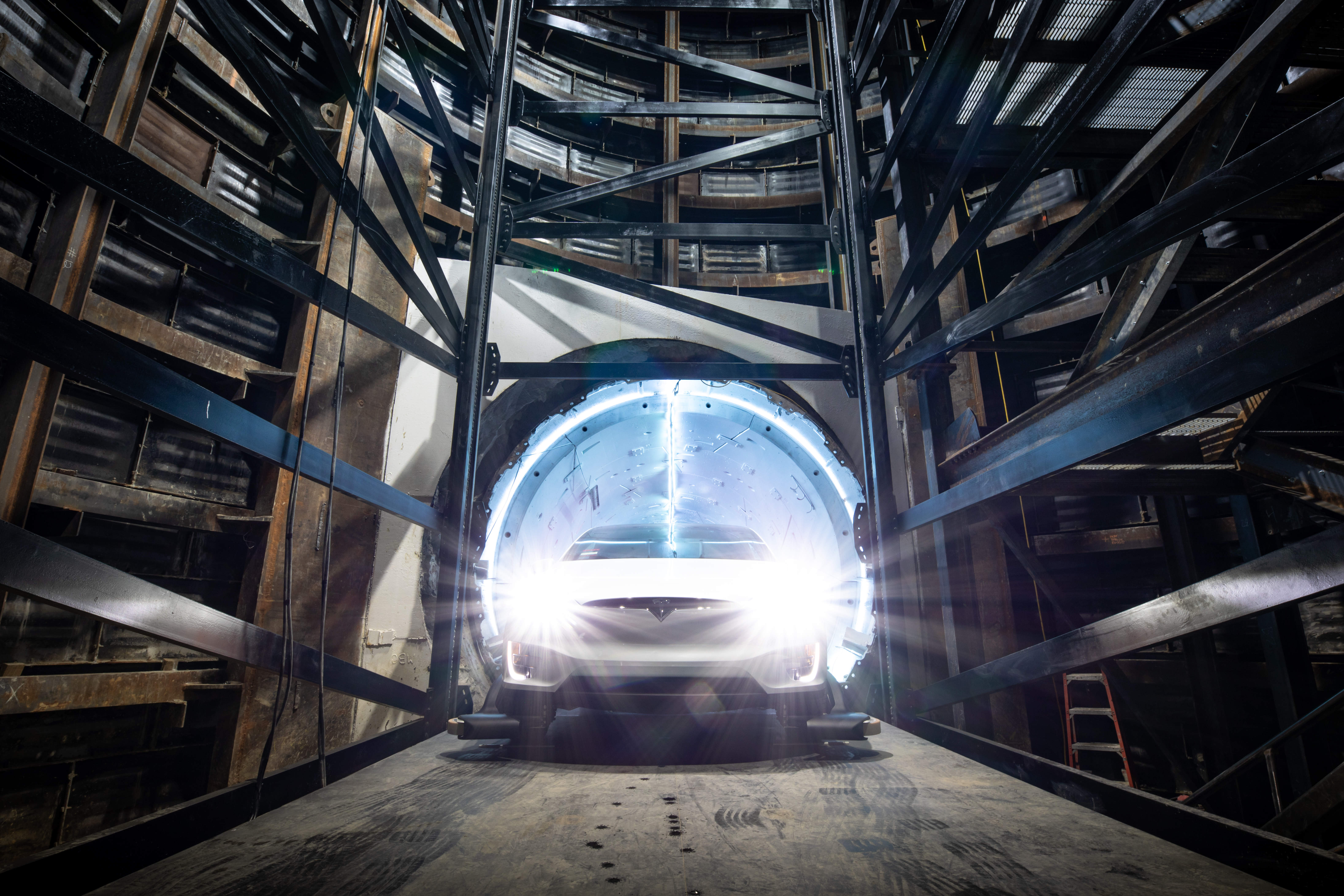
The tunnels could be stacked — Musk calls it a 3D network — and operate like a giant underground highway with vehicles entering and exiting at strategic points along the way via ramp, spiral or elevator depending on available space. The main tunnel would allow vehicles, which are stabilized via a retractable tracking wheels, to travel up to 150 miles per hour. Once a vehicle leaves the main artery, speeds would be reduced. (The retractable tracking wheels are important, new development; Musk said they originally were going to place the vehicles on a skate, which would travel at high speeds, but ditched the idea because it was too “complex.”
These entry points could take as little room as two parking spaces for an elevator, Musk said, which TechCrunch was able to attest to, at least with the demonstration tunnel.
“You can weave these stations throughout the fabric of the city without changing the character of the city, Musk said during a press briefing.
There are some important caveats to this system. This is a concept; it currently doesn’t exist at the scale Musk envisions, although there are numerous cities and utilities interested. (Davis noted they get between 5 and 20 requests or inquires a day from municipalities and utilities).
Tesla in @boringcompany tunnel with retractable wheel gear that turns a car into a rail-guided train & back again pic.twitter.com/3a6i0NoSmi
— Elon Musk (@elonmusk) December 19, 2018
And only autonomous, electric vehicles would be allowed in the Loop, as The Boring Company is calling the concept. A Tesla Model X was used in the demo Wednesday night, although Musk insisted during a press briefing that “this is not some walled garden or something only for Teslas.” He also said, several times, that this is meant to be a complement to other forms of transport, not to the exclusion of other things.
The Loop would also have dedicated vehicles for pedestrians and bicyclists that Musk speculated could cost about $1 a ride, if shared. The vehicles designated for public transport would run in a loop and get priority.
The public transport piece is notable because, if the Loop existed today, there would be few vehicles that could qualify as autonomous and electric, except Tesla. While the Tesla Model X was used in the demo rides Wednesday night, Musk said he believes smaller electric vehicles like the Model 3, or the yet to be seen Model Y, would be better use cases. And yes, there would be bike racks.
The demo ride
TechCrunch’s ride through the Hawthorne test tunnel began near 120th street and Prairie Avenue, next to a nondescript building — “The Brick Store” stenciled discreetly on one side — that only stood out because of all the security surrounding it. The Model X had been outfitted with the retractable wheels, which Musk said would be an aftermarket product that might cost between $200 and $300.
Once the vehicle descended, the test driver slowly accelerated to about 44 mph through the tunnel, back towards Crenshaw and 120th Street. The tunnel, hazy with dust from the construction, and lit by neon-like lighting, delivered a bumpy-ish ride on occasion. Musk later explained that this was because they had some trouble with the paving. A system for the public would be much smoother, he said.
The entry point, near the Brick Store, provides an important link to the Boring Company story and vision. Earlier this year, TechCrunch reported that Musk has started a company called The Brick Store LLC to produce and sell bricks, according to public documents. The new company, which was founded in July, will be managed by Davis, the ex-SpaceX engineer who is also running The Boring Company (TBC).
The plan, is for the Boring Company to use the dirt extracted during the boring process to produce bricks, which will cost $0.10 a brick, Musk said. These bricks were on display, in the form of a giant watchtower, outfitted with a Medieval-era guard.
The next step for the Boring Company is to develop its next generation boring machine, the Line Storm (reference to a Robert Frost poem) and eventually Prufrock, which will deliver a 15-fold cost savings to current technologies, said Musk, who noted that 15% of overall tunnel cost is dirt removal.
This cheaper tunnel is possible, Musk says, through a several small yet notable innovations. Costs are reduced by tripling the boring speed and keeping the tunnels to a smaller diameter. But the real key is the ability of the machine to simultaneously mine and install the reinforcement segments, something the next-generation Line Storm will be able to do.
And that’s just the beginning.
“The Loop is just a stepping stone to the hyperloop, Musk said, in reference to the high-speed futuristic mode of transport he first floated in a white paper several years ago. “the Loop will be transport within cities and the hyperloop will be transport between them.”
Facebook’s got 99 problems but Trump’s latest “bias” tweet ain’t one
By any measure Facebook hasn’t had the best of years in 2018.
But while toxic problems keep piling up and, well, raining acidly down on the social networking giant — from election interference, to fake accounts, faulty metrics, security flaws, ethics failures, privacy outrages and much more besides — the silver lining of having a core business now widely perceived as hostile to democratic processes and civilized sentiment, and the tool of choice for shitposters agitating for hate and societal division, well, everywhere in the world, is that Facebook has frankly far more important things to worry about than the latest anti-tech-industry salvo from President Trump.
In an early morning tweet today, Trump (again) attacked what he dubbed anti-conservative “bias” in the digital social sphere — hitting out at not just Facebook but tech’s holy trinity of social giants, with a claim that “Facebook, Twitter and Google are so biased towards the Dems it is ridiculous!”
Facebook, Twitter and Google are so biased toward the Dems it is ridiculous! Twitter, in fact, has made it much more difficult for people to join @realDonaldTrump. They have removed many names & greatly slowed the level and speed of increase. They have acknowledged-done NOTHING!
— Donald J. Trump (@realDonaldTrump) December 18, 2018
Time was when Facebook was so sensitive to accusations of internal anti-conservative bias that it fired a bunch of journalists it had contracted and replaced them with algorithms — which almost immediately pumped up a bunch of fake news. RIP irony.
Not today, though.
When asked if it had a response to Trump’s accusation of bias a Facebook spokesperson told us: “We don’t have anything to add here.”
The brevity and alacrity of the response suggested the spokesperson had a really cheerful expression on their face when they typed it.
The relief of Facebook not having to give a shit this time was kinda palpable, even in pixel form.
It was also a far cry from the screeds the company routinely dispenses these days to try to muffle journalistic — and indeed political — enquiry.
Trump evidently doesn’t factor ‘bigly’ on Facebook’s oversubscribed risk-list.
Even though Facebook was the first name on the president’s (non-alphabetical) tech giant hit-list.
Still, Twitter appeared to have irked Trump more, as his tweet singled out the short-form platform — with an accusation that Twitter has made it “much more difficult for people to join [sic] @realDonaldTrump”. (We think by “join” he means follow. But we’re speculating wildly.)
This is perhaps why Twitter felt moved to provide a response to the claim of bias, albeit also without wasting a lot of words.
Here’s its statement:
Our focus is on the health of the service, and that includes work to remove fake accounts to prevent malicious behavior. Many prominent accounts have seen follower counts drop, but the result is higher confidence that the followers they have are real, engaged people.
Presumably the president failed to read our report, from July, when we trailed Twitter’s forthcoming spam purge, warning it would result in users with lots of followers taking a noticeable hit in the coming days. In a word: Sad.
Of course we also asked Google for a response to Trump’s bias claim. But just got radio silence.
In similar “bias” tweets from August the company got a bigger Trump-lashing. And in a response statement then it told us: “We never rank search results to manipulate political sentiment.”
Google CEO Sundar Pichai has also just had to sit through some three hours of questions from Republicans in Congress on this very theme.
So the company probably feels it’s exhausted the political bias canard.
Even while, as the claims drone on and on, it might truly come to understand what it feels like to be stuck inside a filter bubble.
In any case there are far more pressing things to accuse Google’s algorithms of than being ‘anti-Trump’.
So it’s just as well it didn’t waste time on another presidential sideshow intended to distract from problems of Trump’s own making.
Uber to resume autonomous vehicle testing months after fatal accident
Uber has been granted permission by the state of Pennsylvania to reinstate tests of its autonomous vehicles, as first reported by Reuters.
A spokesperson for Uber confirmed to TechCrunch that the ride-hailing giant received a letter of authorization from the Pennsylvania Department of Transportation and clarified that the company has not yet resumed self-driving operations.
Uber halted testing of its self-driving cars following a fatal accident in Tempe, Arizona this March that left a pedestrian dead. An autonomous Uber SUV accompanied by a safety driver was driving northbound when it struck a woman, who was taken to the hospital where she later died as a result of her injuries.
Investigators later determined the driver, Rafaela Vasquez, had looked down at a phone 204 times during a 43-minute test drive, according to a 318-page police report released by the Tempe Police Department.
In the aftermath of the accident, Uber paused all of its AV testing operations in Pittsburgh, Toronto, San Francisco and Phoenix.
Moving forward, Uber will test its self-driving cars more cautiously, per a recently released Uber safety report. The company will require that two employees are in the front seat of its cars at all times, that an automatic braking system is enabled and that its safety employees are more strictly monitored.
Uber, which first began developing its autonomous vehicle fleet in 2015 and initiated tests the following year, confidentially filed for an initial public offering two weeks ago. The company, currently valued at $72 billion, is expected to debut at a valuation as high as $120 billion early next year.