5 unicorns that will probably go public in 2019 (besides Uber and Lyft)

There’s been plenty of fanfare surrounding Uber and Lyft’s initial public offerings — slated for early 2019 — since the two companies filed confidential IPO paperwork with the U.S. Securities and Exchange Commission in early December. On top of that, public and private investors have had plenty to say about Slack and Pinterest’s rumored 2019 IPOs. But those aren’t the only “unicorn” exits we should expect to witness in the year ahead.

Using its proprietary company rating algorithm, data provider CB Insights ranked five billion-dollar companies most likely to perform IPOs next year in its latest tech IPO report. The algorithm analyzes non-traditional public signals, including hiring activity, web traffic and mobile app data, to make its predictions. These are the startups that topped their list.


Peloton

Peloton co-founder and CEO John Foley speaks onstage during TechCrunch Disrupt SF 2018 on September 6, 2018 in San Francisco, California. (Photo by Kimberly White/Getty Images for TechCrunch)

Peloton, dubbed the “Netflix of fitness,” has raised nearly $1 billion in venture capital funding in the six years since it was founded by John Foley, most recently raising $550 million at a $4 billion valuation. The manufacturer of tech-enabled exercise equipment is more than doubling in size every year and is “weirdly profitable,” an unusual characteristic for a venture-backed business of its age. Headquartered in New York, Peloton doesn’t have any public IPO plans, though Foley recently told The Wall Street Journal that 2019 “makes a lot of sense” for its stock market debut.

Select investors: L Catterton, True Ventures, Tiger Global

Cloudflare

Cloudflare co-founder and CEO Matthew Prince appears onstage at the 2014 TechCrunch Disrupt Europe/London. (Photo by Anthony Harvey/Getty Images for TechCrunch)

Cybersecurity unicorn Cloudflare is likely to transition to the public markets in the first half of 2019 in what is poised to be a strong year for IPOs in the security industry. The web performance and security platform is said to be preparing for an IPO at a potential valuation of more than $3.5 billion after last raising capital in 2015 at a $1.8 billion valuation. Since it was founded in 2009, the San Francisco-based company has raised just north of $250 million in VC funding. CrowdStrike, another security unicorn, is also on track to go public next year, and it wouldn’t be surprising to see Illumio and Lookout make the jump to the public markets, as well.

Select investors: Pelion Venture Partners, NEA, Venrock

Zoom

San Jose-based Zoom Video Communications has reportedly tapped Morgan Stanley to lead its upcoming IPO

Zoom, a provider of video conferencing services, online meeting and group messaging tools that’s raised $160 million in VC cash to date, is eyeing a multi-billion IPO in 2019 and has reportedly hired Morgan Stanley to lead the offering. Founded in 2011, the company most recently brought in a $100 million Series D financing, entirely funded by Sequoia, at a $1 billion valuation in early 2017. Based in San Jose, Calif., Zoom is hoping to garner a valuation significantly larger than $1 billion when it IPOs, according to Reuters.

Select investors: Sequoia, Emergence Capital Partners, Horizons Ventures

Rubrik

Data management company Rubrik co-founder and CEO Bipul Sinha

Data management company Rubrik has quietly made moves indicative of an impending IPO. The startup, which provides data backup and recovery services for businesses across cloud and on-premises environments, hired former Atlassian chief financial officer Murray Demo as its CFO earlier this year, as well as its first chief legal officer, Peter McGoff. Palo Alto-based Rubrik was valued at more than $1 billion with a $180 million funding round in 2017. The company has raised nearly $300 million to date.

Select investors: Lightspeed Venture Partners, Greylock, Khosla Ventures

Medallia

Medallia, a customer experience management platform that’s nearly two decades old, may finally become a public company in 2019. The San Mateo, Calif.-based company, which has been rumored to be planning an IPO for several years, hired a new CEO this year and reported $250 million in GAAP revenue for the year ending January 31, 2018, according to Forbes. Medallia hasn’t raised capital since 2015, when it secured a $150 million funding deal at a $1.2 billion valuation. It has raised a total of just over $250 million.

Select investor: Sequoia

HQ Trivia launches HQ Words as reinstalled CEO seeks a game-changer

HQ’s expansion beyond trivia is emerging from beta, but the question is whether it’s different and accessible enough to revive the startup’s growth. HQ Words opens to everyone today with games at 6:30pm PT within the HQ Trivia app after several weeks of closed beta testing of the Wheel of Fortune-style game. The launch will be the first big move of Rus Yusupov now that he’s been officially renamed CEO a week after the tragic death of fellow co-founder and former CEO Colin Kroll, HQ confirms to TechCrunch.

“Intermedia Labs introduced the world to a category-defining product, HQ Trivia. Once again, with HQ Words, Intermedia Labs is poised to captivate the world with a revolutionary experience that will bring people together in new ways around live mobile video,” Yusupov tells us. “HQ Words is the most interactive experience we’ve ever made.”

Kroll’s passing comes at a tough time for HQ. Its daily player count has declined since it became a phenomenon a year ago. The novelty has begun to wear off, and with so many experienced trivia whizzes, cash jackpots are often split between enough people that winners only get a few bucks. Interrupting your days or nights to play at a particular time can be inconvenient compared to the legions of always-available other games. Yusupov, who was HQ’s CEO until Kroll took over in September, will have to figure out what will attract casual crosswords players and those who flocked to Zynga’s Words with Friends — the kind of disruptive thinking Kroll excelled at.

“Colin and I shared many incredible life moments over the last 7 years. We embarked on an incredible journey co-founding two breakthrough companies together – and the lessons we learned at Vine and HQ will continue to have a big impact on me. Like many relationships, we’ve also had our challenges – but it was during these challenging times that Colin’s kind soul and big heart would truly shine,” Yusupov wrote in a statement about his co-founder that was originally published by Digiday in a touching memorial post. Between building Vine and HQ together, the pair have reimagined mobile entertainment, giving millions a chance to show off their wits and creativity. “He had this incredible ability to make everyone feel special. He listened well. He thought deeply. But above all, he cared about people more than work. The driving force behind his innovations was the positive impact they would have on people and world. Colin’s innovations and inventions have changed many people’s lives for the better and will continue to impact the world for years to come.”

HQ Trivia’s co-founder and former CEO Colin Kroll passed away earlier this month

How to play HQ Words

In HQ Words, players compete live to solve word puzzles by correctly choosing which letters are hidden. You can find the game inside the existing HQ Trivia iOS and Android apps. Host Anna Roisman pluckily provides a clue and then dispenses hints as the 25-second timer for each puzzle counts down. If the clue is “gemstone” and you’re shown “_ _ _ m _ _ _”, you’ll have to tap D, I, A, O, and N in any order. Choose three wrong letters or fail to fill out the words and you lose. You’ll spin a wheel before the game starts to get one letter that’s automatically revealed each round.

Make it through 10 rounds and you and other winners get a cut of the cash prize, with the three who solved the puzzles fastest scoring a bigger chunk of the jackpot. The startup earns money through selling you extra lives inside Words, though it will probably feature sponsored games and product placement like Trivia does to pull in marketing dollars. Words will go live daily at 6:30pm Pacific after Trivia’s 6:00 game, so you can turn it into HQ hour with family and friends.

HQ Words is much more frenetic than Trivia. Rather than picking a single answer, you have to rapidly tap letters through a combination of educated and uneducated guesses. That means it really does feel more interactive, since you’re not sitting for minutes with just a sole answer tap to keep you awake. And because it doesn’t require deep and broad trivia knowledge, Words could appeal to a wider audience. The spinner also adds an element of pure luck, as a weaker player who gets to auto-reveal a vowel might fare better than a wiser player who gets stuck with a “Z” like I always seem to.

Fill in the blank

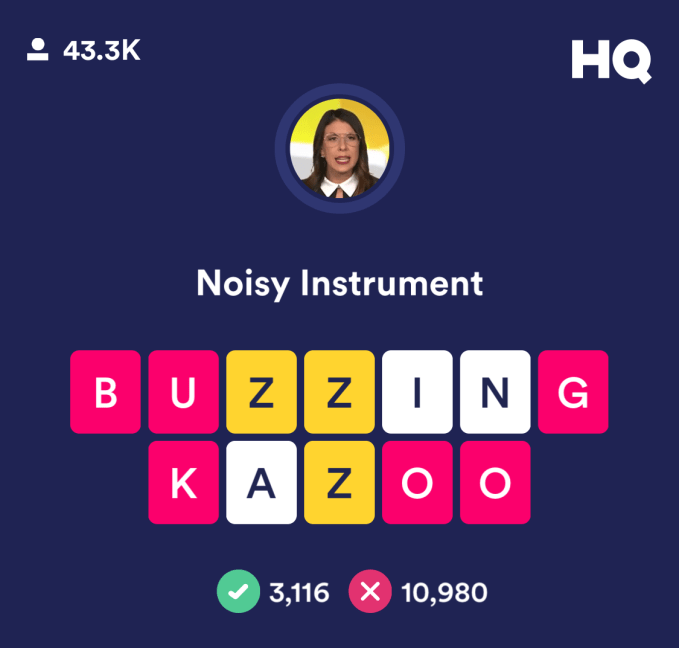
The concern is that at its core, Words is still quite similar to Trivia. They’re both real-time, elimination round-based knowledge games played against everyone for money. Both at times feel like they use cheap tricks to eliminate you. A recent Words puzzle asked you to name a noisy instrument, but the answer wasn’t “kazoo” but “buzzing kazoo” — something I’m not sure anyone has ever formally called it. Given the faster pace of interaction, even tiny glitches or moments of lag can be enough to make you lose a round. An HQ Words beta game earlier this week failed to show some users the keyboard, causing mass elimination. The pressure to get HQ’s engineering working flawlessly has never been higher.

The phrasing of some HQ Words answers seems like a stretch

HQ originally agreed to let TechCrunch interview Kroll about what makes Words different enough to change the startup’s momentum. Yusupov was supposed to fill in after Kroll was sadly found dead last Friday of an apparent drug overdose. He later declined to talk or provide written responses. That’s understandable during this time of mourning and transition. But HQ will still need to build an answer into its app. Meanwhile, Chinese clones and U.S competitors have begun co-opting the live video quiz idea. Facebook has even built a game show platform for content makers to create their own.

HQ could benefit from a better onboarding experience that lets people play a sample game solo to get them hooked and tide them over until the next scheduled broadcast. Mini-games or ways to play along after you’re eliminated could boost total view time and the value of brand sponsorships. A “quiet mode” that silences the between-round chatter and distills HQ to just the questions and puzzles might make it easier to play while multi-tasking. Head-to-head versions of Trivia and Words might help HQ feel more intimate, and there’s an opportunity to integrate peer-to-peer gambling like ProveIt trivia.  And branching out beyond knowledge games into more social or arcade-style titles would counter the idea that HQ is just for brainiacs.

Around the height of HQ’s popularity it raised a $15 million funding round at a $100 million valuation. That seems justified, given HQ will reportedly earn around $10 million in revenue this year. Gamers are fickle, though, and today’s Fortnite can wind up tomorrow’s Pokémon GO [Update: Draw Something would be a better example] — a flash in the pan that fizzles out. Words is a great bridge to a world outside of Trivia, but HQ must evolve, not just iterate.

Convo now lets you see which employees got the memo

Convo, a tool perhaps best described as a real-time company message board, picked up a new trick this week: automated acknowledgements.

It’s a pretty common thing in the corporate world: you need to send something out to all of the employees at your company, but you also need to know exactly who has seen it (and, of course, who hasn’t.) Who actually got the memo? Can you say that everyone has seen some mandatory reading? Who still needs to see it?

You can try to use email read receipts, but those are hit-or-miss — particularly as many email clients disable them by default nowadays. You can make everyone sign a form saying they’ve seen the document in question, but that’s a pain in the butt. When all you need is a list that says “Yep, these employees have all seen this blurb of text” so you can meet some new compliance requirement, it shouldn’t be complicated.

Convo’s new tool makes it pretty easy: write your post like any other, but check the “Recipients must acknowledge to view” box before sending it out.

When it pops up in your colleagues’ Convo timeline, it’ll be almost entirely blurred, save for a subject line and a prompt asking them to acknowledge the post. Once they deliberately acknowledge it, the post is de-blurred, the original poster gets an alert letting them know someone has read it, and the reader’s name moves from the “Has not seen” to the “Has seen” list.

To be clear, this isn’t a security feature; there are ways to get around the blurring without officially acknowledging it. Hell, you can just say ‘Hey Jim, did you already open that convo post? Let me see it on your phone’. The point here isn’t preventing anyone in the company from seeing something, but in making sure everyone has seen something, and having an automatically generated list to fulfill any compliance requirements. If you’re using Convo’s group features correctly, it should only show up for people you intend to see it in the first place.

The feature rolled out earlier this week. It’ll be available for all Convo networks for the next month to check out, at which point they expect to limit it to Enterprise-level customers.

An Apple event, but with Bad Lip Reading

Bad Lip Reading has held a special place in my heart longer than just about any other YouTube channel. The formula is just too perfect: take a thing we know, blend it up in a stew of uncanny absurdity, and re-release it into the world. They’ve done it with The Hunger Games, the NFL, and now something readers of this site probably know all too well: a live Apple event.

BRB, pre-ordering my Handsome Anthony.

Crowdfunded developer of space sim Star Citizen takes on $46M in funding at nearly $500M valuation

The story of the game Star Citizen and Cloud Imperium, the company developing it, is almost too ludicrous to believe: a crowdfunding effort to create a space sim of unparalleled size and realism, raising hundreds of millions, with backers paying thousands for ships and gear in a game that’s years from release. Yet it’s real enough that it just pulled in $42 million in private funding to help bring it closer to release.

Star Citizen began as the brainchild of Chris Roberts, architect of the Wing Commander series and other well-received space games. His idea was to crowdfund the team’s next game, and did so in 2012; the money started rolling in, and it never really stopped. Nor has the game ceased to grow in its ambitions, adding things like entire planets to the lineup that seem, on their face, somewhat insane.

There’s no shortage of histories of the game and its developers out there, so for our purposes let it suffice to say that over the last six years the company has raised $211 million, the vast majority of which comes from gamers “pledging” anywhere from a few bucks to thousands of dollars for all manner of things related to the title. Early access to builds, exclusive ships, testing new content, etc.

A huge amount of work has been done on the game, so this isn’t just a colossal con, though there are plenty who think the game, and its first-person shooter counterpart Squadron 42, can’t possibly ever fulfill its ambitions and justify the money people have put into it.

That doesn’t seem to be the opinion of Clive Calder, founder of Zomba and producer in a variety of entertainment formats, whom Roberts met during a clandestine campaign to solicit funding.

Roberts, who writes the story in one of his candid messages to the project’s fanbase, had decided a while back that he didn’t want to use pledged funds for marketing purposes — at least not the kind of marketing blitz AAA games tend to require for a successful global release. So he went looking for investment, and found Calder, with whom he “got on like a house on fire.”

Calder’s family office agreed to invest $46 million for a 10 percent stake in Cloud Imperium, which all told puts it near a half-billion valuation. One may very well question the sanity of such a valuation for a company that has not yet shipped an actual product — working prototypes, sure, but not a completed game — but hell, at least they’re making something people are excited about. That’s got to be worth a couple bucks.

Cloud Imperium gains two new board members from outside, though Roberts, who commands the kind of loyalty that only decades in an industry can create, was quick to point out that “control of the company and the board still firmly stays with myself as chairman, CEO and majority shareholder.”

In another act of not exactly radical but not legally required transparency, the company also posted an outline of the company’s financials over the last six years. Unsurprisingly, the company has been investing most of its cash into game development in the form of salaries, contracts and overhead; a non-trivial amount has gone toward “publishing operations, community, events and marketing,” which with a game as community-focused as Star Citizen is not surprising.

The company has grown steadily, adding a hundred people a year or so to a present size of 464 — which is the kind of size you’d expect on a AAA game like Assassin’s Creed or Red Dead Redemption. Even more would be added on as temporary artists, actors and so on.

I’m sure it has escaped no one that pledges appear to have peaked, though if they remain steady the company clearly will have enough to continue operations if it doesn’t expand. But one does also see perhaps a secondary motive in seeking investment from outside the community. At some point people are going to want a game.

To that end, Squadron 42, at least, is scheduled for release in Q2 2020 — though backers and critics will both chuckle a little at the idea that Cloud Imperium will be able to hit those goals. The games, infamously, were originally slated for release long ago. But the scope of the project has grown since its conception and although some no doubt would rather be playing the completed game today, they may very well find that good things come to those who wait. And wait. And wait…

Gaming chat startup Discord raises $150M, surpassing $2B valuation

Chatty gamers are apparently worth billions.

Discord, the gaming chat startup with more than 200 million active users, announced Friday that it had secured $150 million in funding at a $2.05 billion valuation. The round was led by Greenoaks Capital with participation from Firstmark, Tencent, IVP, Index Ventures and Technology Opportunity Partners.

The company announced this past April that they had raised $50 million in funding at a $1.65 billion valuation. With this latest bout of cash, Discord has now pulled in more than $280 million in funding.

The influx of new money comes as the chat startup goes full speed ahead on one of its most ambitious offshoots to date, taking on games giant Valve with a gaming store meant to rival the ubiquitous Steam store. The company launched a global beta of the Discord Store in October; they recently announced that starting in 2019, they will be establishing a revenue split of 90/10 for developers that are self-publishing titles on the store, a margin much friendlier to indie devs than the 70/30 split on Steam.

The company’s bread-and-butter remains its chat service, which brings voice and text communications to gamers looking to talk with teammates and fellow enthusiasts during and outside of gameplay. Discord isn’t the only service that offers this capability, but it is definitely one of the most popular with hundreds of millions of users coming to the app every month.

We chatted with CEO Jason Citron at our most recent Disrupt SF event, where he talked about the opportunities available in the online games sales market and what challenges the company had up ahead.

NORAD Santa tracker will stay on even if the government shuts down

For more than 60 years, the North American Aerospace Defense Command, better known as NORAD, and its predecessor, the Continental Air Defense Command (CONAD) have tracked Santa’s flight around the world on December 24.

And it will continue this year, even if there’s a government shutdown, the operations center said Friday in a tweet.

In the event of a government shutdown, NORAD will continue with its 63-year tradition of NORAD Tracks Santa on Dec. 24. Military personnel who conduct NORAD Tracks Santa are supported by approximately 1,500 volunteers who make the program possible each and every year. pic.twitter.com/fY0oyjrdDc

— NORAD & USNORTHCOM (@Norad_Northcom) December 21, 2018

The NORAD Santa tracker is supported by some 1,500 volunteers who staff telephones and computers to answer calls and e-mails from children (and adults) from around the world, according to NORAD.

People can get live updates through the NORAD Tracks Santa website, which is available in seven languages, over telephone lines and by e-mail. There are even live updates on Twitter.

You can follow along here too.

The tradition all began over a misprinted phone number in an advertisement in the local paper. The ad said, “Hey, Kiddies! Call me direct and be sure and dial the correct number.” When a young child called that December 24, in 1955, it went to the CONAD operations center in Colorado Springs, Colo.

Colonel Harry Shoup, who was on duty that night, answered the phone. It wouldn’t be the first child who called that night. Shoup had his operators find the location of Santa Claus and reported it to every child who phoned in, kicking off what would become an annual tradition.

JD.com’s billionaire founder Richard Liu won’t be charged in sexual misconduct case

Roughly four months after JD.com’s billionaire CEO Richard Liu was arrested and later released by Minneapolis police on suspicion of alleged sexual misconduct, local authorities say they will not be charging him in a sexual misconduct case. In a statement, Hennepin County Attorney Mike Freeman said it was not possible to prove beyond a reasonable doubt the charges brought against Liu.

“As is the case in many sexual assault incidents, it was a complicated situation,” said Freeman in the release. “It is also similar to other sexual assault cases with the suspect maintaining the sex was consensual.”

An attorney for the accuser — a Chinese undergraduate who was studying at the University of Minnesota this fall — warned in an interview with the WSJ that “her story will be told.”

According to audio recordings reviewed by the WSJ, the woman told police that she attended a dinner with Liu and his associates on August 30th, and that Liu raped her in her home afterward.

JD.com, one of China’s largest online retailers, has from the outset called the accusations unsubstantiated, with Liu denying all wrongdoing.

The Rodecaster Pro is a perfect centerpiece to a home podcasting studio

My podcasting rig is simple: Two microphones, a Tascam recorder, two XLR cables. I’ve upgraded things a bit in the past year — improved the mics, bought some foam windscreens and bought a pair of tabletop, foldable mic stands. But the principle is the same: take nothing I can’t fit into a laptop sleeve.

It’s served me pretty well in the five years I’ve been doing my show. While friends were building soundproof posting studios in their homes, I went with a rig I could take with me. It’s a lot easier to ask someone to be on your show if you’re able to go to them.

Here’s a picture I took of comedian Hannibal Buress after recording an upcoming episode in my hotel room in Lagos, Nigeria. That’s my setup right there. It’s sitting atop my rolling luggage, which is turned upside down on a small hotel coffee table. Improvisation is key.

There are trade-offs, of course. Sound is a big one. The mics themselves are pretty crisp, but ambient noise is an issue. I’ve recorded a bunch of these in cafes, bars and restaurants. I tell myself it’s part of the charm. And, of course, with a Tascam, you don’t have the same sort of sophisticated control you get with a board.

Perhaps I’ve always secretly fantasized about what a home studio might look like. Cost has always been a factor, of course. These things add up like crazy. Also, the barrier of entry is needlessly complex. A handful of companies have looked to capitalize on the increasingly profitable world of non-professional podcasts. Blue has produced some pretty compelling USB-based stuff. For those who want to record multiple guests in the same room, however, things start to get much trickier.

I jumped at the chance to try out the Rodecaster Pro. From the looks of it, it just might be the ideal product to help home podcasters scratch that itch. The product is essentially a six-channel soundboard with self-contained production capabilities. The idea is to just record everything live to a single track that can be uploaded directly to your podcast server of choice.

That includes everything from live mixing to an octet of sound pads you can use to trigger music beds and sound effects. Better yet, you can patch people in remotely by connecting a smartphone via hardwire or Bluetooth.

It’s a really lovely piece of hardware. I showed it to a few folks during setup, and everyone was impressed by the look of the thing, from the pro knobs to the brightly illuminated sound pads with customizable colors.

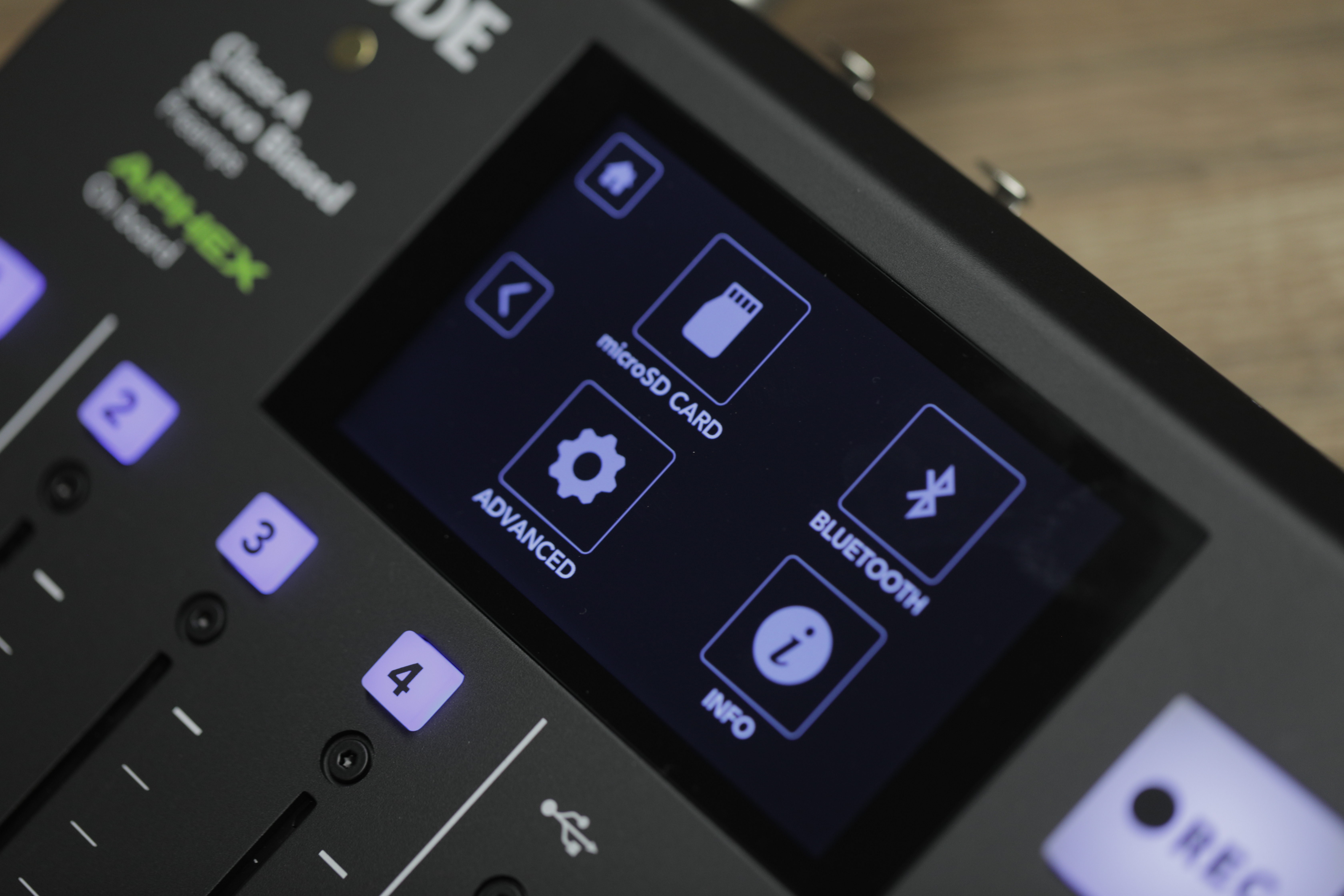
There’s a small touchscreen display at the top of the board that serves both as a way to gauge levels and navigate various settings. Essentially it serves as a way to bypass the computer entirely, once you’ve finished the setup process. The Rodecaster operates on a similar principle as much of anchor.fm’s offerings, giving users the path of least resistance to bringing a podcast to life.

It’s an admirable goal, especially in the world of podcasting, where content democratization is supposed to be a guiding principle. And certainly setup is painless, so far as mixing boards go. I had to fine-tune and troubleshoot a few things to get it up and running, but within an hour or two, everything was perfectly set up and running.

The downside to that level of simplicity, however, is that it removes the ability to fine-tune some key parts of the process. The most glaring omission is multi-track recording. Sure, you can record four people on mics and a fifth on a phone call, but it all records to the same track. That’s fine and dandy if you want something quick and dirty (as, granted, some podcasters do), but I’m a proponent of editing.

If you’re trying to make it sound professional, you’re going to want to cut it down. Even as someone whose podcast often runs in excess of an hour, I still find I spend much more time chopping the show up in Audacity than I do actually recording. It sucks, but that’s what you need to do if you want it to sound half decent.

Even if you’re not editing for content, at least cut the “uhms” and “ahs” and all of those bits where everyone talks over each other. That’s a hell of a lot easier to do when you’re operating with multiple tracks. I realize not everyone feels that way, but the option would be nice.

Setup mostly consists of unboxing and plugging in cables. Rode sent up a deluxe edition in a giant backpack that also included a pair of its Podcaster microphones and large, heavy stands. You’ll need to go through a couple of screens to set up odds and ends like time and date and to pair it to your phone, if you plan to go that route.

I tethered the board to my laptop during setup, in order to customize the sounds. It comes preloaded by default with applause, laughter, a rimshot and the like — it’s the Morning Zoo Crew package. I tossed in an intro and outro song and a couple of custom effects for good measure (Reggaeton air horn and Nelson from The Simpsons, naturally).

There’s a total of 512MB of storage, so you can add longer tracks as well, associating them by dropping them onto the corresponding pads on the desktop app. Check the levels, pop in a microSD card for recording and you’re off to the races.

I’ll admit that I ran into a couple of hiccups with things like phone audio through the board. Also, the rear headphone jacks require an adapter if you want everyone to hear themselves and the sound effects. Seems like an odd choice, given the novice target audience. Especially since the front cans use a standard jack size.

Original Content records its weekly episode on Fridays, so the timing worked out perfectly to test the thing out. Anthony and I set up mics across the table from each other and we beamed Jordan in via phone.

I hit record, tapped the intro music and we were off. Somewhat annoyingly, the buttons can only trigger the sounds, but not turn them off. That’s great for something like the air horn (for ironic comedic effect only, I swear), but less great with music. You’ll want to edit that down to the length you need it, otherwise you’ll end up potting down the fader, effectively losing that channel until it’s finished playing. The ability to see how much time is remaining on each track would have been a nice touch, but it’s not crucial here.

Once everything was up and running, we didn’t run into any issues for the hour and change we spent recording (aside from me riding the sound effect board a little too hard, perhaps). We finished recording, popped out the card and transferred the files. Boom, podcast.

The sound quality on the Rode mics is really terrific — borderline studio-quality stuff. The episode will be up in a few days, so you can judge for yourself. The sound on Jordan’s phone connection isn’t great, but you can’t really fault Rode for the poor state of cellphone call quality these days.

The Rodecaster Pro does exactly what is says on the box — and does most of it quite well. As someone who operated a board back in my radio days, I got back into the swing of things almost immediately. I’d forgotten how much I’d enjoyed going through those motions in the intervening years. And the ability to actually do a show face to face brings a level of energy and understanding you lose when relegated to Skype.

Bottom line: $600 for the board alone is going to be prohibitively expensive for many novice podcasters. But for a select few looking to start down the path to serious podcasting, this will really hit the sweet spot and up your game with the press of a button.

A runaway GoFundMe campaign to build Trumps’ border wall raises questions about its funding — and the future

Florida men are seemingly involved in so many strange happenings involving pythons, alligators and restaurant break-ins that when a parody “Florida Man” Twitter account surfaced back in 2013, it became an immediate sensation.

But a five-day-old GoFundMe fundraiser for Donald Trump’s border wall by a Florida man is starting to look anything like a joke. With ambitions to raise a brow-raising $1 billion, it has already secured nearly $13 million from more than 200,000 individuals since launching on Sunday. And GoFundMe campaigns do not have deadlines.

Where that mounting pile of money will land is the looming question. The man behind the campaign, Brian Kolfage, formerly ran conspiracy-theory websites, along with a Facebook page called Right Wing News that was shut down by Facebook in October.

Kolfage, who is also a U.S. veteran who served in Iraq and lost both legs and one arm, talks at some length about his public service on his GoFundMe page. He also states that he has been on Fox News “many times, [so] you can see I’m credible and a real person.” He meanwhile mentions nothing about his media ventures, telling NBC News yesterday that he doesn’t “want it to be a distraction” to potential donors.

More concerning are some of the claims that Kolfage makes at the page, including that 100 percent of the donations will go to the Trump Wall, when there is no mechanism that would allow such a transfer of funds as of this moment. Congress would have to enact a statute to permit it. Writes Kolfage: “How will we get the funds to the right place? We have contacted the Trump Administration to secure a point of contact where all the funds will go upon completion. When we get this information secured, we will update. We have many very high level contacts already helping.”

The page also tells visitors that the U.S. government has accepted large donations from private investors in the past, linking to a 2012 story about billionaire David Rubenstein, co-founder of the Carlyle Group, who donated $7.5 million to repair cracks near the top of the Washington Monument. What the GoFundMe campaign does not make clear is that Congress was behind that particular initiative, allocating $7.5 million to the repairs on the condition that private donations would match that same amount.

In fact, numerous government agencies accept matching gifts from private donors, including the National Endowment for the Humanities. But the idea is to double the impact of government-led initiatives through those contributions, not to invite donors to dictate the initiatives themselves. As U.S. Representative Bob Goodlatte, a Republican from Virginia and the chair of the House Judiciary Committee, told the New York Post yesterday, “Obviously, we can’t let citizens raise money and say, ‘The government will spend my money on this purpose.’?”

Given that roughly one-third of Americans of voting age identify as Republicans, two-thirds of whom appear to support Trump’s push for a border wall, Kolfage’s $1 billion target doesn’t sound entirely outlandish. The campaign has already landed one $50,000 donation, and if it gains further momentum, others may come to view it as a straightforward way to flex their financial and political muscle.

Indeed, at some point, the campaign, if it continues to gain momentum, could begin to raise questions, beyond whether or not it’s smart for people to be sending their money to Kolfage. Specifically, though it’s against the law for the government to accept donations with strings attached, might we see a day when the U.S. citizens are able to wield as much power as lobbying groups by coming together on financial platforms like GoFundMe? Though no amount of money committed to Kolfage’s GoFundMe campaign would obligate the government to build a border wall, already Republican lawmakers have introduced bills seeking to allow the Treasury Department to accept public donations for the purpose of funding one. The bills are unlikely to go anywhere once Democrats take control of the House next month, but they could pave the path for future legislation.

In the meantime, what happens to Kolfage and the many millions of dollars he has raised will be interesting to watch. As a Post report yesterday noted, GoFundMe’s terms of service prohibit “not using funds for their stated purpose,” meaning that if the government can’t find a way to work with Kolfage, he may have to reimburse donors. Or, at least, GoFundMe — which hasn’t responded to our requests for comment — may be saddled with doing so.

It wouldn’t be the first time the platform has had to return money to a campaign’s donors.

Just last month, a New Jersey couple and a homeless man were accused of making up a story that raised more than $400,000 through GoFundMe, money that they reportedly spent on a car, trips, high-end handbags and casinos. The couple and the man now face charges of second-degree theft by deception and conspiracy to commit theft by deception. GoFundMe has said it will fully reimburse the campaign’s 14,000 donors.

Interestingly, GoFundMe has never revealed how much it has raised from its own investors, which include Iconiq, Stripes Group, Accel, TCV, Greylock and Meritech Capital. It raised its first outside round of capital four years ago. The company was founded in 2010.

Pictured above: The strip mall in Castle Rock, Colorado, where donors to Kolfage’s GoFundMe campaign are being asked to send their checks.

The Kardashian apps are dead

In this app-laden world, there is now a void. One so large, it will be difficult to fill. Perhaps, the Kardashians will reconsider.

The Kardashian sisters, specifically Kim Kardashian West, Khloé Kardashian and Kylie Jenner are shutting down their apps in 2019. Kendall Jenner stopped updating her app and website last year. The apps and accompanying websites were provided through Whalerock Industries.

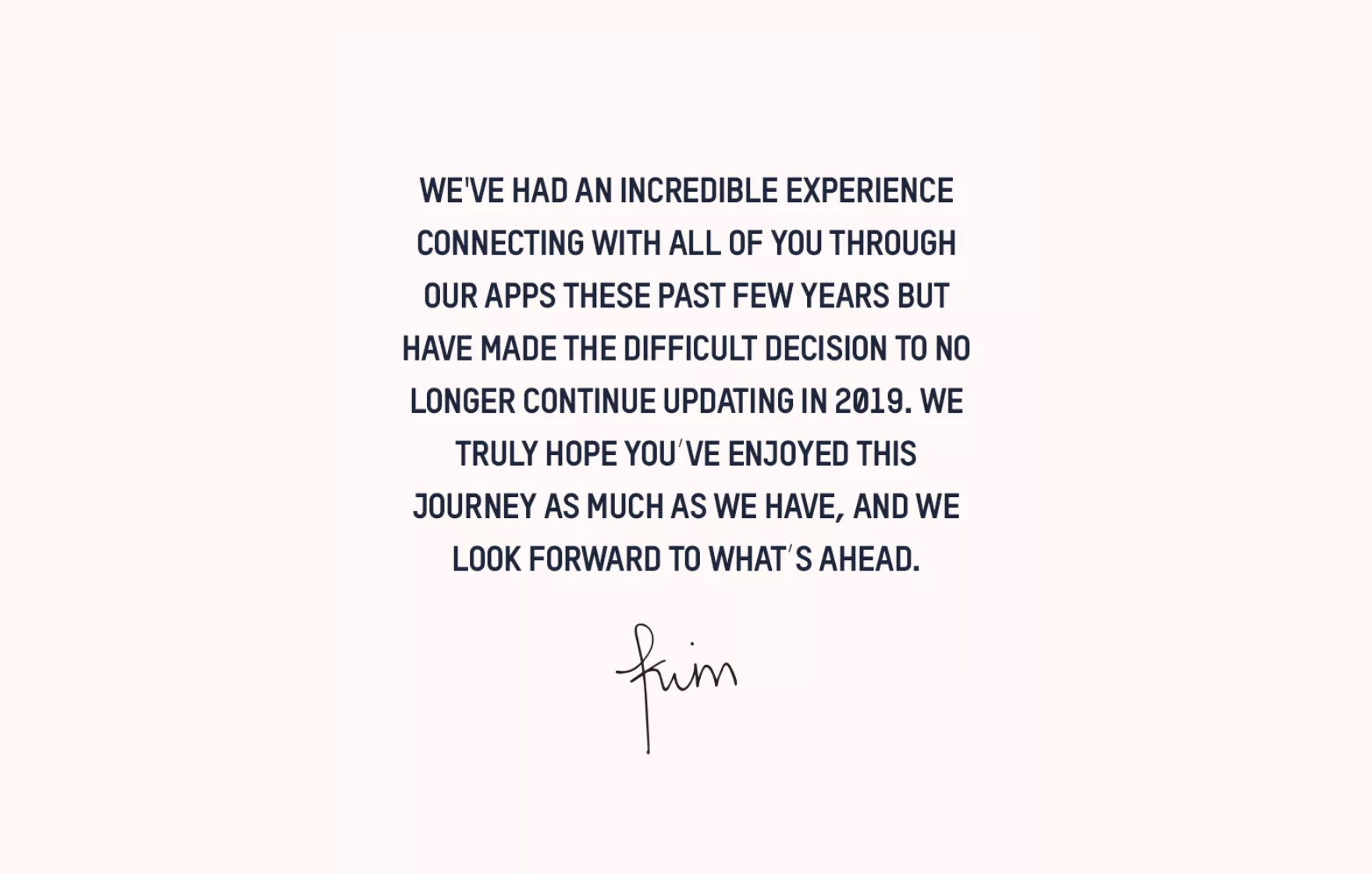
“We’ve had an incredible experience connecting with all of you thorough our apps these past few years but have made the difficult decision to no longer continue updating in 2019. We truly hope you’ve enjoyed this journey as much as we have, and we look forward to what’s ahead,” the statement from Kim Kardashian West said. Kourtney Kardashian issued a similar statement, adding a note to subscribers to follow her on Instagram.

kim kardashian app statement

It was a wild run for the Kardashian apps, at least in the beginning.

Kim Kardashian West made her debut in the iTunes App Store with “Kim Kardashian: Hollywood” game, which may have grossed the star and development partner $200 million in annual revenue, according to some reports at the time.

In 2015, the whole family got involved. Kim Kardashian West, Khloé Kardashian, Kendall Jenner and Kylie Jenner launched their own subscription apps in September 2015 — all of which shot up into the App Store’s top charts.

The apps, which charge customers $2.99 per month for a peek inside their lives, seemed poised to generate millions in annual gross revenue if growth rates and retention numbers could be sustained.

It appears that by 2018, the apps started tanking, and badly. According to App Annie, the apps don’t even make the overall ranking, which means they’re somewhere lower than #1,500.

Kim Kardashian app annie stat

If only there was another way to a follow their lives.

Self-driving car startup Zoox gets permit to transport passengers in California

While more than 60 companies have received permits to test their driverless vehicles in California, Zoox has become the first permitted to actually transport people in those vehicles. The California Public Utilities Commission today granted Zoox a permit to participate in the state’s Autonomous Vehicle Passenger Service pilot.

During the testing period, Zoox must have a safety driver behind the wheel and will not be allowed to charge passengers for rides. And, as part of the program, Zoox must provide data and reports to the CPUC regarding any incidents, number of passenger miles traveled and passenger safety protocols.

“This is an important milestone on our pathway to deploying a fully autonomous commercial service,” Zoox head of Corporate and Regulatory Affairs told TechCrunch via email.

This comes three months after Zoox tested autonomous rides as part of the Global Action Summit, and four months after Zoox co-founder Tim Kentley-Klay’s ouster from the company in late August. His firing came about a month after Zoox closed a $500 million funding round led by Mike Cannon-Brookes of Grok Ventures, which brought its total amount of funding to $800 million.

Zoox ultimately aims to commercially deploy autonomous vehicles by 2020 in the form of its own ride-hailing service. The cars themselves will be all-electric and fully autonomous. Meanwhile, ride-hail companies like Uber and Lyft are also working on autonomous vehicles, as well as a number of other large players in the space.

Zoox’s permit with the CPUC is good until December 21, 2021. For some background, the CPUC has two pilot programs in place. One is for passenger testing with a safety driver and the other is for passenger testing without a safety driver in the vehicle.

Bellabeat’s new hybrid smartwatch tracks your stress…and goes with your outfit

Bellabeat, the company behind a variety of health and wellness wearable devices aimed at women, is now selling its first smartwatch. The device, which is simply called “Time,” was announced earlier this month right in the midst of holiday shopping season. Like other fitness trackers, the watch is capable of basic tasks like counting your steps, tracking sleep patterns and reminding you to move. But unlike traditional smartwatches — which, aesthetically, are still very much just a screen on your wrist — the Time is designed to look like jewelry.

The hybrid device looks like a watch — albeit not a very expensive one.

It’s squarely in the range of fashion jewelry, with either silver or rose gold stainless steel finishes to choose from, and a minimalist watch face that forgoes complications like the date or the moon phase, for example. It even lacks a second hand.

That said, I prefer its cleaner look-and-feel to the gaudier smartwatches put out by brands like Michael Kors and Fossil. (Plus, there’s no Android Wear/Wear OS to contend with here.)

As an analog watch, it has both its pros and cons.

It’s designed to be hypoallergenic so as not to irritate those with sensitive skin, and it has some water resistance. (ATM grade 3, meaning it can withstand a vigorous hand washing and the rain. You can’t swim, bathe or dive with it.)

You also don’t have to charge it, which makes it feel more like a “real” watch than a gadget.

However, there’s a potential downside here, too — the coin cell battery only lasts “up to” six months. You’ll then need to use the tiny tool it ships with to replace the old battery with a new one.

Of course, some will see a user-replaceable battery as a perk. I don’t, but that’s a personal preference on my part.

I much prefer just dropping my Apple Watch onto a charger rather than having to keep up with a small watch tool, which can be easy to lose or misplace in the time between repairs. I’m also not a fan of having to unscrew tiny screws and then finding some sort of small, sharp object to pop out the battery. Perhaps that’s because I have a child with a dozen or so battery-operated toys. I’m constantly unscrewing things to replace batteries, and frankly I don’t need another.

In any event, among the watch’s better aspects is the fact that it packages up fitness and wellness tracking in a device that passes as a regular — and even fairly attractive — piece of fashion jewelry. The Time will go better with some of your outfits where you just don’t think the Apple Watch works — even with one of Apple’s fancier bands.

Of course, it’s not as seamless to use Time as the Apple Watch, which has the Apple platform advantage. (Or an Android smartwatch paired with an Android phone, for that matter.)

Instead, you have to sync your activity between the watch and the third-party Bellabeat app to view things like the steps taken or hours slept. You do so by tapping a sync button in the app and double-tapping on the watch face.

The app can also serve as way to keep up with other aspects of your health and wellness, including your hydration goals, stress, meditation time and your period.

The stress metrics are calculated for you, based on factors like activity levels, sleep quality, reproductive health and meditation over the past week. But hydration and menstruation have to be logged manually (*unless you’re using Bellabeat Spring — see below.)

The mediation tracking only calculates your progress through the app’s own selection of more than 30 included exercises. While it’s nice to have access to those resources included in the app, many people are already using popular meditation apps like Calm or Headspace. An “import” option for externally logged “mindful minutes” would have been nice here.

One of Time’s better features are its silent alarms and inactivity alerts. Instead of pings and loud noises, the watch more calmly reminds you of things with vibrations you configure. There are also included alarms for waking up, taking your vitamins, taking your contraception pill and another general alarm setting, each with their own toggle switches and settings.

There is something to be said for a quieter smartwatch, especially if stress levels are a concern. (There’s also something to be said for a device that’s built by a woman with the needs of women in mind. Remember how long it took for Apple to realize period tracking was a thing?)

That said, it’s unfortunately becoming harder for smaller device makers to compete with the Apple Watch, which has now moved into advanced areas with its Series 4 line, with sports, life-saving ECG and fall detection features, along with smarter workout detection (and yes, you can still swim with it), plus its ability to work with the broader iOS app ecosystem in a more native way.

But the Apple Watch is pricier at $399 and up for current models. Bellabeat’s Time, by comparison, is $179.

The Bellabeat mobile app will work with other Bellabeat products, including its wellness tracker Leaf (which can be worn as a bracelet, necklace, clip, etc.), and $59 smart water bottle, Spring.

Combined, the Spring and Time could be a good entry point into the world of fitness and wellness trackers for those who never felt that wearables and trackers were right for them. Bellabeat’s line is more of a lifestyle choice based just as much on looks as on tech, if not more so.

The question now is whether or not Bellabeat can carve out a big enough slice of the smartwatch market, which continues to be dominated by Apple, to sustain itself in the years ahead.

Bellabeat was a Y Combinator 2014 grad founded by female entrepreneur Urska Srsen, and has raised ~$19 million to date, according to Crunchbase. It previously sold products for expectant mothers, as well, but those have been phased out. Bellabeat declined to share any user metrics or revenue figures, when asked.

Bounce raises $1.2M to tap local retailers for short-term storage

If you’ve ever found yourself lugging a big suitcase from meeting to meeting, a startup called Bounce could make your life easier. Using Bounce, you’ll be able to pay for short-term storage at hotels, dry cleaners and other local businesses.

The San Francisco-based startup is announcing that it has raised $1.2 million in seed funding from investors including Structured Capital managing partner Jillian Manus, Seabed VC, Airbnb general counsel Rob Chesnut and Canadian entrepreneur Michael Hyatt.

CEO Cody Candee (pictured above with his co-founder and CTO Aleksander Rendtslev) said he’s actually not someone who owns a lot of stuff himself, but he realized that “people are constantly planning their days and planning their lives around the things that they own,” whether that’s running home to drop something off or heading straight to your hotel from the airport because you need to get rid of your luggage.

So Bounce has already signed up more than 100 locations across New York, San Francisco, Washington, DC and Chicago, and it says they’ve been used to store tens of thousands of bags. You currently browse these locations through the Bounce website, but Candee said an iOS app launch is imminent.BounceApparently Bounce vets its locations, partly to ensure that they have secure storage areas and that their posted store hours are accurate — so that you don’t rush to the store to pick something up before closing, only to discover that everyone left early. Candee added that the most common use cases include travelers who have checked out of their hotels, people attending events (I once tried to carry my gym bag into Madison Square Garden and I will never do that again) and salespeople who are hopping from meeting to meeting.

There are other companies that appear to have a similar idea — for example, Vertoe was part of winter class at Techstars NYC — but Candee said that competitors are mostly “attacking just the luggage storage space,” which he suggested is “relatively easy to build.”

In contrast, he said, “The way we see it is, we’re really building a tech platform and basically thinking about these broader use cases.” In fact, he said Bounce is already testing out a system where items are transported by local couriers between different storage locations.

“We’re thinking about what could be built on top of that platform,” Candee said. “A drycleaner could come on our platform and they could basically say, ‘Hey, drop your clothes off’ and then Bounce it back to wherever that user is.”

Gift Guide: 13 last-minute gifts that you can still get in time

Welcome to TechCrunch’s 2018 Holiday Gift Guide! Need more gift ideas? Check out our Gift Guide Hub.

Whoops. You goofed up. It seemed like you had plenty of time before Christmas was here and now there are four days left and all the shops are slammed and you’ve (mostly) missed the shipping window.

It’s okay! We’ve all been there.

We’ve compiled a list of things we think are great but that you should still be able to get in time, be it online or in a local big box store.

Amazon Kindle Oasis

The Kindle Oasis ($250 on Amazon) is a really, really good e-book reader. It’s lightweight, the battery lasts forever and, as a very welcome bonus, it’s water-resistant — so a quick unexpected dunk in the bath tub won’t fry it.

Plus, as one of Amazon’s flagship devices, they keep it heavily stocked at all of their shipping centers… meaning even on the Friday before Christmas, you should be able to swing same-day delivery.


Your favorite books, sent right to their e-book reader

(Photo Credit: Andrzej Wojcicki from Getty Images)

Oh, they’ve already got a Kindle? Utilize it! Send them your favorite book(s) of 2018. Amazon makes it straightforward to have an e-book delivered as a gift; you can either email a code to yourself which you pop in a card, or have it sent straight to their inbox.


Chromecast or Fire TV

The Chromecast has found its way onto our Gift Guides for three years running now, and with good reason: it’s just excellent. Plug it into any TV, and you can now send content from most of your smartphone’s popular apps (Netflix/Hulu/HBO/Spotify/etc.) with the tap of a button. There’s no remote required, because your phone is the remote. The standard HD model goes for $35, while the 4K-friendly model bumps the price up to $60 — but both models should be available at your local Targets, Best Buys, etc.

(If your gift recipient is more about that Alexa-life, Amazon’s $35 Fire TV 4K stick is also a super-solid media streamer — and the remote has Alexa built in!)


Subscription boxes!

You forgot to get them something for Christmas, so why not get them something for the next few months? A card explaining what’s on the way with an ETA on the first delivery, and bam, you’re set and no one knows you totally forgot about Christmas.

And there are so many options now! Friend got a green thumb? Succulent Studios delivers two hearty plants each month for around $16.50. Sweet tooth? Japan Crate (pictured above) airdrops all sorts of fun/whacky goodies with prices ranging from $12-$35 a month. LootCrate brings the geeky goods. TryTheWorld nurtures their inner-foodie.


Gift cards for services they already use
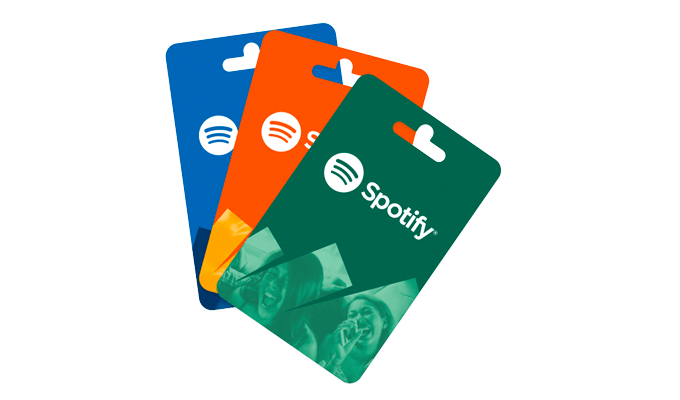
Does your friend binge watch The Office on Netflix on loop? Do they never have Spotify turned off? Why not subsidize those habits for them for a few months? Gift cards are normally the classic “Eh, I didn’t know what to get you, so buy your own thing” gift — but in this case, you’re saving them money you know they’re gonna spend otherwise.


A really long charging cable for their phone

No one has enough charging cables for their phone. I have probably 30 lightning cables, and I still find myself digging around for one a few times a week. Meanwhile, most people use the cable that comes with their phone, which are usually hilariously short and start to fray in about 30 seconds.

Anker’s PowerLine+ II cables are awesome, especially for the price; $10-$20 gets you a 10-ft cable to let your friend actually use their phone comfortably while it charges. The insulation is braided, which in addition to making it look fancy also means that it’s super tough. I’ve been using one for well over a year now and it still looks brand new. They’ve got options for whatever port their phone might use, be it Lightning, microUSB or USB-C.

Is it the most touching gift? Nope! But it’s suuuuper practical, and they’ll probably use it all the time.


A massive (or intentionally small!) battery pack
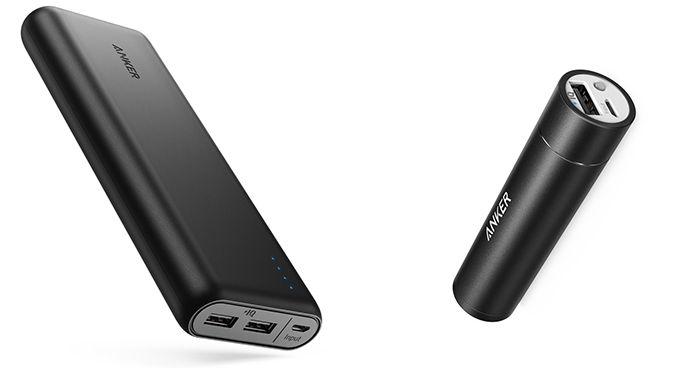
Phone screens are getting bigger. Phone processors are getting faster, and more power hungry.

Phone batteries, meanwhile, are hardly keeping up. I don’t know many people, at this point, who can get through a full day without worrying about their phone’s battery at least once. Why not take that stress away?

If they tend to carry a big bag or backpack, consider something like the Anker PowerCore ($55). With a 20,000mAh battery inside, it’ll juice up pretty much any phone multiple times before the battery itself needs a recharge. If they tend to go with smaller bags (or just their pockets), the PowerCore+ Mini ($20) is about the size of a tube of lipstick. It’s only 3,350mAh, but that’s enough to get most phones back up to nearly 100 percent. In case of emergency, batteries like this can save your life.


Your favorite apps

Know someone is getting a new phone for Christmas? Why not help them load it up? Think of all your favorite apps/games of 2018, and send them over as gifts.

Apple makes it easy to send specific iOS apps/games as gifts, assuming you know the recipients email address. If your friend’s on Android, it’s a bit trickier — you’ll probably want to just buy them a Google Play gift card and write your recommendations in a card.


Tile trackers

Got a friend who’s always losing their keys? Or can never find their wallet?

Tiles are little Bluetooth-powered widgets that you strap to anything you tend to misplace. When that thing goes missing, you just pop into the app and ping it. If it’s close, it’ll start chirping away. If it’s not nearby — like, say, if you left it at a restaurant — it’ll go into “Community Find” mode; if anyone else using the Tile app happens to walk by and detect it, it’ll ping you with its exact location.

This year Tile released a new model that fixes one of the product’s only pain points: battery replacement. Whereas previous models lasted a year before requiring you to ship it in for replacement, the new Tile Mates ($60 for 4) use CR1632 batteries that can be swapped by the user.


Raspberry Pi

If your friend is a coder/builder/tinkerer, giving them a Raspberry Pi is like giving an artist a big, beautiful blank canvas. It’s a surprisingly powerful itty-bitty computer, capable of powering an infinite number of DIY projects. It can be a media server! Or the brains for a self-driving RC car! Or the conductor of your Christmas Light symphony!

There are lots of options for the Raspberry Pi — from the tiny-but-powerful Pi Zero W (~$10) to any one of a ton of clones. If you’re not sure which one is right, the Raspberry Pi 3 Model B ($35) is probably a safe bet; it’s powerful and flexible, but still small and cheap.


PopSocket

If you somehow haven’t seen one of these out in the wild, a quick breakdown: PopSockets ($10) are collapsible grips that stick to your devices (phones, tablets, e-readers, etc) and make them easier to hold for extended periods of time. Slide the PopSocket between two fingers and your device pretty much holds itself. The PopSocket pops out (hence the name) when in use, but folds into itself and becomes super slim when it’s time to go back in your pocket.

I wasn’t super sold on these things at first; I was perfectly content just holding my phone the normal way, thank you very much.

Then I added one to my Kindle… and, well, it’s changed the way I read. I read more often, and I read everywhere. The Kindle is very light, but can be awkward to hold for hours on end. The PopSocket makes it so that the Kindle basically just floats along with my hand. It took about a day before I’d ordered another one for my phone.

They’re easy to find at Target or Best Buy, with a lot of locations dedicating entire aisles to them. They’ve got thousands of different looks (plus licensed stuff from Marvel, Star Wars, etc.) so you should be able to find one that fits your friend’s style.


Smart Plugs

Smart plugs are a perfect first dip into the smart home waters. They let you use your phone to toggle the lamps and other myriad non-connected devices you’ve got around the house. They’re super simple to set up — unplug your lamp, insert smart plug, reconnect the lamp through the smart plug, then get the plug on your Wi-Fi.

I’ve used a bunch of different plugs, but my current favorite is the Belkin Wemo Mini Smart Plug (~$25). It’s easy to install, and stable enough that they’re more or less set-and-forget.


Board games!

If you hear “board games” and nothing but pained memories of hours-long Monopoly and Scrabble battles fill your brain, you’re in for a treat. Board games have been going through a wonderful revolution over the past decade or so, and some recent games are just incredible. You can team up to escape a sinking island in Forbidden Island, wear out your brain with Anomia or spend weeks (seriously!) saving the world with Pandemic: Legacy.

Need help finding the right game? Most big cities have a dedicated board game shop, and I’ve never been to one where the employees weren’t eager to help. We also have a list with some of our favorites for both 2018 and 2017.

TechCrunch Gift Guide 2018 banner