Amazon Prime Day even has a lot of rivals this year. From pet products to board games, here are the spoils of Target’s discounts.
Category: Tech news
hacking,system security,protection against hackers,tech-news,gadgets,gaming
Facebook’s entry into VR advertising isn’t going too well
Facebook’s efforts to bring advertising to the Oculus virtual reality platform it has spent billions of dollars building out doesn’t seem to be off to a great start.
The company announced last week that they were planning to roll out their first in-game ads inside the title “Blaston” from the prolific VR game developer Resolution Games, and just days later the game studio has shared that after hearing an earful from users they’ve decided to abandon the ad rollout.
“After listening to player feedback, we realize that Blaston isn’t the best fit for this type of advertising test,” a tweet from the Blaston account read. “Therefore, we no longer plan to implement the test. We look forward to seeing you in the arena and hope you try the Crackdown Update that went live today!”
This potential ad rollout had been particularly noteworthy because the ads were being tested inside a title from a third-party developer. Facebook has purchased a handful of VR studios in recent months and owns a number of the most popular Quest titles inside its marketplace, so the opportunity to roll out advertising with a third-party partner gave Facebook a chance to frame the advertising rollout as a way for other developers to open up their monetization channels, rather than for Facebook to do so.
The announcement last week still brought out plenty of critics in the VR community who weren’t thrilled about Facebook’s broader struggles with balancing advertising efforts with user privacy, but other users seemed to be more annoyed by the prospect of ads being rolled out inside a paid title they had already purchased. Blaston retails for $9.99 in the Oculus store.
Update: Resolution Games reached out to TechCrunch with a statement, floating the possibility of further ad tests down the road inside one of the developer’s free apps. “To make it clear, we realize that Blaston isn’t the best fit for this type of advertising test. As an alternative, we are looking to see if it is feasible to move this small, temporary test to our free game, Bait! sometime in the future.”
Resolution Games abandoning the test before it even started is an early setback for Facebook’s VR advertising efforts that showcases just how skeptical the Oculus platform’s most vocal users still are of Facebook. In a blog post last week, Facebook sought to address early concerns with what user data would be used to serve up advertising in VR, specifically noting that conversations recorded by the headset’s microphone and images analyzed by the onboard tracking cameras would not be used.
Facebook saw considerable backlash last year from virtual reality fans when they shared that new headset owners would need a Facebook account in order to activate their devices. While criticism poured in following the announcement, the recently released $299 Quest 2 headset has already outsold all of Facebook’s previous VR devices combined, the company has said.
We’ve reached out to Facebook for comment.
45 Best Amazon Prime Day Deals for $50 or Less (Updated)
Don’t break the bank in the name of a sale. We found a bunch of budget-friendly discounts on Amazon.
Daily Crunch: Facebook rolls out podcasts and Live Audio Rooms for US listeners
To get a roundup of TechCrunch’s biggest and most important stories delivered to your inbox every day at 3 p.m. PDT, subscribe here.
Hello and welcome to Daily Crunch for June 21, 2021. The tech industry is skipping any sort of a summer slowdown. Facebook is taking on Clubhouse and Spotify, India is still figuring out how to manage its burgeoning technology industry, and everyone is raising money. Plus, we have notes on a new VC fund that has quite a twist. Let’s get into it! — Alex
The TechCrunch Top 3
- Facebook wants your voice: Facebook’s live-audio service is out, putting Big Blue in competition with Clubhouse, a buzzy startup, and Spotify. In the wake of Clubhouse’s super-active early 2021, a host of Big Tech companies are looking to capture the magic that the startup managed to bottle. How successful Facebook will be at cutting in on Clubhouse’s game is not clear; so far, Facebook has yet to dominate the dating world, for example, making its entrance into the live-audio space more potential than promise of domination.
- Consumer fintech is looking good: New numbers from European fintech unicorn Revolut dropped today, with TechCrunch’s Romain Dillet taking a look at the company for our publication. The gist is that Revolut had a deeply unprofitable 2020, but one that showed a real ramp toward smaller losses as it went on. I doodled on the company’s numbers here, if that’s your thing.
- IPOs keep coming: Sure, we’re still waiting for Robinhood to file to go public, but after WalkMe’s public debut last week, there are new tech companies approaching the public markets. Couchbase filed today, kicking off the process of floating the database software company backed by Accel, Mayfield and Ignition Partners. Expect more filings in the coming weeks.
Startups
To keep proper tabs on both sides of the startup fundraising marketplace, we’re stripping VC news into its own section on occasion. Today is one such day. First, however, some startup news:
- $10M for e-bikes: Ubco, a New Zealand-based electric utility bike startup, announced a $10 million raise today. The company is best known for its Ubco 2X2, an “all-wheel-drive electric motorbike that looks like a dirt bike but rides like a moped” — and looks rather fetching. Urban transit is changing as cities look to limit their car — and carbon — footprints. If trends hold, startups like Ubco could find themselves selling into a market that is moving in their direction.
- Consumers love debt: TechCrunch covered news today that Kredivo, an Indonesian buy now, pay later (BNPL) startup, added $100 million to its credit facilities. The new capital access doubles the amount of debt that Kredivo can access. The news illustrates both the global consumer appetite for rejiggered debt products that transcend traditional credit cards, as well as the willingness of investors around the world to provide BNPL companies with ever more capital access. More on the subject here.
- Music licensing remains complicated, lucrative: When Ludacris rapped that up-and-coming artists should “get a entertainment lawyer in the music profession,” he wasn’t kidding. The musical world is complicated. Mechanical licenses, platform cuts — it’s a lot. And where there’s complexity, there’s opportunity. Songtradr just raised $50 million to help license music to “high-profile names for advertising, films, TV, gaming and the like,” TechCrunch wrote in covering its latest round. Songtradr has now raised more than $100 million to fund its efforts.
- Are shoes still hot? Backers of SoleSavy think so. They just put $12.5 million into the company’s Series A round. Unlike StockX — which is big business these days — SoleSavy isn’t a retail marketplace. Instead, it’s a company looking to build a sneaker head community. A community is like a subreddit, but on a different CMS and hosting provider, in case you’d forgotten.
Venture Capital News
What educational background generates the best entrepreneurs? Every university will tell you that they are the best. Many founders manage without a degree at all. The Academy Investor Network is betting that graduates of American military academies will prove lucrative. The fund just announced a $2.5 million anchor LP for its first fund, adding to capital from Scout Ventures, where co-founder Emily McMahan is a venture partner. She’s partnering with Sherman Williams in targeting a $50 million first raise.
Let’s see how far their thesis carries them. At least they will be able to brag with confidence that when it comes to rucking they will have the highest founder quality in the world.
Seed is not the new Series A
Usually, a teacher who grades students on a curve is boosting the efforts of those who didn’t perform well on the test. In the case of cloud companies, however, it’s the other way around.
As of Q1 2021, startups in this sector have a median Series A around $8 million, reports PitchBook. With $100+ million rounds becoming more common, company valuations are regularly boosted into the billions.
Andy Stinnes, general partner at Cloud Apps Capital Partners, says founders who are between angel and Series A should seek out investors who are satisfied with $200,000 to $500,000 in ARR. Usually a specialist firm, these VCs are open to betting on startups that haven’t yet found product-market fit.
(Extra Crunch is our membership program, which helps founders and startup teams get ahead. You can sign up here.)
Big Tech Inc.
India’s tech scene deals with more government oversight: The Indian e-commerce industry is huge, with Amazon and Walmart battling with domestic companies — or buying them, in the case of Flipkart and Walmart — for market share in a growing market. All the activity is attracting complaints and possible government intervention. TechCrunch reported today that India “proposed … banning flash sales on e-commerce platforms and preventing their affiliate entities from being listed as sellers as the South Asian market looks to further tighten rules.”
India’s government is also busy battling with Twitter, as we’ve reported at length.
Germany is not enthused with Apple: With a fourth investigation opened, this time involving Apple, Germany’s oversight of competition in the tech world ratcheted up another few degrees today. In the case of Big Phone, the governmental body will “determine whether or not the iPhone maker meets the threshold of Germany’s updated competition law.” If Apple does, it would allow the country’s government to “intervene proactively” regarding the company’s activity.
Apple is also taking fire in its domestic market for what some perceive as heavy-handed tactics regarding its mobile app ecosystem, a market that the Cupertino-based company both moderates and extracts rents from.
Uber buys Cornershop: Today is a notable day for Latin American tech startups as the U.S. ride-hailing giant agreed to buy the 47% of Cornershop that it doesn’t own. The price? 29 million Uber shares. That’s about $1.3 billion worth of Uber equity.
The car service and delivery magnate bought Postmates last year, adding to its ability to deliver more than merely rides. The Cornershop buy fits into the thesis because the smaller company is also in the delivery market.
TechCrunch Experts: Growth Marketing

Image Credits: SEAN GLADWELL (opens in a new window) / Getty Images
TechCrunch wants to help startups find the right expert for their needs. To do this, we’re building a shortlist of the top growth marketers. We’ve received great recommendations for growth marketers in the startup industry since we launched our survey.
We’re excited to read more responses as they come in! Fill out the survey here.
Our editorial coverage about growth marketing includes articles from the TechCrunch team, guest columns and posts like “5 tips for brands that want to succeed in the new era of influencer marketing” by Eric Dahan on Extra Crunch. If you’re interested in writing a column, learn more here.
24 Prime Day Deals for Your Post-Vax Summer Adventures
Seeking some safe fun in the sun? Head outside with deals on speakers, luggage, and more.
What does Red Hat’s sale to IBM tell us about Couchbase’s valuation?
The IPO rush of 2021 continued this week with a fresh filing from NoSQL provider Couchbase. The company raised hundreds of millions while private, making its impending debut an important moment for a number of private investors, including venture capitalists.
According to PitchBook data, Couchbase was last valued at a post-money valuation of $580 million when it raised $105 million in May 2020. The company — despite its expansive fundraising history — is not a unicorn heading into its debut to the best of our knowledge.
We’d like to uncover whether it will be one when it prices and starts to trade, so we dug into Couchbase’s business model and its financial performance, hoping to better understand the company and its market comps.
The Couchbase S-1
The Couchbase S-1 filing details a company that sells database tech. More specifically, Couchbase offers customers database technology that includes what NoSQL can offer (“schema flexibility,” in the company’s phrasing), as well as the ability to ask questions of their data with SQL queries.
Couchbase’s software can be deployed on clouds, including public clouds, in hybrid environments, and even on-prem setups. The company sells to large companies, attracting 541 customers by the end of its fiscal 2021 that generated $107.8 million in annual recurring revenue, or ARR, by the close of last year.
Couchbase breaks its revenue into two main buckets. The first, subscription, includes software license income and what the company calls “support and other” revenues, which it defines as “post-contract support,” or PCS, which is a package of offerings, including “support, bug fixes and the right to receive unspecified software updates and upgrades” for the length of the contract.
The company’s second revenue bucket is services, which is self-explanatory and lower-margin than its subscription products.
23 Best Gaming Gear Deals for Prime Day 2021: PC, Switch, PlayStation, Xbox
Amazon’s big sale event is here, and it’s hot out. Let’s build an indoor oasis with these video game peripherals.
Twitch suspends two popular female creators over sexy ASMR streams
Popular Twitch streamers Amouranth and Indiefoxx are the two latest casualties of Twitch’s ongoing battle to enforce its own confusing rules around sexually suggestive content.
Both creators were suspended following ASMR streams that pushed the bounds of Twitch’s community guidelines forbidding content that isn’t quite sexual in nature but is still too risqué for a platform deeply self-conscious about its advertising business. The Amazon-owned company declined to comment on the length of the bans or what provoked them, but pointed TechCrunch toward its rules on sexual content.
It’s possible that both Amouranth (Kaitlyn Siragusa) and Indiefoxx (Jenelle Dagres) will be reinstated Monday, 72 hours after their Friday ban, but both channels remained unavailable at the time of writing. Siragusa confirmed to Polygon that she was suspended after a stream in which she did yoga poses while making ear-licking sounds into a microphone.
4K ASMR EAR LICKING! YOGA POSE
— Indiefoxx
OF (@indiefoxxlive) June 18, 2021
The so-called “ASMR-meta” on Twitch, where streamers boost their views by whispering into their microphones or producing licking sounds, sometimes while holding yoga poses, follows the controversy around hot tubs on Twitch that exploded last month. In both instances, some Twitch creators believe that the platform’s rules are selectively enforced.
“With ASMR meta and crazy yoga poses, believe it or not I watched two other girls doing it to the tune of 2-5k views without any bans for months before I folded the activity into ASMR creating the infamous ‘ASMR’ meta,” Siragusa wrote on Twitter. “Those other streamers are still unbanned and continue to do it. My sin was taking inaction as a sign of tacit acceptance, and then blowing the top off the secret and hitting 30k viewers.”
Because both the ASMR meta and the hot tub meta were dominated by female streamers, the whole situation has attracted even more misogyny within the Twitch community, where female streamers are still regularly harassed off the platform.
I will always find it ENORMOUSLY IRONIC that the generation that fought “violent video games don’t cause an uptick in gun/violent crimes”(I agree), instantly turn tail & succumb to a bad take like “HOT TUB/ASMR GIRLS LITERALLY CREATE CREEPERS that plague other girl creators!”
— Kaitlyn (@wildkait) June 20, 2021
In a blog addressing the proliferation of women streaming from pools and hot tubs at the time, Twitch wrote that “being found to be sexy by others is not against our rules, and Twitch will not take enforcement action against women, or anyone on our service, for their perceived attractiveness.” The company clarified that while a bathing suit in a bedroom might break the rules, “contextually appropriate” swimwear is allowed.
Twitch also acknowledged the complexity of its own difficult to parse rules:
Our intention with the Sexually Suggestive policy was to draw a line on content that is overtly or explicitly sexually suggestive, not to ban all content that could be viewed as sexually suggestive – but we acknowledge that our rules are not as clear as they could be.
Prohibiting every form of content that could be interpreted as suggestive would also result in far more restrictions on the video games and premium content that we currently allow, especially considering the ways that female characters are sometimes objectified or presented in a sexualized manner.
Its solution at the time was to create a “Pools, Hot Tubs, and Beaches” category where that content could live. Most of Twitch’s categories are dedicated to specific games, with most of the platform’s nongaming streams listed in the popular catch-all category “Just Chatting.”
ASMR has its own category, with 2.4 million followers, encompassing ear-tingling ASMR streams that don’t push the boundaries of Twitch’s rules with the more recent crop of those that do. So far, instead of building out a more thoughtful way to corral sexually suggestive content, the company is opting to punish anybody who it decides crosses the line. But it’s possible that could all change: Last month, Twitch said it was working on new policies to further clarify the rules on sexually suggestive content.
Unfortunately for Twitch — and for the female creators disproportionately affected by its uneven policies — the abundance of ear-licking streams suggests that until then, the company will be making these same determinations over and over as it tries to draw a line within a gray area of its own making.
Electric utility bike startup Ubco raises $10 million to fund its global expansion
Ubco, the New Zealand-based electric utility bike startup, has raised $10 million to fund a global expansion focused on the U.S. market and scale up its commercial subscription service business.
Ubco’s hero product, the Ubco 2X2, is an all-wheel drive electric motorbike that looks like a dirt bike but rides like a moped. What began as a solution for farmers to get around pastures and farms easily, safely and quickly has expanded to include an urban version of the bike that caters to fleet enterprise customers, gig economy workers and city riders.
Since its founding in 2015, the company has produced two versions of its 145-pound utility bike: The Work Bike, the original off-road vehicle, and the Adventure Bike, the newer version that’s made for city riding but can handle itself off-road.
Now that Ubco’s got a fresh cash infusion from the round led by Seven Peak Ventures, Nuance Capital and TPK Holdings, it hopes to continue expanding into existing verticals, like food delivery, postal service and last-mile logistics. The company already works with Domino’s in New Zealand and the United Kingdom, as well as a range of other national clients, like the New Zealand Post, the Defense Force, the Department of Conservation and P?mu, or Landcorp Farming Limited and other local restaurants and stores.
“We have a strong enterprise market in New Zealand and have developed a strong pipeline of sales internationally,” Timothy Allan, CEO and co-founder, told TechCrunch.
While direct consumer sales make up for most of Ubco’s revenue at present, the company is pushing aggressively into enterprise, and more specifically, subscription services. The 2X2 is built on an intelligent platform that includes vehicle and power systems, cloud connectivity and data analysis, which enables the subscription model to work alongside fleet management systems.
Ubco expects revenue to climb from $2.1 million in 2020 to $8.4 million by the end of 2021 as it pushes to increase its annual recurring revenue through subscriptions. Ubco’s subscription model, which costs about $50 to $60 per week ($75 to $85 NZD) for fleet enterprise customers, is being rolled out in New Zealand, Australia, the U.K., Europe and the U.S. this year and into 202. Consumers will get access to the subscriptions, as well, within the next couple of months, according to a spokesperson for the company.
Allan sees subscriptions as the future of the EV industry, not just because it allows for a high chance of profitability, but also because it’s far more environmentally sustainable. As the company expands this part of its business model, it hopes to lead the circular economy space.
The company predicts that vehicles run through the subscription model will have four times the life expectancy as those sold outright and produce 80% less carbon overall compared to a combustion vehicle.
“Subscription means we own the vehicle, so we manage the lifecycle,” said Allan. “So the first life starts at high intensity, and that might be 60,000 kilometers delivering pizza, or it might be 30,000 kilometers on a farm, which are equally hard for different reasons. Then after, that vehicle will go down to a lower intensity application. After that the battery can then be pulled out, and that might go into passive solar storage or something like that.”
Allan sees solving the end-of-life issue as a personal and professional challenge, one with room for creativity since no one has fully figured out the correct way of doing it. He says he takes a bottom-up approach when it comes to the engineering of the vehicle in a way that allows for easier recycling.
“Like when you design a battery, fuck putting fire retardant foam into it because you can’t get it back at the end of life,” he said. “So it starts with correctly labeling, engineering with intent so that you’re designing for this type of assembly, and then your business or commercial system needs to support the concept. Now, we’ve got the advantage because the economics and incentives are aligned, and that all aligns with New Zealand’s product stewardship legislation.”
Trying to perfect the circular economy through utility vehicles isn’t just about doing what’s right for the environment. Allan thinks it’ll be a smart business decision in the end, one that will draw in customers and give the company a competitive edge with enterprise clients.
“This is a part of your journey with us as a customer,” said Allan. “If we can design subscriptions and the life of the vehicle in such a way that you feel good about it, that’s where we’re driving from. Most people want to do the right thing, and we can provide something that logically fits the economics, can be done at scale and can be managed holistically.”
Every Good Prime Day Deal on the Amazon Devices We Like
Many of Amazon’s best discounts are on its own devices, including Kindles, Echo speakers, Fire tablets, and more.
The 20 Best Deals at Walmart’s Prime Day Rival Sale
Prime Day is more than Amazon now. Here are the best deals we’ve found at Walmart’s “Deals for Days” event.
Spielberg’s Amblin inks multiyear feature film deal with Netflix
In something of an about-face, Amblin Partners, Steven Spielberg’s long-running film production company, will produce several films per year for Netflix. The deal reflects Netflix’s rising star and arguably acceptance by the legendary director of a new order to the cinematic world where home viewing is a first-class citizen.
The deal was announced in a press release with few details except glowing quotes from Amblin and Netflix executives. All that is certain is that Amblin will produce “multiple new feature films per year” for Netflix.
“From the minute Ted [Sarandos, Netflix co-CEO and chief content officer] and I started discussing a partnership, it was abundantly clear that we had an amazing opportunity to tell new stories together and reach audiences in new ways,” said Spielberg in the release.
Those new ways didn’t sound so amazing to Spielberg a couple years ago when he was reportedly pushing to exclude Netflix films from the Academy Awards.
“Once you commit to a television format, you’re a TV movie,” Spielberg told ITV in March of 2019. “I don’t believe films that are just given token qualifications in a couple of theaters for less than a week should qualify for the Academy Award nomination.”
Ultimately no real push was made, though. Whether Spielberg was misrepresented, changed his mind or just read the room, he has since tempered his position. He has said rather that he simply wants to cherish and protect “the theatrical experience” — understandable from one of the pioneers of the modern blockbuster.
Naturally it’s a huge get for Netflix, which will get a steady stream of Amblin features, though there’s no guarantee of a Spielberg picture. Meanwhile Amblin will continue its longtime partnership with Universal, which fills the more traditional moviemaking and distribution side of things. The company has already broken bread with streaming companies, with shows and films made for and distributed by Netflix and others, but this is most significant partnership so far.
Perhaps it was COVID that suggested to Spielberg and Amblin that streaming platforms are, far from going away, simply the future of the industry in many ways. In a world where the “theatrical experience” is a potential superspreader event and people are perfectly happy to watch (and pay for) a “premiere” at home, it may be better to roll with the punches and hope that things bounce back.
Sneaker community startup SoleSavy raises $12.5 million Series A to build an end-to-end sneakersphere
Collectibles boomed during the pandemic and while NFT outfits like NBA Top Shot exploded as consumers flirted with newer efforts, the sneaker world grew even more mature with enthusiasts digging deeper into communities dedicated to the hobby/passion/obsession/alternative asset class.
Vancouver’s SoleSavy, a sneaker community dedicated to giving fans a curated place to navigate the world of shoes, with all of its drops, news and rumors, has raised a $12.5 million Series A just months after wrapping a $2 million seed round, showcasing investor enthusiasm behind vertical-specific premium social experiences. The round was led by Bedrock Capital with participation from Dapper Labs’ CEO Roham Gharegozlou, Diplo, Bessemer Ventures and Turner Novak’s Banana Capital, among others.
CEO Dejan Pralica says the company has tripled its user base since its seed raise late last year, while growing its team from 10 to 37 employees in the same period.
Today, SoleSavy’s community is based largely around a network of Slack groups where users can discuss just about everything. Though the platform’s chat communities are organized in Slack now, Pralica sees a future where the company could build its own chat hub for members, something to further tie-in the startup’s app, website and online conversations. The more near-term goal is to grow this community into a hub of trusted buyers and sellers where a peer-to-peer member marketplace can thrive. SoleSavy is at the forefront of a new generation of more social internet marketplaces where vertical-specific communities can gather and grow inside an all-encompassing platform.
“I do envision on end-to-end platform that’s very integrated,” Pralica tells TechCrunch.”I want to make sneakers fun again and enjoyable for the people that are passionate about them.”
Part of that fun has been diminished by free-for-all chat groups that can quickly grow toxic or grow exploitative as moderators look to cash in on their networks, something SoleSavy hopes a more curated approach can bring back.
Sneaker enthusiast group SoleSavy raises $2M, setting the stage for a community-driven commerce boom
As my boss (and TC’s resident sneaker head) Matthew said in his write-up of SoleSavy’s seed raise earlier this year:
That positive community vibe is what Pralica says is SoleSavy’s long-term focus and differentiating factor that keeps the 4,000 members across the U.S. and Canada interacting with the group on a nearly daily basis … I’ve been in a dozen or so different groups focused on buying large quantities of each release to resell over the years and many of them are, at best, rowdy and at worst toxic. That’s an environment that SoleSavy wanted to stay away from, says Pralica. Instead, SoleSavy tries to court those who want to buy and wear the shoes, trade them and yes, maybe even resell personal pairs eventually to obtain and wear another grail.
The company’s sizable Series A raise just months after a seed showcases that plenty of investors are intrigued by the idea of verticalized marketplaces built up around social communities, Pralica sees the funding as a chance to ignore fundraising for a while and focus on “building for the future” while identifying new opportunities in the sneakersphere.
SoleSavy has been pretty focused on North American sneaker heads so far, but Pralica see that hefty Series A check taking the platform into new markets, including Australia and New Zealand, United Kingdom, Singapore, Japan and broader Europe. The company also plans to use the new funding to build out its editorial network with podcasts, editorial features, original video and member events.
How to land the top spot in Google search with featured snippets in 2021
Ryan Sammy
Contributor
Contributor
Ryan Sammy is director of strategy at Fractl, a growth marketing agency that helps Fortune 500s and boutique businesses improve backlink portfolios, brand awareness and organic traffic through high-quality content.
More posts by this contributor
Search is changing. Most search engines now don’t just bring up a page of 10 search results and two ads at the top when you type in a query. Instead, Google search queries can bring up a whole range of results, and sometimes answer your questions without you ever having to click through to a page.
Take, for example, a search like this: “how many days until halloween.”
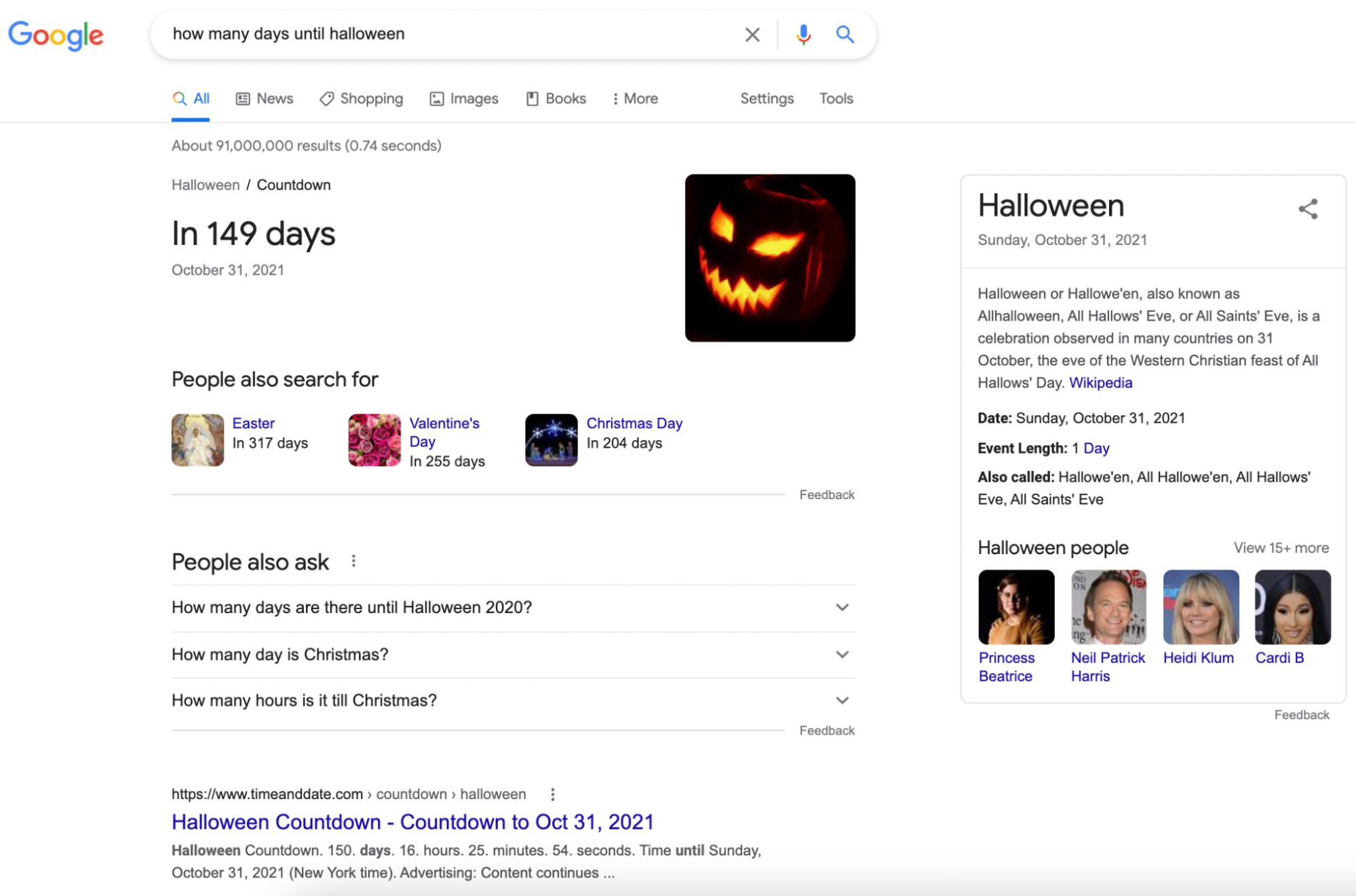
A featured snippet counting down the days to Halloween. Image Credits: Ryan Sammy
You can see that instead of displaying the top result right away, Google answers the question for you in a rich snippet. It also gives you related search queries featuring countdowns for other holidays. On the right is a knowledge panel from Wikipedia about Halloween, and below that, you’ll see the featured snippets section. These snippets will expand when clicked with answers for related questions.
Featured snippets are collections of sentences or words that Google pulls directly from a webpage relevant to the search query.
Finally, after these answers to your queries and any related questions, you get to the first result. At this point, do you even need to visit the website?
Google search is not what it used to be. We all want to be No. 1 on the search results page, but these days, getting to that position isn’t enough. It might be worth your while to instead go after the top featured snippet position.
What’s a featured snippet?
Featured snippets are collections of sentences or words that Google pulls directly from a webpage relevant to the search query. These snippets are displayed right below the search box and are meant to answer search queries quickly. The snippets can appear in the form of lists, how-to steps, tables, short paragraph boxes and other formats.
TikTok launches Jump, a third-party integration tool
TikTok announced today the launch of its Jump program, which expands the app’s potential for third-party integrations. TikTok began beta-testing this feature in February with Whisk, a recipe-sharing app, though only select creators could use the feature. Now, Jump will start rolling out to all users with an expanded slate of partners.
Jumps can only be built by third-party providers after being approved through an application process. Platforms like Breathwrk, Wikipedia, Quizlet, StatMuse and Tabelog participated in the beta test, and now, TikTok says providers like BuzzFeed, Jumprope, IRL and WATCHA will begin implementing their own Jumps in the coming weeks. So, an educational creator could link to Quizlet flashcards to review a concept they explained in a TikTok, or a yoga instructor could share breathing exercises on Breathwrk. For a platform that doesn’t even let all users include a link in their bio yet, this expands the existing tools creators have to engage their audience.

Image Credits: TikTok
TikTok is positioning Jump as a feature that propels discovery. Sean Kim, Head of Product, TikTok U.S. writes, “TikTok has become a destination both to be entertained and to learn; through TikTok Jump, we’re creating that ‘last mile’ of our community’s discovery journey and helping to spark action and deeper interaction both on and off the platform.”
But on other apps like Snapchat and WeChat, these lightweight third-party integrations drive e-commerce. Jump is similar to competitor Snapchat’s Minis feature, which lets you buy movie tickets via Atom, for example. Both Minis and Jump integrations can be built using HTML5. Meanwhile, WeChat facilitates over $250 billion dollars in annual transactions through its own mini apps — there were over a million mini apps on WeChat as of 2018.
While Instagram has been ramping up its e-commerce features on Reels, its TikTok competitor, it’s possible that Jump could later be used to sell items featured in a video. In December, Walmart piloted video shopping on TikTok, which performed well enough that they did it again in March. But for now, it seems like Jump is being used to improve user experience and deepen the platform’s relationships with third-party partners.