Smart speakers hit critical mass in 2018

We already know Alexa had a good Christmas — the app shot to the top of the App Store over the holidays, and the Alexa service even briefly crashed from all the new users. But Alexa, along with other smart speaker devices like Google Home, didn’t just have a good holiday — they had a great year, too. The smart speaker market reached critical mass in 2018, with around 41 percent of U.S. consumers now owning a voice-activated speaker, up from 21.5 percent in 2017.

According to a series of reports from RBC Capital Markets analysts released in December, the near doubling of the adoption rate for smart speakers in the U.S. was driven by growth in both Alexa and Google Home devices, while Apple’s HomePod played only a small role.

The firm found that U.S. penetration of Alexa-enabled devices reached 31 percent this year, compared with 41 percent overall for smart speakers.

It also forecast that Alexa would generate $18 billion to $19 billion in total revenue by 2021 — or ~5 percent of Amazon’s revenue — through a combination of device sales, incremental voice shopping sales and other platform revenues. In the U.S., there are now more than 100 million Alexa-enabled devices installed — a key milestone for Alexa to become a “critical mass platform,” the report noted.

RBC additionally called out Amazon’s progress with Alexa’s development, with launches like Alexa Guard, which listens for break-ins and smoke detector alarms; plus new features like local voice control for when the internet is down; location-based reminders; advanced routines; email integrations; expanded calling options; and many others.

Alexa’s third-party app ecosystem also grew in 2018, with 150 percent year-over-year growth in skills to reach over 60,000 total Alexa skills by year-end. That’s up from 40,000 skills in May; 25,000 in Q3 2017; and just 5,000 two years ago.

Google Home also gained traction in 2018, with U.S. penetration for Google devices growing to 23 percent, up from 8 percent in 2017. Each household owns around 1.7 devices, which leads a Google Home install base of around 43 million in the U.S., and around 9 million in other Google Home markets, the forecast said.

However, the report doesn’t see as much revenue coming in from Google Home over the next few years, compared with Alexa. Instead, it estimates that Google Home generated $3.4 billion in revenue this year, and will grow that to $8.2 billion by 2021.

But combined with Google’s other hardware products like Pixel, Nest and Chromecast, the hardware suite will have generated approximately $8.8 billion in 2018, and will grow to $19.6 billion in 2021.

This is the first year the analysts asked about Apple’s HomePod in the consumer survey, and they found its share of the U.S. smart speaker market remains small. Amazon has a 66 percent share to Google’s 29 percent. HomePod had 5 percent, it said.

Porsche’s top-of-the-line EV to get the Turbo name and a $130,000-plus price tag

Porsche’s upcoming Taycan, which is expected to go on sale next year, will have at least three variants of the all-electric sports car, including an all-wheel drive version. But it’s the Taycan Turbo — the name Porsche is giving its top-of-the-line variant — that reveals the automaker’s strategy.

The names — the Taycan for the base model, Taycan 4S for the all-wheel drive version and Taycan Turbo for the performance variant — as well as prices ranges for each were first reported by columnist Alex Roy. As Roy notes, however, “turbo” is vocabulary used for internal combustion engine vehicles.

It appears the performance version of the Porsche Taycan EV will be branded “Turbo”.

Because ICE nomenclature is how one converts customers to EV.

? pic.twitter.com/R181DyaAYu

— Alex Roy (@AlexRoy144) December 26, 2018

Porsche parent company Volkswagen Group has pledged to spend more than $1 billion developing the Taycan, which roughly translates to  “lively, young horse” in a nod to its iconic emblem.

The electric vehicle is seen (in some circles) as a threat to Tesla, which has dominated the luxury electric vehicle market. With so much investment headed toward Porsche’s first all-electric vehicle, the German automaker is smartly using nomenclature familiar to its existing customer base, many of whom have never owned an EV.

Watch the ANYmal quadrupedal robot go for an adventure in the sewers of Zurich

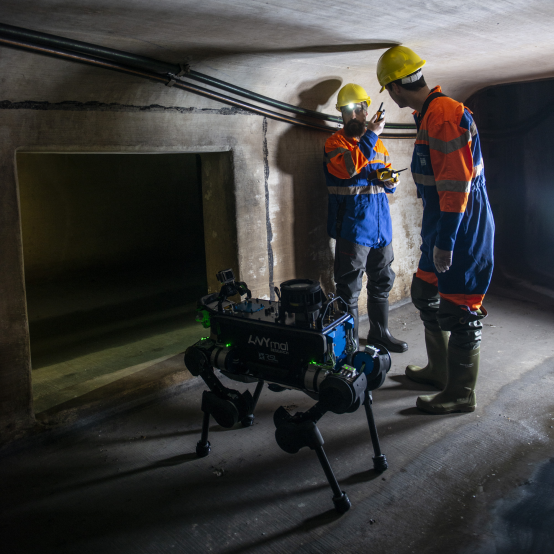
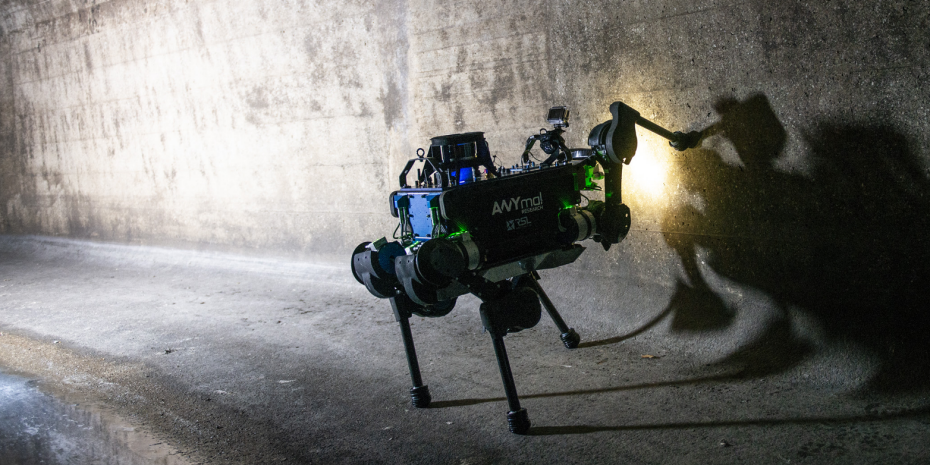
There’s a lot of talk about the many potential uses of multi-legged robots like Cheetahbot and Spot — but in order for those to come to fruition, the robots actually have to go out and do stuff. And to train for a glorious future of sewer inspection (and helping rescue people, probably), this Swiss quadrupedal bot is going deep underground.

ETH Zurich / Daniel Winkler

The robot is called ANYmal, and it’s a long-term collaboration between the Swiss Federal Institute of Technology, abbreviated there as ETH Zurich, and a spin-off from the university called ANYbotics. Its latest escapade was a trip to the sewers below that city, where it could eventually aid or replace the manual inspection process.

ANYmal isn’t brand new — like most robot platforms, it’s been under constant revision for years. But it’s only recently that cameras and sensors like lidar have gotten good enough and small enough that real-world testing in a dark, slimy place like sewer pipes could be considered.

Most cities have miles and miles of underground infrastructure that can only be checked by expert inspectors. This is dangerous and tedious work — perfect for automation. Imagine instead of yearly inspections by people, if robots were swinging by once a week. If anything looks off, it calls in the humans. It could also enter areas rendered inaccessible by disasters or simply too small for people to navigate safely.

But of course, before an army of robots can inhabit our sewers (where have I encountered this concept before? Oh yeah…) the robot needs to experience and learn about that environment. First outings will be only minimally autonomous, with more independence added as the robot and team gain confidence.

“Just because something works in the lab doesn’t always mean it will in the real world,” explained ANYbotics co-founder Peter Fankhauser in the ETHZ story.

Testing the robot’s sensors and skills in a real-world scenario provides new insights and tons of data for the engineers to work with. For instance, when the environment is completely dark, laser-based imaging may work, but what if there’s a lot of water, steam or smoke? ANYmal should also be able to feel its surroundings, its creators decided.

ETH Zurich / Daniel Winkler

So they tested both sensor-equipped feet (with mixed success) and the possibility of ANYmal raising its “paw” to touch a wall, to find a button or determine temperature or texture. This latter action had to be manually improvised by the pilots, but clearly it’s something it should be able to do on its own. Add it to the list!

You can watch “Inspector ANYmal’s” trip below Zurich in the video below.

Why your startup shouldn’t rush to $1 million in revenue

Martina Lauchengco
Contributor

Martina spent over 20 years as a marketing and product executive building and crafting strategies for market-defining software like Microsoft Office and Netscape Navigator. As an operating partner at Costanoa Ventures, she sits on multiple boards and advises companies on all things go-to-market. She also teaches at the UC Berkeley graduate school of engineering.

Jim Wilson
Contributor

Jim is a seasoned sales executive with over 25 years experience in diverse technology industries. As an operating partner at Costanoa Ventures, Jim provides companies with sales and market entry strategy advice.

There is a prevailing belief that the magic formula for early-stage tech startups hinges on how quickly they achieve $1 million in annual recurring revenue (ARR). Investors in SaaS companies, in particular, are very guilty of pushing this or its equally loaded corollary, “When will you sign your first six-figure deal?”

But in the rush toward these numbers, too many startups lose sight of their primary intent: These metrics are supposed to be an indicator of product/market fit. We’ve seen companies reach $1 million in ARR in less than a year, yet not have enough market momentum to get their next million easily. We’ve seen early-stage companies so concerned about getting those first sales, they don’t validate the market and if they’re building the right product. We’ve also watched a focus on new logos make companies forget about keeping existing customers happy, introducing unexpectedly high churn — something startups can’t afford.

Those first customers and that first million are supposed to be the bedrock on which the rest of the business grows. Founders must constantly ask what they’re learning about their market, product and go-to-market approach — in that order! — so the business becomes a flywheel.

Revenue is a lagging indicator of sales success, so must likewise be prioritized accordingly. That’s not to say revenue isn’t vitally important and that there isn’t a great deal of urgency to it, but focusing on it too much too early can mask big problems that will hurt startups later when the stakes are higher.

Here are a few lessons we’ve learned by watching our early-stage companies go through this crucial phase. Every early-stage company needs to do them well.

Customer and market discovery is job No. 1

We talk about product and knowing customers a lot, but that is insufficient. Startups must understand the market, as well. How do customers do this today? Is there urgency around the problem? What is the community saying? An early investor in PagerDuty went onto Reddit and Quora and just looked at who people were talking about. It made his decision easy.

To be really successful, it is as important to understand market dynamics as it is to deliver a great product. This also helps zero in on all the aspects of your ideal customer profile; it needs to be more specific than you think! This also then helps qualify customers for future sales.

Elevate Security stood out in their super-crowded security space because they carved out a unique position around people-powered security. They used their early sales process to carefully qualify who would help them best develop their products. Their first product got shout-outs on social media from users who loved it — a rare occurrence in security — and were indicators they had found good initial customers and were creating something unique.

Build a product that sells itself

You’ll always find smart people saying, “I love what you’re doing.” Some things are so broken even a mediocre improvement is worth a change. But this is why revenue can be a false indicator for scalable success: Founders find enough early adopters to get that first million, which leads them to believe the product is enough. The company starts chasing more revenue, not investing in a product-based growth engine. If sales keeps hitting their numbers, everyone believes things are fine. Until they’re not. And then it’s usually a really heavy lift, with 6-12 months of product, sales or team upgrades.

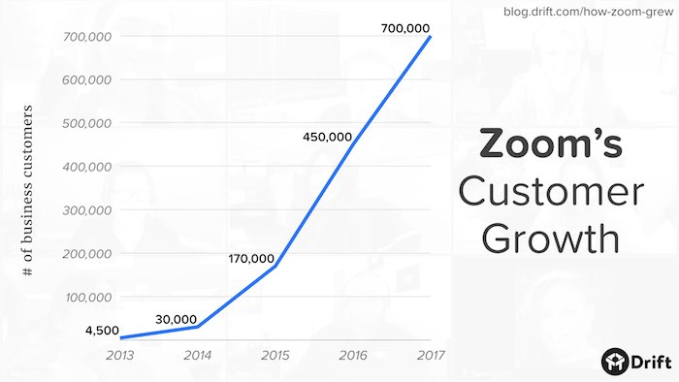
What startup doesn’t want a growth curve like this? Zoom had triple-digit growth for the last four years in a crowded, mature video conferencing category. Janine Pelosi, Zoom’s head of marketing, said the reason they were so successful before and after she arrived was they have a great product. It’s reliable, easy to use, and the founder, Eric Yuan, was selling it every day. Yuan knew the market really well coming out of Webex, and always touching customers meant he could adjust company strategy accordingly. Zoom embodied the real magic formula: know your market + build great product.

Pay attention to customer engagement and delight

Customer satisfaction is simple: It comes from the perception that people get value from their purchase; it’s much less about how much they paid. It’s also always cheaper to make an existing customer happy than it is to acquire a new one, so make sure even in the early days that you’re investing in making current customers happy advocates.

Aquabyte uses computer vision to identify sea lice in the $160 billion aquafarming market. When they showed customers FreckleID (think facial recognition for fish) to uniquely identify fish in a pen of 200,000, fish farmers loved the idea. The price they were willing to pay was 3x what the CEO thought possible. They’re likewise investing heavily in making sure their initial customer is successful with the product and are delighting them in unexpected ways (handwritten holiday cards). They have more prospects in their pipeline than they have capacity, which means they don’t need to expand sales to grow revenue fast.

Your startup may have the coolest tech, be in the biggest market and have the smartest team. No matter what your board says, remember revenue is NOT the primary indicator; it is simply an indicator. To become a breakout success, you need to read the tea leaves of all aspects of your market and build a product and customer experience that is truly superior.

Iota Biosciences raises $15M to produce in-body sensors smaller than a grain of rice

Fitness trackers and heart-rate monitors are all well and good, but if you want to track activity inside the body, the solutions aren’t nearly as convenient. Iota Biosciences wants to change that with millimeter-wide sensors that can live more or less permanently in your body and transmit wirelessly what they detect, and a $15 million Series A should put them well on their way.

The team emerged from research at UC Berkeley, where co-founders Jose Carmena and Michel Maharbiz were working on improving the state of microelectrodes. These devices are used all over medical and experimental science to monitor and stimulate nerves and muscle tissues. For instance, a microelectrode array in the brain might be able to help detect early signs of a seizure, and around the heart one could precisely test the rhythms of cardiac tissues.

But despite their name, microelectrodes aren’t really small. The tips, sure, but they’re often connected to larger machines, or battery-powered packs, and they can rarely stay in the body for more than a few weeks or months due to various complications associated with them.

Considering how far we’ve come in other sectors when it comes to miniaturization, manufacturing techniques and power efficiency, Carmena and Maharbiz thought, why don’t we have something better?

“The idea at first was to have free-floating motes in the brain with RF [radio frequency] powering them,” Carmena said. But they ran into a fundamental problem: RF radiation, because of its long wavelength, requires rather a large antenna to receive them. Much larger than was practical for devices meant to swim in the bloodstream.

“There was a meeting at which everything died, because we were like two orders of magnitude away from what we needed. The physics just weren’t there,” he recalled. “So were like, ‘I guess that’s it!’ ”

But some time after, Maharbiz had a “eureka” moment — “as weird as it sounds, it occurred to me in a parking lot. You just think about it and all these things align.”

His revelation: ultrasound.

Power at the speed of sound

You’re probably familiar with ultrasound as a diagnostic tool, for imaging inside the body during pregnancy and the like — or possibly as a range-finding tool that “pings” nearby objects. There’s been a lot of focus on the venerable technology recently as technologists have found new applications for it.

In fact, a portable ultrasound company just won TechCrunch’s Startup Battlefield in Lagos:

Iota’s approach, however, has little to do with these traditional uses of the technology. Remember the principle that you have to have an antenna that’s a reasonable fraction of an emission’s wavelength in order to capture it? Well, ultrasound has a wavelength measured in microns — millionths of a meter.
So it can be captured — and captured very efficiently. That means an ultrasound antenna can easily catch enough waves to power a connected device.

Not only that, but as you might guess from its use in imaging, ultrasound goes right through us. Lots of radiation, including RF, gets absorbed by the charged, salty water that makes up much of the human body.

“Ultrasound doesn’t do that,” Maharbiz said. “You’re just Jell-O — it goes right through you.”

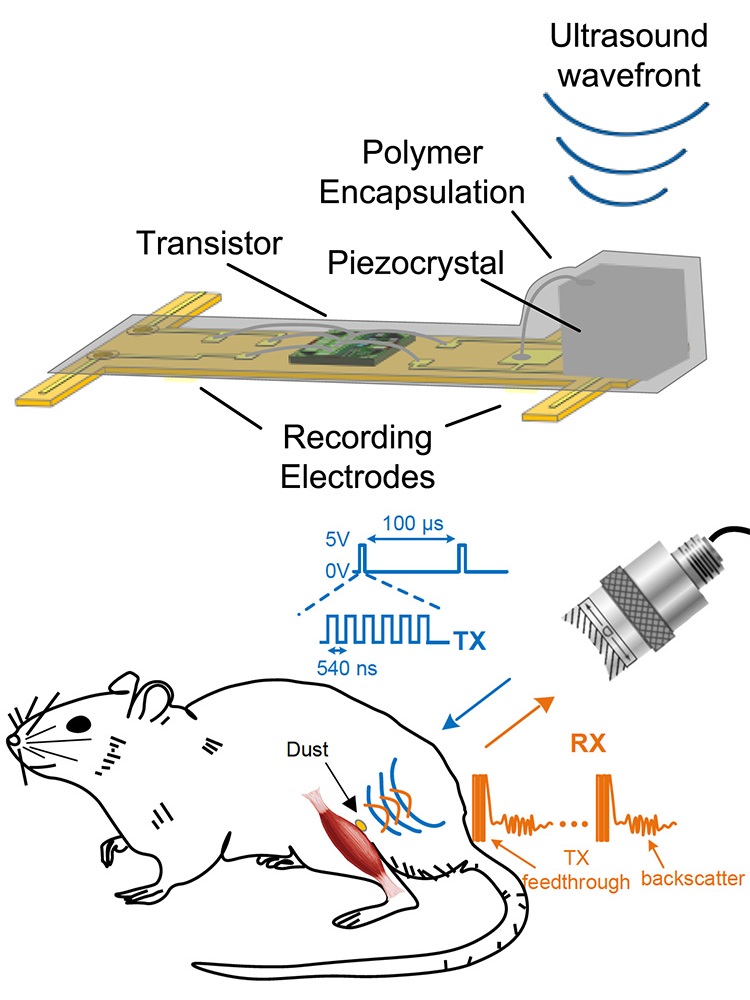
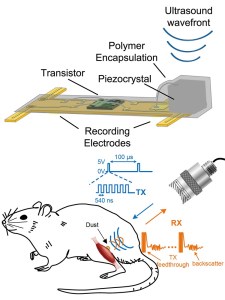
The device they put together to take advantage of this is remarkably simple, and incredibly tiny. On one side is what’s called a piezoelectric crystal, something that transforms force — in this case, ultrasound — into electricity. In the middle is a tiny chip, and around the edge runs a set of electrodes.

It’s so small that it can be attached to a single nerve or muscle fiber. When the device is activated by a beam of ultrasound, voltage runs between the electrodes, and this minute current is affected by the electrical activity of the tissue. These slight changes are literally reflected in how the ultrasonic pulses bounce back, and the reader can derive electrophysiological voltage from those changes.

Basically the waves they send power the device and bounce back slightly changed, depending on what the nerve or muscle is doing. By sending a steady stream of pulses, the system collects a constant stream of precise monitoring data simply and non-invasively. (And yes, this has been demonstrated in vivo.)
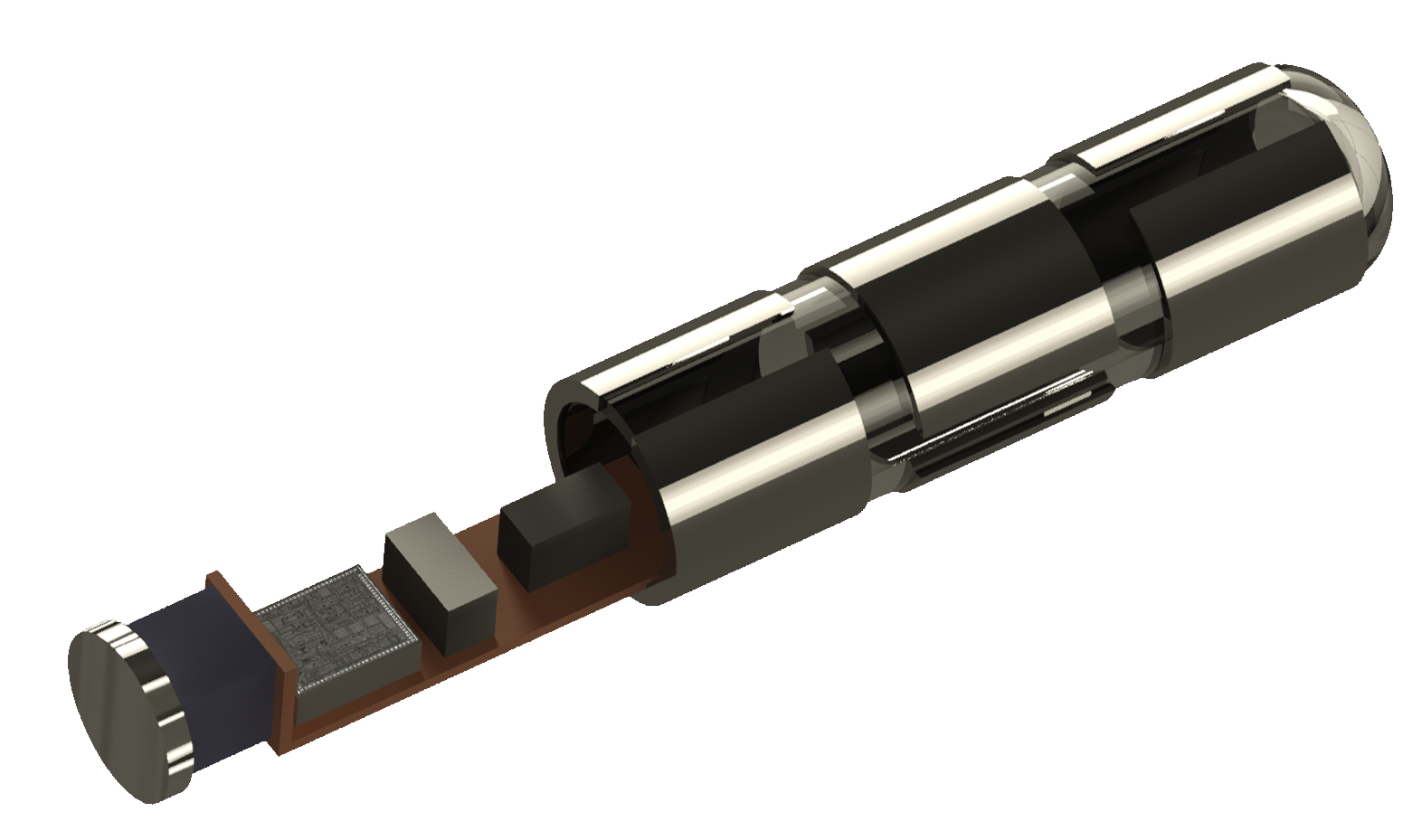
Contained inside non-reactive, implant-safe containers, these microscopic “motes” could be installed singly or by the dozen, doing everything from monitoring heart tissue to controlling a prosthesis. And because they can also deliver a voltage, they could conceivably be used for therapeutic purposes, as well.

And to be clear, those purposes won’t be inside the brain. Although there’s no particular reason this tech wouldn’t work in the central nervous system, it would have to be smaller and testing would be much more complicated. The initial applications will all be in the peripheral nervous system.

At any rate, before any of that happens, they have to be approved by the FDA.

The long medtech road

As you might guess, this isn’t the kind of thing you can just invent and then start implanting all over the place. Implants, especially electronic ones, must undergo extreme scrutiny before being allowed to be used in even experimental treatment.

Fortunately for Iota, their devices have a lot of advantages over, say, a pacemaker with a radio-based data connection and five-year battery. The only transmission involved is ultrasound, for one thing, and there are decades of studies showing the safety of using it.

“The FDA has well-defined limits for average and peak powers for the human body with ultrasound, and we’re nowhere near those frequencies or powers. This is very different,” explained Maharbiz. “There’s no exotic materials or techniques. As far as constant low-level ultrasound goes, the notion really is that it does nothing.”
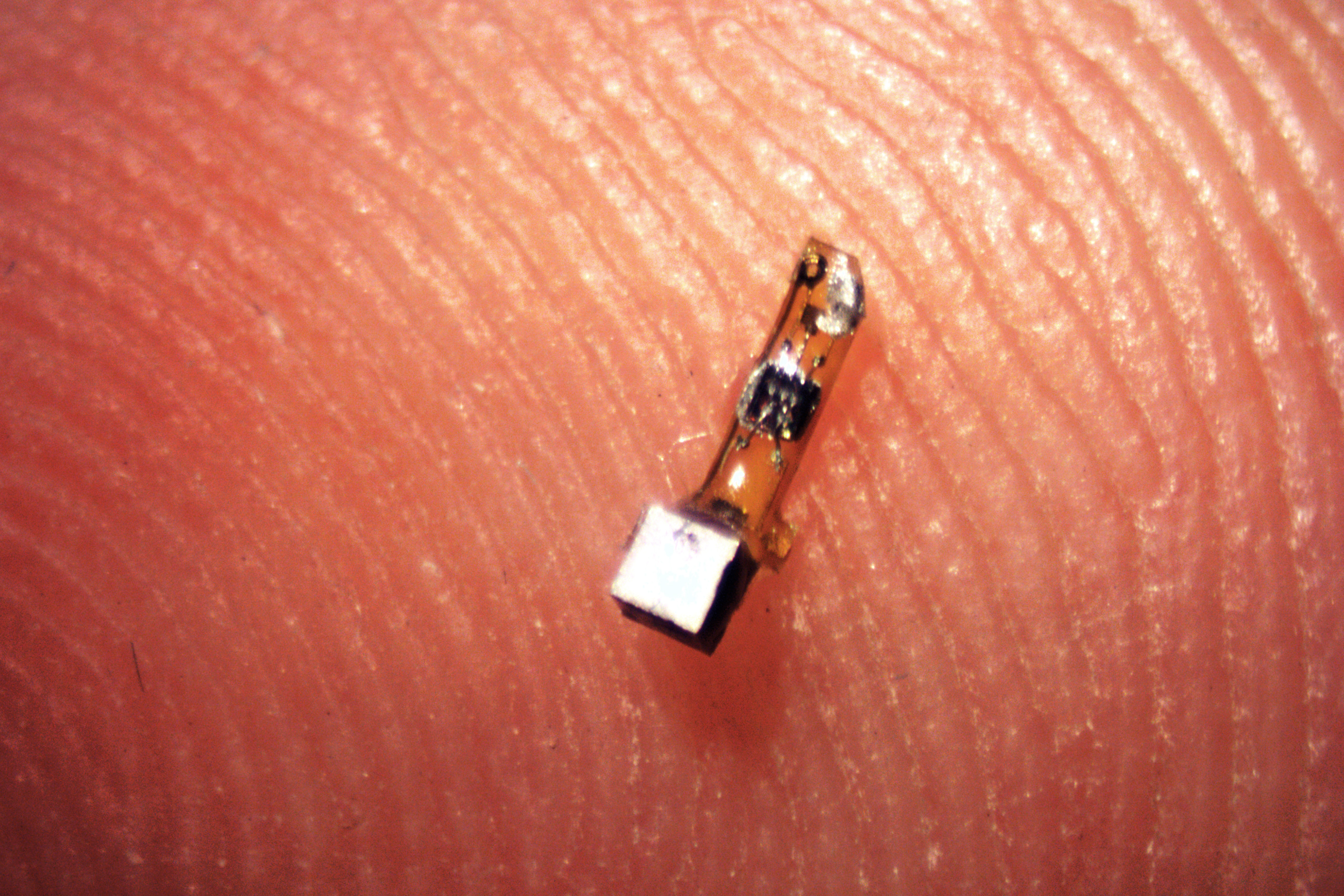
And unlike a major device like a medication port, pump, stint, pacemaker or even a long-term electrode, “installation” is straightforward and easily reversible.

It would be done laparoscopically, or through a tiny incision. said Carmena. “If it has to be taken out, it can be taken out, but it’s so minimally invasive and small and safe that we keep it,” he said.

These are all marks in Iota’s favor, but testing can’t be rushed. Although the groundwork for their devices was laid in 2013, the team has taken a great deal of time to advance the science to the point where it can be taken out of the lab to begin with.

In order to get it now to the point where they can propose human trials, Iota has raised $15 million in funding; the round was led by Horizons Ventures, Astellas, Bold Capital Partners, Ironfire and Shanda. (The round was in May but only just announced.)

The A round should get the company from its current prototype phase to a point, perhaps some 18 months distant, when they have a production-ready version ready to present to the FDA — at which point more funding will probably be required to get through the subsequent years of testing.

But that’s the game in medtech, and all the investors know it. This could be a hugely disruptive technology in a number of fields, although at first the devices need to be approved for a single medical purpose (one Iota has decided on but can’t disclose yet).

It’s a long road, all right, but at the end of it is the fulfillment of a promise straight out of sci-fi. It may be years before you have microscopic, ultrasound-powered doodads swimming around inside you, but that future is well on its way.

People lost their damn minds when Instagram accidentally went horizontal

Earlier today, when Instagram suddenly transformed into a landscape-oriented Tinder-esque nightmare, the app’s dedicated users extremely lost their minds and immediately took to Twitter to be vocal about it.

As we reported, the company admitted that the abrupt shift from Instagram’s well-established vertical scrolling was a mistake. The mea culpa came quickly enough, but Instagram’s accidental update was already solidified as one of the last meme-able moments of 2018.

That was supposed to be a very small test that went broad by accident. Should be fixed now. If you're still seeing it simply restart the app. Happy holidays! ?

— Adam Mosseri (@mosseri) December 27, 2018

Why learn about the thing itself and why it happened when you could watch the meta-story play out in frantic, quippy tweets, all vying for relevance as we slide toward 2019’s horrific gaping maw? If you missed it the first time around, here you go.

us: pls chronological timelines
insta: what? insta stories?
us: nonono chronological timelines
insta: did you mean IGTV
us: NO CHRONOLOGICAL TIMELINES
insta: ohhhh you want to scroll horizontally #instagramupdate

— ?, ?, ?, ?, ?, ? (@triviastigma) December 27, 2018

Instagram literally went “felt cute but might delete later” #instagramupdate

— Basma (@basmahxmde) December 27, 2018

@ instagram during those 0.2 seconds of the horizontal feed pic.twitter.com/ZyfKIHsOGI

— alex (@alexojovel) December 27, 2018

*New Instagram updates*

everyone: pic.twitter.com/OiinUERwEa

— Complex (@Complex) December 27, 2018

These Instagram updates are weird. I think Instagram wants us to leave. Like when a guy goes “you’re just to good for me.” We should listen.

— Quinta. (@quintabrunson) December 27, 2018

A handful of memes even managed to incorporate another late-2018 meme, Sandra Bullock in Bird Box — a Netflix original that is not a birds-on-demand service, we are told.

Everyone: we hate the new Instagram update

Instagram: pic.twitter.com/5crPlrNlOl

— Jeyson Paez (@jeysonpaez) December 27, 2018

You know how in apocalypse movies where a part of the population starts freaking out because they’re infected by something unfamiliar and start rampaging? I felt like I was in one when I woke up to people losing their minds over the Instagram update. I’ve already locked my doors.

— Eugene Lee Yang (@EugeneLeeYang) December 27, 2018

Unupdate might not be a word, but it is absolutely a state of mind.

*Everyone when they saw the new update* #instagramupdate pic.twitter.com/MvYtYejnXw

— Skyleigh Tweedy (@SkyleighTweedy) December 27, 2018

instagram when they saw the update wasn’t a hit:
when they quickly remove it:#instagramupdate pic.twitter.com/UHqrOxphRb

? ???? ? (@localsatanicboy) December 27, 2018

For better or worse, the Met got involved with what we can only assume is a Very Important Artifact for the cause.

When you hear #Instagram might update its format so you hold on tighter to your vertical scroll…

?: Marble hand holding a scroll, Roman, 1st or 2nd century A.D. https://t.co/k0TgNTaeiS pic.twitter.com/cuxwORgWnT

— The Met (@metmuseum) December 27, 2018

When Instagram releases an update and within 15 minutes everybody hates it #InstagramUpdate pic.twitter.com/2l0wBZwU78

— Meg Warpus (@MegWarpus) December 27, 2018

Due to a bug, some users saw a change to the way their feed appears today. We quickly fixed the issue and feed is back to normal. We apologize for any confusion.

— Instagram (@instagram) December 27, 2018

But can we ever really go back? Can we unsee a fate so great, one still looming on some distant social influencer shore? Probably yeah, but that doesn’t mean we won’t all lose it if it happens again.

Reid Hoffman denies direct knowledge of funding disinformation in the Alabama Senate race

One of Silicon Valley’s prominent billionaires is in hot water after funding deceptive social media campaigns with echoes of Russia’s own political playbook. Reid Hoffman, who co-founded LinkedIn in 2003 and is now a partner at Greylock, footed the bill for a small political project with the aim of getting Democrat Doug Jones elected in 2017’s special election. Now, Hoffman is sorry — but he also maintains that he didn’t know where his money ended up.

It’s not clear what impact the project had in successfully electing Jones, but internal documents reveal that the effort known as Project Birmingham “experimented with many of the tactics now understood to have influenced the 2016 elections.” Those tactics are now widely regarded as both politically and professionally toxic as tech companies — most notably Facebook — continue to face intense scrutiny over their role in facilitating the spread of disinformation meant to influence U.S. political behavior.

As The New York Times reported:

The project’s operators created a Facebook page on which they posed as conservative Alabamians, using it to try to divide Republicans and even to endorse a write-in candidate to draw votes from Mr. Moore. It involved a scheme to link the Moore campaign to thousands of Russian accounts that suddenly began following the Republican candidate on Twitter, a development that drew national media attention.

In a statement following reporting from The New York Times and The Washington Post, Hoffman did not dispute the assertion that he funded the efforts, but denied any knowledge of the controversial tactics themselves.

“I want to make it clear from the outset that I had never even heard of this project before reading about it in the Times’ coverage,” Hoffman said in the statement, published to Medium. “The Times articles imply that I had knowledge of it and that I endorsed its tactics. Let me be absolutely clear: I do not.”

Hoffman went on to disavow the use of political disinformation intended to influence the outcome of an election.

“I would not have knowingly funded a project planning to use such tactics, and would have refused to invest in any organization that I knew might conduct such a project,” Hoffman said. “Nevertheless, I do have an apology to make and have learned a lesson here.”

In his Medium post Hoffman describes how he became more politically active after the 2016 U.S. presidential election. He recounts how he funded dozens of political and civic engagement organizations in conjunction with a group called Investing in Us. “Our goal is to identify promising organizations and provide them with resources to accelerate positive change,” Hoffman said.

Many of those investments appear to be uncontroversial, including contributions to the Center on Rural Innovation and an organization called Opportunity at Work which helps connect Americans with job opportunities. As Hoffman explains, his entanglement in the Alabama Senate race came about through his choice to fund a group called American Engagement Technologies (AET):

One of the early organizations that we supported was American Engagement Technologies (AET), a group which sought to develop technical solutions to counteract fake news, bot armies, and other kinds of digital manipulation and disinformation, and to use social media and data analytics to increase civic engagement and improve access to accurate information about candidates and issues.

AET, in turn, provided funding to a group called New Knowledge. Through AET or otherwise, I have never personally authorized or directed any funding to New Knowledge. I?—?regretfully?—?do not know why AET chose to support New Knowledge or for what specific purposes, if any, this funding was allocated.

To reiterate yet again, I find the tactics that have been recently reported highly disturbing. For that reason, I am embarrassed by my failure to track AET?—?the organization I did support?—?more diligently as it made its own decisions to perhaps fund projects that I would reject.

Though Hoffman’s post did not specify an amount, The Washington Post reported that Hoffman invested $750,000 in AET. The group is helmed by Mikey Dickerson, a former Google engineer who served as the founding director of the USDS during Obama’s presidency.

Earlier this week, Facebook suspended the account of Jonathon Morgan, the head of New Knowledge. Morgan previously acknowledged that he set up a misleading Facebook page to test his ability to engage with conservative voters and bought less than $10 worth of Twitter retweets for the same goal. Morgan characterized this undertaking as “small-scale” and told The Washington Post that these efforts were made only in “his own capacity as a researcher seeking to understand the mechanics of disinformation tactics, not as New Knowledge’s leader.”

Last week, Doug Jones articulated his support for a federal probe into the role the disinformation tactics could have played in his successful Senate bid. Hoffman also expressed his support for a federal investigation.

“We cannot permit dishonest campaign tactics to go unchecked in our democracy?—?no matter which side they purportedly help,” Hoffman said.

TrueFacet, which sells pre-owned, authenticated watches and jewelry, is raising a $10 million round of funding

The secondary luxury goods market has been growing wildly in recent years, with more shoppers opting to both sell their lightly used luxury goods like clothing and jewelry for cold, hard cash, as well as buying the pre-owned, authenticated luxury goods of others.

One of the biggest beneficiaries of the trend is The RealReal, a nearly eight-year-old shopping destination for the growing population of people who might not be willing or able to purchase a new Hermes Birkin bag but are willing to buy one in like-new condition for considerably less. The idea — which seems to be working — is to create a virtuous cycle, wherein the bag’s original purchaser receives the bulk of that re-sale price, then uses the money to buy another new handbag (or a used one) that can be resold at a later point in time.

Another beneficiary of the trend: TrueFacet, a five-year-old, New York-based marketplace that claims to have more than 40,000 watches and 55,000 pieces of pre-owned authenticated watches and jewelry for sale at its site, and that has more recently begun offering pre-owned timepieces directly through brands like Fendi Timepieces, Raymond Weil and Roberto Coin that now partner with TrueFacet to carry their pre-owned timepieces with a manufacture warranty.

Apparently, shoppers are buying what they’re collectively selling. The company, which had previously raised $14.7 million in funding from investors, looks to be closing in on another $10 million round, judging by freshly filed SEC paperwork that shows it has so far raised $7 million in funding and is targeting $9.8 million altogether.

TrueFacet’s backers include Founders Co-op,  Freestyle Capital and Maveron, led by partner Jason Stoffer, who also happens to sit on the board of Dolls Kill, an edgy clothing marketplace that we wrote about on Monday.

TrueFacet has some tough competition in the space, including Crown & Caliber, a six-year-old, Atlanta, Ga.-based company that has never announced outside funding, and 15-year-old, Germany-based Chrono24, which has raised €21 million over the years. Both sell timepieces alone, however.

It also competes directly with The RealReal, which has raised nearly $300 million from investors and sells clothing and high-end home decor, as well as jewelry and watches. (The company doesn’t break out publicly which of these categories outpace the others in terms of sales.)

Interestingly, like The RealReal, which now operates permanent offline stores in both New York and L.A., TrueFacet is also crossing the chasm into the offline world, though it’s taking baby steps toward that end.

Specifically, earlier this month, it announced a partnership with Stephen Silver Fine Jewelry, which sells timepieces to many monied Bay Area VCs and other Silicon Valley bigs at stores in Redwood City and Menlo Park, Calif. For the time being at least, the jeweler will also sell pieces from TrueFacet’s collection.

Elon Musk argues comments on Twitter are protected speech in request to dismiss ‘pedo guy’ lawsuit

Elon Musk has filed a motion to dismiss a defamation lawsuit filed against him by the British cave rescuer who sued the billionaire entrepreneur for calling him a pedophile.

Musk’s motion presents numerous reasons to dismiss the defamation lawsuit, all of which come back to a two main points: Twitter is “infamous for invective and hyperbole,” and therefore should not be considered fact and these “imaginative attacks,” even if offensive, “are by their nature opinion and protected by the First Amendment.” 

Musk’s lawyers ask a single question in the request: “Accepting Unsworth’s well-pleaded allegations as true, would a reasonable reader believe that Musk’s statements were supported by objective facts or were instead “nonactionable opinion?”

The list of arguments laid out in the motion to dismiss are:

  1. Unsworth must prove that the reasonable reader would believe Musk possessed private facts implicating Unsworth as a pedophile.
  2. In context, Musk’s statements cannot reasonably be read as asserting underlying knowledge that Unsworth was a pedophile
  3. Statements on unmoderated Internet forums are presumptively opinion.
  4. Musk’s underlying argument is that “his over-the-top insults are not statements of fact.”
  5. Musk disclosed the basis for his personal opinion: Thailand’s documented problems with sex tourism
  6. Musk’s over-the-top insults are not statements of fact
  7. Musk’s colloquial statements are not reasonably interpreted as statements of facts
  8. Musk’s expressions of uncertainty show that his statements did not have a concrete factual foundation and were therefore opinion
  9. Readers did not interpret Musk’s statements as factual assertions

Whether these arguments will be enough to convince a judge to dismiss the lawsuit is unclear. However, it raises a different question. If the argument is to be believed, it would suggest that other claims and promises Musk puts on Twitter shouldn’t be trusted as fact either.

The whole “pedo guy” episode began over the summer after Musk and employees at his companies, SpaceX, Tesla, and The Boring Company, became involved in an effort to extract 12 boys and their soccer coach from the Tham Luang Nang Non cave system located in Northern Thailand after flooding trapped the group for weeks. Musk’s team developed and then sent  mini submarine built out of rocket parts that he thought could help.

The team of divers who eventually rescued every person trapped in the cave didn’t use the mini-submarine, dubbed by Musk’s people as “Wild Boar.”

Unsworth, a British ex-pat who lives in Thailand, helped plan the rescue operation and recruited other cave diving experts. The fight began after Unsworth gave an interview on CNN International, in which he called the mini submarine a “PR stunt,” that it “had absolutely no chance of working” and that Musk could “stick his submarine where it hurts.”

Musk subsequently lashed out on Twitter and insinuated that Unsworth was a pedophile. He later deleted the offending tweet and tried to backpedal — even offering an apology of sorts on Twitter. And it could have all ended there. But then Musk dug it all up again during a debate with ex-TechCrunch journalist Drew Olanoff — once again on Twitter. Olanoff had brought up the “pedo guy” attack as an example of Musk telling untruths.

Unsworth filed a lawsuit September in the U.S. District Court for the Central District of California against Musk for defamation. The lawsuit alleges that between July 15 and August 30, Musk periodically used Twitter and emails to the media to publish false and defamatory accusations against Unsworth, including accusations of pedophilia and child rape.

Read the entire motion here.

Cap table management tool Carta valued at $800M with new funding

Startups supporting startups are blazing a new trail with support from venture capitalists.

Co-working spaces like The Wing and The Riveter raked in funding rounds this year, as did Brex, the provider of a corporate card built specifically for startups. Now Carta, which helps companies manage their cap tables, valuations, portfolio investments and equity plans, has announced an $80 million Series D at a valuation of $800 million. The company, formerly known as eShares, raised the capital from lead investors Meritech and Tribe Capital, with support from existing investors.

The round brings Carta’s total funding to $147.8 million. Its existing investors include Spark Capital, Menlo Ventures, Union Square Ventures and Social Capital, though the latter didn’t participate in the Series D funding. Tribe Capital, however, is a new venture capital firm launched by Arjun Sethi, who previously led Social Capital’s investment in Carta, Jonathan Hsu and Ted Maidenberg, a trio of former Social Capital partners who exited the VC firm amid its transition from a traditional VC fund to a technology holding company. Tribe is said to be in the process of raising its own $200 million debut fund.

Founded in 2012 by Henry Ward (pictured), the Palo Alto-based company plans to use the latest investment to develop their transfer agent and equity administration products and services to better support startups transitioning into public companies. It also will launch additional products for investors to collect data from their portfolio companies and to manage their back office.

“We’ve come this far by changing how ownership management works for private companies—popularizing electronic securities and cap table software, combined with audit-ready 409As,” Ward wrote in an announcement. “But our ambitions go far beyond supporting privately-held, venture-backed companies.”

Carta, which counts Robinhood, Slack, Wealthfront, Squarespace, Coinbase and more as customers, currently manages $500 billion in equity. This year, Carta expanded its headcount from 310 employees to 450 employees, launched board management and portfolio insights products and completed a study in partnership with #Angels that highlighted the major equity gap female startup employees are victim to.

The study, released in September, revealed that women own just 9 percent of founder and employee startup equity, despite making up 35 percent of startup equity-holding employees. On top of that, women account for 13 percent of startup founders, but just 6 percent of founder equity — or $0.39 on the dollar.

Elon Musk lays out ambitious plan for Tesla Supercharger network in Europe

Tesla CEO Elon Musk is making some audacious promises again for the company’s network of electric fast chargers, known as Superchargers. This time, he’s aiming for 100 percent Tesla Supercharger coverage in Europe by next year.

In response to a question on Twitter, Musk said Tesla’s Supercharger coverage will extend to 100 percent of Europe in 2019. “From Ireland to Kiev, from Norway to Turkey,” Musk wrote.

A look at Tesla’s Supercharger map shows a high concentration of the fast chargers in Western Europe. Countries like Albania, Estonia, Latvia, Lithuania, Romania, Serbia and Moldova don’t have any Superchargers.

Yes. Supercharger coverage will extend to 100% of Europe next year. From Ireland to Kiev, from Norway to Turkey. https://t.co/7FQZgLCTVJ

— Elon Musk (@elonmusk) December 26, 2018

Musk also laid out plans to focus on cities, specifically to work with landlords to add home charging units at apartment buildings.

We are dramatically increasing Tesla Superchargers within cities & working with landlords to add home charging to apartment buildings

— Elon Musk (@elonmusk) December 26, 2018

Musk then went further, this time in response to a Twitter follower who noticed that Superchargers planned for San Antonio and Austin in 2018 had yet to be completed. The billionaire entrepreneur said “all major highways in Texas will have Superchargers, all the way to Brownsville and across Mexico.”

Definitely. All major highways in Texas will have Superchargers, all the way to Brownsville & across Mexico.

— Elon Musk (@elonmusk) December 26, 2018

He even laid out plans, although less specific, to add Superchargers to Africa in 2020. There are no Superchargers on the African continent.

Tesla’s Supercharger network was launched in 2012 in an effort to encourage owners of its electric vehicles to travel longer distances. A Supercharger adds up to 170 miles of range in about 30 minutes (although TechCrunch has experienced slightly longer charge times depending on location).

Musk has made bold promises for the company’s Supercharger network before. And while the company has made substantial progress and investment in its Supercharger network, it’s still nowhere near its previously promised target. 

In April 2017, Tesla said it would double its global network of Superchargers from more than 5,400 to more than 10,000 by the end of the year. It fell short of that goal, with about 8,250 Superchargers.

Earlier this year, Musk laid out plans to have 18,000 superchargers globally by the end 2018. As of December 27, Tesla has 11,583 Superchargers (within 1,386 Supercharger stations) globally.

Philips Hue has been having a holiday outage, too

Alexa wasn’t the only thing that crashed over Christmas due to an influx of new users. Apparently, Philips Hue has been having an outage, as well. A multi-day outage, in fact. The company confirmed on Wednesday that customers were experiencing issues creating new accounts, logging in and linking their account to third parties. It blamed the issues on “a lot of new activations.”

In other words, many people received Hue’s connected lighting products over the holidays and were now trying to set up their smart bulbs and other devices all around the same time. Hue’s servers couldn’t keep up with the demand and weren’t responding to the incoming requests. That meant users couldn’t create or log into their MyHue account, or connect their lights to their Amazon Echo or Google Home.

Customers were, understandably, very frustrated — especially because their issues began on Christmas, and had continued for days with no word from the company.

It's been almost two full days of being unable to log into MyHue or connect with my Echo. You really should consider a small coupon for all the people affected this Christmas. Lots of other smart bulb options out there…

— John Daniel Hubbard (@JDanHubbard) December 27, 2018

It’s been two days.

— Holly Quate (@hollyquate) December 26, 2018

Others complained they had wasted several hours troubleshooting the problem, having not realized it was a Hue outage that was at fault, as a result of this lack of communication.

I find this out after wasting 5 hours of my St Stephens day trying to link my account to my google home assistant ?????Ridiculous ??

— Lorraine Comiskey (@Jewelor) December 26, 2018

I am so stressed spent 5 hours last night trying to troubleshoot and nothing your lights are awesome but the problem with the software is really killing it for me just spent $500 on your lights would be nice if I could control them with my google home

— Logan czarnecki (@LoganCzarnecki) December 26, 2018

Philips Hue’s Twitter account didn’t make a public announcement about the outage until Wednesday — instead, the company was only replying to individual users.

Because Twitter hides replies in a separate tab, visitors to Hue’s Twitter page wouldn’t have seen any statements from the company unless they clicked over to see the back-and-forth conversations with Hue’s customers — and some of those weren’t outage-related.

People who followed Hue on Twitter wouldn’t have seen these replies in their own timelines, either.

We’re currently seeing a lot of new activations which may result in some customers not being able to create a new account, log in, or link their account to third parties. We hope to have this solved soon and like to ask you to try again later. Apologies and happy holidays!

— Philips Hue (@tweethue) December 26, 2018

Philips Hue had also downplayed the problem in its initial replies, as well, saying server issues were affecting only a “small percentage” of users.

Customers were told to try again or try in a few hours.

Hi. Unfortunately we have been facing some issues with our servers, affecting a small percentage of our users. We advise you to try again, or try again in a few hours. Our developers are looking into it. We are sorry for the inconvenience.

— Philips Hue (@tweethue) December 26, 2018

While Alexa had crashed on Christmas due to a similar problem of too many new users hitting its servers all at once, its outage only lasted a couple of hours.

In Philip Hue’s case, customers have been inconvenienced for much longer.

Many are also new Hue customers — those who are trying to trying to create their account and set up their devices for the first time. For some, Hue’s smart light bulbs may even be their first experience with a smart home device — and this outage may leave them not wanting to try again.

Early on Thursday, Hue’s Twitter account began to reply to individual users, telling them the service “should be up and running.”

But it also warned them that, depending on demand, they may have to try a few times today to get everything going. The company additionally suggested to some that they should try to set up the lights during off-peak hours, like the morning.

We reached out to Philips Hue to ask if the outage was indeed resolved, and will update with a statement if one is provided.

Update, 12/27/18, 1:30 PM ET: According to a spokesperson, the company hopes to have the issue corrected soon. They said:

“Following the holidays, we are seeing a high number of users setting up their Hue accounts. Unfortunately, this is causing a delay for some customers who have not been able to create their Hue account or link Hue to their voice assistant. We are working to support this increased traffic and help our customers complete their setup. We expect to have the issue corrected shortly.”

Hey Natalia, we are sorry about that. We can assure you that it will work again later and your present isn't ruined forever. At the moment the service should be up and running depending on the demand at the moment, so please try again a few times today. Our sincere apologies.

— Philips Hue (@tweethue) December 27, 2018

Hey Brad, the issue should now be resolved, during peak times you might still not be able to complete your account setup. We’d like to ask you to try again, preferably during a quieter moment, for example in the morning. We’re working hard on a solution to prevent this.

— Philips Hue (@tweethue) December 27, 2018

Instagram accidentally rolled out tap-to-advance feed, removes it

Instagram confirms that a bug this morning mistakenly rolled out a massive change to its feed that replaced the traditional scrolling with horizontal tap-to-advance, like with Stories. In October, TechCrunch reported Instagram was testing tap-to-advance for browsing through Explore posts. But many users woke up to a shock this morning when their familiar vertical swipe stopped advancing the main feed. Many users immediately complained that the gesture felt awkward and annoying.

“Due to a bug, some users saw a change to the way their feed appears today. We quickly fixed the issue and feed is back to normal. We apologize for any confusion,” an Instagram spokesperson tells TechCrunch. The company confirms it’s still testing the navigation style in Explore.

Instagram was attempting to test the feature with a small percentage of users, but the bug caused a much broader rollout to a few orders of magnitude more people than planned, according to head of Instagram Adam Mosseri. Users can restart their Instagram and the change should disappear.

Sorry about that, this was supposed to be a very small test but we went broader than we anticipated. ?

— Adam Mosseri (@mosseri) December 27, 2018

Tap-to-advance makes it easier to move between posts with them staying fully in view, compared to scrolling where it can take some adjustment to make sure the top or bottom of a post isn’t cut off. But scrolling revealed the author of a post first, then the content, then the caption, which is a sensible and intuitive way to browse. Tap-to-advance could send users’ eyes flitting around the screen in an exhausting manner. But most importantly, people have spent eight years growing accustomed to scrolling the Instagram feed. Suddenly breaking that behavior pattern was sure to piss people off.

It’s possible that Instagram could still bring tap-to-advance to the main feed in the future. But given how angry the responses were, it might now think twice unless the data shows the change makes people spend a lot more time in the app.

Here’s a look at how tap-to-advance in the feed worked, and the alert users got about how it works.