Kevin Cooley nearly lost his house to the La Tuna fire, LA’s biggest wildfire in recent history, but he captured these extraordinary images.
Category: Tech news
hacking,system security,protection against hackers,tech-news,gadgets,gaming
Blockchain Can Wrest the Internet From Corporations’ Grasp
Opinion: It’s time to restore the open source, community-led ethos of the original internet—with crypto.
FloWater just raised $15 million to put bottled water out of business
FloWater, an eight-year-old, Burlingame, Ca.-based company whose reusable water bottle refilling stations produce purified water, has raised $15 million in its first major round of funding. Bluewater, a Swedish company that sells water purifiers, among other things, led the round.
FloWater caters to schools, colleges, fitness centers, hotels, and offices, and, in the words of CEO Rich Razgaitis, set out to address four environmental concerns from the outset: obesity in the U.S. which has been tied in part to the rise of sugary, carbonated beverages; the nearly 40 billion single-use plastic water bottles that are used up and tossed aside every year; the millions of barrels of oil and hundreds of millions of pounds of CO2 byproduct waste used to create and transport bottled water; and the toxins in single-use plastic bottles, including endocrine-disrupting chemicals.
It has a pretty compelling case to make, in short, as other purveyors of refilling stations would surely argue, and which clearly persuaded 13 investors altogether (according to a new SEC filing) to write checks to the company.
And it all started with an $18,600 bank loan, according to the company’s founder, Wyatt Taubman, who remains on the company’s board but stepped aside as head honcho in 2015 and has since founded a cold-pressed juice company.
Per his LinkedIn, Taubman, says he used that bank loan to launch a pilot refill station, before shaking $125,000 out of friends and family, and a second, $62,000 loan to launch additional refill stations. The company later raised $950,000 from the Tech Coast Angels and the Hawaii Angels, hired Razgaitis, redesigned the look of its product and, in 2016, raised $2.6 million in Series A funding.
FloWater customers include Google, Airbnb, Specialized Bikes, and, somewhat ironically, Red Bull.
It says its stations are now in nearly 50 states.
Samsung’s Space Monitor is practical and minimal
Samsung always has a huge presence at CES, but it isn’t the giant TVs and flashy next-generation gadgets that have my attention this year; it’s this simple, flexible monitor that looks like it would be right at home in any workspace. It’s called the Space Monitor, presumably because it gives you space, not because it’s meant for use in space. I don’t see why you couldn’t, though.
What the Space Monitor does is very simple: it clamps to your desk and sits straight up from the edge — up against the wall if there is one — and takes up about as little space as it’s possible for a display to.
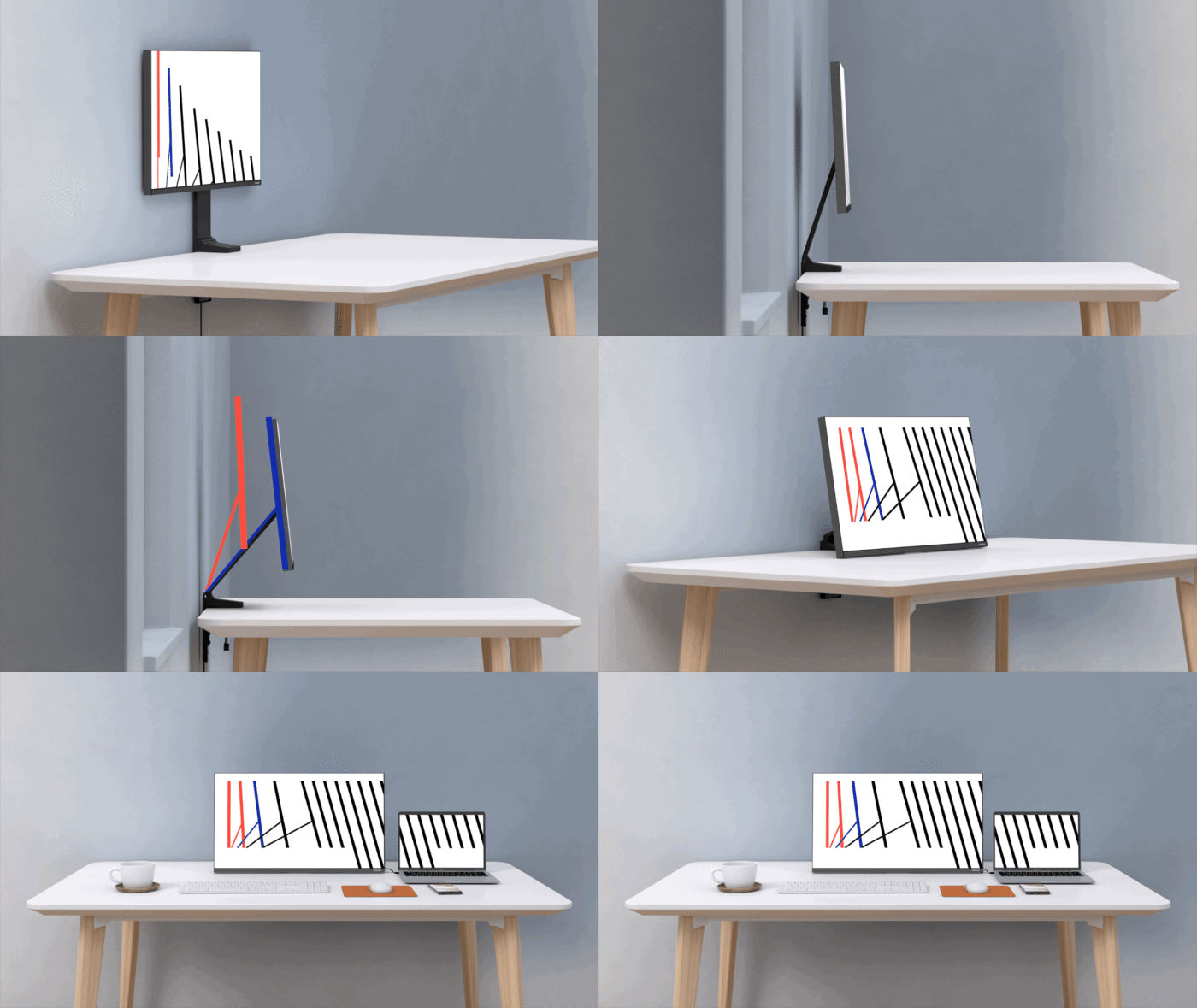
When you want to bring something closer, or lower, or just need to adjust the angle or whatever, the neck of the monitor lets you bring it down all the way to the level of your desk and tilt it up or down as well (though not side to side). Cables go up through the stand so you won’t see them at all.
Combined with very thin bezels on the sides (there’s a thicker, but still very reasonable one on the bottom) this makes for quite a minimal presence, and it could allow someone (like me) to shrink their workspace in some dimension or other. I like my Dell Ultrasharps, but if I was putting together a new desk situation, I’d probably look very hard at these Samsungs.
Sure, you could do a wall mount, but this is much easier and you don’t have to fiddle around with tools or load calculations. Just clamp it on there.
There are two models, a 27-inch QHD (2560×1440) model and a 32-inch 4K one (3840×2160); the latter costs $500, so the former will probably be a bit less. They use VA panels, which hopefully will be about as good as IPS, though of course not quite so good as OLED (though for that tech you’d have to add another zero to the price).
Only downside: 60 Hz maximum refresh rate. That’s a possible dealbreaker for some. But the specs also list a 4 ms response time, without explaining further. Perhaps I’ve misunderstood, but I asked Samsung to explain the discrepancy. The specs for the 27-inch display could also differ.
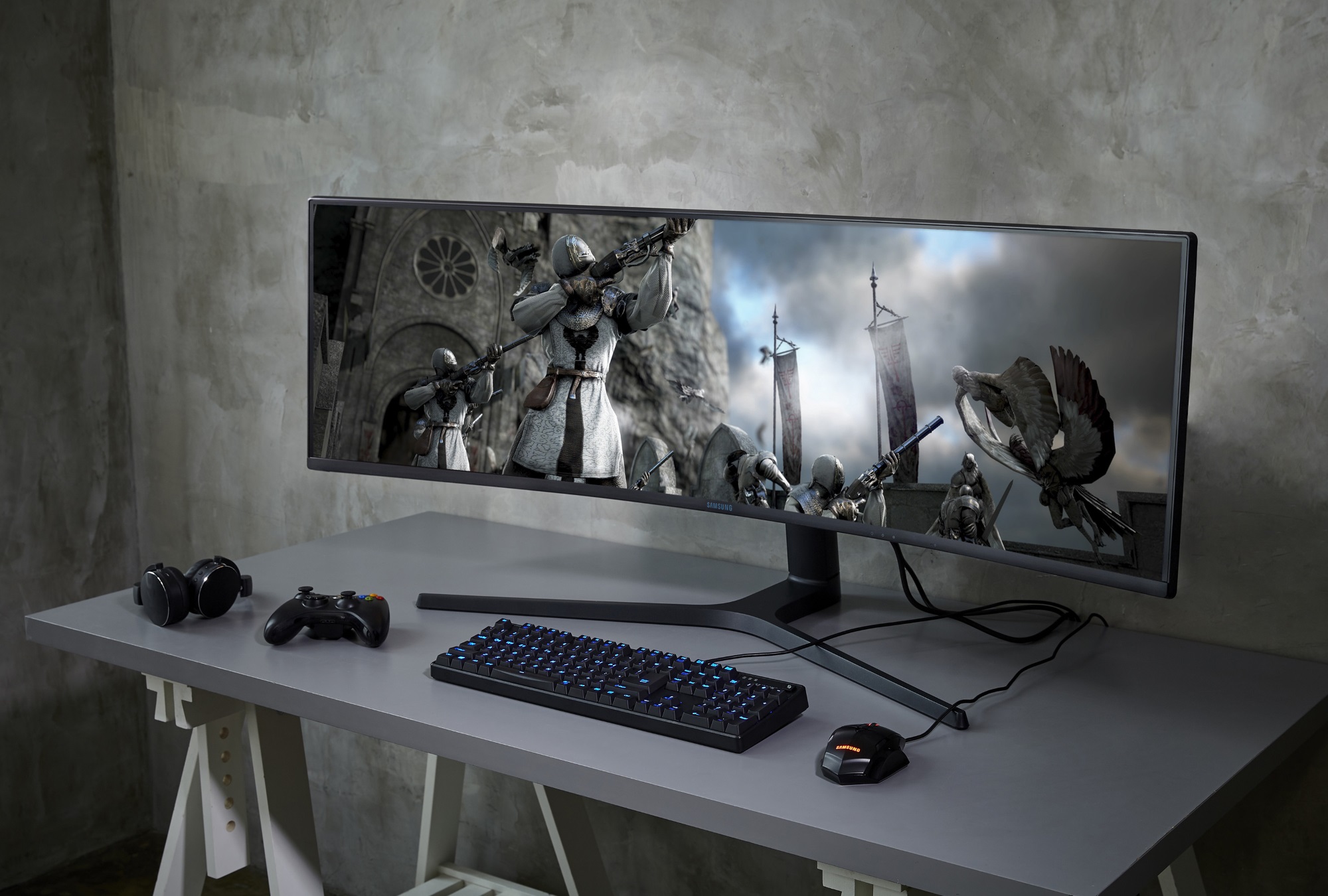
It feels nice to have a reason to visit the actual CES main halls this year. And of course, for the maximalists out there, I’ll also be sure to check out the mammoth new ultrawide:
Pokémon GO creator Niantic closes $190M funding round
Mobile AR gaming startup Niantic has closed a $190 million round of funding according to newly filed SEC docs.
The filing comes after a WSJ report last month suggested the company was in the process of closing a $200 million raise from investors, including IVP, aXiomatic Gaming and Samsung, at a $3.9 billion valuation. The round closed shortly after that report on December 20 according to the new documents.
With the close of this round, Niantic has now raised more than $415 million to date. The startup’s other investors include Founders Fund, Spark Capital and Alsop Louie Partners, among others. The filing details that there were 26 investors in this funding round.
The new influx of cash comes as the creator of Pokémon GO prepares to release its next major title, Harry Potter: Wizards Unite. The augmented reality game does not have a release date yet, but is expected to launch this year.
Zelda has a minus world
Listen, everyone. It’s not every day that a new fact comes to light regarding a game that came out more than 30 years ago. And I happen to love it when retro games get broken in fabulous and entertaining ways. So the news that The Legend of Zelda for NES has a minus world like Super Mario Bros. and others hit me like a freight train.
The phenomenon was discovered by YouTuber SKELUX, who starts off his video with a quick explanation of how minus worlds work. If you think about an NES game as a big file, there are places where graphics are stored, sounds and music are described and, of course, level layouts and enemy logic are kept.
As a player, you are expected to navigate the structured parts of this file, namely the game world — level 1, 2, 3, this or that dungeon or town, etc. But there are ways to escape that structure by exploiting flaws in the game’s code, letting you run free in portions of the game’s data that aren’t meant to be “real” levels — yet the game’s engine will interpret the data as best it can, producing in some cases pretty wacky but still navigable levels. This type of thing gets its name from Super Mario Bros., where you could easily warp to a buggy level “-1” and progress from there.
Zelda and other games often use data trickery to get around the natural limitations of 8-bit computing and severely restricted storage space. For instance, did you know that in order to store them more efficiently, Zelda’s dungeons all fit together like giant tiles?

I just about lost my mind when I found out about that. Note that the above is two 16×8 grids set one on top of the other.
As SKELUX explains, the overhead map is similarly divided, except the bottom “half” isn’t actually filled with map data. And although there are cheats that let you walk through walls, the game’s code detects when you reach an invalid map coordinate and returns you to the starting location. But a little hackery takes that safety measure out of play and the result:
 A new world!
And a horribly buggy one, as it turns out right from the start. Octoroks are shooting boomerangs out of their snouts; the old man on one screen tells you it’s dangerous to go alone, then next door says “leave your life of money”; a Molblin caterpillar shoots fireballs at you; glitchy inverted witch women swarm the statues of Death mountain; and so on.
It’s a strange, hilarious world, and one that obviously was not crafted but is simply created on the fly by the game’s engine attempting to make sense of the data it’s reading. It isn’t canon.
This type of video game archaeology is endlessly fascinating to me, because it demonstrates both the fragility and the robustness of these venerable pieces of software — and, of course, the enduring love and interest they engender in fans. Another one that recently absorbed my attention was the explanation of parallel dimensions inside Super Mario 64 and how sliding between them lets you beat a level with only half a press of the jump button.
That’s all. Please return to your ordinary lives, which likely seem just a bit more ordinary now that you know one more magical secret of the Legend of Zelda.
Apple losses trigger a plunge in US markets
Bad news from Apple and signs of slowing international and domestic growth sent stocks tumbling in Thursday trading on all of the major markets.
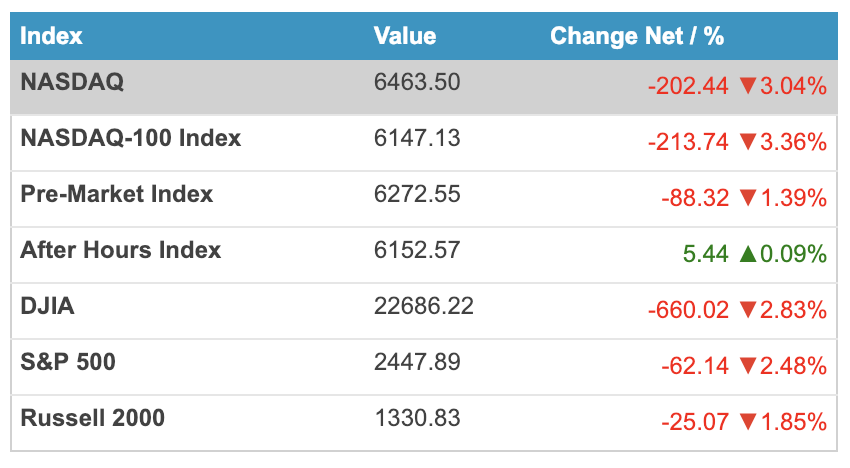
Investors erased some $75 billion in value from Apple alone… an amount known technically as a shit ton of money. But stocks were down broadly based on Apple’s news, with the Nasdaq falling 3 percent, or roughly 202.44 points, and the Dow Jones Industrial Average plummeting 660.02 points, or roughly 2.8 percent.
Apple halted trading of its stock yesterday afternoon to provide lower guidance for upcoming earnings.
Apple’s news from late yesterday that it would miss its earnings estimates by several billion dollars thanks to a collapse of sales in China was the trigger for a broad sell-off that erased gains from the last trading sessions before the New Year (which saw the biggest one-day gain in stocks in recent history).
Apple’s China woes could be attributed to any number of factors, D.A. Davidson senior analyst Tom Forte said. The weakening Chinese economy, patriotic fervor from Chinese consumers or the increasingly solid options available from domestic manufacturers could all be factors.
Sales were suffering in more regions than China, Forte noted. India, Russia, Brazil and Turkey also had slowing sales of new iPhone models, he said.
Investors have more than just weakness from Apple to be concerned about. Chinese manufacturing flipped from growth to contraction in December and analysts in the region expect that the pain will continue through at least the first half of the year.
“We expect a much worse slowdown in the first half, followed by a more serious and aggressive government easing/stimulus centred on deregulating the property market in big cities, and then we might see stabilisation and even a small rebound later this year,” Ting Lu, chief China economist at Nomura in Hong Kong, wrote in a report quoted by the Financial Times.
U.S. manufacturing isn’t doing much better, according to an industrial gauge published by The Institute for Supply Management. The institute’s index dropped to its lowest point in two years.
“There’s just so much uncertainty going on everywhere that businesses are just pausing,” Timothy Fiore, chairman of ISM’s manufacturing survey committee, told Bloomberg. “No matter where you look, you’ve got chaos everywhere. Businesses can’t operate in an environment of chaos. It’s a warning shot that we need to resolve some of these issues.”
The index remains above the threshold of a serious contraction in American industry, but the 5.2-point drop from the previous month in the manufacturing survey is the largest since the financial crisis, and was only exceeded one other time — following the September 11, 2001 terror attacks on the U.S.
Square finds its Sarah Friar replacement with new CFO Amrita Ahuja
Founder and chief executive Jack Dorsey says Square has poached Amrita Ahuja from Blizzard Entertainment, a division of the gaming company Activision Blizzard, to lead finance at the merchant services and mobile payments company.
Ahuja will join Square later this month, about three months after long-time Square chief financial officer Sarah Friar exited the company in favor of a CEO opportunity at Nextdoor, a neighborhood social networking site. Friar, often described as Dorsey’s right-hand woman, joined Square in 2012 and led the startup through an initial public offering that valued the company at about $3 billion.
Prior to an eight-year stint at Blizzard, Ahuja clocked in a few years at Fox Networks Group, the Walt Disney Company and Morgan Stanley, where she was an analyst in the investment banking division.
“In Amrita, we have found an amazing, multidimensional business leader,” Dorsey said in a statement. “Amrita brings the ability to consider and balance opportunities across our entire business, and she will help strengthen our discipline as we invest, build, and scale.”
Shares of Square [NYSE: SQ] dropped more than 8 percent on Thursday.
Political ‘fixer’ Bradley Tusk seeks $70M for Tusk Ventures’ sophomore fund
Longtime political operative Bradley Tusk got his start in Silicon Valley in 2011, when a little-known founder of a transportation startup requested his help surmounting regulatory barriers. That founder, Travis Kalanick, couldn’t afford Tusk’s $25,000 fee, so Tusk agreed to accept half of his payment in equity. As you can imagine, that deal worked out pretty well for Tusk, whose shares in Uber are now said to be worth $100 million.
Tusk (pictured) spent several years advising Uber’s expansion strategy and, in 2015, decided to turn his efforts into a full-fledged business: part venture fund, part political strategy. Today, Tusk and his partner, Jordan Nof, filed paperwork to raise $70 million for their second venture fund, Tusk Venture Partners II.
A spokesperson for Tusk Ventures declined to comment.
The New York-based firm previously brought in $36 million for its debut fund — capital it used to back scooter “unicorn” Bird; medical marijuana delivery company Eaze; the marketplace for household service providers Handy; cryptocurrency exchange Coinbase; and fintech startup Grove.
In addition to deploying capital into startups, Tusk Ventures lends its political expertise to support companies plagued with regulatory barriers and communications issues, as well as help with grassroots organizing, opposition research and partnerships. Bird, of course, is an excellent example of a company that’s struggled with local politics as it has scaled across the U.S. and beyond. The scooter-sharing company was banned from San Francisco after releasing scooters without permits and has upset local leaders in Santa Monica, Los Angeles and more.
“Our diverse team of regulatory and political experts take on entrenched interests and politicians trying to stifle innovation so our companies don’t have to,” the firm writes on its website. “Our unique model provides startups with access to political, investment and operational expertise that is second to none.”
Prior to transitioning into startup advising and investing, Tusk served as campaign manager for Mike Bloomberg, as deputy governor of Illinois and as communications director for Senator Chuck Schumer. He also penned the book, The Fixer: My Adventures Saving Startups from Death by Politics, released last year.
Tusk joined us last week on TechCrunch’s Equity podcast to discuss mobile voting, his thoughts on Uber’s upcoming initial public offering and sky-high valuation and Saudi money in VC. Listen to that episode below.
Hey look, it’s the Samsung Galaxy S10
Well, what have we here? If it isn’t the Samsung Galaxy S10, courtesy of perennial smartphone outer, EVLeaks. This marks one the first good looks we’ve got at the phone, which is likely due out in a couple of months at Mobile World Congress.
It’s a pretty rough photo — the icons are all blurred out and the cropping job isn’t great, likely in an effort to conceal the source. But it’s a pretty decent shot of the front — and hey, we probably have a month and change to go for the thing to start leaking like crazy.
The most interesting bit here is probably the least surprising. After holding off on the notch last generation, Samsung has skipped it over entirely, instead opting for the hole-punch camera design we recently noted would be all the rage in 2019 smartphones. Huawei, notably, already beat Samsung to the proverbial hole-punch late last year with the Nova 4.
Samsung Galaxy S10 "Beyond 1," in the wild. pic.twitter.com/EMquh59Kln
— Evan Blass (@evleaks) January 3, 2019
The “Beyond 1” mentioned here is the working title for the flagship phone. “Beyond 2” will likely be the S10 Plus, while the “Beyond 0” is expected to be a budget version, akin to the iPhone XR.
Another tidbit from the new leak is the phone’s apparent ability to wirelessly charge compatible handsets and perhaps even Samsung wearables. That would put the product in line with another recent Huawei handset, the Mate 20 Pro.
Elon Musk is sticking with SpaceX board member Steve Jurvetson, shows new SEC filing
Several weeks ago, the WSJ reported that SpaceX, Elon Musk’s rocket company, was set to raise $500 million from earlier shareholders and the Scottish money management firm Baillie Gifford & Co. in a bid to help get its internet service business off the ground.
The Hawthorne, Calif. company still hasn’t announced the round, but it nevertheless made things official today, filing with the SEC more details about the fundraise. Though the filing doesn’t confirm Baillie Gifford’s involvement, it does show that the company has secured from 8 investors at least $273.2 million toward a planned $500 million round.
It also, notably, lists the involvement of longtime investor Steve Jurvetson, who has been on the board of both SpaceX and Musk’s car company, Tesla Motors, for 10 and 13 years, respectively. Why it’s worth mentioning: After Jurvetson left DFJ, the venture capital firm he co-founded, in 2017 amid questions about his personal conduct, there was uncertainty around whether he would keep those director positions. Indeed, at the time, a Tesla spokesperson told the outlet Recode that Steve Jurvetson “is on a leave of absence from the SpaceX and Tesla boards pending resolution of these allegations.”
DFJ’s investigation into those allegations led the firm to later apologize for an event hosted at the Half Moon Bay home of Jurvetson, which reportedly featured sex and drug use. Musk, however, who attended the event, suggested that it was far more sedate, telling WIRED at the time, “If there are ‘sex parties’ in Silicon Valley, I haven’t seen or heard of one . . If you want wild parties, you’re in the wrong place. Obviously. That DFJ party was boring and corporate, with zero sex or nudity anywhere.”
Either way, Jurvetson wasted little time in forming a new venture firm, Future Ventures, which has been up and running for 11 months and looks to fund startups in commercial space exploration, deep learning, quantum computing, robotics, AI, blockchain, sustainable transportation, synthetic biology and clean meat.
Now we know that he remains involved in SpaceX, too, even while sources suggest he is still, 13 months later, on leave. (Neither Jurvetson nor SpaceX has responded to requests for comment for this story.)
It’s not so surprising, given that Musk and Jurvetson have enjoyed a long relationship. In fact, because SpaceX remains privately held and Musk holds super-voting shares, he has extra power in corporate decison-making, as Recode noted in a more recent report.
Meanwhile, publicly traded Tesla has also stuck by Jurvetson. Despite changes to the board’s composition that were brought about as part of its settlement with the SEC — late last year, it added new board members Larry Ellison and Kathleen Thompson-Wilson, and Robyn Denholm replaced Musk as chairman — Jurvetson remains a director.
Assuming SpaceX closes its newest round of funding, it will have raised $2.5 billion in equity funding altogether, according to Dow Jones VentureSource.
Other outside directors listed on the new filing include Luke Nosek of Founders Fund; Donald Harrison, a longtime Googler who is currently the company’s president of global partnerships and corporate development; Kimbal Musk, brother to Elon; and Antonio Gracias of Valor Equity Partners.
Kimbal Musk and Gracias, like Jurvetson, also sit on the board of Tesla, much to the chagrin of one prominent shareholder advisory firm that has urged the company to boot them out.
Jeffrey Sonnenfeld, who is Senior Associate Dean for Executive Programs at Yale University’s School of Management, also thinks they should go, calling them “cronies” and characterizing Musk’s refusal to part ways with Jurvetson in particular “irresponsible.”
“It’s some of the bro culture loyalty that Musk defends,” says Sonnenfeld of the fact that Jurvetson remains a director with both companies while remaining on temporary leave.
Not holding any punches, Sonnenfeld further blames for the SEC for not doing even more about Tesla’s board when it tangled with Musk last year. “The SEC didn’t even think of this oddity as a governance concern. The fact that [both companies] have this director on there, who, even if he is completely innocent, has been unable to serve the interests of the company now for 13 months, is just one of the many ways that Musk so artfully outmaneuvered the agency.”
Directors “have to represent all owners of a company,” adds Sonnenfeld. “If Jurvetson and Musk have some personal bond, then Musk could hire him as an advisor or consultant. But he shouldn’t be in an agency role. These aren’t city council meetings.”
According to the WSJ’s earlier report, SpaceX’s new round will be used to finance a new satellite internet service, one whose early designs suggest it could be powered by more than 4,000 satellites orbiting the earth at low altitudes.
Update: Note, an earlier version of this story noted that Jurvetson remains involved in SpaceX but did not report on his continued status on temporary leave.
Synapse raises $6M to bring neural net weapon detection to x-ray machines
With all of the advances made by computer vision tech in the past few years, it might seem a little crazy that so much of the x-ray security equipment being used at sensitive locations is leaning so heavily on human workers to stop weapons from slipping through.
Synapse Technology is creating computer vision tech that can interface with existing x-ray machines through a hardware add-on that doesn’t void the warranty but does add a neural net-powered assistant to lend a second set of eyes to the items being scanned.
The startup has announced the close of a $6 million seed round led by Founders Fund, 8VC and Village Global.
While the company’s largely focused on security checkpoints for “critical infrastructure” sites like government buildings or schools, the company has key interests in getting their tech into airports, another clear market for the tech. Synapse is running a pilot program at Tokyo’s Narita airport and the company says that the scanners are pulling in 14 percent more prohibited items as a result of using their technology.
The startup has helped scan more than 5 million bags to date and is pushing to expand the scope of what they can detect. The company has been performing lab tests to detect 3D-printed weapons with their technology.
“[X-ray machines] are relying on human beings which are just fundamentally limited,” Synapse president Ian Cinnamon told TechCrunch in an interview. “With our software and AI, they can now automatically be detecting weapons with a much higher degree of accuracy.
Synapse’s tech isn’t analyzing luggage to make sure you aren’t packing toiletries over 3 oz. in your carry-on. For now the team’s really focused on detecting the more high-profile threats, such as guns and sharp objects like knives. Beyond improving the quality of life for airport security workers, the company says that their AI tech makes it easier for them to detect objects behind large electronics, meaning that Synapse tech could one day let people leave their laptops in bags without compromising security.
For airports, the list of prohibited items stretches into the dozens, so Synapse isn’t really looking to replace workers but give them fewer things to worry about. “The more that our algorithms take on, the better that humans are able to perform,” Cinnamon tells us.
The startup will be using this funding to get its product into more critical infrastructure locations and ramp up hiring.
Automation will be the end of banks as we know them
Jason C. Brown
Contributor
Contributor
Jason C. Brown is CEO and co-founder of Tally, the world’s first automated debt manager.
The unbundling of the bank has begun.
Just 10 years ago, the average consumer had very few financial relationships and interacted with just one or two institutions to fulfill all of their financial needs. But fintech companies are breaking up the old guard by focusing on specific things that banks have done and simply doing them better. As a result, the average consumer now has numerous financial relationships, each with a clear-cut purpose.
The fintech revolution started after the 2008 financial crisis, and was driven largely out of frustration with the existing establishment. Facing heavy scrutiny, banks pulled back dramatically on a lot of their activities to reduce risk, which left a significant gap in the marketplace. Fintech companies stepped in and brought new ideas to an industry that had seriously lacked innovation. But now that the economy has rebounded, banks are aggressively running straight into that gap to recapture what they lost.
The established banks are focused on copying the best of what fintech has to offer. They’re moving slowly and are a solid five years behind, but their goal is to provide a just-good-enough mobile experience to ensure their customers stay with them. Banks know they don’t need to be better than the fintech companies; their advantages of scale and distribution ensure they can maintain their substantial customer base with a sufficient product.
Those advantages prevent fintech companies from truly competing against banks. If a bank really wants to be in a certain business, it can dominate a fintech company every single day because it has lower cost of funds and can afford to pay more per customer. That makes me generally pessimistic about any fintech company whose only wedge is serving a market that banks don’t serve. Most of those companies will find themselves unable to grow beyond a certain level in the long-term because they will be copied by the establishment.
Thinking about how to stay relevant as a fintech company, the only defensible, long-term strategy is driven by automation.
Automation is the ultimate reduction in friction because it allows optimizations to happen perpetually.
The next 20 years are going to be defined by the way automation transforms the average person’s life. An intelligent service will make, and then execute, most of an individual’s financial decisions in the not-so-distant future. That service will collaborate with the person to understand their human objectives — when they want to retire or where they can afford to send their children to college — and use its super intelligence and its ability to execute things in microseconds over and over to put the entire financial system to work for the person. The individual may not understand how or why the intelligent service is doing all of these things, but he or she knows the actions are completely in the service of improving his or her life.
Imagine a scenario where a person ports their entire financial profile wherever they want it. With the push of a button, all of their accounts are transferred from one place to another, much like porting a phone number.
The cellphone industry, for example, fought very hard to prevent the porting of numbers because not allowing it created stickiness. That stickiness reduced people’s willingness to switch carriers, which allowed the carriers to charge higher prices. In 2003, when the government forced the industry to allow the porting of phone numbers, cellphone plan prices went down. Excess profits evaporated when this friction was eliminated.
Automation is the ultimate reduction in friction because it allows optimizations to happen perpetually. Automation allows optimizations to happen at zero marginal cost. Automation allows optimizations to happen without human involvement, and when you’re able to do that, the customer is always matched with the ideal financial situation.
This is a nightmare scenario for banks: Once automation reduces enough friction in the financial industry, banks lose their relationships with customers. They become a utility; a provider of pipes and wires that allow money to be stored and moved from place to place. Then, specialized fintech companies swoop in and use their data expertise to make decisions for people and execute on those decisions. The end result is an invisible, intelligent service that figures out everything for the customer and does it for them.
In this sense, the power of automation goes beyond an intelligent service’s ability to decide what’s best and take action on behalf of a customer. Automation’s ability to reduce friction allows for a more competitive market, and those actions can create additional wealth for the customer by matching them with the best available product in the marketplace.
Figuring out how to weave intelligent automation into a product experience, a manufacturing process or a product development process is crucial to growth and success for fintech companies. Those that fail to recognize the changing technological landscape run the risk of losing their market share and their position in the marketplace.
3D-printed gun activist Cody Wilson indicted for sexual assault
The State of Texas has indicted Cody Wilson, a 3D-printed gun rights activist who fought to allow makers to post and print guns, of sexual assault after he had sex with a 17-year-old girl. The affidavit noted that he met the girl on a website for finding “sugar daddies.” The indictment, posted on Ars, notes that he faces “four counts of sexual assault of a child, two charges of indecency with a child by contact, and two charges of indecency with a child by exposure.”
The charges are punishable by up to 20 years in prison and a $10,000 fine.
The affidavit on the crime said Wilson used the name Sanjuro on the site and that he paid the 17-year-old $500 for sex. His company, DefenseDistributed, has dumped him as founder.
Wilson is out on $150,000 bond and not yet in jail.
He rose to prominence for supporting 3D-printed guns as far back as 2013, causing a panic that reduced interest in the 3D printing industry and led to a court decision in July that found 3D printed gun plans to be legal.
Cruise and DoorDash to test food delivery using self-driving cars in San Francisco
Cruise is partnering with DoorDash to pilot food and grocery delivery in San Francisco using self-driving vehicles.
The companies announced Thursday that the testing program will begin in early 2019 with an initial focus on the San Francisco market.
“Delivery is a significant opportunity for Cruise as we prepare to commercialize our autonomous vehicle technology and transform transportation,” said Dan Ammann, who became CEO of Cruise late last year. “Partnering with DoorDash will provide us with critical learnings as we further our mission to deliver technology that makes people’s lives better and more convenient.” Cruise co-founder Kyle Vogt stepped down as CEO and now holds the CTO position at the company.
The program will be available to select DoorDash customers, who will be able to receive deliveries from restaurants via a Cruise autonomous vehicle. The partnership will also explore grocery fulfillment via Cruise vehicles for select grocers already partnered with DoorDash.
“We see autonomous vehicles playing a major role in the future of delivery as consumer behaviors continue to shift online, and we are confident Cruise’s leading technology will help us scale to meet growing consumer demand,” DoorDash CEO Tony Xu said in a statement.
The pilot program adds an interesting twist to Cruise’s plans to launch a self-driving ride-hailing service in 2019. The partnership with DoorDash could be viewed as a way for Cruise to perfect its tech and how it can be used in different ways, particularly how it interacts with people.