5 takeaways from BuzzFeed’s SPAC deck

Digital media outfit BuzzFeed announced today that it will go public via a SPAC, or blank check company. BuzzFeed also disclosed that it will purchase Complex, another media company, for $300 million in cash and shares in BuzzFeed itself; the SPAC deal will help finance its purchase of Complex.

The transaction will see BuzzFeed merge with 890 Fifth Avenue Partners Inc., a public company, with the combined entity sporting an enterprise valuation of around $1.5 billion after its completion.

BuzzFeed’s SPAC partner is bringing $288 million in cash to the table, and BuzzFeed intends to raise another $150 million in a convertible debt offering.

In raw numbers, BuzzFeed is a large company with hundreds of millions of dollars in yearly revenue and a roughly break-even business in recent years.

In raw numbers, BuzzFeed is a large company with hundreds of millions of dollars in yearly revenue and a roughly break-even business in recent years. The company’s investor presentation anticipates a return to growth after a mostly flat 2020, and rising profitability over time.

So let’s get into the company’s investor presentation. We want to know about its historical growth, anticipated growth, revenue mix and profitability, as well as how the company thinks about its news division. Let’s go!

I’ve broken each of our points into its own minisection, so if you want to skate ahead to any particular point, feel free!

Historical revenue growth

Why is BuzzFeed buying Complex? In part, because it adds audience scale to its platform, a key to the company’s expected future advertising revenue growth (more on that in a moment). But also because Complex adds a lot of revenue to its overall top-line picture.

For example, in BuzzFeed’s historical revenue figures we see the following numbers:

  • 2019: $425 million.
  • 2020: $421 million.

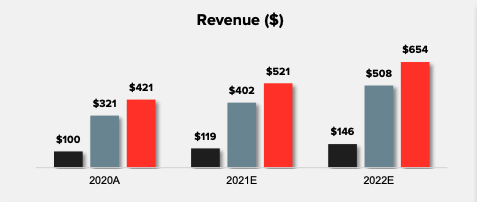
But the company’s historical results are inclusive of Complex. Here’s the breakdown of the company’s historical revenues (gray) and Complex’s own (black). The combined figures are what BuzzFeed notes in its trailing metrics:

Image Credits: BuzzFeed SPAC deck

From this breakdown, we can see that BuzzFeed anticipates 19% growth from Complex in 2021, and just under 23% growth from the group it’s acquiring in 2022.

Per a later slide, BuzzFeed grew 4% in 2019, inclusive of historical Complex numbers. That figure fell to -1% in 2020.

Our read of the company’s historical revenue growth is that it weathered a turbulent 2020 in reasonable health; digital advertising took a huge hit in the first half of the year, likely impacting BuzzFeed’s operating results. To see it manage an essentially flat revenue result last year feels pretty OK.

Future revenue growth

SmartAsset rethinks financial advisory, and becomes a unicorn in the process

SmartAsset, a marketplace that connects consumers to financial advisors, announced today that it has raised $110 million in a Series D round of funding.

The financing values New York-based SmartAsset at over $1 billion, and brings its total raised since its 2012 inception to just over $161 million, according to Crunchbase.

TTV Capital led SmartAsset’s Series D, which also included participation from Javelin Venture Partners, Contour Venture Partners, Citi Ventures, New York Life Ventures, North Bridge Venture Partners and CMFG Ventures.

The company last raised in June of 2018 – a $28 million Series C led by Focus Financial Partners. Since then, it says it has grown revenue “by 10 times” and is now on the cusp of reaching $100 million in ARR (annual recurring revenue). It recently made its one millionth consumer/advisor match on its SmartAdvisor platform. Also in 2020, SmartAsset says it referred $10 billion in new, closed assets under management (AUM) to financial advisors and firms across the U.S.

Besides pairing consumers with advisors with its Automated Financial Modeling software, SmartAsset claims to reach over 100 million people each month through its personal finance content, tools and “personalized” calculators.

Prior to starting the company, Carvin worked in finance. In an interview with Y Combinator (one of its backers), he shared how his frustration in finding information about buying a home and getting a mortgage “that was useful, accurate and unbiased” led him to join forces with Philip Camilleri to found SmartAsset.

“Calculators had obvious errors and the content seemed like it was all written by people that wanted me to take out the largest mortgage possible,” he added. So the pair launched SmartAsset in an effort to provide people with the tools and content to help them make better decisions around topics such as retirement, taxes, savings, homeownership and insurance.

Image Credits: SmartAsset CEO and co-founder Michael Carvin / SmartAsset

The company plans to use the new capital to invest in new product offerings, technology infrastructure and data partnerships. It also plans to boost its current headcount of 202 by more than 75% this year.

TTV Capital Partner Mark Johnson said the company “is quickly expanding its lead in one of the largest markets in the U.S. by providing an incredibly valuable resource for both consumers and financial advisors alike.”

The funding and its flashy valuation comes with a certain weight, even in the growing world of unicorn companies.

The company claims that, with today’s news, co-founder Michael Carvin now becomes the third Black founder and CEO of a company valued at over $1 billion. Others include Compass CEO and founder Robert Reffkin, whom we recently profiled here, and Calendly CEO and founder Tope Awotona, who we have also profiled.

While exciting, the unfortunate rarity of Black-led unicorns is a symptom of historical underfunding in Black or African-American startup founders. Crunchbase estimates that in 2020, 1% of total venture capital funding, or $1 billion, went to this cohort of founders.

“I hope seeing more successful Black founders inspires more people of color to start companies so that one day this is not news,” Carvin told TechCrunch.

A number of Black-led venture capital firms have closed investments in the past year, which could change this number, including Collab Capital’s $50 million investment vehicle, Harlem Capital, which closed a $134 million seed fund earlier this year; Cleo Capital, which set a $20 million target for Fund II; and MaC VC, which landed $103 million for its inaugural fund.

HBCUvc and Google for Startups also announced this month two separate efforts to provide non-dilutive capital to early-stage, underrepresented founders.

With a Series D under its belt, SmartAsset is working on taking out the bias from personal finance – while it itself is a case study in how overlooked founders, which routinely suffer from this exact phenomenon, continue to lead strong businesses.


Companies navigate ethical minefield to build proof of vaccination apps

In the U.S, after you get vaccinated against COVID-19 you are given a small paper card issued by the CDC that is essentially the only evidence that you’ve received your shots. It might seem like a flimsy level of proof, one that you could easily lose, but replacing that paper copy with a digital one has become a political lightning rod in America.

In spite of that, many companies are attempting to attack the problem to produce a viable form of digital proof, sometimes called vaccine passports. For all intents and purposes, what many call a vaccine passport is simply proof you’ve been vaccinated that you can carry on your smartphone, rather than on a card in your wallet.

Some have argued against the digital approach for privacy reasons. Others have claimed it is a civil liberties issue, and some have pointed to equity issues related to not having equal access to appropriate technology or the internet.

That lack of consensus along with the open ethical questions, has led some states, including Florida and Georgia, to ban the use of electronic passport records, at least as far as requiring them to conduct state business or to create a centralized vaccination record-keeping system. In Iowa, the governor signed a law last month that prohibits businesses and the state from requiring any proof to access services, whether the card is physical or digital.

These are just a few examples of the patchwork of state laws and executive orders that has resulted in even more complexity for companies trying to develop products to solve this problem. But not every state is banning digital vaccination records. Earlier this month, California opened a registration system to request a digital record of your vaccination and New York announced a system earlier this year to download proof of vaccination to your smartphone. More on these approaches later.

We spoke to several experts to get their take on moving your vaccine card to the digital world to find out how this could work in spite of the obvious friction.

Practical issues

According to Dr. Shira I. Doron from Tufts Medical Center in Boston, whose specialties include infectious diseases and hospital epidemiology, it’s not as simple a matter as may sound.

For starters she says, states have not kept records in a consistent way. People have been getting vaccinated in all kinds of places from school gyms to pharmacies to stadiums, and it’s not clear if those records have made their way to people’s primary care physicians, assuming they even have one.

“[Vaccine passports could work] if [a system] had been rolled out that way [with central record keeping in mind] from December 15th [when we started vaccinating], but it was not. So, if somebody takes it on to go backwards and issue that kind of proof to people, maybe a system like that could work — and of course there are a lot of people that have taken issue with the ethics of that,” she said.

For her, it comes down to infection rates. As they drop with more people getting vaccinated, it could alleviate the need for any kind of proof at all because we would be safer simply because the infection rate fell below 10%. “I think that more ideally we get down to such a low infection rate and such high rate of vaccination that there is no longer a concern about people walking into a building,” she said.

Putting it in on the blockchain

If the infection rate remains higher than desirable, or certain entities like universities want to require it, how do we offer proof of vaccination beyond the paper card? Some people are pointing to the blockchain, but the approach isn’t without controversy. New York State is using IBM’s blockchain technology for its proof of vaccination called Excelsior Pass, but privacy advocates worry that doing so could expose people’s personal medical information.

The idea with the IBM approach is that you to go to your physician’s healthcare portal or some other place that has your vaccine records, and which has partnered with IBM. The portal will present you with a QR code which you can take a picture of with your phone and store in your phone’s digital wallet. The person then presents the QR code at a venue, which uses a companion scanning application to view it to see proof of vaccination (or a recent negative test). Finally the venue would verify the identity of that person with a secondary form of ID like a driver’s license.

The question then is why use the blockchain at all in this instance. IBM Global VP of Payer and Emerging Business Networks Eric Piscini, says that there are three main reasons. “The first is that the immutability of the blockchain is extremely important, and that’s [a big reason] why we use it. The second piece, which is also very important is the decentralization of that platform so that [all of the vaccine data] is not just in one place. It’s decentralized and managed by different parties. […] The third piece […] is the audit trail, and not just for me as a consumer, but as an [entity] that is trying to verify me,” he explained.

But are those reasons enough to justify its use? Steve Wilson, an analyst at Constellation Research, who specializes in end user privacy thinks the blockchain is an inappropriate technology to use for digital proof of vaccination. “Basically, I don’t see how blockchain adds anything to the digitizing of COVID vaccinations or tests. The purpose of blockchain is to crowd-source agreement on the ordering of some events, and logging that order in a shared record. What problem in vaccination management does that address,” he asked.

An open-source approach to the problem

When California released a digital vaccination record app last week, it went a different route, using an open-source framework called the Smart Health Cards Framework. The framework was developed by an organization called The Commons Project (TCP) along with a broad coalition of health and technology organizations including Oracle, Microsoft, Salesforce, Epic and others.

JP Pollak, co-founder of The Commons Project, Senior Researcher-in-Residence at Cornell Tech, and Assistant Professor at Weill Cornell Medicine, says that since the government has made clear it won’t be compiling vaccine records in a central database, and because the vaccine administration system itself is so fragmented, it’s even more challenging to create digital records. His organization is working to create a solution to that problem.

“What we’re working on at The Commons Project is a steering group called the Vaccination Credential Initiative or VCI. And the purpose of that group is basically to design and advocate for a specification, someday hopefully a standard, that makes it so that all of those disparate issuers of vaccines can issue the same vaccine record in a signed and portable format,” he said.

That comes in the form of a Smart Health Card app that VCI has developed. “The additional layer that we have built is what turns [your vaccine] information into what we’re calling the Smart Health Card. And basically it’s all of the information that goes on your CDC card — so your name, your date of birth, the type of vaccine that you received, the dates of your doses, lot numbers and where you received it. All of those kinds of things get packaged up into this credential, and that credential is then signed by the issuer,” he said.

In addition to California, the state of Louisiana also went live with the The Commons Project solution this week, and Walmart recently announced that anyone that received their vaccine through them is now able to download a digital version of their vaccine record directly to the CommonHealth app (available on Android) or CommonPass app (available on iOS or Android). The company also hinted that other companies that have administered the vaccine would be following Walmart’s lead in the coming weeks and providing access to digital records through the same apps.

The approach doesn’t necessarily solve all of the criticisms around equitable access to technology, privacy or the ethics of being asked to show proof vaccination, but it does provide a means to deliver the information digitally for those that want it in an open way.

Regardless of the method your state chooses, if it indeed chooses any approach at all,  it will come with its own set of pros and cons. The paper CDC card, as Wilson points out, is similar in many ways to the “Yellow Card” vaccination record that people traveling overseas have been carrying for decades, and that has worked fine.

But it seems that in 2021 when approximately half the world’s population owns a smartphone, while two-thirds have some sort of mobile phone, smart or otherwise, it makes sense to make this record available in a digital form. For the many startups and large companies trying to solve that problem, they will have to do more than come up with a clever solution. They will also need to figure out how to convince individuals, businesses and governments that it makes sense to even offer this approach, and that may be the biggest hurdle of all.

 

After raising $10M, Ryte launches ‘Carbon KPI’ to measure the CO2 footprint of web sites

As we become more and more aware of the kind of impact we are having on this planet we call our home, just about everything is having its CO2 impact measured. Who knew, until recently, that streaming Netflix might have a measurable impact on the environment, for instance. But given vast swathes of the internet are populated by websites, as well as streaming services, then they, too, must have some sort of impact.

It transpires that a new service has identified how to gauge that, and now it’s raised venture capital to scale.

Ryte raised €8.5 million ($10 million) in a previously undisclosed round led by Bayern Kapital out of Munich and Octopus Investments out of London earlier this year for its Website User Experience Platform.

It has now launched the ‘Ryte Website Carbon KPI’, which claims to be able to help make 5% of all websites carbon neutral by 2023.

Ryte says it worked with data scientists and environmental experts to develop the ability to accurately measure the carbon impact of clients’ websites. According to carbon transition think tank, the Shift Project, the carbon footprint of our gadgets, the internet, and the systems supporting them account for about 3.7% of global greenhouse emissions. And this trend is rising rapidly as the world digitizes itself, especially post-pandemic.

Ryte has now engaged its data scientist, Katharina Meraner, who has a PhD in climate science and global warming, and input from Climate Partner, to launch this new service.

“There are currently 189 million active websites,” Ryte CEO Andy Bruckschloegl said. “Our goal is to make 5% of all active websites, or 9.5 million websites, climate neutral by the end of 2023 with the help of our platform, strong partners, social media activities, and much more. Time is ticking and making websites carbon neutral is really easy compared to other industries and processes.”

Ryte says it is also collaborating with a reforestation project in San Jose, Nicaragua, to allow its customers to offset their remaining emissions through the purchase of climate certificates.

Using a proprietary algorithm, Ryte says it measures the code of the entire website, average page size, as well as monthly traffic by channel then produces a calculation of the amount of CO2 it uses up.

Admittedly there are similar services, but these are ad-hoc and not connected to a platform. A simple Google search will bring us sites like Websitecarbon, Ecosistant, and academic papers. But as far as I can tell, a startup like this hasn’t put this kind of service into their platform yet.

“Teaming up with Ryte will help raise awareness on how information technology contributes to climate change – while at the same time providing tools to make a difference. Ryte’s industry-leading carbon calculator enables thousands of website owners to understand their carbon footprint, to offset unavoidable carbon emissions and thus lay a basis for a comprehensive climate action strategy,” commented Tristan A. Foerster, Co-CEO ClimatePartner.


Reform your startup’s meeting culture

Chuck Phillips
Contributor

Chuck Phillips is the co-founder of MeetWell, an application that enables teams to achieve a better work-life balance while saving companies money by reducing the amount of bad meetings they attend.

Bad meetings are the fast food of the knowledge worker; it’s so deliciously quick and easy to throw a 60-minute default meeting on everyone’s schedule, but the long-term costs are extremely unhealthy.

Busy meeting organizers drive-thru schedule meetings because they think they don’t have time to plan. They expect good outcomes to come from little preparation, which doesn’t happen. The meetings are being held and progress is stilted.

One way to save everyone significant time (and win lots of friends) would be to just get rid of all meetings, but a well-prepared and well-run session can expedite communication and get a team closer to its goals. Unfortunately, most meetings are lazily planned and poorly run, imprisoning attendees and halting productivity.

So how can you separate the good meetings from the bad?

Measure your meeting waistline

No one measures the impact of their meetings. So the first step is to start keeping meeting metrics so that you can identify the bad meetings on your teams’ calendars.

Every time a recurring meeting is added to a calendar, a kitten dies.

My company has created a calendar assistant that automatically measures and stops bad meetings before they occur, but if you can’t automate the prevention of bad meetings, survey and learn from attendees after the meeting to record and measure them.

Create taxonomies and quantify the types of meetings that are being held — for example: “information sharing,” “brainstorming,” “1:1,” “decision-making,” etc.

After several months (ideally a year) of collecting metrics, you can grade the quality and look for patterns. You will probably find something along these lines:

  • Very few employees decline meetings, even when it’s obvious that the meeting is going to be a doozy.

Check out the expert speakers joining us on Extra Crunch Live in July

What are the most important factors when you’re pitching your startup for fundraising? What questions come to the minds of the VCs you’re pitching? How do you get the deal across the finish line? Or choose the right investors for your company to begin with?

Extra Crunch Live looks to answer all these questions and more. Thus far, Coda’s Shishir Mehrotra and investor S. Somasegar have told us what sings in Coda’s pitch doc (not deck). We’ve heard how important it is to be customer-obsessed from Toast’s Aman Narang and BVP’s Kent Bennett. And Fifth Wall’s Brendan Wallace laid out all the biggest opportunities in prop tech. And that was just in the last month or so.

In July, we have more top-notch speakers on the roster, including big-name founders and seasoned investors. What’s more, these speakers are ready to hear about your startup. ECL features the Extra Crunch Live Pitch-off, where founders in the audience can pitch their products to speakers and get live feedback.

So without any further ado, here is a look at the amazing speakers we have joining us in July.

Jordan Nof (Tusk Venture Partners) + Michelle Davey (Wheel)

July 14 – 12pm PT/3pm ET

Jordan Nof, co-founder and general partner at Tusk Venture Partners, led early investments in companies like Lemonade, Bird and Sunday. He also invested in Wheel, co-founded by Michelle Davey, an infrastructure company focused on virtual care. Join in a conversation with them on Extra Crunch Live about what it takes to raise funding and use it to the greatest effect.

REGISTER FOR TUSK VENTURE PARTNERS AND WHEEL


Extra Crunch Live: Startup Alley Edition w/ Alexa von Tobel

July 21 – 12pm PT/3pm ET

Check out the Startup Alley companies that will exhibit at TechCrunch Disrupt 2021 in an episode dedicated to the art of the pitch.

REGISTER FOR STARTUP ALLEY EDITION


Stephanie Zhan (Sequoia Capital) + Nick Fajt (Rec Room)

July 28 – 12pm PT/3pm ET

Sequoia Capital is one of the biggest names in VC. On this episode of ECL, Sequoia partner Sephanie Zhan and Rec Room CEO Nick Fajt talk about how the two came together for the startup’s seed round, why Zhan also led the Series A, and how it’s gone on to raise nearly $150 million in funding.

REGISTER FOR SEQUOIA CAPITAL AND REC ROOM


As a reminder, Extra Crunch Live is accessible to anyone and everyone who wants to come hang out. However, only Extra Crunch members get access to the content on-demand. If you’re not already an Extra Crunch member, what are you waiting for? 


SPAC charts are exercises in the limits of hype

Having read more SPAC investor decks in the last twelve months than I’d like to admit to, I thought I was over being irked by their bullishness. Call me conservative, but public companies shouldn’t be full of shit, and companies going public should probably aim for a similar target.

That’s why S-1 filings for traditional IPOs are great. When it comes to numbers, they are honest. The filings don’t include forecasts for the next year, let alone the next half decade. Sure, companies will make a pitch for their model and methods, but S-1 filings are pretty good from an honesty perspective. Mostly.

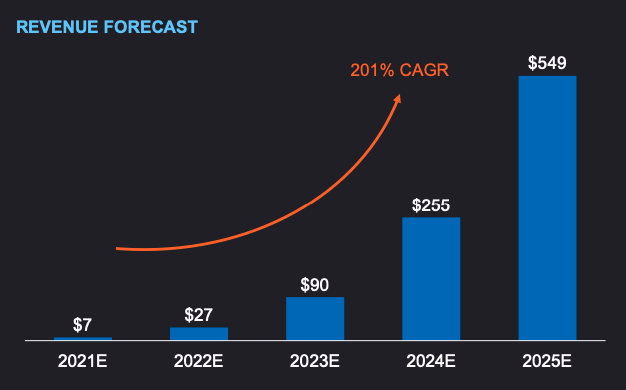
SPAC investor decks are the opposite. I mean, look at this chart:

Historical revenue? Who needs it! Look at the growth that could maybe, possibly, theoretically happen! 201% CAGR!

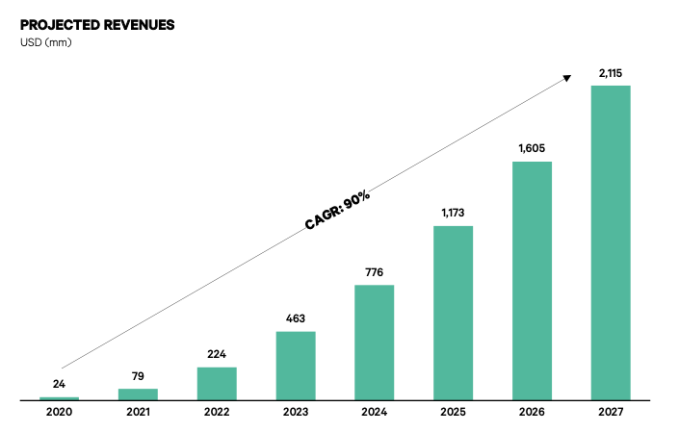
Here’s another favorite:

Sure, Bob.

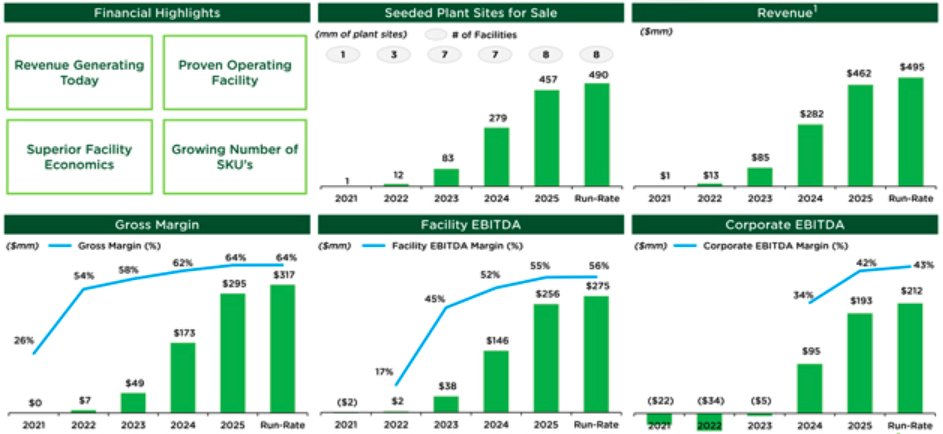
Here’s a super-grainy image from the Local Bounti SPAC investor deck. It’s the least-blurry version I could find. Enjoy the charts!

I’m going to change the numbers on these, label them “Alex’s future blogging output” and turn them in before my next performance review.

Here’s another great one, this time from Pear Therapeutics:

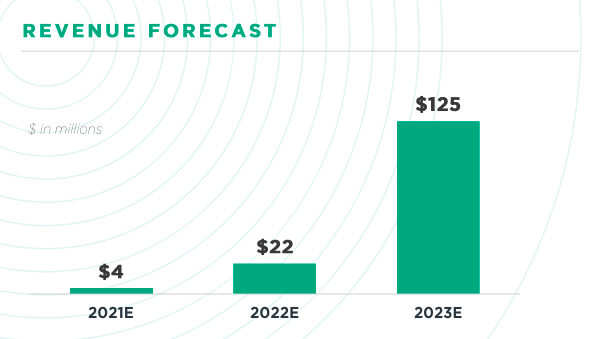
And one more, this time from the recent Embark deal that TechCrunch covered here:

What about historical revenues? Or expectations from 2021, 2022 or 2023? Who knows!

Given what we’ve learned about the accuracy of SPAC performance predictions, I think we need a Godzilla-sized Salt Bae to make all of this palatable.


Tesla backs vision-only approach to autonomy using powerful supercomputer

Tesla CEO Elon Musk has been teasing a neural network training computer called ‘Dojo’ since at least 2019. Musk says Dojo will be able to process vast amounts of video data to achieve vision-only autonomous driving. While Dojo itself is still in development, Tesla today revealed a new supercomputer that will serve as a development prototype version of what Dojo will ultimately offer. 

At the 2021 Conference on Computer Vision and Pattern Recognition on Monday, Tesla’s head of AI, Andrej Karpathy, revealed the company’s new supercomputer that allows the automaker to ditch radar and lidar sensors on self-driving cars in favor of high-quality optical cameras. During his workshop on autonomous driving, Karpathy explained that to get a computer to respond to new environment in a way that a human can requires an immense dataset, and a massively powerful supercomputer to train the company’s neural net-based autonomous driving technology using that data set. Hence the development of these predecessors to Dojo.

Tesla’s newest-generation supercomputer has 10 petabytes of “hot tier” NVME storage and runs at 1.6 terrabytes per second, according to Karpathy. With 1.8 EFLOPS, he said it might be the fifth most powerful supercomputer in the world, but he conceded later that his team has not yet run the specific benchmark necessary to enter the TOP500 Supercomputing rankings.

“That said, if you take the total number of FLOPS it would indeed place somewhere around the fifth spot,” Karpathy told TechCrunch. “The fifth spot is currently occupied by NVIDIA with their Selene cluster, which has a very comparable architecture and similar number of GPUs (4480 vs ours 5760, so a bit less).”

Musk has been advocating for a vision-only approach to autonomy for some time, in large part because cameras are faster than radar or lidar. As of May, Tesla Model Y and Model 3 vehicles in North America are being built without radar, relying on cameras and machine learning to support its advanced driver assistance system and autopilot. 

When radar and vision disagree, which one do you believe? Vision has much more precision, so better to double down on vision than do sensor fusion.

— Elon Musk (@elonmusk) April 10, 2021

Many autonomous driving companies use lidar and high definition maps, which means they require incredibly detailed maps of the places where they’re operating, including all road lanes and how they connect, traffic lights and more. 

“The approach we take is vision-based, primarily using neural networks that can in principle function anywhere on earth,” said Karpathy in his workshop. 

Replacing a “meat computer,” or rather,  a human, with a silicon computer results in lower latencies (better reaction time), 360 degree situational awareness and a fully attentive driver that never checks their Instagram, said Karpathy.

Karpathy shared some scenarios of how Tesla’s supercomputer employs computer vision to correct bad driver behavior, including an emergency braking scenario in which the computer’s object detection kicks in to save a pedestrian from being hit, and traffic control warning that can identify a yellow light in the distance and send an alert to a driver that hasn’t yet started to slow down.

Tesla vehicles have also already proven a feature called pedal misapplication mitigation, in which the car identifies pedestrians in its path, or even a lack of a driving path, and responds to the driver accidentally stepping on the gas instead of braking, potentially saving pedestrians in front of the vehicle or preventing the driver from accelerating into a river.

Tesla’s supercomputer collects video from eight cameras that surround the vehicle at 36 frames per second, which provides insane amounts of information about the environment surrounding the car, Karpathy explained.

While the vision-only approach is more scalable than collecting, building and maintaining high definition maps everywhere in the world, it’s also much more of a challenge, because the neural networks doing the object detection and handling the driving have to be able to collect and process vast quantities of data at speeds that match the depth and velocity recognition capabilities of a human.

Karpathy says after years of research, he believes it can be done by treating the challenge as a supervised learning problem. Engineers testing the tech found they could drive around sparsely populated areas with zero interventions, said Karpathy, but “definitely struggle a lot more in very adversarial environments like San Francisco.” For the system to truly work well and mitigate the need for things like high-definition maps and additional sensors, it’ll have to get much better at dealing with densely populated areas.

One of the Tesla AI team game changers has been auto-labeling, through which it can automatically label things like roadway hazards and other objects from millions of videos capture by vehicles on Tesla camera. Large AI datasets have often required a lot of manual labelling, which is time-consuming, especially when trying to arrive at the kind of cleanly-labelled data set required to make a supervised learning system on a neural network work well.

With this latest supercomputer, Tesla has accumulated 1 million videos of around 10 seconds each and labeled 6 billion objects with depth, velocity and acceleration. All of this takes up a whopping 1.5 petabytes of storage. That seems like a massive amount, but it’ll take a lot more before the company can achieve the kind of reliability it requires out of an automated driving system that relies on vision systems alone, hence the need to continue developing ever more powerful supercomputers in Tesla’s pursuit of more advanced AI.

Fintech veteran Jitendra Gupta is ready for his new inning — now he is going after banks in India

For most people in India, having to engage with banks doesn’t instill a sense of joy. Banks in the South Asian market are notorious for making unannounced spam calls to upsell customers loans and credit cards, even when they have been explicitly asked not to do so.

Moreover, when a customer does reach out to a bank with a query, it can take forever to get the job done. Take ICICI Bank, India’s third largest bank and until recently my only banking partner for over six years, for an example.

It is now in its third month in figuring out who exactly in its relationship with Amazon is supposed to re-issue me a credit card. I have moved on with my life, and it looks like they did, too, likely before they even looked at my query.

Small and medium-sized businesses aren’t a big fan of banks, either. If you operate an early-stage startup, it’s anyone’s guess if you will ever be able to convince a bank to issue you a corporate account. So of course, startups — Razorpay and Open — took it upon themselves to fix this experience.

For consumers, too, in recent years, scores of startups have arrived on the scene to improve this banking experience. Whether you are a teenager, or just out of college, or a working professional, or don’t have a credit score, there are firms that can get you a credit card and loan.

But even these services have a ceiling limit of some sort. And customers aren’t loyal to any startup.

“A customer’s relationship is always with the entity where they park their savings deposit,” said Jitendra Gupta, a high-profile entrepreneur who has spent a decade in the fintech world. Since these customers are not parking their money with fintech, “the startups have been unable to disrupt the bank. That’s the hard reality.”

So what’s the alternative? Gupta, who co-founded CitrusPay (sold to Naspers’ PayU) and served as managing director of PayU, has been thinking about these challenges for more than two years.

“If you really want to change the banking industry, you cannot operate from the side. You have to fight from the centre, where they deposit their money. It’s a very time-consuming process and requires a lot of initial capital and experience with banks,” he told TechCrunch in an interview.

After more than a year and a half of raising about $24 million — from Sequoia Capital India, 3one4 Capital, Amrish Rau, Kunal Shah, Kunal Bahl, Tanglin Venture Partners, Rainmatter and others — Gupta is ready to launch what he believes will address a lot of the issues individuals face with their banks.

His new startup, called Jupiter, wants to bring “delight” to the banking experience, and it will launch in India on Thursday.

“We believe that a bank account should be a smart account, where it gives you insight, shares personalized tips and guides you through attaining some financial discipline,” he said.

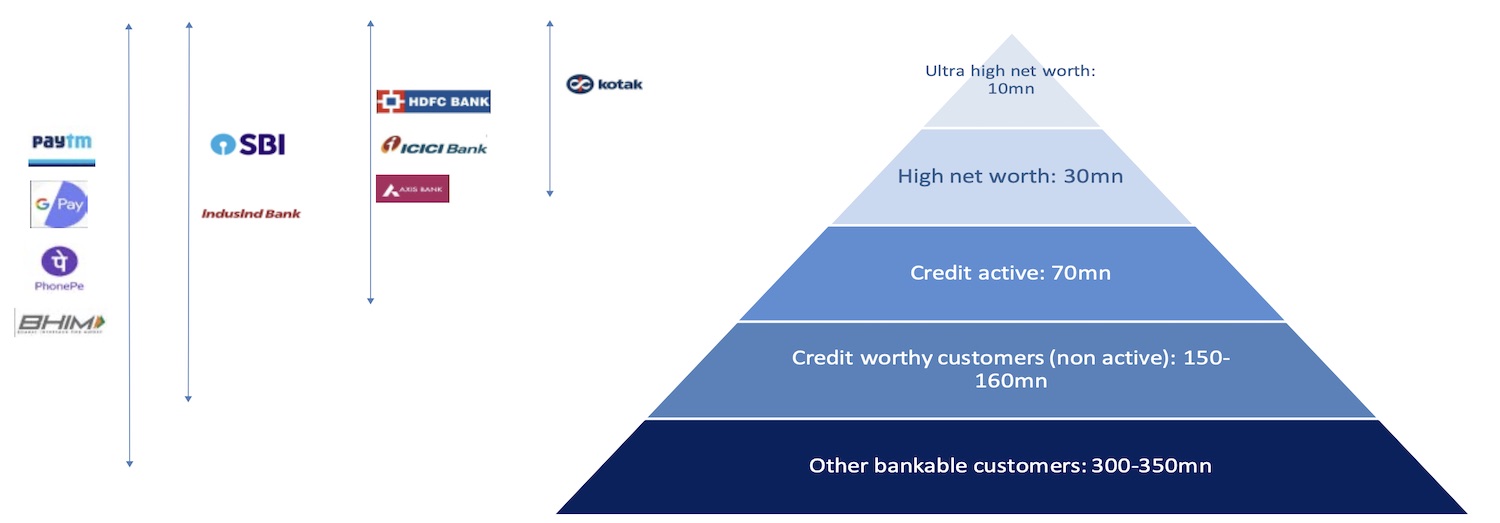
A snapshot of the reach of banks and fintech startups in India. Data: CIBIL, Statista, BofA Global Research. Image: BofA

To be sure, Jupiter, too, will offer loans and other financial services to customers. But instead of making irrelevant calls to customers, it will assess which of its customers are running short on money and give the option to take a credit line from its app itself, he said. “The upsell doesn’t need to happen by way of spam. It needs to happen by way of contextualization and personalization.”

“Jupiter has been built in a deep integration with the underlying bank, allowing the consumer to have a frictionless experience for all their banking needs,” said Amrish Rau, chief executive of Pine Labs, co-founder of CitrusPay and longtime friend of Gupta.

The startup, which employs 115 people, has developed a number of products for customers joining on day one. The products include the ability to buy now and pay later on UPI, a feature first offered in the market by Jupiter, and a mutual fund portfolio analyzer. A debit card, in-app chat with a customer service agent, expense categorisation, finding the right card, determining the existing health insurance coverage, and more are ready to ship, the startup said.

Jupiter is currently working on providing zero mark-up on forex transactions, and frictionless two-factor authentication. The startup has published a public Trello page where it has outlined the features it is working on and when it expects to ship them, as well as features suggested by its beta-testing customers. “I want to establish full transparency in what we are working on to build trust with customers,” said Gupta.

Jupiter will have its own customer relationship team that will engage with the startup’s users. The startup, which last month opened a waiting list for customers to sign up, had amassed more than 25,000 applications as of two weeks ago.

Even Jupiter, which one day wishes to disrupt the banking sector, currently has to partner with banks. Its partners are Federal Bank and Axis Bank.

I asked Gupta about the excitement his investors see in Jupiter. “Everyone believes, as you see with fintech giants such as Nubank globally, that we will become a full bank,” he said.

But for the time being, Gupta said he is not looking to partner with more banks. “I don’t want Jupiter to attract customers because they want to bank with Federal or Axis. I want them to come to Jupiter because they want to bank with Jupiter,” he said.

In the next 12 months, the startup hopes to serve more than 1 million customers.

Clubhouse is building a DM text chat feature

Some Clubhouse users were treated to a surprise feature in their favorite app, but it wasn’t long for this world. A new UI element called “backchannel” popped up briefly before disappearing late last week, pointing the Clubhouse faithful to a new area of the app and generating plenty of chatter among users ready for more ways to connect.

Wow looks like accidental update of @clubhouse enabled in app backchannel & switch of side bar & full experience.

Seems it’s rolled back now but from what I saw it was beautiful!!

On stage > move to hallway > hit arrow > back channel popped up! @jowyang @GaryLHenderson pic.twitter.com/5bJfVlg7t5

— Brian Fanzo ? Keynote Speaker $ADHD (@iSocialFanz) June 18, 2021

While the backchannel screen was totally blank without so much as a text entry box, it looks like the company is working on building out the text chat feature that Clubhouse CEO Paul Davison previously discussed in a company town hall.

“…. I think that there are so many people who do DM backchannels all the time, so many people who want to deepen friendships and relationships with people and do all sorts of other stuff — I think this is something that we should have,” Davison said.

Here's a comment where @pdavison mentions the need for a backchannel of sorts (where people can DM each other) for @Clubhouse during a recent town hall.

/via @_SimonLau cc @morqon @BryanMenegus pic.twitter.com/qTwTDN6GZU

— Chris Messina (@chrismessina) June 21, 2021

The Clubhouse co-founder went on to say that building the feature to suit the app’s use cases won’t be trivial and wouldn’t be happening right away. He also declined to elaborate on if the app would add traditional one-on-one DMs or a more open group text chat feature.

When reached for comment, Clubhouse didn’t dissuade TechCrunch from the assumption that a messaging feature is around the corner, but issued a coy statement.

“As part of our product building process, Clubhouse regularly explores and tests potential features,” a Clubhouse spokesperson told TechCrunch. “These functions sometimes become part of the app, sometimes they don’t.”

Spotify’s new Clubhouse copycat app Greenroom offers its own live text chatroom that users can access by swiping right in the app, giving it a bit of flexibility that Clubhouse has yet to offer. From the looks of the Clubhouse backchannel feature, it also lives in a window accessed through swiping, though that’s obviously subject to change.

Mobile commerce startup Via rounds up $15 million in Series A funding

Mobile commerce is where it’s at, and rising investment in so-called conversational commerce startups underscores the opportunity.

Via, a two-year-old, Bay Area-based startup, is among those riding the wave, having identified some trends that are becoming clearer by the month. First, more e-commerce sales will be on mobile phones this year than desktops (as much as 70% by some estimates), people tend to read text messages almost immediately, and consumers spend upwards of 30 minutes a day engaging with mobile messaging apps.

Via also insists that unlike an expanding pool of startups that are focused on helping retailers and others broadcast their marketing messages in SMS, there’s room for a player to better address the many other pieces that add up to a happy consumer experience, from delivering coupon codes to starting the returns process.

Indeed, according to co-founder and CEO Tejas Konduru — a Brigham Young grad whose parents immigrated to the U.S. from India and who have themselves worked at tech startups — one insight his now 50-person company had early on was that despite that so many of their customers now use the mobile browser to visit and shop from their stores, many retailers use website builders like Shopify or BigCommerce to “cram everything everything into mobile, leaving only enough space for, like, one picture and a Buy button.” Konduru figured there must be a way to take the shopping experience that all these customers have with brands on their website and make them happen in a quick, mobile-native way.

Via’s solution, he says, is to help those businesses interact with customers on the devices and apps they use most often. “When someone uses Shopify or BigCommerce or any of those platforms,” says Konduru, “we also connect it to Via, and it basically takes the entire shopping experience and allows [customers] to quickly swipe right through a menu or like through a catalog on, for example, Facebook Messenger. Via will also create like a native iOS Android app by taking a website, cloning it into a native iOS Android app, then sell the push notification in-app chat layer. Essentially,” he adds, “anytime someone shops on the phone and they’re not using the browser is what Via is handling.”

The “message” seems to be getting through to the right people. Via, which launched last year, says it now employs 54 people on a full-time basis, has 190 brands as customers and just secured $15 million in Series A funding led by Footwork, the new venture firm co-founded by former Stitch Fix COO Mike Smith and former Shasta Ventures investor Nikhil Basu Trivedi.

Other participants in the round include Peterson Ventures, where Konduru once interned; famed founder Josh James of Domo, where Konduru also once interned; and a long list of other notable individual investors, including Ryan Smith of Qualtrics and Lattice co-founder and CEO Jack Altman.

As for how the company charges, it doesn’t ask for a monthly or yearly fee, as per traditional SaaS companies, but instead charges per interaction, whether that’s an SMS or a voice minute or video or a GIF.

It’s starting to add up, according to Konduru, who says that Via’s average customer is seeing 15 times return on its investment and that from May of 2020 — when the company’s service went live — through December, the company generated $51 million in sales. Konduru declined to say exactly how much Via saw from those transactions, but says the company is on track to reach $10 million in annual recurring revenue this year.

As for how brands get started with Via, it’s pretty simple, by the company’s telling. As long as a company is using a commerce platform — from Shopfiy to WooCommerce to Salesforce — it takes just five minutes or so to produce a mobile app with a menu featuring the types of interactions the brand can enable via Via’s platform, says Konduru.

Konduru, who dabbled in investment banking before deciding to launch Via, says he isn’t surprised by the startup’s fast traction, though he says he has been taken aback by the breadth of conversations the company sees. While he imagined Via would be a strong marketing channel for brands that use the platform to push out notifications about abandoned shopping carts and upcoming deliveries, it’s more of a two-way street than he’d imagined.

“Every month, there are maybe 15,000 people who start the returns process through Via and will get a notification from a channel that Via supports. But suddenly — let’s say the customer gets the wrong T-shirt size — people start communicating with the brand. You see everything from fan appreciation to address changes to messaging about bad discount codes to where’s-my-order type exchanges. That’s something I didn’t expect,” says Konduru, who says that before raising its Series A round, Via raised $4.2 million in seed funding led by Peterson Ventures.

“I thought that people would just look at the notification and, like, move it into the abyss somewhere. Instead, people start interacting with the brand.”