The NYT gets into voice with 5 new Alexa skills, including a daily briefing, quiz and more

The New York Times is expanding its efforts around audio programming and voice assistants, the company announced today. The NYT says it’s launching a daily flash briefing for Alexa devices, as well as an interactive news quiz, and — in an interesting twist — it will be introducing “enhanced coverage” in its Sunday paper that prompts readers to launch dedicated Alexa skills to learn more about the stories they’re reading.

On weekdays, the Times will offer a short news briefing for Alexa devices that’s hosted by Michael Barbaro of The NYT’s popular podcast, “The Daily.” Listeners can enable the Alexa skill, then ask to hear the top stories by saying “Alexa, what’s my Flash Briefing,” or “Alexa, what’s in the news?,” for example.

For now, the flash briefing consists of the last portion of “The Daily,” where Barbaro says “Here’s what else you need to know today.” Over time, the company plans to expand upon that with new stories and sound bites.

Also new today is a daily news quiz, created by “The Daily’s” producers. This will be available on Fridays, and is triggered by saying “Alexa, play The New York Times News Quiz.”

The quiz will ask questions that listeners answer to then be told if they are right or wrong. The skill will provide additional context, as well.

While daily briefing skills and quizzes are among the most popular types of Alexa skills today, the way the paper is experimenting with its Sunday paper contest is interesting.

Skill discovery is still a huge challenge on voice assistants. And even when you enable a skill, you may forget to use it or not remember what it’s called, if it’s not something you launch regularly.

The NYT’s solution is to add Alexa prompts to its printed edition of the Sunday paper, for select sections including travel, music and books.

Starting this weekend, a special section will feature Travel’s annual list of 52 Places to Go. Readers can choose to listen to the Times’s new “Traveler” writer Sebastian Modak, as he visits all the places on the list, by saying, “Alexa, open the 52 Places Traveler.”

In addition, a command to “open The Pop Music Roundup” will offer a voice round-up from Times pop music editor Caryn Ganz, while saying “Alexa, get book recommendations from The New York Times” will trigger Alexa to tell you what the paper’s book critics are reading and recommend.

All three of these Alexa skills will continue beyond this weekend and will include fresh content.

“We’ve only just begun to explore the ways that voice technology can bring Times journalism to our audience, where and how they want it,” said Monica Drake, assistant managing editor, The New York Times, in a statement about the Alexa skills. “This project is a great starting point in this effort as we begin to experiment the ways voice can work in conjunction with stayed mediums like print while also exploring native Times experiences like the flash briefing and interactive news quiz, built specifically for voice services,” she added.

The NYT already offered some of its news through Alexa and other voice assistants prior to today, as its podcast “The Daily” has been available across platforms. But this is the first time it has rolled out dedicated Alexa skills like this.
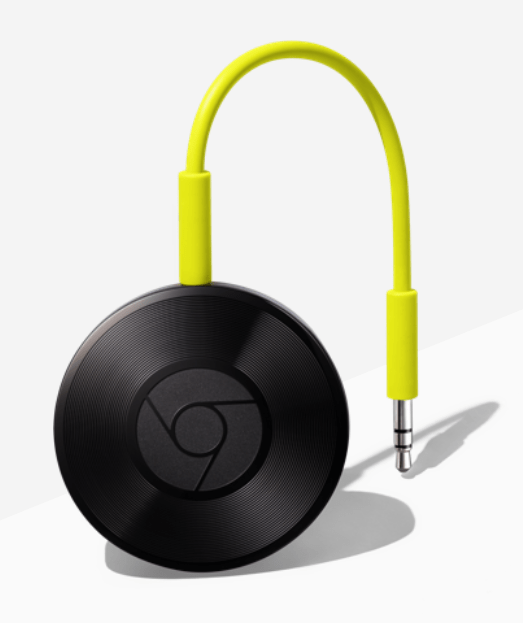
Google cans the Chromecast Audio

The Chromecast Audio is no more. Google has decided to stop manufacturing the audio dongle that allowed you to add any “dumb” speaker to your Google Cast setup. If you still want one, you’ll have to hurry — and to entice you to buy a discontinued product, Google is now selling its remaining inventory for $15 instead of $35.

“Our product portfolio continues to evolve, and now we have a variety of products for users to enjoy audio,” Google told us in a statement. “We have therefore stopped manufacturing our Chromecast Audio products. We will continue to offer assistance for Chromecast Audio devices, so users can continue to enjoy their music, podcasts and more.”
While the Chromecast turned out to be a major hit for Google, the Chromecast Audio was always more of a niche product.

Google is clearly more interested in getting people to buy its Google Home products and Assistant- or Cast-enabled speakers from its partners. It’s also worth noting that all Google Home devices can connect to Bluetooth-enabled speakers, though plenty of people surely have a nice speaker setup at home that doesn’t have built-in Bluetooth support. “Bluetooth adapters suck,” Google told us at the time, though at this point, it seems a Bluetooth adapter may just be the way to go.

The Chromecast Audio first launched back in 2015, in conjunction with the second-generation Chromecast. Over the years, the Chromecast Audio received numerous updates that enabled features like multi-room support. Google says it’ll continue to support Chromecast Audio users for the time being, so if you have already invested in this ecosystem, you should be set for a few more years.

Netflix faces $25 million lawsuit over ‘Black Mirror: Bandersnatch’

If you watched Netflix’s latest “Black Mirror” production, there’s no doubt it reminded you of the “Choose Your Own Adventure” books. Now, the publisher that owns the trademark to “Choose Your Own Adventure,” Chooseco, LLC, is suing Netflix. The publisher is alleging trademark infringement, The Hollywood Reporter first reported.

In the complaint, Chooseco says Netflix “used the mark willfully and intentionally to capitalize on viewers’ nostalgia for the original book series from the 1980s and 1990s. The film’s dark and, at times, disturbing content dilutes the goodwill for and positive associations with Chooseco’s mark and tarnishes its products.”

In one scene, the main character explains to his dad that his video game, “Bandersnatch,” is based on the fictional “Choose Your Own Adventure” book.

20th Century Fox, according to Chooseco, has an options contract to develop a series based on the publisher’s books. Netflix, on the other hand, pursued a license beginning in 2016 but did not receive one, the suit says. Chooseco alleges it also sent Netflix a cease-and-desist letter before the release of “Bandersnatch.”

Chooseco is seeking at least $25 million or Netflix’s profits from the film, whichever amount is the greatest, for Netflix’s alleged trademark infringement, false designation of origin, unfair competition and trademark dilution.

Netflix declined to comment for this story.

Square loses another key executive as Mary Kay Bowman joins Visa

Square’s management continues to shuffle. One week after the merchant services and mobile payments company tapped Amrita Ahuja to lead finance, replacing long-time executive Sarah Friar who landed the chief executive role at Nextdoor, the company’s head of payments, Mary Kay Bowman, has joined Visa as its head of seller solutions.

The company will promote someone internally to fill the position, according to a source familiar with the matter.

Bowman joined Square in 2015 after more than a decade at Amazon, most recently as the e-commerce giant’s director of global payments. In her new role, Visa says Bowman will lead the credit card company’s “strategy for acceptance products and solutions, driving the design, development and delivery of new services and solutions that will transform the payment experience for both sellers and consumers.”

“This is a critical role, as the point of sale is undergoing dramatic change as it shifts from traditional payment acceptance to digital, cross-channel payment experiences,” Visa wrote in a company announcement released Friday morning.

Gartner finds PC sales doldrums continued in 2018

Gartner has released its quarterly PC sales survey for the fourth quarter of 2018, and it was the same old story. PC sales plunged in the fourth quarter and were down 1.3 percent for the year. The three top players — HP, Dell and Lenovo — accounted for 63 percent of sales worldwide in the quarter.

The company found in their preliminary sales research that worldwide sales totaled 68.6 million units in the fourth quarter. That may sound like a big number, but it’s down 4.3 percent over the same period last year.

Gartner principal analyst Mikako Kitagawa said after a couple of quarters of modest growth, the market began to slow down again for a number of reasons, including political and economic uncertainty and a CPU shortage. “There was even uncertainty in the U.S. — where the overall economy has been strong — among vulnerable buyer groups, such as small and midsize businesses (SMBs). Consumer demand remained weak in the holiday season. Holiday sales are no longer a major factor driving consumer demand for PCs,” she said in a statement.

That could be because consumers are spending much more time on mobile phones. Many tasks, whether shopping, email, banking or social media, that once required a home PC can easily be done on a mobile phone now, leaving PCs to the realm of business, where it isn’t always practical to do work on a smaller footprint. In fact, Black Friday online shopping totaled $6.1 billion this year, with mobile phones accounting for $2.1 billion.

The trade war that has adversely affected Apple and other tech companies probably also had an impact on the PC market.

Lenovo was the biggest winner in the worldwide report, achieving 24.2 percent of market share with number of units sold up 5.9 percent from last year. HP had 22.4 percent market share, but its numbers were down -4.4 percent. Dell came in third with 15.9 percent with market share, up a modest 1.4 percent.

Chart: Courtesy of Gartner

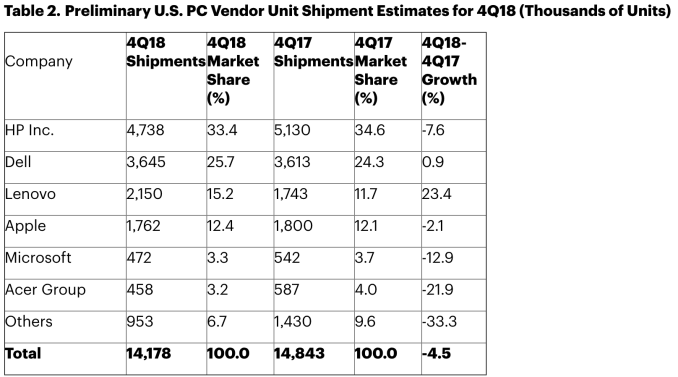
In the U.S., sales were even worse, down 4.5 percent, as small business buyers stayed away in the quarter. “The fourth quarter is typically a buying season for small office/home office (SOHO) and small business buyers in the U.S. as they want to use up the untouched budget before the tax year ends,” Kitagawa explained in the report. Unfortunately, they didn’t seem to do that this year.

Chart: Courtesy of Gartner

The top three vendors in U.S. sales were HP with 33.4 percent market share, growth down -7.6 percent; Dell with 25.7 percent, growth up 0.9 percent and Lenovo with 15.2 percent, growth up a whopping 23.4 percent for the quarter, making it the big winner in the U.S. market in terms of sales growth.

In case you’re wondering, Apple, which was forced to issue new guidance for Q12019 earnings last week due to lower iPhone sales, also had softer PC sales last quarter, with numbers down 2.1 percent in the U.S. and 3.8 percent worldwide. Gartner found that Apple PCs account for 12.4 percent of market share in the U.S. and 7.2 percent worldwide.

The report is based on data from sales of desktop PCs, notebooks and devices such as the Microsoft Surface, but excludes Chromebooks and iPads. Gartner is careful to point out these are preliminary numbers and they could change once the final data is in.

Elon Musk shows off the assembled Starship test rocket

After weeks of teasing renderings and production photos, Elon Musk finally showed off the finished Starship test rocket last night.

Starship test flight rocket just finished assembly at the @SpaceX Texas launch site. This is an actual picture, not a rendering. pic.twitter.com/k1HkueoXaz

Elon Musk (@elonmusk) January 11, 2019

As you can well see, the Starship test rocket has a stainless steel skin, which had a few people scratching their heads. Steel is indeed quite durable, but weighs more than other materials used in rockets, like carbon fiber, aluminum and titanium. Musk argues, however, that stainless steel’s resistance to extreme temperature, especially heat, makes it a better fit for this type of rocket.

The Starship rocket, previously called the BFR, is an integral piece of the SpaceX road map. It’s meant to take the place of the Falcon and Falcon Heavy rockets as a primary launch vehicle, which means lots of re-entry (which means lots of heat).

This test model, currently at the Boca Chica, Texas launch site, is meant for suborbital VTOL tests, which will take place in March. The orbital version will be taller, with thicker skins, and a more smoothly curving nose section, with launches on the books for 2020.

SpaceX first Starship hopper under Texas Boca Chica Beach’s cloudy sky.@elonmusk #Starship #SpaceX pic.twitter.com/hVg5Ken7Vp

— Evelyn Janeidy Arevalo (@JaneidyEve) January 10, 2019