An explosive new report from Buzzfeed News makes the impeachment of Donald Trump not just possible, but likely.
Category: Tech news
hacking,system security,protection against hackers,tech-news,gadgets,gaming
Microsoft is calling an audible on smart speakers
The Harman Kardon Invoke was fine. But let’s be real — the first Cortana smart speaker was dead on arrival. Microsoft’s smart assistant has its strong suits, but thus far statement of purpose hasn’t been among them. CEO Satya Nadella appears to have acknowledged as much this week during a media event at the company’s Redmond campus.
“Defeat” might be a strong word at this stage, but the executive is publicly acknowledging that the company needs to go back to the drawing board. In its current configuration, the best Microsoft can seemingly hope for with Cortana is a slow ramp up after a greatly delayed start. For all of the company’s recent successes, the gulf between its offering and Alexa, Assistant and (to a lesser degree) Siri must seem utterly insurmountable.
The new vision for Cortana is an AI offering that works in tandem with products that have previously been considered its chief competitors. That’s in line with recent moves. Over the summer, Microsoft and Amazon unveiled integration between the two assistants. Nadella used this week’s event to both reaffirm plans to work with Alexa and Google Assistant and note that past categories probably don’t make sense, going forward.
“We are very mindful of the categories we enter where we can do something unique,” he told the crowd. “A good one is speakers. To me the challenge is, exactly what would we be able to do in that category that is going to be unique?”
It’s a fair question. And the answer, thus far, is nothing. Like Samsung’s Bixby offerings, the primary distinguisher has been the devices on which it has chosen to roll out — appliances for Bixby and PCs for Microsoft. And while moves by Apple, Amazon and Google have all been acknowledgements that desktops and laptops may play an important role in the growth of smart assistants moving forward, they were hardly a major driver early on.
I suspect this will also mean the company will invest less in pushing Cortana as a consumer-facing product for the time being, instead focusing on the ways it can help other more popular assistants play nicely with the Microsoft ecosystem.
Pharma Spending on Doctors Is Correlated With Opioid Deaths
A new study shows that doctors wrote more prescriptions, and more people overdosed on opioids, in counties where drug companies spent more money.
Privacy campaigner Schrems slaps Amazon, Apple, Netflix, others with GDPR data access complaints
European privacy campaigner Max Schrems has filed a fresh batch of strategic complaints at tech giants, including Amazon, Apple, Netflix, Spotify and YouTube.
The complaints, filed via his nonprofit privacy and digital rights organization, noyb, relate to how the services respond to data access requests, per regional data protection rules.
Article 15 of Europe’s General Data Protection Regulation (GDPR) provides for a right of access by the data subject to information held on them.
The complaints contend tech firms are structurally violating this right — having built automated systems to respond to data access requests which, after being tested by noyb, failed to provide the user with all the relevant information to which they are legally entitled.
Indeed, noyb tested eight companies in all, in eight different countries in Europe, and says it found none of the services provided a satisfactory response. It’s filed formal complaints with the Austrian Data Protection Authority against the eight, which also include music and podcast platform SoundCloud; sports streaming service DAZN; and video on-demand platform Flimmit .
The complaints have been filed on behalf of 10 users, per Article 80 of the GDPR, which enables data subjects to be represented by a nonprofit association such as noyb.
Here’s its breakdown of the responses its tests received — including the maximum potential penalty each could be on the hook for if the complaints stand up:
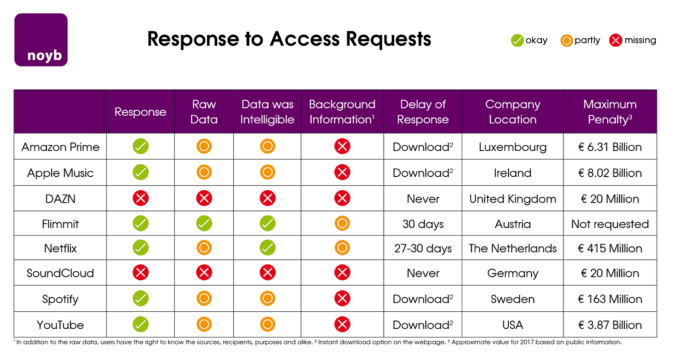
Two of the companies, DAZN and SoundCloud, failed to respond at all, according to noyb, while the rest responded with only partial data.
Also, noyb points out that in addition to getting raw data, users have the right to know the sources, recipients and purposes for which their information is being processed. But only Flimmit and Netflix provided any background information (though again, still not full data) in response to the test requests.
“Many services set up automated systems to respond to access requests, but they often don’t even remotely provide the data that every user has a right to,” said Schrems in a statement. “In most cases, users only got the raw data, but, for example, no information about who this data was shared with. This leads to structural violations of users’ rights, as these systems are built to withhold the relevant information.”
We’ve reached out to the companies for comment on the complaints. Update: Spotify told us: “Spotify takes data privacy and our obligations to users extremely seriously. We are committed to complying with all relevant national and international laws and regulations, including GDPR, with which we believe we are fully compliant.”
Last May, immediately after Europe’s new privacy regulation came into force, noyb lodged its first series of strategic complaints — targeted at what it dubbed “forced consent,” arguing that Facebook, Instagram, WhatsApp and Google’s Android OS do not give users a free choice to consent to processing their data for ad targeting, as consenting is required to use the service.
Investigations by a number of data protection authorities into those complaints remain ongoing.
Photo Gallery: Meet the Workers Who Build an Entire City of Ice Every Year
Photographer Kevin Frayer goes behind the scenes at the massive Harbin International Ice and Snow Festival in China’s Heilongjiang Province.
An ‘Assassin’s Creed’ DLC Controversy Leads the Week’s Game News
Also: hey, why do Star Wars games keep getting canceled?
Breville Smart Oven Pizzaiolo Review: Love at First Slice
Breville’s smart oven makes a foolproof, restaurant-quality Neapolitan-style pizza, and sits on your countertop.
Space Billboards Are Just the Latest Orbital Stunt
A company that wants to slap logos on the night sky is raising tricky questions about what belongs in space.
‘Glass’ Review: It’s not Perfect, But It Says a Lot About Heroism
There’s one big question at the core of writer-director M. Night Shyamalan’s new movie: Who gets to be a hero?
If Edible Insects Are the Future, We Should Talk About Poop
Insects are touted as a major new source of protein, but scaling up Big Cricket could mean new problems—such as what to do with all their “frass.”
India’s Plan to Curb Hate Speech Could Mean More Censorship
India’s government has proposed rules that would require encrypted messaging services like WhatsApp to decrypt data, threatening the security of users globally.
Trump’s Missile Defense Plan Creates More Problems Than It Solves
The Trump administration has presented its Missile Defense Review, and yes, there are lasers.
Is It Time for a Google Fitness Watch?
Fitness is what’s driving smartwatches.
Why Does a Lunar Eclipse Get Called a Blood Moon?
It means that people (*cough astrologers not astronomers*) are giving names to phenomena that don’t really need cute labels.
‘Dragon Ball Super: Broly’ and the Franchise’s Surprising Longevity
More than 30 years after the original manga began, the anime series and feature films are more popular than ever.