Tesla CFO Deepak Ahuja is retiring

At the tail end of Tesla’s earnings call today, Elon Musk dropped a surprise bit of news: the company’s CFO, Deepak Ahuja, will be retiring.

“There is no good time to make this change,” said Ahuja, but noted that after two back-to-back profitable quarters, now might be the best time.

Ahuja first served as Tesla’s CFO from 2008 to 2015, then again from February 2017 on. Zach Kirkhorn, currently Tesla’s VP of Finance, will take over the role moving forward.

Elon notes that Ahuja’s retirement “won’t be immediate,” but didn’t give a specific timeline. He also says that he plans for Ahuja to stay on as a senior advisor “for probably years to come.”

Elon Musk wants Teslas to automatically call a tow truck when something breaks

As Tesla ramps up production and gets more cars on the road, the company is still working out a few speed bumps when it comes to service. When something goes wrong, getting it fixed tends to take longer than many owners are willing to wait.

In September of last year, Elon Musk promised to make fixing service times a priority. On an earnings call today, he outlined two ways they’re working on it: more spare parts at service centers, and giving Tesla cars the ability to automatically get the process started by calling a tow truck as soon as it detects an issue.

Said Elon on the call:

The next thing we want to add is if a car detects something wrong — like a flat tire or a drive unit failure — that before the car has even come to a halt, there’s a tow truck and service loaner on the way.

False alarm? Don’t want a tow truck to show up? You’ll be able to cancel it through the in-dash display.

If they can get it to work, it sounds great — but it’s not an easy challenge. Pulling it off in one or two major cities? Simple enough. But nationwide, or worldwide? That’s a much bigger logistical problem.

Elon didn’t give a time frame for when such a feature might roll out.

Regarding spare parts, Musk said that some of the existing processes for getting parts to service centers are “quite boneheaded,” and that they’ve “just been like … super dumb on some of the things [they’ve] done.” As an example, he mentioned a service center in China that, when ordering parts that are made in China, must first wait for those parts to be shipped from China to a warehouse in the U.S. and then back.

Elon says Tesla might unveil its pickup truck ‘this summer’

Tesla is building a pickup truck. We’ve known that for a few years now. But when?

In an earnings call this afternoon, Elon Musk said that he’s hoping to unveil the truck this summer.

“It will be… unique,” he added.

Note, of course, that “unveil” doesn’t mean “ship.” That, presumably, won’t happen for a while. The company is still knee-deep in Model 3 production, and is finishing its Gigafactory in Shanghai and its long-awaited Semi truck — and is actively working on getting its SUV (tentatively called the “Model Y”) into the tooling stage. The company has a lot on its plate right now.

The Criterion Channel streaming service is coming on April 8

The Criterion Collection’s streaming service has a launch date: April 8.

The company had previously made its library of classic art-house and international films available through streaming partners — first Hulu, then FilmStruck. However, FilmStruck shut down last fall, apparently a victim of its corporate parent WarnerMedia’s bigger streaming plans.

Criterion subsequently announced that it would both make its movies available through the yet-to-launch WarnerMedia service and launch a streaming service of its own, called The Criterion Channel.

Today, Criterion announced the channel’s launch date and started taking signups from “charter” subscribers. In exchange for signing up early, you’ll get a discounted subscription fee of $9.99 per month or $89.99 annually (compared to the regular price of $10.99 per month or $99.99 annually), and even before the launch, you’ll be able to watch films as part of the channel’s Movie of the Week series.

The Criterion Channel will be available in the United States and Canada, and should work on desktop, Apple TV, Amazon Fire, Roku, iOS and Android devices.

Updated with the correct pricing.

Meet the 20 startups in this year’s GCT Startup-in-Residence program

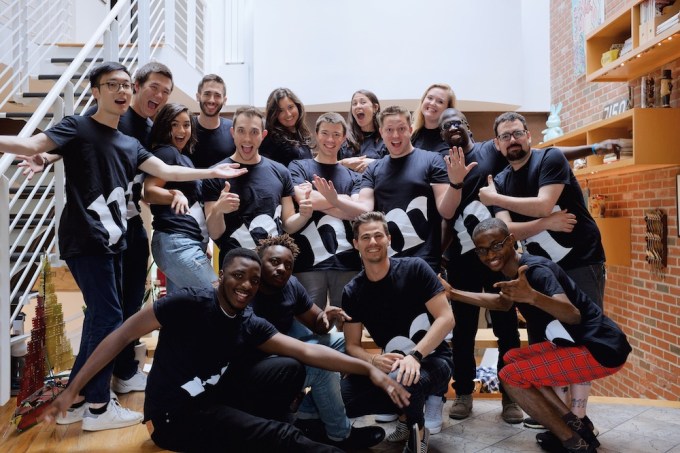
At the end of last year, Grand Central Tech announced plans to work with the Milstein real estate family to transform a midtown Manhattan high-rise into a tech hub called Company. And startups remain an important part of the mix — in fact, Company is unveiling a list of 20 startups participating in this year’s GCT Startup-in-Residence program.

What does Startup-in-Residence mean? Well, Company CEO Matthew Harrigan said the program will continue to offer what it’s always offered — desk space, as well as access to events and amenities, for a select group of early-stage entrepreneurs. And participants don’t have to give up equity or pay rent.

The deal might seem too good to be true, but Harrigan argued that the startups make Company more appealing to its enterprise tenants: “We are retrofitting this building to look and feel and operate like a brand new building … but the one amenity that cannot be simply rolled out is people.”

He also said the program is only taking up 15,000 square feet of the building’s 150,000 total square feet.

“It sounds like an exceptionally generous offering and it isn’t,” he said. “It sounds like it doesn’t make a ton of business sense but that’s actually wrong … Fifteen thousand square feet of space to great early-stage founders helps establish a truly remarkable program and campus in New York City. Those resources are well spent.”

In the past, we’ve written about Grand Central Tech as an accelerator program, but Harrigan said, “We weren’t and aren’t an accelerator” — it just used “the nomenclature that’s known.” Now the program is taking on a more fitting name, though it sounds like the operations won’t be changing too dramatically.

“We typically have very sophisticated founding teams, giving them an ideal environment in which to work,” Harrigan said. “By and large, our companies are left to their own devices — we don’t presume to create a curriculum or some series of programming. It’s a somewhat passive approach, but we make sure all people in the community are linked up with each other.”

Also worth noting: This year’s class consists of 40 percent women founders and CEOs, and it covers industries like energy, mental health, e-commerce, biotech, adtech and food.

Here’s a list of the companies, with descriptions provided by Company (and edited by me for clarity and length). We’ve also written about a number of them before, so I’m including links to past coverage when possible.

  • Octave? ?is a full-stack mental health provider, purpose-built to capitalize on evolving consumer habits and a new wave of interest in the space.
  • Vowel ?is a multi-user enterprise voice platform operating in stealth. The company enables businesses to analyze, manage and drive actionable insights from audio data generated in the workplace/meetings.
  • Nara Organics? ?is a natural baby food company that is manufacturing the first biodynamic infant formula in the U.S.
  • Twine Labs? ?is a workforce analytics platform that’s creating a single source of truth on employee data across various disaggregated internal corporate databases. Data is then benchmarked against industry standards to help chief people officers gain vital, previously unavailable perspective.
  • Taskade? ?is a new workplace collaboration platform that enables more efficient team management and product workflows.
  • Oova? is a biomedical technology company for women’s health that uses smart connected devices to actively monitor hormone levels and help manage women’s fertility health. The company is a spin-out of Mt. Sinai.
  • Summer? ?is a next-generation student loan management and repayment platform providing users with a comprehensive view of their debt and targeted recommendations on how to alleviate it, which evolves based on their current life circumstances.
  • Chartable? ?is creating a new enterprise adtech and analytics platform for audio. It’s aiming to do something similar to what DoubleClick, App Annie, Flurry and others did when apps were first introduced.
  • Particle Health? ?is creating a new medical record data company, leveraging blockchain technology to enable a single health record tying together previously disparate information from a patient’s various doctors, and yielding valuable data insights in the process.
  • Project OTC ?is a holistic new consumer brand targeting outdated over-the-counter brands and products such as antacids, Vitamin C/immunity support and headache relief. The company is operating in stealth.

Moved team

  • Moved? ?is building a new concierge layer on top of the disorganized, disaggregated moving services supply chain. A user calls Moved, shares details and is given a concierge who manages the move and coordinates across all the various service providers, including the landlord or real estate owner.
  • Hydra? ?is a ?new network of membership-based wellness spaces in metropolitan areas that complements the growth of small format fitness classes and provides its members areas to refresh, regroup and recharge.
  • GoodTalk? ?is a new consumer app meant to distill and amplify one of the primary aspects of social platforms. For example, five experts on a given topic can form a chat thread, which other users of the app can view but not comment on.
  • Otis? is building a new investment platform to enable distributed ownership in fine art and collectibles.
  • Snackable? ?uses natural language processing to intelligently digest podcasts into “snackable” 30-60 second moments to enable easier social sharing of podcast content — something that has plagued the burgeoning podcast space.

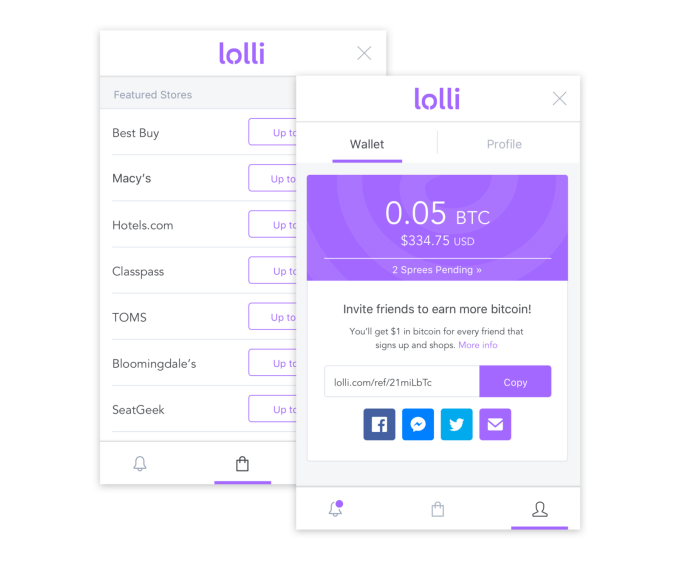
Lolli allows users to receive Bitcoin for their online purchases

  • Lolli? ?is building a new e-commerce platform that allows customers to accumulate Bitcoin rewards through simple brand and retail purchases by capturing the rebate/coupon value already broadly distributed throughout e-commerce.
  • RaisedByUs? ?is a nonprofit workplace social good program for companies that already includes Casper, Squarespace, Shutterstock, Seatgeek, Sailthru, Birchbox, MongoDB and DigitalOcean among others. RaisedByUs helps teams do meaningful, team-building, vetted volunteer work easily.
  • Nesterly? ?i?s a home-sharing platform that is working to bring affordable housing to the next generation by allowing senior homeowners to easily rent out their extra space.
  • Bokksu? ?is a subscription-based food company that curates exclusive artisan snacks in local markets and uses video and written storytelling to detail origin stories through an immersive customer experience.

Electric scooter startup Grin merges with Brazil-based Yellow

Consolidation in the micromobility space has arrived — in Brazil, at least. A few months after Y Combinator-backed Grin merged its electric scooter business with Brazil-based Ride, it’s now merging with Yellow, the bike-share startup based in Brazil that has also expressed its ambitions to get into electric scooters.

If Yellow sounds familiar to you, it may be because, in September, the company raised $63 million in a funding round led by GGV Capital. That was the largest Series A round for a Latin American startup. A month later, Grin raised a $45.7 million Series A round.

As part of the merger, Grin and Yellow are rebranding as Grow Mobility. Initially, however, both apps will maintain their apps and brands. Grow Mobility operates more than 135,000 micromobility vehicles across six countries and plans to more than double its fleet in the next few months across Latin America.

“The demand for these everyday services across Latin America is huge and, by combining strengths and resources, we will be able to move quickly to serve more users,” Grin co-founder and Grow CEO Sergio Romo said in a press release. “We look forward to building on Grin and Yellow’s strong relationships with local officials and other stakeholders who are eager to partner with us in creating long-lasting value for our region.”

Over in the U.S., there are countless electric scooter startups. As my colleague Kate Clark said in last month, it’s only a matter of time before we see some consolidation.

Facebook plans new products as Instagram Stories hits 500M users/day

Roughly half of Instagram’s users 1 billion users now use Instagram Stories every day. That 500 million daily user count is up from 400 million in June 2018. 2 million advertisers are now buying Stories ads across Facebook’s properties.

CEO Mark Zuckerberg called Stories the last big game-changing feature from Facebook, but after concentrating on security last year, it plans to ship more products that make “major improvements” in people’s lives.

During today’s Q4 2018 earnings call, Zuckerberg outlined several areas where Facebook will push new products this year:

  • Encryption and ephemerality will be added to more features for security and privacy
  • Messaging features will make Messenger and WhatsApp “the center of [your] social experiences”
  • WhatsApp payments will expand to more countries
  • Stories will gain new private sharing options
  • Groups will become an organizing function of Facebook on par with friends & family
  • Facebook Watch will become mainstream this year as video is moved there from the News Feed, Zuckerberg expects
  • Augmented and virtual reality will be improved, and Oculus Quest will ship this spring
  • Instagram commerce and shopping will get new features

Zuckerberg was asked about Facebook’s plan to unify the infrastructure to allow encrypted cross-app messaging between Facebook Messenger, Instagram, and WhatsApp, as first reported by NYT’s Mike Isaac. Zuckerberg explained that the plan wasn’t about a business benefit, but supposedly to improve the user experience. Specifically, it would allow Marketplace buyers and sellers in countries where WhatsApp dominates messaging to use that app to chat instead of Messenger. And for Android users who use Messenger as their SMS client, the unification would allow those messages to be sent with encryption too. He sees expanding encryption here as a way to decentralize Facebook and keep users’ data safe by never having it on the company’s servers. However, Zuckerberg says this will take time and could be a “2020 thing”.

Facebook says it now has 2.7 billion monthly users across the Facebook family of apps: Facebook, Instagram, Messenger, and WhatsApp. However, Facebook CFO David Wehner says “Over time we expect family metrics to play the primary role in how we talk about our company and we will eventually phase out Facebook-only community metrics.” That shows Facebook is self-conscious about how its user base is shifting away from its classic social network and towards Instagram and its messaging apps. Family-only metrics could mask how teens are slipping away.

Google+ for consumers will shut down on April 2nd

It’s no secret that Google planned to pull life support from the consumer version of Google+, its failure of a social network, in April. Until now, though, we didn’t know the exact date. That date, Google announced today, is April 2.

On that date, Google will start deleting all content, including Google+ pages, photos and videos, and everything else on the site. If you were one of the last few Google+ users — or you just feel nostalgic about the stuff you posted there — now is the time to download all of that data.

If your company uses Google+ (and there must be some companies that do), then rest assured you will still be able to use it for the foreseeable future. Google is only shutting down the consumer version, as well as all Google+ APIs. Indeed, those APIs, which turned out to be major security liabilities, will shut down on March 7.

And there you have it. That’s the curtain call for Google+, the social network that could’ve been, from an era when Google desperately tried to catch up with Facebook and Twitter and integrated Google+ into every conceivable product. It even went so far as changing its sacred search results based on social signals (which really didn’t work all that well). The result was a bit of a disaster for Google and it took a while to right the ship.

PayPal revenues miss but growth is strong from new acquisitions

PayPal revenues missed, but strong growth from its recent iZettle and Hyperwallet acquisitions and booming business at Venmo point to a strong outlook for the payments giant.

In all, PayPal saw revenues for the quarter of $4.23 billion against analysts’ estimates of $4.24 billion, according to data from Yahoo Finance. Earnings per share at the company were up to 69 cents versus analysts’ expectations of 62 cents on a non-GAAP basis.

For the full year, PayPal saw revenue hit $15.45 billion versus analysts’ estimates of $15.46 billion.

The addition of 2.9 million net new active accounts resulting from the acquisitions of Hyperwallet and iZettle show how those two deals are already adding value, as PayPal moves to expand internationally and away from its core market in the U.S.

Payment transactions totaled 2.9 billion for the quarter, up 28 percent, and the $164 billion in total payment volume was a 23 percent increase from the year ago period.

“In 2018 we set new benchmarks for the company for revenue, net new active accounts and engagement across our platform. We launched new products, strengthened existing relationships and entered into new strategic partnerships with some of the biggest and most influential global brands in technology, retail and finance,” said Dan Schulman, president and CEO of PayPal. “We greatly expanded our global reach, serving 267 million customer accounts, including 21 million merchant accounts. We believe 2019 will be another strong year for us, and we intend to build on our strengths to extend our leadership as the leading open digital payments platform.”

Other than the additions from the new acquisitions, the other bright spot for PayPal was the volume coming in from its Venmo business. In all, volume of Venmo transactions hit $19 billion, growing by 80 percent, in the fourth quarter. For the year, nearly $62 billion changed hands on the Venmo platform.

Mobile payments were also up for the company. Roughly $67 billion was transacted through mobile devices for the quarter, a 40 percent boost on year-ago numbers.

Despite the generally positive outcomes, PayPal’s stock was down 4.4 percent to $88.11 in after-hours trading on the Nasdaq.

The forthcoming WarnerMedia streaming service will be partially supported by ads

In November, AT&T opened up about its plans for its forthcoming WarnerMedia streaming service, which aims to leverage the entertainment properties AT&T gained by way of its Time Warner acquisition last year. The company said the service will have three tiers — an entry-level, movie-focused service; a premium tier with original programming and blockbusters; and a bundle that includes them both. Today, AT&T revealed another detail: Some of the service’s content will be supported by advertising.

Speaking to investors this morning on its Q4 earnings call, AT&T CEO Randall Stephenson said the new service will have what he referred to as a “two-sided business model.”

That is, the service will include subscription-based, commercial-free programming on the high-end — like HBO or Netflix offers. But it seems the entry-level portion of the service will be ad-supported, according to the exec’s comments.

“Customers have become accustomed to advertising-free subscription services,” Stephenson noted. “And we think HBO and a lot of the Warner Brothers content, that’s really premium content, will fit into that mold,” he said. “But there are other elements where advertising-supported models are going to be important to keep prices down, to keep costs for the consumer down and actually fund additional content acquisition and purchasing,” Stephenson added.

He said the model for the new service would be “heavy” on the subscription side, with “some” ad-supported elements to it. The latter would be enabled by AT&T’s ad tech called Xandr.

The exec acknowledged, too, the challenge of entering the market at this point with yet another streaming offering, but seemed optimistic about AT&T’s chances.

“We have really high expectations for our streaming service. We don’t think there is going to be a proliferation of these that will succeed over time, but those who have very, very strong IP — deep libraries of IP — are the ones that we think are going to succeed over time,” he said.

What was less clear is whether the ad-supported elements to the WarnerMedia service would actually involve any of its content streaming for free to consumers, or whether it will just make the service more affordable — like Hulu’s core TV package, which just dropped its pricing to $6 per month. (AT&T currently owns a stake in Hulu, but it has been weighing putting it up for sale to pay down debt. That’s still on the table, the company said today.)

If WarnerMedia’s service goes the ad-supported route for its entry-level tier, it will face a lot of competition. Today, there are a number of ways to stream free movies and TV on demand, thanks to advertising-supported offerings from a host of major players.

For example, there’s free content on The Roku Channel; Walmart’s ad-supported video on Vudu; Amazon-owned IMDb’s new service FreediveViacom’s new acquisition, Pluto TV; Sinclair’s local broadcaster-focused service Stirr; and sometime this year, media center software maker Plex will offer free movies. Comcast will also launch a free streaming service for its pay TV customers in 2020.

If, however, WarnerMedia chooses to charge a small amount for its ad-supported content, then it will have to go up against Hulu’s core package — which looks more compelling as it includes original programming.

On the subscription side of things, the service will be up against paid services like Netflix, Time Warner’s own HBO NOW (and the other ways to get HBO over-the-top), plus the forthcoming launches from Apple (presumably) and Disney.

What’s more is that the company doesn’t plan on entirely cutting off access to its content by bringing it all in-house. As Stephenson mentioned today, AT&T recently extended its license for “Friends” to Netflix, instead of cutting them off.

“We said exclusivity is probably not that critical on that type of content, but it’s critical to have on our platform,” he explained. “So we did license it to Netflix as you saw, but on a non-exclusive basis. And so each of these decisions on significant content like that are going to be evaluated in terms of how critical is it to our platform to have it as exclusive, versus the economics of licensing it to others.”

Tesla reports back-to-back profitable quarters

Tesla reported Wednesday a profit of $139 million, or $0.78 a share, and better-than-expected sales, yet failed to meet analysts’ expectations for earnings in the fourth quarter. Shares fell after the markets closed and are down 1.7 percent as of 2:30 pm PT.

Tesla has managed to string together two profitable periods in a row thanks to sales of the Model 3 and despite several headwinds in the fourth quarter, including a non-cash charge of $54 million attributable to non-controlling interests, higher import duties on components from China, a price reduction for Model S and Model X in China and the introduction of a lower-priced mid-range version of Model 3.

In October, Tesla reported its first profit after seven consecutive quarters of losses. It was only the third time in its history that it had achieved this milestone.

Tesla’s profitable fourth quarter lies in stark contrast to its financial position in the same period last year when it reported a loss of $675 million, or $1.75 a share.

Perhaps just as important as the automaker’s income is its cash position. Tesla reported that its cash position improved by $1.45 billion despite the scheduled repayment of a $230 million convertible bond in the fourth quarter.

“We have sufficient cash on hand to comfortably settle in cash our convertible bond that will mature in March 2019,” the shareholder letter to investors said.

Here are a few of the highlights:

  • Tesla’s Q4 revenues were $7.2 billion, up from $6.8 billion in the third quarter
  • Tesla’s Q4 operating cash flow less capital expenditures improved to $910 million
  • Cash and cash equivalents increased by $718 million to hit $3.7 billion at the end of the fourth quarter
  • Model 3 production volumes in Fremont should reach a sustained rate of 7,000 units per week by end of 2019

Analysts took a measured tone in reaction to Tesla’s fourth-quarter earnings report, noting the company’s accomplishments as well as the challenges that lie ahead.

“Things really aren’t going to get any better for Tesla in the U.S. than they did at the end of 2018,” Jessica Caldwell, executive director of industry analysis at Edmunds, said in an emailed statement. “Turning a profit, creatively addressing production challenges and getting the Model 3 to the masses were huge milestones, but keeping up this momentum is going to be virtually impossible. Tesla’s product lineup is starting to get stale, and now thanks to the elimination of the federal tax credit, buying one has never been more expensive. While there’s still a cool factor to owning a Tesla, it may not be enough to convince buyers to choose one over brand new models from Audi, Porsche and Jaguar. Tesla’s in an awkward purgatory between being a startup and a mainstream automaker, and the biggest open question heading into 2019 is where the company really goes from here. Tesla is used to owning the spotlight, but for the next year we might see a lower-key Tesla as the company takes baby steps to keep things moving along while it plans for the future.”

The challenges will be for Tesla to improve, or at least maintain, margins even as the federal tax credit continues to wind down.

Looking ahead

Tesla is forecasting that Model 3 volumes will “grow substantially” in 2019 due to a full year of high production rates at its facility in Fremont, California.

Tesla said it plans to start producing Model 3 vehicles at its “gigafactory” in Shanghai by the end of the year. The automaker says they intend to slash the cost of producing Model 3s at the factory in China, a bold prediction that if successful will help boost margins.

“We expect the capital spend per unit of capacity for this factory to be less than half of that of our Model 3 line in Fremont,” the company said.

Tesla is also targeting cost reductions in the U.S and expects operating expenses will grow by less than 10 percent in 2019. The automaker says that restructuring actions taken in the first quarter — which includes layoffs that occurred this month — will reduce costs by about $400 million annually.

Tesla’s first-quarter financials will reflect a one-time restructuring cost, the company forecasted.

As a result, Tesla says it’s remaining optimistic that it will post a small profit in the first quarter if it can successfully keep costs down and handle logistics and delivery challenges in Europe and China.

Tesla reported January 2 that it delivered 90,700 vehicles during the fourth quarter, just shy of what analysts expected. The company said at the time that it delivered 13,500 Model S sedans, 14,050 Model X SUVs and 63,150 Model 3s.


Microsoft Azure revenue growth slows in Q2

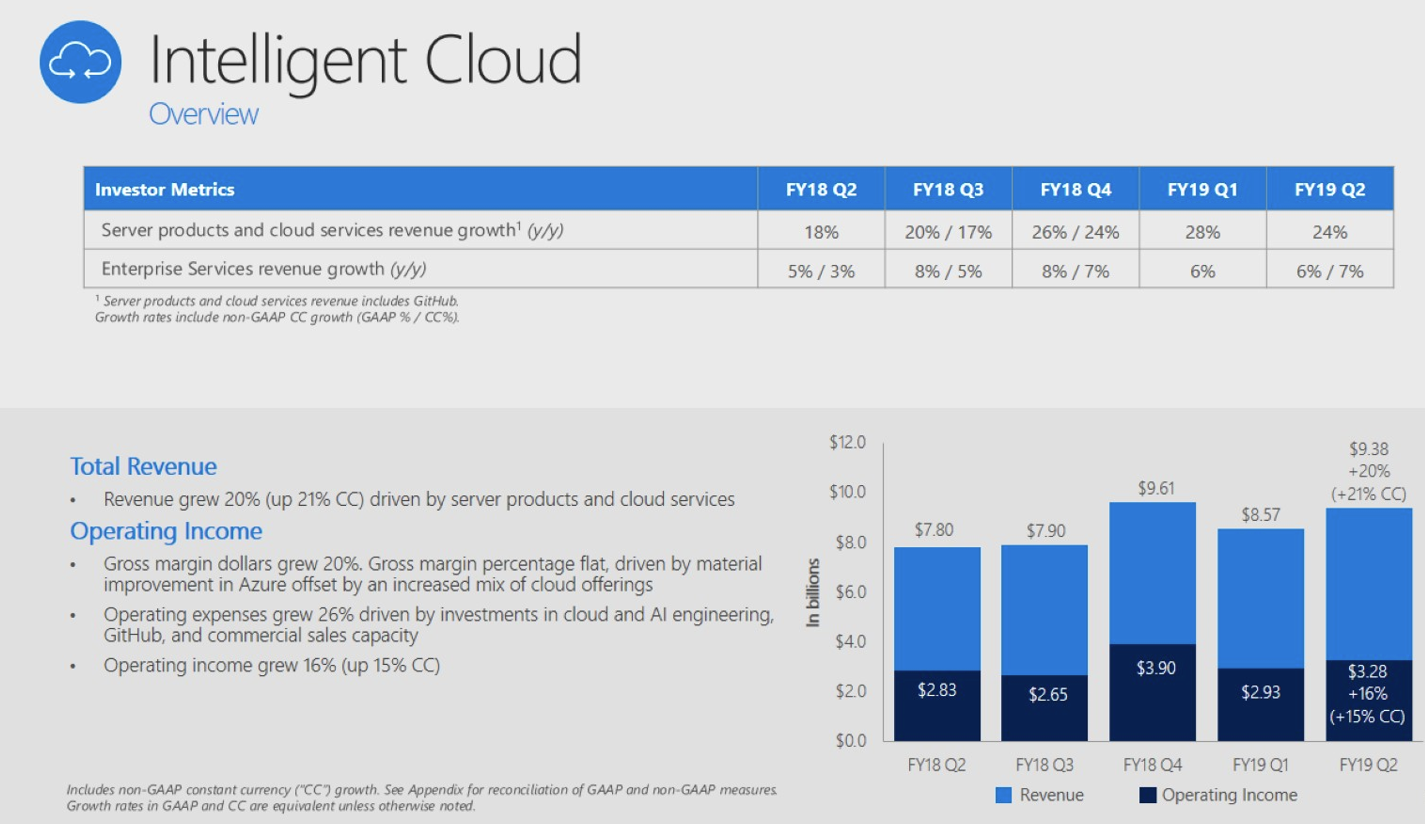
Microsoft announced its quarterly earnings today. For the most part, those earnings came in around Wall Street’s expectations, without any major surprises and a total revenue of $32.5 billion. Given the company’s bets on cloud computing, what’s maybe most important, though, is that Azure recorded revenue growth of 76 percent. That’s the same growth the company booked in the last quarter, and is still respectable growth, but depending on your perspective, you can also read it as growth flattening out.

“Our strong commercial cloud results reflect our deep and growing partnerships with leading companies in every industry, including retail, financial services and healthcare,” said Satya Nadella, CEO of Microsoft. “We are delivering differentiated value across the cloud and edge as we work to earn customer trust every day.”

Azure falls into Microsoft’s “Intelligent Cloud” category, which includes other server products and enterprise services. In total, those services booked $9.4 billion in revenue, up 20 percent. Commercial cloud revenue was up 48 percent year-over-year.

As for the rest of the earnings, it’s worth noting that revenue from Microsoft’s Surface devices was up 39 percent, but that was expected, given the time of year and the fact the company released a number of new devices in recent months. Gaming, too, was a strong area, with Xbox software and services up 31 percent.

You can find the full release here.

Facebook shares shoot up after strong Q4 earnings despite data breach

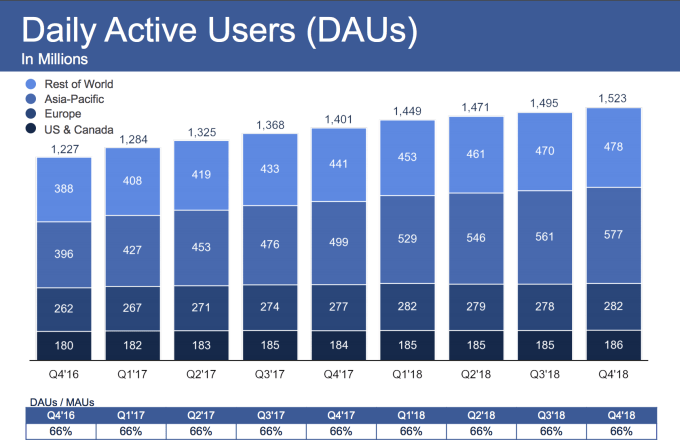
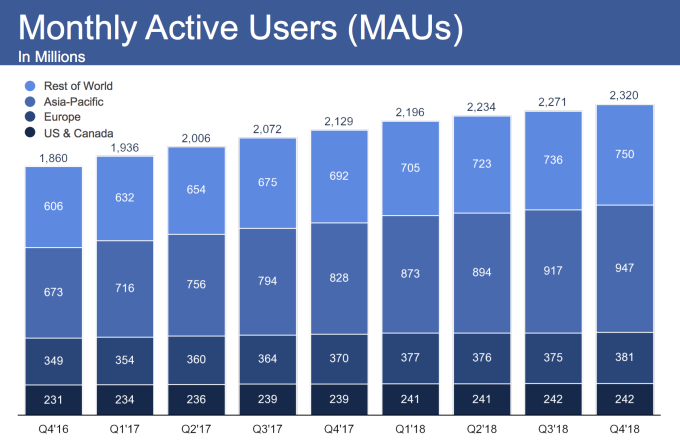
Facebook managed to beat Wall Street’s estimates in its Q4 earnings amidst a constant beat down in the press. Facebook hit 2.32 billion monthly users, up 2.2 perecent from 2.27 billion last quarter, speeding up its growth rate. Facebook climbed to 1.52 billion daily active users from 1.49 billion last quarter for a 2 percent growth rate that dwarfed last quarter’s 1.36 percent.

Facebook earned $16.91 billion off all those users with a $2.38 GAAP earnings per share. Those numbers handily beat Wall Street’s expectations of $16.39 billion in revenue and $2.18 GAAP earnings per share, plus 2.32 billion monthly and 1.51 billion daily active users. Facebook’s daily to monthly user ratio, or stickiness, held firm at 66 percent where it’s stayed for years, showing those still on Facebook aren’t using it much less.

Facebook shares had closed today at $150.42 but shot up over 11 percent following the record revenue and profit announcements to hover around $167. A big 30 percent year-over-year boost in average revenue per user in North America fueled those gains. Yet that’s still down from $186 where it was a year ago and a peak of $217 in July.

CEO Mark Zuckerberg went beyond his usual intro to the earnings report where he assures investors things are going well and highlights new opportunities. This quarter he noted “We’ve fundamentally changed how we run our company to focus on the biggest social issues, and we’re investing more to build new and inspiring ways for people to connect.”

Squeezing Money From The Olds

Facebook managed to grow its DAU in both the critical US & Canada and Europe markets where it earns the most money after stagnation or shrinkage in previous quarters. The fact that Facebook is no longer dwindling it its most lucrative markets is surely contributing to its share price climb. Facebook’s monthly active user plateaued in North America but roared up in Europe. That was shored up by a reversal of last quarter’s decline in Rest Of World average revenue per user, which fell 4.7% in Q3 but bounced back with 16.5 percent growth in Q4.


Facebook raked in $6.8 billion in profit this quarter as it slowed down hiring and only grew headcount 5 percent from 33,606 to 35,587. It seems Facebook has gotten to a comfortable place with its security staff-up in the wake of election interference, fake news, and content moderation troubles. Its revenue is up 30 percent year-over-year while profits grew 61 percent, which is pretty remarkable for a 15-year old technology company.

Earnings Call

Facebook’s plan to concentrate on product innovation in 2019 after focusing on security in 2018 was the core of today’s earnings call. Zuckerberg laid out a product roadmap for more ephemerality and encryption, how unifying the infrastructure of Facebook’s messaging apps will better connect Marketplace to WhatsApp, Groups will become an organizing function for more of the Facebook experience, and shopping features will crop up across the family of apps. You can read Zuckerberg’s full opening statement here.

New stats included 500 million daily Instagram Stories users and 2 million advertisers on Stories. Zuckerberg said he was pleasantly surprised by Facebook Portal sales but didn’t give specifics. He revealed 2.7 billion people now use Facebook’s family of apps each month. However, CFO David Wehner warned the company would eventually stop sharing Facebook-only stats, presumably to mask the shift of younger users to its other apps. He also cautioned that due to the shift of users from feeds to Stories that Facebook has less experience monetizing, and targeting headwinds due to increased privacy scrutiny, Facebook predicts mid-single digit revenue growth rate reductions each quarter this year.

We just released our community update and quarterly results.We've fundamentally changed how we run our company to…

Posted by Mark Zuckerberg on Wednesday, January 30, 2019

While the quarter went well, morale isn’t quite as rosy. It’s been a brutal quarter for Facebook At least its swifter user growth rates show Facebook survived its biggest ever data breach without scaring off too many people. Meanwhile it’s continuously struggled with scandals like hiring opposition research firm Definers, and it saw its new teen app Lasso largely flop. Facebook will have to convince investors it knows how to win back the next generation, or at least keep squeezong a lot more money out of the last one like it did in Q4.