Facebook’s head of comms hits the road after 8 years at the company

Facebook head of communications Caryn Marooney is leaving for greener pastures, she announced today, on Facebook of course. She joins the growing number of executives and high-level employees departing the company during and after what may be its toughest year.

“I spent a lot of time over the winter holiday reflecting, and with the New Year, and after 8 years at Facebook, I’ve decided to step down as leader of the communications group,” Marooney wrote. “I’ve decided it’s time to get back to my roots: going deep in tech and product.”

She thanked CEO Mark Zuckerberg and COO Sheryl Sandberg, with whom she worked closely. The former commented to thank Marooney “for the dedication and brilliance you have brought to Facebook over the years.”

Certainly she saw Facebook during a period of intense growth and transition, though arguably the company’s entire history has been marked by those traits. But 2011’s Facebook was remarkably smaller and less complex — operationally, ethically and legally — so to have gone from that middle stage to the present must certainly have been quite a ride.

Marooney is just the latest in what seems like a constant of high-profile departures over the last year:

Obviously in a large company there’s going to be turnover. But an average of one a month seems like a lot.

There’s no indication Marooney left because of any acute cause other than wanting to move on to the next thing. It’s just that a lot of people seem to be doing it at the same time.

Sonos CFO Michael Giannetto will retire later this year

At the tail end of its shareholder letter for Q1 2019, Sonos disclosed that the company’s chief financial officer, Mike Giannetto, will be retiring “later this year.” Giannetto has been with Sonos for seven years, helping to guide the company through its IPO back in August of 2018.

As for who will take over the role: Sonos isn’t sure yet. They’ve hired a search firm to help them find a new CFO, but CEO Patrick Spence writes that Giannetto “will help with that search and be around as long as we need him to ensure a smooth transition.”

Sonos stock dipped by about 17 percent immediately after the news was announced (from $12.37 at market close to $10.42 after hours) but has climbed its way back up a bit to around $11.76 per share.

Story developing…

Many popular iPhone apps secretly record your screen without asking

Many major companies, like Air Canada, Hollister and Expedia, are recording every tap and swipe you make on their iPhone apps. In most cases you won’t even realize it. And they don’t need to ask for permission.

You can assume that most apps are collecting data on you. Some even monetize your data without your knowledge. But TechCrunch has found several popular iPhone apps, from hoteliers, travel sites, airlines, cell phone carriers, banks and financiers, that don’t ask or make it clear — if at all — that they know exactly how you’re using their apps.

Worse, even though these apps are meant to mask certain fields, some inadvertently expose sensitive data.

Apps like Abercrombie & Fitch, Hotels.com and Singapore Airlines also use Glassbox, a customer experience analytics firm, one of a handful of companies that allows developers to embed “session replay” technology into their apps. These session replays let app developers record the screen and play them back to see how its users interacted with the app to figure out if something didn’t work or if there was an error. Every tap, button push and keyboard entry is recorded — effectively screenshotted — and sent back to the app developers.

Or, as Glassbox said in a recent tweet: “Imagine if your website or mobile app could see exactly what your customers do in real time, and why they did it?”

The App Analyst, a mobile expert who writes about his analyses of popular apps on his eponymous blog, recently found Air Canada’s iPhone app wasn’t properly masking the session replays when they were sent, exposing passport numbers and credit card data in each replay session. Just weeks earlier, Air Canada said its app had a data breach, exposing 20,000 profiles.

“This gives Air Canada employees — and anyone else capable of accessing the screenshot database — to see unencrypted credit card and password information,” he told TechCrunch.

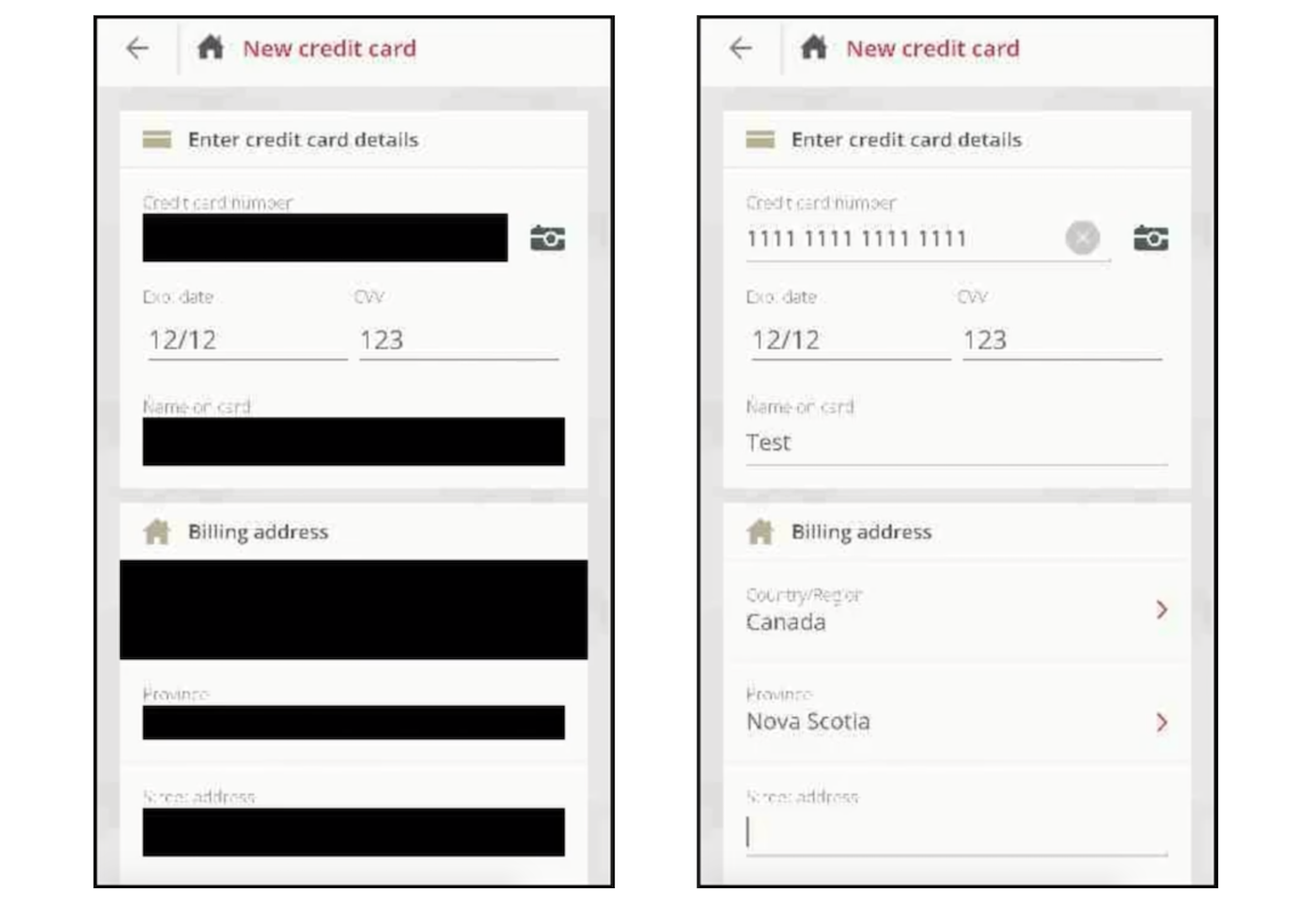
In the case of Air Canada’s app, although the fields are masked, the masking didn’t always stick (Image: The App Analyst/supplied)

We asked The App Analyst to look at a sample of apps that Glassbox had listed on its website as customers. Using Charles Proxy, a man-in-the-middle tool used to intercept the data sent from the app, the researcher could examine what data was going out of the device.

Not every app was leaking masked data; none of the apps we examined said they were recording a user’s screen — let alone sending them back to each company or directly to Glassbox’s cloud.

That could be a problem if any one of Glassbox’s customers aren’t properly masking data, he said in an email. “Since this data is often sent back to Glassbox servers I wouldn’t be shocked if they have already had instances of them capturing sensitive banking information and passwords,” he said.

The App Analyst said that while Hollister and Abercrombie & Fitch sent their session replays to Glassbox, others like Expedia and Hotels.com opted to capture and send session replay data back to a server on their own domain. He said that the data was “mostly obfuscated,” but did see in some cases email addresses and postal codes. The researcher said Singapore Airlines also collected session replay data but sent it back to Glassbox’s cloud.

Without analyzing the data for each app, it’s impossible to know if an app is recording a user’s screens of how you’re using the app. We didn’t even find it in the small print of their privacy policies.

Apps that are submitted to Apple’s App Store must have a privacy policy, but none of the apps we reviewed make it clear in their policies that they record a user’s screen. Glassbox doesn’t require any special permission from Apple or from the user, so there’s no way a user would know.

Expedia’s policy makes no mention of recording your screen, nor does Hotels.com’s policy. And in Air Canada’s case, we couldn’t spot a single line in its iOS terms and conditions or privacy policy that suggests the iPhone app sends screen data back to the airline. And in Singapore Airlines’ privacy policy, there’s no mention, either.

We asked all of the companies to point us to exactly where in its privacy policies it permits each app to capture what a user does on their phone.

Only Abercombie responded, confirming that Glassbox “helps support a seamless shopping experience, enabling us to identify and address any issues customers might encounter in their digital experience.” The spokesperson pointing to Abercrombie’s privacy policy makes no mention of session replays, neither does its sister-brand Hollister’s policy.

“I think users should take an active role in how they share their data, and the first step to this is having companies be forthright in sharing how they collect their users data and who they share it with,” said The App Analyst.

When asked, Glassbox said it doesn’t enforce its customers to mention its usage in their privacy policy.

“Glassbox has a unique capability to reconstruct the mobile application view in a visual format, which is another view of analytics, Glassbox SDK can interact with our customers native app only and technically cannot break the boundary of the app,” the spokesperson said, such as when the system keyboard covers part of the native app, “Glassbox does not have access to it,” the spokesperson said.

Glassbox is one of many session replay services on the market. Appsee actively markets its “user recording” technology that lets developers “see your app through your user’s eyes,” while UXCam says it lets developers “watch recordings of your users’ sessions, including all their gestures and triggered events.” Most went under the radar until Mixpanel sparked anger for mistakenly harvesting passwords after masking safeguards failed.

It’s not an industry that’s likely to go away any time soon — companies rely on this kind of session replay data to understand why things break, which can be costly in high-revenue situations.

But for the fact that the app developers don’t publicize it just goes to show how creepy even they know it is.


Got a tip? You can send tips securely over Signal and WhatsApp to +1 646-755–8849. You can also send PGP email with the fingerprint: 4D0E 92F2 E36A EC51 DAAE 5D97 CB8C 15FA EB6C EEA5.

Weather and climate-related disasters cost the US $80 billion in 2018, but go ahead and say climate change isn’t real

Weather and climate-related disasters cost the U.S. economy $80 billion last year — and have hit the nation’s bottom line to the tune of roughly $100 billion per year over the last five years, according to a new survey from the National Oceanic and Atmospheric Administration.

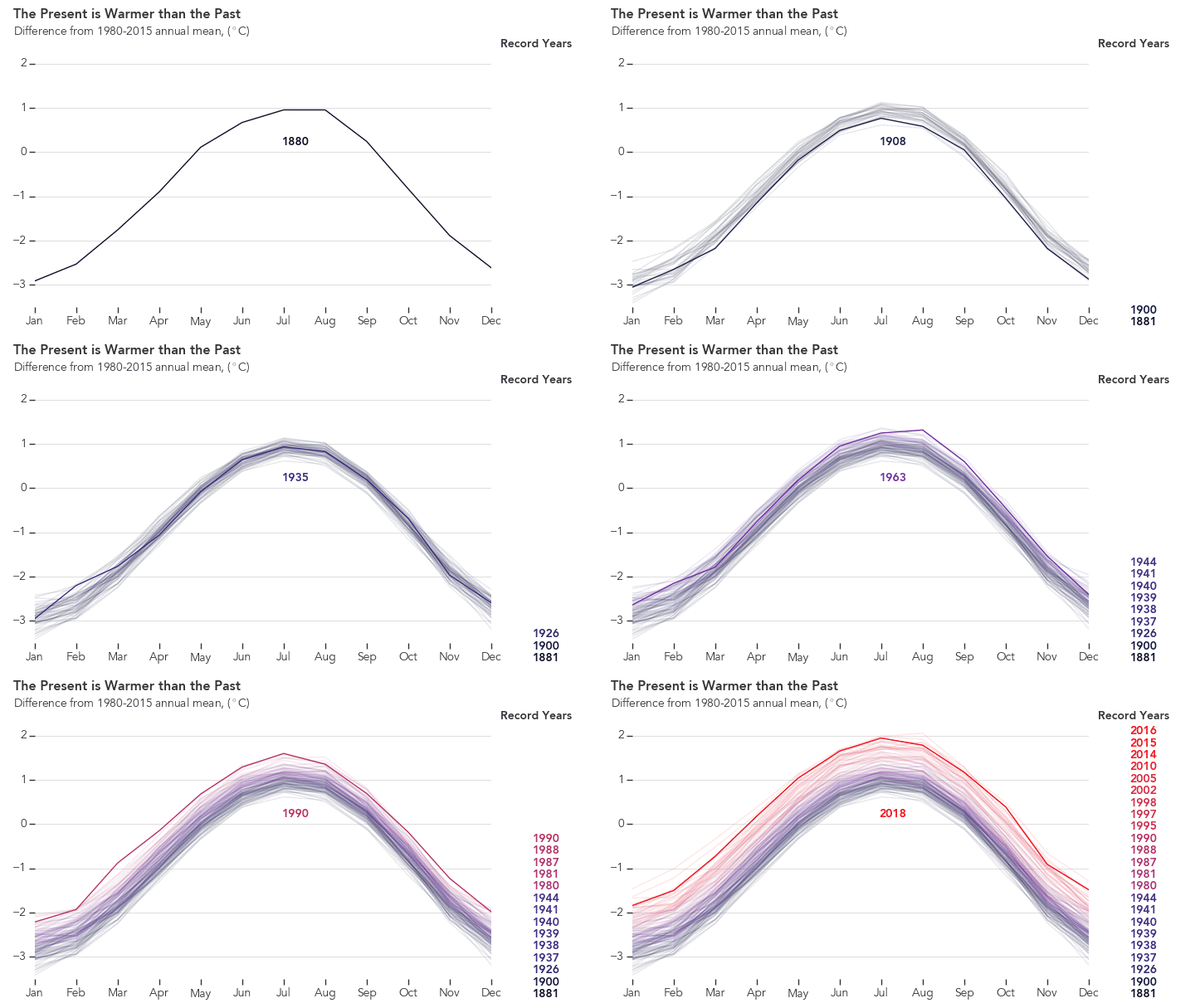
That tally comes as NASA reported that 2018 was also the fourth warmest year ever recorded — continuing a trend of record-breaking global temperatures.

It looks like the anthropogenic causes of climate change are becoming harder to ignore.

Indeed, the NOAA’s Climate.gov report was very blunt about the causes of the increasing frequency with which natural disasters are occurring across the country:

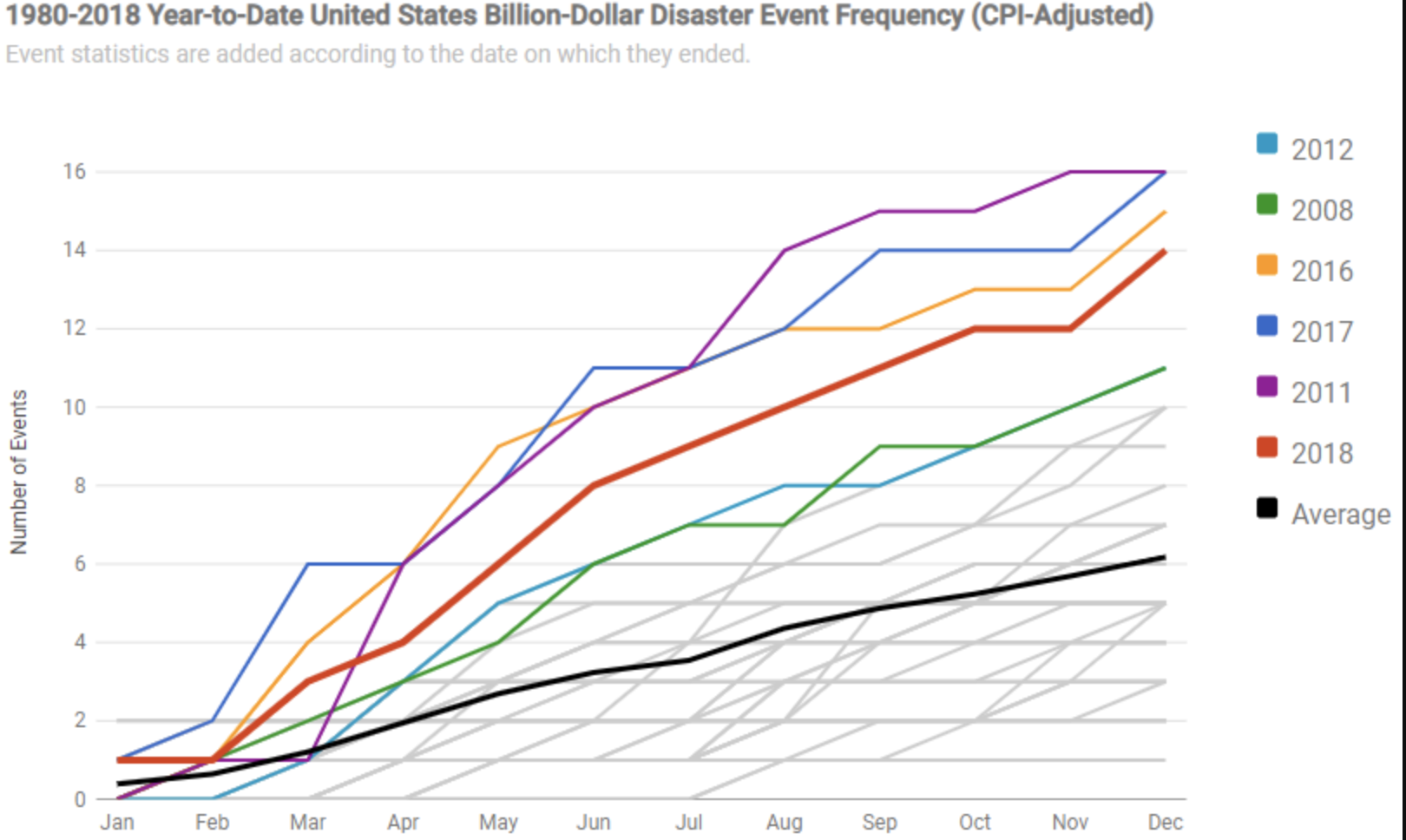
The past three years (2016-2018) have been historic, with the annual average number of billion-dollar disasters being more than double the long-term average. The number and cost of disasters are increasing over time due to a combination of increased exposure, vulnerability, and the fact the climate change is increasing the frequency of some types of extremes that lead to billion-dollar disasters.

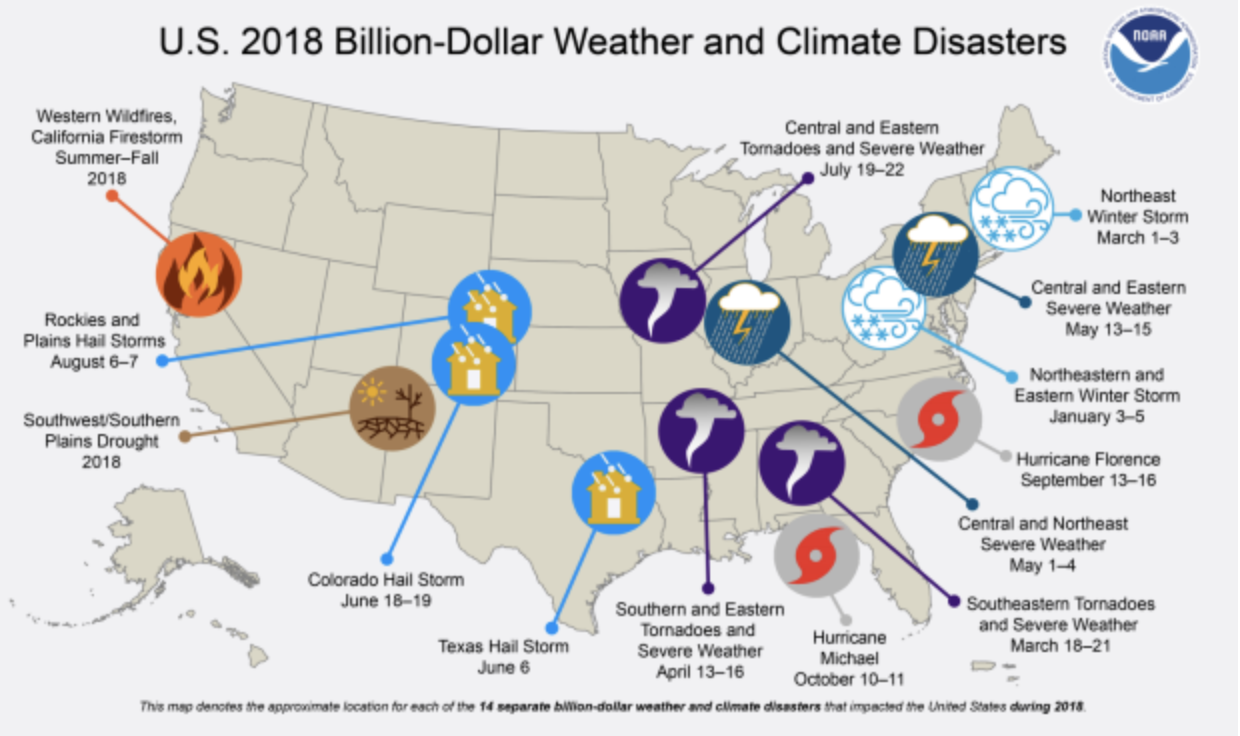
In total, the U.S. was hit by 14 separate disaster events whose costs were more than $1 billion: the litany of climatological horrors included two tropical cyclones, eight severe storms, two winter storms, prolonged drought and wildfires (that probably burned all the partridges out of their pear trees).

As the NOAA report notes, this tally is the fourth highest number of total events ever recorded — behind 2017 and 2011 (tied at 16 natural disasters) and 2015, which saw 15 natural disasters worth more than $1 billion slam the U.S.

Last year was also one of the costliest for the American economy in terms of the impact from natural disasters. The $80 billion price tag is only topped by 2017, when storms, fires, floods and drought cost the economy $312.7 billion (a record); 2005, when the number hit $220.8 billion and 2012 when $128.6 billion was lost due to climate-related disasters.

Of the events that are the most damaging and costliest to the U.S. economy, hurricanes rank the highest. And from 2016-2018 the U.S. was impacted by six separate hurricanes that cost the economy more than $1 billion. In all, those disasters wrought some $329.9 billion in economic damage and killed 3,138 people.

While there’s a tragic, historic precedence for the damage caused by hurricanes, the Western wildfire seasons of the past two years are unprecedented in size and scope in modern history. With costs running over $40 billion, the wildfire costs in the U.S. for the last two years are equal to the cost from fires for the previous 37 years combined.

Meanwhile, NASA scientists have said that the past five years have been, collectively, the warmest years in the modern record.

“2018 is yet again an extremely warm year on top of a long-term global warming trend,” said GISS Director Gavin Schmidt, in a statement.

Since the 1880s, the average global surface temperature has risen about 2 degrees Fahrenheit — and this warming is caused in large part by increased emissions into the atmosphere of carbon dioxide and other greenhouse gases, Schmidt said.

“The impacts of long-term global warming are already being felt — in coastal flooding, heat waves, intense precipitation and ecosystem change,” said Schmidt, in a statement.

It’s important to note that overall global warming contributes to drastic shifts in climate patterns and climate change. It doesn’t mean that there won’t be conditions of extreme cold as (ahem) some people seem to think.

In the beautiful Midwest, windchill temperatures are reaching minus 60 degrees, the coldest ever recorded. In coming days, expected to get even colder. People can’t last outside even for minutes. What the hell is going on with Global Waming? Please come back fast, we need you!

— Donald J. Trump (@realDonaldTrump) January 29, 2019

In fact, global warming hasn’t gone anywhere… yet.

There is a plan being proposed by Democrats in the House of Representatives that aims to push the U.S. to rapidly decarbonize its economy in a bid to offset some of the worst effects that are expected should global temperatures continue to rise (and if anyone wants to send that to me, I’d be obliged).

If anyone wants to send me a version of this draft that's circulating I'm at shieber at techcrunch dot com. Would be great to see it. KTHANXBYE cc: @SenMarkey, @AOC https://t.co/BlstRPD78a

— (((Jonathan Shieber))) (@jshieber) February 6, 2019

Given that most reports put a 12-year time frame around reversing the worst impacts of climate change, and U.S. reports put the potential economic damage of unchecked warming at somewhere close to $500 billion, getting a move on toward possible solutions seems like a good idea. Let’s hope Congress can follow through.


Why Spotify is betting big on podcasting

Podcasting revenues hit $314 million in 2017, according to a third-party survey released last summer. It’s a large number for what’s been historically regarded as a niche and difficult to monetize medium, but still pales in comparison to the additional $400-$500 million Spotify says it’s willing to spend on the space this year alone.

Two major acquisitions announced early today already comprise a massive commitment to the category. The purchase of Gimlet was reported to have made up nearly half that figure, at $230 million. While no number has been revealed for the purchase of Anchor, Spotify no doubt paid a pretty penny for the buzzy creation/distribution platform, which has raised $14.4 million to date.

What, then, makes Spotify so confident that it will be able to get a return on such a massive investment? To hear the company talk about it, the service fell a bit ass backwards into the whole podcasting phenomenon. For one of the world’s largest audio platforms, Spotify was actually remarkably late to the game. Podcasting dates back at least until 2000, gaining popular momentum around 2004. A year later, Apple began supporting the technology with iTunes 4.9.

After a lengthy beta period, Spotify only opened its podcast submission program to all-comers last October. As Spotify struggles to stay ahead of Apple Music’s looming growth, however, the company is now apparently suddenly all-in on podcasting.

In an interview with TechCrunch, Spotify’s Chief R&D Officer Gustav Söderström admits that the company wasn’t doing a particularly good job serving up podcasting content. “The user experience was really poor,” he says. “There was no 15-second skip. In spite of that, we saw a lot of users listening to podcasts. It was kind of unexpected and we didn’t really understand why. It turned out people really wanted to have podcasts in Spotify with their music. If you look at radio, it’s not that surprising.”

What Spotify discovered was what many no doubt already suspected: Many users don’t necessarily need or want additional applications for all of their different audio types. Even more to the point, Spotify has excelled in one key place many other podcasting platforms have failed: discovery. It’s been a key piece in the company’s growth as the leading music streaming service and could serve to help resolve one of podcasting’s biggest pain points for most users.

Matt Hartman, partner at Betaworks — an early investor in both Gimlet and Anchor — says the massive acquisitions could help signal the beginning of a new wave of podcasting growth.

“This feels like a turning point to a third wave,” Hartman says. “Discovery is a big part of the structural issues that have been in podcasting in the past and with audio in general. And Spotify has a specific solution to that on the music side. Between discovery and monetization, I think that’s where it starts to go from niche to mainstream.”

The same firm that put podcasting revenue at $314 million for 2017 forecasts that the number will hit $659 million next year, marking a 110 percent increase. That’s a healthy bump, but still a ways away from returning Spotify’s investment in a category that’s currently split amongst countless different players — including, notably, Apple, whose iPod gave the medium its name.

Eventually, Spotify will monetize podcasts the same way it has music — through subscriptions and ad revenue. In the short term, Spotify will allow both Gimlet and Anchor to operate as they have. Gimlet in particular has demonstrated an ability to make money hand over fist. In addition to raising $28.5 million, the company has devoted a chunk of operations to created sponsored content — using its vast resources to create custom podcasts for brands looking to pay a pretty penny.

When I spoke to Gimlet’s founders following its last major round, they were happy to discuss what’s become a kind of intellectual property machine, having already licensed shows like Alex, Inc. and Homecoming to ABC and Amazon. But building companies and quality content take time. Acquiring them, on the other hand, just takes money — albeit a hell of a lot of it in this case. Spotify was late to the draw but is still hoping to ramp up quickly. So it bought one of the premier players in premium podcasting.

“The question is how much you want to invest, and only history decides if this is right or not,” says Söderström. “We think this is the right time to invest. We could have continued on our own, but we think this is a great acceleration of the strategy we already had […] This was a great chance for us to accelerate the amount of talent we have at Spotify.”

Spotify has long offered some exclusive content from Gimlet and other podcasting studios. It says it will continue to do so here, while making the majority of shows available on all platforms. Ditto for shows created through Anchor, which offers an easy method for pushing out to different services — the company recently claimed it was powering around 40 percent of new podcasts.

Even if these acquisitions do eventually make fiscal sense for Spotify, what does this “third wave” of podcasting ultimately mean for creators? The great promise of podcasting has always been a sort of democratization of content. Anyone with a computer and a microphone can create a podcast. But if the early days of the world wide web have taught us anything, it’s that all things trend toward the corporate in a capitalist society.

Anchor, a plucky startup out of New York, has offered a welcome respite, bringing novice podcasters the tools to build easy podcasts out of the box. Spotify tells me that the company will keep Anchor’s branding and products around as consumer-facing offerings to help on-board users (it wouldn’t offer the same promise for Gimlet’s brand). More recently, Anchor has also worked to make ad sales more accessible for budding podcasters).

How all of that trickles down to content creators, however, remains to be seen. Music streaming like Spotify and Apple Music have been notoriously stingy when it comes to actually paying out musicians. And premium content, the kind Spotify was after in its Gimlet purchase, takes time and money, both things that are harder and harder to come by in this digital age.

Hartman disputes the music comparison, noting that podcasting is a nascent field without the same kind of precedent for monetization. “Podcasting wasn’t this massive industry that got disrupted,” he says. “It’s an industry that is figuring out its way and growing. Creators go into podcasting trying to find a new way to connect to audiences.”

Eclipse Ventures in Palo Alto just added two more big wheels as general partners

Mike McNamara retired from the electronics manufacturing giant and services business Flex last December after 12 years as CEO of the company — and another 12 working his way up to the corner office — but he didn’t say at the time where he was headed.

As it turns out, McNamara had decided to join Eclipse Ventures, a four-year-old, Palo Alto, Calif.-based firm led by Lior Susan, who’d previously founded LabIX, a hardware investment platform backed by Flex, when it was still called Flextronics.

McNamara isn’t the firm’s only new general partner, either. Eclipse is also announcing today that it has brought aboard Sanjay Jha, who was most recently the CEO of Global Foundries and was both CEO and co-CEO of Motorola Mobility before that. (And before Motorola Mobility, Jha spent 14 years as an executive at Qualcomm, including as the COO of one of its divisions.)

The hires are a big deal. They’re also in line with the other big wheels that Susan has drawn into Eclipse, which funds full-stack companies — meaning companies selling hardware, software and data — and which just officially closed on $500 million in funding two weeks after an SEC filing appeared that suggested as much.

In 2016, for example, Eclipse hired as a partner Greg Reichow, who was previously Tesla’s executive leader of global manufacturing, factory/automation engineering, supply chain and “product excellence.”

Eclipse is also run by Pierre Lamond, who made his name over a very long career with Sequoia Capital.

Others of its (male-only) investment team include Adam Bryant, who was formerly a director with Proterra, the electric bus company; Justin Butler, who led commercial operations at Misfit, a digital health company acquired by the Fossil Group for more than $250 million; and Seth Winterroth, who was previously an investor at GE Ventures.

Eclipse is still relatively low-flying as venture firms go, despite the team it has assembled. Very possibly, Susan learned a lesson about being in the headlines, having been a part of Formation 8, a firm that made a splashy debut but later disbanded.

Either way, it’s not slow to pull the trigger. According to Crunchbase, Eclipse has invested in roughly 50 companies. Among those startups to receive checks from the firm most recently are Augury, a six-year-old, New York-based machine health startup that connects vibration and ultrasonic sensors to smartphones to detect machine malfunctions before they happen, which just raised $17 million in Series B funding; and Spell, a two-year-old, New York-based deep learning and AI infrastructure platform that last month raised $15 million co-led by Eclipse.

Facebook will reveal who uploaded your contact info for ad targeting

Facebook’s crack down on non-consensual ad targeting last year will finally produce results. In March, TechCrunch discovered Facebook planned to require advertisers to pledge that they had permission to upload someone’s phone number or email address for ad targeting. That tool debuted in June, though there was no verification process and Facebook just took businesses at their word despite the financial incentive to lie. In November, Facebook launched a way for ad agencies and marketing tech developers to specify who they were buying promotions “on behalf of.” Soon that information will finally be revealed to users.

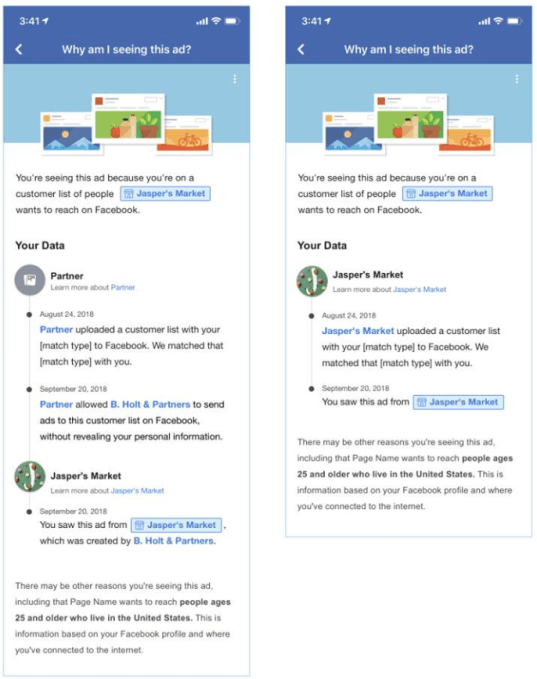
Facebook’s new Custom Audiences transparency feature shows when your contact info was uploaded and by whom, and if it was shared between brands and partners

Facebook previously only revealed what brand was using your contact info for targeting, not who uploaded it or when

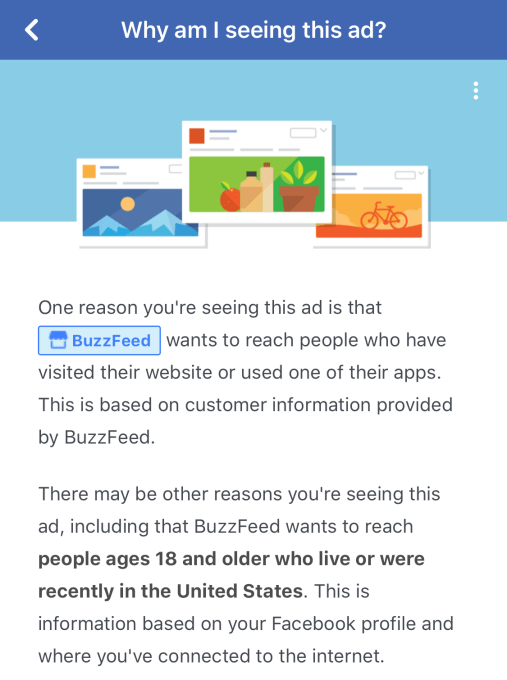
Starting February 28th, Facebook’s “Why am I seeing this?” button in the drop-down menu of feed posts will reveal more than the brand that paid for the ad, some biographical details they targeted and if they’d uploaded your contact info. Facebook will start to show when your contact info was uploaded, if it was by the brand or one of their agency/developer partners and when access was shared between partners. A Facebook spokesperson tells me the goal is to keep giving people a better understanding of how advertisers use their information.

This new level of transparency could help users pinpoint what caused a brand to get hold of their contact info. That might help them change their behavior to stay more private. The system could also help Facebook zero in on agencies or partners that are constantly uploading contact info and might not have attained it legitimately. Apparently seeking not to dredge up old privacy problems, Facebook didn’t publish a blog post about the change but simply announced it in a Facebook post to the Facebook Advertiser Hub Page.

The move comes in the wake of Facebook attaching immediately visible “paid for by” labels to more political ads to defend against election interference. With so many users concerned about how Facebook exploits their data, the Custom Audiences transparency feature could provide a small boost of confidence in a time when people have little faith in the social network’s privacy practices.

How students are founding, funding and joining startups

Shawn Xu
Contributor

Shawn Xu is a managing partner at The Dorm Room Fund.

There has never been a better time to start, join or fund a startup as a student. 

Young founders who want to start companies while still in school have an increasing number of resources to tap into that exist just for them. Students that want to learn how to build companies can apply to an increasing number of fast-track programs that allow them to gain valuable early stage operating experience. The energy around student entrepreneurship today is incredible. I’ve been immersed in this community as an investor and adviser for some time now, and to say the least, I’m continually blown away by what the next generation of innovators are dreaming up (from Analytical Space’s global data relay service for satellites to Brooklinen’s reinvention of the luxury bed).
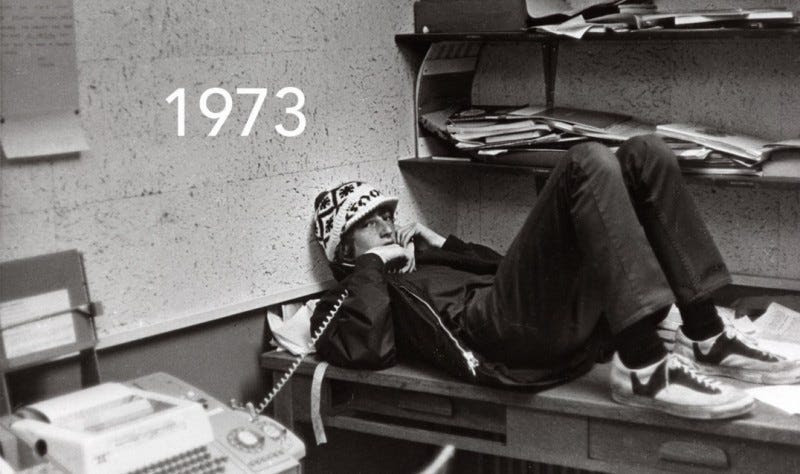
Bill Gates in 1973

First, let’s look at student founders and why they’re important. Student entrepreneurs have long been an important foundation of the startup ecosystem. Many students wrestle with how best to learn while in school —some students learn best through lectures, while more entrepreneurial students like author Julian Docks find it best to leave the classroom altogether and build a business instead.

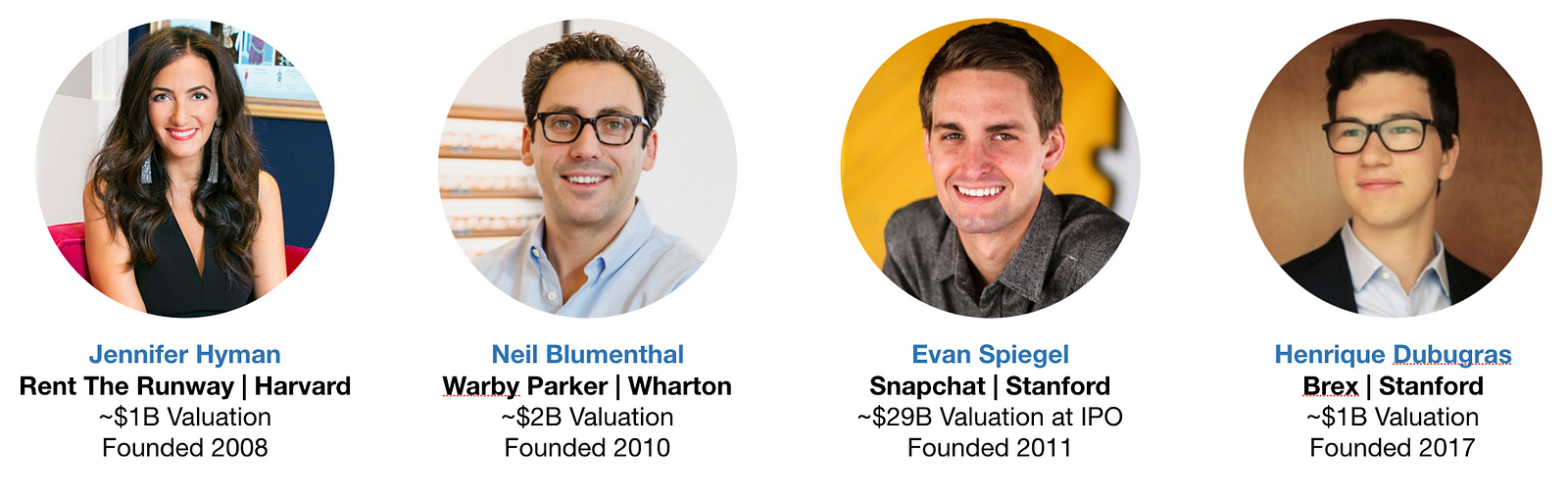
Indeed, some of our most iconic founders are Microsoft’s Bill Gates and Facebook’s Mark Zuckerberg, both student entrepreneurs who launched their startups at Harvard and then dropped out to build their companies into major tech giants. A sample of the current generation of marquee companies founded on college campuses include Snap at Stanford ($29B valuation at IPO), Warby Parker at Wharton (~$2B valuation), Rent The Runway at HBS (~$1B valuation), and Brex at Stanford (~$1B valuation).

Some of today’s most celebrated tech leaders built their first ventures while in school?—?even if some student startups fail, the critical first-time founder experience is an invaluable education in how to build great companies. Perhaps the best example of this that I could find is Drew Houston at Dropbox (~$9B valuation at IPO), who previously founded an edtech startup at MIT that, in his words, provided a: “great introduction to the wild world of starting companies.”
Student founders are everywhere, but the highest concentration of venture-backed student founders can be found at just 5 universities. Based on venture fund portfolio data from the last six years, Harvard, Stanford, MIT, UPenn, and UC Berkeley have produced the highest number of student-founded companies that went on to raise $1 million or more in seed capital. Some prospective students will even enroll in a university specifically for its reputation of churning out great entrepreneurs. This is not to say that great companies are not being built out of other universities, nor does it mean students can’t find resources outside a select number of schools. As you can see later in this essay, there are a number of new ways students all around the country can tap into the startup ecosystem. For further reading, PitchBook produces an excellent report each year that tracks where all entrepreneurs earned their undergraduate degrees.
Student founders have a number of new media resources to turn to. New email newsletters focused on student entrepreneurship like Justine and Olivia Moore’s Accelerated and Kyle Robertson’s StartU offer new channels for young founders to reach large audiences. Justine and Olivia, the minds behind Accelerated, have a lot of street cred— they launched Stanford’s on-campus incubator Cardinal Ventures before landing as investors at CRV.

StartU goes above and beyond to be a resource to founders they profile by helping to connect them with investors (they’re active at 12 universities), and run a podcast hosted by their Editor-in-Chief Johnny Hammond that is top notch. My bet is that traditional media will point a larger spotlight at student entrepreneurship going forward.

New pools of capital are also available that are specifically for student founders. There are four categories that I call special attention to:

  • University-affiliated accelerator programs
  • University-affiliated angel networks
  • Professional venture funds investing at specific universities
  • Professional venture funds investing through student scouts
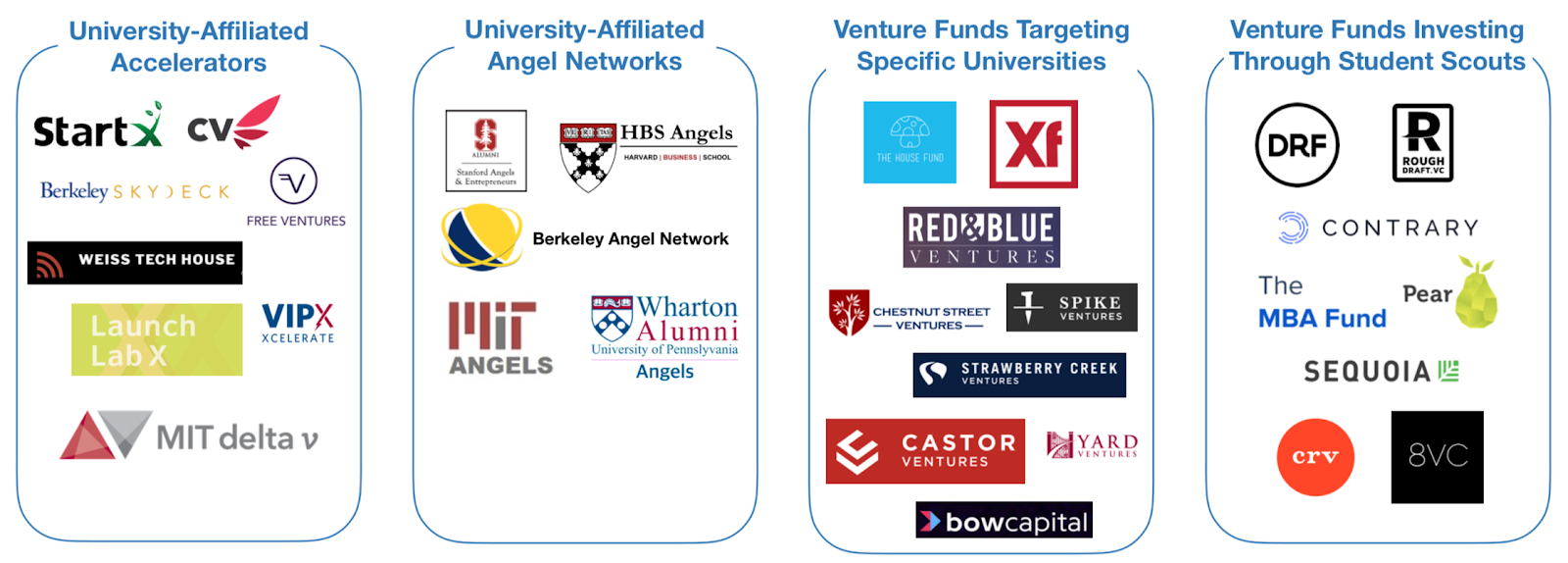
While it is difficult to estimate exactly how much capital has been deployed by each, there is no denying that there has been an explosion in the number of programs that address the pre-seed phase. A sample of the programs available at the Top 5 universities listed above are in the graphic below?—?listing every resource at every university would be difficult as there are so many.

One alumni-centric fund to highlight is the Alumni Ventures Group, which pools LP capital from alumni at specific universities, then launches individual venture funds that invest in founders connected to those universities (e.g. students, alumni, professors, etc.). Through this model, they’ve deployed more than $200M per year! Another highlight has been student scout programs?—?which vary in the degree of autonomy and capital invested?—?but essentially empower students to identify and fund high-potential student-founded companies for their parent venture funds. On campuses with a large concentration of student founders, it is not uncommon to find student scouts from as many as 12 different venture funds actively sourcing deals (as is made clear from David Tao’s analysis at UC Berkeley).
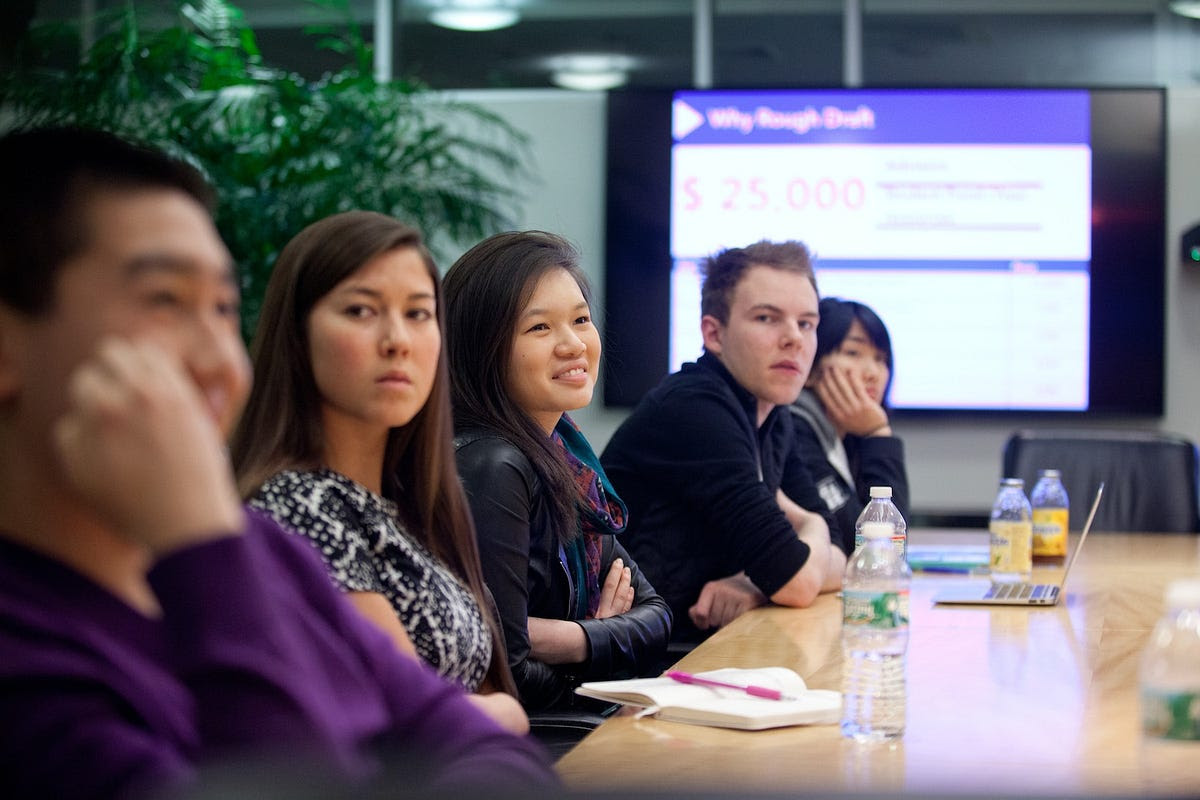
Investment Team at Rough Draft Ventures

In my opinion, the two institutions that have the most expansive line of sight into the student entrepreneurship landscape are First Round’s Dorm Room Fund and General Catalyst’s Rough Draft VenturesSince 2012, these two funds have operated a nationwide network of student scouts that have invested $20K?—?$25K checks into companies founded by student entrepreneurs at 40+ universities. “Scout” is a loose term and doesn’t do it justice?—?the student investors at these two funds are almost entirely autonomous, have built their own platform services to support portfolio companies, and have launched programs to incubate companies built by female founders and founders of color. Another student-run fund worth noting that has reach beyond a single region is Contrary Capital, which raised $2.2M last year. They do a particularly great job of reaching founders at a diverse set of schools?—?their network of student scouts are active at 45 universities and have spoken with 3,000 founders per year since getting started. Contrary is also testing out what they describe as a “YC for university-based founders”. In their first cohort, 100% of their companies raised a pre-seed round after Contrary’s demo day. Another even more recently launched organization is The MBA Fund, which caters to founders from the business schools at Harvard, Wharton, and Stanford. While super exciting, these two funds only launched very recently and manage portfolios that are not large enough for analysis just yet.

Over the last few months, I’ve collected and cross-referenced publicly available data from both Dorm Room Fund and Rough Draft Ventures to assess the state of student entrepreneurship in the United States. Companies were pulled from each fund’s portfolio page, then checked against Crunchbase for amount raised, accelerator participation, and other metrics. If you’d like to sift through the data yourself, feel free to ping me?—?my email can be found at the end of this article. To be clear, this does not represent the full scope of investment activity at either fund?—?many companies in the portfolios of both funds remain confidential and unlisted for good reasons (e.g. startups working in stealth). In fact, the In addition, data for early stage companies is notoriously variable in quality, even with Crunchbase. You should read these insights as directional only, given the debatable confidence interval. Still, the data is still interesting and give good indicators for the health of student entrepreneurship today.

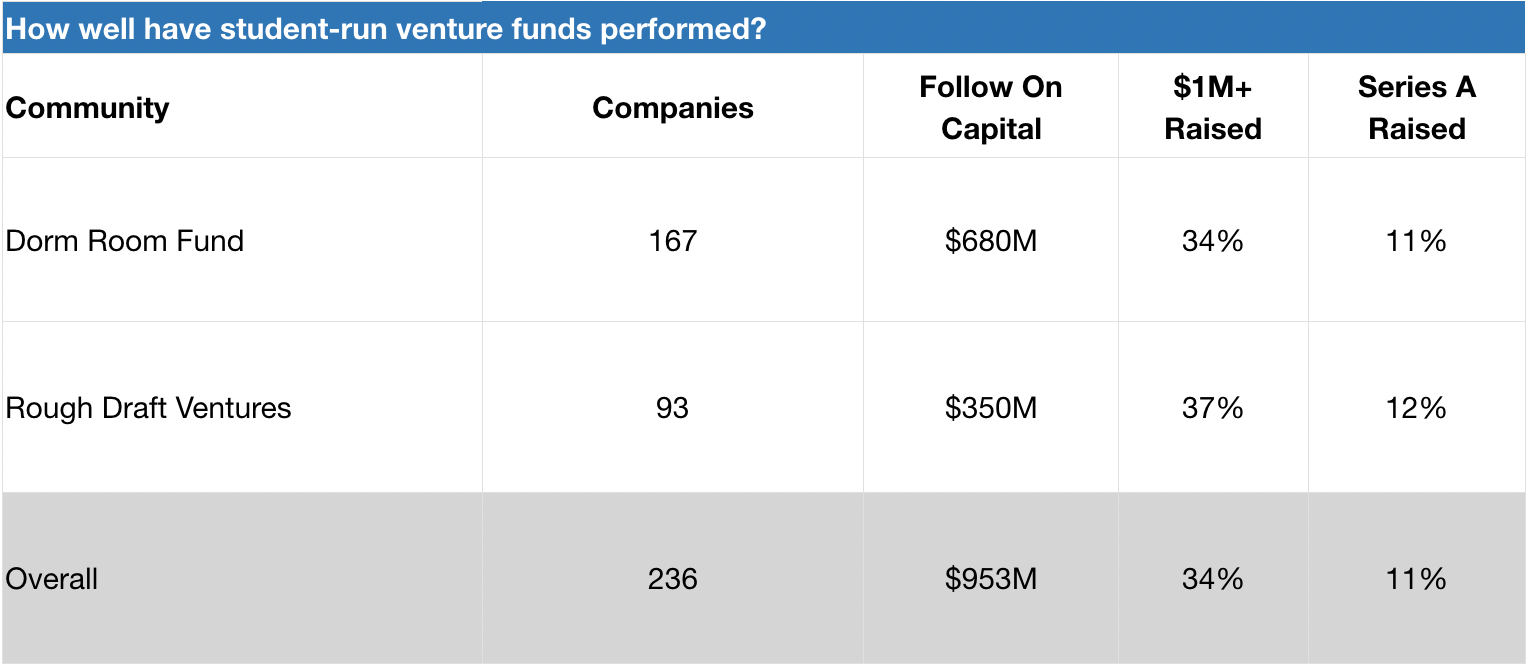
Dorm Room Fund and Rough Draft Ventures have invested in 230+ student-founded companies that have gone on to raise nearly $1 billion in follow on capital. These funds have invested in a diverse range of companies, from govtech (e.g. mark43, raised $77M+ and FiscalNote, raised $50M+) to space tech (e.g. Capella Space, raised ~$34M). Several portfolio companies have had successful exits, such as crypto startup Distributed Systems (acquired by Coinbase) and social networking startup tbh (acquired by Facebook). While it is too early to evaluate the success of these funds on a returns basis (both were launched just 6 years ago), we can get a sense of success by evaluating the rates by which portfolio companies raise additional capital. Taken together, 34% of DRF and RDV companies in our data set have raised $1 million or more in seed capital. For a rough comparison, CB Insights cites that 40% of YC companies and 48% of Techstars companies successfully raise follow on capital (defined as anything above $750K). Certainly within the ballpark!
Source: Crunchbase

Dorm Room Fund and Rough Draft Ventures companies in our data set have an 11–12% rate of survivorship to Series A. As a benchmark, a previous partner at Y Combinator shared that 20% of their accelerator companies raise Series A capital (YC declined to share the official figure, but it’s likely a stat that is increasing given their new Series A support programs. For further reading, check out YC’s reflection on what they’ve learned about helping their companies raise Series A funding). In any case, DRF and RDV’s numbers should be taken with a grain of salt, as the average age of their portfolio companies is very low and raising Series A rounds generally takes time. Ultimately, it is clear that DRF and RDV are active in the earlier (and riskier) phases of the startup journey.

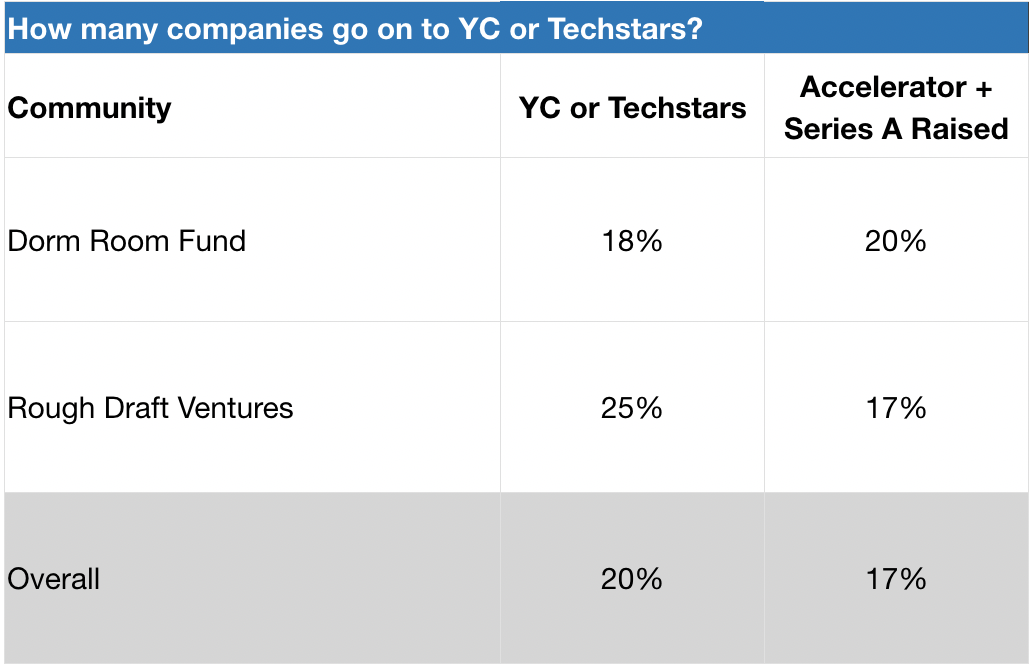
Dorm Room Fund and Rough Draft Ventures send 18–25% of their portfolio companies to Y Combinator or Techstars. Given YC’s 1.5% acceptance rate as reported in Fortune, this is quite significant! Internally, these two funds offer founders an opportunity to participate in mock interviews with YC and Techstars alumni, as well as tap into their communities for peer support (e.g. advice on pitch decks and application content). As a result, Dorm Room Fund and Rough Draft Ventures regularly send cohorts of founders to these prestigious accelerator programs. Based on our data set, 17–20% of DRF and RDV companies that attend one of these accelerators end up raising Series A venture financing.
Source: Crunchbase

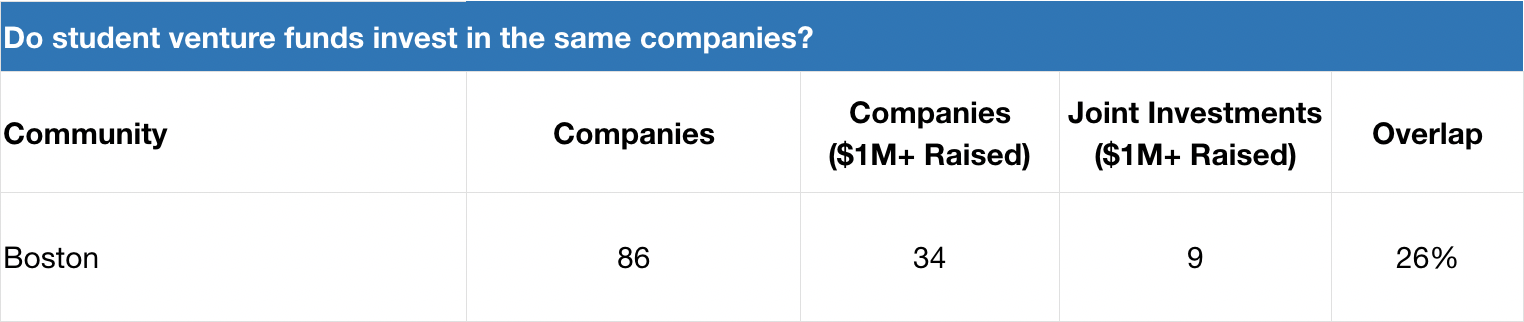
Dorm Room Fund and Rough Draft Ventures don’t invest in the same companies. When we take a deeper look at one specific ecosystem where these two funds have been equally active over the last several years?—?Boston?—?we actually see that the degree of investment overlap for companies that have raised $1M+ seed rounds sits at 26%. This suggests that these funds are either a) seeing different dealflow or b) have widely different investment decision-making.
Source: Crunchbase

Dorm Room Fund and Rough Draft Ventures should not just be measured by a returns-basis today, as it’s too early. I hypothesize that DRF and RDV are actually encouraging more entrepreneurial activity in the ecosystem (more students decide to start companies while in school) as well as improving long-term founder outcomes amongst students they touch (portfolio founders build bigger and more successful companies later in their careers). As more students start companies, there’s likely a positive feedback loop where there’s increasing peer pressure to start a company or lean on friends for founder support (e.g. feedback, advice, etc).Both of these subjects warrant additional study, but it’s likely too early to conduct these analyses today.

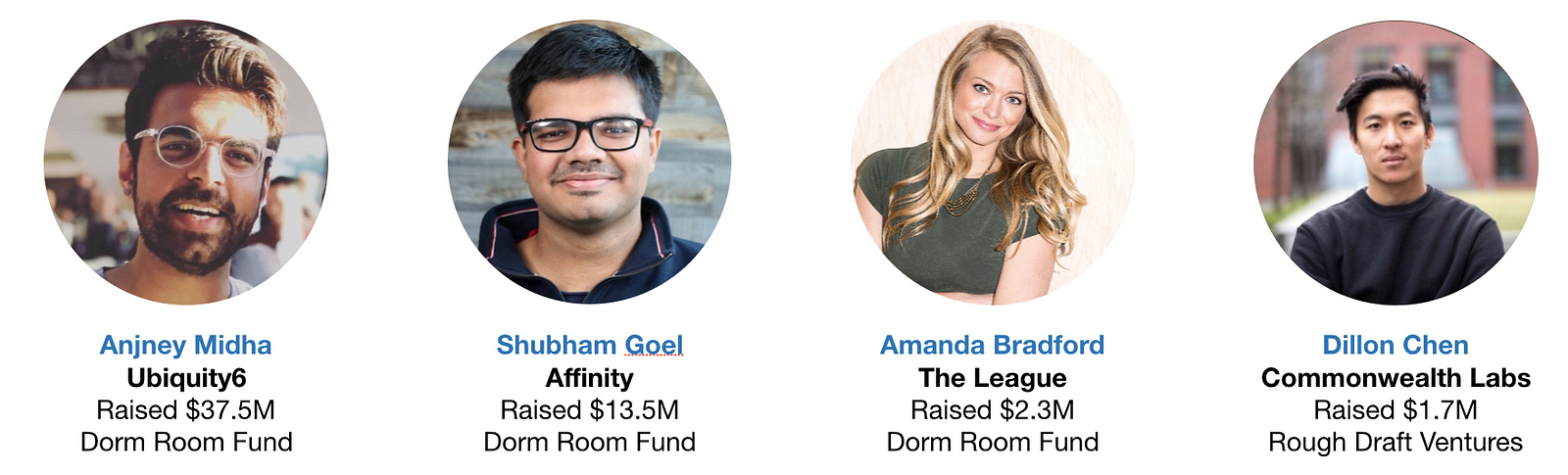
Dorm Room Fund and Rough Draft Ventures have impressive alumni that you will want to track. 1 in 4 alumni partners are founders, and 29% of these founder alumni have raised $1M+ seed rounds for their companies. These include Anjney Midha’s augmented reality startup Ubiquity6 (raised $37M+), Shubham Goel’s investor-focused CRM startup Affinity (raised $13M+), Bruno Faviero’s AI security software startup Synapse (raised $6M+), Amanda Bradford’s dating app The League (raised $2M+), and Dillon Chen’s blockchain startup Commonwealth Labs (raised $1.7M). It makes sense to me that alumni from these communities that decide to start companies have an advantage over their peers?—?they know what good companies look like and they can tap into powerful networks of young talent / experienced investors.
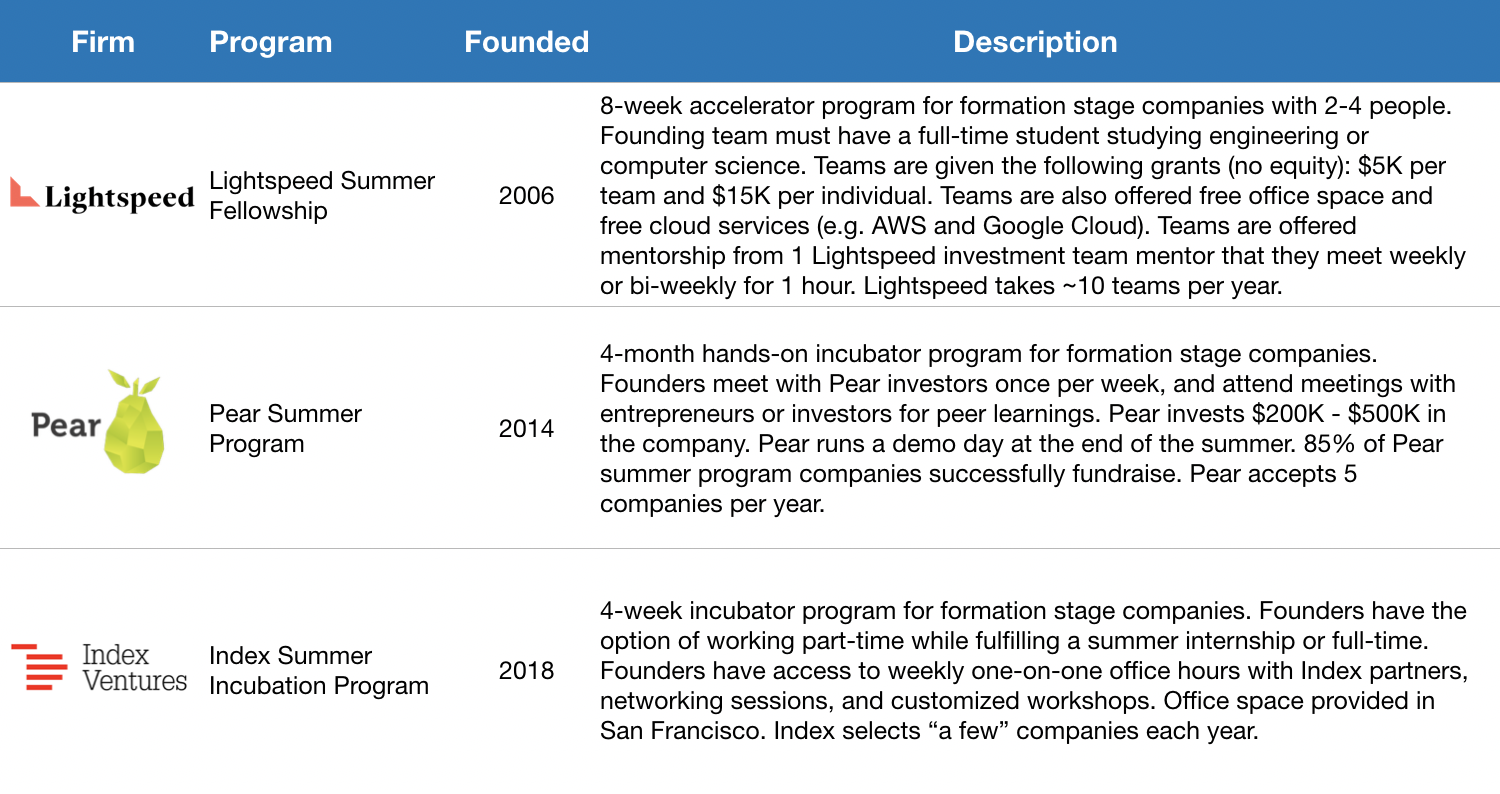
Beyond Dorm Room Fund and Rough Draft Ventures, some venture capital firms focus on incubation for student-founded startups. Credit should first be given to Lightspeed for producing the amazing Summer Fellows bootcamp experience for promising student founders?—?after all, Pinterest was built there! Jeremy Liew gives a good overview of the program through his sit-down interview with Afterbox’s Zack Banack. Based on a study they conducted last year, 40% of Lightspeed Summer Fellows alumni are currently active founders. Pear Ventures also has an impressive summer incubator program where 85% of its companies successfully complete a fundraise. Index Ventures is the latest to build an incubator program for student founders, and even accepts founders who want to work on an idea part-time while completing a summer internship.
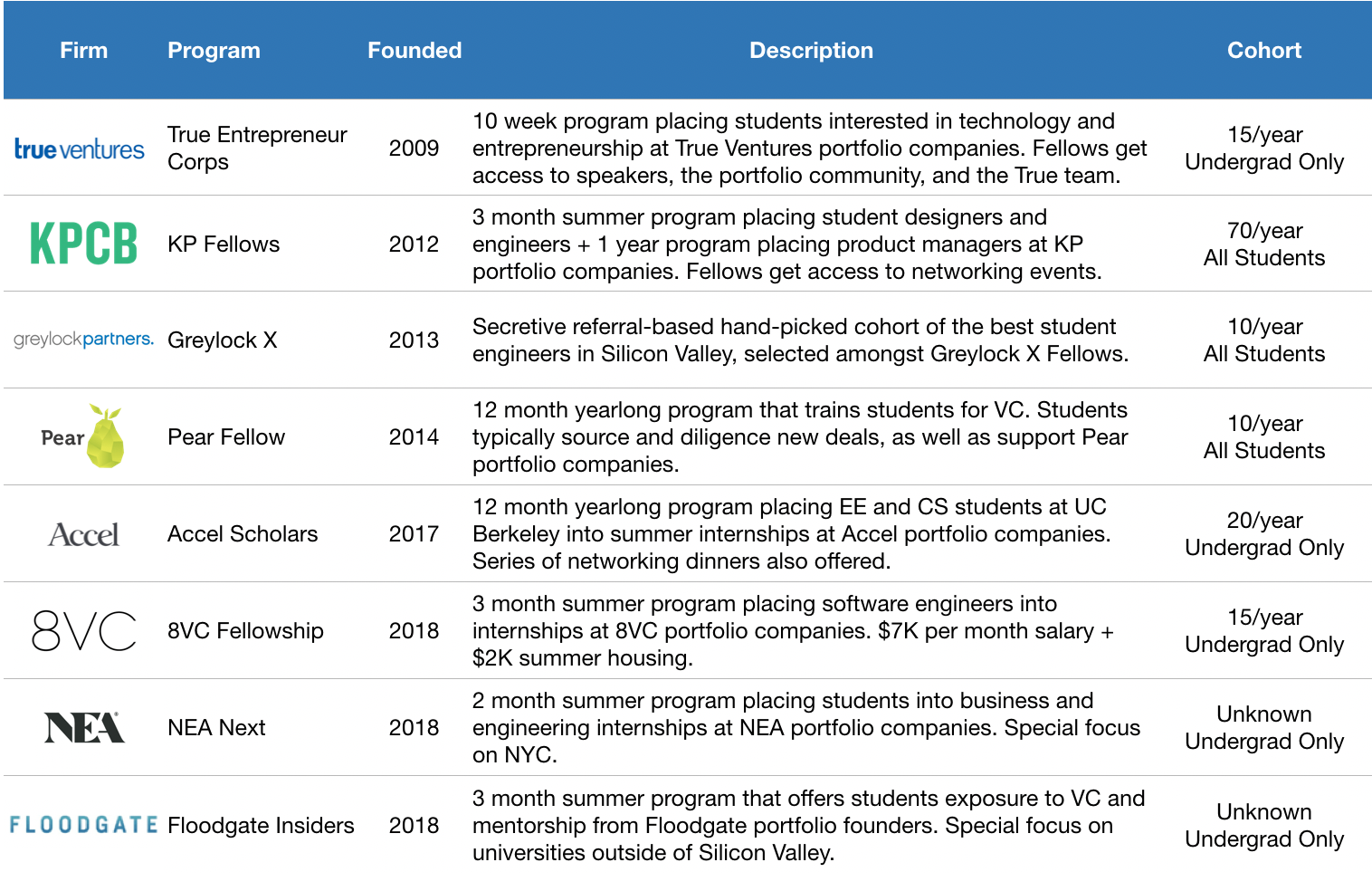
Let’s now look at students who want to join a startup before founding one. Venture funds have historically looked to tap students for talent, and are expanding the engagement lifecycle. The longest running programs include Kleiner Perkins’<strong class=”m_1196721721246259147gmail-markup–strong m_1196721721246259147gmail-markup–p-strong”> KP Fellows and True Ventures’ TEC Fellows, which focus on placing the next generation’s most promising product managers, engineers, and designers into the portfolio companies of their parent venture funds.

There’s also the secretive Greylock X, a referral-based hand-picked group of the best student engineers in Silicon Valley (among their impressive alumni are founders like Yasyf Mohamedali and Joe Kahn, the folks behind First Round-backed Karuna Health). As these programs have matured, these firms have recognized the long-run value of engaging the alumni of their programs.

More and more alumni are “coming back” to the parent funds as entrepreneurs, like KP Fellow Dylan Field of Figma (and is also hosting a KP Fellow, closing a full circle loop!). Based on their latest data, 10% of KP Fellows alumni are founders?—?that’s a lot given the fact that their community has grown to 500! This helps explain why Kleiner Perkins has created a structured path to receive $100K in seed funding to companies founded by KP Fellow alumni. It looks like venture funds are beginning to invest in student programs as part of their larger platform strategy, which can have a real impact over the long term (for further reading, see this analysis of platform strategy outcomes by USV’s Bethany Crystal).
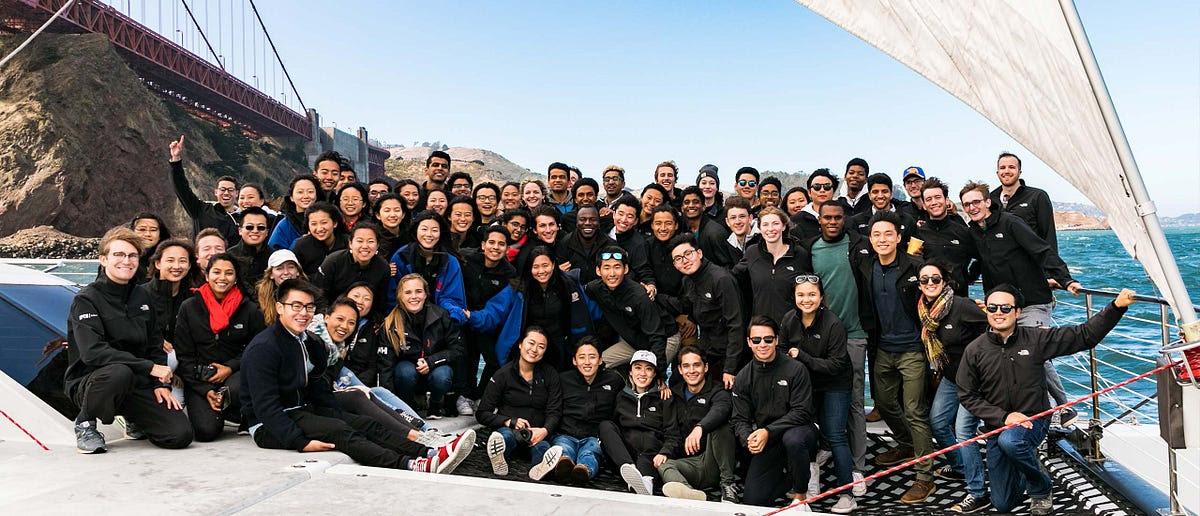
KP Fellows in San Francisco

Venture funds are doubling down on student talent engagement?—?in just the last 18 months, 4 funds have launched student programs. It’s encouraging to see new funds follow in the footsteps of First Round, General Catalyst, Kleiner Perkins, Greylock, and Lightspeed. In 2017, Accel launched their Accel Scholars program to engage top talent at UC Berkeley and Stanford. In 2018, we saw 8VC Fellows, NEA Next, and Floodgate Insiders all launch, targeting elite universities outside of Silicon Valley. Y Combinator implemented Early Decision, which allows student founders to apply one batch early to help with academic scheduling. Most recently, at the start of 2019, First Round launched the Graduate Fund (staffed by Dorm Room Fund alumni) to invest in founders who are recent graduates or young alumni.

Given more time, I’d love to study the rates by which student founders start another company following investments from student scout funds, as well as whether or not they’re more successful in those ventures. In any case, this is an escalation in the number of venture funds that have started to get serious about engaging students?—?both for talent and dealflow.
Student entrepreneurship 2.0 is here. There are more structured paths to success for students interested in starting or joining a startup. Founders have more opportunities to garner press, seek advice, raise capital, and more. Venture funds are increasingly leveraging students to help improve the three F’s?—?finding, funding, and fixing. In my personal view, I believe it is becoming more and more important for venture funds to gain mindshare amongst the next generation of founders and operators early, while still in school.

I can’t wait to see what’s next for student entrepreneurship in 2019. If you’re interested in digging in deeper (I’m human?—?I’m sure I haven’t covered everything related to student entrepreneurship here) or learning more about how you can start or join a startup while still in school, shoot me a note at [email protected]A massive thanks to Phin Barnes, Rei Wang, Chauncey Hamilton, Peter Boyce, Natalie Bartlett, Denali Tietjen, Eric Tarczynski, Will Robbins, Jasmine Kriston, Alicia Lau, Johnny Hammond, Bruno Faviero, Athena Kan, Shohini Gupta, Alex Immerman, Albert Dong, Phillip Hua-Bon-Hoa, and Trevor Sookraj for your incredible encouragement, support, and insight during the writing of this essay.


References to next-gen Oculus ‘Rift S’ headset reportedly found in internal code

After we broke the news in November that Oculus’s former CEO had left the company partially due to disagreements on the company’s PC hardware direction, including the cancellation of a high-end “Rift 2” in favor of a more iterative “Rift S” headset, new details are emerging that confirm Facebook’s directional shift for its flagship headset.

User interface code discovered by UploadVR seems to confirm that Oculus is actively readying their software for the “Rift S” hardware. Details, including the “Rift S” name and the fact that the headset will be powered by onboard cameras rather than external sensors, were apparent from code that referenced options to change settings on the “Rift S cameras.” The report also details that the displays could function differently and utilize a software-based approach for adjusting for the distance between a user’s eyes.

We’ve reached out to Facebook for comment.

UploadVR found some supporting files that back up my November report that Oculus is releasing a new headset with inside-out tracking called the Rift S https://t.co/9wK02Pr80n

— Lucas Matney (@lucasmtny) February 5, 2019

Our initial report detailed that Oculus would be abandoning its external sensor system and relying on the onboard tracking camera setup from the Oculus Quest headset. Additionally we shared details that the device’s display resolution would be getting a small bump.

We’ve been told that the Rift S headset will launch this year. Last year, the Oculus Go headset was revealed at Facebook’s F8 conference; will we see a similar unveil in a few months for both the Rift S and Oculus Quest, or will the social networking giant space out its VR hardware launches a bit?

Blue Apron hopes lower-cost meal kits, now on Jet in NYC, will help save its business

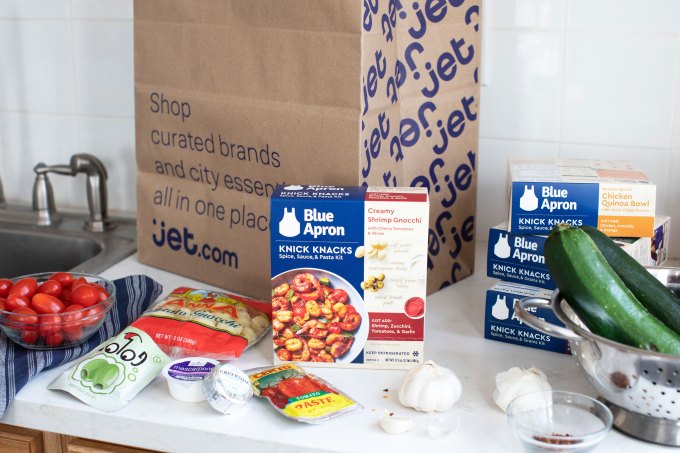
Blue Apron is introducing a lower-cost version of its meal kits, initially only for Jet.com shoppers in the greater New York City metro area. The new kits, called “Knick Knacks,” still require refrigeration, but require customers to supply their own protein and produce to complete the meal. But by dropping the two most expensive ingredients from the meal, the company has brought the price down to $7.99, compared with prices that ranged from $17 to $23 for the meal kits that launched on Jet last fall.

As you may recall, Walmart subsidiary Jet announced in October that it would begin selling Blue Apron’s meal kits to its City Grocery customers. Jet had relaunched its site the month prior with a new focus on serving the needs of urban shoppers, which included same-day delivery of groceries. The revamped site is now localized to where shoppers live, with images and messaging specific to the customer’s city.

The localization efforts would begin in New York, Jet said at the time, before rolling out to other major U.S. metros like Boston, Philadelphia and D.C.

Jet then became the first online retailer to sell Blue Apron’s meal kits — giving the meal kit company a needed boost at a time when its subscriber base had been in decline.

Though Blue Apron’s name had become synonymous with meal kits, they were beset with challenges on all sides — including then fast-growing competitors like HelloFresh, an inability to reduce unit costs, customer base declines and the challenges in converting newcomers to subscribers in the face of competition from ready-to-eat meals, delivered on demand and available at most markets today for pickup.

With Knick Knacks, Blue Apron is tackling some of the issues with its meal kits — namely, the high cost and the need to subscribe to receive them.

The company announced Knick Knacks last week on its earnings call, where it reported still very concerning numbers.

Earnings were down -62 percent year-over-year at $-0.18 and quarterly revenues dropped by -28 percent to reach $150.62 million, versus $210.64 million in the same period a year ago.

At this point, the future of Blue Apron is very much tied to how well its strategic partnerships, like this with Jet and the other with WW (formerly, Weight Watchers), eventually play out.

The new kits themselves will include a combination of pre-portioned spices, sauces, grains and dairy ingredients from Blue Apron’s premium suppliers, such as crème fraîche from Vermont Creamery, furikake from Mara Seaweed and preserved lemon puree from NY Shuk, as well as Blue Apron’s own proprietary products, such as its line of custom spice blends, the company says.

The debut collection includes the following:

  • Za’atar-Spiced Chicken
  • Mexican-Spiced Chicken Quinoa Bowl
  • Japanese-Style Steak & Rice Bowl
  • Creamy Shrimp Gnocchi

The kits are available in New York’s metro area only for the time being for both same-day and next-day delivery. The company declined to say when they’d hit other markets, or if Blue Apron would sell the kits elsewhere, like in Jet parent Walmart’s stores.

Blue Apron’s new launch comes at a tough time for the food delivery industry as a whole. Earlier this year, meal delivery business Munchery failed after having raised $125 million; Doughbies, Sprig, Maple, Juicero and Josephine also folded.

Instacart CEO apologizes for tipping debacle

On the heels of a recently filed class-action lawsuit over wages and tips, as well as drivers and shoppers speaking out about Instacart’s alleged practices of subsidizing wages with tips, Instacart is taking steps to ensure tips are counted separately from what Instacart pays shoppers.

In a blog post today, Instacart CEO Apoorva Mehta said all shoppers will now have a guaranteed higher base compensation, paid by Instacart. Depending on the region, Instacart says it will pay shoppers between $7 to $10 at a minimum for full-service orders (shopping, picking and delivering) and $5 at a minimum for delivery-only tasks. The company will also stop including tips in its base pay for shoppers.

“After launching our new earnings structure this past October, we noticed that there were small batches where shoppers weren’t earning enough for their time,” Mehta wrote. “To help with this, we instituted a $10 floor on earnings, inclusive of tips, for all batches. This meant that when Instacart’s payment and the customer tip at checkout was below $10, Instacart supplemented the difference. While our intention was to increase the guaranteed payment for small orders, we understand that the inclusion of tips as a part of this guarantee was misguided. We apologize for taking this approach.”

For the shoppers who were subject to that approach, Instacart says it will retroactively pay people whose tips were included in payment minimums.

You can read the full blog post at the bottom of this post. For background, Instacart had previously guaranteed its workers at least $10 per job, but workers said Instacart offset wages with tips from customers.

The suit alleges Instacart “intentionally and maliciously misappropriated gratuities in order to pay plaintiff’s wages even though Instacart maintained that 100 percent of customer tips went directly to shoppers. Based on this representation, Instacart knew customers would believe their tips were being given to shoppers in addition to wages, not to supplement wages entirely.”

In addition to the lawsuit, workers have taken to Reddit and other online forums to speak out against Instacart’s paying practices. Since introducing a new payments structure in October, which includes things like payments per mile, quality bonuses and customer tips, workers have said the pay has gotten worse — far below minimum wage. In one case, Instacart paid a worker just 80 cents for over an hour of work. Instacart has since said it was a glitch — caused by the fact that the customer tipped $10 — and has introduced a new minimum payment for orders. So, Instacart paid the worker $10.80, but just 80 cents of it came from Instacart.

While Instacart has said this was an edge case, Working Washington says this has happened in other cases. In another case, Instacart paid a worker just $7.26 (including cost of mileage) for over two hours’ worth of work.

“We heard loud and clear the frustration when your compensation didn’t match the effort you put forth,” Mehta wrote in the blog post. “As we looked at some of the extreme examples that have been surfaced by you over the last few days, it’s become clear to us that we can and should do better. Instacart shouldn’t be paying a shopper $0.80 for a batch. It doesn’t matter that this only happens 1 out of 100,000 times – it happened to one shopper and that’s one time too many.”

Here’s the full text of Mehta’s post:

To Our Shopper Community:

Every day, millions of people entrust Instacart to help get the food they need to feed their families and get back valuable time to spend with their loved ones. By delivering to and for our customers, you’ve become household heroes for millions of families across North America. This past week however, it’s become clear, that we’ve fallen short in delivering on our promise to you.

As you know, we’ve made changes to our shopper earnings model over the last year. These changes were designed to increase transparency while also keeping pace with a rapidly-evolving industry. In doing so, we’ve tried, in good faith, to balance those needs, but clearly we haven’t always gotten it right.

As a company, we remain committed to listening and putting our shoppers more at the forefront of our decision making. Based on your feedback, today we’re launching new measures to more fairly and competitively compensate all our shoppers. As part of this, our earnings approach moving forward will adhere to the following:

  • Tips should always be separate from Instacart’s contribution to shopper compensation

  • All batches will have a higher guaranteed compensation floor for shoppers, paid for by Instacart

  • Instacart will retroactively compensate shoppers when tips were included in minimums

Below are details on each new element of shopper earnings, which we will be rolling out in the coming days.

Tips Should Always Be Separate From Instacart’s Contribution to Shopper Compensation – After launching our new earnings structure this past October, we noticed that there were small batches where shoppers weren’t earning enough for their time. To help with this, we instituted a $10 floor on earnings, inclusive of tips, for all batches. This meant that when Instacart’s payment and the customer tip at checkout was below $10, Instacart supplemented the difference. While our intention was to increase the guaranteed payment for small orders, we understand that the inclusion of tips as a part of this guarantee was misguided. We apologize for taking this approach.

All Batches Will Have a Higher Guaranteed Floor for Shoppers, Paid by Instacart – We’re instituting a higher minimum floor payment from Instacart on all batches. Today our minimum batch payment is $3. Depending on the region, our minimum batch payment will increase to between $7 and $10 for full service batches (where a shopper picks, packs and delivers the order) and $5 for delivery only batches (where a shopper delivers the order after a separate person picks the groceries). These increased batch floors will be consistent for all shoppers within a particular geographic area. In addition to the higher guaranteed floors, Instacart will also pay a quality bonus and peak boosts for orders that qualify. Any tips earned by shoppers will be separate and in addition to Instacart’s contribution.

Instacart Will Retroactively Compensate Shoppers When Tips Were Included in Minimums – Over the coming days, as we transition to the new higher minimum floor payments, we will make you whole on the transactions that have occurred since the launch of this feature. Specifically, we will proactively reach out to all shoppers who were adversely affected by instances in which Instacart’s payment was below the $10 threshold. For example, if a shopper was paid $6 by Instacart, to compensate for our mistake, he or she will receive an additional $4 from Instacart.

In creating these changes to improve, enhance and create clarity for shopper compensation, these new measures will do the following:

1. Better protect shoppers from smaller, outlying batches. We heard loud and clear the frustration when your compensation didn’t match the effort you put forth. As we looked at some of the extreme examples that have been surfaced by you over the last few days, it’s become clear to us that we can and should do better. Instacart shouldn’t be paying a shopper $0.80 for a batch. It doesn’t matter that this only happens 1 out of 100,000 times – it happened to one shopper and that’s one time too many. We believe that these new guaranteed floor minimums will better protect our shoppers going forward.

2. Customer tips will no longer have any impact on Instacart’s contribution to shopper earnings. With an average tip of $5, our customers regularly recognize shoppers with tips for the services they provide. We believe that with these changes customers will continue to be able to recognize great service and have full confidence that their tips are going to the shopper who delivered their order, with no impact whatsoever on what the shopper receives from Instacart. As always, shoppers will receive 100% of their tips, regardless of the batch compensation.  

3. These changes will increase Instacart’s overall contribution to our shopper’s earnings and we believe that the change in tip structure will separate Instacart from an industry standard that’s no longer working for our shoppers and our customers.

Finally, I want to thank you for your feedback. It’s our responsibility to change course quickly when we realize we’re on the wrong path and we believe today’s changes are a step in the right direction.

Apoorva Mehta

Founder & CEO of Instacart

SpaceX and Boeing commercial crew capsule test dates slip yet again

One of the most important upcoming events in the space industry is undoubtedly the advent of SpaceX and Boeing’s competing crew-bearing capsules, which the companies have been working on for years. But today brings yet another delay for both programs, already years behind schedule.

Boeing’s Starliner and SpaceX’s Crew Dragon capsules will in the future be used to send astronauts to the International Space Station and conceivably other orbital platforms. As such, they are being engineered and tested with a rigor greatly exceeding that of ordinary cargo capsules.

It isn’t an easy task, though, and both companies have come a long way, but we’re well past the original estimated service debut of 2017. When it comes to shooting humans into space, of course, it’s done when it’s done, and not a day before.

This month was to be a major milestone for Crew Dragon, which was scheduled to make an uncrewed test trip to the ISS; Boeing planned to perform orbital tests soon as well, but both have been put off, according to NASA’s Commercial Crew blog:

The agency now is targeting March 2 for launch of SpaceX’s Crew Dragon on its uncrewed Demo-1 test flight. Boeing’s uncrewed Orbital Flight Test is targeted for launch no earlier than April.

These adjustments allow for completion of necessary hardware testing, data verification, remaining NASA and provider reviews, as well as training of flight controllers and mission managers.

In other words, they’re just plain not ready. Close, but for human spaceflight, close isn’t good enough.

The rest of 2019 will, if there are no serious delays, be filled with further milestones in the program. Here’s the tentative schedule:

  • SpaceX Demo-1 (uncrewed): March 2, 2019
  • Boeing Orbital Flight Test (uncrewed): NET April 2019
  • Boeing Pad Abort Test: NET May 2019
  • SpaceX In-Flight Abort Test: June 2019
  • SpaceX Demo-2 (crewed): July 2019
  • Boeing Crew Flight Test (crewed): NET August 2019

This summer, then, should be a momentous one for space travel. In the meantime, the only way to get people into orbit is the Russian Soyuz system, which has proven itself over and over but ultimately is both outdated and, well, Russian. A homegrown, 21st-century alternative is rapidly becoming a must-have.

Robin’s robotic mowers now have a patented doggie door just for them

Back in 2016 we had Robin up onstage demonstrating the possibility of a robotic mower as a service rather than just something you buy. They’re still going strong, and just introduced and patented what seems in retrospect a pretty obvious idea: an automatic door for the mower to go through fences between front and back yards.

It’s pretty common, after all, to have a back yard isolated from the front lawn by a wood or chain link fence so dogs and kids can roam freely with only light supervision. And if you’re lucky enough to have a robot mower, it can be a pain to carry it from one side to the other. Isn’t the whole point of the thing that you don’t have to pick it up or interact with it in any way?

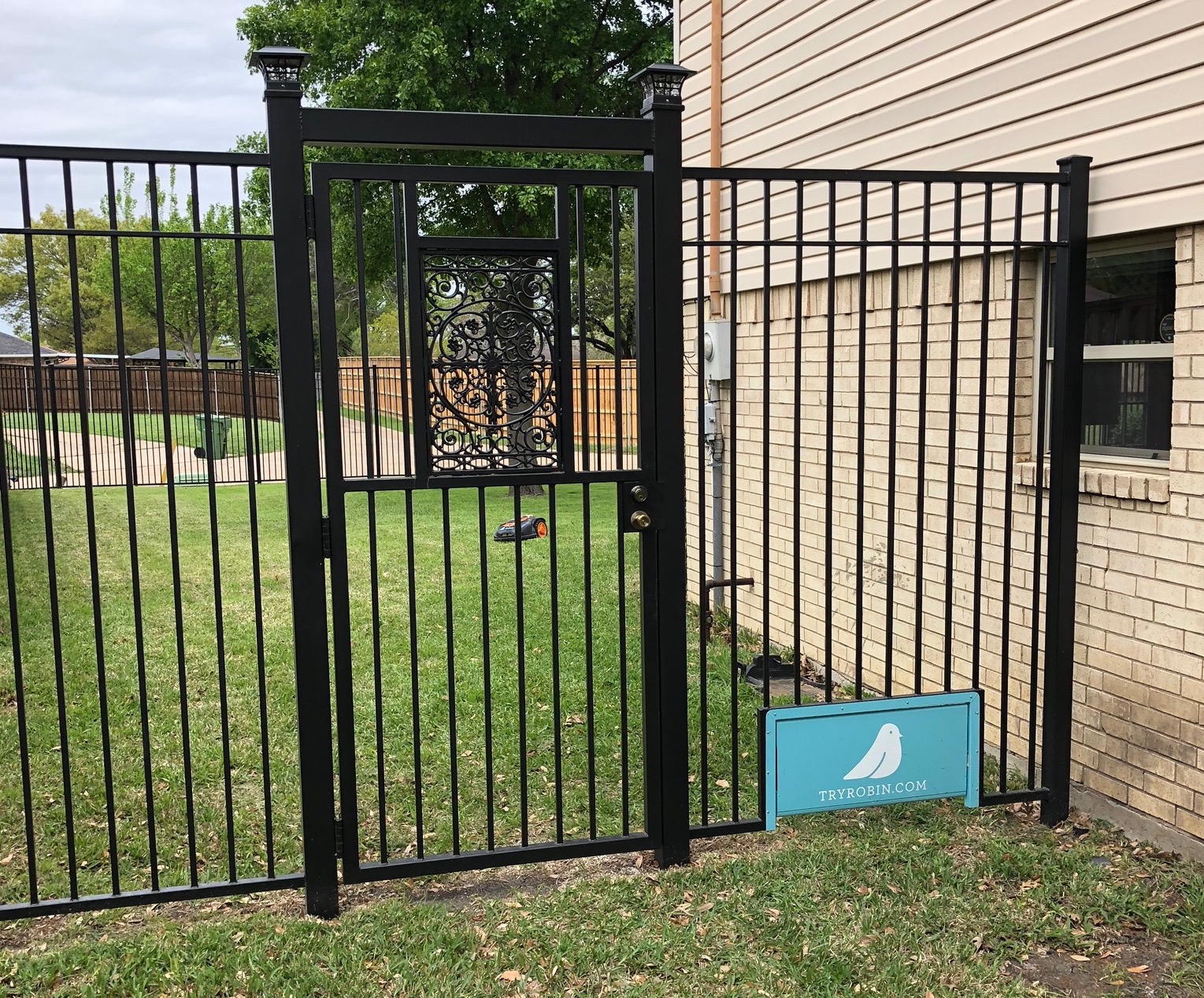
The solution Justin Crandall and his team at Robin came up with is simple and straightforward: an automatic mower-size door that opens only to let it through.

“In Texas over 90 percent of homes have a fenced in backyard, and even in places like Charlotte and Cleveland it’s roughly 25-30 percent, so technology like this is critical to adoption,” Crandall told me. “We generally dock the robots in the backyard for security. When it’s time to mow the front yard, the robots drive to the door we place in the fence. As it approaches the door, the robot drives over a sensor we place in the ground. That sensor unlocks the door to allow the mower access.”

Simple, right? It uses a magnetometer rather than wireless or IR sensor, since those introduced possibilities of false positives. And it costs around $100-$150, easily less than a second robot or base, and probably pays for itself in goodwill around the third or fourth time you realize you didn’t have to carry your robot around.

It’s patented, but rivals (like iRobot, which recently introduced its own mower) could certainly build one if it was sufficiently different.

Robin has expanded to several states and a handful of franchises (its plan from the start) and maintains that its all-inclusive robot-as-a-service method is better than going out and buying one for yourself. Got a big yard and no teenage kids who can mow it for you? See if Robin’s available in your area.

Microsoft really, really, really doesn’t want you to buy Office 2019

Microsoft launched a new ad campaign for its Office suite today. Usually, that’s not something especially interesting, but this one is a bit different. Instead of simply highlighting the features of Word and Excel, Microsoft decided to pitch Office 365 and Office 2019 against each other (as an extra gimmick, it used twins to do so, too). But here’s the deal: Microsoft really doesn’t want you to buy Office 2019, and the ads make that abundantly clear.

The reason for that is obvious: Office 365 is a subscription product while Office 2019 (think Office Home & Student or other SKUs) comes with a perpetual license, so that’s a one-time sale for Microsoft. Subscriptions are a better business for Microsoft in the long run (hence its recent focus on products like Microsoft 365, too).

For the longest time, the annual non-365 Office release was simply a snapshot of the state of the Office apps at a given time. That changed with Office 365. Now, Office 365 users are the ones who get all the online features, including a bunch of AI-driven tools, while the Office 2019 versions don’t get any of these.

Office 365 subscriptions start at $70 for personal use and $8.25/month for business users. Office Home and Business is a one-time $250 purchase.

Unsurprisingly, in the new ads, which give the actors twins various challenges to perform in the likes of Word, Excel and PowerPoint, Office 365 beats Office 2019 every time. Yawn. The ads aren’t very good and you will cringe a few times (though sadly, they are no rival to Microsoft’s worst commercial ever, 2009’s Songsmith debacle), but you’ll definitely come away with a sense that Microsoft really wants you to subscribe to Office 365 and not buy a perpetual Office 2019 license and then maybe buy the next update in 2025.

Investigation finds e-scooters a cause of 1,500+ accidents

An investigation by Consumer Reports may force electric scooter businesses to double back on safety measures.

The magazine found electric scooters caused 1,545 injuries in the U.S. since late 2017, according to data collected from 110 hospitals and five public agencies in 47 cities where Bird or Lime, the leading tech-enabled scooter-sharing platforms, operate.

The news comes shortly after UCLA published a study finding that 249 people required medical care following scooter accidents, with one-third of that group arriving at the hospital in an ambulance.

“These injuries can be severe,” Tarak Trivedi, an emergency physician at UCLA and the study’s lead author, told CNET. “These aren’t just minor cuts and scrapes. These are legit fractures.”

Despite commentary from scooter CEOs suggesting otherwise, safety doesn’t seem to be a priority for businesses in the space. Given the nature of the industry, taking a ride on an e-scooter or a dockless bike without a helmet is the norm. That, coupled with failed hardware, irresponsible riding practices and access to scooters in the evening, has unsurprisingly led to several accidents and even casualties. Just this past weekend, the city of Austin reported a pedestrian riding a Lime scooter died after being struck by an Uber driver. The Lime scooter rider was traveling the wrong way down an interstate.

Lime, Bird and other leading scooter providers do provide free helmets to riders and don’t encourage poor scooter etiquette, but ensuring riders actually carry helmets or don’t do stupid things like travel the wrong way down a busy road is impossible.

With a fresh $310 million in Series D funding for Lime, announced today, it will be interesting to see how the company ramps up safety efforts.