Outcry about the layoffs has continued throughout the week.
Category: Tech news
hacking,system security,protection against hackers,tech-news,gadgets,gaming
BRCK acquires ISPs EveryLayer and Surf to boost Africa’s public Wi-Fi
Jake Bright
Contributor
Contributor
Jake Bright is a writer and author in New York City. He is co-author of The Next Africa.
Kenyan communications hardware company BRCK has acquired the assets of Nairobi based internet provider Surf and its U.S. parent EveryLayer in a purchase deal of an undisclosed amount announced Friday.
Based in Nairobi, Surf is a hotspot service provider aimed at offering affordable internet to lower income segments. BRCK is a five year old venture that pairs its rugged WiFi routers to internet service packages designed to bring people online in frontier and emerging markets.
With the acquisition, BRCK gains the assets of San Francisco based EveryLayer and its Surf subsidiary, including 1200 hotspots and 200,000 active customers across 22 cities in Kenya, according to BRCK CEO and founder Erik Hersman. EveryLayer CEO Mark Summer confirmed these details with TechCrunch.
Backed by $10 million from investors including Steve Case’s Revolution VC fund, BRCK plans to use its new resources to expand to an undisclosed East African country and is eying options abroad. “We’re looking at Indonesia and starting our pilot in Mexico next month,” Hersman told TechCrunch on a call from Kigali.
BRCK built its platform around providing internet solutions primarily in Kenya and Rwanda. In 2017, the company rolled out its SupaBRCK product and paired it to its Moja service, which offers free public WiFi—internet, music, and entertainment—subsidized by commercial partners.

There’s not a requirement to click on or watch advertisements to gain Moja access, though users can gain faster access if they “interact with one of our business partners…by doing a survey, downloading an app, or watching an ad,” said Hersman.
In 2018, BRCK began offering SupaBRCK devices to drivers of Nairobi’s Mutatu buses for Kenyan commuters to access Moja. As of January Moja traffic is racking up 300,000 active uniques and 3.7 million impressions per month, according to Hersman.
The BRCK founder has described Africa’s internet challenges—mainly the lowest penetration rates in the world—as shifting toward more of an affordability than availability problem.
“The demand on internet in Africa is largely driven by the 10 to 15 percent who can afford it. The real massive opportunity is trying to connect the 70 to 80 percent of the people who can’t. That’s where the internet race really is,” Hersman told TechCrunch in 2017.
Speaking on the recent EveryLayer asset acquisition, Hersman explained that improvements over recent years in Africa’s smartphone penetration, internet costs, and broadband capabilities are not necessarily translating to large portions of Africa’s 1.2 billion people.
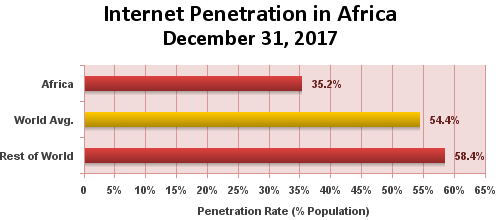
“Even with penetration improving, even with data prices going down, there’s still not a viable way to get internet to huge swaths of people,” he told TechCrunch. “The real numbers are that about 20 percent in every country can now afford to buy data-bundles, but 80 percent can’t.”
With the recent asset acquisition BRCK hopes to add its experience in delivering internet solutions on transit networks to Surf’s WiFi and IP capabilities toward new partnerships and service countries.
“Surf has a model for fixed WiFi and a team that roll things out in Kenya and new geographies. We can go to big ISPs in other countries and create partnerships…for fixed WiFi followed by transportation connectivity,” said Hersman.
BRCK will maintain the Surf name in the short term, “but over the next three to six months it will all be rebranded and the platform will become Moja WiFi,” Hersman said. Surf’s existing employees have been invited to join BRCK.
As for Surf’s parent company, EveryLayer, “at this point it will be shutdown. One of the founders Andris Bjornson will join BRCK,” CEO Mark Summer told TechCrunch.
In 2018, EveryLayer announced a partnership whereby Surf would also offer Facebook’s Express WiFi hotspots on its network. With the acquisition, that arrangement will continue “only for those existing express WiFi locations” until BRCK transitions “those…nodes to Moja WiFi in the next three to six months, explained BRCK CEO Erik Hersman. “
On data-privacy for BRCK’s Moja users, “BRCK doesn’t capture personally identifying information beyond the MacID of the device connecting…We don’t associate users’ browsing data with individual users and there are no logins,” Hersman told TechCrunch.
Netflix’s ‘Umbrella Academy’ Is Your New X-Men—Ugh
Sure, it’s derivative. That’s what you’ll love about it—and what might drive you crazy.
7 Best Cold-Brew Coffee Makers (2019)
Learn how to make fantastic cold brew with our picks for the best cold-brew coffee makers, best cold-brew coffee grounds, and our advice.
Personal Data Collection: The Complete Wired Guide
Information about you, what you buy, where you go, even where you look is the oil that fuels the digital economy.
Darpa Wants to Solve Science’s Reproducibility Crisis With AI
Social science has an image problem—too many findings don’t hold up. A new project will crank through 30,000 studies to try to identify red flags.
Au Revoir, Airbus A380
It was so huge that it required a whole special bespoke transportation logistics setup, but no one wanted to buy it.
How Do I (Safely) Use Dating Apps?
Happy Love Day! (Ugh) Here’s how to get started with Tinder, Bumble, and so on
Before There Was Internet Paranoia, There Was Lyndon LaRouche
He was considered a wacko and denied access to a broad audience. Today, anyone can spread wild ideas online.
Trump’s Wall Won’t Solve a National Emergency. It Is One
President Trump has signaled that in addition to signing a congressional spending bill, he will declare a national emergency to fund his misbegotten border wall.
Amazon Won’t Build Its HQ2 in New York City
The company says it will no longer build its highly anticipated office in Queens, after the deal faced backlash from politicians, taxpayers, and activists.
BuzzFeed News employees vote to unionize
Shortly after BuzzFeed News employees revealed that they had voted to unionize, its editor-in-chief said the company wants to meet with them to discuss voluntarily recognition. Employees announced today that they are organizing as BuzzFeed News Union under the NewsGuild of New York.
“Our staff has been organizing for several months, and we have legitimate grievances about unfair pay disparities, mismanaged pivots and layoffs, weak benefits, skyrocketing health insurance costs, diversity, and more,” says a mission statement posted to BuzzFeed News Union’s site. It adds that employees have been meeting for years and ramped up its efforts last fall when BuzzFeed laid off video staffers and its podcast team. Organizing efforts gained more urgency two weeks ago, when BuzzFeed cut 15 percent of its workforce, or about 250 jobs.
BuzzFeed News’ deputy news director Jason Wells reports that the publication’s editor-in-chief, Ben Smith, told employees “we look forward to meeting with the organizers to discuss a way toward voluntarily recognizing their union.”
Just a few hours after we went public with our unionizing effort, @buzzfeedben has responded to our demand for voluntary recognition @bfnewsunion pic.twitter.com/rgXitJyBcF
— Davey Alba (@daveyalba) February 13, 2019
Wells’ notes that BuzzFeed News is “on track to be one of the last major newsrooms to unionize in the wake of industry pressures that have shrunk many media outlets.” Other outlets with new employee unions include HuffPost and the Los Angeles Times. The NewsGuild of New York also represents the New York Times, Reuters, the Daily Beast and the Los Angeles Times.
In their mission statement, BuzzFeed News Union’s organizers said they want an agreement that “requires due process for termination, a diverse newsroom, reasonable severance amid layoffs, a competitive 401(k), rights to our creative works, and affordable health insurance.”
It also calls on BuzzFeed News’ management to address pay gaps and give employees on contract, or “permalancers, who are paid through a third party but are functionally members of our team,” the same treatment as other staff.
BuzzFeed CEO Jonah Peretti said during a 2015 company meeting that he didn’t think “a union is right for BuzzFeed,” though his recent response to employees demanding that the company compensate their laid-off colleagues for unused paid time off make signal a more conciliatory approach. After the meeting, BuzzFeed News paid out all unused vacation and comp days to laid-off staff even in states they are not legally required to do so.
It isn’t just apps. China’s cinemas broke records during Lunar New Year
China celebrated Lunar New Year last week as hundreds of millions of people travelled to their hometowns. While many had longed to see their separated loved ones, others dreaded the weeklong holiday as relatives awkwardly caught up with them with questions like: “Why are you not married? How much do you earn?”
Luckily, there are ways to survive the festive time in this digital age. Smartphone usage during this period has historically surged. Short video app TikTok’s China version Douyin noticeably took off by acquiring 42 million new users over the first week of last year’s holiday, a report from data analytics firm QuestMobile shows. Tencent’s mobile game blockbuster Honor of Kings similarly gained 76 percent DAUs during that time, according to another QuestMobile report.
People also hid away by immersing themselves in the cinema during the Lunar New Year, a movie-going period akin to the American holiday season. This year, China wrapped up the first six days of the New Year with a record-breaking 5.8 billion ($860 million) yuan box office, according to data collected by Maoyan, Alibaba’s movie ticketing service slated for an initial public offering.
The new benchmark, however, did not reflect an expanding viewership. Rather, it came from price hikes in movie tickets, market research firm EntGroup suggests. On the first day of Year of the Pig, tickets were sold at an average of 45 yuan ($6.65), up from 39 yuan last year. That certainly put some price-sensitive audience off — though not by a huge margin as there wasn’t much to do otherwise. (Shops were closed. Fireworks and firecrackers, which are traditionally set off during the New Year to drive bad spirits away, are also banned in most Chinese cities for safety concerns.) Cinemas across China sold 31.69 million tickets on the first day, a slight decline from last year’s 32.63 million.
Dawn of Chinese sci-fi

Image source: The Wandering Earth via Weibo
Many Chinese companies don’t return to work until this Thursday, so the box office results are still being announced. Investment bank Nomura put the estimated total at 6.2 billion yuan. What’s also noticeable about this year’s film-inspired holiday peak is the fervor that sci-fi The Wandering Earth whipped up.
American audiences may find in the Chinese film elements of Interstellar’s space adventures, but The Wandering Earth will likely resonate better with the Chinese audience. Adapted from the novel of Hugo Award-winning Chinese author Liu Cixin, the film tells the story of the human race seeking a new home as the aging sun is about to devour the earth. A group of Chinese astronauts, scientists and soldiers eventually work out a plan to postpone the apocalypse — a plot deemed to have stoke Chinese viewers’ sense of pride, though the rescue also involves participation from other nations.
The film, featuring convincing special effects, is also widely heralded as the dawn of Chinese-made sci-fi films. The sensation gave rise to a wave of patriotic online reviews like “If you are Chinese, go watch The Wandering Earth” though it’s unclear whether the discourse was genuine or have been manipulated.
Alibaba’s movie powerhouse
This record-smashing holiday has also been a big win for Alibaba, the Chinese internet outfit best known for ecommerce and increasingly cloud computing. Its content production segment Alibaba Pictures has backed five of the movies screened during the holiday, one of which being the blockbuster The Wandering Earth that also counts Tencent as an investor.
Tech giants with online streaming services are on course to upend China’s film and entertainment industry, a sector traditionally controlled by old-school production houses. In its most recent quarter, Alibaba increased its stake to take majority control in Alibaba Pictures, the film production business it acquired in 2014. Tencent and Baidu have also spent big bucks on content creation. While Tencent zooms in on video games and anime, Baidu’s Netflix-style video site iQiyi has received wide acclaim for house-produced dramas like Yanxi Palace, a smash hit drama about backstabbing concubines that was streamed over 15 billion times.
Seeing all the entertainment options on the table, the Chinese government made a pre-emptive move against the private players by introducing a news app designed for propaganda purposes in the weeks leading to the vacation.
“The timing of the publishing of this app might be linked to the upcoming Chinese New Year Festival, which the Chinese Communist Party sees as an opportunity and a necessity to spread their ideology,” Kristin Shi-Kupfer, director of German think tank MERICS, told TechCrunch earlier. “[It] may be hoping that people would use the holiday season to take a closer look, but probably also knowing that most people would rather choose other sources to relax, consume and travel.”
DoorDash subsidizes driver wages with tips
It’s true that DoorDash offsets the amount it pays its drivers with customer tip, according to an FAQ page on its own site.
“For each delivery, you will always receive at least $1 from DoorDash plus 100% of the customer tip,” DoorDash states on a Dasher FAQ page. “Where that sum is less than the guaranteed amount, DoorDash will provide a pay boost to make sure you receive the guaranteed amount. Where that sum is more than the guaranteed amount, you pocket the extra amount.”
To be clear, drivers see the guaranteed amount in the app before deciding to accept or reject the order. That amount is based on the size of the order, whether or not you have to place the order in person, distance away, traffic and other factors.
On another page, DoorDash describes its payment structure as follows: $1 plus customer tip plus pay boost, which varies based on the complexity of order, distance to restaurants and other factors. It’s only when a customer doesn’t tip at all, which DoorDash told Fast Company happens about 15 percent of the time, that DoorDash is on the hook to pay the entire guaranteed amount.
Here’s an example of what Dashers see:
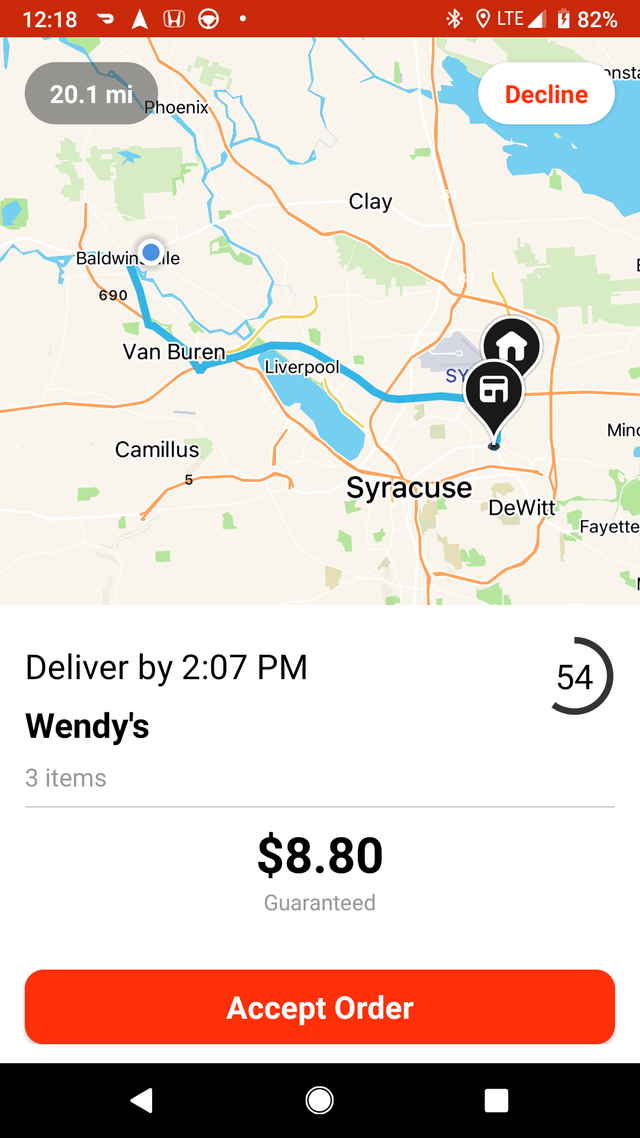
“DoorDash doesn’t show workers what part of the ‘guarantee’ is from tip and what part is from DoorDash,” Sage Wilson of labor organization Working Washington told TechCrunch in an email. “(Instacart’s old policy did show this, which is why it was easier to demonstrate.) So that’s exactly where their “transparency” stops— at the point when it’s clear they’re taking tips.”
And just because DoorDash is upfront about parts of its practice, it doesn’t mean drivers are okay with it. There’s a webpage, Reddit and Subreddits that all describe DoorDash’s practices.
On the website, No Tip Doordash, it states:
While the tip may technically be going to the driver, it is only replacing the normal delivery pay. Your tip saves doordash money, and it is not increasing the drivers pay. Please tip in cash, if available.
In a statement to Bloomberg, DoorDash said it implemented this policy to “ensure that Dashers are more fairly compensated for every delivery.”
This comes shortly after Instacart apologized and announced it would stop engaging in that practice. In a blog post last week, Instacart CEO Apoorva Mehta said all shoppers will now have a guaranteed higher base compensation, paid by Instacart. Depending on the region, Instacart says it will pay shoppers between $7 to $10 at a minimum for full-service orders (shopping, picking and delivering) and $5 at a minimum for delivery-only tasks. The company will also stop including tips in its base pay for shoppers.
Amazon also reportedly engages in this practice, according to The Los Angeles Times.
I’ve reached out to DoorDash and will update this story if I hear back.
This story has been updated to reflect comments from Working Washington organizer Sage Wilson.
No, your tweets aren’t awful. Twitter’s Likes are currently borked.
If you have been experiencing issues with the Like or Retweet count on Twitter and are desperately seeking validation, here it is: yes, it’s Twitter, not you (probably). The company confirmed today that it is working on a fix for a problem with notifications that’s been messing with Like counts.
Some people around the world are experiencing an issue with notifications, Likes, and Retweets. We’re working on resolving this and will follow up soon. We apologize for the inconvenience.
— Twitter Support (@TwitterSupport) February 12, 2019
Many users around the world have reported seeing the number of Likes on their tweets fluctuate continuously, making them wonder if accounts were being suspended in mass or if Twitter was deleting them.
Here’s the word thing happening with Twitter right now (they said they’re going to fix it)
Look at the likes and retweets. pic.twitter.com/TAPOXhoziM
— Yashar Ali
(@yashar) February 12, 2019
why is twitter deleting so many likes off peoples’ tweets? are accounts getting mass s*spended or… pic.twitter.com/MabHOOxXi0
— bts went to the grammys (@functionbts) February 12, 2019
twitter please stop taking away the likes on my tweets they’re all that I have
— gracie hoos (@cottoncandaddy) February 12, 2019
Oppression thy name is twitter likes! pic.twitter.com/pvB4rBMpg8
— Molly Jong-Fast (@MollyJongFast) February 12, 2019
Twitter did not say when the issue began, but based on a careful study of Twitter search results, and not on my own desperate longing for validation from internet strangers, the issue has been going on for almost a day.