Alan raises another $45 million for its health insurance product

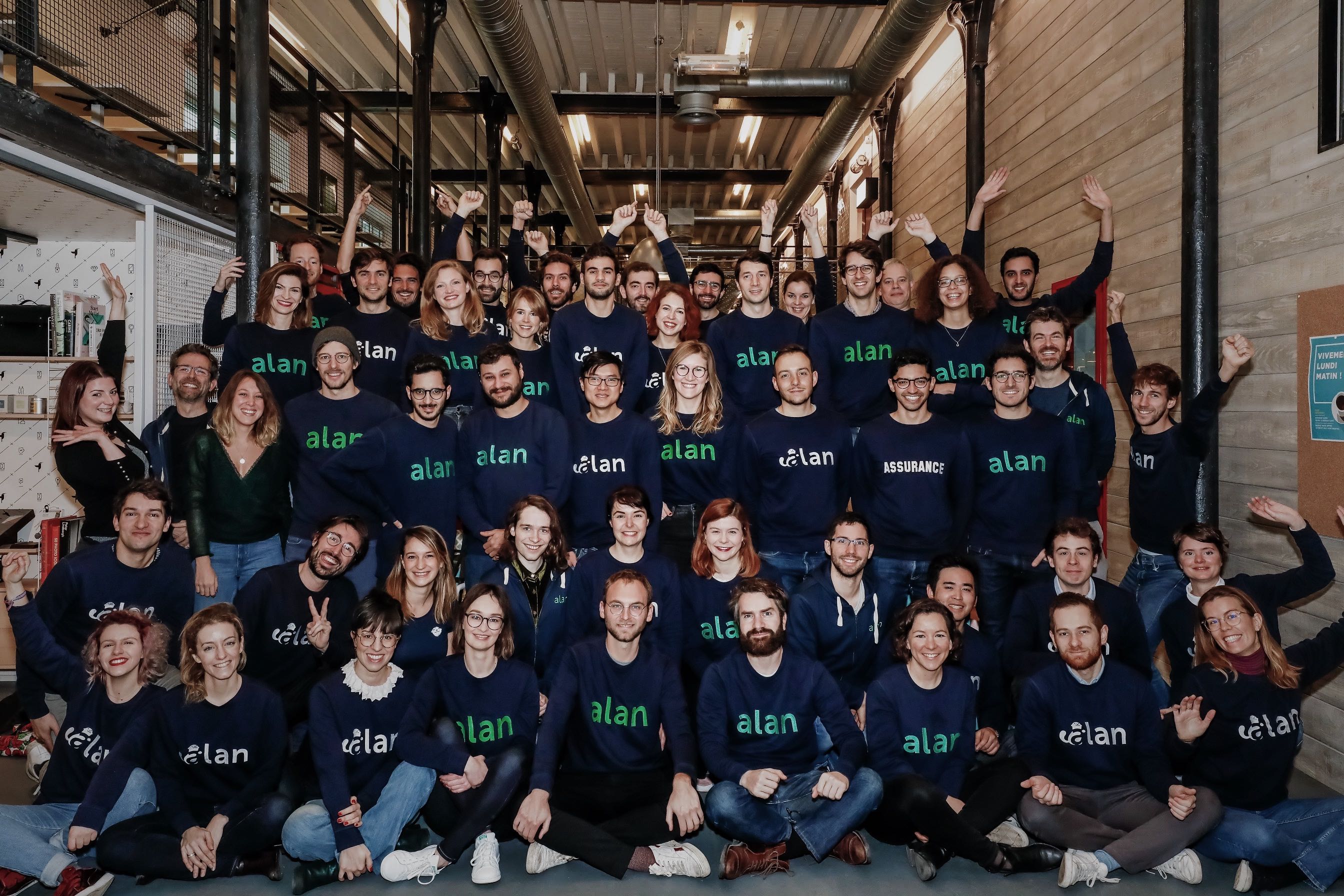
Paris-based startup Alan has raised a Series B round of funding of $45 million (€40 million). Index Ventures is once again leading the round, with partners of DST Global also participating. The company had raised a $28 million funding round only 10 months ago.

Alan is a software-as-a-service startup tackling a very specific industry: the health insurance market in France — and soon across Europe. The company wants to create a well-designed insurance product with transparent pricing and policies to make healthcare more accessible. And it isn’t just a marketplace — the startup has obtained an official health insurance license and is the first new health insurance company in France in 30 years.

In France, every employee is covered by the national healthcare system for basic reimbursements, as well as a private insurance company for more expensive treatments. In addition to that, legacy insurance companies have neglected those products as they usually don’t generate a lot of margins on that segment. It creates a huge market opportunity for Alan.

With today’s funding announcement, the startup has shared some numbers. In 2018 alone, the company grew from 5,000 insured people to 27,000, and revenue jumped from $4 million to $25 million (€3.5 million to €22 million). Alan has been focused on freelancers as well as small and medium companies, such as My Little Paris, Le Slip Français, Ledger and Converteo.

More interestingly, Alan is close to break-even right now with 64 employees. That gives you an idea of Alan’s margins.

Following today’s funding round, the company is going to hire a lot more people. There should be around 175 people working for Alan by the end of the year.

On the product front, the company is always looking at ways to make the experience as seamless as possible. “We’re trying to make the insurance process instantaneous, from quotes to coverage and reimbursements” co-founder and CEO Jean-Charles Samuelian told me.

But Alan has always been about healthcare at large, not just insurance products. So let’s see how they can use this influx of funding to simplify healthcare in general.

Steve Jurvetson tells all: about his new $200 million fund, his new partner, his new shopping list, and more

Steve Jurvetson is staging a comeback, disclosing today that his new San Francisco-based, early-stage venture firm Future Ventures, has raised $200 million for its debut fund.

“It’s good to be back in the saddle again,” says Jurvetson, whose career was somewhat famously derailed in the fall of 2017 when a former girlfriend wrote a Facebook post, accusing DFJ — the firm Jurvetson cofounded in 1985 — of “predatory behavior.” DFJ said publicly the next day that it was already investigating “indirect and secondhand allegations” about Jurvetson, and within weeks, the firm and Jurvetson apparently had enough of each other, mutually deciding that it was time to part ways. (Jurvetson, who was recently wed for the second time, has since said he poorly handled his love interests, some of which he acknowledges were extramarital.)

It was surely an embarrassing chapter for Jurvetson, who’d enjoyed a pristine reputation, but notably, he didn’t lose the support of some of his former colleagues. At the time, two founders who worked previously at DJF spoke up on his behalf, crediting both Jurvetson and DFJ with “cultivating an environment where women advance professionally.” And Jurvetson has formed Future Ventures with another former apprentice who he mentored for a year at DFJ: Maryanna Saenko, who Jurvetson says is a “full partner” in the endeavor and who he characterizes as “the most talented investor I’ve ever worked with.”

Certainly, they have much in common in the way of interests. Jurvetson has famously funded companies that seemed dangerously futuristic and capital intensive at the time, including Space X and Tesla. Saenko, who has two degrees from Carnegie Mellon in materials science and engineering, has long been fascinated with deep learning, space exploration, and robotics. She even helped start up Airbus Ventures before joining DFJ, where she worked with Jurvetson on deals like the “clean meat” company Memphis Meats and Orchid, a San Francisco-based startup that’s developing a a surveillance-free layer on top of the internet.

They must work well together. Soon after Jurvetson left the firm, Saenko also split, spending six months at Khosla Ventures before rejoining him in November, when they began putting together a pitch deck in earnest for Future Ventures . Meetings with prospective investors soon followed.

Asked about Future Ventures’s backers, Jurvetson says they are “people who know what I’m doing and want to invest in that — tech CEOs, other VCs, hedge fund [investors] —  people who’ve known me for decades. I figured that was the easiest place to start.” Not that anyone is funding Jurvetson out of blind loyalty, one surmises. Future Ventures is charging 2.5 percent in management fees and 25 percent of any profits earned, above the standard “2 and 20” that many fund managers charge and more in line with the what the best-performing funds are able to secure from their investors.

He seemingly has the track record for it. Future Ventures hasn’t written its first check just yet, but “the vast majority of term sheets I’ve issued [over my career] have been the only term sheet offered to the company,” claims Jurvetson. Pointing this editor to the companies he has funded over time, he adds that: “In almost every case, I was the first VC to offer a term sheet and take a board seat, and there was no one competing with me.”

Among his bets that look prescient in hindsight are SpaceX and Tesla, on whose boards Jurvetson still sits. But he also holds a seat on the board of the quantum computing company D-Wave and was an early investor in Planet, the satellite company.

Whether he still has the magic touch is something he’ll have to prove at Future Ventures, but the firm’s investors are giving it more time than is standard to invest the fund: 15 years instead of 10. Future Ventures will also be able to pull the trigger faster on deals than some firms because of its size, which is small by design, says Jurvetson. Though he and Saenko may eventually bring aboard a “partner-track associate,” for now, two is the right number partners and “never more than five.”

Team size is “so important,” says Jurvetson. “My favorite time was when i had a three partners” at the outset of DFJ, which he formed with investors Tim Draper and John Fisher. “You can have meetings whenever you want. You can iterate and deliberate. You want your team to be cognitively diverse but also small. Once you have more than seven people, it’s no longer a team.”

As for what Future will back, Jurvetson says the future of food production remains one great area of interest, as is the proliferation of neural networks at “the edge — of your phone, your car, your security camera.” The latter, he notes, can be a “pain in the ass today, [issuing] false alarms all the time. But you can build a sensory cortex so that it becomes more intelligent and recognizes the owners of the house and doesn’t sound the alarm when it shouldn’t. And it doesn’t need to push that information to the cloud” to know it, either.

Jurvetson admits that earlier in his career, he had the propensity to “fund science projects” that were not necessarily businesses that could scale. Longtime industry observers may recall, for example, Jurvetson’s early enthusiasm for nanotech. (Jurvetson was right, just too early, if you put synthetic biology in this bucket. )

But he also says that his reputation for investing early in what may sound crazy has paid off, and he’s counting on it continuing to do so. It’s why he’s a fixture at places like space conferences; they make it easier for him to reach founders who are focused on things he hasn’t necessarily heard of before.

Indeed, if everything goes as planned, he says, “What I’ll be most excited about five years from now will be an industry sector that I couldn’t name for you today.”

Apple acquires talking Barbie voicetech startup PullString

Apple has just bought up the talent it needs to make talking toys a part of Siri, HomePod, and its voice strategy. Apple has acquired PullString, also known as ToyTalk, according to Axios’ Dan Primack and Ina Fried. TechCrunch has received confirmation of the acquistion from sources with knowledge of the deal. The startup makes voice experience design tools, artificial intelligence to power those experiences, and toys like talking Barbie and Thomas The Tank Engine toys in partnership with Mattel. Founded in 2011 by former Pixar executives, PullString went on to raise $44 million.

Apple’s Siri is seen as lagging far behind Amazon Alexa and Google Assistant, not only in voice recognition and utility, but also in terms of developer ecosystem. Google and Amazon has built platforms to distribute Skills from tons of voice app makers, including storytelling, quizzes, and other games for kids. If Apple wants to take a real shot at becoming the center of your connected living room with Siri and HomePod, it will need to play nice with the children who spend their time there. Buying PullString could jumpstart Apple’s in-house catalog of speech-activated toys for kids as well as beef up its tools for voice developers.

PullString did catch some flack for being a “child surveillance device” back in 2015, but countered by detailing the security built intoHello Barbie product and saying it’d never been hacked to steal childrens’ voice recordings or other sensitive info. Privacy norms have changed since with so many people readily buying always-listening Echos and Google Homes.

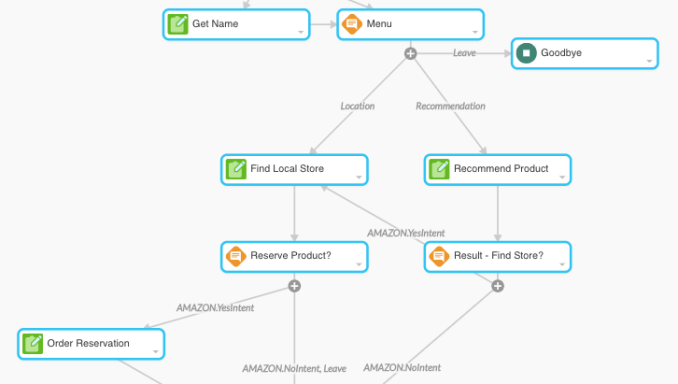
In 2016 it rebranded as PullString with a focus on developers tools that allow for visually mapping out conversations and publishing finished products to the Google and Amazon platforms. Given SiriKit’s complexity and lack of features, PullString’s Converse platform could pave the way for a lot more developers to jump into building voice products for Apple’s devices.

We’ve reached out to Apple and PullString for more details about whether PullString and ToyTalk’s products will remain available.

The startup raised its cash from investors including Khosla Ventures, CRV, Greylock, First Round, and True Ventures, with a Series D in 2016 as its last raise that PitchBook says valued the startup at $160 million. While the voicetech space has since exploded, it can still be difficult for voice experience developers to earn money without accompanying physical products, and many enterprises still aren’t sure what to build with tools like those offered by PullString. That might have led the startup to see a brighter future with Apple, strengthening one of the most ubiquitous though also most detested voice assistants.

Marriott now lets you check if you’re a victim of the Starwood hack

Hotel chain giant Marriott will now let you check if you’re a victim of the Starwood hack.

The company confirmed to TechCrunch that it has put in place “a mechanism to enable guests to look up individual passport numbers to see if they were included in the set of unencrypted passport numbers.” That follows a statement last month from the company confirming that five million unencrypted passport numbers were stolen in the data breach last year.

The checker, hosted by security firm OneTrust, will ask for some personal information, like your name, email address, as well as the last six-digits of your passport number.

Marriott says data on “fewer than 383 million unique guests” was stolen in the data breach, revealed in September, including guest names, postal addresses, phone numbers, dates of birth, genders, email addresses and reservation information. Later it transpired that more than 20 million encrypted passport numbers were also stolen, along with 8.6 million unique payment card numbers. Marriott said only 354,000 cards were active and unexpired at the time of the breach in September.

Opening up the checker to the wider public is a bright spot in what’s been a fairly atrocious incident recovery by Marriott since the breach. The company’s initial response was plagued with hiccups and missteps that many security experts stepped in to fill in the gaps at their own expense.

The checker won’t kick back a result straight away — you’ll have to wait for a response — and Marriott doesn’t say how long that’ll take. There is a certain irony in having to turn over your own data — not least to a third-party — to be told if you’re a victim of a breach. It’s literally the last thing any breach victim wants to do: hand over even their more of their personal information. But that’s the world we’re living in, and everything is terrible.

Use the checker at your own risk.

Deploy the space harpoon

Watch out, starwhales. There’s a new weapon for the interstellar dwellers whom you threaten with your planet-crushing gigaflippers, undergoing testing as we speak. This small-scale version may only be good for removing dangerous orbital debris, but in time it will pierce your hypercarbon hides and irredeemable sun-hearts.

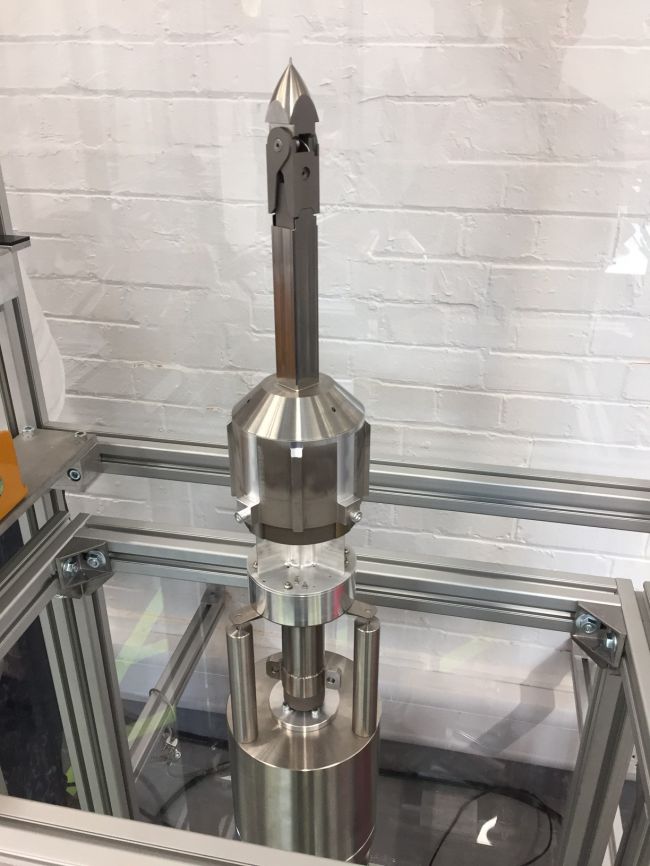
Literally a space harpoon. (Credit: Airbus)

However, it would be irresponsible of me to speculate beyond what is possible today with the technology, so let a summary of the harpoon’s present capabilities suffice.

The space harpoon is part of the RemoveDEBRIS project, a multi-organization European effort to create and test methods of reducing space debris. There are thousands of little pieces of who knows what clogging up our orbital neighborhood, ranging in size from microscopic to potentially catastrophic.

There are as many ways to take down these rogue items as there are sizes and shapes of space junk; perhaps it’s enough to use a laser to edge a small piece down toward orbital decay, but larger items require more hands-on solutions. And seemingly all nautical in origin: RemoveDEBRIS has a net, a sail and a harpoon. No cannon?

You can see how the three items are meant to operate here:

The harpoon is meant for larger targets, for example full-size satellites that have malfunctioned and are drifting from their orbit. A simple mass driver could knock them toward the Earth, but capturing them and controlling descent is a more controlled technique.

While an ordinary harpoon would simply be hurled by the likes of Queequeg or Dagoo, in space it’s a bit different. Sadly it’s impractical to suit up a harpooner for EVA missions. So the whole thing has to be automated. Fortunately the organization is also testing computer vision systems that can identify and track targets. From there it’s just a matter of firing the harpoon at it and reeling it in, which is what the satellite demonstrated today.

This Airbus-designed little item is much like a toggling harpoon, which has a piece that flips out once it pierces the target. Obviously it’s a single-use device, but it’s not particularly large and several could be deployed on different interception orbits at once. Once reeled in, a drag sail (seen in the video above) could be deployed to hasten reentry. The whole thing could be done with little or no propellant, which greatly simplifies operation.

Obviously it’s not yet a threat to the starwhales. But we’ll get there. We’ll get those monsters good one day.

GoTrendier raises $3.5 million to take on Spanish-language fashion marketplaces

Thanks to environmentally conscious young buyers, throwaway culture is dying not only in the U.S., but also in Latin America — and startups are poised to jump in with services to help people recycle used clothing.

GoTrendier, a peer-to-peer fashion marketplace operative in Mexico and Colombia, has raised $3.5 million USD to do just that. And investors are eyeing the startup as the digital fashion marketplace growth leader in Spanish-speaking countries. 

GoTrendier, founded by Belén Cabido, is a platform that lets users buy and sell secondhand clothing. Cabido tells me that the new capital will enable GoTrendier to expand deeper into Mexico and Colombia, and launch in a new country: Chile. 

GoTrendier enables users to buy and sell used items through the GoTrendier site and app. The platform categorizes users as either salespeople or buyers. Salespeople create their own stores by uploading photos of garments along with a description and sale price. Buyers browse the platform for deals and once a buyer bites, the seller is given a prepaid shipping label. 

Sound familiar? Businesses like Poshmark and GoTrendier have no actual inventory, which allows the companies to take on less of a risk by having smaller overhead costs. In turn, the company acts as more of a social community for fashion exchanges.

In order to make money, Poshmark takes a flat commission of $2.95 for sales under $15. For anything more than that, the seller keeps 80 percent of their sale and Poshmark takes a 20 percent commission. Poshmark also owes its success to the socially connected shopping experience it created and the audience building features available to sellers — as detailed in this Harvard Business School study. GoTrendier has a similar commission pricing strategy, taking 20 percent off plus an additional nine pesos (about 48 cents in U.S. currency) for all purchases. The service also takes advantage of social media and sharing features to help connect and engage its fashion-loving community. 

But these companies are also largely venture-backed. In the case of GoTrendier, the round gave shareholder entry to Ataria, a Peruvian fund that invests in early-stage tech companies with high earning potential. Existing investors Banco Sabadell and IGNIA reinforced their position, along with Barcelona-based investors Antai Venture Builder, Bonsai Venture Capital and Pedralbes Partners.

GoTrendier amassed a user base of 1.3 million buyers and sellers throughout its four years of existence. The service operates in Mexico and Colombia, and will use its newest capital to launch in Chile — another market Cabido says is experiencing high demand for a secondhand fashion buying and selling service.

Online marketplace companies are growing in Latin America as smartphone adoption and digital banking services multiply in the region. But international expansion has proven to be an issue. Enjoei, a similar fashion marketplace that owns the market share in Brazil, had a botched attempt at expanding to Argentina due to Portugese-Spanish language barriers and eventually determined that Brazil was a large enough market in which to build its business — thus carving out an opportunity for companies like GoTrendier that offer the same services to dominate the surrounding Spanish-speaking markets in Latin America.

Many have remarked that Latin America’s tech scene is filled with copycats — or companies that emulate the business models of American or European startups and bring the same service to their home market. In order to secure bigger foreign investment checks, founders from growing tech regions like Latin America certainly must invent proprietary technologies. Yet there’s still value — and capital — in so-called copycat businesses. Why? Because the users are there and in some cases it’s just easier to start up.

According to investor Sergio Pérez of Sabadell Venture Capital, “The volume of the market for buying and selling second-hand clothes in the world was 360 million transactions in 2017 and is expected to reach 400 million in 2022.” A 2018 report from ThredUp also claimed that the size of the global secondhand market is set to hit $41 billion by 2022. The “throwaway” culture is disappearing thanks to environmentally conscious millennial buyers. As designer Stella McCartney famously said, “The future of fashion is circular – it will be restorative and regenerative by design and the clothes we love never end up as waste.” By buying on GoTrendier, the company claims its users have been able to save USD $12 million and have avoided more than 1,000 tons of CO2 emissions.

Founders building companies in Latin America aren’t necessarily as capital-hungry as Silicon Valley-based founders, (where a Series A can now equate to $68 million, apparently). Cabido tells me her company is able to fulfill operations and marketing needs with a lean staff of 30, noting that there’s a lot of natural demand for buying and selling used clothing in these regions, thus creating organic growth for her business. She wasn’t looking to raise capital, but investors had their eye on her. “[Investors] saw the tension of the marketplace, and we demonstrated that GoTrendier’s user base could be bigger and bigger,” she says. With sights set on new markets like Chile and Peru, Cabido decided to move forward and close the round.  

Poshmark, which benefits from indirect and same-side network effects, has raised $153 million to date from investors like Temasek Holdings, GGV and Menlo Ventures. Just like GoTrendier, Poshmark’s Series A was also a $3.5 million round.

Who’s to say that that amount of capital can’t boost a network effects growth model in Latin America too? The users are certainly waiting. 

Even years later, Twitter doesn’t delete your direct messages

When does “delete” really mean delete? Not always, or even at all, if you’re Twitter .

Twitter retains direct messages for years, including messages you and others have deleted, but also data sent to and from accounts that have been deactivated and suspended, according to security researcher Karan Saini.

Saini found years-old messages in a file from an archive of his data obtained through the website from accounts that were no longer on Twitter. He also reported a similar bug, found a year earlier but not disclosed until now, that allowed him to use a since-deprecated API to retrieve direct messages even after a message was deleted from both the sender and the recipient — though, the bug wasn’t able to retrieve messages from suspended accounts.

Saini told TechCrunch that he had “concerns” that the data was retained by Twitter for so long.

Direct messages once let users “unsend” messages from someone else’s inbox, simply by deleting it from their own. Twitter changed this years ago, and now only allows a user to delete messages from their account. “Others in the conversation will still be able to see direct messages or conversations that you have deleted,” Twitter says in a help page. Twitter also says in its privacy policy that anyone wanting to leave the service can have their account “deactivated and then deleted.” After a 30-day grace period, the account disappears, along with its data.

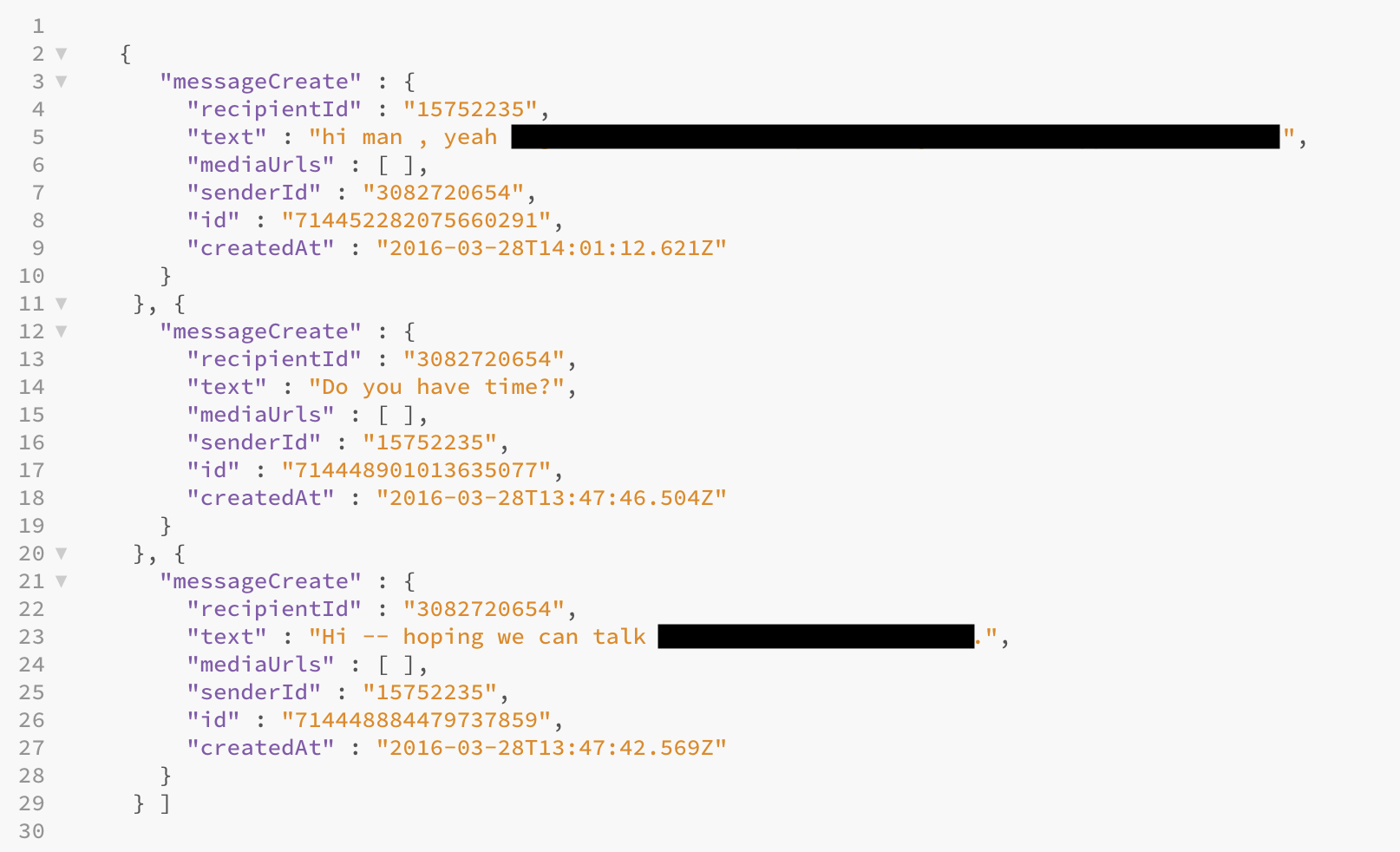
But, in our tests, we could recover direct messages from years ago — including old messages that had since been lost to suspended or deleted accounts. By downloading your account’s data, it’s possible to download all of the data Twitter stores on you.

A conversation, dated March 2016, with a suspended Twitter account was still retrievable today (Image: TechCrunch)

Saini says this is a “functional bug” rather than a security flaw, but argued that the bug allows anyone a “clear bypass” of Twitter mechanisms to prevent accessed to suspended or deactivated accounts.

But it’s also a privacy matter, and a reminder that “delete” doesn’t mean delete — especially with your direct messages. That can open up users, particularly high-risk accounts like journalist and activists, to government data demands that call for data from years earlier.

That’s despite Twitter’s claim that once an account has been deactivated, there is “a very brief period in which we may be able to access account information, including tweets,” to law enforcement.

A Twitter spokesperson said the company was “looking into this further to ensure we have considered the entire scope of the issue.”

Retaining direct messages for years may put the company in a legal grey area ground amid Europe’s new data protection laws, which allows users to demand that a company deletes their data.

Neil Brown, a telecoms, tech and internet lawyer at U.K. law firm Decoded Legal, said there’s “no formality at all” to how a user can ask for their data to be deleted. Any request from a user to delete their data that’s directly communicated to the company “is a valid exercise” of a user’s rights, he said.

Companies can be fined up to four percent of their annual turnover for violating GDPR rules.

“A delete button is perhaps a different matter, as it is not obvious that ‘delete’ means the same as ‘exercise my right of erasure’,” said Brown. Given that there’s no case law yet under the new General Data Protection Regulation regime, it will be up to the courts to decide, he said.

When asked if Twitter thinks that consent to retain direct messages is withdrawn when a message or account is deleted, Twitter’s spokesperson had “nothing further” to add.

Opendoor files to raise another $200M at a $3.7B valuation, documents show

The housing market is predicted to cool this year, but the market for startups selling houses? It seems to be heating up. Opendoor, the company that aims to bypass real estate agents and brokers by providing an online platform — by way of a mobile app — for people to buy and sell properties direct, has filed papers in Delaware indicating that it would like to raise around $200 million more, at a valuation of about $3.7 billion.

The raise comes just one month after Knock, an Opendoor competitor, raised $400 million.

Eric Wu, Opendoor’s CEO and co-founder, did not respond to a request for comment, and a spokesperson for Opendoor declined to comment.

The Delaware documents (embedded below) do not make it clear if this would come in the form of an outside round, or a secondary sale, or a combination of the two; nor is it clear if the funding has closed already. The documents are dated February 8th of this year.

The shares are described as a “Series E-2”, which likely means this is an extension on Opendoor’s last round, from September 2018, of $400 million. That itself was an expansion of a previous E round, which Opendoor had raised in June 2018, of $325 million. Opendoor had been valued at around $2.47 billion post-money in September, according to PitchBook, and the shares in the document are around 37 percent higher — hence the $3.7 billion estimation here.

Backers of the company include SoftBank, along with some 36 others that include some of the biggest names in VC, such as Andreessen Horowitz, Coatue, General Atlantic, GV, Initialized, Khosla, NEA, Norwest and many more.

The premise of Opendoor — co-founded by Wu, Ian Wong, Justin Ross and Keith Rabois on the back of an idea that Rabois had many years before — is to cut out some of the steps, and subsequent money and time spent, that come with buying or selling a property. (For those who have been through it, you know that the extra fees and rigmarole can be a killer and sometimes feels like it could be done better; that’s what Opendoor is addressing, in part with a very transparent pricing structure.)

Opendoor does this by becoming the virtual middle man. As Opendoor describes it, “If you’re selling, sell your home to us to eliminate the hassles of showings and months of uncertainty. If you’re buying, we make it incredibly easy to tour hundreds of Opendoor homes so you can find the perfect one.” It also has created a streamlined process to cut down the paperwork and work that agents do around transactions.

As of September last year, Opendoor had raised $2 billion in debt to finance these purchases — although the company today said that it is now “buying homes at a run rate of almost $4 billion a year” and that its transaction rate is currently at over 2,000 customers per month, including both buyers and sellers, and it has served some 30,000 customers to date across 19 metro regions covering more than 20 cities:

It’s proving to be a popular proposition. In 2018, more than 800,000 people toured Opendoor homes.

While housing prices had largely recovered in a lot of U.S. cities hurt by the previous crash, experts have said that a rise in inventory, coupled with rising mortgage rates and tax uncertainly, are set to cool the overall market in 2019.

But with the housing industry regularly rebounding and growing over the longer term — the saying “safe as houses” doesn’t come from thin air — it may be that investors are still prepared to make further-reaching bets on platforms that could prove to be strong players when the market is on a high.

Interestingly, Wu has hinted that the company will be making some moves in the area of mortgages and home improvement loans, which could free up and encourage more transactions at a time when traditional mortgage rates are rising.

“We’re doing some things around mortgages that will be integrated into the shopping experience,” Wu said in September, adding that the company “also wants to enable home buyers to personalize their experience.”

We’ll update this post as we learn more.

Daily Crunch: Amazon scraps HQ2 plans in NYC

The Daily Crunch is TechCrunch’s roundup of our biggest and most important stories. If you’d like to get this delivered to your inbox every day at around 9am Pacific, you can subscribe here.

1. Did New York lose anything with Amazon’s rejection? It’s complicated.

Amazon announced yesterday that it’s taking its ball and going home, rather than dealing with mean, pushy New Yorkers (warning: not an exact quote). As a result, some outside observers are painting a picture of a city and its politicians losing out for their recalcitrance.

Jon Shieber acknowledges that there’s plenty to criticize on both sides. But for those who think New Yorkers are idiots for not giving Amazon billions in tax incentives, he has a simple message: You’re wrong.

2. Netflix office goes on lockdown over report of a potential shooter, suspect now in custody

According to the LAPD, there were no shots fired, no reports of injuries and the suspect in question has been taken into custody.

3. Samsung is preparing to launch a sports smartwatch and AirPods-like earbuds

Samsung’s newest product launch happens next week, but the Korean tech giant has already revealed the lineup of wearable devices that will be unveiled alongside the Galaxy S10.

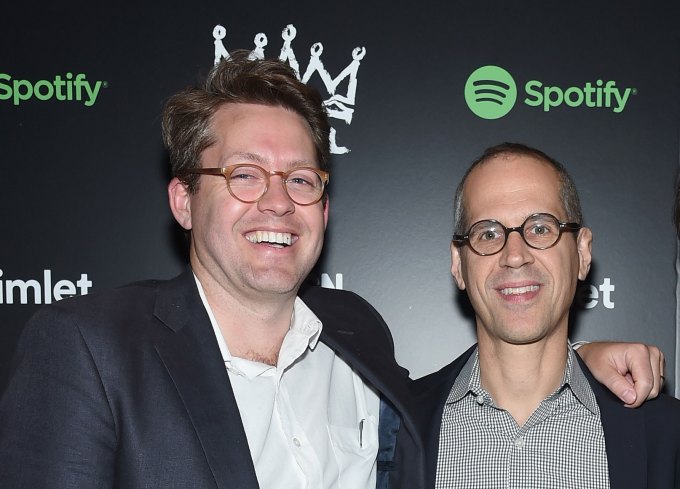
NEW YORK, NY – MAY 08: Gimlet Media President Matt Lieber, Gimlet Media CEO Alex Blumberg (Photo by Jamie McCarthy/Getty Images for Spotify)

4. Spotify says it paid $340M to buy Gimlet and Anchor

Spotify doubled down on podcasts last week with a deal to buy podcast companies Gimlet and Anchor. The acquisition price was initially undisclosed, but Spotify has quietly confirmed that it spent €300 million — just shy of $340 million — to capture the companies.

5. Everything you need to know about GM’s new electric bikes

General Motors announced last year it was getting into the electric bike business. Now, GM has given this new brand a name — AR?V — and revealed some of the details about its go-to-market plan.

6. China’s Didi is laying off 15 percent of its staff

The cut comes as China’s largest ride-hailing company copes with a stricter regulatory environment that puts a squeeze on driver supply, as well as backlash from two high-profile passenger murders last year.

7. Dubai airport briefly halts flights after drone spotted

It’s the latest in a recent string of scares involving personal drones flying too close to a commercial airport. At the height of the holiday season, London’s Gatwick airport was closed for a day and a half over similar concerns.