Lime hires its first CFO

Lime is hiring Ted Tobiason, former managing director in tech equity capital markets at Morgan Stanley, to serve as its chief financial officer.

This comes following Lime’s behemoth $310 million Series D round earlier this month. Led by Bain Capital Ventures, Andreessen Horowitz, Fidelity Ventures, GV and IVP, the round values Lime at $2.4 billion.

Lime, which got its beginnings as a bike-share company, has deployed its scooters and bikes in more than 100 cities in the U.S. and 27 international cities. Since June, Lime has more than doubled the number of cities where it operates in the U.S. Lime has also partnered with Uber to offer Lime scooters within the Uber app.

Additionally, Lime recently brought on Nancy Lee, formerly of Google, to lead its human resources efforts as chief human resources officer. Lee formerly worked at Google as its head of diversity. She retired from the company in December 2016, but has since found a new home with Lime.

“During her tenure at Google, Nancy played a key role in encouraging Google to disclose its diversity demographic data publicly,” Lime wrote in a blog post. “Her commitment to inclusion and transparency will be instrumental in leading Lime’s cross-cultural team throughout 2019 and beyond.”

Lime has been on a hiring spree as of late, filling out the ranks in its executive team. Earlier this month, Lime appointed its head of engineering, Li Fan, to CTO and hired Duke Stump, formerly of Lululemon, to serve as its CMO.

“Both Ted and Nancy have outstanding experience at companies that have scaled from small to large,” Lime CEO Toby Sun said in a statement. “With their leadership, we’re excited to take Lime to the next level in building a world-class business and people-first company.”

Stop limiting quantum computing to speed

William ("Whurley") Hurley
Contributor

William Hurley, commonly known as whurley, is an American entrepreneur and the founder of Chaotic Moon Studios, Honest Dollar, and Equals: The Global Partnership for Gender Equality in the Digital Age. He is currently chairing the Quantum Computing Working Group for the IEEE Standards Association (IEEE-SA), and is the founder and chief executive of Strangeworks.
More posts by this contributor

The classical computing paradigm has always been tied to speed, at least in the popular imagination. Sure, in reality the goals for classical computing have always been more complex: the increasing ability to handle bigger, more numerous or just more nuanced data sets, manipulated in new ways to suss out valuable insights, and so forth. But speed is how we judge our smartphones, tablets and laptops: how fast are they? Therefore, which one is the “best”?

So it’s little wonder this illusory yardstick has carried over into discussions of quantum computing. When you read the popular press about quantum computing, it’s all about speed, speed, speed. Everything is about speed. And that sort of thinking will prevent us from grasping just what quantum computing can do for us.

First of all, classical computing’s preoccupation with speed is now viewed as antiquated and potentially harmful, as the search for speed blinded us to energy efficiency, arguably the focus of the most urgent current research and development work.

Extrapolating this quantitative fixation to quantum computing is a distraction and doesn’t capture the qualitative difference between classical computing and quantum computing.

Everyone is talking about the limitations of classical machines and how they might be overcome with a quantum computer. But too often the focus is on speed, transactional speed. I’ve literally been asked how much faster quantum computers will be at executing trades. Better yet, I’ve been asked for a chart showing speed comparisons between your standard rack mount computers you would find in a data center and quantum computers.

This simply isn’t the way we should be looking at this amazing new technology. Instead, we should be thinking of problem-solving in a way we never even thought of. That’s what quantum computers are for. These machines aren’t designed to solve problems that we’re solving today, only faster — they’re designed to solve problems we haven’t even imagined. They’re a completely new class of machine with completely new capabilities.

Think instead of the classic traveling salesman challenge: if provided with a list of towns and the distances between each one, what is the shortest possible route that includes every town yet returns to the point of origin?

We need to use our imagination to discover what quantum computing can do for us.

Or consider the Seven Bridges of Königsberg. This formerly Prussian city occupied both sides of the Pregel River, including two islands in the river, all connected to each other by seven bridges. Could a walk through the city be devised that crossed each of these bridges only once? Leonhard Euler proved in 1736 that it couldn’t. This brain teaser really demanded analytical techniques that could be tested mathematically. And that “negative” finding led Euler to create what is widely considered to be the first theorem of graph theory and the first proof in the theory of networks.

An odd problem with no answer led to mathematical breakthroughs. What if Euler had had a quantum computer? Would that have helped? I confess I have no idea, but my point is that we need to use our imagination to discover what quantum computing can do for us, divorced from the speed-obsessed world of classical computing, which isn’t really analogous.

Quantum computers are completely different than classical computers in their design and they are capable of doing things we’ve never even dreamed of.

Quantum computers will not replace classical computers, we’re going to have both, because they’re designed to do different things.

Classical computers use bits, represented by a 0 or 1. They perform calculations in essentially the same way we did when we used an abacus. Because of this, the types of problems we can solve with classical computers are effectively the same we can solve by hand. This means the types of problems classical computers are good for are limited to problems in which the evaluation time doesn’t grow too quickly with the size of the input. In other words, if the evaluation time increases exponentially with input, you’re probably going to be dead by the time a classical computer gets around to getting you an answer (if it ever does).

Quantum computers use qubits, or quantum bits. A qubit can be 0 or 1 just like its classical counterpart; however, it also can be in a superposition of these states, which looks like this:

a|0?  + b|1?

Where a and b are complex numbers. When we measure a qubit, we get 0 with probability |a^2| or 1 with probability |b^2|. Quantum computers use unitary transformations on the state of the qubits to perform calculations. So combine these two factors and now you have computational possibilities simply not possible by hand — or classical computer. This means better factoring, searching and simulation of quantum mechanics. All of which mean a completely new era of computing that in my belief will change computing more in the next 10 years than it has changed in its entire history.

Instead of fixating on speed, we need to imagine what sorts of computational challenges will be quantum computing’s sweet spot? If these computers aren’t meant for the calculations of the past, then they’re not meant to be utilized to solve the problems of the past either. What quantum computing is meant for is to solve completely new problems we haven’t even dreamed of yet.

Pokémon GO will soon let you change teams for about $8

Early on in Pokémon GO, you’re asked to make a decision: Which team do you want to be on? Instinct (Yellow)? Valor (Red)? Mystic (Blue)?

The question comes a bit out of the blue. Especially amongst those who started early and have stuck with the game, it’s not uncommon to hear people grumble about how they wish they’d chosen differently. But once you choose, it’s final; changing teams means making a whole new account and starting the grind from Level 1. Well, until now.

Pokémon GO will soon let you change your team by way of an in-game “Team Medallion” item. Realizing that there are too many Mystic in your area and want to mix it up a bit? You can switch to Valor. Are most of your friends Instinct and you want to help them hold gyms? You can.

But there are catches: It’ll cost money, and you can only do it once a year. It’ll cost you 1,000 Pokécoins — that’s the in-game currency, (slowly) obtainable by holding in-game locations or in exchange for real money via in-app purchase. A pack of 1,200 coins currently goes for $10, so 1,000 coins works out to a little over $8.

As for why there’s a once-per-year cap? It helps make sure people have some degree of loyalty to their chosen teams… but it also helps maintain the game’s mechanics. There are some advantages to playing alongside members of your team — stat boosts in the big group boss battles (or “Raids”), a few extra Pokéballs when your team does the most damage in said raids, etc. — and letting people change too much might screw that up a bit.

This is the latest in a streak of recent additions meant to fulfill longstanding requests from the playerbase, and perhaps respark the interest of some players who moved on. They added trading (a staple of the main series) in June of last year, and player-vs-player battles (another staple) in December. App Annie says the game is currently the 67th most popular title in the iOS app store.

Niantic says the team medallion should roll out on February 26th.

As shared kitchens heat up, a China-based startup, Panda Selected, nabs $50 million led by Tiger Global

A few weeks ago, we told you that former Uber CEO Travis Kalanick looks to be partnering with the former COO of the bike-sharing startup Ofo, Yanqi Zhang, to bring his new L.A.-based company, CloudKitchens, to China. Kalanick didn’t respond to our request for more information, but according to the South China Morning Post (SCMP), his plan is to provide local food businesses with real estate, facilities management, technology and marketing services.

He might want to move quickly. Kitchens that invite restaurants to share their space to focus on take-out orders is a concept that’s picking up momentum fast in China. And one company looks to have just assumed pole position in that race: Panda Selected, a Beijing-based shared-kitchen company that just raised $50 million in Series C funding led by Tiger Global Management, with participation from earlier backers DCM and Glenridge Capital. The round brings its total funding to $80 million.

Little wonder there’s a contest afoot. China’s food-delivery market is already worth $37 billion dollars, according to the SCMP, which says 256 million people in China used online food ordering services in 2016, and the number is expected to grow to 346 million this year.

And that’s still a little less than a quarter of the country’s population of 1.4 billion people.

Panda Selected is wasting little time in trying to reach them. While SCMP says that online delivery services already blanket 1,300 cities. Panda Selected, founded just three years ago, says it already operates 120 locations that cover China’s biggest centers, including Shanghai, Beijing, Shenzhen and Hangzhou. It claims to work with more than 800 domestic catering brands, including Luckin Coffee, Kungfu and TubeStation. The company also says that its kitchens are typically 5,000-square-feet in size and can accommodate up to 20 restaurants in each space.

With its new funding, it expects to double that number over the next eight months, too, its  founder, Haipeng Li, tells Bloomberg. That’s going to make it difficult to challenge, especially by any U.S.-based company, given overall relations between the two countries and the ever-changing regulatory environment in China.

Then again, this may be just the first inning. Stay tuned.

DoorDash raises $400M round, now valued at $7.1B

Delivery company DoorDash is announcing that it has raised $400 million in Series F financing.

Earlier this month, The Wall Street Journal reported that the company was looking to raise $500 million at a valuation of $6 billion or more. In fact, DoorDash now says the funding came at a $7.1 billion valuation.

The round was led by Temasek and Dragoneer Investment Group, with participation from previous investors SoftBank Vision Fund, DST Global, Coatue Management, GIC, Sequoia Capital and Y Combinator.

DoorDash has been raising money at an impressive rate, with a $535 million round last March followed by a $250 million round (valuing the company at $4 billion) in August.

Co-founder and CEO Tony Xu told me the round is “a reflection of superior performance over the past year.” Apparently, the company is currently seeing 325 percent growth, year-over-year, and it points to recent data from Second Measure showing that the service has overtaken Uber Eats in U.S. market share for online food delivery — DoorDash now comes in second to Grubhub.

“I think the numbers speak for themselves,” Xu said. “If you just run the math on DoorDash’s course and speed, we’re on track to be number one.”

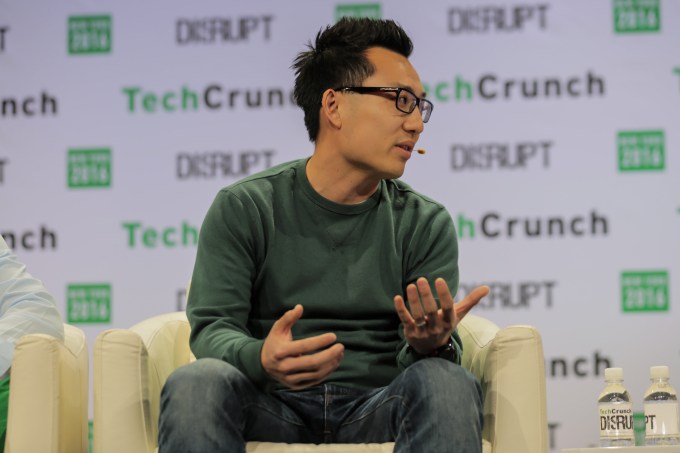
Tony Xu of DoorDash

He attributed the company’s growth to three factors: its geographic reach (3,300 cities in the United States and Canada), its selection of partners (not just restaurants — Walmart is using DoorDash for grocery deliveries) and DoorDash Drive, which allows businesses to use the DoorDash network to make their own deliveries.

He added that DoorDash has been “growing in a disciplined way, turning markets towards profitability.”

The funding, Xu said, will allow the company to continue investing in Drive, in its DashPass subscription service (where you pay $9.99 per month for free deliveries on orders of $15 or more from select restaurants) and in more hiring. And while DoorDash is currently available in all 50 states, Xu said there’s still plenty of room to cover additional territory in the U.S. and especially Canada.

“To me, this round … really changes the position of the company, not only as we march towards market leadership, but as we go beyond restaurants and become the last mile for commerce,” he said.

Not all of DoorDash’s recent news has been good. Along with Instacart, the company has been under scrutiny for subsidizing its driver payments with customer tips.

When asked about the criticism, Xu said the current compensation system was tested “not in a quarter, not in a month, but tested for months” before being implemented in 2017, and since then, there’s been a “significant increase” in retention among “dashers,” along with improved dasher satisfaction and on-time deliveries.

“When it comes to this pay model that has been in the press, the most important thing, I would say, is looking again at the facts and results,” he said.

Pinterest files confidentially to go public

Visual search engine Pinterest has joined a long list of high-flying technology companies planning to go public in 2019. The business has confidentially submitted paperwork to the Securities and Exchange Commission for an initial public offering slated for later this year, according to a report from The Wall Street Journal.

Pinterest declined to comment.

Founded in 2008 by Ben Silbermann, earlier reports indicated the company was planning to debut on the stock market in April. In late January, Pinterest took its first official step toward a 2019 IPO, hiring Goldman Sachs and JPMorgan Chase as lead underwriters for its offering.

The company garnered a $12.3 billion valuation in 2017 with a $150 million financing.

Touting 250 million monthly active users, Pinterest has raised nearly $1.5 billion in venture capital funding from key stakeholders Bessemer Venture Partners, Andreessen Horowitz, FirstMark Capital, Fidelity and SV Angel. The business brought in some $700 million in ad revenue in 2018, per reports, a 50 percent increase year-over-year.

Pinterest employs 1,600 people across 13 cities, including Chicago, London, Paris, São Paulo, Berlin and Tokyo. The company says half its users live outside the U.S.

Pinterest will likely follow Lyft, Uber and Slack to the public markets, which have all filed confidential paperwork for IPOs or, in Slack’s case, a reported direct listing, expected in the coming months.

Google ends forced arbitration for employees

Google is finally ending forced arbitration for its employees. These changes will go into effect for both current and future Google employees on March 21.

While Google won’t reopen settled claims, current employees can litigate past claims starting March 21.

For the contractors Google works with directly, it will remove mandatory arbitration from their contracts. The caveat, however, is that it won’t require outside firms that employ contractors to do the same. Still, Google says it will notify suppliers so that they can see if that approach would work for them.

This is a direct response to a group of outspoken Google employees protesting the company’s arbitration practices. Last month, a group of Google employees took to Twitter and Instagram in an attempt to educate the public about forced arbitration. That came about one month after this same group of 35 employees banded together to demand Google end forced arbitration as it relates to any case of discrimination. The group also called on other tech workers to join them.

Forced arbitration ensures workplace disputes are settled behind closed doors and without any right to an appeal. These types of agreements effectively prevent employees from suing companies.

Following the massive, 20,000-person walkout at Google in November, Google got rid of forced arbitration for sexual harassment and sexual assault claims, offering more transparency around those investigations and more. Airbnb, eBay and Facebook quickly followed suit. Despite some progress across the industry, the end of forced arbitration across all workplace disputes is not widespread.

Since getting rid of forced arbitration for cases relating to sexual harassment and assault, Google said it has been exploring the issue and ultimately decided on implementing a blanket change.

Twitter’s latest test changes ‘Retweet with Comment’ so it looks more like a Reply

Twitter’s new prototype testing program isn’t the only way it’s working to fix conversations on its site. The company confirmed it’s currently running another public-facing test focused on making Twitter “more conversational” — but this time with Retweets instead of Replies. The test involves using a thin line to connect a quote-style retweet to the person commenting on the tweet, instead of placing the quoted tweet in a box as before.

Here are some visual aids.

Today, when you comment on a tweet you’re reposting, the original tweet is boxed in like this:

The new test sees Twitter eliminating the box entirely, and connecting the comment to the tweet using the same sort of line that is used today with Replies.

For example, here is a before and after of the change. (Click through to the tweet to view the images larger). You can see the original look on the left, and the update using the line on the right:

Interesting change pic.twitter.com/FDnCAdjxMa

?ia Masna (@amasna) February 20, 2019

We asked Twitter if this was a permanent change or just a test, and a spokesperson confirmed it was the latter.

The test was available on Android on Tuesday of this week, but began rolling out to iOS users yesterday.

Despite the launch of the new testing program, the company said it would continue to A/B test various conversational features and other changes within its public app.

“The fact that we’re doing this [Twitter prototype testing program] doesn’t mean that we don’t do regular testing – like we do with all our development processes in our regular app all the time,” Sara Haider, Twitter’s director of product management, noted in an interview at CES in January.

The prototype program, meanwhile, serves as more of an experimental testing grounds where Twitter users are able to directly influence the development process with their feedback and opinions.

Twitter had learned over the years that some of the best ideas come from the community itself. Many of its products — including @ Replies, the hashtag (#), tweetstorms (now “threads”) and Retweets (originally “RT”) — were developed in response to how people were already using Twitter. Now, Twitter hopes to tap into the hive mind to build whatever else is coming next.

But not all of Twitter’s changes are community-driven. (After all, I’m not sure anyone was really all that concerned about how Retweets were displayed.)

That means you’ll still see Twitter testing smaller changes like this one in the public app.

Whether or not the lines will eventually come to replace the box for Retweets still remains to be seen, however. While it does make the comment seem more like someone is continuing a conversation, the update arguably makes it easier to confuse a Retweet with a Reply, too.

“We’re working on updates to Retweet with Comment as part of our efforts to make Twitter more conversational,” a spokesperson for Twitter confirmed to TechCrunch. They also hinted we’d see more tests of this nature in the future, as well.

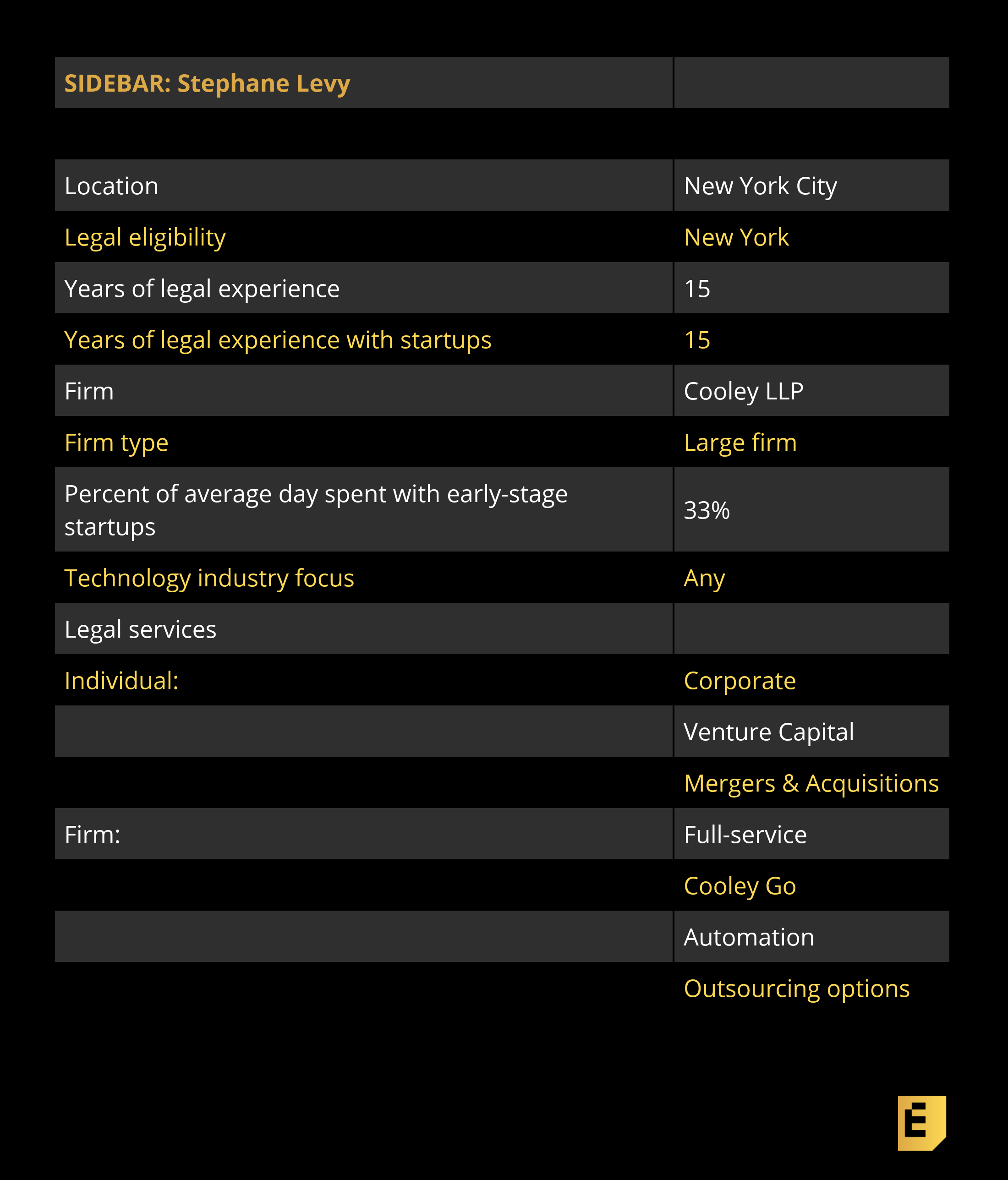
Verified Startup Lawyer: Stephane Levy

Stephane Levy got his start in the days of Silicon Alley almost two decades ago, and built up his practice with New York startups and beyond through all the ups and downs since then.

Today, as a partner at Cooley LLP, he works with a wide range of companies, from company formation, seed and later stage rounds, all the way through to M&A transactions and IPOs. He also teaches at Cornell University Law School as an adjunct professor, on legal matters affecting emerging companies and venture capital transactions.

“We met him in the very early days, and his help on all things relating to the company, investors, corporate decisions, fundraising, and just simple strategy has been spot on. He’s always someone I can rely on to give me honest feedback that will eventually play out to be true.” Sachin Kamdar, New York City, CEO, Parsely


On the New York startup scene

“I was probably one of a handful of tech lawyers in NY, at least of my vintage, working with startups and venture funds in the early and mid 2000s, so I kind of grew up doing that stuff in New York when most of the other corporate lawyers in the city were focused on more traditional M&A, private equity, capital markets, etc.”

When a client is having a rough time

“I’m not going to drop a company just because they are going through hard times or treat them any different. It’s a mixed bag out there, and at the end of the day you’ll have some really successful companies and some that are having a tougher time, but you have to take a long view. If a company is going through a really tough time — for example, they’re having trouble raising money — them not getting any attention from their lawyer will really compound some of the issues.”

What makes startup lawyers good

“The key is to try to bring your judgment to bare and say, “Listen, there’s going to be some risk. I’m not going to advocate you do everything on my punch list of ideal things you can be doing from a legal perspective, but if you have to focus on a few things to stay out of trouble for now, these would be them.” Not every lawyer is able to give that type of guidance or has, I guess, the experience or the judgment to be able to do that, but that’s something that entrepreneurs really value.”

Sample horror story

“Let’s say three founders take a third each and they don’t impose vesting. A year later, one of the founders leaves to go get a job somewhere and doesn’t want to give a portion of the equity back. Those are potentially really significant errors that could cost the company and the founders.  I just feel bad because the reality is we’ve automated a lot of our formation processes up front such that it really doesn’t cost much for founders to get state of the art documents in place from the get go.”

Below, you’ll find the rest of the founder reviews, the full interview, and more details like pricing and fee structures. This article is part of our ongoing series covering great lawyers and other experts who founders love to work with. More details here.

Click here to register for Extra Crunch, or log in here.

Nintendo’s Reggie Fils-Aimé retires (and Bowser claims the castle)

Reggie Fils-Aimé is retiring after more than a decade spent as president of Nintendo of America. His career spanned many console generations, starting with the troubled GameCube and ending with the fabulously successful Switch. Reggie will be succeeded by Doug Bowser, who has worked under him for the last four years.

In a statement provided by Nintendo, Reggie (who frequently went by his first name in familiar fashion) offered the following farewell:

Nintendo owns a part of my heart forever. It’s a part that is filled with gratitude – for the incredibly talented people I’ve worked with, for the opportunity to represent such a wonderful brand, and most of all, to feel like a member of the world’s most positive and enduring gamer community. As I look forward to departing in both good health and good humor, this is not ‘game over’ for me, but instead ‘leveling up’ to more time with my wife, family and friends.

In addition, he posted a video farewell on Twitter:

Nintendo fans, Reggie has a message for all of you. Please take a look. pic.twitter.com/EAhaEl5oEJ

— Nintendo of America (@NintendoAmerica) February 21, 2019

Reggie has been one of Nintendo’s most public and recognizable faces ever since the early days of his ascendancy, which coincidentally was when I began covering E3 regularly for work. I had the privilege of meeting him numerous times for interviews and Q&As, as well as just bumping into him at this or that event.

His indefatigably on-message manner, as if he had a prepared remark for every possible question, was impossible to be frustrated with because of his undeniable charisma and passion for the games and devices he was promoting. It may have been hard to tell where Reggie ended and Nintendo PR began (perhaps now we’ll never know), but he was never anything less than helpful and engaging in my experience.

When he took over Nintendo of America, the company as a whole was recovering from a down period marked by a console (the GameCube) that had not kept pace with the competition and a handheld that, while popular, was flagging and clearly old-fashioned.

As most will remember, however, the company soon turned all that around with the DS and Wii, two of the best-selling consoles of all time and ones that returned Nintendo to its household name status, as well as vastly expanding the “gamer” demographic. Of course, the Wii U was a disappointment (though home to many great games), but since then the Switch has restored confidence in the company’s ability to innovate and deliver. With some 20 million sold since launch, Reggie is leaving on a high note.

Reggie’s involvement from the outside seemed to be to pretend these things didn’t exist until 30 seconds before going onstage to announce them, after which he would tirelessly promote them to every outlet and fan that managed to make eye contact with him. He was accessible, friendly and if not candid he was certainly honest and earnest at all times. He’ll certainly be missed by many, myself included.

Doug Bowser will take over as president on April 15, Reggie’s official last day. Bowser joined in 2015 and led the sales and marketing for the Switch, so you know he’s got momentum — plus, you know, the name.

I’ve asked Nintendo for any further information on Reggie’s departure, such as whether he’ll still be involved with the company at all, and will update this post if I hear back.

So long, Reggie, and best of luck on the next level!

Robotics, AR and VR are poised to reshape healthcare, starting in the operating room

About 20 years ago, a medical device startup called Intuitive Surgical debuted the da Vinci robot and changed surgical practices in operating rooms across the United States.

The da Vinci ushered in the first age of robotic-assisted surgical procedures with a promise of greater accuracy and quicker recovery times for patients undergoing certain laparoscopic surgeries. 

For a time, it was largely alone in the market. It has skyrocketed in value since 2000, when the stock first debuted on public markets. From the $46 million that the company initially raised in its public offering to now, with a market capitalization of nearly $63 billion, Intuitive has been at the forefront of robotic-assisted surgeries, but now a new crop of startups is emerging to challenge the company’s dominance.

Backed by hundreds of millions in venture capital dollars, new businesses are coming to refashion operating rooms again — this time using new visualization and display technologies like virtual and augmented reality, and a new class of operating robots. Their vision is to drive down the cost and improve the quality of surgical procedures through automation and robotic equipment.

“There were 900,000 surgeries done using surgical robotics out of a total of 313 million surgical procedures,” globally, says Dror Berman, a managing director of Innovation Endeavors.

Berman is an investor in Vicarious Surgical, a new robotics company that plans to not only improve the cost and efficiency of surgical procedures, but enable them to be performed remotely so the best surgeons can be found to perform operations no matter where in the world they are.

“Robotics and automation present multiple opportunities to improve current processes, from providing scientists the opportunity to vastly increase experimental throughput, to allowing people with disabilities to regain use of their limbs,” Berman wrote in a blog post announcing his firm’s initial investment in Vicarious.

The $3.4 billion acquisition of Auris Health by Johnson & Johnson shows just how lucrative the market for new surgical robotics can be.

That company, founded by one of the progenitors of the surgical robotics industry, Fred Moll, is the first to offer serious competition to Intuitive Surgical’s technological advantage — no wonder, considering Dr. Moll also founded Intuitive Surgical.

Last year, the company unveiled its Monarch platform, which takes an endoscopic approach to surgical procedures that is less invasive and more accurate to test for — and treat — lung cancer.

“A CT scan shows a mass or a lesion,” Dr. Moll said in an interview at the time. “It doesn’t tell you what it is. Then you have to get a piece of lung, and if it’s a small lesion. It isn’t that easy — it can be quite a traumatic procedure. So you’d like to do it in a very systematic and minimally invasive fashion. Currently it’s difficult with manual techniques and 40 percent of the time, there is no diagnosis. This is has been a problem for many years and [inhibits] the ability of a clinician to diagnose and treat early-stage cancer.”

Monarch uses an endoscopy procedure to insert a flexible robot into hard-to-reach places inside the human body. Doctors trained on the system use video game-style controllers to navigate inside, with help from 3D models.

Tesla Model 3 loses Consumer Reports recommendation over ‘reliability problems’

Consumer Reports has placed the Tesla Model 3 into that fun-to-drive, terribly unreliable category where brands like Alfa Romeo, Land Rover and Maserati also live.

Consumer Reports, which has a complicated relationship with Tesla, says it can no longer recommend the Model 3 because issues with the paint, trim and body hardware raises reliability questions. CR members reported the results in an annual reliability survey that includes data on about 470,000 vehicles.

The report caused Tesla shares to fall more than 2.7%.

The Model 3 is arguably Tesla’s most important vehicle. Tesla’s survival hinges on Model 3. It’s no longer just about being able to produce and deliver the vehicle cost effectively — although those are biggies. If more consumers turn to other electric vehicles, the sales momentum that helped Tesla have two consecutive quarters of profits could falter.

Owners appear to like, even love, the Model 3. It received top marks in CR’s recent owner satisfaction survey and also earned a positive road-test score. It’s a weird duality — and one the even CR acknowledges — that other aspirational, lifestyle and luxury vehicles share. Owners love the vehicles, despite persistent issues with the components inside them.

“While Teslas perform well in Consumer Reports’ road tests and have excellent owner satisfaction, their reliability has not been consistent, according to our members, which has resulted in changes to their recommended status,” Jake Fisher, senior director of auto testing at Consumer Reports, said in statement.

Tesla has asked Consumer Reports for more details about the issues customers reported. According to Tesla, CR said they had no more specific information to share. (See update below)

“Not only are our cars the safest and best performing vehicles available today, but we take feedback from our customers very seriously and quickly implement improvements any time we hear about issues,” a Tesla spokeswoman said in an emailed statement. “That’s just one of the reasons why, in this very same survey from Consumer Reports, Model 3 was rated as the #1 most satisfying car, and why Tesla vehicles have topped Consumer Reports’ Owner Satisfaction survey every year since 2013 – the first year Tesla was included in it.”

CR provided TechCrunch the email exchange with Tesla, which shows that the consumer advocacy organization answered many of the automaker’s questions. Tesla asked for details on when the survey was conducted, some of the methodology, the number of Tesla Model 3 owners who responded to the survey and for more detail on customer complaints about the trim, windows, and door handles.

The total sample size was nearly 500 Model 3s, according to CR. “Among 2018 model vehicles, the number we have for the Model 3 is far more than many vehicles we receive data for,” CR wrote in the email. “All of the data used for our prediction was from 2018 models. We had insufficient data on 2017 vehicles to make a judgment.”

CR told TechCrunch that typical sample sizes are between 200 to 300 vehicles.

CR didn’t provide Tesla with detailed information about the complaints on the door latches. On the windows, CR wrote: “Members reported problems about the windows, including glass defects. One customer commented about the “rear window developed stress cracks after delivery.”

The question of reliability has persisted for all of Tesla’s vehicles. CR doesn’t recommend the Model X or Model S either due to reliability issues. The Tesla Model X was included in CR’s top 10 least reliable vehicles list for 2019.

The CR survey revealed problems with the suspension, particularly in the 2017 Model S and hardware issues in the Model X. Owners in the survey cited numerous reliability problems with the Model 3.

Tesla noted that it has made “significant improvements” to correct any issues that Model 3 customers may have experienced that are referenced in this report. The automaker also cited that its return policy allows any customer who is unhappy with their car to return it for a full refund.

“This new data from Consumer Reports comes from their annual Owner Satisfaction survey, which runs from July through September, so the vast majority of these issues have already been corrected through design and manufacturing improvements, and we are already seeing a significant improvement in our field data,” the spokesperson said.

Tesla has the capability, which it uses often, to roll out software updates to fix bugs, improve performance, and treat customers to fun surprises. Paint and trim issues are a different matter, of course.

And despite this ability to fix and improve the vehicle over time, the CR reliability survey might be enough to turn potential customers away from Tesla and towards another electric vehicle brand.

It’s possible that Tesla’s fan base is strong enough to keep the sales momentum. Plenty of other brands and models, have a fervent following despite problems with the vehicle.

“In most cases, reliability issues will undermine satisfaction,” Fisher said. “But when a vehicle has an enthusiastic following, like with Tesla, owners may overlook some issues. We’ve seen this with other vehicles such as the Jeep Wrangler and Chevrolet Corvette.”