The so-called Pineapple Express is dumping rain down all over California, for one thing. An explanation in the form of a song. (With apologies to Talking Heads.)
Category: Tech news
hacking,system security,protection against hackers,tech-news,gadgets,gaming
Star Trek: Discovery will return for a third season
We’ve still barely caught up with the Red Angel, whatever it is, but CBS just confirmed that Star Trek: Discovery will be coming back for a third season. Discovery will also add Michelle Paradise as a co-showrunner alongside Alex Kurtzman, making her the fifth showrunner to come aboard the Discovery in its relatively short tenure exploring the known universe.
Season 3, the #StarTrekDiscovery crew is beaming your way https://t.co/jHp0FjLOLc pic.twitter.com/gdVFh4liS8
— Star Trek (@StarTrek) February 27, 2019
“The massive success of Star Trek: Discovery’s second season launch exceeded our expectations in both driving subscriber growth and generating a phenomenal response from Star Trek fans,” CBS All Access executive vice president Julie McNamara said. “With Alex Kurtzman and Michelle Paradise at the helm, we look forward to continuing Star Trek: Discovery’s journey, growing the Star Trek franchise on CBS All Access and bringing fans new Star Trek stories for many years to come.”
We’re about halfway through Discovery’s second season, which is set to have 14 episodes. The show’s first season consisted of a handful of separate-ish story arcs, from Michael Burnham’s redemption to the Tardigrade drama and then on to the deeper, darker mad science and Terran Empire stuff. So far, Season 2 has drifted between a more episodic formula and the mystery of Spock, in what’s likely a season-spanning story arc, though honestly we’ll be happy with whatever happens as long as we don’t ever have to hear about the mycelial network again… ever.
While Discovery Season 2’s standalone adventure episodes are fluffier fun, the show’s willingness to plunge into the dark side of Starfleet keeps us coming back. That aspect of the show is apparently compelling enough that it’s even inspired a Discovery spin-off centered around Starfleet’s morally ambiguous black ops team Section 31, starring Discovery’s excellent Michelle Yeoh.
In the U.S., the new season of Star Trek: Discovery will continue its exclusive run on CBS All Access. That means fans of the latest iteration of the well-loved series will have to keep ponying up for yet another streaming service if they want to keep up with Burnham, Saru and Tilly as they navigate the vastness of space with only an intergalactic moral compass and the mycelial network (ugh) to guide them.
Presto raises $30M to bring its AI platform and tabletop ordering hardware to restaurant chains
The “restaurant of the future” may elicit thoughts of a chrome diner with robot servers and an otherwise hefty amount of Tokyo futurist kitsch, but the fact is that the forthcoming sit-down dining experience may just end up looking a lot like ordering from a takeout app.
Presto is working with restaurants to update the 21st century dine-in experience, letting customers order and pay from their table with a tablet device while also providing hardware like wearables for servers so they can be alerted when they are needed by customers.
The company announced today that they’ve raised $30 million in growth funding from Recruit Holdings and Romulus Capital. I2BF Global Ventures, EG Capital and Brainchild Holdings also participated in the raise.
Considering how much online shopping has shaped commerce and apps like Instacart and Uber Eats are changing how we get food delivered to our houses, it’s a bit peculiar that physical restaurants with hundreds of locations have been so slow to shift the customer experience toward a greater reliance on tech.
Presto has launched partnerships with a number of restaurant chains like Applebee’s, Red Lobster, Denny’s and Outback Steakhouse. These aren’t exactly mom-and pop locations, but Presto CEO Raj Suri says these large restaurant groups are always looking to shift their weight to improve efficiencies across the board with new tech in a way that most small businesses just aren’t.
“I would say most restaurant groups are looking at how they can become more of a tech company… and adopt technology that could help them become more efficient,” Suri tells TechCrunch. “The industry is moving in this direction in a pretty significant way and it won’t be long before you see our technology in every restaurant.”
Beyond the ordering hardware, Presto’s new AI platform is aiming to give restaurants a more robust look at the state of each individual business and insights that help managers make decisions about staffing or deciding which food items to stock. The platform leverages a variety of data inputs so that things like nearby sporting events or weather patterns can be integrated into suggestions about how many servers should be staffed on a given Tuesday.
Presto is looking to supercharge their platform with the funding and rapidly expand their footprint. The 11-year-old company is now supporting 5,000 restaurant locations, but Suri says that Presto will double that number in 2019.
OneWeb’s first six global internet satellites are safely in orbit
Update: Launch and deployment successful!
 After four years and more than $2 billion in funding, OneWeb is ready to launch the first six satellites out of a planned constellation of 650 with which it plans to blanket the world in broadband. The Arianespace-operated Soyuz rocket will take off at 1:37 Pacific time from Guiana Space Center. You can watch it live at OneWeb’s site here.
OneWeb is one of several companies that aims to connect the world with a few hundred or thousand satellites, and certainly the most well-funded — SoftBank is the biggest investor, but Virgin Group, Coca-Cola, Bharti Group, Qualcomm and Airbus have all chipped in.
The company’s plan is to launch a total of 900 (650 at first) satellites to about a 1,100-kilometer low Earth orbit, from which it says it will be able to provide broadband to practically anywhere on Earth — anywhere you can put a base station, anyway. Much cheaper and better than existing satellite connectivity, which is expensive and slow.
 Sound familiar? Of course, SpaceX’s side project, Starlink, has similar ambitions, with an even greater number of satellites planned, and Swarm is aiming for a smaller constellation of smaller satellites for low-cost access. And Ubiquitilink just announced this week that its unique technology will remove the need for base stations and beam satellite connections directly to ordinary phones. And they’ve all launched satellites already!

The launch vehicle fueling today at GSC.
OneWeb has faced numerous delays; the whole constellation was originally planned to be in place by the end of 2019, which is impossible at this point. But delays are the name of the game in ambitious space-based businesses, and OneWeb hasn’t been just procrastinating — it has been girding itself for mass production, raising funds to set up launch contracts and improving the satellites themselves. Its updated schedule, as it states in the mission summary: “OneWeb will begin customer demos in 2020 and provide global, 24-hour coverage to customers in 2021.”
At a reported cost of about a million dollars per satellite — twice the projected cost in 2015 — just building and testing the constellation will likely rub up against a billion dollars, and that’s not counting launch costs. But no one ever said it would be cheap. In fact, they probably said it would be unbelievably expensive. That’s why SoftBank and the other investors are “committing to a lot more capital,” as CEO Adrián Steckel told the Financial times last month.
The company also announced its first big deal with a telecom; Talia, which provides connectivity in Africa and the Middle East, signed on to use OneWeb’s services starting in 2021.
Soyuz launches could carry more than 30 of these satellites each, meaning it would take at least 20 to put the whole constellation in orbit. This first launch, however, only has six aboard; the other spots on board the mass launch system have dummy payloads to simulate how it should be going forward.
A OneWeb representative told me that this launch is meant to “verify the satellite design and validate the end to end system,” which is probably a good idea before sending up 600 more. That means OneWeb will be testing and tracking these six birds for the next few months and making sure the connection with ground stations and other aspects of the whole system are functioning properly.
Full payloads will start in the fall, after OneWeb opens its (much-delayed) production facility just outside Kennedy Space Center in Florida.
You can watch the launch at OneWeb’s site here.
Hands-on with Microsoft’s new HoloLens 2
Earlier this week, Microsoft used its MWC press conference to announce the next version of its HoloLens mixed reality visor. When it demoed the first version back in 2015, quite a few pundits assumed that the company had somehow faked the demos because this kind of real-time tracking and gesture recognition, combined with a relatively high-res display and packaged as a standalone device, had never been done before.
The fact that Microsoft took its sweet time to release this next version clearly shows that it wanted to gather feedback from its first set of users and developers who wrote apps for it. Microsoft also wasn’t under a lot of pressure to release an update, given that it never had a real competitor, with maybe the exception of Magic Leap, which is still in its very early days.
If version 1 came as a major surprise, then version 2, which I’ve now had time to try at MWC, is in many ways the natural evolution of the original promise: it’s more comfortable to wear, the field of view is large enough to feel more natural and the interaction model has been tweaked to make using HoloLens apps faster and easier. The hardware, too, has obviously been brought up to modern specs.
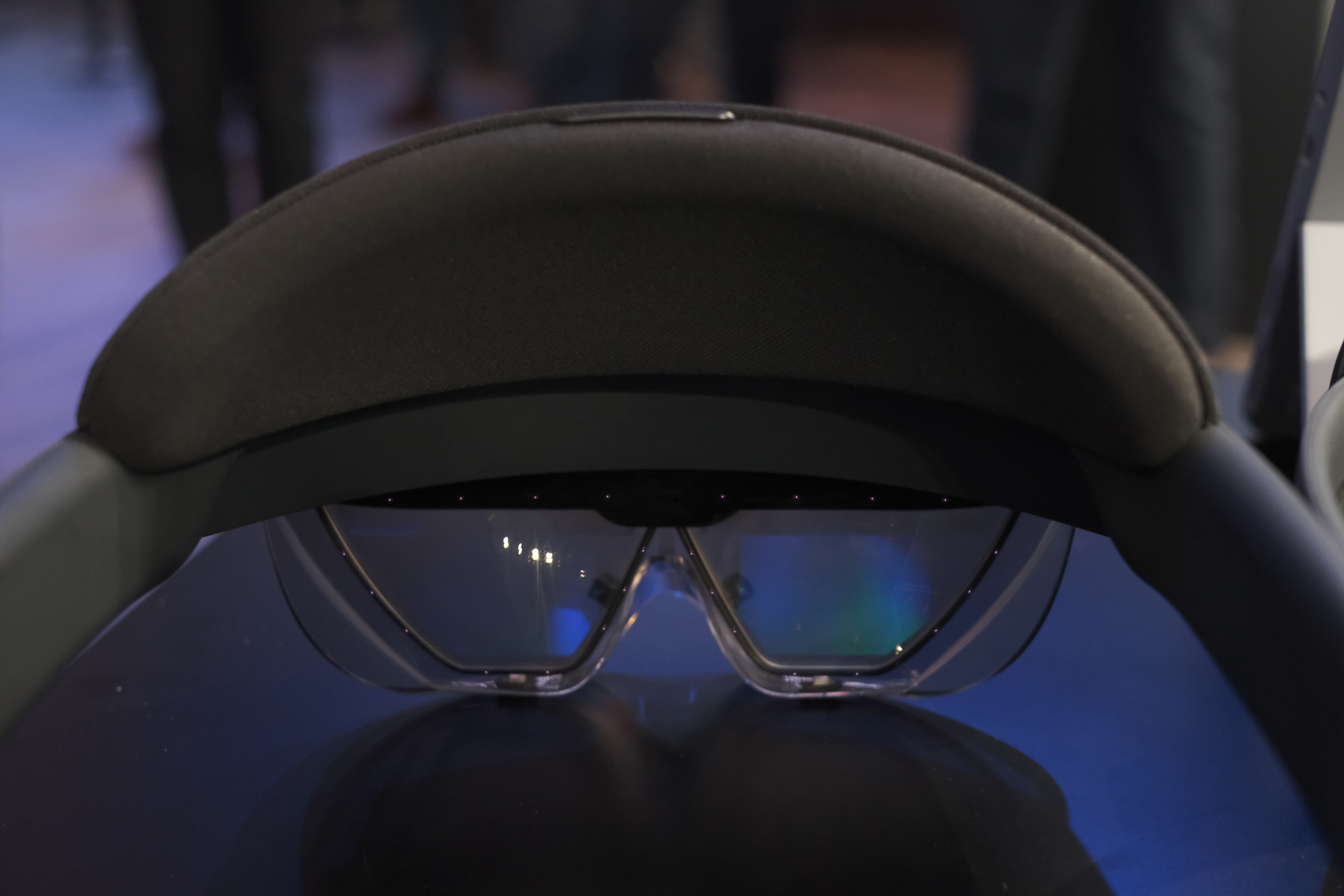
The first thing you’ll notice when you try the new version is that the initial calibration process that measures the distance between your eyes is now automatic. You essentially play a little game where you track a light in front of you and the new gaze recognition system takes care of setting up the calibration. Once that’s done, a hummingbird appears and lands on your hand. That’s also when you realize how much bigger the field of view has become. The bird is big enough that I’m pretty sure it wouldn’t have fit into the relatively small box that restricted the HoloLens 1’s field of view.
Don’t get me wrong, the experience is still not quite what Microsoft’s videos would have you believe. You are still very aware of the fact that there’s an abrupt end between where the AR images appear and where they end — but it’s far less jarring now that you have this bigger box. As far as the resolution goes, the specs are pretty much the same and there’s no practical difference that I noted.

The other thing you’ll notice right from the get-go is that Microsoft wasn’t kidding when it said that the new HoloLens would be far more comfortable to wear. The original felt clamped to your head (and for me, it had a tendency to slowly slide down my face) and you never quite forgot how heavy it was. The new one rests comfortably on your forehead, and, while you still essentially clamp it to your face by tightening a knob at the back, wearing it feels far more natural. The actual device is only a few grams lighter than the first edition, but with what I assume is a different weight distribution, it simply feels lighter. And if you wear glasses, then there’s no pressure on those anymore either because none of the weight rests on your nose.
Another major difference: The HoloLens 2 is now a real visor that you can flip open. So while you can obviously look through the lenses, you can now also easily move the HoloLens away from your face.
 As you go through the process of trying the new HoloLens, you’ll sooner or later come across menus, buttons and sliders. In the first version, the hand and gesture tracking wasn’t quite there to let you interact with those naturally. You’d have to use special gestures for that. Now, you simply tap on them as if you were using a smartphone. And when there’s a slider, you grab it and move it. The new demo applications that Microsoft showed off at MWC make good use of all of these.
And there’s another difference: This time around, Microsoft is clearly stating that the HoloLens 2 is for business users, and all of the demos focused on those. Gone are the days of shooting aliens as they break through your walls or playing virtual Minecraft on a table in your living room. Indeed, as Lorraine Bardeen, general manager of Engineering, D365 Mixed Reality Apps at Microsoft told me, the company clearly encouraged a lot of experimentation when it launched the first version. By now, those use cases have become clear.
“When we first started with HoloLens, both internally and in the first wave when we talked about, that this was a completely wide open technology,” she said. “It’s like if you had asked 30 years ago, what could you do with a personal computer. We started by making a bunch of sample applications.” Those applications showed off what you could do in gaming, communications, commercial applications, etc.
“We started by saying that this could be and do anything,” she added. But as HoloLens 1 arrived in the hands of users, a couple of clusters emerged and it’s those that Microsoft wants to focus on for the best out-of-box experience. But it’s also worth noting that Microsoft has committed to keeping HoloLens an open ecosystem. So if game developers want to create games — or their own game stores — there’s nothing holding them back.
Even though it’s now a far more capable device, at $3,500, it’s not a consumer device, and I don’t expect we’ll see any AAA games ported to HoloLens 2 anytime soon.

Coterie, a young New York startup, promises to deliver charming party kits to your doorstep
Party planning can be fun if you have the time for it and happen to know what you’re doing. For the rest of us, it can be a daunting, time-consuming endeavor, one that requires visits to numerous websites, in-store visits when those products invariably don’t arrive in time, then return visits to pick up those last items that you could have sworn you’d thrown in your shopping cart but did not.
Enter Coterie, a nine-month-old, New York-based startup that was incubated with the help of the investment firm Female Founders Fund and that is assembling party kits that it’s delivering to customers’ doorsteps, for everything from birthday parties to baby showers to friendversary get-togethers.
Just tell the site how many people you expect, whether it’s 10 or 50, then pick a kit. For example, the “lux” version of its “shine on” package — which could pretty much suit any occasion — comes with glittery plates, metallic flatware, votives, string lights, gold paper straws, dressed-up paper cups and napkins and confetti. Oh, also, gold paper fans as either wall or table decoration.
In the near future, customers of the site will also be able to handpick their products.
It’s less expensive to assemble your own party items, particularly if they are made of paper. That “lux” kit for 50 guests costs $329, with free shipping. These are also mostly items that can’t be reused.
Still, many of Coterie’s products can be recycled and, more to the point for Coterie, the sum of their parts can make a party sparkle in photos. Indeed, ease aside, a big motivator for Coterie customers seemingly will be how their parties look on social media, though venture capitalist Laura Chau disagrees with this assessment.
In fact, Chau, an investor at Canaan Partners who wrote a check to Coterie on behalf of her firm — Coterie has raised $2.75 million altogether, including from Female Founders Fund — says the company more or less pokes fun at social media. As she explains it, Coterie is building a modern brand that gives consumers a “frictionless, elevated and more beautiful experience. But the goal is not to feed on the fake perfection of Instagram but to blow up the idea that such perfection is real.”
Either way, party kits done the right way looks like a big business opportunity to Chau, who says she sees dozens of direct-to-consumer brands every month that might be interesting but don’t fit the venture model because the market is too small or too crowded. With Coterie, she says, it’s a “massive category with only one legacy player — Party City. And no one likes Party City.”
This last part is true, though there are also other, legacy players that no one really likes, including Oriental Trading Company.
Canaan and Female Founders Fund also appear to be betting that the tailwinds from Instagram and Pinterest will drive consumer demand for this kind of product. Just look up “festive planning” on Pinterest to see what we mean.
Coterie was founded by Sarah Raffa and Linden Ellis, two early employees of another e-commerce brand, Daily Harvest. According to an interview with CNN earlier this week, the friends were determined to start their own company, bouncing ideas off the partners at Female Founders Fund until collectively striking on Coterie.
The service launched on Monday.
Dow Jones’ watchlist of 2.4 million high-risk individuals has leaked
A watchlist of risky individuals and corporate entities owned by Dow Jones has been exposed, after a company with access to the database left it on a server without a password.
Bob Diachenko, an independent security researcher, found the Amazon Web Services-hosted Elasticsearch database exposing more than 2.4 million records of individuals or business entities.
The data, since secured, is the financial giant’s Watchlist database, which companies use as part of their risk and compliance efforts. Other financial companies, like Thomson Reuters, have their own databases of high-risk clients, politically exposed persons and terrorists — but have also been exposed over the years through separate security lapses.
A 2010-dated brochure billed the Dow Jones Watchlist as allowing customers to “easily and accurately identify high-risk clients with detailed, up-to-date profiles” on any individual or company in the database. At the time, the database had 650,000 entries, the brochure said.
That includes current and former politicians, individuals or companies under sanctions or convicted of high-profile financial crimes such as fraud, or anyone with links to terrorism. Many of those on the list include “special interest persons,” according to the records in the exposed database seen by TechCrunch.
Diachenko, who wrote up his findings, said the database was “indexed, tagged and searchable.”

From a 2010-dated brochure of Dow Jones’ Watchlist, which at the time had 650,000 names of individuals and entities. The exposed database had 2.4 million records. (Screenshot: TechCrunch)
The data is all collected from public sources, such as news articles and government filings. Many of the individual records were sourced from Dow Jones’ Factiva news archive, which ingests data from many news sources — including the Dow Jones-owned The Wall Street Journal. But the very inclusion of a person or company’s name, or the reason why a name exists in the database, is proprietary and closely guarded.
Many financial institutions and government agencies use the database to approve or deny financing, or even in the shuttering of bank accounts, the BBC previously reported. Others have reported that it can take little or weak evidence to land someone on the watchlists.
The records we saw vary wildly, but can include names, addresses, cities and their location, whether they are deceased or not and, in some cases, photographs. Diachenko also found dates of birth and genders. Each profile had extensive notes collected from Factiva and other sources.
One name found at random was Badruddin Haqqani, a commander in the Haqqani guerilla insurgent network in Afghanistan affiliated with the Taliban. In 2012, the U.S. Treasury imposed sanctions on Haqqani and others for their involvement in financing terrorism. He was killed in a U.S. drone strike in Pakistan months later.
The database record on Haqqani, who was categorized under “sanctions list” and terror,” included (and condensed for clarity):
DOW JONES NOTES:
Killed in Pakistan's North Waziristan tribal area on 21-Aug-2012.
OFFICE OF FOREIGN ASSETS CONTROL (OFAC) NOTES:
Eye Color Brown; Hair Color Brown; Individual's Primary Language Pashto; Operational Commander of the Haqqani Network
EU NOTES:
Additional information from the narrative summary of reasons for listing provided by the Sanctions Committee:
Badruddin Haqqani is the operational commander for the Haqqani Network, a Taliban-affiliated group of militants that operates from North Waziristan Agency in the Federally Administered Tribal Areas of Pakistan. The Haqqani Network has been at the forefront of insurgent activity in Afghanistan, responsible for many high-profile attacks. The Haqqani Network's leadership consists of the three eldest sons of its founder Jalaluddin Haqqani, who joined Mullah Mohammed Omar's Taliban regime in the mid-1990s. Badruddin is the son of Jalaluddin and brother to Nasiruddin Haqqani and Sirajuddin Haqqani, as well as nephew of Khalil Ahmed Haqqani.
Badruddin helps lead Taliban associated insurgents and foreign fighters in attacks against targets in south- eastern Afghanistan. Badruddin sits on the Miram Shah shura of the Taliban, which has authority over Haqqani Network activities.
Badruddin is also believed to be in charge of kidnappings for the Haqqani Network. He has been responsible for the kidnapping of numerous Afghans and foreign nationals in the Afghanistan-Pakistan border region.
UN NOTES:
Other information: Operational commander of the Haqqani Network and member of the Taliban shura in Miram Shah. Has helped lead attacks against targets in southeastern Afghanistan. Son of Jalaluddin Haqqani (TI.H.40.01.). Brother of Sirajuddin Jallaloudine Haqqani (TI.H.144.07.) and Nasiruddin Haqqani (TI.H.146.10.). Nephew of Khalil Ahmed Haqqani (TI.H.150.11.). Reportedly deceased in late August 2012.
FEDERAL FINANCIAL MONITORING SERVICES NOTES:
Entities and individuals against whom there is evidence of involvement in terrorism.
Dow Jones spokesperson Sophie Bent said: “This dataset is part of our risk and compliance feed product, which is entirely derived from publicly available sources.” The spokepserson said an “authorized third party” was to blame for the exposure, but did not name the alleged company or provide evidence for the claim.
We asked Dow Jones specific questions, such as who the source of the data leak was and if the exposure would be reported to U.S. regulators and European data protection authorities, but the company would not comment on the record.
Two years ago, Dow Jones admitted a similar cloud storage misconfiguration exposed the names and contact information of 2.2 million customers, including subscribers of The Wall Street Journal. The company described the event as an “error.”
Got a tip? You can send tips securely over Signal and WhatsApp to +1 646-755–8849. You can also send PGP email with the fingerprint: 4D0E 92F2 E36A EC51 DAAE 5D97 CB8C 15FA EB6C EEA5.
Compass acquires Contactually, a CRM provider to the real estate industry
Compass, the real estate tech platform that is now worth $4.4 billion, has made an acquisition to give its agents a boost when it comes to looking for good leads on properties to sell. It is acquiring Contactually, an AI-based CRM platform designed specifically for the industry, which includes features like linking up a list of homes sold by a brokerage with records of sales in the area and other property indexes to determine which properties might be good targets to tap for future listings.
Contactually had already been powering Compass’s own CRM service that it launched last year, so there is already a degree of integration between the two.
Terms of the deal are not being disclosed. Crunchbase notes that Contactually had raised around $18 million from VCs that included Rally Ventures, Grotech and Point Nine Capital, and it was last valued at around $30 million in 2016, according to PitchBook. From what I understand, the startup had strong penetration in the market, so it’s likely that the price was a bit higher than this previous valuation.
The plan is to bring over all of Contactually’s team of 32 employees, led by Zvi Band, the co-founder and CEO, to integrate the company’s product into Compass’s platform completely. They will report to CTO Joseph Sirosh and head of product Eytan Seidman. It will also mean a bigger operation for Compass in Washington, DC, which is where Contactually had been based.
“The Contactually team has worked for the past 8 years to build a best-in-class CRM that aggregates relationships and automatically documents every touchpoint,” said Band in a statement “We are proud that our investment into machine learning has resulted in new features like Best Time to Email and other data-driven, follow-up recommendations which help agents be more effective in their day-to-day. After working extensively with the Compass team, it was apparent that joining forces would accelerate our missions of building the future of the industry.”
For the time being, customers who are already using the product — and a large number of real estate brokers and agents in the U.S. already were, at prices that ranged from $59/month to $399/month depending on the level of service — will continue their contracts as before.
I suspect that the longer-term plan, however, will be a little different: You have to wonder if agents who compete against Compass would be happy to use a service where their data is being processed by it, and for Compass itself. I would suspect that having this tech for itself would give it an edge over the others.
Compass, I understand from sources, is on track to make $2 billion in revenues in 2019 (its 2018 targets were $1 billion on $34 billion in property sales, and it had previously said it would be doubling that this year). Now in 100 cities, it’s come a long way from its founding in 2012 by Ori Allon and Robert Reffkin.
The bigger picture beyond real estate is that, as with many other analog industries, those who are tackling them with tech-first approaches are sweeping up not only existing business, but in many cases helping the whole market to expand. Contactually, as a tool that can help source potential properties for sale that owners hadn’t previously considered putting on the market, could end up serving that very end for Compass.
The focus on using tech to storm into a legacy industry is also coming at an interesting time. As we’ve pointed out before, the housing market is predicted to cool this year, and that will put the squeeze on agents who do not have strong networks of clients and the tools to maximise whatever opportunities there are out there to list and sell properties.
The likes of Opendoor — which appears to be raising money and inching closer to Compass in terms of valuation — is also trying out a different model, which essentially involves becoming a middle part in the chain, buying properties from sellers and selling them on to buyers, to speed up the process and cut out some of the expenses for the end users. That approach underscores the fact that, while the infusion of technology is an inevitable trend, there will be multiple ways of applying that.
This appears to be Compass’s first full acquisition of a tech startup, although it has made partial acqui-hires in the past.
FTC ruling sees Musical.ly (TikTok) fined $5.7M for violating children’s privacy law, app updated with age gate
A significant FTC ruling issued today will see video app TikTok fined $5.7 million for violating U.S. children’s privacy laws, and will impact how the app works for kids under the age of 13. In an app update being released today, all users will need to verify their age, and the under 13-year-olds will then be directed to a separate, more restricted in-app experience that protects their personal information and prevents them from publishing videos to TikTok .
In a bit of bad timing for the popular video app, the ruling comes on the same day that TikTok began promoting its new safety series designed to help keep its community informed of its privacy and safety tools.
The Federal Trade Commission had begun looking into TikTok back when it was known as Musical.ly, and the ruling itself is a settlement with Musical.ly.
The industry self-regulatory group Children’s Advertising Review Unit (CARU) had last spring referred Musical.ly to the FTC for violating U.S. children’s privacy law by collecting personal information for users under the age of 13 without parental consent. (The complaint, filed by the Department of Justice on behalf of the Commission, is here.)
Musical.ly, technically, no longer exists. It was acquired by Chinese firm ByteDance in 2017. The app was then shut down mid-2018 while its user base was merged into TikTok.
But its regulatory issues followed it to its new home.
According to the U.S. children’s privacy law COPPA, operators of apps and websites aimed at young users under the age of 13 can’t collect personal data like email addresses, IP addresses, geolocation information or other identifiers without parental consent.
But the Musical.ly app required users to provide an email address, phone number, username, first and last name, a short biography and a profile picture, the FTC claims. The also app allowed users to interact with others by commenting on their videos and sending direct messages. In addition, user accounts were public by default, which meant that a child’s profile bio, username, picture and videos could be seen by other users, the FTC explained today in its press release.
It also noted that there were reports of adults trying to contact children in Musical.ly, and until October 2016 there was a feature that let others view nearby users within a 50-mile radius.
“The operators of Musical.ly—now known as TikTok—knew many children were using the app but they still failed to seek parental consent before collecting names, email addresses, and other personal information from users under the age of 13,” said FTC Chairman Joe Simons, in a statement. “This record penalty should be a reminder to all online services and websites that target children: We take enforcement of COPPA very seriously, and we will not tolerate companies that flagrantly ignore the law.”
COPPA law, of course, becomes a bit complex to implement for apps like TikTok that sit in a gray area between being oriented toward adults and being aimed at kids. Specifically, apps preferred by tweens and teens — like Snapchat, Instagram, YouTube and TikTok — are often clamored for by younger, under-13 kids, and parents often comply.
But some parents are caught off guard by these apps. The FTC says Musical.ly had fielded “thousands of complaints” from parents because their children under the age of 13 had created Musical.ly accounts.
In addition to the $5.7 million fine, the FTC settlement with Musical.ly includes an agreement that will impact how the TikTok app operates.
It says TikTok is now considered a “mixed audience” app, which means there needs to be an age gate implemented on the app. Instead of locking out under-13 users from the TikTok service, younger users will be directed to a different in-app experience that restricts TikTok from collecting the personal information prohibited by COPPA.
TikTok is also complying with the ruling by making significant changes to its app. It will now restrict under-13 kids from being able to film and publish their videos to the TikTok app. It will also take down all videos from kids under 13.
Instead, the under-13 crowd will only be able to like content and follow users. They will be able to create and save videos to their device — but not to the public TikTok network. Nor can they share videos on the app with their friends if they use TikTok via a private account.
As TikTok already has a large number of younger kids on its app, it will push an app update today that displays the new age gate to both new and existing users alike. Kids will then need to verify their birthday in order to be directed to the appropriate experience.
This is not likely going to have an impact on how many kids use TikTok, however. Kids today already know to lie to age pop-ups so they can enter a restricted app. That’s how they set up accounts on Facebook, Instagram, Snapchat and elsewhere.
However, the move at least puts TikTok on a level playing field with other “mixed audience” apps instead of allowing it to pretend U.S. children’s privacy laws do not exist.
TikTok reportedly has been installed a billion times worldwide, according to recent data from Sensor Tower. The company doesn’t publicly disclose its figures, but the FTC says since 2014, more than 200 million users had downloaded the Musical.ly app worldwide, with 65 million accounts registered in the United States.
The Commission vote to authorize the staff to refer the complaint to the Department of Justice and to approve the proposed consent decree was 5-0. Commissioner Rohit Chopra and Commissioner Rebecca Kelly Slaughter issued a separate statement, shared below:
The Federal Trade Commission’s action to crack down on the privacy practices of Musical.ly, now known as TikTok, is a major milestone for our Children’s Online Privacy Protection Act (COPPA) enforcement program. Agency staff uncovered disturbing practices, including collecting and exposing the location and other sensitive data of young children. In our view, these practices reflected the company’s willingness to pursue growth even at the expense of endangering children. The agency secured a record-setting civil penalty and deletion of ill-gotten data, as well as other remedies to stop this egregious conduct. This is a big win in the fight to protect children’s privacy.
This investigation began before the current Commission was in place. FTC investigations typically focus on individual accountability only in certain circumstances—and the effect has been that individuals at large companies have often avoided scrutiny. We should move away from this approach. Executives of big companies who call the shots as companies break the law should be held accountable.
When any company appears to have a made a business decision to violate or disregard the law, the Commission should identify and investigate those individuals who made or ratified that decision and evaluate whether to charge them. As we continue to pursue violations of law, we should prioritize uncovering the role of corporate officers and directors and hold accountable everyone who broke the law.
Daily Crunch: Spotify launches in India
The Daily Crunch is TechCrunch’s roundup of our biggest and most important stories. If you’d like to get this delivered to your inbox every day at around 9am Pacific, you can subscribe here.
1. Spotify launches its streaming service in India
Just for India, Spotify users who do not pay for a subscription can play any song on demand on mobile. There are also playlists for India and a “Starring…” feature that includes music from Bollywood movies.
“Not only will Spotify bring Indian artists to the world, we’ll also bring the world’s music to fans across India,” said Spotify CEO Daniel Ek.
2. FTC creates antitrust task force to monitor tech industry
This isn’t necessarily a precursor to some big action like breaking up a big company or imposing rules or anything like that. It seems more like a recognition that the FTC needs to be ready to move quickly and decisively in tech matters.
3. This is the Stanford thesis presentation that launched Juul
Against a backdrop of public backlash and looming federal regulations, the world’s biggest e-cigarette manufacturer has released video of the original thesis presentation that launched the company.

4. We’re ready for foldable phones, but are they ready for us?
After years of prototypes, the age of foldables has finally arrived.
5. D-Wave announces its next-gen quantum computing platform
With the latest improvements, developers can use the machine to solve larger problems with fewer physical qubits — or larger problems in general.
6. How Amazon took 50 percent of the e-commerce market and what it means for the rest of us
Some thoughts from the former SVP of Walmart’s global e-commerce supply chain.
7. Steam fights for future of game stores and streaming
Cracks are starting to appear in Steam’s armor, threatening to make it the digital equivalent of GameStop — a once unassailable retail giant whose future became questionable when it didn’t successfully change with the times. (Extra Crunch subscription required.)

Affirm’s latest partnership brings its alternative financing to Walmart’s US stores and website
Financial technology company Affirm, which offers consumers an alternative to cash and credit when paying for large purchases, has scored a notable new partner: Walmart. The companies announced this morning that Affirm’s financing options would be made available in more than 4,000 Walmart Supercenters across the U.S., and will roll out to Walmart.com in the weeks ahead.
Customers will be able to check their eligibility for an Affirm loan online before heading into Walmart to shop, and then receive their decision in real time, without a hit to their credit score. (If they move forward and use the loan, that’s when it would impact credit.)
If approved, the customer can opt for a repayment term of three, six or 12-month installments on purchases ranging from $200 to $2,000. Customers are also shown the exact repayment amount they’ll owe, with the interest displayed in dollars not as an interest rate. There are no other hidden fees.
Walmart’s on-store shoppers will receive a unique barcode that’s scanned at checkout by a Walmart associate, the company says.
The offering will go live across Walmart Supercenters nationwide, except in Iowa, West Virginia and Puerto Rico, and will be soon available on Walmart.com. (Some items don’t qualify for financing with Affirm, including alcohol, tobacco, groceries, pharmacy, personal care, firearms and money services.)
Before today, Affirm had partnered with Walmart-owned businesses Allswell and Hayneedle, but this deal is one of its largest to date.
The company over the past few years has focused largely on e-commerce partnerships to grow its business and today works with a number of online brands, including Casper, Wayfair, Tradesy, The RealReal, Shopify, Reverb, Betabrand, Expedia, Eventbrite and others.
San Francisco-based Affirm, run by PayPal co-founder Max Levchin, is now one of several businesses offering consumers point-of-sale loans and installment plans, along with Sezzle, Klarna, Afterpay, Square and more. These services may help people with bad credit or low credit scores make bigger purchases they couldn’t otherwise afford, as they’re unable to apply for traditional credit.
 Affirm, for instance, uses its own formula for calculating risk and approving loans, which involves data science, artificial intelligence and machine learning technologies.
Other consumers may prefer Affirm and the like because of the flexibility of its payment plans and transparent pricing. (Affirm touts that it has no deferred interest, compounding interest or late fees, for example.)
But critics warn these businesses can hurt credit scores and entice people to overspend. They’re often referred to as modern-day loan sharks, rebranded for millennials — a generation wary of carrying credit card debt.
The company’s Gen X and younger user base could be one reason why Walmart chose to work with Affirm, as it needs a way to reach millennial shoppers.
“We are focused on providing customers transparent, easy, and convenient ways to pay, and offering Affirm both in stores and online is one way to do that,” said Daniel Eckert, senior vice president of Walmart Services & Digital Acceleration, in a statement. “Providing multiple ways to shop and finance select items with no hidden fees is an important way we deliver on our promise to help our customers save money and live better,” he added.
Netflix’s ‘Roma’ wins Best Director and two more Oscars (but not Best Picture)
“Roma” took home three Academy Awards tonight — though not Best Picture, which went to “Green Book.”
Alfonso Cuarón did win an Oscar for directing the film. It was his second victory in the category, following his previous award for “Gravity.” And it marks the fifth time in six years that Best Director has gone to one of the “Three Amigos,” a trio of acclaimed Mexican directors that also includes Guillermo del Toro and Alejandro Iñárritu.
“Roma” is based on Cuarón’s childhood in Mexico City, as told through the eyes of the family’s maid Cleo. It went into the night with 10 nominations, tying “The Favourite” for the most nods, so it seemed well-positioned to bring home the first Best Picture award for a streaming film (it would also have been the first for a foreign language film).
Despite losing out on the biggest prize, it won the awards for Best Cinematography, Best Foreign Film and Best Director.
“Being up here doesn’t get old,” Cuarón said as he took the stage for the third time. He went on to thank the Academy for recognizing “a film centered around an indigenous woman — one of the 70 million domestic workers in the world without work rights, a character that had been historically relegated to the background in cinema.”
Netflix spent an estimated $25 to $30 million to campaign for “Roma” — a particularly impressive sum since the film cost $15 million to make. The company also dropped its previous insistence on simultaneously releasing films on streaming and in theaters. (Creating an exclusive theatrical window of just a few weeks still wasn’t enough to win over the major theater chains.)
While “Roma” was the big streaming success story for the night, Netflix’s “Period. End of Sentence.” won for Best Documentary (Short Subject). The streamer’s “Ballad of Buster Scruggs” also received three nominations, though it didn’t win in any category.
Meanwhile, Hulu’s “Minding the Gap” was nominated for Best Documentary Feature, but lost to “Free Solo.”
Beyond the streaming news, “Black Panther” was the first superhero movie to be nominated for Best Picture. Ultimately, it took home the awards for Best Costume Design, Best Production Design and Best Original Score. Also on the superhero front: “Spider-Man: Into the Spiderverse” won for Best Animated Feature.
And since I’ve written about “First Man” — hey, it won for Best Visual Effects!
The awards were given out at a ceremony without a host, for only the second time in Oscar history. Instead of a monologue, there was a montage highlighting all kinds of movies from the past year, and then Tina Fey, Amy Poehler and Maya Rudolph came out to make a few host-style jokes before presenting the first award.
And how did I feel about the results? Well …
If Green Book wins Best Picture I’m going to set this television on fire
— Anthony Ha (@anthonyha) February 25, 2019
How Netflix is eating the Academy
It’s Oscar night! Do you care? If you’re me, and/or the statistically average watcher, the answer is: a whole lot less than you used to. Last year’s viewership hit an all-time low. Whither Hollywood, which just does not dominate the cultural conversation the way it used to?
Oh, at first glance it’s doing just fine — last year the total US box office hit almost $12 billion, the highest ever. But look a little deeper and the numbers are more troubling. Most of that gain is from higher ticket prices. The total number of movie tickets sold in the USA has fallen by more than 10% over the last 20 years, despite population growth.
“Netflix!” you say, and yes indeed, and even more than you think. “Hollywood is now irrelevant,” says no less an authority than onetime Hollywood mogul Barry Diller, now chairman of IAC. “Netflix has won this game.” Streaming is the future, despite the studios’ attempt to promote “cloud lockers” for movie ownership, one of which (UltraViolet) closed down last year, while others, such as Disney’s Movies Anywhere (disclaimer/disclosure: I did some ancillary work for MA at my dayjob a couple of years ago) have not exactly conquered the landscape.
In fact, perhaps the keenest-eyed industry analyst alive, Matthew Ball, former head of strategy at Amazon Studios, argues that Netflix has so transcended Hollywood that its real competition is another, and surprising, entity entirely:
Fortnite is Netflix's most threatening competitor.
— Matthew Ball (@ballmatthew) December 6, 2018
He unpacks that in a fascinating piece which is then surpassed by his four–parts–and–counting deep dive into “Netflix Misunderstandings,” composed last summer and since then required reading for every armchair media analyst worldwide. Some highlights:
This cash loss only exists because Netflix is funding next year’s content against this year’s revenue. Netflix could have chosen to stabilize its 2018 content offering at 2017 levels … and had the company done this, it would have generated $700MM in cash, not lost $2B.
[…]
At a time in which most tech companies need to be bullied into admitting they’re also media companies, Netflix’s tech identity is often glossed over. It is as much a technology and product company as Google, Apple or Amazon.
[…]
Hastings knows that if Netflix falls short of, say, 250MM subscribers, his business will buckle. His spend is predicated upon achieving this degree of scale … Even at the low end, Netflix would have achieved greater dominance than the media business has ever seen.
[…]
The company boasts that it will launch 700 total original series in 2018 (or 14 per week) and offer more than 1,000 by the end of the year. This raises the question of what, exactly, is an “Original” … Understanding this difference is critical for any attempt to benchmark SVOD services
We can conclude that Netflix’s (and, to a lesser extent, Amazon Prime’s) reshaping of the visual media industry has only just begun; the repercussions of the first few tremors are still rippling through Hollywood, but we can expect ever bigger quakes in the years to come.
The saving grace is that the rest of the world is getting wealthier, and spending more on Hollywood … although the studios only pull in roughly 25% of what their releases in China gross, compared to 50% back home. Still, 25% of a huge number is still very large, and China is huge. Two of last year’s top 15 worldwide movies made essentially all of their money in China. It seems plausible that The Wandering Earth, which has pulled in $557 million in China only two weeks, will make more money there this year than presumed 2019 #1 Avengers:Endgame will in the USA. (Infinity War earned $679 million domestically.)
So where does that leave Hollywood? Being slowly disrupted back home by technical superiors in the form of Netflix and Amazon Prime, while racing to make up their losses overseas. But it’s not like Netflix doesn’t have a robust international strategy. Hollywood’s studios aren’t going anywhere anytime soon, but, with the possible exception of Disney, they’ll soon have to get used to being mid-level players rather than the kings of the world they once were.
The Google Assistant gets a button
Traditionally, the Google Assistant always lived under the home button on Android phones, but as the company announced at MWC today, LG, Nokia, Xiaomi, TCL and Vivo are about to launch phones with dedicated assistant buttons, similar to what Samsung has long done with its Bixby assistant.
The new phones with the button that are launching this week are the LG G8 ThinQ and K40 and the Nokia 3.2 and 4.2. The upcoming Xiaomi Mi Mix 3 5G and Mi 9, as well as new phones from Vivo (including the Vivo V15 Pro) and TCL will also feature a dedicated Assistant button. With this, Google expects that over 100 million devices will soon offer this feature.
With a dedicated button, Google can also build a few new features into the Android OS, too, that’ll make it easier to bring up some Assistant features that were traditionally always a few taps away.
As expected, a single tap on the button will bring up the Assistant, just like a long tap on your phone does today. A double tap will bring up the Assistant’s visual snapshot feature that provides you with contextual information about your day and location (similar to the sorely missed Google Now of days gone by). A long press activates what Google calls a “walkie talkie feature.” This ensures that the Assistant listens to longer queries, which Google says is “perfect for emails or long text message.”
It’s interesting to see that the Android ecosystem is now building these buttons into phones (and we can probably assume that Google’s own next-gen Pixel devices or the fabled low-end Pixel 3 will have one, too). They will make it easier to discover the Assistant, of course, and maybe get people to use it more often, too — and that’s surely what Google is hoping for.
LG’s latest flagship uses your hand veins to unlock
We’ve already known about the G8 ThinQ for some months now. And a few weeks back, LG made the whole camera rig official, announcing that the handset would be getting a ToF image sensor on its front-facing camera, bring, among other things, advanced face unlock technology.
The company did manage to save a few tricks for the product announcement, including a strange little biometric addition. LG says the phone’s Hand ID tech is the first to use “advanced palm vein authentication” — which could well be accurate. Certainly it’s not a mainstream feature yet.

And I’ll give it to LG, Hand ID is a much catchier name than “palm vein unlock,” which is one of the creepier sounding smartphone features in recent memories. Still, the underlying technology is actually pretty cool here, once you’re down shuddering from how weird the whole thing is on the face of it.
From the company’s press materials, “LG’s Hand ID identifies owners by recognizing the shape, thickness and other individual characteristics of the veins in the palms of their hands.” It turns out, like faces and fingerprints, everyone’s got a unique set of hand veins, so once registered, you can just however your hot blue blood tubes over the handset to quickly unlock in a few seconds.
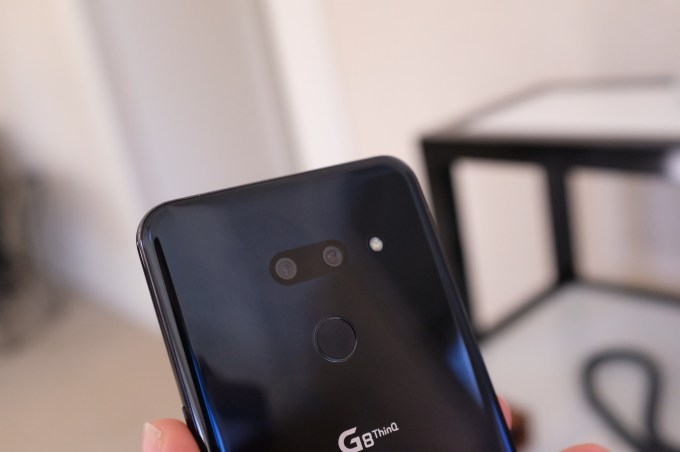
The Z camera also does depth-sensing face unlock that’s a lot harder to spoof than the kind found on other Android handsets. LG’s also put the tech to use for a set of Air Motion gestures, which allow for hands-free interaction with various apps like the camera (selfies) and music (volume control).
I played around with the feature, and if I’m being totally honest, it takes some getting used to. You’ve got to train yourself to get things just right, which could well dissuade most users from any sort of long-term adoption of features that can pretty quickly with accomplished with a tap.
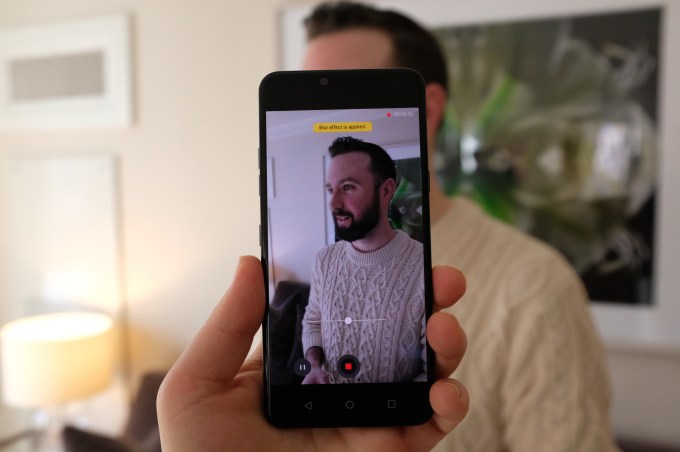
Other notable features for the new flagship include a 6.1 QHD+ OLED display and a new video portrait mode, which lets users adjust bokeh on the fly.
The handset will hit the States “in the coming weeks.” Pricing is still TBD, but I anticipate that it will cost around the same a previous LG flagships.