Fortnite Season 8 is about to kick off — here’s what to expect

Fortnite Season 8 is almost here. There’s a lot we don’t know — most things, really — but the long wait will be over soon. If you can’t stand the anticipation or the requisite server downtime, we’re here to speculate so you’ll be mildly less bored. It worked for us.

If Fortnite’s snowy Season 7 felt like it was dragging on through winter, things look to be warming up and melting out. Epic’s hinting makes it pretty clear that Season 8 will be a maritime adventure of some kind, swapping abominable snowmen for… pirates. There have been other watery clues though in recent days those expanded on what we assumed to be a marine theme of some kind, suggesting the map may soon be crawling with sea-faring marauders.

??????

— Fortnite (@FortniteGame) February 28, 2019

If you combine the four pieces of an image teaser for the new season, you’ll clearly see a skull-looking situation with a hook hand on the right side and a… dragon-like creature (viper? scaly dude?) on the left. Below those images there’s a more clear dragon/monster creature and um, a freaked out looking banana. Because Fortnite.

'X' Marks The Spot
Treasure abound
Loot that has been lost
Can always be found.
4 days to Season 8. pic.twitter.com/1U8n7x4pQQ

— Fortnite (@FortniteGame) February 24, 2019

Here's the complete image of all four Season 8 teasers! #Fortnite pic.twitter.com/JLM952boz8

— Fortnite News – fnbr.news (@FortniteBR) February 27, 2019

Update: According to an Xbox leak, that right-side dragon creature actually could be a tiger mask that’s one of three featured Season 8 skins. Unfortunately, that tiger skin is so sweet I’ll probably have to play continuously until I get it, even though this game and I are on a break right now.

Xbox with the screw up this time! #fortnite #fortniteseason8 pic.twitter.com/QMNP3pgkcK

— fortnite leaks and news ??[1.5K] (@fortniteleaks14) February 28, 2019

The red background and shape under the figures is distinctly lava-inspired, so we’re expecting a volcanic and or tectonic event to impact the map in some way that’s probably going to be centered around Wailing Woods, which has become brown, fissure-ridden and crispy in the last few days.

Then again, dragons can also make things pretty brown and crispy… as could a volcano full of dragons. And of course there’s the mystery of the dragon eggs below the castle made of ice. Will they turn out to be related to Season 8’s map transformation? Maybe, maybe not!

Sensing a theme…

Beyond the thematic elements, Fortnite players should also expect some kind of new mass server-wide live event to whisk them into the fresh season. Some people think this will be a volcanic monster with billions of HP that everyone has to take down across servers, and given the scaled imagery and impending volcano situation, that’s as good a guess as any.

Beyond pirates, dragons, volcanoes and assorted oceanic stuff, we don’t really know what else to expect yet, but knowing Epic’s penchant for maximalism, it’ll probably be, well, epic.  One thing we do know: You should take one last joyride in the clouds because planes are set to be vaulted. Maybe players will be flying dragons this time tomorrow — that’s fine! Fly whatever you want, fly it in your banana suit, just please, please lock the plane noise in the vault for good.

Ahoy, mateys! Season 8 approaches and X marks the spot!

Downtime begins tomorrow, February 28 at 4 AM ET (0900 UTC).

— Fortnite (@FortniteGame) February 27, 2019

Medium lowers its paywall for Twitter users

If you’re not the paying sort, Medium has a mile-wide new hole in its paywall that might interest you. (But really, you should be the paying sort.)

On Wednesday, Medium CEO and Twitter co-founder Ev Williams announced that Medium is tearing down its paywall for readers that visit the site through Twitter. In tweets, Williams elaborated on the company’s thinking a bit, explaining that the decision wouldn’t affect Medium members who rely on paid readerships, as paid readers would still be counted like they were before.

All @Medium paywalled stories are now free and unmetered when you’re coming from Twitter.

— Ev Williams (@ev) February 27, 2019

“It doesn’t affect compensation—assuming you mean for Partner Program,” Williams said. “That’s determined by readership from paying members, which will still be counted (assuming they’re logged in).”

Still, it’s difficult to imagine how paid memberships will go up with content readily accessible for free. When asked by a Twitter user if the decision would disincentivize would-be paying users, Williams maintained that Medium would be keeping an eye on what happens to its paid subscription base.

“We will certainly watch that, and if it has a negative impact, we may change this in the future,” Williams said. “As it stands, Twitter is a relatively small (but important) part of our traffic, and we expect this to have a positive effect.”

Part of that logic is likely the idea that bringing more people into Medium through Twitter will convert more paid readers. A Medium membership is $5 monthly or $50 a year and that money goes into a pool that is doled out to writers — a refreshingly creator-friendly approach compared to the house-always-wins attitude of other platforms.

Earlier this month, Medium picked up San Francisco publication the Bold Italic to sweeten its paywalled offerings. It’s clear that cultivating some premium content is central to Medium’s move to bring in subscribers, but the gaping Twitter-shaped hole in the paywall is a bit counterintuitive. Still, with Medium — as with all mercurial tech platforms in publisher’s clothing — everything is subject to change.

In late 2017, Medium added the option for any author or publisher to operate their own paywall on the platform, but it revoked the offering abruptly last year. That move reminded publishers getting cozy with Medium that the company is, at its heart, a tech company that can change its approach to business on a dime, taking publishers along for the ride.

However it shakes out, it’s clear that Medium is trying out a few new things. A day prior to the paywall announcement, Medium launched a new tech and science publication called OneZero — one of the four new digital magazines. Medium plans to power those flagship editorial brands with its “sustainable, subscription business model.” That model is something it didn’t have in place in early 2017, when Medium hit some bumps, made some layoffs and lost the Ringer (and other smaller publishers) before realigning itself in order to chart a non-ad-supported path forward.

SoFi founder Mike Cagney’s new company, Figure, just raised another $65 million

Figure, a 13-month-old, San Francisco-based company that says it uses blockchain technology to provide home equity loans online in as little as five days, has raised a whole lot of money in not a lot of time: $120 million to date, including $65 million in fresh funding from RPM Ventures and partners at DST Global, with participation from DCG, Nimble Ventures, Morgan Creek, and earlier investors Ribbit Capital and DCM.

The money isn’t entirely surprising, given who founded the company, Mike Cagney, who founded SoFi and built it into a major player in student loan refinancing in the U.S. before leaving amid allegations of sexual harassment and an anything-goes corporate culture that saw at least two former employees sue the company.

Today, SoFi has moved on under the leadership of CEO Anthony Noto, a former Twitter executive who is working to reshape SoFi from a lending company into more of a full-fledged financial services company with savings and checking accounts, as well as exchange-traded funds, all with the aim of making its platform stickier than in the past.

It may be a bigger endeavor than Noto had realized. Though Cagney once predicted the company would IPO in 2018 or 2019, SoFi isn’t even considering a public offering this year, Noto told reporters earlier this week.

Cagney has meanwhile moved on, too, though he still seems set on taking on traditional banks. Indeed, while Figure is providing home loans today – – it says it has provided more than 1,500 home equity lines to date — it’s also moving to diversify into new areas, including wealth management, unsecured consumer loans, and checking accounts offered (for now) in partnership with an existing bank.

Interestingly, Figure, which employs 100 people, is targeting a very different demographic than did SoFi, as Cagney told American Banker recently. Whereas SoFi marketed to young people earning high salaries, Figure is going after older customers who may not be seeing much in the way of income but have much of their wealth tied up in their homes instead.

Given that older Americans are projected to outnumber children for the first time in history by 2030, according to U.S. census data, Cagney clearly sees the writing on the wall.

Unsurprisingly, he’s not the only one. Other startups trying to make it easier for Americans to borrow against their homes include Point, a roughly four-year-old startup that lends capital to people and receives partial ownership in their homes in return.

Cagney cofounded Figure with his wife, June Ou, who is the company’s chief operating officer. She was previously chief technology officer at SoFi.

As for its culture and lingering questions that customers and potential partners may have about what happened at SoFi, Cagney — who has said he had consensual sexual relationships with female subordinates at SoFi — insists that Figure is benefiting from lessons learned.

At SoFi, he told American Banker, “[W]e grew so fast and we never really understood what we were going to grow into, and culture never took a front seat.” Figure meanwhile has a  “very clear adherence to a  no-asshole policy.”

Open-source communities fight over telco market

When you think of MWC Barcelona, chances are you’re thinking about the newest smartphones and other mobile gadgets, but that’s only half the story. Actually, it’s probably far less than half the story because the majority of the business that’s done at MWC is enterprise telco business. Not too long ago, that business was all about selling expensive proprietary hardware. Today, it’s about moving all of that into software — and a lot of that software is open source.

It’s maybe no surprise then that this year, the Linux Foundation (LF) has its own booth at MWC. It’s not massive, but it’s big enough to have its own meeting space. The booth is shared by the three LF projects: the Cloud Native Computing Foundation (CNCF), Hyperleger and Linux Foundation Networking, the home of many of the foundational projects like ONAP and the Open Platform for NFV (OPNFV) that power many a modern network. And with the advent of 5G, there’s a lot of new market share to grab here.

To discuss the CNCF’s role at the event, I sat down with Dan Kohn, the executive director of the CNCF.

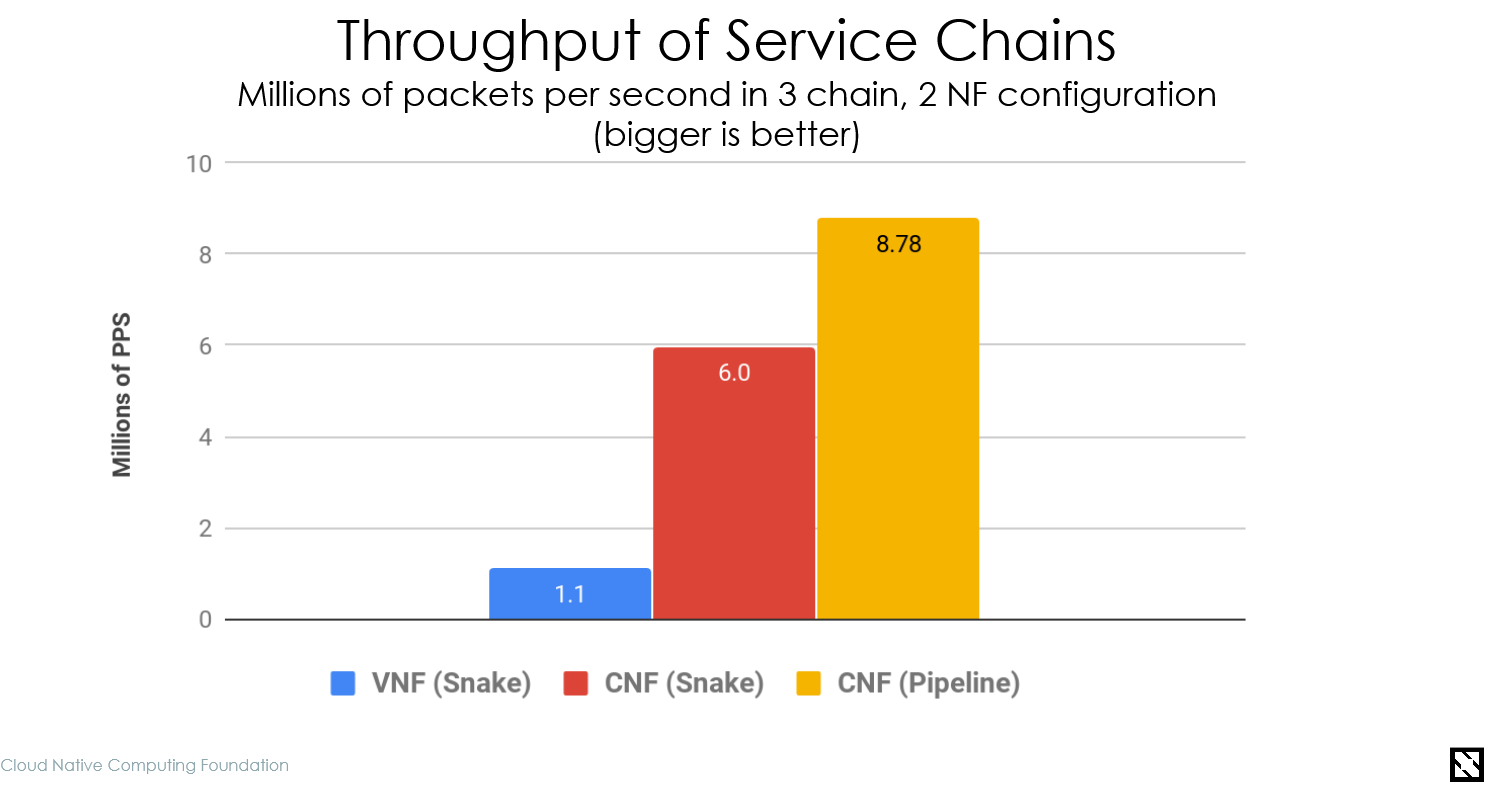

At MWC, the CNCF launched its testbed for comparing the performance of virtual network functions on OpenStack and what the CNCF calls cloud-native network functions, using Kubernetes (with the help of bare-metal host Packet). The project’s results — at least so far — show that the cloud-native container-based stack can handle far more network functions per second than the competing OpenStack code.

“The message that we are sending is that Kubernetes as a universal platform that runs on top of bare metal or any cloud, most of your virtual network functions can be ported over to cloud-native network functions,” Kohn said. “All of your operating support system, all of your business support system software can also run on Kubernetes on the same cluster.”

OpenStack, in case you are not familiar with it, is another massive open-source project that helps enterprises manage their own data center software infrastructure. One of OpenStack’s biggest markets has long been the telco industry. There has always been a bit of friction between the two foundations, especially now that the OpenStack Foundation has opened up its organizations to projects that aren’t directly related to the core OpenStack projects.

I asked Kohn if he is explicitly positioning the CNCF/Kubernetes stack as an OpenStack competitor. “Yes, our view is that people should be running Kubernetes on bare metal and that there’s no need for a middle layer,” he said — and that’s something the CNCF has never stated quite as explicitly before but that was always playing in the background. He also acknowledged that some of this friction stems from the fact that the CNCF and the OpenStack foundation now compete for projects.

OpenStack Foundation, unsurprisingly, doesn’t agree. “Pitting Kubernetes against OpenStack is extremely counterproductive and ignores the fact that OpenStack is already powering 5G networks, in many cases in combination with Kubernetes,” OpenStack COO Mark Collier told me. “It also reflects a lack of understanding about what OpenStack actually does, by suggesting that it’s simply a virtual machine orchestrator. That description is several years out of date. Moving away from VMs, which makes sense for many workloads, does not mean moving away from OpenStack, which manages bare metal, networking and authentication in these environments through the Ironic, Neutron and Keystone services.”

Similarly, ex-OpenStack Foundation board member (and Mirantis co-founder) Boris Renski told me that “just because containers can replace VMs, this doesn’t mean that Kubernetes replaces OpenStack. Kubernetes’ fundamental design assumes that something else is there that abstracts away low-level infrastructure, and is meant to be an application-aware container scheduler. OpenStack, on the other hand, is specifically designed to abstract away low-level infrastructure constructs like bare metal, storage, etc.”

This overall theme continued with Kohn and the CNCF taking a swipe at Kata Containers, the first project the OpenStack Foundation took on after it opened itself up to other projects. Kata Containers promises to offer a combination of the flexibility of containers with the additional security of traditional virtual machines.

“We’ve got this FUD out there around Kata and saying: telco’s will need to use Kata, a) because of the noisy neighbor problem and b) because of the security,” said Kohn. “First of all, that’s FUD and second, micro-VMs are a really interesting space.”

He believes it’s an interesting space for situations where you are running third-party code (think AWS Lambda running Firecracker) — but telcos don’t typically run that kind of code. He also argues that Kubernetes handles noisy neighbors just fine because you can constrain how many resources each container gets.

It seems both organizations have a fair argument here. On the one hand, Kubernetes may be able to handle some use cases better and provide higher throughput than OpenStack. On the other hand, OpenStack handles plenty of other use cases, too, and this is a very specific use case. What’s clear, though, is that there’s quite a bit of friction here, which is a shame.

A big ruling against Fox raises concerns of ‘self-dealing’ with Hulu

An arbitrator has awarded $179 million in damages to the stars and creative team behind the Fox show “Bones.”

As laid out in an in-depth Hollywood Reporter story, the ruling could have bigger implications for the streaming world, particularly as the major media companies are looking to launch their own streaming services, which will presumably take advantage of their existing content libraries.

Stars David Boreanaz and Emily Deschanel, along with executive producer Barry Josephson and Kathy Reichs (who wrote the novels that “Bones” was based on), sued 21st Century Fox in 2015. They alleged that the Fox studio licensed the show for below-market rates to Fox networks and later to Hulu, cheating them out of their rightful share of the profits.

The dispute ultimately went into arbitration. Now arbitrator Peter Lichtman has ordered Fox (which currently owns a 30 percent stake in Hulu, and is in the process of being acquired by Disney) to pay one of the largest profit-sharing awards in Hollywood history.

As part of his ruling (embedded below), Lichtman examines Fox’s deal to stream “Bones” reruns on Hulu. These kinds of deals — where studios sell content to a corporate sibling — aren’t unusual, but the company is still expected to pay fair market value.

It seems, in this case, that Hulu was only giving Fox a share of ad revenues, something that Lichtman describes skeptically: “So, when Fox contends that there is no evidence of a better deal struck by another studio in terms of the percentage of ad revenue, this is true because no other studio would make such a deal based on the percentage of ad revenue” (emphasis in the original).

Lichtman then moves on to what he calls “perhaps the most shocking piece of evidence related to the Hulu issues,” namely the fact that executive Dan Fawcett signed the licensing agreement on behalf of both Fox and Hulu.

“As stated above, Mr. Fawcett literally signed the agreement for both parties in his representative capacity for both sides,” Lichtman writes. “The obvious inferences of self-dealing, conflict of interest and the lack of any arm’s length negotiations leap off the page.”

Ultimately, Lichtman concludes that there’s one obvious reason why Hulu got such a good deal.

“It is undisputed that the Fox conglomerate had an equity stake in Hulu, and the evidence established that ‘Fox writ large’ essentially handed over the digital rights at a low cost to build up value of that enterprise,” he says.

Fox, meanwhile, is challenging the ruling and arguing that most of the damages should be avoided.

“The ruling by this private arbitrator is categorically wrong on the merits and exceeded his arbitration powers,” the company said in a statement. “Fox will not allow this flagrant injustice, riddled with errors and gratuitous character attacks, to stand and will vigorously challenge the ruling in a court of law.”

Regardless of how this case plays out, it probably won’t be the last time Hollywood talent challenges the studios over streaming profits.

Update: Disney has provided the following statement from CEO Bob Iger:

[Fox executives] Peter Rice and Dana Walden are highly respected leaders in this industry, and we have complete confidence in their character and integrity. Disney had no involvement in the arbitration, and we understand the decision is being challenged and will leave it to the courts to decide the matter.

Bones arbitrarion ruling by TechCrunch on Scribd

Box fourth quarter revenue up 20 percent, but stock down 22 percent after hours

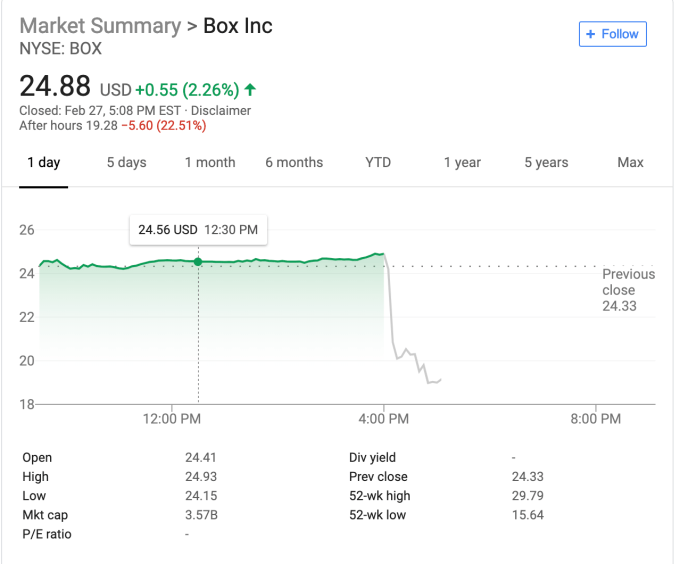
By most common sense measurements, Box had a pretty good earnings report today, reporting revenue up 20 percent year over year to $163.7 million. That doesn’t sound bad, yet Wall Street was not happy with the stock getting whacked, down more than 22 percent after hours as we went to press. It appears investors were unhappy with the company’s guidance.

Part of the problem, says Alan Pelz-Sharpe, principal analyst at Deep Analysis, a firm that watches the content management space, is that the company failed to hit its projections, combined with weaker guidance; a tough combination, but he points out the future does look bright for the company.

Box did miss its estimates and got dinged pretty hard today; however, the bigger picture is still of solid growth. As Box moves more and more into the enterprise space, the deal cycle takes longer to close and I think that has played a large part in this shift. The onus is on Box to close those bigger deals over the next couple of quarters, but if it does, then that will be a real warning shot to the legacy enterprise vendors as Box starts taking a chunk out of their addressable market,” Pelz-Sharpe told TechCrunch.

This fits with what company CEO Aaron Levie was saying. “Wall Street did have higher expectations with our revenue guidance for next year, and I think that’s totally fair, but we’re very focused as a company right now on driving reacceleration in our growth rate and the way that we’re going to do that is by really bringing the full suite of Box’s capabilities to more of our customers,” Levie told TechCrunch.

Holger Mueller, an analyst with Constellation Research says failing to hit guidance is always going to hurt a company with Wall Street. “It’s all about hitting the guidance, and Box struggled with this. At the end of the day, investors don’t care for the reasons, but making the number is what matters. But a booming economy and the push to AI will help Box as enterprises need document automation solutions,” Mueller said.

On the positive side, Levie pointed out that the company achieved positive non-GAAP growth rate for the first time in its 14-year history, with projections for the first full year of non-GAAP profitability for FY20 that it just kicked off.

The company was showing losses on a cost per share of 14 cents a share for the most recent quarter, but even that was a smaller loss than the 24 cents a share from the previous fiscal year. It would seem that the revenue is heading generally in the correct direction, but Wall Street did not see it that way, flogging the cloud content management company.

Chart: Box

Wall Street tends to try to project future performance. What a company has done this quarter is not as important to investors, who are apparently not happy with the projections, but Levie pointed out the opportunity here is huge. “We’re going after 40 plus billion dollar market, so if you think about the entirety of spend on content management, collaboration, storage infrastructure — as all of that moves to the cloud, we see that as the full market opportunity that we’re going out and serving,” Levie explained.

Pelz-Sharpe also thinks Wall Street could be missing the longer-range picture here. “The move to true enterprise started a couple of years back at Box, but it has taken time to bring on the right partners and infrastructure to deal with these bigger and more complex migrations and implementations,” Pelz-Sharpe explained. Should that happen, Box could begin capturing much larger chunks of that $40 billion addressable cloud content management market, and the numbers could ultimately be much more to investor’s liking. For now though, they are clearly not happy with what they are seeing.

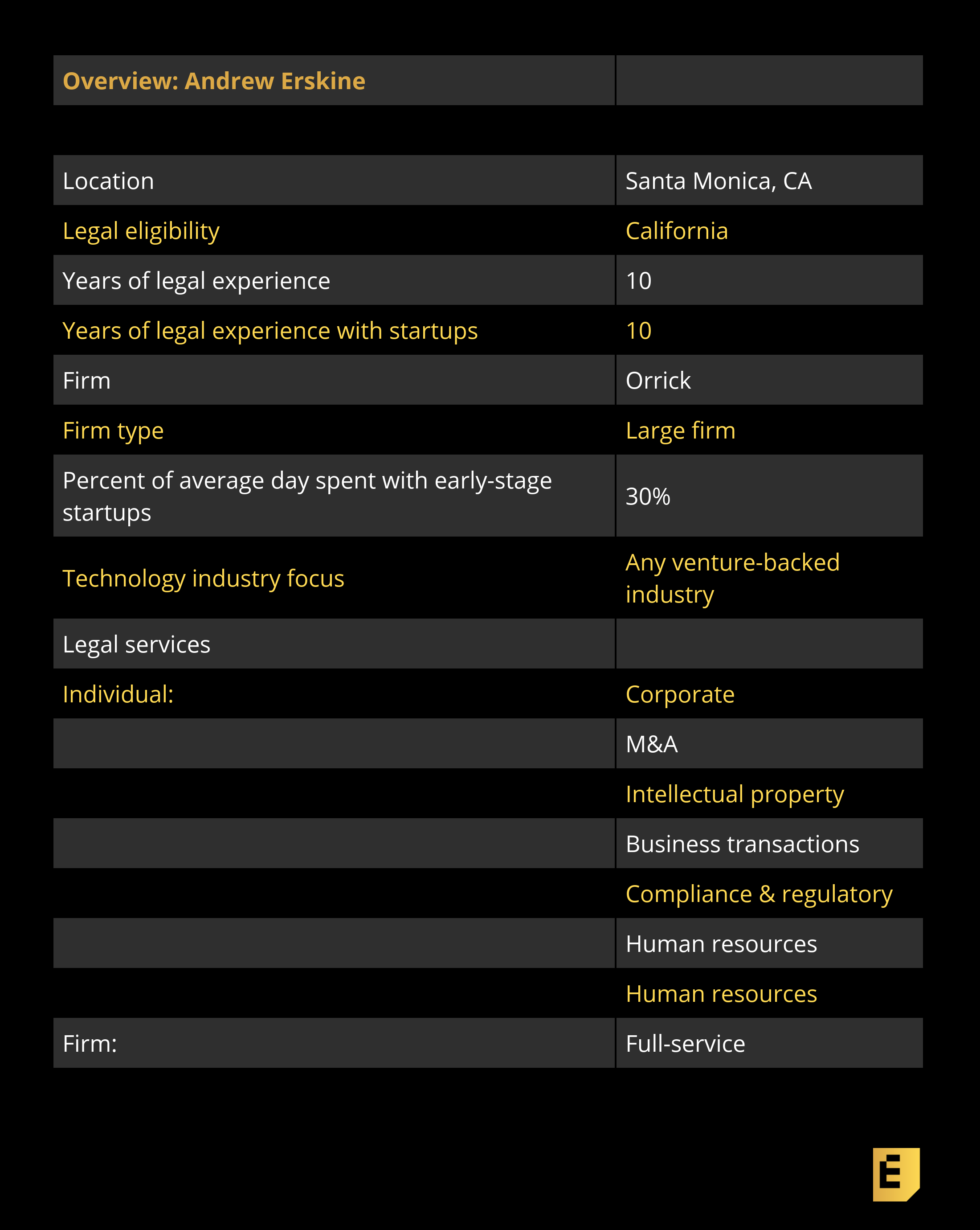
Verified Expert Lawyer: Andrew Erskine

Andrew Erskine has developed his legal career along with the rise of the tech startup scene in Los Angeles. Today, as a partner at Orrick in its Santa Monica office, he works with companies large and small in the area and beyond.


His approach:

“The way that I practice and the philosophy I have is that clients aren’t really coming to me with legal problems. They’re coming with business problems and we need to solve them with that context. It’s almost never an answer of, ‘This is the law, now go do what it is that the law says exactly what you need to do.’ It’s more of, ‘This is the way that your business works and how I understand it, and these are the rules that are set out for you to follow and you need to think about how to follow them.’”

On LA’s startup scene:

“Andrew provides the same level of effort, expertise and professionalism when I was a pre-seed company with no capital as he did when we had raised $100 million.” Brian Thomas, Los Angeles, co-founder, Clutter

“The LA community has gotten to a point where it’s sophisticated and it’s significant. It’s one of the largest communities in the world, but we still need to be doing what we can to protect it and support it and help it grow further. It’s because we touch so many early-stage companies and, obviously, we have a lot of communication with early-stage investors and as you go up the chain, mid-late stage as well, a lot of it is also just trying to make sure that people are being connected the way that they need to be.

“I spend a lot of time just trying to put people in touch with each other, including a lot of people that are not my clients — I don’t do any work for them. They’re just people that I know in the community and we’ve become friends and I’m trying to make sure that what they’re trying to do is growing at the same rate.”

On early-stage problems:

“We’ve had acquisitions in the ten figures in recent years where people were coming out of the woodwork at the very last minute saying, ‘Hey, I own a piece of this company.’ And it was just something that founders never really thought to raise and then of course you’re dealing with the huge issue at the most critical point in the company’s history. So, things like that will happen.

“A lot of that is just trying to get that out of founders that you start working with, the stuff that you see in your experience can come back to really bite people, you just ask them day one, right away. ‘Hey, are there skeletons in the closet? Because if there are…’ ”

Below, you’ll find the rest of the founder reviews, the full interview and more details like their pricing and fee structures.

This article is part of our ongoing series covering the early-stage startup lawyers who founders love to work with, based on this survey (which we’re keeping open for more recommendations) and our own research. If you’re a founder trying to navigate the early-stage legal landmines, be sure to check out our growing set of in-depth articles, like this checklist of what you need to get done on the corporate side in your first years as a company.


The Interview

Eric Eldon: How did you get involved with tech companies and startups?

Andrew Erskine: I was a summer associate over here in LA and a bunch of outside groups would come talk about what they do. There was like one guy in the city working with startups and he came in and explained what he did and that was it. I heard him and I was like, ‘That’s what I want to do. Period.’ Just the way that he described what he was doing, the level of contact that he had with the people that are making decisions at these companies, the actual founders and lead investors, and the ability to not just be providing purely legal advice, but really trying to help these companies grow and build a vessel around them, giving them business advice, personal advice, whatever it is. It just sounded so much more fascinating than the idea of being one out of 100 on a deal and I just decided that I had to do it and it turned out really exactly how I hoped it would.

Eric Eldon: Can you just tell me more about how you see a lawyer playing a role in developing a tech startup ecosystem? 

US bans lithium batteries from cargo holds on passenger flights

On Wednesday, the U.S. Department of Transportation and the Federal Aviation Administration issued new rules designed to protect air passengers from the potential dangers of lithium ion batteries. The new interim final rule disallows lithium ion cells and batteries in the cargo area of passenger airplanes. The rule also sets new guidance for lithium ion batteries that travel on cargo-carrying planes, specifying that they not exceed a state of being 30 percent charged.

“This rule will strengthen safety for the traveling public by addressing the unique challenges lithium batteries pose in transportation,” U.S. Secretary of Transportation Elaine L. Chao said of the new rule.

In 2016, the U.N.’s International Civil Aviation Authority put similar restrictions in place for all member countries in an effort to prevent the risk of in-flight cargo hold fires. The rule won’t affect current guidance that allows electronic devices in the passenger cabin of planes, only codifying the guidance already in place by the U.N. authority under U.S. regulation.

The FAA’s current fact sheet suggests that these batteries should be carried in the passenger area and not checked, though it doesn’t go as far as banning them outright:

Devices containing lithium metal or lithium ion batteries, including – but not limited to – smartphones, tablets, and laptops, should be kept in carry-on baggage. If these devices are packed in checked baggage, they should be turned completely off, protected from accidental activation and packed so they are protected from damage.

While passengers won’t be required to change their behavior under the new ruleset, consumers may notice that batteries and charging devices shipped to them may arrive without a full charge.

BlackBerry sues Twitter for patent infringement

BlackBerry, the former smartphone maker, is suing Twitter for alleged patent infringement. If this sounds familiar, it may be because BlackBerry filed a patent infringement suit against Facebook last year.

In its complaint, BlackBerry alleges Twitter has infringed and continues to infringe on six of its patents, which cover things like push notifications, silencing notifications for a message thread and mobile advertising techniques.

BlackBerry, which refers to itself as a pioneer in mobile messaging, alleges Twitter “created mobile messaging applications that co-opt BlackBerry’s innovations, using a number of the innovative user interface and functionality enhancing features that made BlackBerry’s products such a critical and commercial success in the first place.”

As noted above, BlackBerry sued Facebook last year, alleging patent infringement. At the time, BlackBerry cited seven patents that relate to security, user interface features, battery-efficient status updates, mobile messaging in games and, similarly to its issue with Twitter, silencing notifications. A few months later, in September, Facebook filed a suit of its own against BlackBerry, alleging the company infringed on five of its patents. Both of those suits are still in litigation.

BlackBerry was once a smartphone giant, but stopped manufacturing its own hardware in 2016. Then, in 2017, BlackBerry revealed the KEYone smartphone, manufactured by TCL, under the company’s new strategy to focus on software.

Both Twitter and BlackBerry declined to comment.

Netflix may be losing $192M per month from piracy, cord cutting study claims

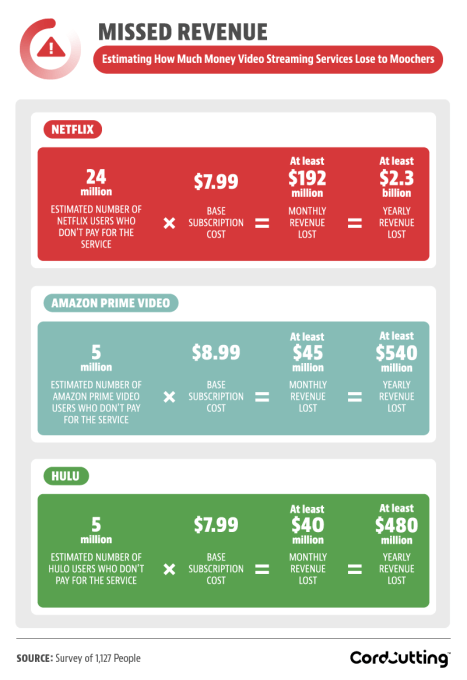
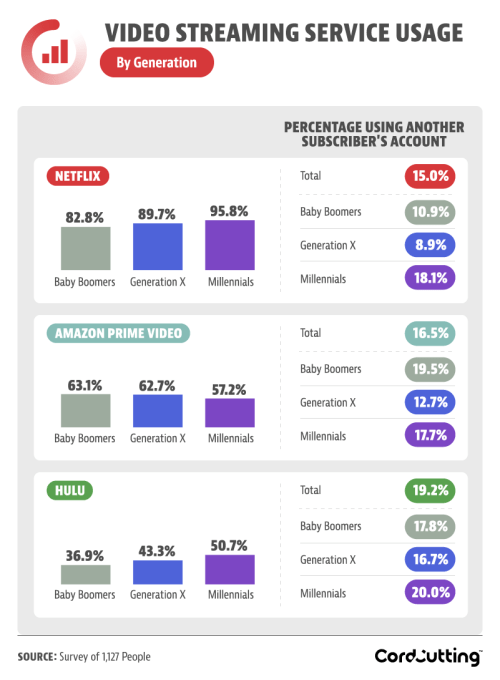
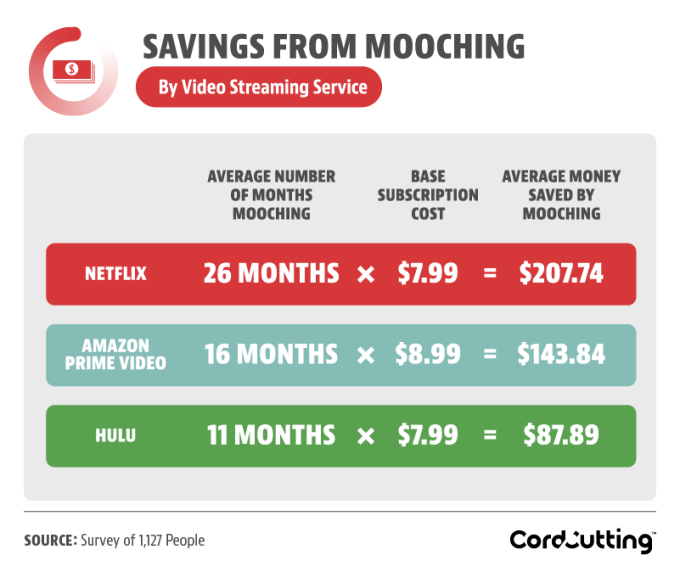
As many as 1 in 5 people today are mooching off of someone else’s account when streaming video from Netflix, Hulu or Amazon Video, according to a new study from CordCutting.com. Of these, Netflix tends to be pirated for the longest period — 26 months, compared with 16 months for Amazon Prime Video or 11 months for Hulu. That could be because Netflix freeloaders often mooch off their family instead of a friend — 48 percent use their parents’ login, while another 14 percent use their sister or brother’s credentials, the firm found.

At a base price of $7.99 per month (the study was performed before Netflix’s January 2019 price increase), freeloading users could save $207.74 over a 26-month period. At scale, these losses can add up, the study claims.

The report estimates Netflix could be losing $192 million in monthly revenue from piracy — more than either Amazon or Hulu, at $45 million per month and $40 million per month, respectively.

Millennials, not surprisingly, account for much of the freeloading. They’re the largest demographic pirating Netflix (18 percent) and Hulu’s service (20 percent). But oddly, it was Baby Boomers who were more likely to borrow someone else’s account to access Amazon Prime Video.

There’s an argument that those who pirate would never be paying customers, so these aren’t true losses. It’s the same sort of thing that was said about Napster mp3 downloads back in the day, or about those pirating movies through The Pirate Bay. But there is some portion of the freeloading population that claims they would pay, if they lost access.

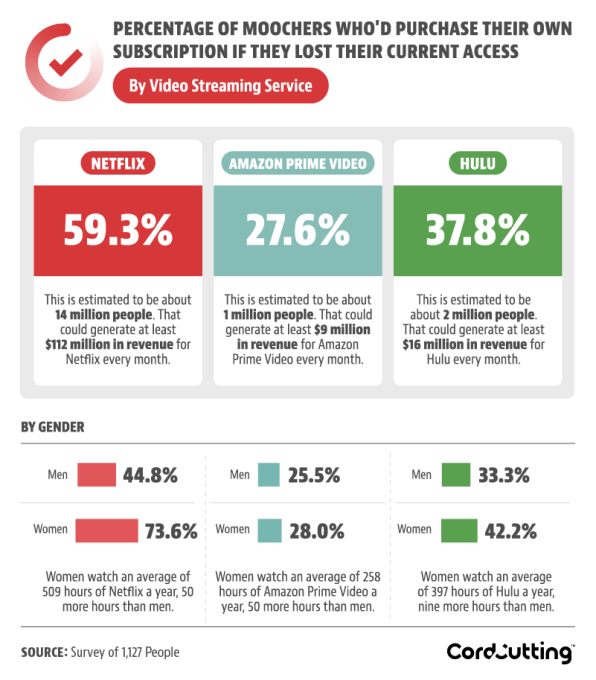
According to the study, 59.3 percent said they would pay for Netflix (or around 14 million people), contributing at least $112 million in monthly revenue, if they lost access. And 37.8 percent, or 2 million, said they’d pay for Hulu; 27.6 percent, or 1 million people, said they’d pay for Prime Video.

Of course, there can be discrepancies between what consumers say they will do versus what they actually end up doing. So such claims that “I’d definitely pay,” have to be taken with the proverbial grain of salt.

It’s worth noting, too, this study calculated figures by looking at Netflix’s single-screen-at-a-time account — in theory, the one meant to be used by a single individual and not shared as a family plan, in order to keep the estimates conservative. The consumer survey defined mooching by asking users if they use a service they don’t pay for, then asked what they would or would not pay for themselves, if that access fell through.

Hulu, at least, has more recently tried to make its service more appealing to penny-pinchers. At its new price — $5.99 per month, rolled out this week — it’s making it harder to justify freeloading.

Netflix, on the other hand, seems to know its value, and raised prices this year so its base plan is a dollar more at $8.99 per month, and its most popular plan has climbed to $12.99 per month.

The full study offers other details on cord-cutting trends, including breakdowns by gender and details on who accounts are mooched from, among other things.