Jeffrey Katzenberg’s streaming service Quibi is doing a show about Snapchat’s founding

Jeffrey Katzenberg and Meg Whitman today announced a slate of new series and projects heading to their forthcoming video streaming service, Quibi. The list includes an origin story to complement Telemundo’s hit show “El Señor de los Cielos;” a music competition show produced by Justin Bieber manager and entertainment exec Scooter Braun; a show from Jennifer Lopez’s company about the power of giving and paying it forward; as well something called “Frat Boy Genius,” which will focus on the rise of Snapchat — and specifically its creator, Evan Spiegel.

“It is the story of how he built and created Snapchat, which is one of the great social platforms of our time,” touted Katzenberg. “And we want to tell a story that is as compelling and interesting about the creation of Snapchat and Evan’s story as “[The] Social Network” was for Facebook,” he added.

The project will be based on the screenplay by the same name, which had written Spiegel as a hard-partying Stanford student, according to Vulture’s review of the much-hyped script.

“He should be flattered,” remarked Katzenberg, of Quibi’s plans for the Spiegel-focused project.

And now to the featured scripts! First up: @Elissits' FRAT BOY GENIUS, illustrated by @boxbrown. pic.twitter.com/GW8KQclrrB

— The Black List (@theblcklst) December 17, 2018

Katzenberg and Quibi CEO Meg Whitman were at SXSW to speak about the upcoming streaming video service, which plans to offer short-form video designed for mobile. On Quibi, consumers watch “quality” video cut into smaller pieces, including both scripted and unscripted original content, exclusives from Quibi’s partners and other daily news and sports programming.

Already, some of Quibi’s content plans have been announced.

For example, Deadline reported last fall that filmmakers Sam Raimi, Guillermo del Toro and Antoine Fuqua and producer Jason Blum will all create series for the service. And a pitch deck had touted other examples of Quibi’s programming — like a show called “Inspired By” with Justin Timberlake and “Under the Gun” with Kobe Bryant. Plus, Katzenberg himself had revealed in a LinkedIn post that Quibi was working on a basketball-related series with Steph Curry’s production company.

However, the story about Snapchat’s founding highlights how Quibi could benefit from its combination of tech and entertainment industry roots, in terms of deciding what to greenlight.

Whitman, a former HP Enterprise president and CEO, also pointed to another example: her penchant for using data to make decisions.
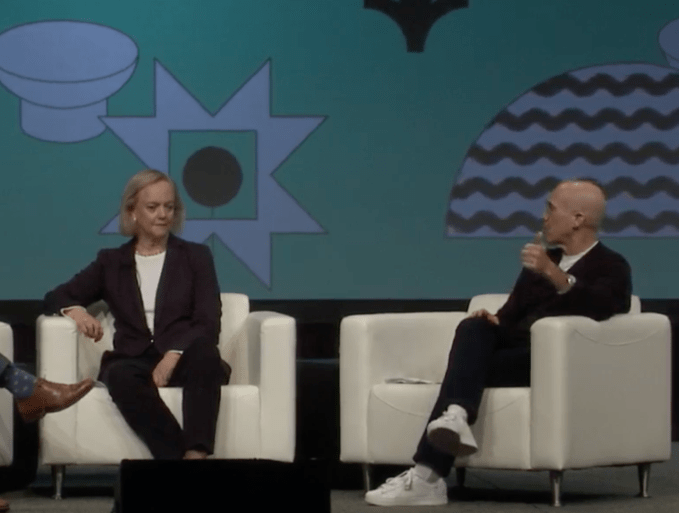
“I am deeply analytical and Jeffrey will argue in stories and allegories,” Whitman said. “And I will say: ‘Jeffrey, do you have any data to suggest that what you have just said is true?’ And he’ll say, ‘no I don’t have any data — but it’s true,’ ” she explained.

“Then I will come with data, facts, total available market size, market segmentation, market research, and he will say, ‘you know, not everything yields to analysis.’ And I’ll say ‘no, not everything does, but most things do,’ ” she said.

For the most part, today’s onstage discussion was a pitch for why Quibi will work and why it needs to exist — with Katzenberg touting its promise as an app that will benefit from 5G mobile networks as well as the cord-cutting behavior among younger millennials, who are no longer interested in traditional pay TV.

Both execs also stressed that Quibi was not a Netflix or YouTube competitor — despite angling for the same share of consumers’ mobile minutes and a set amount of downtime not spent on social media and mobile gaming, for example. They instead believe Quibi will be additive, and other services — like Netflix and Disney+ — can still win, even as Quibi wins.

Katzenberg said that Quibi aims to grab 20 minutes of the 70 minutes per day people spend watching short-form video, but doesn’t believe it will necessarily come at the expense of YouTube or others.

“Six years ago it was six minutes. A year and a half ago, it was 40 minutes. And today it’s 70 minutes,” he said, illustrating mobile video’s rise. “People love being able to watch great short-form content on the go.”

“What we know is that our users are watching a lot of video on mobile. They’re excited about the opportunity to see something differentiated. But honestly, we’re using a lot of judgment, and we’ll know whether it works when it launches,” Whitman added. 

Quibi will publish more than 100 pieces of content every week, meaning it’s going to be making 5,300-5,400 pieces of content per year, Katzenberg said. He also mentioned a few others examples of programming, including a daily round-up of the best of late night TV, and spoke more vaguely of the potential for a show that delivered music news, the way that MTV’s Kurt Loder once did.

The streaming service is launching in April 2020, Katzenberg also confirmed today, putting a more definitive time stamp on the launch time frame beyond “early 2020” or “spring.”
MyEquifax.com is yet another security disaster

One would think that having one of the most high-profile breaches in recent memory would make a company take security to heart, but Equifax is full of surprises. The latest is that its MyEquifax.com site, to which the company invites those affected by its poor security practices to freeze and unfreeze their credit, itself has extremely poor security.

It’s all documented by security researcher Brian Krebs, who discovered the issue not in some special investigation but in the process of signing up at the site himself. What he found was that “getting an account at MyEquifax.com was easy. In fact, it was too easy.”

In matters of banking and credit, identity is a very important thing to establish. That’s why when you go to MyEquifax.com, it asks you for an email, then for your Social Security number and date of birth.

Slight problem: SSN and DOB were among the personal data leaked in the Equifax breach to begin with! And it doesn’t even check that you own the email address you submit. It does ask a few verification questions, but as Krebs points out these are often public information, such as the street you live on, or your mother’s maiden name, and as such rather worthless for security purposes.

One you have been “verified” with this process, you can immediately request a security freeze on your credit report, or unfreeze it if it’s frozen.

Oh, and don’t worry — if you established a PIN for this purpose when setting this up previously, you won’t need that. Yes, this poorly secured website specifically does not require a PIN, though a PIN is required for the same requests via phone or email. When Krebs asked a company representative about this, they explained:

We deployed an experience that embraces both security standards (using a multi-factor and layered approach to verify the consumer’s identity) and reflects specific consumer feedback on managing security freezes and fraud alerts online without the use of a PIN. The account set-up process, which involves the creation of a username and password, relies on both user inputs and other factors to securely establish, verify, and authenticate that the consumer’s identity is connected to the consumer every time.

None of that is true. Even elementary security standards like confirming the email address aren’t “embraced,” and multi-factor authentication is trivial to bypass.

This is bad but at least Equifax isn’t alone: It looks like credit reporting agencies Transunion and Experian also have ways of getting around PINs. You’d just think that Equifax, having failed so badly at security before, would want to make its setup a little more robust — even meeting basic standards would be good.

As Krebs points out, however, it’s in your interest to set up an account with your actual email address and information, since if you don’t, it seems pretty much anyone with a few data points on you can do so themselves, gaining the ability to freeze and unfreeze your credit.

‘Captain Marvel’ never quite takes flight

“Captain Marvel” isn’t a bad movie, exactly.

It seems, at this point, that Marvel’s moviemaking machinery is incapable of producing a genuinely terrible film. There’s no “Batman v. Superman: Dawn of Justice” or “Suicide Squad” in the Marvel filmography, just “Thor: The Dark World,” “Ant-Man” and “Doctor Strange” — movies that are fine but forgettable.

Still, I wanted more than that for “Captain Marvel,” and I suspect that I’m not alone.

That’s because after 20 films, Marvel Studios is finally giving a woman top billing. It’s “Captain Marvel,” full stop, in the first Marvel title directed by a woman — Anna Boden, who co-directed and co-wrote the film with her regular collaborator Ryan Fleck. As a result (and in response to star Brie Larson’s laudable efforts to make the press tour more inclusive), the movie has attracted a predictable swarm of online trolls.

So it’d be nice to report that “Captain Marvel” is an absolute triumph. The fact that it’s not has nothing to do with Larson, who plays Carol Danvers (the current incarnation of Captain Marvel) with a winning mix of charm and determination. The problem, I suspect, lies in the movie’s depiction of the Captain Marvel character.

Nick Fury

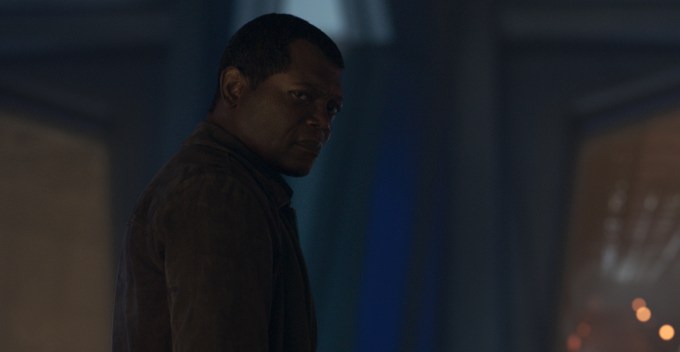
Marvel Studios’ CAPTAIN MARVEL..Nick Fury (Samuel L. Jackson) ..Photo: Film Frame..©Marvel Studios 2019

When the story begins, she isn’t Captain Marvel yet. Instead, she’s an amnesiac soldier-in-training known as Vers, who fights alongside an alien race known as the Kree in a war against their shapeshifting enemies, the Skrulls. (I will never stop being grateful to Marvel filmmakers for embracing the crazy sci-fi quality of the comics.)

The story eventually brings us to Earth in the 1990s, where we learn more about Vers’ past. But her backstory and her pyrotechnic powers remain abstract: When the credits rolled, she still felt like a blank slate. And while Larson absolutely sells the big, heroic lines that the script gives her, they feel more like generic messages of empowerment, rather than dialogue that shows us who the character is.

Luckily, though Captain Marvel remains a cipher, she’s surrounded by a strong supporting cast, including Samuel L. Jackson and Ben Mendelsohn (perhaps the most reliably delightful presence in the current wave of blockbusters), both transformed — Mendelsohn into a goblin-like Kree Skrull soldier, Jackson into a younger version of Nick Fury, the secret agent who eventually spearheads the Avengers.

In fact, the CGI technology that Marvel has been using to de-age its older actors is given its best showcase to date, largely avoiding the uncanny valley feeling that I got in “Captain America: Civil War” (with a scene that turned Robert Downey, Jr. into a sulking teenager) and “Ant-Man and the Wasp” (which gave us flashbacks to a middle-aged Michael Douglas and Michelle Pfeiffer).

And the story’s middle stretch, which pairs up Jackson and Larson on a buddy comedy-style road trip — with a shockingly cute cat along for the ride — is probably the film’s highlight.

Unfortunately, the genuinely funny character moments have to share screentime with a by-the-numbers Marvel plot, rote action scenes and tired jokes that harp on the ’90s setting. (To be fair, my preview screening audience enjoyed the period humor a lot more than I did. Maybe it depends on whether you find the sight of a Blockbuster Video — or Brie Larson wearing a Nine Inch Nails T-shirt — to be inherently funny.)

If anything, this illustrates how lucky we were to get “Wonder Woman” and “Black Panther,” back-to-back: They broke down barriers in on-screen representation, but they managed to be fun, memorable, good movies (or, in the case of “Black Panther,” a genuinely great one) at the same time.

With “Captain Marvel,” on the other hand, we get the first in what may be the new standard. Now women and minorities can star in their own superhero films, and they can be just as unremarkable as the ones with white guys.