CXA, a health-focused digital insurance startup, raises $25M

CXA Group, a Singapore-based startup that helps make insurance more accessible and affordable, has raised $25 million for expansion in Asia and later into Europe and North America.

The startup takes a unique route to insurance. Rather than going to consumers directly, it taps corporations to offer their employees health flexible options. That’s to say that instead of rigid plans that force employees to use a certain gym or particular healthcare, a collection over 1,000 programs and options can be tailored to let employees pick what’s relevant or appealing to them. The ultimate goal is to bring value to employees to keep them healthier and lower the overall premiums for their employers.

“Our purpose is to empower personalized choices for better living for employees,” CXA founder and CEO Rosaline Koo told TechCrunch in an interview. “We use data and tech to recommend better choices.”

The company is primarily focused on China, Hong Kong and Southeast Asia where it claims to works with 600 enterprises including Fortune 500 firms. The company has over 200 staff, and it has acquired two traditional insurance brokerages in China to help grow its footprint, gain requisite licenses and its logistics in areas such as health checkups.

We last wrote about CXA in 2017 when it raised a $25 million Series B, and this new Series C round takes it to $58 million from investors to date. Existing backers include B Capital, the BCG-backed fund from Facebook co-founder Eduardo Saverin, EDBI — the investment arm of the Singapore Economic Development Board — and early Go-Jek backer Openspace Ventures, and they are joined by a glut of big-name backers in this round.

Those new investors include a lot of corporates. There’s HSBC, Singtel Innov8 (of Singaporean telco Singtel), Telkom Indonesia MDI Ventures (of Indonesia telco Telkom), Sumitomo Corporation Equity Asia (Japanese trading firm) Muang Thai Fuchsia Ventures (Thailand-based insurance firm), Humanica (Thailand-based HR firm) and PE firm Heritas Venture Fund.

“There are additional insurance companies and strategic partners that we aren’t listing,” said Koo.

Rosaline Koo is founder and CEO of CXA Group

That’s a very deliberate selection of large corporates which is part of a new strategy to widen CXA audience.

The company had initially gone after massive firms — it claims to reach a collective 400,000 employees — but now the goal is to reach SMEs and non-Fortune 500 enterprises. To do that, it is using the reach and connections of larger service companies to reach their customers.

“We believe that banks and telcos can cross-sell insurance and banking services,” said Koo, who grew up in LA and counts benefits broker Mercer on her resume. “With demographic and work life event data, plus health data, we’re able to target the right banking and insurance services.

“We can help move them away from spamming,” she added. “Because we will have the right data to really target the right offering to the right person at the right time. No firm wants an agent sitting in their canteen bothering their staff, now it’s all digital and we’re moving insurance and banking into a new paradigm.”

The ultimate goal is to combat a health problem that Koo believes is only getting worse in the Asia Pacific region.

“Chronic disease comes here 10 years before anywhere else,” she said, citing an Emory research paper which concluded that chronic diseases in Asia are “rising at a rate that exceeds global increases.”

“There’s such a crying need for solutions, but companies can’t force the brokers to lower costs as employees are getting sick… double-digit increases are normal, but we think this approach can help drop them. We want to start changing the cost of healthcare in Asia, where it is an epidemic, using data and personalization at scale in a way to help the community,” Koo added.

Talking to Koo makes it very clear that she is focused on growing CXA’s reach in Asia this year, but further down the line, there are ambitions to expand to other parts of the world. Europe and North America, she said, may come in 2020.

Netflix is pursuing more interactive content, including, maybe, a rom-com

On the heels of its groundbreaking foray into interactive storytelling with the choose-your-own-adventure style “Black Mirror” episode, Bandersnatch, Netflix will look to produce much more interactive entertainment, according to vice president of content, Todd Yellin.

Speaking at the FICCI-Frames conference for Indian media and entertainment in Mumbai, Yellin said in a keynote that audiences could expect many more interactive stories to come from the streaming media service, according to a report in Variety.

“We realized, wow, interactive storytelling is something we want to bet more on,” Yellin reportedly said. “We’re doubling down on that. So expect over the next year or two to see more interactive storytelling.”

One of the things Yellin floated was the idea of a romantic comedy where the audience would choose “will-they or won’t-they”? It sets up the potential for a world where viewers could determine that Ross and Rachel never go on a break.

The initiative would likely require a lot of heavy lifting from writers, editors and actors. Black Mirror took two years to get from concept to screen and involved a lot of heavy lifting from Netflix .

In Bandersnatch, Netflix collaborated with the writers and directors of Black Mirror to develop the technology to support streaming a film that relied on the “branching narrative” storytelling structure that required viewers to pick between choices to advance the story.

Filmed over a seven-week shoot, the filmmaking process took 250 distinct video segments that were stitched together to cover all possible endings, according to a lengthy description of the making of the episode in The Hollywood Reporter.

Bandersnatch doesn’t have an official run time, and viewers can spend anywhere from an hour and a half to two and a half hours to make it until the credits roll.

Netflix’s investment included new technology that the company calls “state tracking” which logs the choices viewers make as they watch the Bandersnatch episode. The company also engineered a new technology that would load the episode without any lags. And Netflix created a new internal writing tool called Branch Manager so that Brooker could write his script and deliver it directly to the company, according to The Hollywood Reporter.

After all of that internal investment, it’s little wonder that Netflix is planning to roll the new narrative framework out in other storylines, or across different titles.

Netflix had previously applied the choose-your-own-adventure style narratives to children’s animated programming, but since the success of Bandersnatch, that is definitely going to be expanding.

“We do want to take a number of gos at this and see what works for different audiences,” Netflix’s director of product innovation, Carla Engelbrecht Fisher told The Hollywood Reporter. “That’s what we’re engaged in now: What are the other kinds of stories that we can tell and that folks are excited to tell? And continuing to unearth this iceberg of opportunity and see what’s there.”

Blind users can now explore photos by touch with Microsoft’s Seeing AI

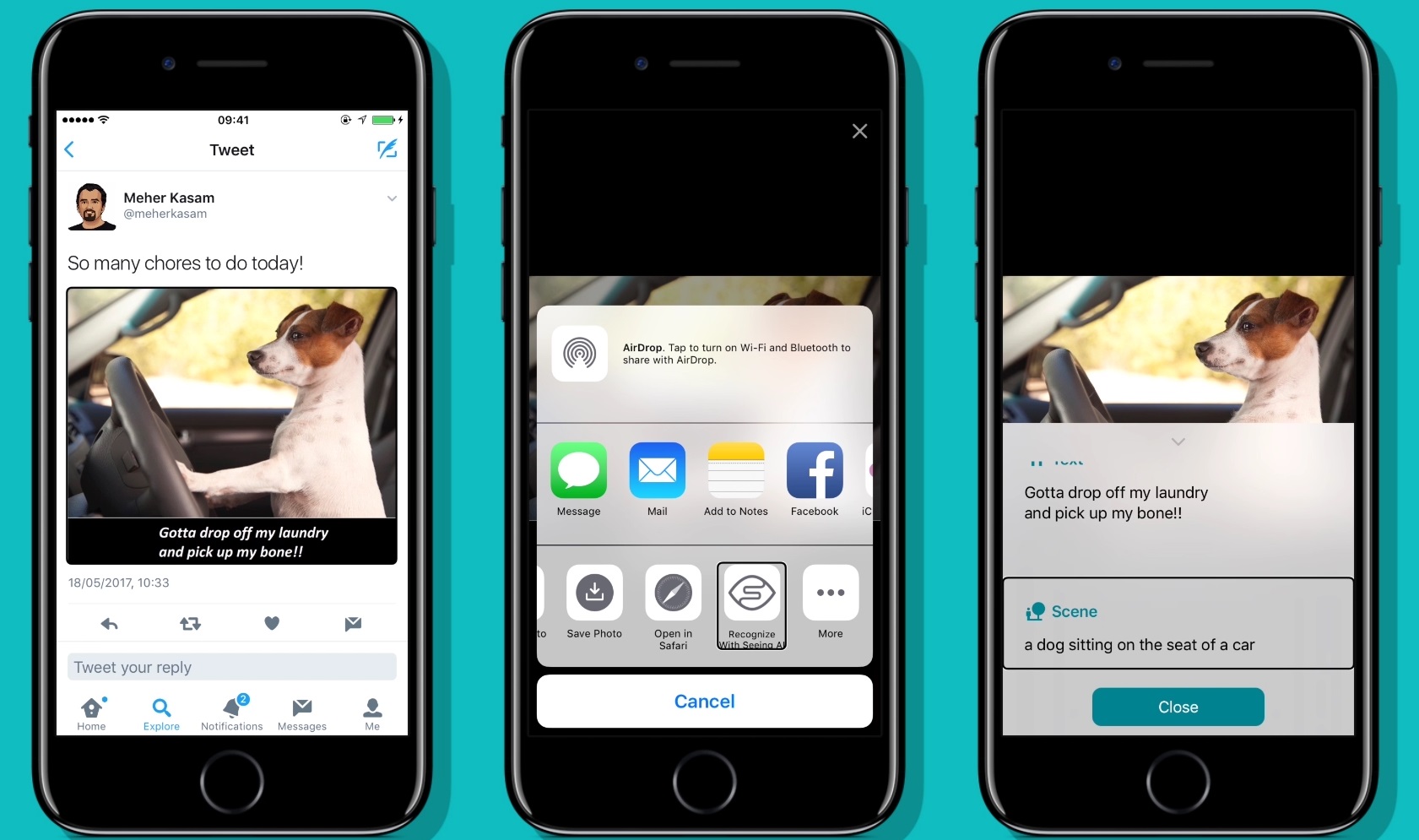
Microsoft’s Seeing AI is an app that lets blind and limited-vision folks convert visual data into audio feedback, and it just got a useful new feature. Users can now use touch to explore the objects and people in photos.

It’s powered by machine learning, of course, specifically object and scene recognition. All you need to do is take a photo or open one up in the viewer and tap anywhere on it.

“This new feature enables users to tap their finger to an image on a touch-screen to hear a description of objects within an image and the spatial relationship between them,” wrote Seeing AI lead Saqib Shaikh in a blog post. “The app can even describe the physical appearance of people and predict their mood.”

Because there’s facial recognition built in as well, you could very well take a picture of your friends and hear who’s doing what and where, and whether there’s a dog in the picture (important) and so on. This was possible on an image-wide scale already, as you can see in this image:

But the app now lets users tap around to find where objects are — obviously important to understanding the picture or recognizing it from before. Other details that may not have made it into the overall description may also appear on closer inspection, such as flowers in the foreground or a movie poster in the background.

In addition to this, the app now natively supports the iPad, which is certainly going to be nice for the many people who use Apple’s tablets as their primary interface for media and interactions. Lastly, there are a few improvements to the interface so users can order things in the app to their preference.

Seeing AI is free — you can download it for iOS devices here.

TPG’s Bill McGlashan is put on indefinite leave after being charged in a giant college admissions cheating scandal

Bill McGlashan, who built his career as a top investor at the private equity firm TPG, has been put on “indefinite administrative leave, effective immediately,” says the firm after McGlashan was caught up in what the Justice Department said today is the largest college admissions scandal it has ever prosecuted.

McGlashan is among 49 others accused of participating in a bribery ring involving parents, admissions counselors, and athletic coaches at Yale, Wake Forest, and the University of Southern California (USC), among other institutions, in an effort to secure spots for their children at the schools.

“As a result of the charges of personal misconduct” against McGlashan, said the firm just now, Jim Coulter, Co-CEO of TPG, will be “interim managing partner” of the parts of TPG that McGlashan oversees, including TPG Growth and The Rise Fund.

“Mr. Coulter will, in partnership with the organization’s executive team, lead all investment work for both going forward,” according to a statement sent us by the firm.

McGlashan, who joined the private equity giant TPG in 2003, first to rethink and lead its earlier-stage strategy and, in more recent years, to lead its social impact strategy under the Rise Fund brand, is one of 33 parents being accused of trying to buy their kids’ admission. Others include actresses Felicity Huffman and Lori Loughlin.

For McGlashan especially, whose job is ostensibly to make a measurable, beneficial social or environmental impact, the charges are particularly damning, highlighting as they do how wealthy families sometimes use their financial muscle in socially unjust ways — in this case, paying to secure spots at colleges and depriving deserving students of admission in the process.

Indeed, TPG seemingly had little choice but separating from McGlashan, at least for now. In making its case against McGlashan and the others, the Justice Department has laid bare each party’s alleged wrongdoings with painstaking specificity.

For his part, McGlashan has been charged with both participating in a college entrance exam cheating scheme and recruitment scheme, including by trying to bribe the senior athletic director at USC, and by paying test center administrators willing to accept bribes to give his oldest son more time to take a college entrance exam than is usually allotted students — and in a special test center where his answers would be corrected after he had completed the test (unbeknownst to him).

McGlashan also allegedly signed-off on plans to doctor a photo that would make McGlashan’s son look like a football recruit and, as McGlashan was told, thus more desirable to the specialty program in arts, technology and business at USC that his son hoped to attend.

This wasn’t all theoretical. According to the Justice Department, after McGlashan’s son took the test in Florida and after the proctor corrected his answers to produce a score of 34 out of 36, it was provided as part of his application to Northeastern University in Boston.

Worse for McGlashan, according to the Justice Department’s complaint, McGlashan discussed with these outside parties repeating the ACT cheating scheme for his two younger children, and parts of these conversations were recorded via a court-authorized wiretap. Here’s just one outtake of many with a participant turned cooperating witness (identified as CW-1):

McGLASHAN: One other, just family question, with [my younger son] now entering his sophomore year, and sort of, the process is beginning, we have him on time and a half. I told [my spouse] yesterday, and [my daughter] by the way, who is the, who I think is the one who needs the most time, has no extra time currently. And [my spouse] is talking to the doctor that assessed them, to get her to ask, to request time for [my daughter]. I told her she should be requesting double time for all of them.

CW-1: 100% multiple days. No matter what, multiple days. So, even if it’s 50%, time and a half, multiple days.

During the call, McGlashan also tries to ensure that his son won’t know that his scores have been tampered with, or the degree to which McGlashan has inserted himself into the process.

McGLASHAN: Now does he, here’s the only question, does he know? Is there a way to do it in a way that he doesn’t know that happened?

CW-1: Oh yeah. Oh he–

McGLASHAN: Great.

CW-1: What he would know is, that I’m going to take his stuff, and I’m going to get him some help, okay?

McGLASHAN: So that, that he would have no issue with. You lobbying for him. You helping use your network. No issue.

CW-1: That letter, that letter comes to you.

McGLASHAN: Yup.

CW-1: So, my families want to know this is done.

McGLASHAN: Yup.

Somewhat unbelievably, the cooperating witness goes on to explain that to take advantage of a “side door” that could further strengthen the odds that McGlashan’s son will be accepted at USC, he will need to create a fake athletic profile for McGlashan’s son, which he says he has done “a million times” for other families. As remarkably, after McGlashan tells him that his family has images of the teenager playing lacrosse and is told by the cooperating witness that USC doesn’t have a lacrosse team, McGlashan is then told that a picture of his son “doing something” – – anything vaguely sporty, in other words – – will “be fine.”

CW-1: I have to do a profile for him in a sport, which is fine, I’ll create it. You know, I just need him– I’ll pick a sport and we’ll do a picture of him, or he can, we’ll put his face on the picture whatever. Just so that he plays whatever. I’ve already done that a million times. So–

McGLASHAN: Well, we have images of him in lacrosse. I don’t know if that matters.

CW-1: They don’t have a lacrosse team. But as long as I can see him doing something, that would be fine.

McGLASHAN: Yeah.

CW-1: And then what happens is, then what you have to do, because this would be a specialty program, is that you have to then talk to the department and say, “Hey listen, can you take him in the department? We’ve gotten him accepted into the university.”

McGLASHAN: Yup. Well I can handle, I think I, I mean, I’ll know after this lunch. I think I can handle them at Iovine and Young.

CW-1: Right.

McGLASHAN: Yeah. Which is where he really wants to go.

CW-1: Right. So you’re saying, “Hey listen, I think I can get him into this school.”

McGLASHAN: Yup.

CW-1: Now, now, can you, ’cause they’re going to come to you and say, this is a selective program, would you want this kid? And he’s quote an “athlete” who’s coming to you. In fact, would you take him? And the department says yes.

Again, McGlashan worries about his son learning of his involvement and wonders if he should try USC’s board instead, where he knows “half” the directors. He’s advised against reaching out to his contacts there, however.

McGLASHAN: Now, would he see that, ’cause that, he’s going to be fairly well seen at the school, because half the board knows me, and I’m going to be sort of 64 calling in and asking people to help, you know [Board Member 1] and [Board Member 2], and all those guys?

CW-1: But, so– what I would suggest is, have you called them? Any of them yet?

McGLASHAN: No.

CW-1: Good, don’t.

McGLASHAN: Okay.

CW-1: Because you don’t need, because when this, the way this, the quieter it, the quieter this is, the better it is, so people don’t say, “Well, okay, this guy, why are all these people calling us? The kid’s already been accepted. He’s coming here as an athlete. He’s already in.” What you just want is, the person you’re meeting with on Friday to say, you know, what we want [is] this kid.

McGLASHAN: So he doesn’t have to know how he got in. Is that the case?

CW-1: What I would say to him, if you want to have that discussion now with [your son] there, that we have friends in athletics, they are going to help us, because [he] is an athlete, and they’re going to help us. From the–

McGLASHAN: But I can’t say that in front of [my son], ’cause he knows he’s not.

CW-1: No, no, right.

McGLASHAN: Yeah.

CW-1: And just say, you know what, we’re going to get, we’re going to get some, we’re going to get people to help us.

McGLASHAN: Why wouldn’t, why wouldn’t I say, “Look, leave it to me to worry about getting him in, ’cause I have a lot of friends involved in the school.”

CW-1: Perfect, perfect. 

Ultimately, McGlashan shelled out more than $250,000 in the scheme.

Unfortunately for everyone involved, the decision to get involved in his son’s college admissions process may wind up costing much more.


Former CEO Zain Jaffer files wrongful termination lawsuit against Vungle

Vungle founder Zain Jaffer filed a lawsuit today accusing the mobile advertising company of wrongfully terminating him from the role of CEO.

The lawsuit cites a section of the California labor code that it says “expressly and specifically prohibits discrimination and retaliation by employers based upon an arrest or detention that did not result in conviction.”

Jaffer was arrested in October 2017 in an incident involving his young son — the charges included performing a lewd act on a child and assault with a deadly weapon. Last year, the charges were dropped, with the San Mateo District Attorney’s Office saying it did “not believe that there was any sexual conduct by Mr. Jaffer that evening,” while “the injuries were the result of Mr. Jaffer being in a state of unconsciousness caused by prescription medication.”

Afterwards, Jaffer began looking into either selling his Vungle shares or pursuing a leadership change at the company, something he alludes to in his statement on the suit:

Once I was absolved of any wrongdoing, I was looking forward to a friendly relationship with the Company. Instead, Vungle unfairly and unlawfully sought to destroy my career, blocked my efforts to sell my own shares or transfer shares to family members, and tried to prevent me from purchasing shares in the Company.

When reached by TechCrunch, a Vungle spokesperson declined to comment on the lawsuit.

The suit does not specify the amount that Jaffer is seeking, but his attorney Joann Rezzo reportedly told Bloomberg that he has suffered at least $100 million worth of harm. When asked about damages, Jaffer’s spokesperson sent us the following statement from Rezzo:

The amount to be awarded would be entirely within the discretion of the jury. My firm won almost $20M for an employee who asserted similar claims against Allstate Insurance Company. Mr. Jaffer’s potential recovery is much, much higher.

The suit she’s referring to involved a former Allstate employee who was awarded $18.6 million after he was fired following an arrest for domestic violence and possession of marijuana paraphernalia. All the charges were eventually dismissed.

You can read Jaffer’s full lawsuit below.

Jaffer v. Vungle Conformed … by on Scribd

National Cancer Institute chief tapped as acting FDA Commissioner

In the wake of FDA Commissioner Scott Gottlieb’s abrupt resignation, Secretary of Health and Human Services Alex M. Azar III announced that Dr. Ned Sharpless will serve as interim commissioner of the Food and Drug Administration.
Since October 2017, Dr. Sharpless served as director of the National Cancer Institute and, before that, worked as a researcher and hematologist-oncologist at the University of North Carolina. He is also a co-founder of G1 Therapeutics, a biotech firm focused on cancer treatment therapies that went public in May of 2017.

Dr. Sharpless is a temporary appointment, with Secretary Azar saying that the search is on for a permanent candidate for the position, according to the NYT.

(1/3) Change is good, but bittersweet. It is difficult for me to say goodbye to @theNCI family as I head to @FDA to serve as acting commissioner. Rest assured that our shared goals for patients and the public’s health will translate into my new duties.

— Dr. Ned Sharpless (@NCIDirector) March 12, 2019

The change comes at a tumultuous time for the e-cigarette industry in particular, which has been a focal point for Commissioner Gottlieb. As vaping continues to grow in popularity among teens, Gottlieb has enforced new rules for the industry and promised to keep a close watch on youth use of these products and the companies that sell them.

Gottlieb praised the appointment:

I’m delighted by the announcement from @SecAzar that @NCIDirector will serve as acting commissioner of #FDA. Ned is a friend to FDA, a great public health champion, a dedicated physician, and will be warmly welcomed into his new role. FDA will benefit greatly from his leadership.

— Scott Gottlieb, M.D. (@SGottliebFDA) March 12, 2019

Whether or not an acting commissioner will be able to push forward initiatives related to the tobacco industry, such as limiting the nicotine in combustible cigarettes and enforcing stricter regulation on e-cigs, is unclear. However, Altria shares fell on the news.

For those concerned @SGottliebFDA’s priorities on e-cigarettes/tobacco wouldn’t continue when he left, @NCIDirector Sharpless has been a supporter of those policies. Altria, Philip Morris International shares erased gains on the news. Here’s Altria pic.twitter.com/0CYSBQcBhM

— Anna Edney (@annaedney) March 12, 2019

Democracy is good for business

Matthew Douglass
Contributor

Matthew Douglass is a board member of the nonpartisan Business for America and previously co-founded digital health company Practice Fusion in 2007.
More posts by this contributor

In America, democracy and capitalism go hand in hand. Watching our democracy function (or, more accurately, malfunction) over the past few years, I have come to the conclusion that there is a slow-moving crisis developing for our democracy — and our economy. For entrepreneurs to have a fighting chance and for existing companies to prosper, our legislators must strive to construct a truly competitive economic system that encourages innovation and works for everyone, not just those with the most political influence or campaign donations.

What might our country look like if we were to surrender policy-making to the anti-democratic forces of campaign donation-obsessed politicians, rent-seeking special interests and behemoth oligopolistic-minded corporations? Well, it would look a lot like what we have now:

The lack of courage demonstrated by our elected politicians to rein in corporate abuses and protect our markets is our giant white flag of surrender, and its effects can be found in nearly every sector of our economy. Our prosperity has been seized by the anti-competitive and anti-innovation forces of a dysfunctional political system dominated by monied special interests. And it’s happening right out in the open for all of us to see. Fret not, however, because it is entirely within our power to squash the bugs that have infested our democracy.

Our elected leaders seem to have hoisted a giant white flag of surrender — either unable or unwilling to rein in corporate abuses and protect our markets. The effects of these anti-competitive and anti- innovation forces of our dysfunctional political system can be found in nearly every sector of our economy. Monied special interests are draining our prosperity, and it’s happening right out in the open for all of us to see.

As business leaders and entrepreneurs, we must demand our politicians step up and take action to protect economic competitiveness and provide guard rails for expansion of our capital markets. For American citizens to have confidence that legislators are working toward these dual goals of protection and expansion, it is absolutely crucial that we first do everything possible to make our democratic elections as competitive and fair as possible.

For America to thrive and innovate in an increasingly competitive global economy, we need strong, uncorrupted, fairly regulated markets.

This notion of prodigious change to our electoral system is not new. In fact, more than two-thirds of the amendments to the U.S. Constitution since the Bill of Rights were crafted specifically to address voting, representation and election shortcomings in our democracy. Fortunately, we don’t have to wait for a constitutional amendment to resolve our problems. There are actionable things we can do right now to expand democratic participation and restore trust in our elections.

For starters, I, along with many other business leaders across America, am supporting the Secure Elections Act, a bipartisan bill introduced in the U.S. Senate last year by Senators Amy Klobuchar (D-MN) and James Lankford (R-OK). This bill requires paper records and rigorous audits to reduce the risk of vote hacking, improves information sharing between federal and state election officials and establishes cybersecurity guidelines to protect our elections.

Further, there are simple, proven changes that make voting accessible to more citizens:

  • Enable automatic (opt-out) voter registration upon turning 18
  • Allow no-fault absentee vote by mail for all voters
  • Expand early voting dates and locations
  • Restore voting rights for people who have served their time for non-violent offenses

Policies that expand voting rights benefit all members of a democracy, regardless their political affiliation. State by state, progress is already being made. In 2018, by an overwhelming margin, voters in Florida restored voting rights to non-violent ex-felons. On the same day, balloters in Nevada and Michigan approved initiatives to automatically register voters when they turn 18, bringing the total to 15 states where this is the law. It’s time to put partisan politics aside and do this in all 50 states.

Finally, elections can be made more democratic and competitive:

  • End gerrymandering of districts
  • Adopt open primaries
  • Enact ranked-choice voting

In 2018, anti-gerrymandering efforts passed at the ballot box in Michigan, Missouri, Utah, Ohio and Colorado. In Pennsylvania, the 21st Century Election Reform Modernization proposal, introduced by Governor Tom Wolf (D), would enact many of these voter-friendly upgrades. The Fair Representation Act, co-sponsored by Ro Khanna (D-CA) here in Silicon Valley, Don Beyer (D-VA) and Jamie Raskin (D-MD), proposes an innovative approach to ensuring we all have a voice in our democracy, no matter where we live.

House Democrats are making a statement with HR1, the first bill of the 116th Congress, which addresses money in politics, ethics and voting rights. It’s a great step in the right direction, but for this to be successful, Republicans must join Democrats to create bipartisan consensus.

As business leaders, our political ideologies are as diverse as our industries. But one thing we should all be able to recognize is that for America to thrive and innovate in an increasingly competitive global economy, we need strong, uncorrupted, fairly regulated markets. To reach that ideal, we must first protect and strengthen the democratic foundations of our elections. I invite every business leader across the nation to join me in fighting for a more democratic democracy for all Americans by supporting legislation and lawmakers working diligently toward that goal.

Uber’s self-driving car unit was burning $20 million a month

Uber thought it would have 75,000 autonomous vehicles on the roads this year and be operating driverless taxi services in 13 cities by 2022, according to court documents unsealed last week. To reach those ambitious goals, the ridesharing company, which hopes to go public later this year, was spending $20 million a month on developing self-driving technologies. 

The figures, dating back to 2016, paint a picture of a company desperate to meet over-ambitious autonomy targets and one that is willing to spend freely, even recklessly, to get there. As Uber prepares for its IPO later this year, the new details could prove an embarrassing reminder that the company is still trailing in its efforts to develop technology that founder Travis Kalanick called “existential” to Uber’s future.

The report was written for Uber as part of last year’s patent and trade secret theft lawsuit with rival Waymo, which accused engineer Anthony Levandowski of taking technical secrets with him when he left Google to found self-driving truck startup Otto. Uber acquired Otto in 2016. Uber hired Walter Bratic, the author of the report, as an expert witness to question Waymo’s valuation of the economic damages it had suffered — a whopping $1.85 billion. Bratic’s report capped at $605,000 the cost to independently develop Waymo’s purported trade secrets.

Waymo eventually settled for 0.34 percent of Uber’s equity, which could be worth around $300 million after an IPO if a recent $90 billion valuation of the company is accurate.  

Bratic’s report provides details of internal analyses and reports codenamed Project Rubicon that Uber carried out during 2016. A presentation in January that year projected that driverless cars could become profitable for Uber in 2018, while a May report said Uber might have 13,000 self-driving taxis by 2019. Just four months later, that estimate had jumped to 75,000 vehicles.

The current head of Uber’s self-driving technologies, Eric Meyhofer, testified that Uber’s original estimates of having tens of thousands of AVs in a dozen cities by 2022 were “highly speculative” “assumptions and estimates.” Although Meyhofer declined to provide any other numbers, he did say, “They probably ran a lot of scenarios beyond 13 cities. Maybe they assumed two in another scenario, or one, or three hundred. It’s a set of knobs you turn to try to understand parameters that you need to try to meet.”

One specific goal, set by John Bares, the engineer then in charge of Uber’s autonomous vehicles, was for Uber to be able to forgo human safety drivers by 2020. The company’s engineers seemed certain that acquiring Otto and Levandowski would supercharge its progress.

“At one point, John Bares and [ex-Google engineer] Brian McClendon estimated that it would help accelerate [AV development] by 12 to 24 months,” testified one Uber corporate development manager.

In a newly unsealed note from a January 2016 meeting with Levandowski, Bares thought that simply talking with Levandowski might be worth tens of millions of dollars: “He would bring (filtered) advice about what to try and not try…that is a day with him and our team could save us months towards 2020 (month = $20 million run rate).”

If Uber had maintained a $20 million monthly run rate since beginning its AV program in early 2015, and allowing $200 million for its Otto purchase, TechCrunch has calculated that Uber could have spent more than $900 million on automated vehicle research. In contrast, Waymo spent $1.1 billion on its own self-driving cars from 2009 to the end of 2015, and could be spending as much as $1 billion a year today.

But the honeymoon period for Otto and Uber was brief. In a deposition for the lawsuit, Bares said that his expectation that the Otto acquisition would advance Uber’s self-driving car efforts lasted for “a three- to four-week period, starting in early January 2016.” By August 2016, he testified, it was actually proving a setback: “We never got any lasers out of it. It had… a huge managerial disruption on our staff… as a result of Anthony’s effort to manage and lead.”

The Bratic report details the number of people Uber had working on automated vehicles. It says the headcount of Uber’s hardware department in June 2017 was 155 people, with 405 people working on software. A separate Uber filing from two months earlier stated that it had more than twice as many people, 1,500, working in its AV unit, although this number may have included Uber’s test operation team and vehicle operators.  

The newly unsealed document also reveals that Waymo claimed Uber’s alleged misappropriation of its trade secrets had accelerated the commercialization of Uber’s autonomous technology by over three years and 10 months.

“This would mean that, applying [Uber’s] assumption of commercialization in 13 cities by 2022, Uber should be ready to commercialize AV technology in 13 cities by 2018,” wrote Bratic. Clearly, this did not happen. In fact, Uber only recently resumed testing a handful of AVs on public roads, following a fatal crash in Tempe, Arizona, last March.

Uber reported a net loss of $865 million in the last quarter of 2018, and has never made a profit.

A first look at Twitter’s new prototype app, twttr

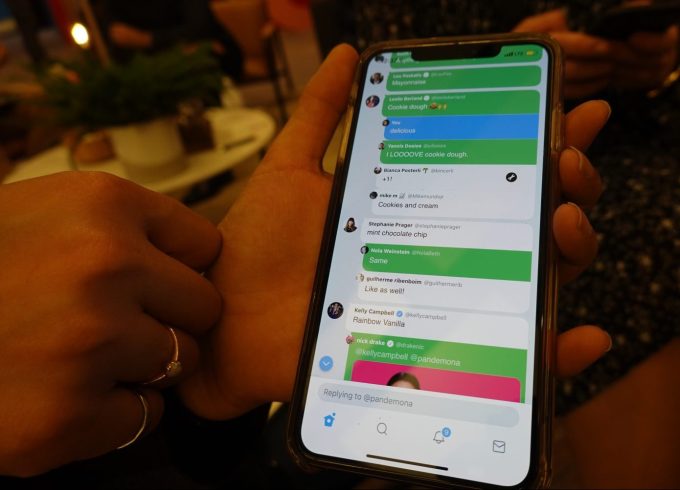
Yesterday, Twitter rolled out its much-anticipated prototype application to the first group of testers. We’ve now gotten our hands on the app and can see how the current version differs from the build Twitter introduced to the world back in January. While the original version and today’s prototype share many of the same features, there have been some small tweaks as to how conversation threads are displayed, and the color-coded reply labeling system is now much more subtle.

“Twttr,” as the prototype build is called, was created to give Twitter a separate space outside its public network to experiment with new ideas about how Twitter should look, feel and operate. Initially, the prototype focuses on changes to replies, with the goal of making longer conversations easier to read.

However, the company said it will likely continue to test new ideas within the app in the future. And even the features seen today will continue to change as the company responds to user feedback.

In the early build of the twttr prototype, the color-coded reply system was intentionally designed to be overly saturated for visibility’s sake, but Twitter never intended to launch a garish color scheme like this to its testers.

The new system is more readable and no longer color codes the entire tweet.

Below are a few screenshots of what the public Twitter app looks like when compared with the new prototype, plus other features found in twttr alone.

Feedback

Above: regular Twitter on the left; twttr on the right

Before digging into twttr’s key features, it’s worth noting there’s an easy way for testers to submit feedback: a menu item in the left-side navigation.

Here, you can tap on a link labeled “twttr feedback” that takes you directly to a survey form where you can share your thoughts. The form asks for your handle, and what you liked and disliked, and offers a space for other comments.

Reply threads

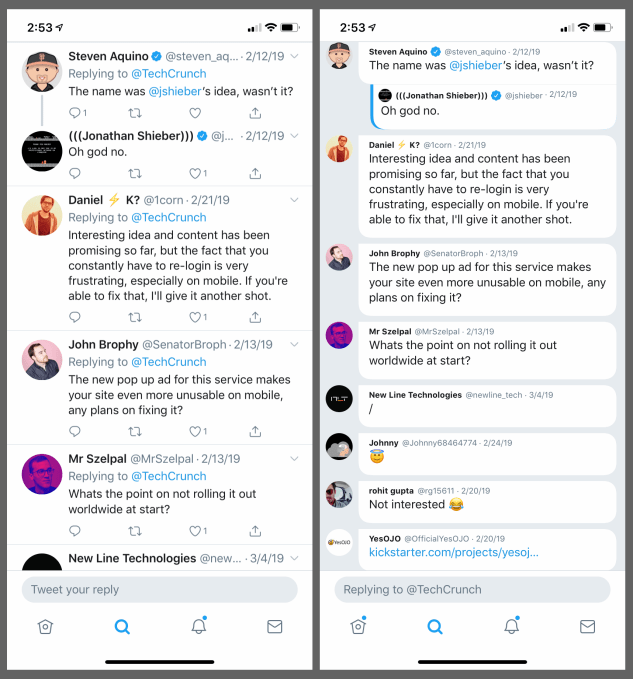
Left: Original Twitter; Right: twttr prototype

This is the big change Twitter is testing in the prototype.

In the photo on the left, you can see how replies are handled today — a thin, gray line connects a person replying to another user within the larger conversation taking place beneath the original tweet. In the photo, TechCrunch editor Jonathan Shieber is replying both to the TechCrunch tweet and the person who tagged him in a question in their own reply to the TC tweet.

In twttr, Shieber’s reply is nested beneath that question in a different way. It’s indented to offer a better visual cue that he’s answering Steven. And instead of a straight line, it’s curved. (It’s also blue because I follow him on Twitter.)

You’ll notice that everyone’s individual responses are more rounded — similar to chat bubbles. This allows them to pop out on the contrasting background, and gives an appearance of an online discussion board.

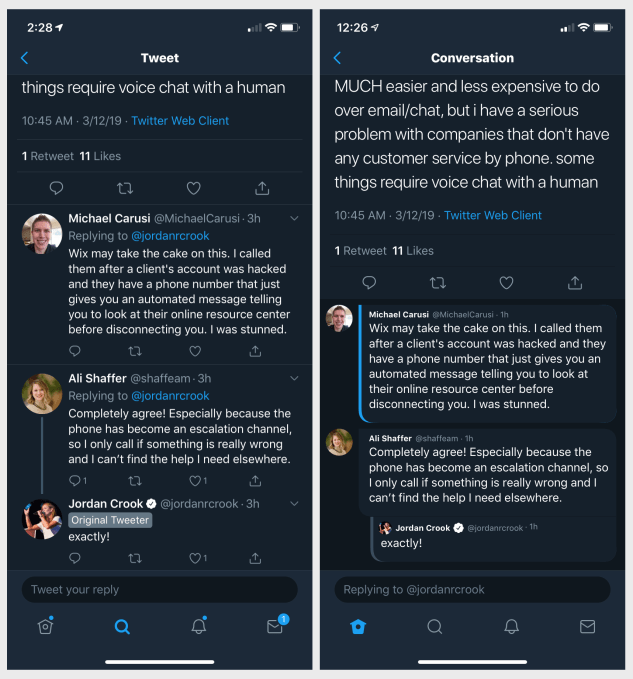
Left: Original Twitter; Right: twttr prototype

This is even more apparent when the background is set to the white day theme instead of the darker night theme.

Color-coded replies

Here’s a closer look at nested replies.

People you follow will be prominently highlighted at the top of longer threads with a bright blue line next to their name, on the left side of their chat bubble-shaped reply. Twitter says the way people are ranked is personalized to you, and something it’s continuing to iterate.

Left: Original Twitter; Right: twttr prototype

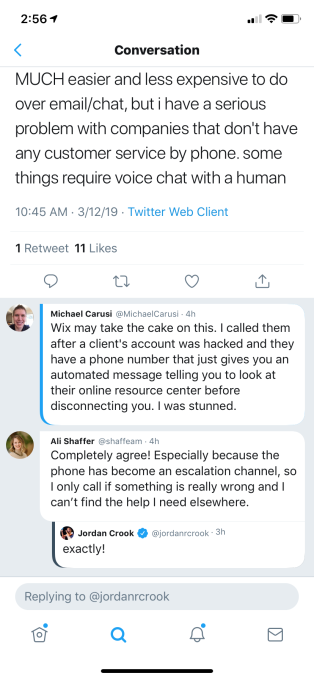
In the public version of the Twitter app, the original poster is also highlighted in the Reply thread with a prominent “Original Tweeter” label. In the prototype, however, they’re designated only by a colored line next to their name, on the left side of the chat bubble. (See Jordan’s tweet above.)

This is definitely a more subtle way to highlight the tweet’s importance to the conversation. It’s also one that could be overlooked — especially in the darker themed Night Mode where the gray line doesn’t offer as much contrast with the dark background.

In the day theme, it’s much easier to see the difference (see below).

Engagements are hidden

Another thing you’ll notice when scrolling through conversations on twttr is that engagements are hidden on people’s individual tweets. That is, there’s no heart (favorite) icon, no retweet icon, no reply bubble icon and no sharing icon, like you’re used to seeing on tweets today.

Instead, if you want to interact with any tweet using one of those options, you have to tap on the tweet itself.

The tweet will then pop up and become the focus, and all the interaction buttons — including the option to start typing your reply — will then become available.

“Show more”

Another change to conversations is that some replies are hidden by default when you’re reading through a series of replies on Twitter.

Often, in long conversation threads, people will respond to someone else in a thread besides the original Tweeter. Both are tagged in the response when that occurs, but the reply may not be about the original tweet at all. This can make it difficult to follow conversations.

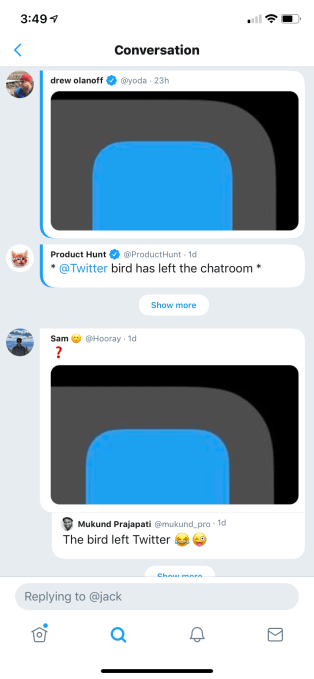
Above: “Show more,” before being expanded

In twttr, these sorts of “side conversations” are hidden.

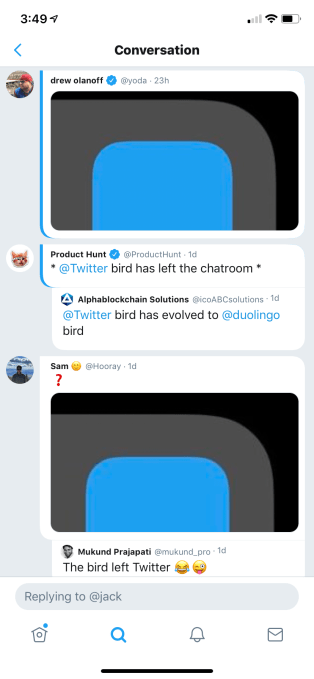
In their place, a “Show more” button appears. When tapped, those hidden replies come into view again. They’re also indented to show they are a part of a different thread.

This change highlights only those replies that are in response to the original tweet. That means people trolling other individuals in the thread could see their replies hidden. But it also means that those responding to a troll comment to the original poster — like one offering a fact check, for example — will also be hidden.

There are other reasons to hide some replies, notes Twitter — like if the original response was too large or the thread has too many replies. It’s not always about the quality of the responses.

Above: after being expanded

The icon!

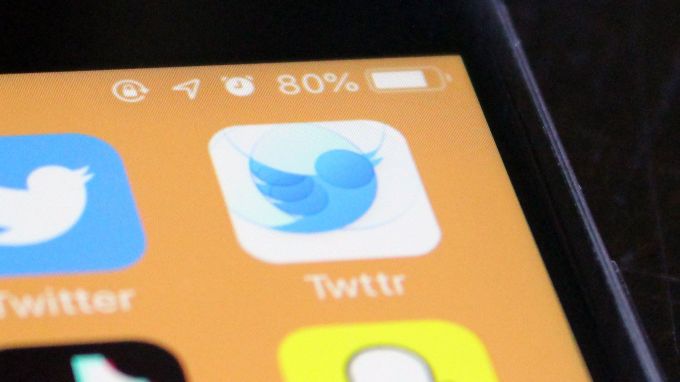
Twttr is very much a prototype. That means everything seen here now could dramatically change at any point in the future. Even the twttr icon itself has gone through different iterations.

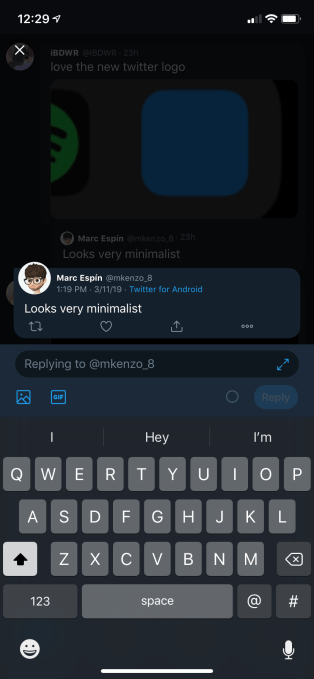
The first version of the icon was a very lovely bird logo that looked notably different from original Twitter. The new version (which we’ll dub twttr’s Yo icon), is a plain blue box.

Twitter has its reasons for that one… and clearly, it didn’t ask for feedback on this particular change.

Where’s that feedback form again?

Notice our new prototype? @jack and I named and designed it based on old times. It’s called, “twttr." The bird flew away from the app icon representing: Simplicity. Blue sky thinking. We’re re-working. Not there yet; hence, no logo. Bold and a little weird. #LetsHaveAConvo pic.twitter.com/WaNR2mOXO9

— Biz Stone (@biz) March 11, 2019

Flight-hailing startup BlackBird raises $10 million to replace driving with flying

The origin story of BlackBird, a startup that links travelers to planes and commercial pilots through an app, didn’t begin with air travel. It was prompted by car sickness.

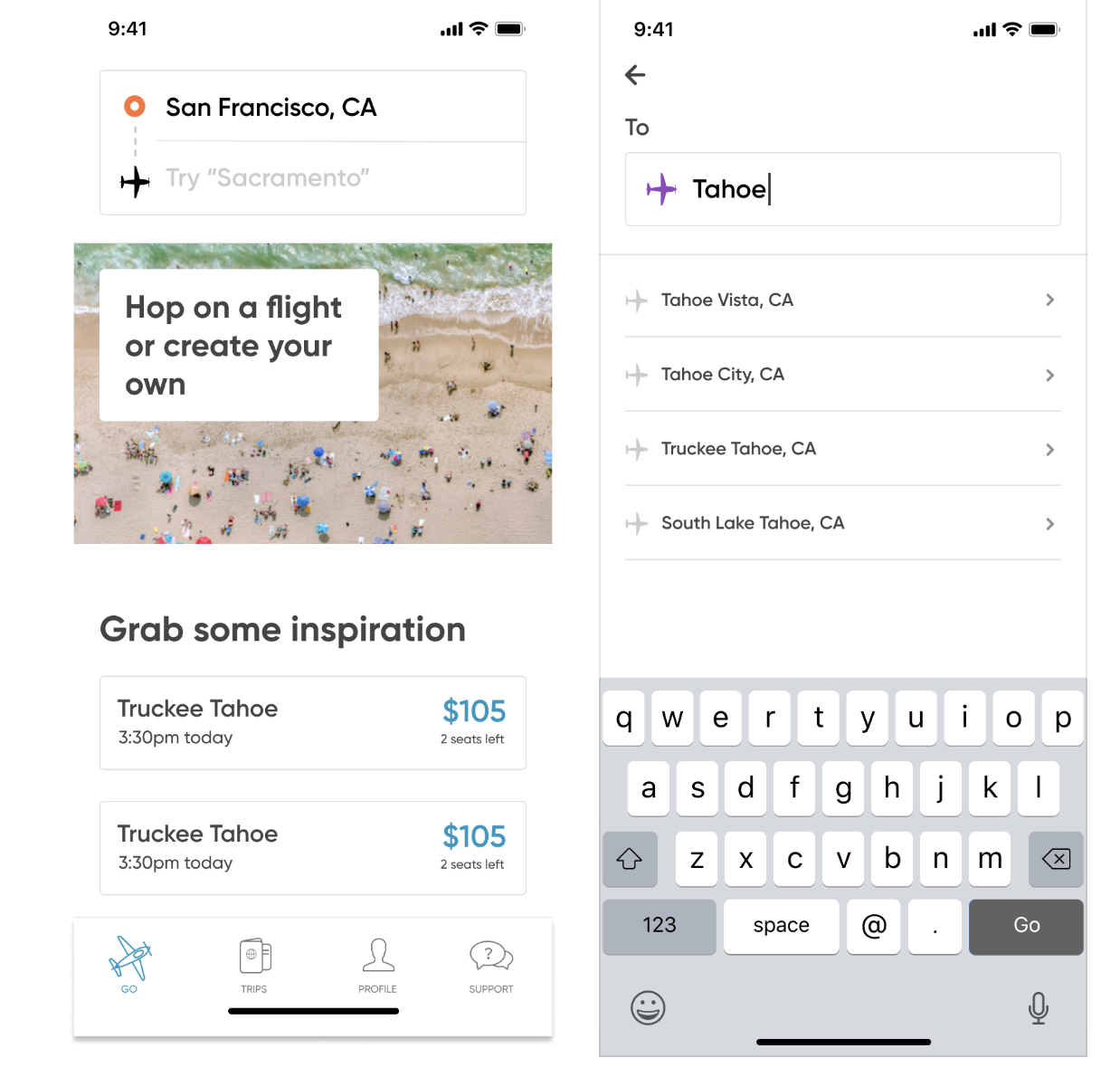
BlackBird CEO and founder Rudd Davis, who was getting his pilot’s license at the time, asked his flight instructor if he would fly his family to Tahoe because his son gets terribly sick every time they traveled by car. What Rudd discovered was an incredible experience that was far more affordable than he realized. 

Davis launched the company in 2016 and has spent the past two years honing in on the business model as well as adding commercial pilots and members. Now, with fresh capital from New Enterprise Associates, BlackBird is ready to spread its wings. 

The company announced Tuesday it has raised $10 million in a Series A round led by NEA. NEA partner Jonathan Golden, who previously worked at Airbnb, has joined the BlackBird board of directors alongside Francoise Brougher of Pinterest, Square and Google, and Andrew Swain, who also is from Airbnb.

BlackBird has also hired Brian Hsu, who spent a decade at eBay and most recently was vice president of supply at Lyft, as chief operating officer. Davis is counting on Hsu, who has experience scaling marketplaces, to help BlackBird expand its membership and reach.


The company will use its new injection of capital to scale up, in terms of users, pilots and employees.

BlackBird currently has more than 700 commercial pilots who fly passengers between 50 and 500 miles from and within California. For now, Davis said this is a self-imposed geographic restriction.

“We’re trying to build up density and build up the network and optimize it before we start replicating it to other geographies,” Davis said.

It does face challenges. BlackBird has to find that price-per-seat sweet spot, which is largely driven by how many users and pilots are on the platform. Seats can be around $80 or upwards of $900, depending on the route, pilot availability and demand. And BlackBird must fight misconceptions of what and who the platform is designed for.

“A lot of people have looked at this space before, and really have kind of come up empty handed,” said Golden, who was a seed investor in BlackBird before joining NEA.

What makes BlackBird so compelling, Golden added, is that it’s not about luxury travel, but instead about how to actually replace driving through flights, which is really compelling.

“When most people think about kind of flying non-commercially, they think about huge jets with couches and for billionaires,” Davis said.And that is not the entirety of general aviation; there’s a huge aspect of aviation that is flying in smaller planes. It just hasn’t really been as accessible.”

Boeing is moving to address potential issues in new 737s as Europe bans its plane

In the wake of the second fatal crash in six months involving Boeing 737 Max 8 airplanes, the European Aviation and Safety Administration is grounding the planes as Boeing said it was taking additional steps to address an issue that may have contributed to the crash.

On Sunday, a Boeing 737 Max 8 plane operated by Ethiopian Airlines crashed just minutes after takeoff, killing all 157 on board the flight. Last October, a Lion Air flight departing from Jakarta crashed in similar circumstances, killing all 189 people on board. The plane involved was also a 737 Max 8.

Responding to the incidents, the European Union Aviation and Safety Administration has banned the plane from operating in European airspace.

Here’s the statement from the EASA:

Following the tragic accident of Ethiopian Airlines flight ET302 involving a Boeing 737 MAX 8, the European Union Aviation Safety Agency (EASA) is taking every step necessary to ensure the safety of passengers.

As a precautionary measure, EASA has published today an Airworthiness Directive, effective as of 19:00 UTC, suspending all flight operations of all Boeing Model 737-8 MAX and 737-9 MAX aeroplanes in Europe. In addition EASA has published a Safety Directive, effective as of 19:00 UTC, suspending all commercial flights performed by third-country operators into, within or out of the EU of the above mentioned models.

Meanwhile, Boeing has issued a statement saying that it has been developing a software update following the Lion Air crash. “This includes updates to the Maneuvering Characteristics Augmentation System flight control law, pilot displays, operation manuals and crew training.”

Essentially, faulty sensors may have been to blame for the Lion Air crash. “The enhanced flight control law incorporates angle of attack (AOA) inputs, limits stabilizer trim commands in response to an erroneous angle of attack reading, and provides a limit to the stabilizer command in order to retain elevator authority,” Boeing said in a statement about its software update.

Essentially, the sensors think the plane is stalling and they apply an opposite remedial action which trims an airplane down, Flying Magazine columnist and small-plane pilot Peter Garrison tells me. It then takes enormous force from the pilots to hold the nose up, rendering them unable to address the problem, he adds.

“Once you are holding on to the controls for dear life you don’t have any hands left to correct the problem,” says Garrison. “You expect that confronted in an emergency the pilot will analyze what’s happening and act accordingly. Human beings don’t necessarily panic, but they lose their ability to reason clearly and to weigh alternative hypotheses when they are under basically what is a threat of death. Even though it may seem obvious that all you have to do is interrupt the autopilot, amazingly that may not occur to a pilot who is hundreds of feet off the ground and has to pull back on a control yoke with hundreds of pounds of force.”

According to Garrison, the blame on Boeing may be misplaced.

“People like to talk about this as the airplane is defective and they’re correcting it with software,” he says. “That’s all nonsense. Planes today are a mix of automatic systems — and by automatic I of course mean digital electronic systems and mechanical ones — and the natural aerodynamics of the airplane, and you can’t separate these.”

If Boeing had made any mistakes, Garrison believes it was in the company’s inability to adequately communicate the problem to pilots and get them ready for taking action in the event of a malfunction.

Even in perfectly designed systems, the transition from automated controls to manual manipulation is difficult to achieve, says Garrison. “It’s not that hard to understand that automation does not make a smooth interface with human control. There’s a break there and it’s a dangerous break,” he said.

Here’s an explanation from Business Insider over the latest thinking around the Lion Air crash that provides further detail.

At the heart of the controversy surrounding the 737 Max is MCAS, the Maneuvering Characteristics Augmentation System. To fit the Max’s larger, more fuel-efficient engines, Boeing had to redesign the way it mounts engines on the 737. This change disrupted the plane’s center of gravity and caused the Max to have a tendency to tip its nose upward during flight, increasing the likelihood of a stall. MCAS is designed to automatically counteract that tendency and point the nose of the plane downward.

Initial reports from the Lion Air investigation, however, indicate that a faulty sensor reading may have triggered MCAS shortly after the flight took off. Observers fear that a similar thing may have happened in Sunday’s Ethiopian Airlines flight.

“Boeing has been working closely with the Federal Aviation Administration (FAA) on development, planning and certification of the software enhancement, and it will be deployed across the 737 MAX fleet in the coming weeks,” the company said in a statement. “The update also incorporates feedback received from our customers.”

Boeing expects the update to be completed across its fleet by April.

In the interim, U.S. politicians have been pleading with the Federal Aviation Administration to take the same steps as countries from around the globe, including the entire European Union, China, Ethiopia, Australia, Singapore and Indonesia, as well as Norwegian Air, Aeromexico, Gol Airlines from Brazil, the South Korean airline, Easair, the South African airline, Comair and others.

No less an authority on aviation than President Donald Trump has also weighed in on the crashes and attendant controversy.

Airplanes are becoming far too complex to fly. Pilots are no longer needed, but rather computer scientists from MIT. I see it all the time in many products. Always seeking to go one unnecessary step further, when often old and simpler is far better. Split second decisions are….

— Donald J. Trump (@realDonaldTrump) March 12, 2019

….needed, and the complexity creates danger. All of this for great cost yet very little gain. I don’t know about you, but I don’t want Albert Einstein to be my pilot. I want great flying professionals that are allowed to easily and quickly take control of a plane!

— Donald J. Trump (@realDonaldTrump) March 12, 2019

Setting aside the president’s calls to return aviation to the early part of the 20th century, several aviation administrations and airlines have grounded the Boeing 737 Max.

So the FAA is among the only civil aviation administrations in the world to keep the Boeing 737 Max 8 airborne.

“An FAA team is on-site with the NTSB in its investigation of Ethiopian Airlines Flight 302. We are collecting data and keeping in contact with international civil aviation authorities as information becomes available,” the FAA said in a statement yesterday. “The FAA continuously assesses and oversees the safety performance of U.S. commercial aircraft. If we identify an issue that affects safety, the FAA will take immediate and appropriate action.”

A spokesperson for the administration said there were no other statements from the administration available at this time.

Earlier today, politicians from both sides of the aisle — including the Republican Utah Senator Mitt Romney and Democratic Senator and presidential hopeful Elizabeth Warren — pleaded with the FAA to reverse their decision, according to Politico.

“Today, immediately, the FAA needs to get these planes out of the sky,” Warren said Tuesday.

That’s not just the view of this columnist. It’s also the opinion of Ray LaHood, the former U.S. Secretary of Transportation, who grounded the 787 Dreamliner following fires in its lithium-ion battery packs in 2013.

“The flying public has to be assured that these planes are safe, and they don’t feel that way now,” LaHood told Bloomberg. “The Secretary of Transportation should announce today that these planes will be grounded until there is 100 percent assurance from Boeing that these planes are safe to fly, because unless they can give that assurance they’re not holding up their promise to be the top safety agency in the U.S.”

Such a move could be bad for Boeing. The 737 is Boeing’s most popular aircraft and the heart of the company’s fleet.

The company has been struggling to keep up with demand for its newest model of the 737, according to reports in The Seattle Times. And the new plane was Boeing’s best seller, keeping the stock buoyant.

A report from National Public Radio showed just how robust sales were for the new aircraft. It’s the fastest-selling plane that Boeing has ever produced. Expectations from executives were for the Max model to account for 90 percent of all 737 deliveries in 2019, according to a statement from the company’s chief financial officer, Gregory Smith, NPR reported.

Boeing stock is down nearly 6 percent in trading on the New York Stock Exchange.

Startup Law A to Z: Employment Law

Your startup will not succeed unless you, the founder, build an exceptional team. Great teams are built on top of great culture. Yet any venture-backed startup founder will tell you, myself included, that developing a positive corporate culture is more art than science, requiring constant and creative recalibration as your company grows. What then does this have to do with employment law?

First, building an exceptional team means hiring great people; whether that involves W-9s for consultants, I-9s for employees, lengthy H-1B visa applications, or a new employee handbook, you need to hire the right people in the right way. Second, one bad employment-related legal dispute can have ripple effects throughout an organization, undermining employee morale and executive credibility in one fell swoop, with palpable culture fallout.

Fortunately, when working to promote healthy company culture, founders can look to employment law for some preventive medicine. In fact, transparency through written policies, clearly communicated in advance and followed in practice, can help create the trust and accountability which are foundational to positive company culture. Moreover, in the event employment disputes do arise, well-drafted employment policies actually provide valuable guidance through difficult to navigate situations, while limiting downside risks to the company, as well.

This article, the fourth in Extra Crunch’s exclusive five-part “Startup Law A to Z” series, follows previous articles on customer contracts,  intellectual property (IP) and corporate matters. This series is calculated to provide founders the information needed to assess legal risks in the areas common to most startups.

After reading this article, or other “Startup Law A to Z” articles, should you identify legal risks facing your startup, Extra Crunch resources can help. For example, the Verified Experts of Extra Crunch include some of the most experienced and skilled startup lawyers in practice today. So use these resources to identify attorneys focused on serving companies at your stage and then reach out for further guidance in the particular issues at hand.

The Employment Law checklist:

Employee vs. independent contractor classification

  • Payroll Taxes and Payroll Providers
  • Federal Classification: 21-Part Test
  • State Classification: Various tests, e.g., Dynamex in California
  • Intentional vs. Unintentional Misclassification and Penalties

Minimum wage and hour laws

  • Application to founders
  • Federal Fair Labor Standards Act (FLSA)
  • State Laws

Meal and rest breaks, vacation pay

  • Federal Fair Labor Standards Act (FLSA)
  • State Laws

Deferred compensation

  • Rule 409A
  • Founders
  • Employees

Sexual harassment, discrimination, and related claims

  • Federal:
    • Civil Rights Act of 1964
    • Age Discrimination in Employment Act of 1967 (ADEA)
    • Americans with Disabilities Act of 1990 (ADA)
    • Equal Pay Act of 1963
    • Genetic Information Nondiscrimination Act of 2008
  • State Laws
  • Employee Handbook
  • Documentation and Investigation

Work authorization / immigration

  • Form I-9 (Employees) and W-9 (Independent Contractors)
  • For Temporary Workers:
    • Visa Waiver Program
    • B-1
  • Employee Visas:
    • H1-B
    • L-1
    • O-1
  • Students:
    • F-1 with OPT STEM Extension
  • Other Visas:
    • EB-5
    • E Visas (E-1, E-2, E3)


Employee vs. independent contractor classification

One of the biggest employment law issues that startups get wrong, often willingly, is “employee” versus “independent contractor” classification. For employees, a startup must withhold and pay federal, state, and local income taxes, state disability, and payments under the Federal Unemployment Tax Act and Federal Insurance Contribution Act (i.e. Social Security and Medicare), not to mention contributions for federal and state unemployment and workers compensation insurance. Given this complexity, startups should absolutely hire a payroll provider to help manage the process, such as ADP, Gusto, Paychex or Quickbooks.

Of course, all of this gets expensive. Instead, far too many early-stage startups simply hire “independent contractors” to avoid everything mentioned above, often misclassifying these workers in the process, whether under federal law, state law, or both.

Scaleway updates its high-performance instances

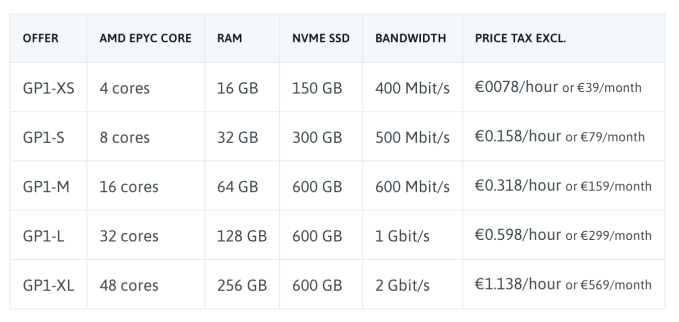
Cloud-hosting company Scaleway refreshed its lineup of high-performance instances today. These instances are now all equipped with AMD EPYC CPUs, DDR4 RAM and NVMe SSD storage. The more you pay, the more computing power, RAM, storage and bandwidth you get.

High-performance plans start at €0.078 per hour or €39 per month ($44.20), whichever is lower at the end of the month. For this price you get 4 cores, 16GB of RAM, 150GB of storage and 400Mbps of bandwidth.

If you double the price, you get twice as many cores, RAM and storage. Higher plans get a tiny discount on performance bumps. And the fastest instance comes with 48 cores, 256GB of RAM, 600GB of storage and 2Gbps of bandwidth. That beast can cost as much as €569 per month ($645).

Here’s the full lineup:

Scaleway had high-performance instances in the past, called “X64” instances. They were relatively cheaper. Despite that price bump, Scaleway manages to stay competitive against Linode, DigitalOcean and others.

A server with 6 CPU cores and 16GB of RAM costs $80 per month on Linode. After that, you have to choose between high memory plans and dedicated CPU plans, so it’s harder to compare.

On DigitalOcean, an instance with 16GB of RAM and 4 CPU cores costs $120 per month. The most expensive instance costs $1,200 per month, and it doesn’t match the specifications of Scaleway’s most expensive instance.

Google’s new voice recognition system works instantly and offline (if you have a Pixel)

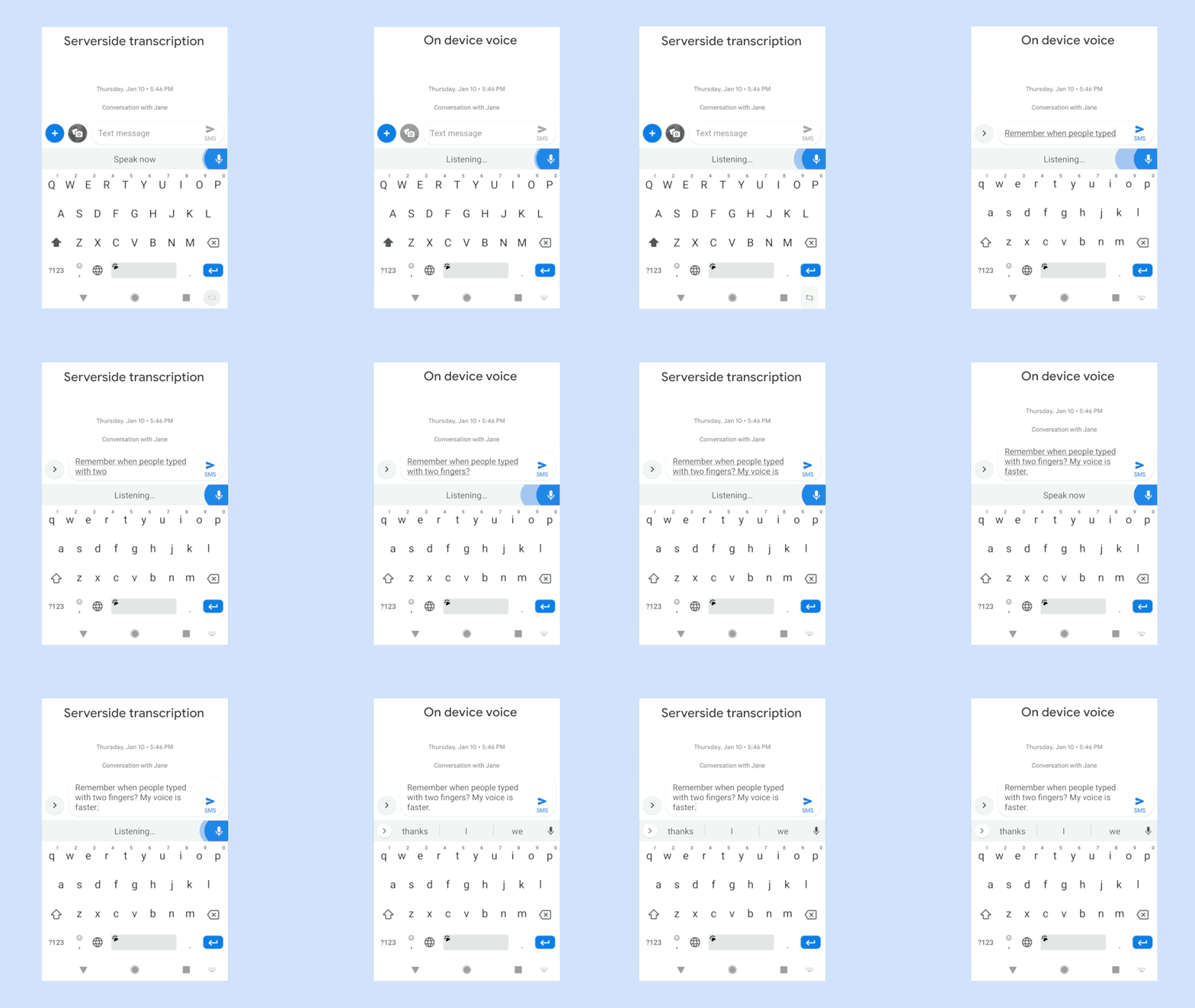
Voice recognition is a standard part of the smartphone package these days, and a corresponding part is the delay while you wait for Siri, Alexa or Google to return your query, either correctly interpreted or horribly mangled. Google’s latest speech recognition works entirely offline, eliminating that delay altogether — though of course mangling is still an option.

The delay occurs because your voice, or some data derived from it anyway, has to travel from your phone to the servers of whoever operates the service, where it is analyzed and sent back a short time later. This can take anywhere from a handful of milliseconds to multiple entire seconds (what a nightmare!), or longer if your packets get lost in the ether.

Why not just do the voice recognition on the device? There’s nothing these companies would like more, but turning voice into text on the order of milliseconds takes quite a bit of computing power. It’s not just about hearing a sound and writing a word — understanding what someone is saying word by word involves a whole lot of context about language and intention.

Your phone could do it, for sure, but it wouldn’t be much faster than sending it off to the cloud, and it would eat up your battery. But steady advancements in the field have made it plausible to do so, and Google’s latest product makes it available to anyone with a Pixel.

Google’s work on the topic, documented in a paper here, built on previous advances to create a model small and efficient enough to fit on a phone (it’s 80 megabytes, if you’re curious), but capable of hearing and transcribing speech as you say it. No need to wait until you’ve finished a sentence to think whether you meant “their” or “there” — it figures it out on the fly.

So what’s the catch? Well, it only works in Gboard, Google’s keyboard app, and it only works on Pixels, and it only works in American English. So in a way this is just kind of a stress test for the real thing.

“Given the trends in the industry, with the convergence of specialized hardware and algorithmic improvements, we are hopeful that the techniques presented here can soon be adopted in more languages and across broader domains of application,” writes Google, as if it is the trends that need to do the hard work of localization.

Making speech recognition more responsive, and to have it work offline, is a nice development. But it’s sort of funny considering hardly any of Google’s other products work offline. Are you going to dictate into a shared document while you’re offline? Write an email? Ask for a conversion between liters and cups? You’re going to need a connection for that! Of course this will also be better on slow and spotty connections, but you have to admit it’s a little ironic.

African e-commerce startup Jumia files for IPO on NYSE

Pan-African e-commerce company Jumia filed for an IPO on the New York Stock Exchange today, per SEC documents and confirmation from CEO Sacha Poignonnec to TechCrunch.

The valuation, share price and timeline for public stock sales will be determined over the coming weeks for the Nigeria-headquartered company.

With a smooth filing process, Jumia will become the first African tech startup to list on a major global exchange.

Poignonnec would not pinpoint a date for the actual IPO, but noted the minimum SEC timeline for beginning sales activities (such as road shows) is 15 days after submitting first documents. Lead adviser on the listing is Morgan Stanley .

There have been numerous press reports on an anticipated Jumia IPO, but none of them confirmed by Jumia execs or an actual SEC, S-1 filing until today.

Jumia’s move to go public comes as several notable consumer digital sales startups have faltered in Nigeria — Africa’s most populous nation, largest economy and unofficial bellwether for e-commerce startup development on the continent. Konga.com, an early Jumia competitor in the race to wire African online retail, was sold in a distressed acquisition in 2018.

With the imminent IPO capital, Jumia will double down on its current strategy and regional focus.

“You’ll see in the prospectus that last year Jumia had 4 million consumers in countries that cover the vast majority of Africa. We’re really focused on growing our existing business, leadership position, number of sellers and consumer adoption in those markets,” Poignonnec said.

The pending IPO creates another milestone for Jumia. The venture became the first African startup unicorn in 2016, achieving a $1 billion valuation after a $326 funding round that included Goldman Sachs, AXA and MTN.

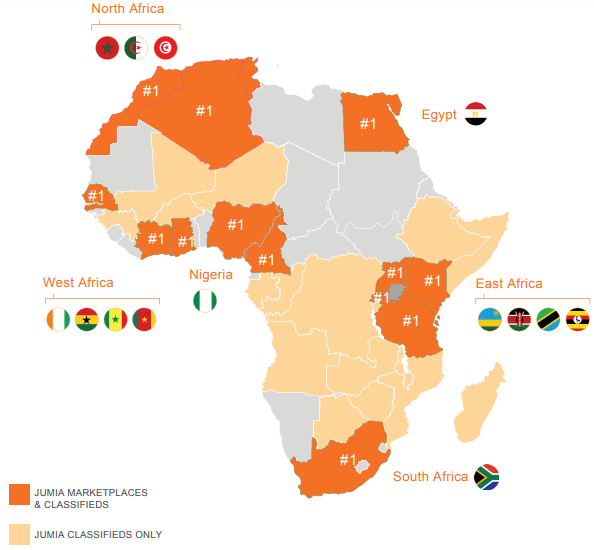
Founded in Lagos in 2012 with Rocket Internet backing, Jumia now operates multiple online verticals in 14 African countries, spanning Ghana, Kenya, Ivory Coast, Morocco and Egypt. Goods and services lines include Jumia Food (an online takeout service), Jumia Flights (for travel bookings) and Jumia Deals (for classifieds). Jumia processed more than 13 million packages in 2018, according to company data.

Starting in Nigeria, the company created many of the components for its digital sales operations. This includes its JumiaPay payment platform and a delivery service of trucks and motorbikes that have become ubiquitous with the Lagos landscape.

Jumia has also opened itself up to traders and SMEs by allowing local merchants to harness Jumia to sell online. “There are over 81,000 active sellers on our platform. There’s a dedicated sellers page where they can sign-up and have access to our payment and delivery network, data, and analytic services,” Jumia Nigeria CEO Juliet Anammah told TechCrunch.

The most popular goods on Jumia’s shopping mall site include smartphones (priced in the $80 to $100 range), washing machines, fashion items, women’s hair care products and 32-inch TVs, according to Anammah.

E-commerce ventures, particularly in Nigeria, have captured the attention of VC investors looking to tap into Africa’s growing consumer markets. McKinsey & Company projects consumer spending on the continent to reach $2.1 trillion by 2025, with African e-commerce accounting for up to 10 percent of retail sales.

Jumia has not yet turned a profit, but a snapshot of the company’s performance from shareholder Rocket Internet’s latest annual report shows an improving revenue profile. The company generated €93.8 million in revenues in 2017, up 11 percent from 2016, though its losses widened (with a negative EBITDA of €120 million). Rocket Internet is set to release full 2018 results (with updated Jumia figures) April 4, 2019.

Jumia’s move to list on the NYSE comes during an up and down period for B2C digital commerce in Nigeria. The distressed acquisition of Konga.com, backed by roughly $100 million in VC, created losses for investors, such as South African media, internet and investment company Naspers .

In late 2018, Nigerian online sales platform DealDey shut down. And TechCrunch reported this week that consumer-focused venture Gloo.ng has dropped B2C e-commerce altogether to pivot to e-procurement. The CEO cited better unit economics from B2B sales.

As demonstrated in other global startup markets, consumer-focused online retail can be a game of capital attrition to outpace competitors and reach critical mass before turning a profit. With its unicorn status and pending windfall from an NYSE listing, Jumia could be better positioned than any venture to win on e-commerce at scale in Africa.