Robotics process automation startup UiPath raising $400M at more than $7B valuation

UiPath, a robotics process automation platform targeting IT businesses, is raising more than $400 million in Series D funding from venture capital investors at a valuation north of $7 billion, sources have confirmed to TechCrunch following a report from Business Insider.

We’ve reached out to the company for comment.

UiPath, founded in 2005, has raised $409 million to date, meaning the new round of capital will double the total capital invested in the startup, as well as its valuation. Its $225 million Series C, raised just six months ago, valued the business at $3 billion, according to PitchBook. UiPath is backed by top-tier investors CapitalG and Sequoia Capital, which co-led its Series C, as well as Accel, Credo Ventures and Earlybird Venture Capital, among others.

The latest funding round is being led by a public institutional investor.

UiPath develops automated software workflows meant to facilitate the tedious, everyday tasks within business operations. RPA is probably a misnomer. It’s not necessarily a robot in the way we think of it today. It’s more like a highly sophisticated macro recorder or workflow automation tool, letting a computer handle a series of highly repeatable activities in a common workflow, like accounts payable.

For example, the process could start by scanning a check, then use OCR to read the payer and the amount, add that information to an Excel spreadsheet and send an email to a human to confirm it has been done. Humans still have a role, especially in processing exceptions, but it provides a way to bring a level of automation to legacy systems, which might not otherwise benefit from more modern tooling.

The company began raising private capital in 2015 and has since experienced rapid growth of its valuation and annual recurring revenue (ARR). UiPath garnered a $1.1 billion valuation with its Series B in March 2018, more than doubled it with its Series C and is again seeing a 2x increase in value with this latest round. This is a result of its swelling ARR.

The company says it went from $1 million to $100 million in annual recurring revenue in less than two years. With its Series C, it counted 1,800 enterprise customers and was adding six new customers a day. Sources tell TechCrunch that UiPath did 180 million in ARR last year and is on track to do $450 million in ARR in 2019.

How to develop a brand identity system (like Intercom)

[Editor’s note: This is the first of a series of articles that we’re writing about branding for startups. It’s part of our latest initiative to find the best brand designers and agencies in the world who work with early-stage companies — nominate a talented brand designer you’ve worked with.]  

When designer Ryan Hubbard joined Intercom, a SaaS unicorn that makes customer engagement tools, he knew that he would be working at the forefront of brand design. The company’s leadership empowered its Intercom Brand Studio to help Intercom stand out in an increasingly crowded field.

“I always look to figure out what is possible or push expectations,” Hubbard says. “There’s a more traditional view on brand design — the idea that people are there to create order and make rules. And that’s valid, but it’s not how I look at it.”

Now a senior designer at Medium, Hubbard has a lot more to say on how startups should approach branding to make a memorable impression.  

The essential principle of branding

“The one thing you should probably have buttoned up prior to investing in brand is some kind of clear point of view about who you are as a company and what makes you different,” says Hubbard.

While the elements of a brand are primarily visual, brand identity is based on foundational values and attitudes that define a company.

That’s why it’s essential to start with your company’s unique story. Those who approach branding as an exercise in defining and expressing their core ideas will find it much easier to create a striking and memorable brand.

Intercom has a compelling origin story about friends in Dublin longing for online customer service to mimic the welcoming atmosphere of the coffee shop where they liked to work. Accordingly, Intercom’s brand focuses on values like approachability, personality, warmth and helpfulness.

Those values translate into the brand’s visual language: a smile-like logo, joyful colors, quirky illustration.

“You could start with, ‘What is the story you’re telling?’ ” says Hubbard. “The stronger and better you can be with your story, that’s a really strong foundation for a good brand.”

How to define your look and feel

The basic elements of visual branding include logo, language, colors, imagery and typography. A strong brand is one that can be distilled down to the most basic elements and still be recognizable. Even a single word written a particular way can convey volumes.

“There’s a lot you can communicate with just typography,” says Hubbard. “The best identity systems I’ve seen — not just in tech — are all brands that are really strong with typography.”

Free-flowing creativity is key in experimenting with these elements. You’ll be holding on tight to your brand identity as you refine your story and identify your values. But it’s important to be open to all kinds of creative expression when you start designing.

“Don’t be too precious with exactly how you want everything to look,” advises Hubbard. “You can’t have a predetermined direction in your mind when you’re going into it.”

Get ideas and images out onto the page quickly. Then identify which draft elements light a spark and develop them. It will soon become obvious which connect most strongly.

How to deploy your branding

Once you have a brand identity system in hand, the next step is deploying it consistently. Your brand must be consistent across touch points, both inside and outside the organization.

But don’t mistake consistency for rigidity. If your brand is built on ideas and not just on a simple collection of visual elements, you can be consistent and creative. Allow your brand to have a life of its own, anchored by its core values and principles.

“It’s really easy to create a brand system that gives you no flexibility for expression, so you wind up putting the same thing over there over and over again,” says Hubbard. “If you don’t give yourself any room to do new exciting things with your brand, you’ll get stagnant and forgotten.”

That’s a death knell for any company, but a strong brand identity system will keep your brand at the forefront of customers’ minds.

Help us find the best startup brand designers and agencies in the world — nominate a talented brand designer you’ve worked with.

Why it’s no surprise that pro rata rights don’t mean what they used to

Yesterday, renowned investor Fred Wilson of Union Square Ventures observed in a blog post that fewer founders in today’s go-go market have been honoring what are called pro rata rights, or the right of an earlier investor in a company to maintain the percentage that he or she (or their venture firm) owns as that company matures and takes on more funding.

If a company isn’t doing well, investors aren’t necessarily interested in maintaining the same ownership percentage they once enjoyed in a company, but when it’s clearly breaking away from the pack, it means a lot. If an investor’s 10 percent take becomes a three percent stake over a startup’s subsequent rounds of funding and that startup sells for a billion dollars, that’s a difference of $70 million dollars, which is the size of many institutional seed-stage funds.

Still, while it’s easy to understand Wilson’s frustration, especially given that pro rata rights are legally provisioned to investors that are making a sizable investment (what’s called a “major investor threshold”), the answer probably isn’t to put more teeth into these agreements, as Wilson posits may be necessary. The solution seemingly, based on conversations we’ve had with founders and VCs in the past, is to be a better VC.

That isn’t easy to do in a world where trillions of dollars are sloshing around, much of it finding its way into startups. The more startups a venture firm supports, the harder it is for venture investors to log meaningful time with founding teams. Add to this the fact that venture firms have been raising new funds faster than ever over the last five years, and that means even less time spent with founding teams that were assured their investors would “roll up their sleeves,” then don’t.

We aren’t accusing Wilson of being preoccupied. We also don’t doubt there are founders who forget how much their early investors supported them when late-stage investors dangle before them a new deal that diminishes those early VCs’ stakes. But even several years ago, investors told us — including on stage — that they’d begun missing out on pro rata opportunities because sometimes they just weren’t paying enough attention. They were distracted by their other portfolio companies. And the industry has only grown more crowded — with startups and capital and new and old relationships — in the time since.

“That interpersonal component is huge,” as a startup attorney told us during that same discussion. “When you have these competing dynamics of: new investor needs to own X percentage of the company, previous lead investors want to have something, a bunch of smaller investors want to have something — the entrepreneur is trying to deal with all of these constituencies. In the end, they need to go to bat for you,” but they’re far more likely to do it if you’ve truly been a partner to them, no matter what a document says.

Put another way, if a founder isn’t talking to a venture investor about his or her next round of funding, that’s not good. But it probably shows how far apart the two sides were in the first place.

How to save the third wave of technology from itself

Daniel Wu
Contributor

Dan Wu is a privacy counsel and legal engineer at Immuta. He holds a JD from Harvard University, and is a PhD candidate for Social Policy and Sociology at The Harvard Kennedy School.

As The New York Times recently profiled, new startups are arising to solve the housing crisis. These startups disrupt what ex-AOL CEO Steve Case calls the “Third Wave,” industries with large social impact. Think: housing, healthcare and finance.

To survive, these companies need to ensure compliance with regulations early on, because mistakes here can have large social consequences. To help new entrants survive in these industries, two closely related technologies — legal technology (“legaltech”) and regulation technology (“regtech”) — help companies navigate rules embedded in text, such as contracts or regulations. Without them, incumbents, who have the most resources to hire lawyers to navigate these rules, are set up to dominate in the Third Wave.

Third Wave startups must tread carefully. Unaudited prefabricated housing designs might mean the use of subpar safety measures and tenant deaths during an earthquake. Oversights in financial transactions, for instance, may unintentionally facilitate money laundering. Privacy violations in healthcare data could lead to an unfair increase in insurance premiums for affected individuals.

To mitigate these social harms, regulations can be complex. In finance, for instance, the new Markets in Financial Instruments Directive has 30,000 pages. To comply, banks can spend $1 billion a year (often 20 percent of their operational budget). Citigroup reportedly hired 30,000 lawyers, auditors and compliance officers in 2014.

For startups, ignorance is no longer a viable strategy. In just the past three years, fintech startups have suffered more than $200 million (almost 5 percent of the total venture dollars invested over that same period) in regulatory fines: 50 percent involving consumer mistreatment and 25 percent involving privacy violations. Zenefits fired 17 percent of its staff, including its CEO, after violating insurance brokerage laws. LendingClub paused operations and cut 10 percent of its workforce after violating state usury and unfair dealing laws.

Companies cannot — and should not — avoid their regulatory and social responsibilities.

Uber — once infamous for its “do first, ask for forgiveness later” strategies — now engages with regulators directly, by building partnerships and applying for permits. VCs, such as Evan Burfield in Regulatory Hacking, argue that these strategies are critical for the next wave of startups.

This work requires not only perseverance but also tremendous resources. Large companies, such as J.P. Morgan or even Uber, have the most money and staff to navigate an increasingly complex regulatory landscape. Because of this, they are in the best position to shape the future and the Third Wave.

Legaltech and regtech can change this trend. These technologies use anything from data analytics to decision trees to help companies navigate rules embedded in text, such as regulations and contracts. Since technology is scalable in ways that hiring 30,000 lawyers is not, small innovators can better compete in a big company’s game.

In one example, Fenergo transformed a highly manual document review for Know Your Customer (KYC) regulations using text analysis and rule logic, speeding up the process by 37 percent.

Other related startups are reducing the costs associated with complying with corporate contracts (such as Ironclad), bankruptcy (such as UpSolve), zoning requirements generally (such as Envelope and Symbium) and for accessory dwelling units (such as Cover), permitting processes (such as Camino.ai) and energy standards (such as Cove Tool).

Because of this environment, analysts are bullish about these technologies. In 2018, nearly $1 billion has been invested in legaltech. Spend on regtech in finance alone is estimated to rise from $10 billion in 2017 to $76 billion in 2022 (a 700 percent increase in five years). For comparison, spend on the sharing economy is estimated to rise from $18 billion in 2017 to $40 billion in 2022.

In the Third Wave, companies cannot — and should not — avoid their regulatory and social responsibilities. If the scandals of Uber and Facebook are any indication, when a company violates laws or loses its integrity, the public and the stock market respond in kind. Journalistic coverage of breaches and unethical data practices has captured public attention. Waves of data regulation have passed across major jurisdictions, such as China, California and Brazil.

Embracing legaltech and regtech can plant long-term competitive advantages. Adopting technology that automates data protection, for instance, can create better customer experiences. By safely analyzing more data, even smaller companies can quickly generate insights and build programs that provide value to their customers.

Technology can empower companies both large and small to embrace the mitigation of social harms and the promotion of positive impact.

Startup executives should take notice.

Streaming site Kanopy exposed viewing habits of users, researcher says

On-demand video-streaming site Kanopy has fixed a leaking server that exposed the detailed viewing habits of its users.

Security researcher Justin Paine discovered the leaking Elasticsearch database last week and warned Kanopy of the exposure. The server was secured two days later, on March 18, a spokesperson told TechCrunch. “We are currently investigating the scope and cause as well as reviewing all of our security protocols.”

Kanopy is like Netflix, but for classic movies and documentaries. The company partners with libraries and universities across the U.S. by allowing library card holders to access films for free.

In a blog post, Paine said the server contained between 25-40 million daily logs, which he said could have identified all the videos searched for and watched from a user’s IP address.

“Depending on the videos being watched — that potentially could be embarrassing information,” he wrote.

The logs also contained geographical information, timestamps and device types, he said. He noted that there was no other personally identifiable information — such as usernames and email addresses — attached to the logs. 

According to a report last year, Kanopy has more than 30,000 movies on its platform.

MoviePass parent’s CEO says its rebooted subscription service is already (sort of) profitable

Two days after MoviePass announced the return of the company’s unlimited ticket plan, Ted Farnsworth, CEO of its parent company Helios and Matheson Analytics, sat down with TechCrunch to offer insight into the state of the beleaguered service.

According to the executive, MoviePass Uncapped is already seeing positive results. While he didn’t share concrete numbers, he says that sign-ups have increased “well over 800 percent in the last few days. And that’s conservative.”

Asked what it would take to make the company’s subscription business profitable, Farnsworth says, “Well, it’s profitable right now.” As for when it turned the corner, he added, “I will tell you this, because it’s out there: MoviePass has actually paid Helios back money over the past several months, towards the loans that they have. So, that gives you an idea of when we really started focusing on getting rid of the 20 percent of the abusers.”

Important caveat: A Helios & Matheson spokesperson later clarified that Farnsworth meant MoviePass’ subscription business is profitable on a revenue-per-subscriber basis. In other words, it’s not losing money on subscriptions, but the business unit isn’t necessarily profitable when you take overhead and debt into account.

The plan marks a return to the initial unlimited model that helped turn MoviePass into a household name in the past year. But that success arrived with a massive price, as the service began hemorrhaging money. MoviePass withdrew the unlimited plan and began reworking its plans on what seemed to be a weekly basis.

In July, at the height of what was supposed to be the Summer of MoviePass, the service experienced an outage as it struggled to pay bills. Helios secured a $5 million loan from creditors Hudson Bay Capital Management in order to turn the lights back on.

Ted Farnsworth

WEST HOLLYWOOD, CA – FEBRUARY 24: Ted Farnsworth attends the 27th annual Elton John AIDS Foundation Academy Awards Viewing Party sponsored by IMDb and Neuro Drinks celebrating EJAF and the 91st Academy Awards on February 24, 2019 in West Hollywood, California. (Photo by Jamie McCarthy/Getty Images for EJAF)

“I think the big SNAFU there was the credit card company,” the executive explains. “When one company sold to the other, we had been doing business with them for four years. They decided it was too much credit for them and literally call the credit line on a Friday night and I do a personal guarantee on a Saturday.”

However things might have gone down on the back end, the optics of such a situation were clearly less than ideal. MoviePass’ struggles were very public from the beginning, as part of a publicly traded company. A literal shut down for the service appeared to be just the latest sign that the too good to be true service was exactly that.

And while Farnsworth admits that the company would have benefited from a bit more privacy, he claims that he never had any doubts about MoviePass’ future, even as he negotiated with creditors for a fresh cash injection.

“There were no moments in my mind where I thought it would go down. In my mind, I thought it was too big to fail,” he says. “You created a household name in less than a year. I think any time you have something like that, where you’re going to run into issues from sheer growth. Our investors did well investing along the way. The investors believed in us and they still do. We knew we had to slow it down to get in front of the fraud side because there were so many moving parts. It was moving so fast.”

It’s that “fraud” that was at the center of MoviePass’ woes, says Farnsworth. MoviePass’ initial downfall, he believes, was the product of too many users “gaming the system.” He believes the total number of users that fall into that category to have been around 20 percent of the overall subscriber base.

It was a minority, certainly, but still a sizable figure, given that, by June of last year, that total figure had exceeded three million. By that point, the service also comprised around five percent of U.S. box office receipts. Much of the past year has been spent attempting to plug holes in the subscription service as the MoviePass boat began rapidly taking on water.

To be clear, “gaming the system” doesn’t just mean watching a lot of movies — Farnsworth says he’s happy to have “hardcore” users, even if they’re buying way more than $9.95 or $14.95 worth of tickets. Instead, his concern is users who are doing things like sharing their subscription or just using a MoviePass ticket to use the theater’s restroom — something surprisingly common in places like Times Square, where public bathrooms are hard to come by.

One of the primary fixes, Farnsworth says, is utilizing mobile tracking to ensure that subscribers are, in fact, using the service as intended, and looking for “red flags” like constantly changing the device using the app. Users are already required to enable location-based tracking in order to enable ticket purchase. This will utilize that to ping the ticket purchaser’s location, in order to make sure that they’re actually attending the movies for which they’ve purchased tickets.
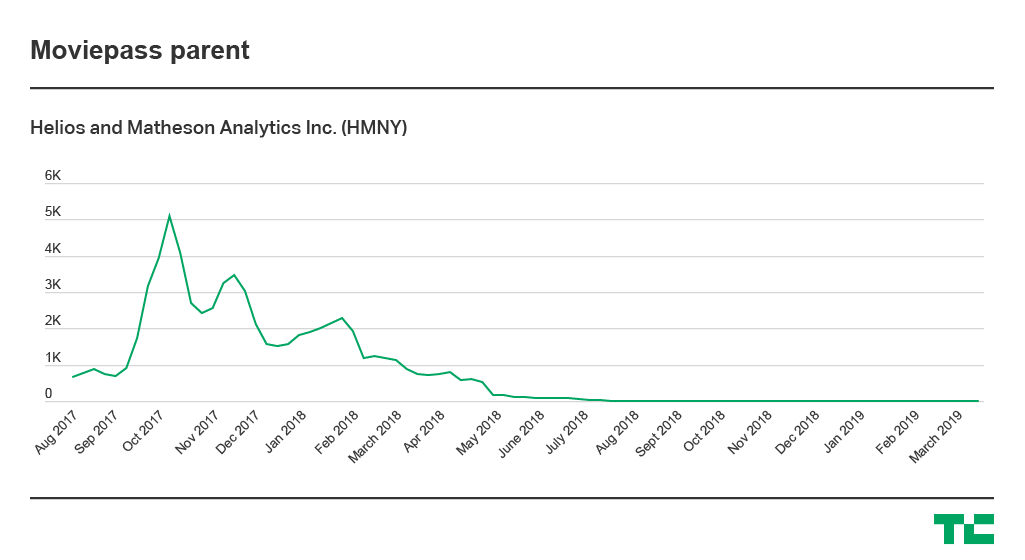
HMNY moviepass parent chart

“For instance, another issue is where people would go to the theater, they’ll pick up the ticket, they’ll hand their ticket to the kid or their child or their friend or whatever it is … and the person that’s paying the subscription goes back home or whatever they do,” he says. The new strategy: “When the movie starts, 30 minutes later [we’re] able to ping them inside the theater, just to make sure they still are at that theater.”

Looking ahead, Farnsworth says that the days of constantly changing pricing and restrictions are over, and that the company is committed to the unlimited plan. In fact, in his telling, the goal was always to get back to the unlimited plan — it was just that MoviePass had to figure out how to cut down on fraud to make the plan work.

At the same time, he says MoviePass’ film studio will also be an important part of the business. It has been overshadowed by the headlines about the company’s subscription struggles, but MoviePass Films has titles starring Bruce Willis, Al Pacino and Sylvester Stallone scheduled for this year.

MoviePass also invested in “Gotti,” and although the film was reviled by critics and only grossed $4.3 million at the box office, Farnsworth doesn’t see it as a failure.

“We never looked at Gotti as a money-maker” he says. “They only projected that it would do a $1.3 million in the box office here. Because then, when we pushed it with MoviePass, we took that up to five million. So, I mean, when you can take a movie — I gotta be careful here, but when you take a movie that might not be that great or perfect, and you can move that needle, [that] was always our theory of subscription.”

Check back later for our full interview with Farnsworth. Also, this post has been updated to reflect that MoviePass recently saw 800 percent growth in sign-ups (not subscribers), and to clarify Farnsworth’s remarks about profitability.


Tesla sues former employees, Zoox for alleged trade secret theft

Tesla has filed a pair of lawsuits against a handful of former employees who went to work at self-driving vehicle startup Zoox and Chinese EV automaker Xiaopeng.

The separate lawsuits filed late Wednesday allege former Tesla employees stole trade secrets and used them at their new places of employment. Tesla declined to comment on either lawsuit.

Zoox and Xiaopeng, also known as XPeng, have not responded to requests for comment. TechCrunch will update this article if either company responds.

While both lawsuits hinge on different trade secrets, they both share certain similarities: allegations of employees taking sensitive and valuable information as they left Tesla.

In one lawsuit, Tesla alleges that Zoox, as well as four former employees, Scott Turner, Sydney Cooper, Christian Dement and Craig Emigh, have made “concerted efforts “to steal Tesla’s proprietary information and trade secrets to help Zoox leapfrog past years of work needed to develop and run its own warehousing, logistics, and inventory control operations.” Tesla called the theft “blatant and intentional.”

Tesla claims in the complaint that the four former employees took “select proprietary Tesla documents useful to their new employer, and at least one of them used Tesla’s confidential information to target other Tesla employees for hiring by Zoox. In the process, they misappropriated Tesla’s trade secrets, violated their agreements with Tesla, and breached their duties of loyalty, all with the knowledge and support of Zoox.”

In a separate case, Tesla alleges former employee Guangzhi Cao, who worked on the company’s Autopilot driver assistance feature, stole source code before abruptly quitting in January and taking a job XPeng. Tesla refers to the company as XMotors in its complaint.

“Tesla’s confidential information is not safe in the hands of XMotors or its employees,” the complaint reads. “Inspired by and on a mission to beat Tesla, XMotors reportedly designed its vehicles around Tesla’s open-source patents and has transparently imitated Tesla’s design, technology, and even its business model. XMotors has also introduced reportedly ‘Autopilot-like’ features (called X-Pilot), and now employs at least five of Tesla’s former Autopilot employees, including Cao.”

Tesla said it has “spent hundreds of millions of dollars” and more than five years developing Autopilot. The company claims that Cao’s action have put that investment at risk.

“Tesla must learn what Cao has done with Tesla’s IP, to whom he has given it, and the extent to which Tesla has been harmed. Tesla files this lawsuit to compel the return of its valuable IP and protect it from further exploitation, and for all other relief as the facts may warrant,” the complaint reads.

This isn’t the first time Tesla or its CEO Elon Musk have filed lawsuits against several employees, some of which have been viewed as acts of retribution. In 2017, Tesla dropped its lawsuit just weeks after its original filing against Sterling Anderson, former director of Autopilot, and Aurora, the self-driving vehicle startup he co-founded, after the two parties reached an agreement.

Tesla filed a lawsuit in December seeking $167 million against former employee Martin Tripp, the former employee whom Musk has referred to as a saboteur. The lawsuit, originally filed in June and seeking just $1 million at the time, alleges Tripp stole confidential and trade secret information, and gave it to third parties.

Tripp filed a formal whistleblower tip to the U.S. Securities and Exchange Commission alleging Tesla misled investors and put its customers at risk.


This is what the Huawei P30 will look like

You can already find many leaked photos of Huawei’s next flagship device — the P30 and P30 Pro. The company is set to announce the new product at an event in Paris next week. So here’s what you should expect.

Reliable phone leaker Evan Blass tweeted many different photos of the new devices in three different tweets:

pic.twitter.com/nIlhxby1Ah

— Evan Blass (@evleaks) March 20, 2019

As you can see, both devices feature three cameras on the back of the device. The notch is getting smaller and now looks like a teardrop. Compared to the P20 and P20 Pro, the fingerprint sensor is gone. It looks like Huawei is going to integrate the fingerprint sensor in the display just like Samsung did with the Samsung Galaxy S10.

Also, mysmartprice shared some ads with some specifications. The P30 Pro will have a 10x hybrid zoom while the P30 will have a 5x hybrid zoom — it’s unclear how it’ll work to combine a hardware zoom with a software zoom. Huawei has been doing some good work on the camera front, so this is going to be a key part of next week’s presentation.

For the first time, Huawei will put wireless charging in its flagship device — it’s about time. And it looks like the P30 Pro will adopt a curved display for the first time, as well. I’ll be covering the event next week, so stay tuned.

Introducing the Extra Crunch Stage at Disrupt SF 2019

Every year we dig deep to make the next TechCrunch Disrupt bigger, bolder and better than before. Disrupt San Francisco 2019, on October 2-4, is no exception. One of the many upgrades we’re proud to announce is the Extra Crunch Stage.

Hold up a second — need a ticket to Disrupt SF 2019? Get one at the super early-bird price before the price increases.

OK, moving on. We’re upgrading last year’s Next Stage to the Extra Crunch Stage — named in honor of TC’s recently launched subscription product. Designed for our most engaged readers, this extra crunchy layer of subscription content goes deep on entrepreneurial and startup topics like inclusion and diversity, hiring practices, legal and product decisions, as well as mental health and wellness in high-performance businesses.

So, how does this translate to the Extra Crunch Stage at Disrupt SF? The programming here will still feature fireside chats and panel discussions focused on topics crucial to founder and investor success. But you can also see and hear plenty of how-to content, and gain practical, actionable insights from the folks who have been out in the trenches getting deals done.

Anyone with an Innovator, Founder or Investor pass can access this delicious insider content found on the Extra Crunch Stage, plus all the speakers, panelists and startup founders who will grace the Main Stage (think Startup Battlefield), the Showcase Stage (in Startup Alley) and the Q&A Stage (where you ask and experts answer).

What else can you expect at Disrupt SF 2019? World-class networking and nearly infinite opportunities. Connecting with people is great — connecting with the right people is even better. Cue CrunchMatch, Disrupt’s free business match-making service, available to all attendees. The platform helps you find and connect with people based on specific mutual criteria, goals and interests. Whether you want to network with founders, investors, technologists, researchers or software engineers, CrunchMatch combines curation and automation to help you make the most of your limited time.

Disrupt SF 2019 takes place October 2-4 at Moscone North Convention Center. Come and experience the new Extra Crunch stage and all the other opportunities, events and connections that could make your startup dreams come true. Those super early-bird tickets won’t last long, so get yours today.

Is your company interested in sponsoring or exhibiting at Disrupt SF? Contact our sponsorship sales team by filling out this form.

Rent the Runway hits a $1 billion valuation

Rent the Runway just closed a $125 million round led by Franklin Templeton Investments and Bain Capital Ventures. This round values the company at $1 billion. In total, Rent the Runway has raised $337 million in venture funding.

“Shared, dynamic ownership is a movement that Rent the Runway has pioneered over the last decade and we’re excited to continue to lead the market and innovate our subscription service,” Rent the Runway CEO Jennifer Hyman said in a statement.

Late last year, Rent the Runway opened a physical location in San Francisco, marking the company’s fifth standalone brick and mortar space. Rent the Runway, which launched about 10 years ago, has expanded from the sole offering of one-time rentals to now three offerings, including two subscription offerings.

With the funding, Rent the Runway plans to scale its subscription business, broaden its clothing and home decor offerings and open additional fulfillment facilities.

Since its founding, a number of other fashion services have cropped up. The most notable one is StitchFix, which went public in 2017. But what differentiates Rent the Runway from the likes of Stitch Fix is that, “they’re trying to get you to buy stuff,” Rent the Runway COO Maureen Sullivan told me back in September. “You’re still buying things that accumulate in your closet.”

Aurora’s Sterling Anderson, Uber ATG’s Raquel Urtasun to discuss self-driving cars and AI at TC Sessions

We’re just weeks away from our TC Sessions: Robotics + AI event at UC Berkeley on April 18.

Some of the best and brightest minds are joining us for the day-long event, including Marc RaibertColin AngleMelonee Wise and Anthony Levandowski . Last week, we added to the list of marquee guests and announced a panel with roboticist Ken Goldberg, who is chief scientist at Ambidextrous Robotics and William S. Floyd Jr. Distinguished Chair in Engineering at UC Berkeley, and Michael I. Jordan, the Pehong Chen Distinguished Professor in the Department of Electrical Engineering and Computer Science and the Department of Statistics at UC Berkeley.

Today we’ve got another exciting panel to unveil.

This is the first time artificial intelligence has joined robotics at this TC Sessions event. And what better way to discuss the intersection of AI and robotics than a panel on autonomous-vehicle technology.

Today we’re revealing two people who are among the top thinkers focused on autonomous-vehicle development: Sterling Anderson, co-founder and chief product officer of Aurora, and Uber ATG chief scientist Raquel Urtasun

The pair will dig into the self-driving stack and how AI is used to help vehicles understand and predict what’s happening in the world around them and make the right decisions.Sterling Anderson

Sterling Anderson

In the brain trust of self-driving car developers, Anderson is highly regarded. Prior to founding Aurora with Chris Urmson and Drew Bagnell, Anderson was director of Tesla’s Autopilot program. He also led the design, development and launch of the Tesla Model X, an all-electric SUV that launched in 2015.

Anderson has a PhD in Robotics from MIT. After finishing his doctorate at MIT, Anderson founded a startup called Gimlet Systems with another self-driving car pioneer, Karl Iagnemma. He also worked at McKinsey & Co.

Raquel Urtasun

Raquel Urtasun

Urtasun, chief scientist and head of Uber ATG Toronto, is also an associate professor in the Department of Computer Science at the University of Toronto.

Urtasun is a co-founder of the Vector Institute for AI. Urtasun is a leading expert in machine perception for self-driving cars. She earned her degree from the computer science department at École Polytechnique Fédéral de Lausanne and post-doc at MIT and UC Berkeley. Her research interests include machine learning, computer vision, robotics and remote sensing.

General Admission ($349) tickets are on sale now. Prices go up at the door, so book today!

Students, grab your discounted $45 tickets here.

Startups, make sure to check out our demo table packages, which include three tickets, for just $1,500.

Daily Crunch: The new iPad mini, reviewed

The Daily Crunch is TechCrunch’s roundup of our biggest and most important stories. If you’d like to get this delivered to your inbox every day at around 9am Pacific, you can subscribe here.

1. Review: Apple’s new iPad mini continues to be mini

Matthew Panzarino tried out Apple’s new tablet with Apple Pencil support, and he says the experience is “aces.”

His only caveat: After using the brilliant new Pencil, the old one feels greasy and slippery by comparison, and lacks the flat edge against your finger for shading or sketching out curves.

2. Windows Virtual Desktop is now in public preview

Starting today, any enterprise user who wants to test out a virtual Windows 10 desktop hosted in the Azure cloud will be able to give it a try.

3. MoviePass co-founder’s new startup PreShow gives you free movie tickets for watching ads

As founding CEO of MoviePass, Stacy Spikes has already changed the way we think about paying for movie tickets. Now he’s pursuing a new approach — providing a free ticket to people who watch 15 to 20 minutes of ads.

4. What latency feels like on Google’s Stadia cloud gaming platform

We got our hands on one of their new controllers and pressed play to try out Doom 2016 gameplay on Google’s new platform.

5. Guesty, a tech platform for property managers on Airbnb and other rental sites, raises $35M

The idea for Guesty came about like many of the best startup ideas do: out of a personal need. In 2013, twin brothers Amiad and Koby were renting out their own apartments on Airbnb, and found themselves spending a lot of time doing the work needed to list and manage those properties.

6. Microsoft warns Windows 7 users of looming end to security updates

The patch rolled out Wednesday warning users of the impending deadline, January 14, 2020, when the software giant will no longer roll out fixes for security flaws and vulnerabilities.

7. Amify raises its first venture round on a promise: to boost revenue for third-party sellers on Amazon

Amify now works with a long line of customers, from brands you might not recognize to household names like Fender guitars and Brooks, all of which pay Amify a percentage of their revenue in exchange for its services.

Paris to tax scooter and bike services

According to the City of Paris, there are 15,000 free-floating vehicles of all forms and shapes in the city, from electric scooters to fluorescent bikes and motorcycle-like scooters. And the City of Paris announced today that companies that operate free-floating services will have to pay a tax depending on the size of their fleet.

If the plan goes through and if you’re running a bike-sharing service, you’ll have to pay €20 per bike per year. For scooter companies, they’ll pay €50 per scooter per year. Motorcycle scooters will be taxed €60 per scooter per year.

According to Le Parisien, it will be a tier system. Every time you go over the basic tier, you’ll have to pay more. Companies will pay 10 percent more for vehicle No. 500 to vehicle No. 999, 20 percent more for vehicle No. 1,000 to vehicle No. 2,999, and 30 percent more for any vehicle after No. 3,000.

Paris is a tiny city — it’s smaller than San Francisco when it comes to geographical footprint. And it’s also impossible to park a car and drive in Paris. That’s why a vast majority of people who live in Paris don’t own a car. It’s simply much faster and cheaper to use the subway or other transportation methods.

That’s why bikes, scooters and motorcycle scooters are thriving. Having fewer cars on the road is a great thing, but it has created some unexpected challenges.

Bike-sharing services thrived when the city’s bike-sharing system was more or less useless during a network upgrade. GoBee Bike, oBike, Ofo and Mobike all launched their services in the streets of Paris. But they’ve all failed. GoBee Bike shut down, Ofo still has a few bikes but no team, Mobike is scaling back international operations…

That was a bad start for free-floating services, as many broken bikes are littering the streets of Paris. The dock-based bike-sharing system Vélib is now working, fine with more than 1,200 stations and tens of thousands of rides per day — you basically see them everywhere.

On the scooter front, there are now nine companies operating in Paris. Yes, you read that number correctly. They all have funny-sounding names too — Lime, Bird, Bolt, Wind, Tier, Voi, Flash, Hive and Dott.

They’re quite popular because there are a ton of bike lanes in Paris. Most people still don’t wear helmets and there are a lot of injuries — but that’s another issue.

Like many other cities, many people complain about scooters crowding the sidewalk. If you’re in a wheelchair, pushing a stroller or if you’re visually impaired, navigating the sidewalk can be difficult these days.

The City of Paris wants to make those companies accountable. They need to take care of their fleets in order to maximize the number of scooters that actually work and remove the broken scooters. And I’m sure there will be some consolidation and bankruptcies in the space.

When it comes to motorcycle scooters, Cityscoot and Coup have been putting more scooters on the road. There’s no reason they would be excluded from the tax. Sometimes, they are cluttering bike parking space, for instance:

Bonjour @COUP_Paris. Voici ce qu'on a pu voir aujourd'hui dans le 13ème : vos scooters tous alignés proprement sur un parking vélo. Ce n'est probablement pas fait par vos clients, donc merci de respecter les infrastructures dédiées aux vélos. @RasLeScoot @C_Najdovski pic.twitter.com/5KzKcTRG41

— Observations Cyclistes (@OCyclistes) February 22, 2019

Let’s see if that strategy works to avoid a dumping strategy. Free-floating services have a huge impact on the environment. Scooters only last a few weeks before they need to be replaced. The solution isn’t to throw more scooters at the problem.

How Amazon and Walmart are putting robots to work behind the scenes

Extra Crunch offers members the opportunity to tune into conference calls led and moderated by the TechCrunch writers you read every day.

This week Brian Heater, fresh off a trip to Pittsburgh to visit a handful of robotics companies, led a discussion about the current state of robotics and how startups are integrating the machines into our lives. When it comes to our home lives, we really only have the Roomba, that circular disc that moves about our floors on its own sweeping up the dust and dirt. In fact, the jobs being performed behind the scenes are the ones robots are digging into.

Obviously we’ve got some fairly unrealistic expectations about robotics that have been served up to us by sci-fi and things like that. And when we take away the state of consumer robotics and household robotics, the best we can do at the moment right now is the Roomba. Which is obviously quite far away from being Rosie the Robot idea that has been promised to us since the 1960s.The rub of all this, however, is that we tend to not actually see them in action. In automation, there’s a concept of three Ds, which are dull, dirty and dangerous. So they’re the jobs that these robotics are basically designed to adopt.

He also touches upon the fear of robots taking our jobs. What he found is that, no, you don’t have anything to fear — unless you’re an elevator operator, he says, and even that’s not across the board. But there is a political response to that by Rep. Alexandria Ocasio-Cortez, who said at SXSW last week: “We should not be haunted by the specter of being automated out of work. We should be excited by that. But the reason that we’re not excited is that we live in a society where if you don’t have a job, you’ll have to die. And at its core, that’s the problem.”

And it’s not robotics discussion without mentioning Amazon . Heater recently visited an Amazon fulfillment center on Staten Island to give you a peek at how robots help get your packages to you on time.

For access to the full transcription and the call audio, and for the opportunity to participate in future conference calls, become a member of Extra Crunch. Learn more and try it for free.