Who needs the dark web? Researchers found 74 groups offering stolen credit cards and hacking tools with simple Facebook searches.
Category: Tech news
hacking,system security,protection against hackers,tech-news,gadgets,gaming
5 of the Best Demos of Projectile Motion and Its Quirks
A dude jumping on a moving trampoline is a great excuse to dive into the unexpected properties of projectile motion.
Is It OK to Make Your Dog Vegan?
When the ethos of eating meets the pathos of puppies, so many tears flow. What there’s considerably less of, though, is science.
Alexa, What’s My Blood-Sugar Level?
Amazon reveals new skills for its voice assistant Alexa, a sign of its growing interest in health care.
Microsoft Employees Revolt, Beheaded Mosquitos, and More News
Catch up on the most important news today in 2 minutes or less.
Amazon reportedly removes the most obvious promotions for its private brands from search results
If it feels like your Amazon search results have been overwhelmed with promotions for their private-label brands, like Amazon Basics, Mama Bear or Daily Ritual, that may be changing. As lawmakers pay more attention to the most powerful tech companies, Amazon has begun quietly removing some of the more obvious promotions, including banner ads, for its private-label products, reports CNBC, which spoke to Amazon sellers and consultants.
Amazon’s aggressive marketing of its own private brands, with ads that often appear in search results above listings for competing items from third-party sellers, have raised antitrust concerns. The company’s increasingly strong gripe on the U.S. retail market has been under scrutiny for years, but pressure intensified last month when Massachusetts senator and Democratic presidential primary candidate Elizabeth Warren announced that breaking up tech giants Amazon, Google and Facebook (and other companies with an annual global revenue above $25 billion that provide marketplace, exchange or third-party connectivity as “platform utilitilies”) in order to reduce their economic dominance will be a major part of her platform. This means that Amazon Marketplace and Basics would be split apart, and acquisitions including Whole Foods and Zappos would be spun out.
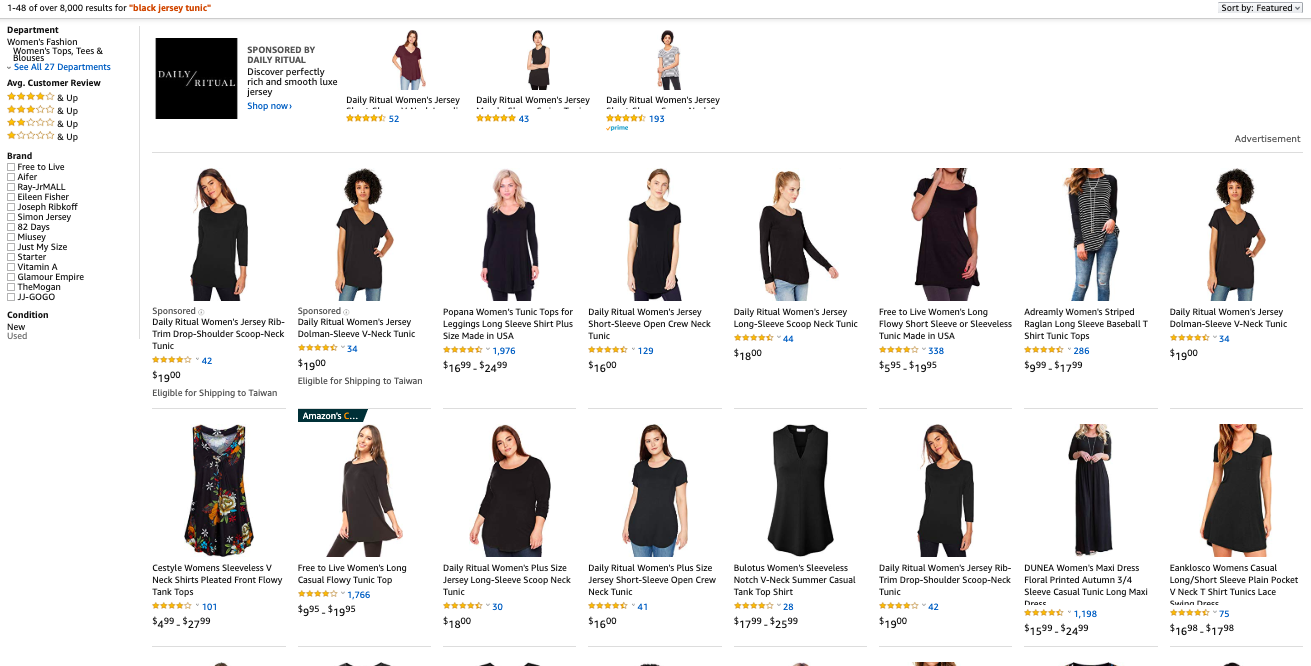
While there isn’t a banner ad, products from an Amazon private label brand, Daily Ritual, still dominate results for “black jersey tunic”
Amazon’s private brands quickly became a major threat to third-party sellers on its platform, increasing from about a dozen brands in 2016, when some of its products began taking the lead in key categories like batteries, speakers and baby wipes, to a current roster of more than 135 private label brands and 330 brands exclusive to Amazon, according to TJI Research.
While Amazon benefits from higher margins, cost-savings from a more efficient supply chain and new data, third-party sellers often suffer. For example, they may have to cut prices to stay competitive, and even lower prices may not be enough attract customers away from Amazon’s promotions for its own items, which show up in many search results.
Other recent measures Amazon has taken to ward off antitrust scrutiny include reportedly getting rid of its price parity requirement for third-party sellers, which meant they were not allowed to sell the same products on other sites for lower prices.
TechCrunch has contacted Amazon for comment.
SpaceX has completed the first tethered hop for the “Starhopper”
SpaceX has completed the first tethered jump for its Starship prototyped, Elon Musk confirmed in a tweet Wednesday evening.
Called the Starhopper because it’s making limited hops to test the landing capabilities of the Starship vehicle, the tethered jump represents the first firing of a rocket engine at the company’s Boca Chica launch site.
The hops are similar to the testing that preceded the commercial development and use of SpaceX’s reusable Falcon 9 rockets. Those tests, the Grasshopper and the F9R Dev, were critical to the development of those earlier rockets in the same way that these early launches will pave the way for SpaceX’s interplanetary Starship.
Starhopper completed tethered hop. All systems green. https://t.co/0m5Bm5slD2
— Elon Musk (@elonmusk) April 4, 2019
The Starhopper is SpaceX’s smaller prototype for what will eventually be its Starship vehicle, which the company hopes will make its first cargo flights by 2022. Musk wants the vehicle to make its first passenger flight in 2023, when the Starship will voyage to the moon. That would be followed by a crewed Mars flight slated for 2024 and the construction of a Mars Base by 2028.
Musk first debuted the new rocket in January. And since the start of the year the company has been testing several components for the new launch vehicle. Most recently, the company tested a new heat shield design that should protect the rocket as it reenters Earth’s atmosphere.
Testing Starship heatshield hex tiles pic.twitter.com/PycE9VthxQ
— Elon Musk (@elonmusk) March 17, 2019
Tesla first-quarter deliveries drop on challenges shipping Model 3 overseas
Tesla delivered 63,000 of its electric vehicles in the first quarter of the year, nearly a one-third drop from the previous quarter, the company reported late Wednesday. Tesla cautioned that it expects first-quarter profits to be negatively impacted by lower than expected delivery volumes and several pricing adjustments.
Deliveries included about 50,900 Model 3 vehicles and 12,100 Model S and X SUVs.
Tesla said despite the challenges that it “ended the quarter with sufficient cash on hand.”
Tesla blamed the striking difference in numbers on its efforts to increase deliveries of its Model 3 electric car in Europe and China, which was fraught with challenges and caused delays.
“Due to a massive increase in deliveries in Europe and China, which at times exceeded 5x that of prior peak delivery levels, and many challenges encountered for the first time, we had only delivered half of the entire quarter’s numbers by March 21, ten days before end of quarter,” Tesla said in its report. “This caused a large number of vehicle deliveries to shift to the second quarter. At the end of the first quarter, approximately 10,600 vehicles were in transit to customers globally.”
Those numbers appear to be further pressured by a drop in Model S and Model X deliveries. Deliveries of the Model S and X dropped by nearly half compared to the fourth quarter.
Tesla delivered 90,966 vehicles during the fourth quarter. Of those, 27,607 were Model S sedans and Model X SUVs and 63,359 were Model 3s.
The company also produced fewer vehicles than it did in the fourth quarter. The drop was entirely due to lower Model S and X numbers. Back in January, Tesla said it would no longer take orders of its 75 kWh version of the Model S and X, which could explain part of that reduction.
In the first quarter, Tesla produced 77,100 total vehicles, consisting of 62,950 Model 3 and 14,150 Model S and X vehicles. That’s nearly 11 percent lower than the fourth quarter when Tesla produced 86,555 vehicles — 61,394 of which were Model 3 cars and 25,161 Model S and X vehicles.
In the first quarter, Tesla produced 1,555 more Model 3 cars than in the fourth quarter.
Tesla still stressed that its sales, particularly in North America where it has been available longer, are strong. The company noted that inventory of Model 3 vehicles in North America “remains exceptionally low, reaching about two weeks of supply at the end of Q1, compared to the industry average of 2-3 months.”
Tesla reaffirmed its prior guidance of 360,000 to 400,000 vehicle deliveries in 2019.
Facebook gets one step closer to building your virtual copy
When it comes to representing yourself on social media, who you actually portray yourself as has always been a bit of a caricature. That thinking has always made it a little interesting to examine how a company like Facebook approaches avatar design for services like their VR avatar system.
Oculus Avatars have undergone a number of transformations and today they’re pushing an update that creates more robust facial expressions that are more human-like than the stiff representations that past iterations showcased. The new Sims-like “Expressive Avatars” are certainly the company’s most unsettling to date, but they’re also the most ambitious.
The company calls the update, the “culmination of user feedback and years of research and innovations in machine learning, engineering, and design.”
There’s this oft-repeated concept of the uncanny valley where things get up to a certain point of realism but then they’re just deeply unsettling because the representation is close but not quite there. That’s more than a little evident here. Oculus initially chose to veer wide when it came to structuring its avatar system based on how people actually looked, but with their latest Expressive Avatars update, things seem to be moving in a different direction.

In a blog post, the company seemed to acknowledge the risks of going all-in on realism while emphasizing that the trade-offs were worth it. They say they discovered people are simply more willing to interact with avatars when they look and behave more like humans:
Back in 2016, we made a conscious decision to avoid showing what we didn’t know in order to better represent what we knew with certainty. Since then, we’ve learned a great deal not only about how our hardware canhelpus simulate believable behaviors with higher confidence, but also about how we can use machine learning and well-understood priors to translate subtle signals into great social presence.
The new avatars boast more realistic mouth and eye movements, a small upgrade that Facebook maintains was intensely challenging to pull off.
This could be a bit of a perilous direction to choose. After all, there’s really one ideal the company can hit, recreating a perfect digital person. They’ve already copped to designing deeply human-like avatar systems; the limits here are obviously both the low power of today’s consumer systems and the inabilities of the platforms to infer very much in terms of interaction and movement aside from what’s captured precisely by sensors.
Facebook’s new Avatar system goes live today on Oculus mobile and PC platforms.
Ousted Nissan chief Carlos Ghosn says ‘I will not be broken’ following latest arrest
Carlos Ghosn, the former Nissan Motor chairman who was released on $9 million bail last month following three earlier indictments for financial wrongdoing, was arrested today on new charges by Tokyo prosecutors.
Japanese public broadcaster NHK first reported the news that Ghosn was brought in for questioning.
Ghosn released a statement following his arrest on what he described as “additional legally dubious charges.”
“My arrest this morning is outrageous and arbitrary,” Ghosn said in the statement emailed to TechCrunch. “It is part of another attempt by some individuals at Nissan to silence me by misleading the prosecutors. Why arrest me except to try to break me? I will not be broken. I am innocent of the groundless charges and accusations against me.”
“After being wrongly imprisoned for 108 days, my biggest hope and wish today is for a fair trial. I was scheduled to present my story in a press conference next week; by arresting me again, the prosecutors have denied me that opportunity, for now, but I am determined that the truth will come out. I am confident that if tried fairly, I will be vindicated.”
NHK showed a video clip of a van leaving Ghosn’s residence Thursday and reported that prosecutors plan to question and are ready to “rearrest” Ghosn on suspicion of aggravated breach of trust. The prosecutors suspect Ghosn of misappropriating company funds for personal use.
The new line of questioning and ultimate rearrest follows fresh accusations that Ghosn used company funds for personal use. It also comes less than a day after Ghosn tweeted — in a new verified Twitter account — “I’m getting ready to tell the truth about what’s happening. Press conference on Thursday, April 11.”
I'm getting ready to tell the truth about what's happening. Press conference on Thursday, April 11.
— Carlos Ghosn ???????? (@carlosghosn) April 3, 2019
Ghosn is one of the auto industry’s best-known leaders. His fall not only disrupted the Nissan-Renault-Mitsubishi Alliance, it rippled throughout and then beyond the auto industry. It was even felt in the venture world.
Last month, Backstage Capital founder and Managing Partner Arlan Hamilton revealed the firm was struggling to close a $36 million fund that aims to invest in women of color. Two separate anchor investors fell through, Hamilton told Axios at the time, and that Backstage also lost out on a $5 million “operations deal” with the Renault-Nissan-Mitsubishi Alliance after Ghosn’s arrest.
Toyota is giving automakers free access to nearly 24,000 hybrid car-related patents
Toyota said Wednesday it will give royalty-free access to its nearly 24,000 patents related to electrification technology and systems through 2030 in a move that aims to encourage rival automakers to adopt the low-emissions and fuel-saving technology.
Collectively the patents represent core technologies that can be applied to the development of various types of electrified vehicles, including hybrid electric, plug-in hybrid electric vehicles and fuel cell electric vehicles, Toyota said. This follows Toyota’s decision back in 2015 to offer 5,680 patents related to its fuel cell electric vehicles.
The Japanese automaker said it will also offer technical support — for a fee — to other manufacturers that are developing and selling electrified vehicles when they use Toyota’s motors, batteries, power control units, control ECUs and other vehicle electrification system technologies as part of their powertrain systems.
Toyota, noting the time, money and other resources necessary to develop “sustainable mobility,” said that opening up its patents will “further promote the widespread use of electrified vehicles, and in so doing, help governments, automakers, and society at large accomplish goals related to climate change.”
“Based on the high volume of inquiries we receive about our vehicle electrification systems from companies that recognize a need to popularize hybrid and other electrified vehicle technologies, we believe that now is the time for cooperation,” said Shigeki Terashi, member of the board and executive vice president of Toyota Motor Corporation. “If the number of electrified vehicles accelerates significantly in the next 10 years, they will become standard, and we hope to play a role in supporting that process.”
The patents run the gamut of what you might find in hybrid vehicles. Toyota is adding some 2,590 patents related to electric motors, 2,020 patents related to PCUs, 7,550 patents related to system controls, 1,320 engine transaxle patents, 2,200 charger patents and 2,380 additional fuel cell patents — bringing the total of fuel cell-related patents to 8,060.
The decision to open up thousands of patents comes at an interesting time for Toyota and the auto industry. Toyota popularized hybrid cars with the Prius. The company has sold more than 13 million hybrid vehicles globally. And in the past few years, automakers have followed suit in a more meaningful way than simply offering one hybrid model.
However, many automakers view hybrids as a bridge technology — a means to an all-electric end. Jaguar Land Rover, GM, Ford and others are all either selling or plan to sell a pure electric vehicle with more being added to their various vehicle portfolios every year. And as far as TechCrunch can tell, the patents that Toyota is offering aren’t related to an all-electric system.
It should be noted that this bridge is a long one; the transition from gas to hybrid to electric will take years if not decades for the traditional automaker. And the while the leap to all-electric vehicles is coming, some automakers are still sorting out their hybrid strategy.
Ruhnn, a Chinese startup that makes influencers, raises $125M in U.S. IPO
Ruhnn, a company that enables influencers to sell through e-commerce and is plotting to change the face of China’s fashion industry, has raised $125 million after it listed on the Nasdaq on Wednesday.
The company sold 10 million American Depositary Shares at $12.5 a pop, the midpoint of its expected range. In an earlier filing with the U.S. Securities and Exchange Commission, the Alibaba-backed firm targeted to raise $200 million from its initial public offering.
While big brands in the U.S. are turning to influencers for marketing actions, a similar trend has been brewing in China. Key opinion leaders, or KOLs as they are locally called, build up millions of followers across social media on account of their expertise in specific fields, ranging from video games to Korean fashion. Recognizing their commercial possibility, savvy talent managers jostle to sign these stars to generate e-commerce success.
Frost & Sullivan’s data shows sales generated by China’s KOLs reached 32.9 billion yuan ($4.9 billion) in 2017 and are expected to produce a healthy 40.4 percent compounded annual growth rate (CAGR) over the next five years. Though in its nascent state, the KOL economy has charmed China’s younger generations. Ruhnn says more than 80 percent of the fans following its KOLs are millennials, or, people born between the 1980s to early 2000s.
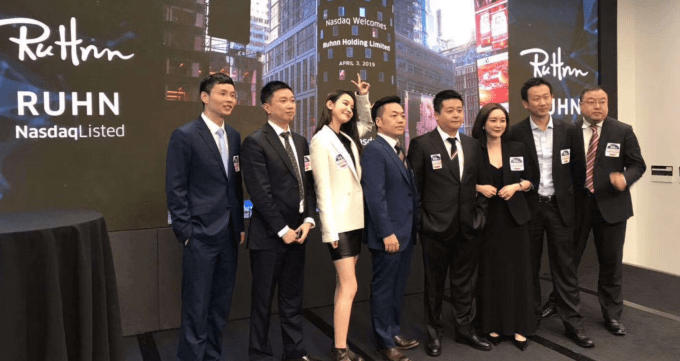
Ruhnn’s management team / Photo: Ruhnn via Weibo
Ruhnn, which was founded in 2016 by Feng Min, a former online shop owner, is one of the early movers to capitalize on China’s up-and-coming internet stars. The Alibaba-backed company supplies a suite of services for KOLs to connect with fans on one hand and brands and retailers on the other. That means influencers receive training to grow their fame and create digital content to market products. In 2018, Ruhnn’s batch of 113 contracted KOLs generated 2 billion yuan ($300 million) in total sales and collected nearly 150 million fans across various social channels.
The firm, which is based in Alibaba’s backyard Hangzhou in eastern China, is more than a talent agency in the traditional sense. The startup operates online stores for online stars and takes care of the full e-commerce cycle, from product design, manufacturing, warehousing, delivery (which it enables through third-party logistics firms) all the way to after-sales services.
The majority of Ruhnn’s revenues come from direct sales of fashion and lifestyle goods, but the company carved out a less asset-heavy platform model in 2017. The approach essentially lets third-party stores and merchants buy advertising services from Ruhnn’s rank of KOLs. Ruhnn has grown this segment from less than 1 percent of its total revenues in 2017 to 11.7 percent in the nine months ended December 2018.
Companies like Ruhnn, which are sometimes called KOL “facilitators” or “incubators,” not only empower internet celebrities; they are also crucial to social platforms hungry for content. Ruhnn’s stars are all over the Chinese internet, engaging users on WeChat, Weibo and Douyin, which is TikTok’s local version.

Zhang Dayi and her fans / Photo: Zhang Dayi via Weibo
Ruhnn and other e-commerce sites that rely on KOLs to sell, such as NYSE-listed, Hangzhou-based Mogu, are also tipped to shake up China’s fashion supply chain. Traditionally, brands get consumer reaction only after they put things on sale. KOL facilitators flip that process by asking influencers to try on brands’ sample garments. From there the stars will ask fans for feedback, based on which brands can adjust their design and factory orders. Ruhnn has also barcoded its inventory, so KOLs and retailers know exactly how consumer tastes are shifting in real time.
In terms of financial outlook, Ruhnn’s revenues increased from 577.9 million yuan ($86.1 million) to 947.6 million yuan between 2017 and 2018. The company is still operating in the red, incurring a net loss of about 90 million yuan, up from 40.1 million yuan a year ago.
Despite being the largest KOL facilitator by revenue according to data from Frost & Sullivan, Ruhnn faces a few hurdles. A report (in Chinese) done by Tencent shows people born after the 2000s are growing tired of being sold to by KOLs. In addition, China could tighten its tax laws around the nascent KOL industry that can have revenue implications for companies like Ruhnn.
The most pressing issue is perhaps Ruhnn’s overreliance on a small handful of top KOLs. One particular influencer, Zhang Dayi, accounted for about half of its total sales for nearly three years. That means Ruhnn is under tremendous pressure to retain Zhang, who currently serves as the firm’s marketing chief, be it through financial incentives or marketing support for the celebrity.
The problem is not unique to Ruhnn, as creators are key to all of China’s content-heavy platforms, including esports streaming site Huya and short-video app Douyin. These companies have spent generously to recruit KOLs and deployed big data to track user sentiments, but we all know that a celebrity’s success is at times a matter of luck.
Talking the future of media with Northzone’s Pär-Jörgen Pärson
We live in the subscription streaming era of media. Across film, TV, music, and audiobooks, subscription streaming platforms now shape the market. Gaming and podcasting could be next. Where are the startup opportunities in this shift, and in the next shift that will occur?
I sat down with Pa?r-Jo?rgen “PJ” Pa?rson, a partner at European venture firm Northzone, to discuss this at SLUSH this past winter. Pa?rson – a Swede who now runs Northzone’s office in NYC – led the top early-stage investor in Spotify and led the $35 million Series C in $45/month sports streaming service fuboTV (which has roughly 250,000 subscribers).
In the transcript below, we dive into the core investment thesis that has guided him for 20 years, how he went from running a fish distribution to running a VC firm, his best practices for effective board meetings and VC-entrepreneur relationships, and his assessment of the big social platforms, AR/VR, voice interfaces, blockchain, and the frontier of media. It has been edited for length and clarity.
From Fish to VC
Eric Peckham:
Northzone isn’t your first VC firm — Back in 1998, you created Cell Ventures, which was more of a holding company or studio model. What was your playbook then?
Femtech’s billion-dollar year
There are a lot of people who never thought they’d see the day venture capitalists would funnel millions into femtech businesses, direct-to-consumer tampon retailers no less. But that’s our new reality and Cora is proof.
San Francisco-based Cora, which develops and sells organic tampons, pads and other personal care products, has just closed a $7.5 million Series A led by Harbinger Ventures. Cora is one of many femtech startups to raise funding this week alone, in what is turning out to be a red-hot year for VC investment in the space.
Femtech, defined as any software, diagnostics, products and services that leverage technology to improve women’s health, has attracted at least $241 million in VC funding so far this year, according to PitchBook. That puts the sector on pace to secure nearly $1 billion in investment by year-end, greatly surpassing last year’s record of $650 million. For more historical context, startups in the space brought in only $62 million in 2012, $225 million in 2014 and $231 million in 2016.
“Investors have realized there is a huge pent-up demand in the market for healthier products for women,” Cora co-founder Molly Hayward tells TechCrunch. “The way in which the VC world is structured, there just has not been a lot of representation. It’s really difficult to understand the value of a product you aren’t ever going to use or to understand a problem you aren’t ever going to have, particularly around period care. This isn’t something we were talking about as a society five years ago.”
The four-year-old startup operates a little differently than your run-of-the-mill D2C company. Like TOMS, the popular footwear brand, Cora donates a month’s supply of products for every month’s supply sold. To date, Cora has donated 5 million pads to girls in India and Kenya and 100,000 products to women in the U.S.
“To me, [Cora] was this incredible, holistic opportunity to change the way that women experience their period,” Hayward said.
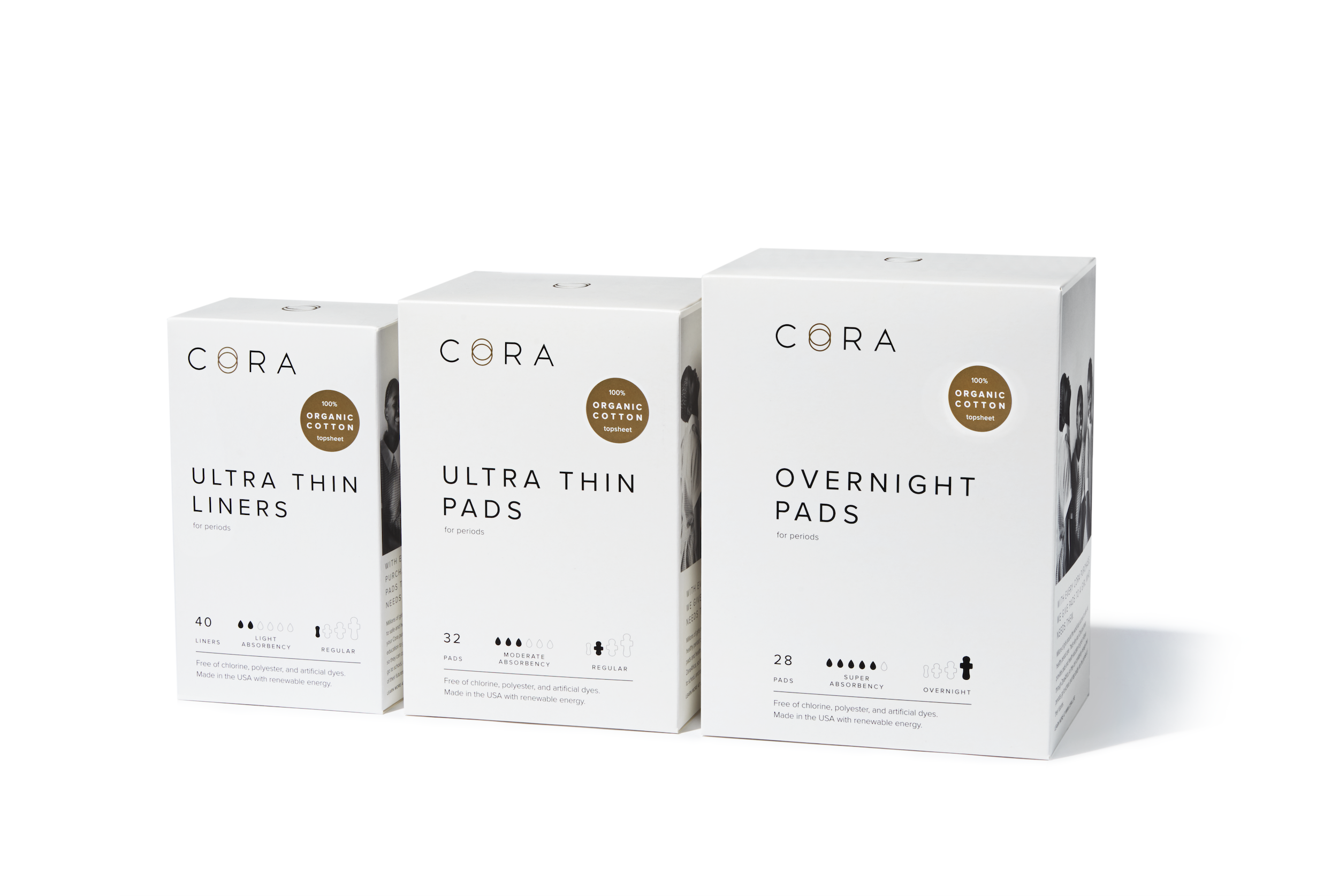 Investors must be excited about Cora’s growth. Though she didn’t disclose specific numbers, Hayward says the brand has expanded 400 percent year-over-year, a metric they are expecting to sustain with this new bout of funding. Cora’s products are sold on a subscription basis, with prices ranging from $8 per month for six tampons to $16 per month for 24. For those unfamiliar with the costs of such products, $8 for six tampons comes at quite the premium. A box of 50 Playtex tampons, for example, retails for around $9.
In Cora’s case, customers are shelling out extra cash for millennial-inspired branding, a soothing unboxing experience and a general ease of access to its products, as well as Cora’s organic, hypoallergenic and compostable materials, which aren’t characteristic of many similar products on the market.
Cora plans to use the capital to put more of its items in Target stores, where it already sells its tampons and pads, and expand its portfolio of products. As part of the funding, Cora has added two more women to its board of directors: Lisa Bougie, the former GM of Stitch Fix, and Andrea Freedman, the former chief financial officer of Method. Its board is now 80 percent female.
MIT’s ‘cyber-agriculture’ optimizes basil flavors
The days when you could simply grow a basil plant from a seed by placing it on your windowsill and watering it regularly are gone — there’s no point now that machine learning-optimized hydroponic “cyber-agriculture” has produced a superior plant with more robust flavors. The future of pesto is here.
This research didn’t come out of a desire to improve sauces, however. It’s a study from MIT’s Media Lab and the University of Texas at Austin aimed at understanding how to both improve and automate farming.
In the study, published today in PLOS ONE, the question being asked was whether a growing environment could find and execute a growing strategy that resulted in a given goal — in this case, basil with stronger flavors.
Such a task is one with numerous variables to modify — soil type, plant characteristics, watering frequency and volume, lighting and so on — and a measurable outcome: concentration of flavor-producing molecules. That means it’s a natural fit for a machine learning model, which from that variety of inputs can make a prediction as to which will produce the best output.
“We’re really interested in building networked tools that can take a plant’s experience, its phenotype, the set of stresses it encounters, and its genetics, and digitize that to allow us to understand the plant-environment interaction,” explained MIT’s Caleb Harper in a news release. The better you understand those interactions, the better you can design the plant’s lifecycle, perhaps increasing yield, improving flavor or reducing waste.
In this case the team limited the machine learning model to analyzing and switching up the type and duration of light experienced by the plants, with the goal of increasing flavor concentration.
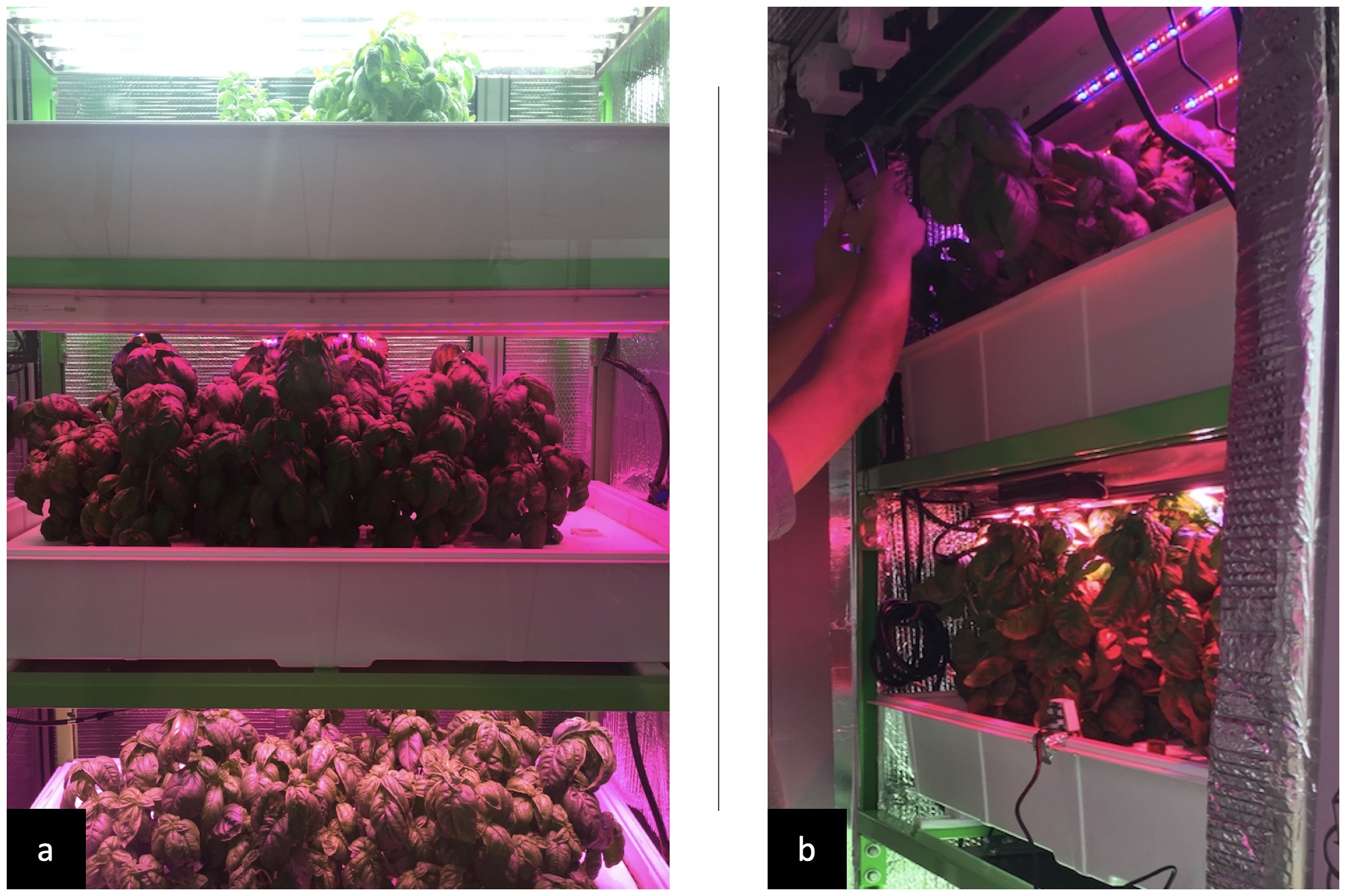 A first round of nine plants had light regimens designed by hand based on prior knowledge of what basil generally likes. The plants were harvested and analyzed. Then a simple model was used to make similar but slightly tweaked regimens that took the results of the first round into account. Then a third, more sophisticated model was created from the data and given significantly more leeway in its ability to recommend changes to the environment.
To the researchers’ surprise, the model recommended a highly extreme measure: Keep the plant’s UV lights on 24/7.
Naturally this isn’t how basil grows in the wild, since, as you may know, there are few places where the sun shines all day long and all night strong. And the arctic and antarctic, while fascinating ecosystems, aren’t known for their flavorful herbs and spices.
Nevertheless, the “recipe” of keeping the lights on was followed (it was an experiment, after all), and incredibly, this produced a massive increase in flavor molecules, doubling the amount found in control plants.
“You couldn’t have discovered this any other way,” said co-author John de la Parra. “Unless you’re in Antarctica, there isn’t a 24-hour photoperiod to test in the real world. You had to have artificial circumstances in order to discover that.”
But while a more flavorful basil is a welcome result, it’s not really the point. The team is more happy that the method yielded good data, validating the platform and software they used.
“You can see this paper as the opening shot for many different things that can be applied, and it’s an exhibition of the power of the tools that we’ve built so far,” said de la Parra. “With systems like ours, we can vastly increase the amount of knowledge that can be gained much more quickly.”
If we’re going to feed the world, it’s not going to be done with amber waves of grain, i.e. with traditional farming methods. Vertical, hydroponic, computer-optimized — we’ll need all these advances and more to bring food production into the 21st century.