A leadership void at DHS means the White House is calling the shots where it wants to, cybersecurity experts warn, and other agencies can muscle in where it won’t.
Category: Tech news
hacking,system security,protection against hackers,tech-news,gadgets,gaming
Julian Assange Arrested, *Jeopardy!* Game Theory, and More News
Catch up on the most important news today in 2 minutes or less.
How To Make Your Amazon Echo and Google Home as Private as Possible
With news that Amazon lets human employees listen to Alexa recordings, you might want to tighten up your smart assistant ship.
Amazon Employees Try a New Form of Activism, as Shareholders
Amid a wave of petitions and walkouts among tech workers, Amazon employees proposed a shareholder resolution around the company’s impact on climate change.
A ‘Herculean’ Study of Scott and Mark Kelly Asks: Are Humans Fit for Space?
Scientists around the world compared the genomes and health changes of twin astronauts. Scott Kelly (left) flew in the International Space Station for a year while Mark Kelly stayed on Earth.
Udacity restructures operations, lays off 20 percent of its workforce
Udacity, the $1 billion online education startup, has laid off about 20 percent of its workforce and is restructuring its operations as the company’s co-founder Sebastian Thrun seeks to bring costs in line with revenue without curbing growth, TechCrunch has learned.
The objective is to do more than simply keep the company afloat, Thrun told TechCrunch in a phone interview. Instead, Thrun says these measures will allow Udacity from a money-losing operation to a “break-even or profitable company by next quarter and then moving forward.”
The 75 employees, including a handful of people in leadership positions, were laid off earlier today as part of a broader plan to restructure operations at Udacity. The startup now employs 300 full-time equivalent employees. It also employs about 60 contractors.
Udacity, which specializes in “nanodegrees” on a range of technical subjects that include AI, deep learning, digital marketing, VR and computer vision, has been struggling for months now, due in part to runaway costs and other inefficiencies. The company grew in 2017, with revenue increasing 100 percent year-over-year thanks to some popular programs like its self-driving car and deep learning nanodegrees, and the culmination of a previous turnaround plan architected by former CMO Shernaz Daver.
New programming was added in 2018, but the volume slowed. Those degrees that were added lacked the popularity of some of its other degrees. Meanwhile, costs expanded and their employee ranks swelled.
Udacity CEO Vishal Makhijani left in October and Thrun stepped in. He took over as chief executive and the head of content on an interim basis. Thrun, who founded X, Google’s moonshot factory, is also CEO of Kitty Hawk Corp., a flying-car startup. In an earlier interview, Thrun told TechCrunch that he discovered the company had grown too quickly and was burdened by its own self-inflicted red tape. Staff reductions soon followed. About 130 people were laid off and other open positions were left vacant, Thrun said.
Thrun insists these latest layoffs aren’t just a half-hearted attempt to quickly cut costs and instead are part of a strategic turnaround plan. He communicated that same thinking in the email sent to employees.
“By bringing our costs in line with our revenue and refocusing our product strategy, we believe we can continue to grow the overall business both in enterprise and consumer segments in fiscal 2019 and beyond, while also achieving a break-even position in terms of both cash flow and EBITA, which will ensure that we can continue to do our important work,” Thrun wrote toward the end of the email to employees.
Last year, Udacity generated $88 million in revenue, but it reported a loss of $40 million.
Even as Udacity slashes costs and headcount, it’s trying to expand its enterprise business, which has had recent success. Udacity now has contracts with 60 enterprise customers, including AT&T and PricewaterhouseCoopers. Airbus and Audi recently signed on, as well.
Udacity’s plan was developed largely by Lalit Singh, the interim COO hired in February. Singh conducted a review of the business, including its operating model and Udacity’s primary costs such as workforce, marketing and other non-workforce expenses. As a result of the review, Udacity has laid off more staff, streamlined operations and programming and cut other costs.
“We have tremendous opportunities in front of us, and we also have some challenges. To succeed, we have to ensure that we have an operating structure that allows us to be nimble, efficient, and better organized to win with fewer silos and frankly, reduced cost,” Thrun wrote in the email.
As of Tuesday, four executives who handle different aspects of the business now report directly to Thrun. Those executives include Singh, Alper Tekin, who recently became CPO, James Richard, who was VP of engineering and has been named CTO, and Caroline Finch, vice president of consumer growth.
Alex Varel, the company’s head of enterprise sales, and Jimmy Lee, head of enterprise operations, will now report to Singh.
The change is striking compared to October, when Thrun came back to temporarily fill the CEO role. At that time, 17 people reported to Thrun.
Udacity also has cut costs and streamlined its marketing efforts, downsized and consolidated office space and made its educational programming consistent throughout the various regions in which it operates, including the U.S., Brazil, China and India.
The company will keep an office, albeit a smaller space, in Mountain View, and one in San Francisco. Udacity is closing an additional satellite office in San Francisco and is evaluating its real estate needs in other countries, as well.
Flying taxis could be more efficient than gas and electric cars on long-distance trips
Flying cars definitely sound cool, but whether they’re actually a good idea is up for debate. Fortunately they do seem to have some surefire benefits, among which you can now count improved efficiency — in theory, and on long trips. But it’s something!
Air travel takes an enormous amount of energy, since you have to lift something heavy into the air and keep it there for a good while. This is often faster but rarely more efficient than ground transportation, which lets gravity do the hard work.
Of course, once an aircraft gets up to altitude, it cruises at high speed with little friction to contend with, and whether you’re going 100 feet or 50 miles you only have to take off once. So University of Michigan researchers thought there might be a sweet spot where taking a flying car might actually save energy. Turns out there is… kind of. The team published their results today in Nature Communications.
The U-M engineers made an efficiency model for both ground transport and for electric vertical take-off and landing (VTOL) aircraft, based on specs from aerospace companies working on them.
“Our model represents general trends in the VTOL space and uses parameters from multiple studies and aircraft designs to specify weight, lift-to-drag ratio and battery-specific energy,” said study co-author Noah Furbush in a U-M news release.
They looked at how these various theoretical vehicles performed when taking various numbers of people various distances, comparing energy consumed.
As you might imagine, flying isn’t very practical for going a mile or two, since you use up all that energy getting to altitude and then have to come right back down. But at the 100-kilometer mark (about 62 miles) things look a little different.
For a 100 km trip, a single passenger in a flying car uses 35 percent less energy than a gas-powered car, but still 28 percent more than an electric vehicle. In fact, the flying car is better than the gas one starting at around 40 km. But it never really catches up with the EVs for efficiency, though it gets close. Do you like charts?

ICEV: Internal combustion engine vehicle; VTOL: Vertical takeoff and landing; BEV: Battery electric vehicle. The vertical axis is emissions.
To make it better, they had to juice the numbers a bit bit, making the assumption that flying taxis would be more likely to operate at full capacity, with a pilot and three passengers, while ground vehicles were unlikely to have their average occupancy of 1.5 people change much. With that in mind, they found that a 100 km trip with three passengers just barely beats the per-person efficiency of EVs.
That may seem like a bit of a thin victory, but keep in mind that the flying car would be making the trip in likely a quarter of the time, unaffected by traffic and other issues. Plus there’s the view.
It’s all theoretical right now, naturally, but studies like this help companies looking to get into this business decide how their service will be organized and marketed. Reality might look a little different from theory, but I’ll take any reality with flying cars.
Google Cloud’s new CEO on gaining customers, startups, supporting open source and more
After Thomas Kurian, Google Cloud’s recently minted CEO, joined the company, he took hundreds of meetings to learn what the company’s prospective and current customers were looking for. The overarching theme of those conversations was always similar, he told me during an interview at Google’s Cloud Next conference: “Love the technology — amazed at it. [They] think that it’s the best of the best. But they want more people that can help them adopt it and improvements to how they do business with us.”
So that’s the first order of business at Google Cloud now. Kurian, who came to Google Cloud after 22 years at Oracle, said that the team is rolling out new contracts and plans to simplify pricing. Most importantly, though, Google will go on a hiring spree. “A number of customers told us ‘we just need more people from you to help us.’ So that’s what we’ll do,” Kurian said.
I asked Kurian whether he believes that his predecessors made a mistake by not doing all of this already. Always the diplomat, Kurian denied that (of course). “No, I think it’s just the natural evolution of every company. Growing up, understanding their business, seeing an opportunity,” he said. “When I look at it, isn’t it a great position to be in? When you have customers saying ‘please hire more people to help me’ rather than ‘please go away from me?’ ”
 Enterprises want Google to figure out the enterprise, Kurian argues, because they want to use the company’s technology. “And so we’re trying to do that.”
No matter what he thinks about Diane Greene’s tenure at Google Cloud, though, Kurian undoubtedly has the opportunity to reshape the organization now. When I asked him about how his own philosophy is different from his predecessor, though, he argued that it’s all about listening to customers and giving them what they want. And what they want is more help, but also better collaboration tools, for example, as well as more industry-specific solutions.
Later on, though, he also noted that what Google Cloud will do going forward is to play to its strengths. “I think you will see us emphasizing our differentiators and strengthening the multi-cloud infrastructure,” he said, and highlighted today’s launch of Anthos as an example of what the company can do — and as a product that was developed in response to customer requests. “We’ve taken the area of security. We’ve taken the area of analytics. We’ve taken the area of AI — and we’ve invested a lot more in solutions there. And the reason is, that’s what customers want from us,” he added
It’s no secret that Google is definitely focusing on bringing more enterprises onto its platform. That’s not to say that Google Cloud doesn’t care about startups, though. “When we say we’re focused on enterprise, it doesn’t mean we’re stopping to focus on the small and medium companies — on the digital natives and the startups,” Kurian said. “Historically, the complaint has always been ‘Google doesn’t focus on enterprises, they focus on digital natives. […] The perception outside that Google doesn’t care about enterprises is not true. And the statement that we’re now going to focus exclusively on enterprises is also not true.”
Kurian argues that nine of the 10 largest media companies use Google Cloud, as well as seven of the 10 largest retailers and six of the top 10 enterprise companies. “Other cloud providers would have you believe that no one is using Google, which is not true,” he added.
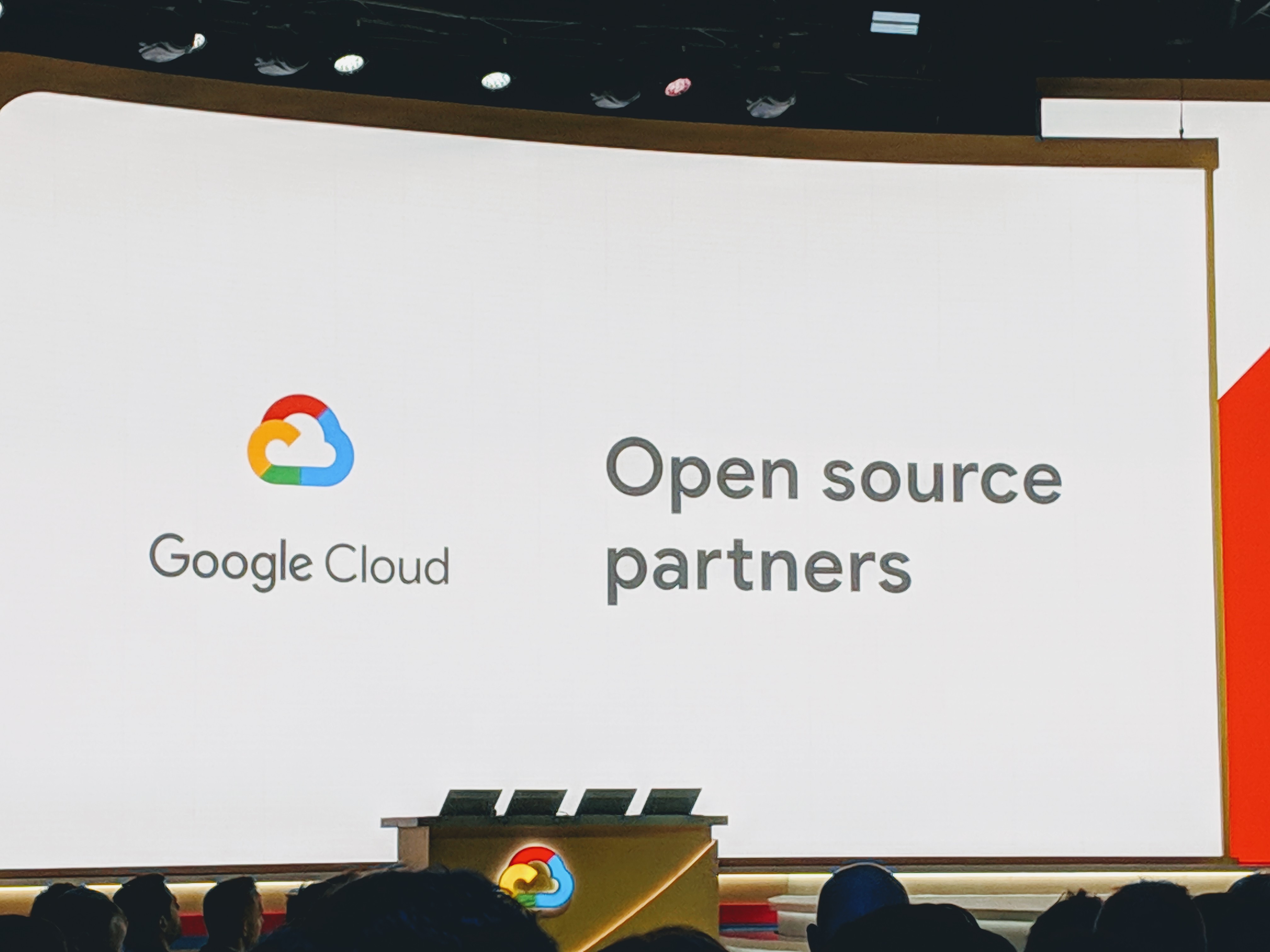
Talking about other cloud providers, it’s also worth noting that Google is taking a very different approach to open source than some of its competitors, and especially AWS. That’s something that isn’t likely to change under Kurian’s leadership at Google Cloud. “The most important thing is that we believe that the platforms that win in the end are those that enable rather than destroy ecosystems. We really fundamentally believe that,” he told me. “Any platform that wins in the end is always about fostering rather than shutting down an ecosystem. If you look at open-source companies, we think they work hard to build technology and enable developers to use it.”
Kurian isn’t the kind of CEO who will directly attack his competitors in an interview, but he did come rather close to it in this context: “In order to sustain the company behind the open-source technology, they need a monetization vehicle. If the cloud provider attacks them and takes that away, then they are not viable and it deteriorates the open-source community.”
As for the future of Google Cloud, Kurian didn’t quite want to look at his crystal ball. Instead, he argued that as long as the company focuses on doing what its customers want — starting with hiring more employees to help those customers and making it easier to do business with Google — those customers will buy a lot more of their cloud technology from Google.

Expanse, which lets its customers know when their digital assets aren’t safe, has raised $70 million in new funding
Expanse, a six-year-old, San Francisco-based company that helps its clients understand and monitor what it calls their “global internet attack surface,” has received a $70 million vote of confidence from its earlier backers, as well as some notable individual investors.
Previous investor TPG Growth led the Series C round, with participation from other earlier investors that include NEA, IVP and Founders Fund. But the company also drew checks directly from Founders Fund co-founder Peter Thiel, Michael Dell, former IBM CEO Sam Palmisano, media entrepreneur Arianna Huffington and Turner Enterprise CEO Taylor Glover.
What do they find so interesting about Expanse, which was formerly known as Qadium? Its traction, for starters. It turns out that when you start indexing global internet protocol addresses before everyone else — meaning the numerical labels assigned to each device connected to a computer network — it’s hard for competitors to catch up.
Indeed, numerous big organizations, including CVS and PayPal, are among others that now use the company’s software-as-a-service to help manage their far-flung digital assets connected to the public internet. According to co-founder and CEO Tim Junio, Expanse has been tripling its sales year over year — and quadrupling the terms of its contracts. Toward that end, he says it now has more than 10 customers that have signed up for $1 million-plus contracts. “VCs like to look at how long it takes to go from $1 million to $10 million in [annual recurring revenue]. It took us 22 months, about as fast as [the now-public cloud-storage company] Box.”
Much of that revenue is also coming from U.S. federal agencies, including the U.S. Army, the U.S. Navy and the U.S. Air Force, as well as the State Department, the Defense Department and the Department of Energy. Collectively, they account for more than $100 million in contracts with Expanse, it says.
Asked if Thiel has played a role in making introductions — Thiel famously advised Donald Trump leading up to his election as president, and Thiel’s former chief of staff, Michael Kratsios, is now the country’s chief technology officer — Junio says that all of Expanse’s investors have helped in making customer introductions and pours water on any suggestion that Thiel has done special favors for the company.
Meanwhile, though the company is known for its work in helping customers identify security risks they don’t know about on their networks — like an IoT device that hasn’t been patched — it’s now going after adjacent problems that are bigger-spend problems, including looking at its customers’ critical suppliers to be sure that they aren’t introducing vulnerabilities, including across their commercial cloud providers and co-hosting facilities.
Eventually, it’s easy to see a day when Expanse sells some of the aggregated data it’s seeing, perhaps on a sector by sector basis, though Junio says that Expanse “isn’t going in that direction” currently. For now, he says, the biggest trend that’s driving the business today is the digital transformation of every type of company, which is resulting in plenty of insecurity. As more businesses move to the cloud, there is always the danger that employees — their own or those acquired through mergers — won’t always know or follow policies, and that they’ll move sensitive data where they should not.
That it’s a trend with no end in sight goes a long way in explaining the momentum of Expanse. Already, the company has 150 employees across offices in San Francisco, Washington, DC, New York and Atlanta. With its newest round — a sum that brings Expanse’s total funding to $135 million altogether — the plan is partly to move into new international markets beyond where it already operates. Those markets include the U.K., Canada, Australia and Japan.
The government is about to permanently bar the IRS from creating a free electronic filing system
Thanks to pressure from tax preparation industry, Congress is getting ready to ban the Internal Revenue Service from ever building a free electronic tax filing system.
As ProPublica reports, the effort is a bipartisan one. The House Ways and Means Committee, led by Massachusetts Democrat, Richard Neal, passed the Taxpayer First Act.
The bill would make changes to the IRS and is sponsored by Georgia Democratic Congressman John Lewis and Mike Kelly, a Republican from Pennsylvania.
One of its stipulations would make it illegal for the IRS to create its own online system for tax filing. That’s right, members of Congress are prohibiting a branch of the federal government from providing a much-needed service that would make the lives of all of their constituents much easier.
And why is Congress taking the step? Because companies like Intuit, the company behind TurboTax, and H&R Block have been lobbying lawmakers for years to take the step.
In other countries, the agencies in charge of taxes have their own programs which make filing taxes more efficient — and free — for citizens. But that would eat into the profits for the tax prep industry, which was estimated to pull in $11 billion in 2018.
“This could be a disaster. It could be the final nail in the coffin of the idea of the IRS ever being able to create its own program,” Mandi Matlock, a tax attorney who does work for the National Consumer Law Center, told ProPublica.
There are a number of ways that the IRS could make tax preparation easier for taxpayers dealing with the only certainty in life other than death.
The IRS could develop a free online system. It could also submit pre-prepared tax returns for people to approve and then file based on the salary data the agency already has.
Roughly 70% of American taxpayers are already able to file for free online, but only 3% do, according to data from the taxpayer advocacy organization, The Taxpayer Advocate Service.
Americans who make less than $66,000 can access the Free File Inc. software online through the IRS.gov website and all taxpayers can download electronic versions of IRS paper forms through the service.
Back in 2002, the IRS entered into an agreement with a consortium fo tax software companies, which was known as Free File, Inc. As part of that deal, the companies agreed to open up access to filing software for about taxpayers who make less than $66,000 and the IRS agreed not to compete with the companies by developing its own software.
That deal has been renewed for over a decade and the new bill before Congress would make it permanent. One reason why folks Congress could be pushing this through is all of the money that H&R Block and Intuit spent to lobby Senators and Representatives. ProPublica estimates that the tax prep industry has spent $6.6 million to advocate for the IRS filing deal. The Ways and Means chair, Neal, received $16,000 in contributions from the two companies in the last two election cycles, according to the ProPublica report.
Apigee jumps on hybrid bandwagon with new API for hybrid environments
This year at Google Cloud Next, the theme is all about supporting hybrid environments, so it shouldn’t come as a surprise that Apigee, the API company it bought in 2016 for $265 million, is also getting into the act. Today, Apigee announced the beta of Apigee Hybrid, a new product designed for hybrid environments.
Amit Zavery, who recently joined Google Cloud after many years at Oracle, and Nandan Sridhar, describe the new product in a joint blog post as “a new deployment option for the Apigee API management platform that lets you host your runtime anywhere—in your data center or the public cloud of your choice.”
As with Anthos, the company’s approach to hybrid management announced earlier today, the idea is to have a single way to manage your APIs no matter where you choose to run them.
“With Apigee hybrid, you get a single, full-featured API management solution across all your environments, while giving you control over your APIs and the data they expose and ensuring a unified strategy across all APIs in your enterprise,” Zavery and Sridhar wrote in the blog post announcing the new approach.
The announcement is part of an overall strategy by the company to support a customer’s approach to computing across a range of environments, often referred to as hybrid cloud. In the Cloud Native world, the idea is to present a single fabric to manage your deployments, regardless of location.
This appears to be an extension of that idea, which makes sense, given that Google was the first company to develop and open-source Kubernetes, which is at the forefront of containerization and Cloud Native computing. While this isn’t pure Cloud Native computing, it is keeping true to its ethos and it fits in the scope of Google Cloud’s approach to computing in general, especially as it is being defined at this year’s conference.
Digital health investors are missing out on a big opportunity to bring healthtech to public schools
Shayan Vyas
Contributor
Contributor
Dr. Shayan Vyas is an associate professor of pediatric medicine at the University of Central Florida and an adviser to healthcare companies.
I first got a glimpse of technology’s potential back in 2010. As a pediatrician at Miami Children’s Health System, I flew to Haiti in the aftermath of the devastating 2010 earthquake to help treat children. Many suffered trauma, but I found myself caring for little ones with chronic conditions, as well. Along with my stethoscope, my computer and smartphone quickly became essential tools in my medical bag, as I sent emails and images to colleagues in Miami for consultations.
Back home, I became acutely aware of how we lagged behind in using technology in pediatric settings. I’m a doctor to the iGeneration. I have patients as young as two who seem instinctively adept at manipulating an iPad, yet their school remains largely stuck in a sepia-tone world.
There’s no excuse. The 2009 HITECH Act brought electronic health records to hospitals and doctors’ practices and the 2010 Affordable Care Act jumpstarted innovation across the healthcare spectrum. Funding in digital health startups continues at a record-breaking pace, with venture capitalists investing $8.1 billion last year, according to Rock Health. The money targeted healthcare providers, pharmaceutical companies and consumers. By comparison, only a tiny fraction — just under $60 million — went to pediatric-related technology in 2018. Young companies and their backers have largely overlooked what I consider the front line of health: our public schools.
Yet legislation on that front should help, as well. Poor health is one of the leading causes of school absenteeism, and the latter is linked to low academic performance. To hold schools accountable, most states have selected absenteeism as a measure of performance under the Every Student Succeeds Act of 2015. That can translate into millions of dollars in reduced state funding for school districts, which should motivate officials to address the reason one in six students misses class repeatedly.
Our children spend an average of 14 percent of their time in school from kindergarten through 12th grade. Any public school parent knows the drill: fill out the same paper forms at the beginning of each year authorizing the school nurse to administer medications with the approval of the child’s pediatrician. Vaccinations, of course, need to be up to date. The nurse, who typically oversees multiple schools, gets overwhelmed trying to screen children who suffer from serious chronic illnesses, such as asthma, diabetes and seizures, from a pool of hundreds of students.
Technology is advancing in everyday life, but schools are being left behind because health programs still rank at the bottom of budget priorities.
Inevitably, some fall through the cracks. More than six million children under the age of 18 suffer from asthma; it is the third leading cause of hospitalization among children under 15 and a major reason for school absenteeism. I’ve had children with asthma under my care where the school nurse is unaware of their condition. Those who suffer acute attacks are on oral steroids and need their medications more frequently — a situation schools often don’t properly monitor. As a result, some students end up in the intensive care unit requiring more aggressive therapy. It’s very frustrating for pediatricians, and devastating for families.
That is a prime example of why we need technology in schools. Lack of data-sharing among schools, pediatricians and families is especially exacerbated, because charts are often paper-based or locked in the school’s system. An electronic medical record can facilitate quicker access to information for monitoring and care coordination. It could prevent potential tragedies, absenteeism and unnecessary costs.
Telehealth can also play a role. Students, especially from low-income households, often don’t have a pediatrician, and so the school becomes by default their clinic. In my former role as medical director of telehealth Florida at Nemours Children’s Health System, we were encouraged by the results of an analysis we did on 1,000 telehealth visits. Sixty-seven percent of parents said they would have taken their child to an emergency room, urgent care center or retail clinic if they didn’t have access to remote consultation. This was outside of the school setting, but the study points to an opportunity for deployment in schools.
Technology is advancing in everyday life, but schools are being left behind because health programs still rank at the bottom of budget priorities. The American Academy of Pediatrics has for years advocated for a full-time nurse on campus, but that’s not always the reality. As the father of a four-year-old boy who’s prone to seizures, I worry.
Schools need to realize they’re not only in the business of education, they’re also in the healthcare business. The two go hand in hand.
Amazon Alexa now offers long-form news coverage in addition to Flash Briefings
One of the top use cases for Amazon Alexa is its ability to quickly summarize the day’s headlines via its customizable “Flash Briefing” skill. Now, Amazon is rolling out a new feature that will allow Alexa device owners to get more in-depth news from their preferred news provider, with this week’s launch of “long-form news.” Currently, the new feature works with news from Bloomberg, CNBC, CNN, Fox News, Newsy and NPR, Amazon says.
Getting the news is already a top voice activity among smart-speaker owners. According to a 2018 Adobe survey, 46 percent of voice assistant users ask their smart speaker for news. And today’s Alexa Skill Store lists more than 5,000 voice apps in its News category, which indicates some level of consumer demand for this sort of content.
But sometimes users want more than just a set of quick headlines. That’s where Alexa’s in-depth news feature aims to help.
Amazon says that voice commands like “Alexa, tell me the news,” “Alexa play news” or “Alexa play news from…” followed by the source’s name, will now launch in-depth news sessions featuring stories curated by the news provider. This can include stories from NPR’s most popular radio shows, CNN’s top headlines, Newsy’s video news and others.
Both Newsy and CNBC will offer video news stories on Alexa devices with a screen, like the Echo Show and Echo Spot. The rest will be audio-only.
Customers can listen or watch all the news stories or move through the different stories with verbal commands like “Alexa, next” or “Alexa, skip” to jump ahead.
When you ask Alexa for the news for the first time, the assistant will ask for your preferred provider. You’ll also be able to change this later in the same Settings screen where you currently configure your Flash Briefing preferences.
This is a little confusing because the section is still labeled Flash Briefing, instead of something more appropriate, like “News” or “News settings,” for example.
In addition, the process of using the new feature is a bit different for those customers who have already been using Flash Briefing, which is also confusing.
If a Flash Briefing user asks Alexa for the news, the assistant will continue to play the Flash Briefing you’ve already configured and are used to accessing by saying things like “Alexa what’s the news?” or “Alexa, tell me the news,” among other things.
If you want to instead now hear the long-form version of the news, you’ll need to specify a source by saying the specific command: “Alexa, play the news from CNN” (or whichever news provider you prefer.)
Amazon seems to understand this process is a little clunky, telling us it’s still “early days” for the feature and it will “continue to listen to customer feedback and evolve the experience over time.”
The launch is a big bet that smart-speaker owners want to do more than stream music, control their smart home or perform other minor tasks, like setting alarms and timers, or using lists, for instance. Instead, it sees Amazon Alexa, to some extent, taking the place of watching a nightly news telecast. That’s an option that many of today’s cord cutters don’t have, as they’ve given up pay TV for just Netflix or some other mix for streaming apps.
Longer-form content could also give Amazon a place to put ad units in the future, if it wanted to go that route.
The long-form news feature began rolling out to customers in the U.S. on Monday.
‘Hateful comments’ result in YouTube disabling chat during a live-streamed hearing on hate
At today’s House Judiciary hearing addressing “Hate Crimes and the Rise of White Nationalism,” hate appears to have prevailed.
As the hearing’s live stream aired on the House Judiciary’s YouTube channel, comments in the live chat accompanying the stream were so inflammatory that YouTube actually disabled the chat feature mid-hearing. Many of those comments were anti-Semitic in nature.
Hate speech has no place on YouTube. We’ve invested heavily in teams and technology dedicated to removing hateful comments / videos. Due to the presence of hateful comments, we disabled comments on the livestream of today’s House Judiciary Committee hearing.
— YouTubeInsider (@YouTubeInsider) April 9, 2019
Unsurprisingly, the hearing struggled to balance its crowded witness list, which included Facebook public policy director Neil Potts and Google public policy lead Alexandria Walden. Potts emphasized that Facebook recently righted its course with regard to white nationalism, though this shift is still in its earliest days.
“Facebook rejects not just hate speech, but all hateful ideologies,” Potts said in the hearing. “Our rules have always been clear that white supremacists are not allowed on our platform under any circumstances.”
The hearing was probably ill-fated from the start. As Democrats attempt to grapple with the real-world effects of white supremacist violence, voices on the far right — recently amplified by figures in Congress — denounce that conversation outright. When political parties can’t even agree on a hearing’s topic, it usually guarantees a performative rather than productive few hours and, in spite of some of its serious witnesses, this hearing was no exception.
Hours after the hearing, anti-Semitic comments continue to pour into the House Judiciary YouTube page, many focused on Rep. Jerry Nadler, the committee’s chair. “White nationalism isn’t a crime its [sic] a human right,” one user declared. “(((They))) are taking over our government,” another wrote, alluding to widespread anti-Semitic conspiracy theories. Many more defended white nationalism as a form of pride rather than a hate-based belief system tied to real-world violence.
“… Hate speech and violent extremism have no place on YouTube,” YouTube’s Walden said during the hearing. “We believe we have developed a responsible approach to address the evolving and complex issues that manifest on our platform.”
Accenture announces intent to buy French cloud consulting firm
As Google Cloud Next opened today in San Francisco, Accenture announced its intent to acquire Cirruseo, a French cloud consulting firm that specializes in Google Cloud intelligence services. The companies did not share the terms of the deal.
Accenture says that Cirruseo’s strength and deep experience in Google’s cloud-based artificial intelligence solutions should help as Accenture expands its own AI practice. Google TensorFlow and other intelligence solutions are a popular approach to AI and machine learning, and the purchase should help give Accenture a leg up in this area, especially in the French market.
“The addition of Cirruseo would be a significant step forward in our growth strategy in France, bringing a strong team of Google Cloud specialists to Accenture,” Olivier Girard, Accenture’s geographic unit managing director for France and Benelux said in a statement.
With the acquisition, should it pass French regulatory muster, the company would add a team of 100 specialists trained in Google Cloud and G Suite to the an existing team of 2,600 Google specialists worldwide.
The company sees this as a way to enhance its artificial intelligence and machine learning expertise in general, while giving it a much stronger market placement in France in particular and the EU in general.
As the company stated, there are some hurdles before the deal becomes official. “The acquisition requires prior consultation with the relevant works councils and would be subject to customary closing conditions,” Accenture indicated in a statement. Should all that come to pass, then Cirruseo will become part of Accenture.