This little translator gadget could be a traveling reporter’s best friend

If you’re lucky enough to get to travel abroad, you know it’s getting easier and easier to use our phones and other gadgets to translate for us. So why not do so in a way that makes sense to you? This little gadget seeking funds on Kickstarter looks right up my alley, offering quick transcription and recording — plus music playback, like an iPod Shuffle with superpowers.

The ONE Mini is really not that complex of a device — a couple of microphones and a wireless board in tasteful packaging — but that combination allows for a lot of useful stuff to happen both offline and with its companion app.

You activate the device, and it starts recording and both translating and transcribing the audio via a cloud service as it goes (or later, if you choose). That right there is already super useful for a reporter like me — although you can always put your phone on the table during an interview, this is more discreet, and of course a short-turnaround translation is useful, as well.

Recordings are kept on the phone (no on-board memory, alas) and there’s an option for a cloud service, but that probably won’t be necessary, considering the compact size of these audio files. If you’re paranoid about security, this probably isn’t your jam, but for everyday stuff it should be just fine.
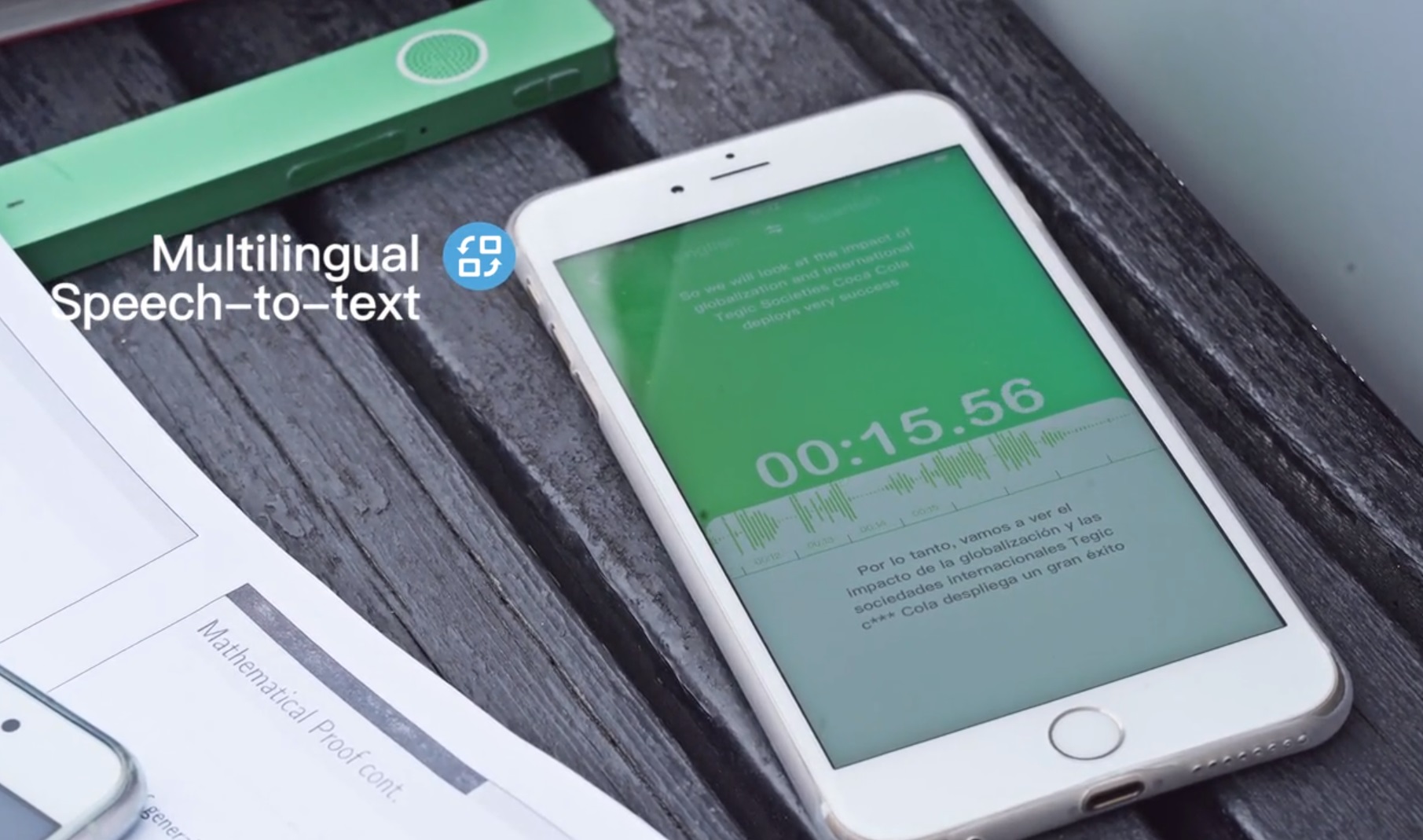
If you want to translate a conversation with someone whose language you don’t speak, you pick two of the 12 built-in languages in the app and then either pass the gadget back and forth or let it sit between you while you talk. The transcript will show on the phone and the ONE Mini can bleat out the translation in its little robotic voice.

Right now translation online only works, but I asked and offline is in the plans for certain language pairs that have reliable two-way edge models, probably Mandarin-English and Korean-Japanese.

It has a headphone jack, too, which lets it act as a wireless playback device for the recordings or for your music, or to take calls using the nice onboard mics. It’s lightweight and has a little clip, so it’s probably better than connecting directly to your phone in many cases.

There’s also a 24/7 interpreter line that charges two bucks a minute that I probably wouldn’t use. I think I would feel weird about it. But in an emergency it could be pretty helpful to have a panic button that sends you directly to a person who speaks both the languages you’ve selected.

I have to say, normally I wouldn’t highlight a random crowdfunded gadget, but I happen to have met the creator of this one, Wells Tu, at one of our events, and trust him and his team to actually deliver. The previous product he worked on was a pair of translating wireless earbuds that worked surprisingly well, so this isn’t their first time shipping a product in this category — that makes a lot of difference for a hardware startup. You can see it in action here:

He pointed out in an email to me that obviously wireless headphones are hot right now, but the translation functions aren’t good and battery life is short. This adds a lot of utility in a small package.

Right now you can score a ONE Mini for $79, which seems reasonable to me. They’ve already passed their goal and are planning on shipping in June, so it shouldn’t be a long wait.

Juul launches a pilot program that tracks how Juul devices get in the hands of minors

Juul Labs is today launching a pilot for its new Track & Trace program, which is meant to use data to identify exactly how Juul devices wind up in the hands of minors.

Juul vaporizers all have a serial number down at the bottom, by the Juul logo. However, it wasn’t until recently that Juul had the capability to track those serial numbers through every step of the process, from manufacture to distribution to retail to sale.

With Track & Trace, Juul is calling upon parents, teachers and law enforcement officials to come to the Juul Report web portal when they confiscate a device from a minor and input the serial number. Each time a device is input in the Track & Trace system, Juul will open an investigation to understand how that minor wound up with that device.

In some cases, it may be an issue with a certain retail store knowingly selling to minors. In others, it may be a case of social sourcing, where someone over 21 years of age buys several devices and pods to then sell to minors.

Juul will then take next steps in investigating, such as talking to a store manager about the issue. It may also enhance its secret shopper program around a certain store or distributor where it sees there may be a spike in sale/distribution, to youth to identify the source of the problem. To be clear, Track & Trace only tracks and traces the devices themselves, and does not use personal data about customers.

Juul isn’t yet widely publicizing Track & Trace (thus, the “Pilot” status), but it is focusing on Houston as a testing ground with banner ads targeted at older individuals (parents, teachers, etc.) pointing them to the portal. Of note: The ad campaign is geofenced to never be shown in or around a school, hopefully keeping the program a secret from young people illegally using Juul.

The company wants to learn more about how people use the portal and test the program in action before widening the campaign around Track & Trace. That said, the Report portal is not limited to Houston residents — anyone who confiscates a Juul can report it through the portal and trigger an investigation.

“It’s important to note that the pilot is an opportunity for us to learn how the technology is working and optimize the technology,” said Chief Administrative Officer Ashley Gould. “It’s not just at the retailer level. It’s a whole process through the supply chain to track that device and find out if everyone who is supposed to be scanning it is scanning it, and the software that we’ve created to track that serial number through the supply chain to the retail store is working. The only way we’re going to know that is when someone puts in the serial number and we see if we have all the data we need to track it.”

According to Juul, every device in production will be trackable in the next few weeks. In other words, Juul vapes that are years old are likely not fully traceable in the program, but those purchased more recently should work with the system.

Juul has been under scrutiny from the FDA and a collection of Democratic Senators due to the device’s rise in popularity among young people. Outgoing FDA Commissioner Scott Gottlieb has called it “an epidemic” and enforced further restrictions on sales of e-cig products.

Juul has also made its own effort, removing non-tobacco and non-menthol flavored pods from all physical retail stores, enhancing their own purchasing system online to ensure online buyers are 21+ and not buying in bulk, going after counterfeits and copycats posing as Juul products and exiting its Facebook and Instagram accounts.

But Juul Labs also committed to build technology-based solutions to prevent youth use of the product. Co-founder and CPO James Monsees told TechCrunch at Disrupt SF that the company is working on Bluetooth products that would essentially make the Juul device as smart as an iPhone or Android device, which could certainly help lock out folks under 21.

However, the Track & Trace program is the first real technological step taken by the e-cig company. And it has been an expensive one. The company has spent more than $30 million to update its packaging, adjust printing standards, change manufacturing equipment and integrate the data and logistics software systems.

For now, Track & Trace is only applicable to Juul vaporizers, but it wouldn’t be shocking to learn that the company was working on a similar program for its Juul Pods.

Editor’s Note: This article mistakenly said that Republican senators were scrutinizing Juul. It has been edited for accuracy.

With a new CEO and fresh funding from Upfront, healthy prepared food delivery service Territory looks to grow

With a new chief executive officer and $4 million in fresh funding from investors including the Los Angeles-based investment firm, Upfront Ventures, Territory Foods is poised for growth.

The company recently hired powerhouse executive Abby Coleman, the former vice president of marketing and strategy at Quidsi and head of e-commerce at Diapers.com as its new chief executive and is now looking to expand its footprint and unique approach to meal delivery beyond its current geographies.

The company uses a proprietary food recommendation engine to determine its subscribers’ personal preferences to deliver them meals that are more tailored to their individual tastes.

Territory also employs a unique business model, leveraging local chefs to prepare meals according to menus designed by the company.

The distributed workforce of gig chefs allows the company greater flexibility in planning, preparing, and distributing its meals, according to Coleman.

A lifelong vegetarian and mother of two vegetarian daughters, the 39-year-old Coleman actually began her business in the food services industry as a caterer before moving on to leadership positions at Kraft Foods and Mondelez International before taking on the vice presidential role at Quidsi.

“My coming on board was really a response to a decision that the board and Patrick [Smith] made that it was time to scale the business,” says Coleman. 

With the new cash the company intends to expand its footprint in locations beyond its hubs in major cities on the East and West coasts (and Texas), including: Baltimore, Dallas/Ft. Worth, Los Angeles, San Francisco, and the Washington metropolitan area.

There’s plenty of opportunity for growth considering that the market for healthy eating and personalized food is roughly $702 billion, according to the company. In 2018, one out of every three Americans reported to following some kind of healthy eating protocol with the percentage highest among 18-34 year olds, according to information provided by Territory.

“It’s rare to see businesses like Territory that hit major trends at the right time with the right product,” said Kara Nortman, Partner at Upfront Ventures. “Territory has been able to consistently punch above its weight with a very smart economic model and a product that consumers love, and we couldn’t be more excited to lean into this business with Abby and her team. Abby’s passionate knowledge of food and superb ecommerce skills combine to make her the perfect leader for Territory’s next phase of growth.”

Indeed, the company’s methodical approach to growth has been a strength that has led it to profitability in core markets like Los Angeles and Washington, Coleman says.

Territory wrings efficiency out of its network of chefs, which has a high retention rate and allows the company to act in an asset light way. Chefs are paid to prepare the meals, but provide the ingredients themselves and work as contractors rather than employees. They pocket the difference between the cost of the ingredients they use and the price they’re paid by Territory to prepare the meals.

Coleman says the business model leverages the excess capacity caterers have while offering them the opportunity to tailor their meals to suit local market tastes.

And just because the chefs are given a bit of free rein doesn’t mean that there’s any lack of quality control, Coleman says. “The emphasis is on the quality control that a product is up to our standards,” according to Coleman. 

Meals are $10.95 and are designed around the needs of customers — ranging from paleo, whole 30, keto, and vegetarian options. Now, Coleman is looking to aggressively expand the flexibility and menu options available to customers.

“It’s more like a restaurant and we’re going to have an entirely new menu next week,” Coleman says. “We create over 400 new dishes a year.”

Despite the woeful performance of public companies like Blue Apron, prepared food companies are still attracting investor attention and interest — especially if they’re married with a pitch to health-conscious consumers targeting a specific diet.

Territory Foods has raised $20 million to date, including the new cash from Upfront Ventures and Lewis & Clark, while Trifecta, another purveyor of prepared foods has raised $2.6 million. And the giants are still around as well, the companies like Plated, HelloFresh, Home Chef (owned by Kroger Foods), and Sun Basket, which have raised over $500 million combined.


Watch the first trailer for ‘Star Wars: The Rise of Skywalker’

Hot on the heels of announcing the details of the upcoming Disney+ streaming service (which will feature plenty of Star Wars content), Disney and Lucasfilm just released the first trailer for “Star Wars: The Rise of Skywalker.”

The unveiling came at the end of a panel at this year’s Star Wars Celebration event in Chicago, where the title of the movie (previously only known as “Star Wars Episode IX”) was finally revealed.

While onstage, director J.J. Abrams and Lucasfilm President Kathleen Kennedy talked about filming after the death of Carrie Fisher. They’d already announced that they will not be using CGI to try to bring Fisher’s character Leia Organa back to life — but she will be a part of “The Rise of Skywalker,” using previously unseen footage from “The Force Awakens.”

“The craziest part is how not crazy it feels,” Abrams said. “Princess Leia lives in this film in a way that is kind of mind-blowing to me.”

Abrams and Kennedy were joined by new and old cast members, including Billy Dee Williams, who is (finally!) returning as Lando Calrissian. Williams said it was a “highlight” of his career to be in the new film — and to work with the 52-year-old Abrams, who he described as “a beautiful young man.

Abrams emphasized the idea that while “The Rise of Skywalker” is the final installment on the Skywalker Saga and the culmination of a nine-film story, it also has to work as its own film, and he said, “This movie, it’s about this new generation and what they’ve inherited, the light and the dark.”

He added that these characters will be facing “the greatest evil,” becoming cagey once interviewer StephenColbert asked him who or what that evil is. But the trailer ends with the familiar laugh of Emperor Palpatine (villain of the prequel trilogy and the original films), and as soon as the lights went up, Palpatine actor Ian McDiarmid was onstage, declaring, “Roll it again.”

“Star Wars: The Rise of Skywalker” will be released on December 20, 2019.