James J. DeCarlo is a shareholder in Greenberg Traurig’s Intellectual Property Practice Group. A registered patent attorney, he is actively involved in virtually all aspects of intellectual property counseling. He has spent nearly 30 years litigating, licensing and procuring patents in the software, hardware, internet and networking spaces, among many others. Mr. DeCarlo can be reached at [email protected].
Chinh H. Pham Contributor
Chinh H. Pham leads Greenberg Traurig’s Emerging Technology Practice, and is co-chair of the Boston Office Intellectual Property Practice Group. He is a registered patent attorney with particular experience in the strategic creation, implementation, and protection of intellectual property rights for high technology clients. Mr. Pham can be reached at [email protected].
On January 4, 2019, the United States Patent and Trademark Office (USPTO) released new Patent Examiner Guidance (“the Guidance”) for subject matter eligibility. The updated guidance could benefit any technology patent applicant who has a computer-related invention — from smartphones to artificial intelligence — and who has previously had difficulty acquiring patents under the USPTO’s procedures for determining patent subject matter eligibility.
This Guidance represents the current methodology for analysis of patent claims under 35 U.S.C. § 101 in view of Mayo v. Prometheus, Alice v. CLS Bank Intl., and subsequent cases, and is intended to provide a more concrete framework for analyzing whether patent claims, as a whole, are merely “directed to” an abstract idea. The Guidance will supersede certain analysis methods articulated in previous guidance, particularly the examiner’s “Quick Reference” that previously sought to categorize abstract ideas.
The Alice/Mayo test
The Guidance acknowledges that applying the Alice/Mayo test to analyze claims under § 101 has “caused uncertainty in this area of the law” and has resulted in examination practices that prevent stakeholders from “reliably and predictably determining what subject matter is patent-eligible.” As such, the Guidance attempts to remedy this uncertainty by revising the USPTO’s analysis under the first step (Step 2A) of the Alice/Mayo test:
Portfolio co-founder: Our other investors want to participate but our lead wants to take most of the round.
Me: OK
Portfolio co-founder: So that means pro-rata is going to be tough.
Me: Let’s see what everyone says.
A few days later.
Portfolio co-founder: The math worked out. Some people didn’t do their pro-rata and others did more.
Me: In theory, this shouldn’t happen because everyone is doing their pro-rata, but this is usually how things seem to work out. The round wasn’t going to be put at risk over pro-rata.
We’re always curious to see how rounds come together when there is limited capacity for both new investors and existing investor pro-rata. For the most part, there is supposed to be one core investor strategy; the maintainers, who use reserves and then opportunity funds or SPVs to avoid or minimize dilution. Sometimes there are also accumulators, who use multiple rounds to expand their ownership, but this is more common in private equity outside of venture capital.
The maintainers are pretty well understood. They have the typical $1 in reserve for each $1 invested, mirroring a common strategy espoused by some of the best VCs. USV shared a great example including fund allocation assumptions. Accumulators are a little more surprising to meet, but Greenspring, which is uniquely positioned to observe a lot of early-stage managers, hint that one of their top performing managers uses the accumulator strategy to get to more than 20 percent, fully diluted at exit. That’s not the whole story though, because, unlike USV, the strategy also involves some additional important assumptions, most notably investing in less-competitive geographies.
We’ve seen other allocation strategies, but we don’t see a lot written about them. For example, some investors tend to be among the first checks and, going through our co-investments with them, it’s clear they don’t always take pro-rata, but don’t seem to fuss about it. Here’s a great example of how one of today’s very best seed-stage investors, Founder Collective, thinks about this:
We dilute alongside our founders over time. So we have the same incentives as our founders to increase the value of the company in future financings.
It’s easy to dismiss this as founder-friendly at the expense of LPs, but I suspect Founder Collective’s LPs don’t see it that way at all. It’s hard to know how often this positioning leads to a higher win rate on competitive deals, but let’s assume there is little difference. Does the math work?
Let’s assume a VC is buying 20 percent of the company and then riding the dilution train down to a fully diluted 5.2 percent on exit at Series F (thanks to Fred Wilson again; in this example, we’re using one of his recent frameworks with these exact numbers). For a $50 million fund, this works just fine. Interestingly, it looks similar to the result for a $100 million fund with reserves, but the later assumes that they can always secure pro-rata and they can make use of opportunity funds to get a bit more upside.
We’ve discussed this a lot as we deployed our last fund. The vast majority of people insisted we needed $1 for every $1 invested, but we found that, thanks to our fund size, the math seemed to work without significant reserves if we purchased enough ownership upfront and, as Founder Collective notes, it seems to align better with founders and our growth-stage co-investors.
Longer funnel (not wider)
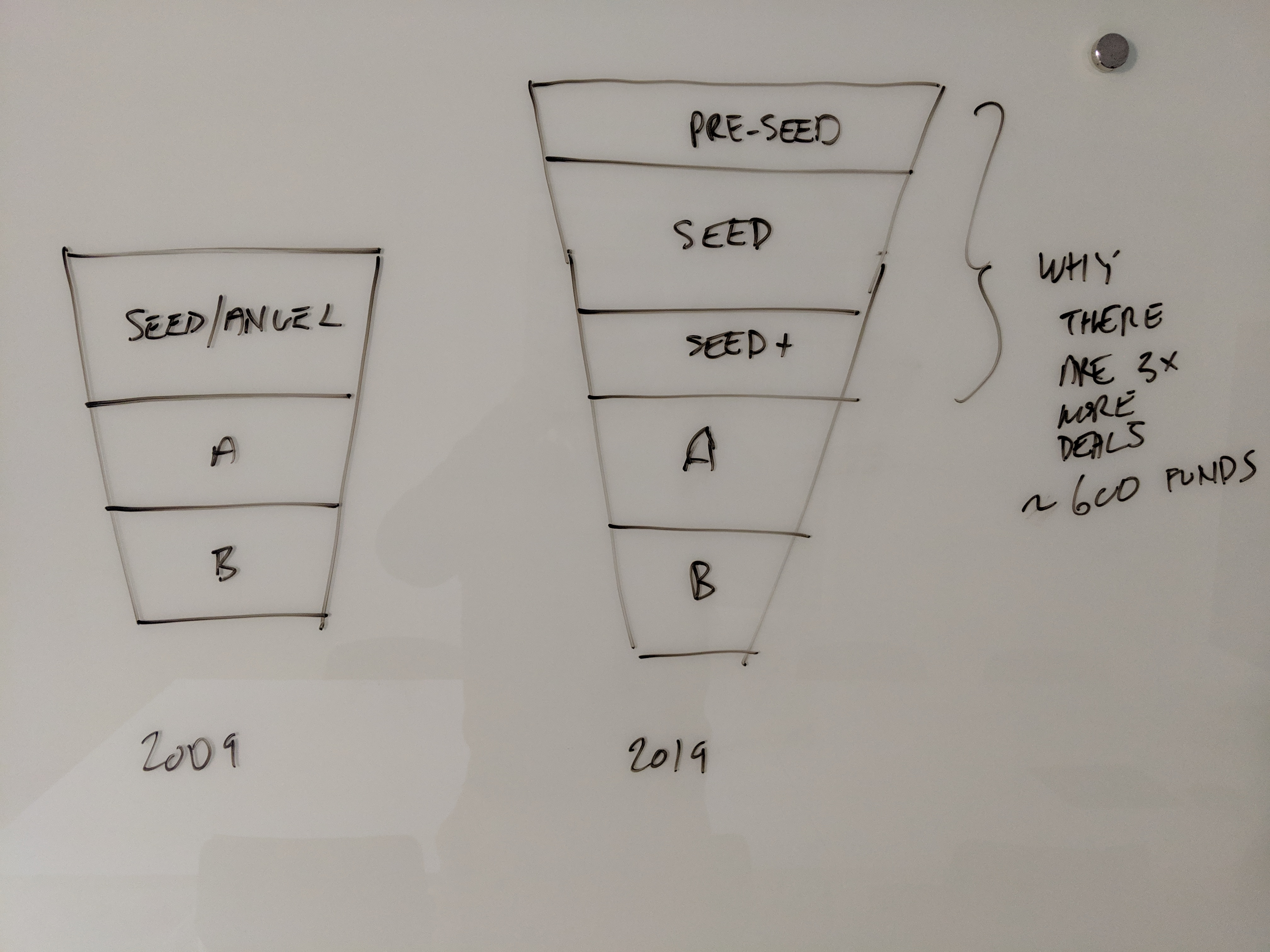
We’ve seen two major changes since we first started investing 12 years ago. The first is well-reflected by a recent deck shared by Mark Suster at Upfront, and highlighted in the slide shown below. It seems like the top of the funding funnel is getting wider.
It’s true that seed stage has grown 3x in the last decade. But that doesn’t necessarily mean the funnel only got wider. It also made it taller, like the image below.
One way to think about this — what used to be a sequence of “seed, A, B” is now, often, but not always a new sequence of “pre-seed, seed and seed+.”
Series A investments are totally different today than they were 10 years ago. But the Series A round is much more competitive because a lot of new money has shown up to play here and this makes accumulation and maintain models much harder, especially for seed and Series A stage-focused funds.
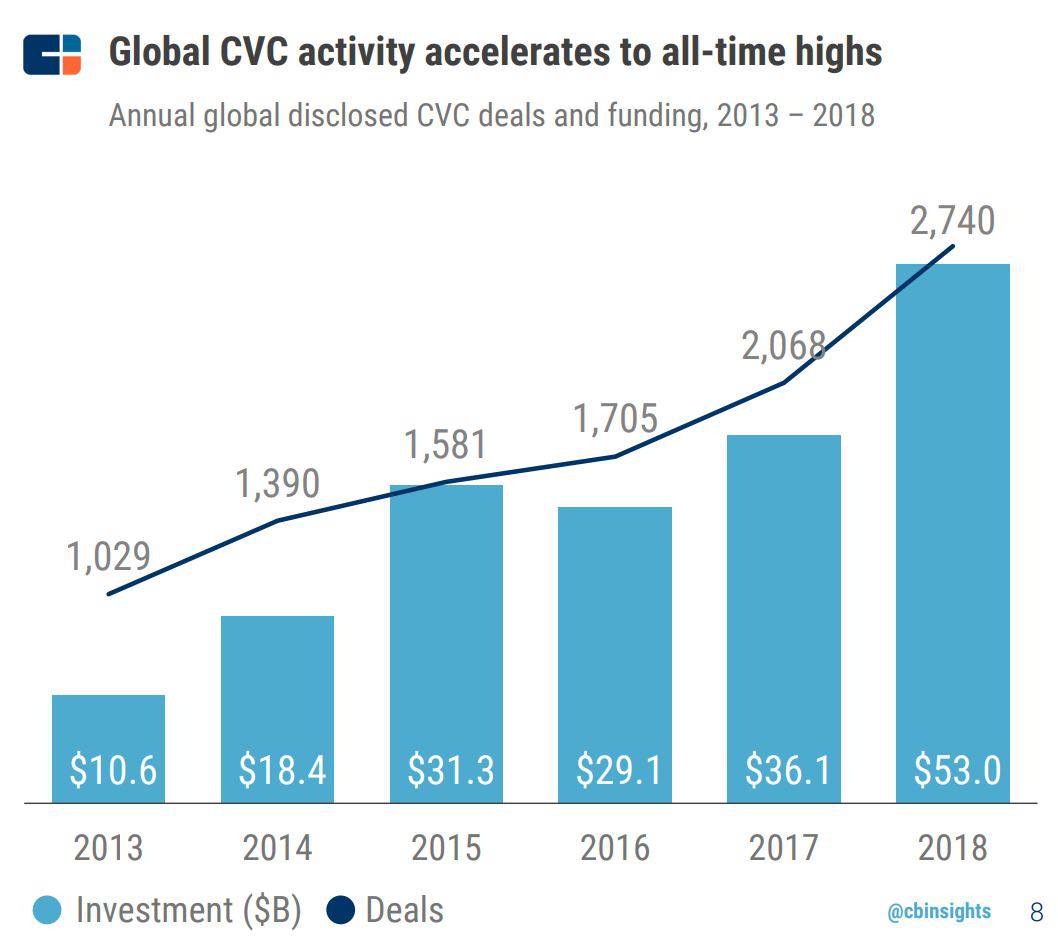
Who are these new players adding to the competition? Some are new VC funds, but a lot of them are corporate VC (CVC) funds.
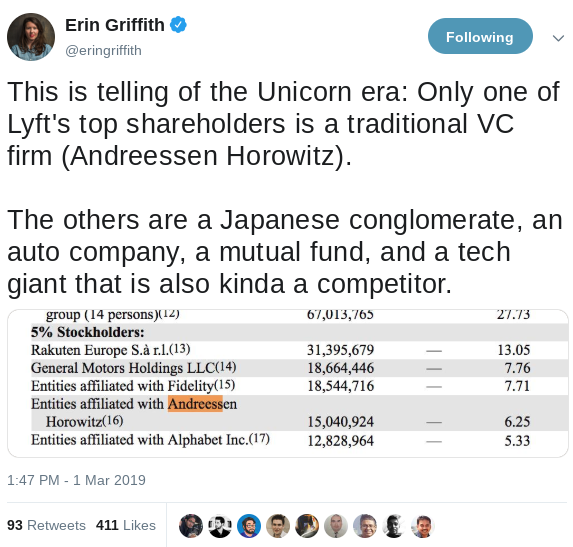
Where is all this CVC money going? We’re pretty sure it’s not in pre-seed or seed, though there is some CVC fund of fund activity into seed funds, but that’s not reflected in this data. And we’ve only seen a few instances of seed+ CVC activity. Interestingly, to find a good example of this, you probably don’t have to look further than Lyft’s S-1, where GM and Rakuten join better-known tech CVC Alphabet.
Regarding the founder conversation referenced earlier, the round is coming together because of a strategic investor who is leading it. This has become more common. Like Lyft’s team, founders understand tech and value sector-specific corporate investors as partners.
We don’t think we’ll see a slowdown in CVC interest any time soon because, much like their big tech counterparts, incumbents in sectors from transportation and real estate to energy and infrastructure all realize that the startup ecosystem is now an extension of their product development process — VC and M&A are now an extension of R&D.
It’s not just that there is more money competing for Series A or B deals now. That money has different goals beyond pure financial returns and the value add is different from VCs. CVCs often bring distribution, ecosystem and domain expertise. So the end result is more competitive A or B rounds and more complex pro-rata discussions.
Strategic pro-rata shuffle
Founders are still trying to sell no more than 20 percent of their company, while traditional VCs are trying to buy 20 percent and we still have to figure out pro-rata for existing investors while making room for growing interest from strategic investors.
For Urban Us, we’ve embraced these new round dynamics — they may make growth-stage allocations a bit more tricky, but strategic investors can deliver a lot of value. One clear result — it’s sometimes better for us not to take our pro-rata at series A.
High conviction before Series A
We tend to think of high conviction as a Series A idea — i.e. Series A investors who accumulate, maintain or use opportunity funds. But the same concept is now at work in the tall part of the funnel — the two or three stages before Series A.
We’ve long been fans of accelerator models like YC, Launch or Techstars. We’ve co-invested with all of them. While there was a sense that “not following” presented signaling risk, accelerators have found creative ways to sidestep the issue — for example, joining rounds only if there is another lead. So this means they can concentrate holdings before Series A.
We now have our own accelerator, URBAN-X, because we’re best positioned to help address some unique challenges for the urbantech companies we’re looking to back. This allows us to be the first investor in most of our portfolio companies. And we can own enough of the company before Series A so we can still achieve our fully diluted ownership targets on behalf of our LPs.
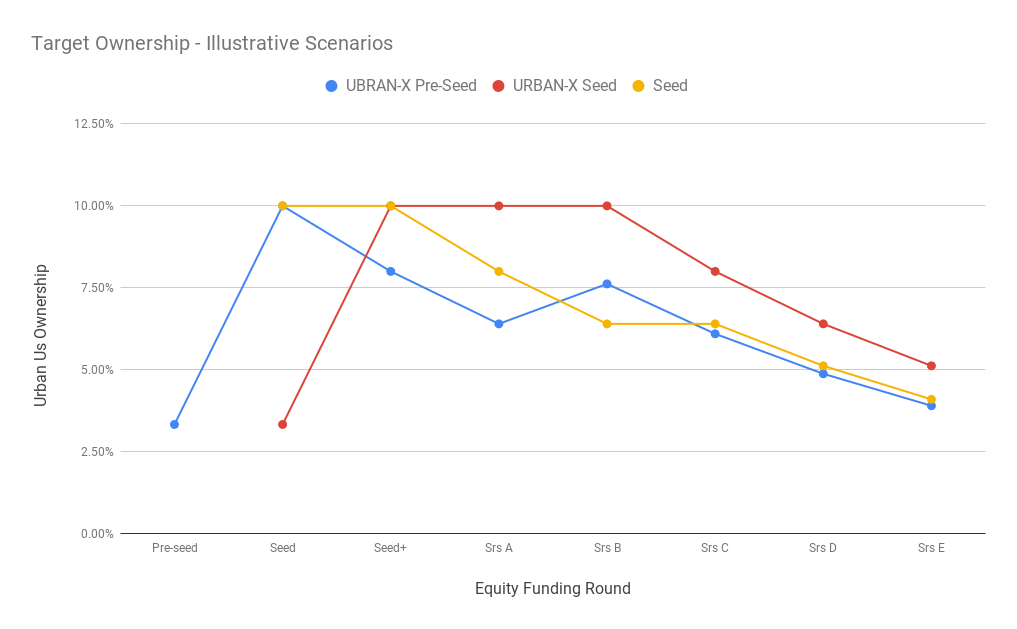
As we look over scenarios related to when we first invest or when we think it will be hard to get pro-rata, we can find a few different paths to a target ownership position at exit. Some variations are shown below reflecting our approach for our newest fund.
The math
Obviously there are many different paths to ownership, especially in a world with two or three rounds happening before Series A. We’ve run a few simulations to understand the impact of different follow-on strategies. To explore different seed-stage allocation approaches, we modified Fred Wilson’s “Doubling Model” to explore a few of the variations. Only one change — we replaced Series A with seed+ as it’s more inline with what we’ve seen. It’s also important because it implies one less round of dilution in some seed strategies. We also assumed most seed investors invest in syndicates, so they don’t buy 20 percent unless they’re on the large end of fund sizes – i.e. $100 million+.
We explored what happens when seed investors make a single investment to buy 10 percent of a company and never follow-on and how might that compare to selective B and C-stage follow-ons or using progress from seed to seed rounds to avoid dilution on more promising companies. There is also the question of the implied fund size and number of investments — if you can make high conviction bets early, you get to make more investments even with a relatively small fund. But eventually you bump into time constraints for partners — getting to 40 deals with two partners can work, but presumes you are not a lone wolf partner and that you make hard choices about where to allocate time — which often seems harder than allocating money.
Up to about $50 million there are a range of possible strategies that can work, but diluting with founders allows more investments, even with smaller funds versus more traditional aggressive follow-on. More deals may be essential to the success of this model. Here’s our modified version of the doubling model (changes to the model are noted with blue cells).
Diluting alongside founders
VCs routinely remind founders that they shouldn’t worry about dilution because they will have a smaller share, but the pie will be bigger. Mostly this math works for founders, so why not VCs? Founder Collective is the only other firm we found that is explicit about aiming for this result. And this may be even more necessary today to make room for more strategic VCs to join traditional VCs.
At Urban Us our investment model is focused on getting fully diluted ownership before Series A. If we can do some pro-rata or sometimes if we need to do a bridge to buy teams more time, we’ll do that. And we’ll be equally excited when founders are able to bring in great new investors to help them through their next growth stage, regardless of their allocation strategy.
Editor’s note: John Mannes is an investor at Basis Set Ventures, a $136 million early-stage venture capital fund focused on supporting startups using machine learning to address big problems across industries. Prior to Basis Set Ventures, John was a TechCrunch writer covering machine intelligence startups, machine learning research and major AI initiatives from big tech.
The Bessemer Process patented in 1856 by Sir Henry Bessemer is one of the inventions most closely associated with catalyzing the second industrial revolution. By reducing the impurities of iron with an innovative oxidizing air blast, the process ushered in a new wave of inexpensive, high-volume steel making.
Bessemer decided to license his patent to a handful of steel makers in an effort to quickly monetize his efforts. But contrary to expectations, technical challenges and monopolistic greed prevented large steel makers from agreeing to favorable licensing terms.
In an effort to drive adoption, Bessemer opened his own steel-making plant with the intention of undercutting competitors. The approach was so successful that each partner in the endeavor walked away from the 14-year partnership with an 81x return.
Some 162 years later, new businesses continue to struggle to convince customers to adopt new technologies — even when it’s in their best interest. Following in the footsteps of founders like Bessemer, today’s innovative startups are discovering that it often makes more sense to launch “full stack” businesses that provide a traditional service optimized with proprietary automation measures.
The full-stack methodology gave birth to companies like Uber and Tesla prior to the apex of the deep-learning revolution. And in today’s AI-first world of data and human labelers, full-stack startups are poised to play an even more important role in the startup ecosystem.
Going full stack comes with the advantage of being able to operate outside traditional incentive structures that limit the ability for large players in legacy industries to implement automation measures.
(Photo by Andrew Spear for The Washington Post via Getty Images.)
What does DIY AI look like?
Startups like Cognition IP, a BSV portfolio company, and Atrium are good examples of this. On paper, these businesses look very similar to traditional law firms in that they employ lawyers to practice patent law and startup law, respectively. But while traditional law firms often don’t automate due to the natural incentives associated with hourly billing, full-stack startups are incentivized by consumer adoption, so they have much to gain from developing a faster, cheaper, better strategy.
In addition to rejiggering old incentive structures à la Bessemer, going full stack opens up opportunities for companies to integrate labeling workflows into more traditional roles, to reap the full benefits of virtuous feedback loops, and to avoid countless complex process integrations.
Data labeling is a critical responsibility for startups that rely on machine learning. Services like Amazon Mechanical Turk and Figure Eight work well when startups have relatively manageable data-labeling responsibilities. But when labeling and human-plus-machine cooperative decision-making are a core part of everyday operations, startups often have to hire employees to manage that workflow internally.
Scaling these teams is expensive and operationally intensive. Going full stack opens up opportunities for companies to integrate labeling workflows into other jobs. Employees traditionally tasked with performing a consumer or enterprise service can take on the extra task at reduced expense. And if their role is assisted by a machine, they will gradually become more productive over time as their assistive models get more accurate with more labeled data.
A second and inherently related benefit of going full stack is that these startups are able to generate — and own — powerful virtuous data feedback loops. Owning data flows creates more impressive moats than merely locking down static data sets. Deep Sentinel has a natural moat in the consumer security space, for example, as it not only has accurate classifiers, but accurate classifiers that continue to improve with real-world data generated in an environment it can control.
Leveraging automation is a matter of balancing risks and rewards
In 1951, Ford’s VP of Operations, Del Harder, decided it was time to upgrade the company’s lines with a more fully automated system for moving materials through the production sequence. It ultimately took five years of tinkering at Ford’s Cleveland Engine Plant before the technique was ready to scale to other factories. By chaining together previously independent parts of the production sequence, Harder had created new frustrating interdependencies.
Founders today going after traditional industries like manufacturing and agriculture similarly understand that the devil is in the details when it comes to scaling. The clear advantage to startups subscribing to the full stack methodology is that they only need to worry about integrating once with their own processes.
But on the flip side, going full stack does come with its own significant scaling expenses. Venture capital as a financing vehicle only makes sense to a certain point with respect to risk, margin and dilution, so many founders attempting to execute this strategic playbook have turned to debt financing.
Fortunately, we have been in good economic times with low interest rates. Traditional full-stack businesses like Tesla and Uber have both raised significant debt, and even up-and-coming players like Opendoor have turned to this financing strategy. A nasty economic downturn could certainly throw a wrench into things for just about everyone.
Like countless other automation technologies that preceded machine learning, the winners of the deep-learning revolution will be startups whose technologies are optimized to work side-by-side with humans to generate outsized returns. Going full stack is difficult, expensive and not the only way to win, but it’s an under-appreciated strategy that’s extremely relevant for today’s machine learning-enabled startups.
Dota2 is one of the most popular, and complex, online games in the world, but an AI has once again shown itself to supersede human skill. In matches over the weekend, OpenAI’s “Five” system defeated two pro teams soundly, and soon you’ll be able to test your own mettle against — or alongside — the ruthless agent.
In a blog post, OpenAI detailed how its game-playing agent has progressed from its younger self — it seems wrong to say previous version, since it really is the same extensive neural network as many months ago, but with much more training.
The version that played at Dota2’s premiere tournament, The International, gets schooled by the new version 99 percent of the time. And it’s all down to more practice:
In total, the current version of OpenAI Five has consumed 800 petaflop/s-days and experienced about 45,000 years of Dota self-play over 10 realtime months (up from about 10,000 years over 1.5 realtime months as of The International), for an average of 250 years of simulated experience per day.
To the best of our knowledge, this is the first time an RL [reinforcement learning] agent has been trained using such a long-lived training run.
One is tempted to cry foul at a data center-spanning intelligence being allowed to train for 600 human lifespans. But really it’s more of a compliment to human cognition that we can accomplish the same thing with a handful of months or years, while still finding time to eat, sleep, socialize (well, some of us) and so on.
Dota2 is an intense and complex game with some rigid rules but a huge amount of fluidity, and representing it in a way that makes sense to a computer isn’t easy (which likely accounts partly for the volume of training required). Controlling five “heroes” at once on a large map with so much going on at any given time is enough to tax a team of five human brains. But teams work best when they’re acting as a single unit, which is more or less what Five was doing from the start. Rather than five heroes, it was more like five fingers of a hand to the AI.
Interestingly, OpenAI also discovered lately that Five is capable of playing cooperatively with humans as well as in competition. This was far from a sure thing — the whole system might have frozen up or misbehaved if it had a person in there gumming up the gears. But in fact it works pretty well.
You can watch the replays or get the pro commentary on the games if you want to hear exactly how the AI won (I’ve played but I’m far from good. I’m not even bad yet). I understand they had some interesting buy-back tactics and were very aggressive. Or, if you’re feeling masochistic, you can take on the AI yourself in a limited-time event later this week.
We’re launching OpenAI Five Arena, a public experiment where we’ll let anyone play OpenAI Five in both competitive and cooperative modes. We’d known that our 1v1 bot would be exploitable through clever strategies; we don’t know to what extent the same is true of OpenAI Five, but we’re excited to invite the community to help us find out!
Although a match against pros would mean all-out war using traditional tactics, low-stakes matches against curious players might reveal interesting patterns or exploits that the AI’s creators aren’t aware of. Results will be posted publicly, so be ready for that.
You’ll need to sign up ahead of time, though: The system will only be available to play from Thursday night at 6 PM to the very end of Sunday, Pacific time. They need to reserve the requisite amount of computing resources to run the thing, so sign up now if you want to be sure to get a spot.
OpenAI’s team writes that this is the last we’ll hear of this particular iteration of the system; it’s done competing (at least in tournaments) and will be described more thoroughly in a paper soon. They’ll continue to work in the Dota2 environment because it’s interesting, but what exactly the goals, means or limitations will be are yet to be announced.
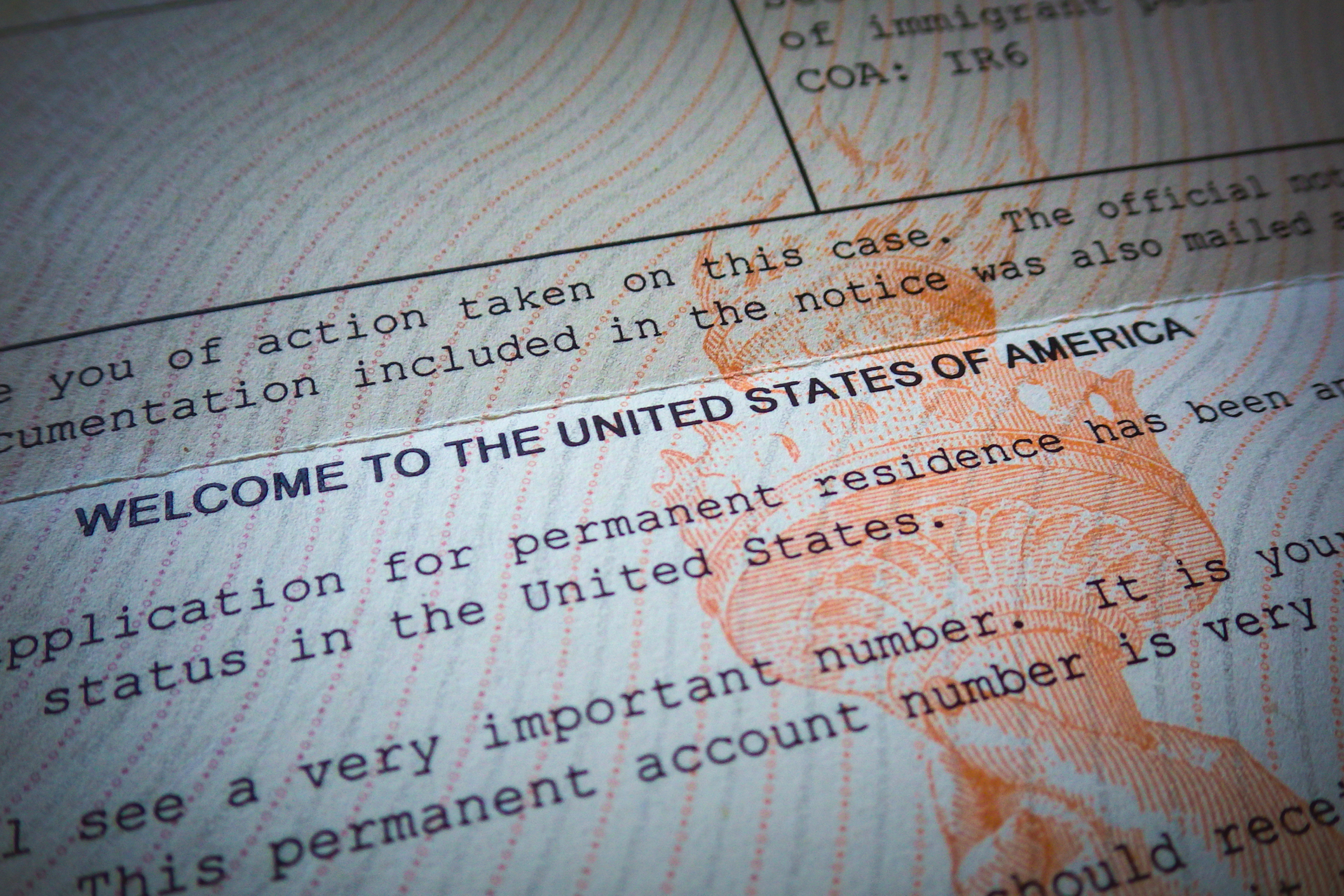
That’s the first thing you read when you find out your green card application was approved. Those long-awaited words are printed on fancier-than-usual paper, an improvement on the usual copy machine-printed paper that the government sends to periodically remind you that you, like millions of other people, are stuck in the same slow bureaucratic system.
First you cry — then you cry a lot. And then you celebrate. But then you have to wait another week or so for the actual credit card-sized card — yes, it’s green — to turn up in the mail before it really kicks in.
It took two years to get my green card, otherwise known as U.S. permanent residency. That’s a drop in the ocean to the millions who endure twice, or even three times as long. After six years as a Brit in New York, I could once again leave the country and arrive without worrying as much that a grumpy border officer might not let me back in because they don’t like journalists.
The reality is, U.S. authorities can reject me — and any other foreign national — from entering the U.S. for almost any reason. As we saw with President Trump’s ban on foreign nationals from seven Muslim-majority nations — since ruled unconstitutional — the highly vetted status of holding a green card doesn’t even help much. You have almost no rights and the questioning can be brutally invasive — as I, too, have experienced, along with the stare-downs and silent psychological warfare they use to mentally shake you down.
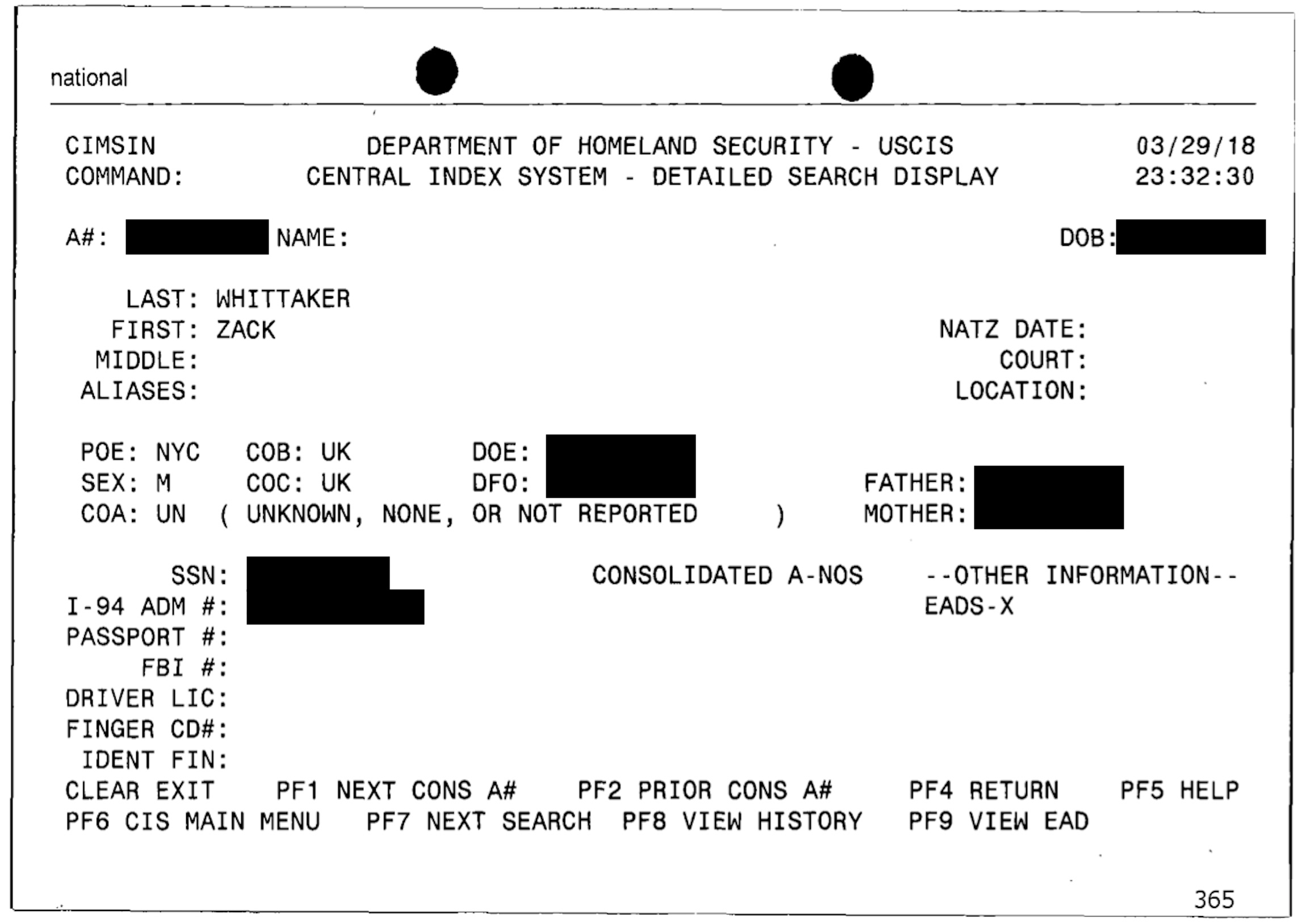
I was curious what they knew about me. With my green card in one hand and empowered by my newfound sense of immigration security, I filed a Freedom of Information request with U.S. Citizenship and Immigration Services to obtain all of the files the government had collected on me in order to process my application.
Seven months later, disappointment.
USCIS sent me a disk with 561 pages of documents and a cover letter telling me most of the interesting bits were redacted, citing exemptions such as records relating to officers and government staff, investigatory material compiled for law enforcement purposes and techniques used by the government to decide an applicant’s case.
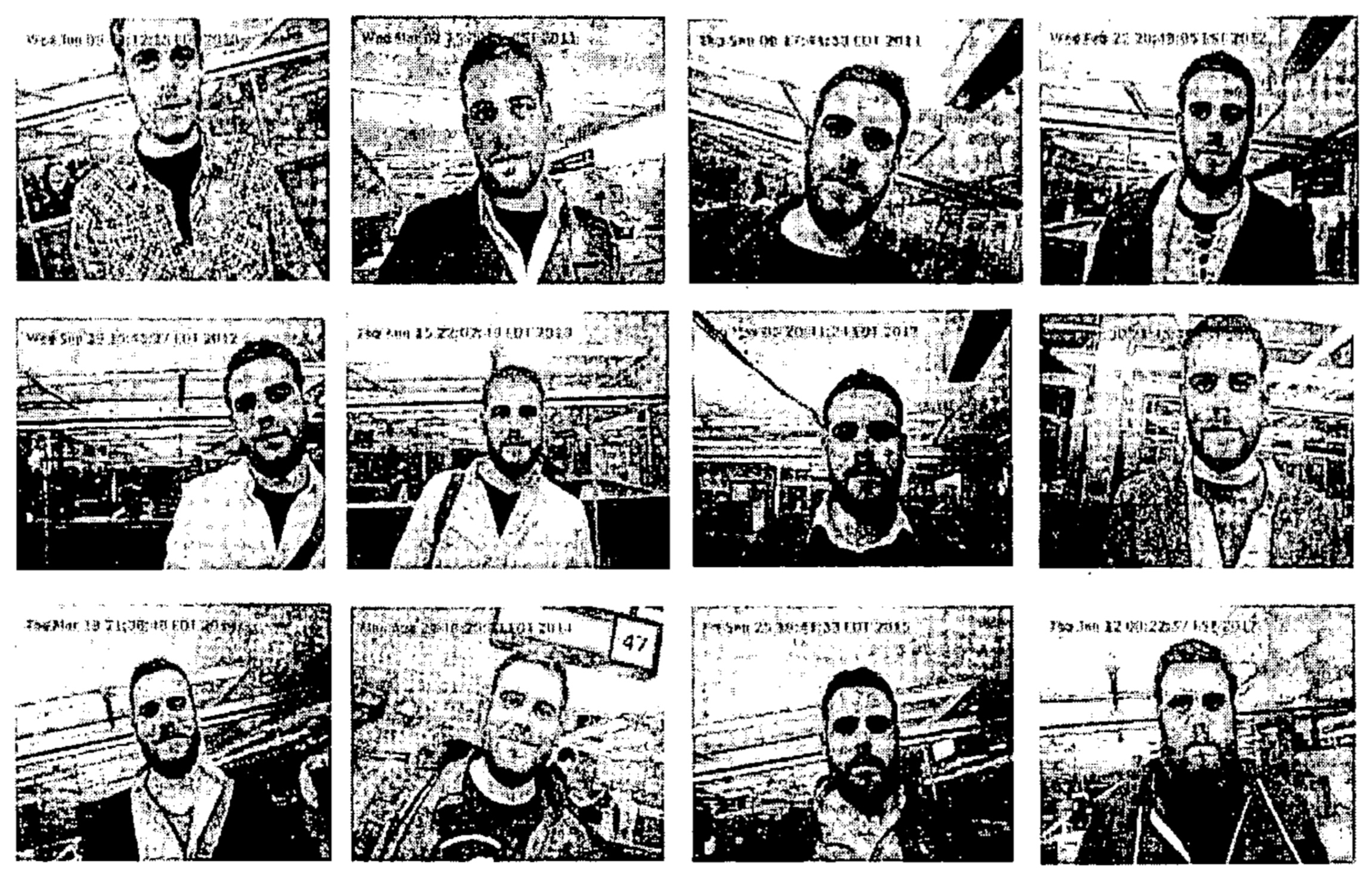
But I did get almost a decade’s worth of photos, taken by border officials, entering the United States.
Seven years of photos taken at the U.S. border (Source: Homeland Security/FOIA)
What’s interesting about these encounters is that you can see me getting exponentially fatter over the years while my sense of style declines at about the same rate.
Each photo comes with a record from a web-based system called the Customer Profile Management Service (CPMS), which stores from a camera at port of entries all the photos of foreign nationals visiting or returning to the U.S.
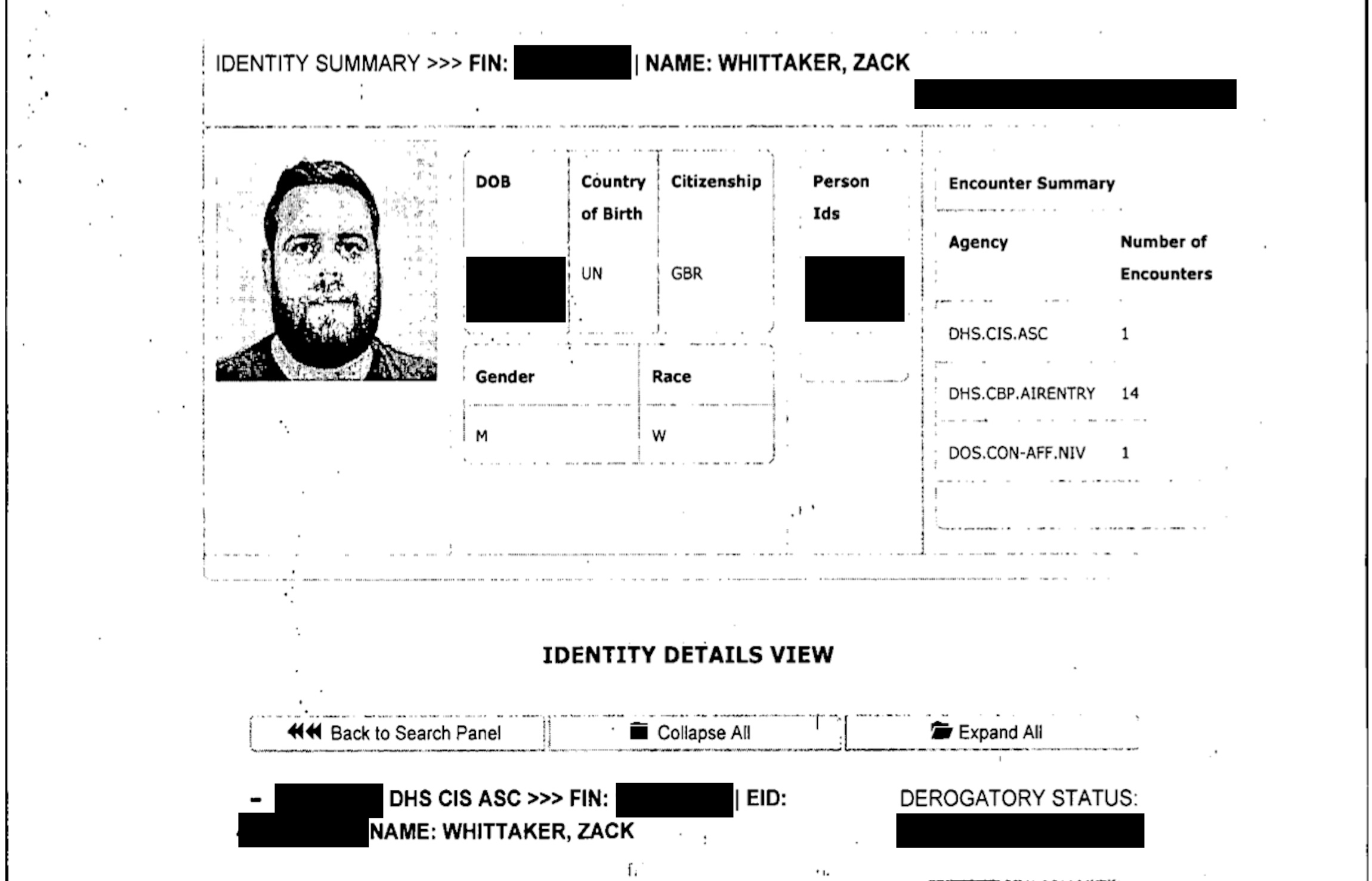
Immigration officers and border officials use the Identity Verification Tool (IVT) to visually confirm my identity and review my records at the border and my interview, as well as checking for any “derogatory” information that might flag a problem in my case.
The government’s IDENT system, which immigration staff and border officials use to visually verify an applicant’s identity along with any potentially barring issues, like a criminal record (Source: FOIA)
Everyone’s file will differ, and my green card case was somewhat simple and straightforward compared to others.
Some 90 percent of my file are things my lawyer submitted — my application, my passport and existing visa, my bank statements and tax returns, my medical exam and my entire set of supporting evidence — such as my articles, citations and letters of recommendation. The final 10 percent were actual responsive government documents, and some random files like photocopied folders.
And there was a lot of duplication.
From the choice files we are publishing, the green card process appears highly procedural and offered little to nothing in terms of decision making by immigration officers. Many of the government-generated documents were mostly box-ticking exercises, such as verifying the authenticity of documents along the chain of custody. A single typo can derail an entire case.
The government uses several Homeland Security systems to check my immigration records against USCIS’ Central Index System, and verify my fingerprints against my existing records stored in its IDENT system to ensure it’s really me at the interview.
USCIS’ Central Index System, a repository of data held by the government as applications go through the immigration process (Source: FOIA)
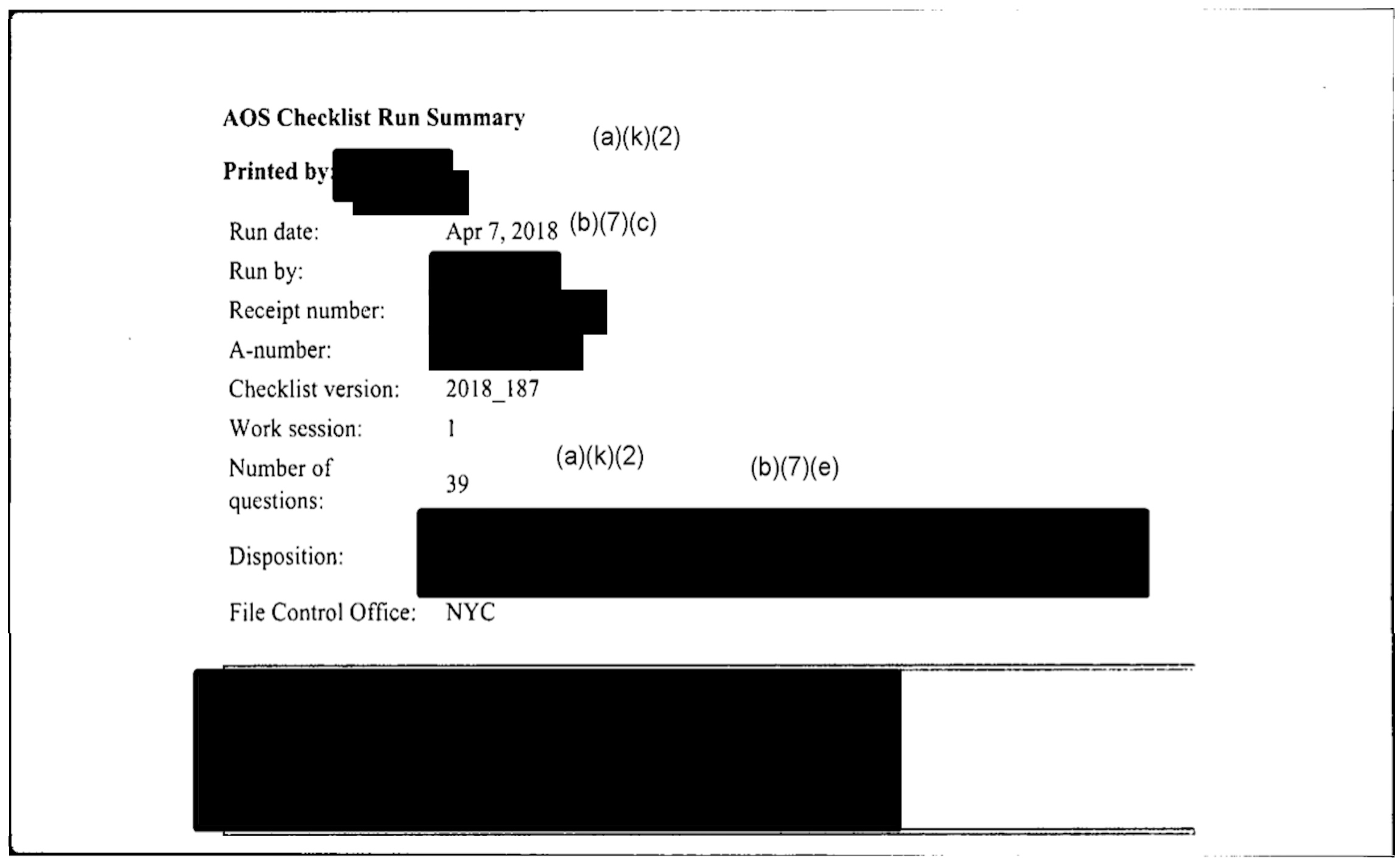
During my adjustment-of-status interview with an immigration officer, my “disposition” was recorded but redacted. (Spoiler alert: it was probably “sweaty and nervous.”)
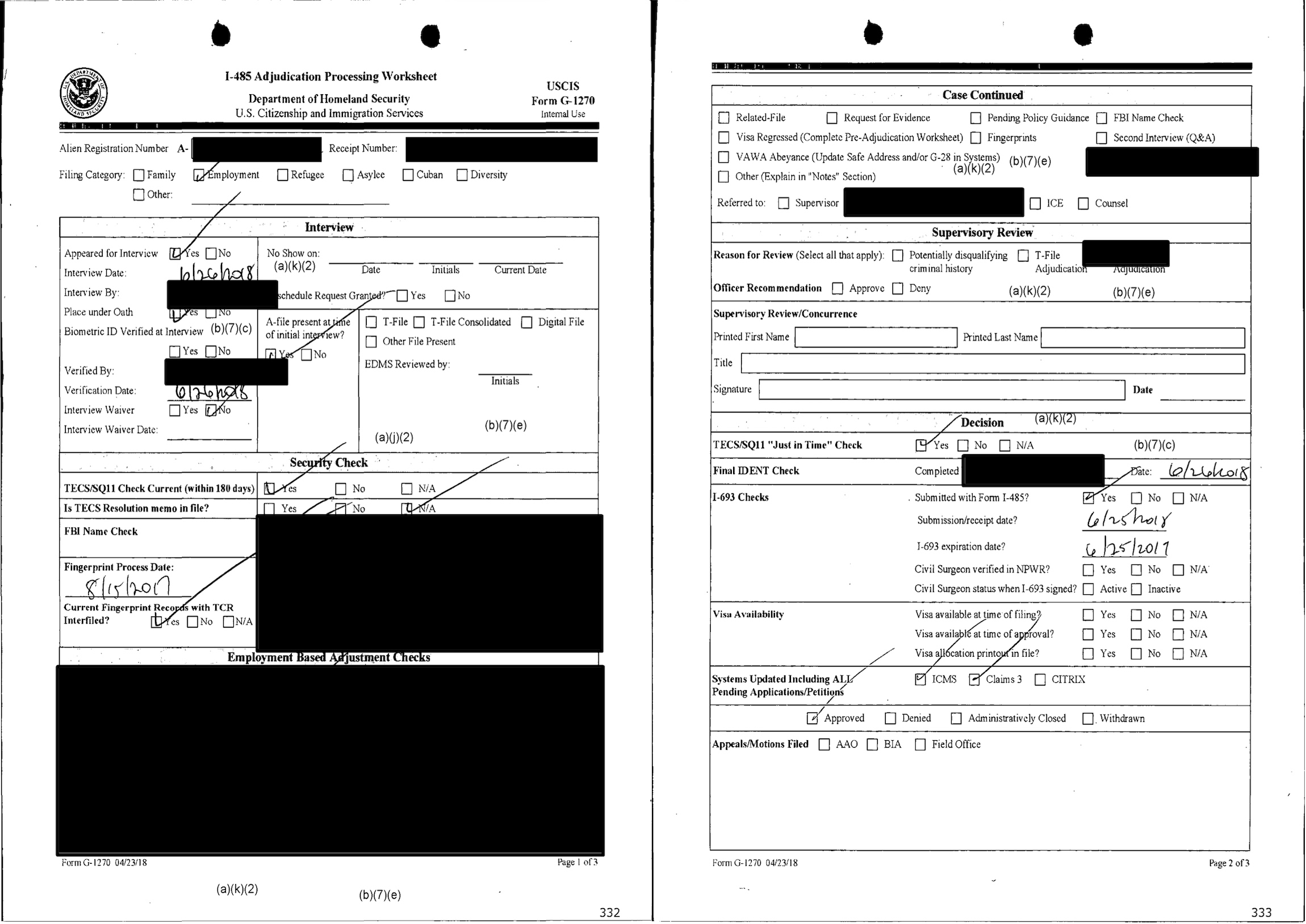
A file filled out by an immigration officer at an adjustment of status interview, which green card candidates are subject to (Source: FOIA)
Following the interview, the immigration officer checks to make sure that the interview procedures are properly carried out. Homeland Security also pulls in data from the FBI to check to see if my name is on a watchlist, but also to confirm my identity as the real person applying for the green card.
And, in the end, two years of work and waiting came down to a single checked box following my interview. “Approved.”
The final adjudication of an applicant’s green card (Source: FOIA)
It’s no secret that you can FOIA for your green card file. Some are forced to file to obtain their case files in order to appeal their denied applications.
Runa Sandvik, a senior director of information security at The New York Times, obtained her border photographs from Homeland Security some years ago. Nowadays, it’s just as easy to request your files. Fill out one form and email it to the USCIS.
For me, next stop is citizenship. Just five more years to go.
Beginning early next month, Lyft customers in NYC will be able to unlock CitiBikes through the Lyft app. Lyft says it picked New York as its fourth location after Washington, D.C., Los Angeles and Santa Monica, Calif. because Citi Bike is one of the most popular bikeshare systems. To date, Citi Bike has logged more than 75 million rides with a fleet of more than 12,000 bikes.
Before, riders needed a special Citi Bike account but with the Lyft integration, that will no longer be necessary. The caveat is that this is only available for riders who are new to Citi Bike. Existing Citi Bike users can use it, but it’s just that those with pre-existing accounts won’t be able to link their accounts to use the Lyft app to unlock bikes just yet. But Lyft says it’s coming over the next few months.
It’s worth noting, however, that Lyft had to pull CitiBike’s pedal-assist bikes off the road this past weekend after receiving reports from some riders that the brakes were too strong, resulting in some people falling off the bikes. Lyft also pulled its pedal assist bikes from San Francisco and Washington D.C.
I didn't report it, but I fractured my arm flipping over the handlebars when trying to brake for a pedestrian in the bike lane. Unfortunate to hear but I feel better knowing I wasn't the only one this happened to. And yes I know how disc brakes work…
“After a small number of reports and out of an abundance of caution, we are proactively pausing our electric bikes from service,” Lyft spokesperson Julie Wood said in a statement to TechCrunch. “Safety always comes first.”
It’s not clear when the pedal-assist bikes will return to the CitiBike, Ford GoBike and Capital Bikeshare fleets. Motivate first deployed pedal assist bikes in San Francisco about one year ago before more broadly deploying the bikes. Currently, Lyft is working with its suppliers and a third-party engineering firm to determine the root cause of the issue. The recall affects about 15 percent of the bikes available, but Lyft plans to temporarily replace the pedal-assist bikes with classic bikes. Meanwhile, Lyft is working on its own electric bike model that it will deploy in the near future.
Since acquiring Motivate, Lyft has expanded to additional neighborhoods outside of Manhattan and agreed to put $100 million into the Citi Bike system. Over the next five years, Lyft plans to triple the number of bikes to 40,000.
Lyft competitor Uber added bikes and scooters to its app last September with the launch of Mode Switch. The idea was to make it easier for people to switch between different modalities.
Justin Cowperthwaite is an Engineering Manager at CircleCI passionate about helping remote teams build collaborative delivery paradigms.
Every engineer deserves a clear growth path so they can understand, plan, and execute on meaningful career growth. Providing a framework for this growth (we call ours a competency matrix; it’s also known as a career ladder, or professional development ladder) is important work, and the responsibility of any organization that wants to nurture and grow its employees.
Back at the beginning of 2018, we had 32 developers and a plan to double throughout the year, we already had a competency matrix, but it was woefully outdated. It focused on our more junior levels, maxing out at a level which some developers had already reached. It was also misaligned with the skills our organization had grown to value, which meant in practice, we often ignored it. It was time for a re-design.
Building a new competency matrix was a learning process, and a lengthy one, taking about eight months to complete. Along the way we discovered things we valued, as well as what the keys steps to building a career ladder are (and which ones are wasteful). While every matrix is different, and will reflect the values of the organization that wrote it, the process of producing a succinct career ladder to guide your team is consistent.
When we published our new Engineering competency matrix in December, we received many emails from teams saying they were working on similar systems. Because of this feedback, I want to share the steps we went through, and the lessons we learned, to help teams reach a productive conclusion with much less waste, and in much shorter time, than trying to figure it out from scratch.
If you want to provide your employees and reports with a clear, agreed-upon and well-defined path for growth within your organization, then this is for you.
Image via CircleCI
Step 1: Make this someone’s top priority
In retrospect, this was the biggest factor in our lengthy redesign process. I had initially taken on this project as one of my many side projects. The only time I had to dedicate to the matrix were early mornings, late nights, and weekends. This was a passion project for me, and I loved working on it, but I was not able to give it the care it needed.
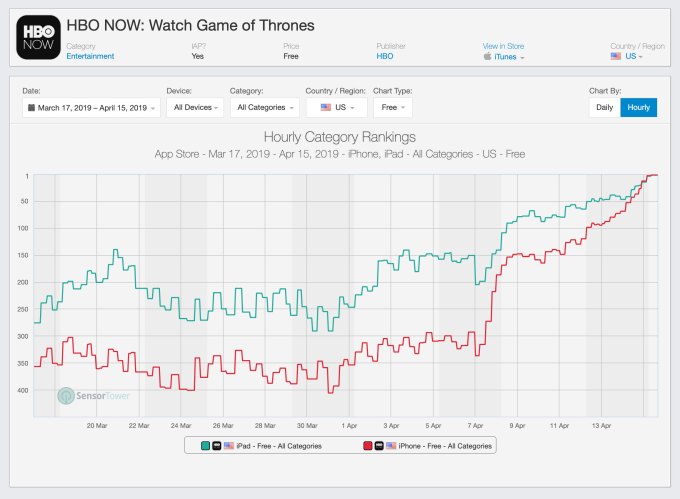
In addition to exciting its loyal legion of fans, HBO’s “Game of Thrones” premiere was also once again great news for installs of the network’s app for cord cutters, HBO NOW, which shot to the top of the App Store this weekend. The app this weekend saw a combined 300,000-plus new mobile subscribers in the U.S. across both Apple’s App Store and Google Play, according to preliminary estimates from Sensor Tower.
This is the highest the app has ranked on the U.S. iPhone App Store in three years, Sensor Tower notes, with its previous highest ranking on April 24, 2016 for the Season 6 “Game of Thrones” premiere. At that time, the app had seen 160,000 downloads on just the one day.
Sensor Tower soon expects to have more precise estimates of the premiere’s impact, as it wants to incorporate numbers from the fans who are getting a late start and downloading the app today.
Currently, the app is holding its No. 1 position on Apple’s App Store. If that continues, it could easily add another couple hundred thousand over the course of today (Monday, April 15, 2019), Sensor Tower estimates. That could see the app surpassing 500,000 new downloads across the three-day period.
To be clear, these numbers refer to users who have never before installed the app on their phone — not re-downloads.
Of course, this isn’t necessarily a 1:1 correlation with new HBO NOW subscribers. Many fans watch the series on their TV’s big screen through an HBO app for devices like Roku, Apple TV, Fire TV and others. Or they may tune in to watch on the web, via their laptop. Still, it’s a notable number — especially considering how late it is in the series for the show to be gaining new fans.
HBO’s app for cable and satellite TV customers, HBO Go, also did well this weekend. It’s on track to exceed 400,000 installs over the same three-day period (the weekend of the Season 8 premiere, plus Monday). This is highest the app has ranked since the Season 7 premiere in July 2017, when it added 350,000 first-time users across both stores worldwide.
Combined, the two apps — HBO Go and HBO NOW — are poised to exceed more than 1 million new installs in this three-day period, Sensor Tower forecasts.
However, fans’ interest in the long-awaited new season may have caused HBO’s apps to struggle some.
There have been reports from Down Detector and Business Insider of users who had issues streaming from the HBO apps, as well as Hulu. But these were nowhere on the scale of crashes we’ve seen in years past — as with the Season 4 “Game of Thrones” premiere, which had HBO issuing a public apology due to the size of the outage. (HBO says it did not have issues with HBO NOW or HBO Go. So the small number of issues could be chalked up to users’ broadband connections, or other factors.)
Other TV apps had a few glitches, too, thanks to the premiere. For example, the TV-tracking social app TV Time temporarily struggled to load, shortly after the premiere’s airing last night. On its app, “Game of Thrones” is one of the most-tracked shows, where it has 4.3 million followers who post comments, photos, memes and more to the show’s in-app community. Today, there are some 6,200 comments in the show’s forum from fans discussing the show.
HBO announced today the Season 8 premiere was watched by a record 17.4 million viewers across all platforms, including linear TV, HBO Go, and HBO NOW. Its prior record was 16.9 million viewers for the Season 7 finale. The Season 8 premiere also had over a million more viewers than the Season 7 premiere, the network said.
4/15/19, 3:07 PM ET: Updated with HBO comment after publication.
Ridesharing companies and airports have always had a bit of a fractious relationship. Riders looking to catch an Uber or Lyft have had to walk to parking garages, follow makeshift signage and find arbitrary pickup points, all while waiting multiples of the ETA for their pickup at busy airports.
Lyft is piloting a new way to pair riders with drivers at the San Diego airport. It’s a Lyft line, but it’s not a carpooling product, it’s actually just a cab line.
Instead of matching with a driver, riders nabbing a regular Lyft will hop in a physical line at the airport and match up with a driver irl. They won’t have to tell them the address before the meter starts running, users will still enter everything in the app, but after doing so they will tell the driver a four-digit code that will sync the request with the driver and get everything moving.
It’s a bit funny when companies try everything only to settle on the old ways, but the fact is for fringe use cases, where everyone is grabbing a ride from a single location, having multiple pickup areas can just make everything move more slowly and coordinating can be tough when Lyft drivers are holding up the process having to wait for riders who are running late or at the wrong location.
Team all of this with the fact that cab companies have made life difficult for Lyft and Uber by lobbying airports to move pickup locations into remote corners and this might just be a way to make life easier for all parties involved.
This is a little bit of a different setup for rideshare users, so at the San Diego Terminal 2 airport pickup, Lyft is going to have some employees there to walk people through the setup. This is launching mid-May, so it’s way too early to guess whether this works and will eventually find its way to other airports — but we can all hope that either Lyft or Uber discover how to make the process easier for everyone.
Airbnb has completed its acquisition of the last-minute hotel booking application, HotelTonight, the company announced on Monday. The deal is Airbnb’s largest M&A transaction yet, and will accelerate the home-sharing giant’s growth as it gears up for an initial public offering.
Airbnb reportedly began talks to acquire HotelTonight months ago, and finally confirmed its intent to acquire the business in early March. Reports indicated a price tag of more than $400 million; Airbnb declined to comment on the size of the deal.
As part of the deal, HotelTonight co-founder and chief executive officer Sam Shank will lead the boutique hotel category at Airbnb, one of the company’s newer units meant to help it scale beyond treehouses and quirky homes.
“When we founded HotelTonight, we sought to reimagine the hotel booking experience to be more simple, fast and fun, and to better connect travelers with the world’s best boutique and independent hotels,” Shank said in a statement. “We are delighted to take this vision to new heights as part of Airbnb.”
Shank launched the San Francisco-based company in 2010. Most recently, it was valued at $463 million with a $37 million Series E funding in 2017, according to PitchBook. HotelTonight raised a total of $131 million in equity funding from venture capital firms including Accel, Battery Ventures, Forerunner Ventures and First Round Capital.
Drones are great. But they are also flying machines that can do lots of stupid and dangerous things. Like, for instance, fly over a major league baseball game packed with spectators. It happened at Fenway Park last night, and the FAA is not happy.
The illegal flight took place last night during a Red Sox-Blue Jays game at Fenway; the drone, a conspicuously white DJI Phantom, reportedly first showed up around 9:30 PM, coming and going over the next hour.
One of the many fans who shot a video of the drone, Chris O’Brien, told CBS Boston that “it would kind of drop fast then go back up then drop and spin. It was getting really low and close to the players. At one point it was getting really low and I was wondering are they going to pause the game and whatever, but they never did.
Places where flying is regularly prohibited, like airports and major landmarks like stadiums, often have no-fly rules baked into the GPS systems of drones — and that’s the case with DJI. In a statement, however, the company said that “whoever flew this drone over the stadium apparently overrode our geofencing system and deliberately violated the FAA temporary flight restriction in place over the game.”
The FAA said that it (and Boston PD) is investigating both to local news and in a tweet explaining why it is illegal.
FAA Statement: The FAA is investigating a report that a #drone flew over @fenwaypark during the baseball game last night. Flying drones in/around stadiums is prohibited starting 1hr before & ending 1hr after the scheduled game & prohibited within a radius of 3 nm of the stadium. pic.twitter.com/o6nOGVf8K2
That’s three nautical miles, which is quite a distance, covering much of central Boston. You don’t really take chances when there are tens of thousands of people all gathered in one spot on a regular basis like that. Drones open up some pretty ugly security scenarios.
Of course, this wasn’t a mile and a half from Fenway, which might have earned a slap on the wrist, but directly over the park, which as the FAA notes above could lead to hundreds of thousands in fines and actual prison time. It’s not hard to imagine why: If that drone had lost power or caught a gust (or been hit by a fly ball, at that altitude), it could have hurt or killed someone in the crowd.
Here’s hoping they catch the idiot who did this. It just goes to show that you can’t trust people to follow the rules, even when they’re coded into a craft’s OS. It’s things like this that make mandatory registration of drones sound like a pretty good idea.
(Red Sox won, by the way. But the season’s off to a rough start.)
A hacker group has breached several FBI-affiliated websites and uploaded their contents to the web, including dozens of files containing the personal information of thousands of federal agents and law enforcement officers, TechCrunch has learned.
The hackers breached three sites associated with the FBI National Academy Association, a coalition of different chapters across the U.S. promoting federal and law enforcement leadership and training located at the FBI training academy in Quantico, VA. The hackers exploited flaws on at least three of the organization’s chapter websites — which we’re not naming — and downloaded the contents of each web server.
The hackers then put the data up for download on their own website, which we’re also not naming nor linking to given the sensitivity of the data.
The spreadsheets contained about 4,000 unique records after duplicates were removed, including member names, a mix of personal and government email addresses, job titles, phone numbers and their postal addresses. The FBINAA could not be reached for comment outside of business hours. If we hear back, we’ll update.
TechCrunch spoke to one of the hackers, who didn’t identify his or her name, through an encrypted chat late Friday.
“We hacked more than 1,000 sites,” said the hacker. “Now we are structuring all the data, and soon they will be sold. I think something else will publish from the list of hacked government sites.” We asked if the hacker was worried that the files they put up for download would put federal agents and law enforcement at risk. “Probably, yes,” the hacker said.
The hacker claimed to have “over a million data” [sic] on employees across several U.S. federal agencies and public service organizations.
It’s not uncommon for data to be stolen and sold in hacker forums and in marketplaces on the dark web, but the hackers said they would offer the data for free to show that they had something “interesting.”
Unprompted, the hacker sent a link to another FBINAA chapter website they claimed to have hacked. When we opened the page in a Tor browser session, the website had been defaced — prominently displaying a screenshot of the encrypted chat moments earlier.
The hacker — one of more than ten, they said — used public exploits, indicating that many of the websites they hit weren’t up-to-date and had outdated plugins.
In the encrypted chat, the hacker also provided evidence of other breached websites, including a subdomain belonging to manufacturing giant Foxconn. One of the links provided did not need a username or a password but revealed the back-end to a Lotus-based webmail system containing thousands of employee records, including email addresses and phone numbers.
Their end goal: “Experience and money,” the hacker said.
In China, the laws limit work to 44 hours a week and require overtime pay for anything above that. But many aren’t following the rules, and a rare online movement puts a spotlight on extended work hours in China’s booming tech sector. People from all corners of society have rallied in support for improvements to startup working conditions, while some warn of hurdles in a culture ingrained in the belief that more work leads to greater success.
In late March, anonymous activists introduced 996.ICU, a domain name that represents the grueling life of Chinese programmers: who work from 9 am to 9 pm, 6 days a week with the threat of ending up at ICU, a hospital’s intensive care unit. The site details local labor laws that explicitly prohibit overtime work without pay. The slogan “Developers’ lives matter” appears at the bottom in solemn silence.
A project called 996.ICU soon followed on GitHub, the Microsoft-owned code and tool sharing site. Programmers flocked to air their grievances, compiling a list of Chinese companies that reportedly practice 996 working. Among them were major names like e-commerce leaders Alibaba, JD.com and Pinduoduo, as well as telecoms equipment maker Huawei and Bytedance, the parent company of the red-hot short video app TikTok.
In an email response to TechCrunch, JD claimed it doesn’t force employees to work overtime.
“JD.com is a competitive workplace that rewards initiative and hard work, which is consistent with our entrepreneurial roots. We’re getting back to those roots as we seek, develop and reward staff who share the same hunger and values,” the spokesperson said.
Alibaba declined to comment on the GitHub movement, although founder Jack Ma shared on Weibo Friday his view on the 996 regime.
“No companies should or can force employees into working 996,” wrote Ma. “But young people need to understand that happiness comes from hard work. I don’t defend 996, but I pay my respect to hard workers!”
Bytedance declined to comment on whether its employees work 996. We contacted Huawei but had not heard back from the company at the time of writing.
996.ICU rapidly rocketed to be the most-starred project on GitHub, which claims to be the world’s largest host of source codes. The protest certainly turned heads among tech bosses as China-based users soon noticed a number of browsers owned by companies practicing 996 had restricted access to the webpage.
The 996 dilemma
The 996 list is far from exhaustive as it comprises of voluntary entries from GitHub users. It’s also hard to nail down the average work hours at a firm, especially a behemoth with tens of thousands of employees where policies can differ across departments. For instance, it’s widely acknowledged that developers work longer than their peers in other units. Anecdotally, TechCrunch has heard that bosses in some organizations often find ways to exploit loopholes, such as setting unrealistic KPIs without explicitly writing 996 into employee contracts.
“While our company doesn’t force us into 996, sometimes, poor planning from upper management forces us to work long hours to meet arbitrary management deadlines,” a Beijing-based engineer at a professional networking site told TechCrunch. This person is one of many sources who spoke anonymously because they are not authorized to speak to media.
BEIJING, CHINA APRIL 25, 2018: Passenger on a train in the Beijing Subway. Donat Sorokin/TASS (Photo by Donat SorokinTASS via Getty Images)
Other companies are more vocal about 996, taking pride in their excessively diligent culture. Youzan, the Tencent-backed, Shopify -like e-commerce solution provider, explicitly demanded staff to live out 996 work styles. Employees subsequently filed complaints in January to local labor authorities, which were said to have launched an investigation into Youzan.
A lot of companies are like Youzan, which equates long hours of work with success. That mindset can easily lure programmers or other staff into accepting extra work time. But employees are hardly the only ones burning out as entrepreneurs are under even greater pressure to grow the business they build from scratch.
“The recent debate over 996 brings to light the intense competition in China’s tech industry. To survive, startups and large companies have no choice but to work extremely hard. Some renown entrepreneurs even work over 100 hours a week,” Jake Xie, vice president of investment at China Growth Capital, an early-stage venture fund, told TechCrunch.
“Overtime is a norm at many internet companies. If we don’t work more, we fall behind,” said a founder of a Shenzhen-based mobile game developing startup. Competition is particularly cut-throat in China’s mobile gaming sector, where creativity is in short supply and a popular shortcut to success is knocking off an already viral title. Speed, therefore, is all it matters.
Meanwhile, a high-performing culture brewing in China may neutralize society’s resistance to 996. Driven individuals band together at gyms and yoga studios to sweat off stress. Getting group dinners before returning to work every night becomes essential to one’s social life, especially for those that don’t yet have children.
Photo source: Jack Ma via Weibo
“There is a belief that more hours equals more learning. I think some percentage of people want to put in more hours, and that percentage is highest for 22 to 30 years old,” a Shanghai-based executive at a tech company that values work-life balance told TechCrunch. “A few people in my team have expressed to us that they feel they cannot grow as fast as their friends who are working at companies that practice 996.”
“If you don’t work 996 when you’re young, when will you?” Wrote 54-year-old Jack Ma in his Weibo post. “To this day, I’m definitely working at least 12 to 12, let alone 996… Not everyone practicing 996 has the chance to do things that are valuable and meaningful with a sense of achievement. So I think it’s a blessing for the BATs of China to be able to work 996.”
(BAT is short for Baidu, Alibaba and Tencent for their digital dominance in China, akin to FANNG in the west.)
Demanding hours are certainly not unique to the tech industry. Media and literature have long documented the strenuous work conditions in China’s manufacturing sector. Neighboring Japan is plagued by karoshi or “death from overwork” among its salarymen and Korean companies are also known for imposing back-breaking hours on workers, compelling the government to step in.
Attempts to change
Despite those apparent blocks, the anti-996 movement has garnered domestic attention. The trending topic “996ICU gets blocked by large companies” has generated nearly 2,000 posts and 6.3 million views on Weibo. China’s state-run broadcaster CCTV chronicled the incident and accused overtime work of causing “substantial physical and psychological consequences” in employees. Outside China, Python creator Guido van Rossum raised awareness about China’s 996 work routine in a tweet and on a forum.
“Can we do something for 996 programmers in China?” He wrote in a thread viewed 16,700 times.
The 996 campaign that began as a verbal outcry soon led to material acts. Shanghai-based lawyer Katt Gu and startup founder Suji Yan, who say they aren’t involved in the 996.ICU project, put forward an Anti-996 License that would keep companies in violation of domestic or global labor laws from using its open source software.
But some cautioned the restriction may undermine the spirit of open source, which denotes that a piece of software is distributed free and the source code undergirding it is accessible to others so they can study, share and modify the creator’s work.
“I strongly oppose and condemn 996, but at the same time I disagree with adding discretionary clauses to an open source project or using an open source project for the political game,” You Yuxi, creator of open-source project Vue, which was released under the MIT license, said on the Chinese equivalent to Twitter, Weibo. (Gu denies her project has any “political factors.”)
Others take a less aggressive approach, applauding companies that embrace the more humane schedule of “9 am to 5 pm for 5 days a week” via the “995.WLB” GitHub project. (WLB is short for “work-life balance.”) On this list are companies like Douban, the book and film review site famous for its “slow” growth but enduring popularity with China’s self-proclaimed hippies. WeWork, the workplace service provider that bills itself as showing respect for employees’ lives outside work, was also nominated.
While many nominees on the 996 list appear to be commercially successful, others point to a selection bias in the notion that more work bears greater fruit.
“If a company is large enough and are revealed to be practicing 996, the issue gets more attention. Take Youzan and JD for example,” a Shanghai-based developer at an enterprise software startup told TechCrunch.
“Conversely, a lot of companies that do practice 996 but have not been commercially successful are overlooked. There is no sufficient evidence that shows a company’s growth is linked to 996… What bosses should evaluate is productivity, not hours.”
Or, as some may suggest, managers should get better at incentivizing employees rather than blindingly asking for more hours.
“As long as [China’s] economy doesn’t stall, it may be hard to stop 996 from happening. This is not a problem of the individual. It’s an economic problem. What we can do is offering more humane care and inspiring workers to reflect, ‘Am I working at free will and with passion?’ instead of looking at their work hours,” suggested Xie of China Growth Capital.
While a push towards more disciplined work hours may be slow to come, experts have suggested another area where workers can strive for better treatment.
“It seems almost all startups in China underfund the social security or housing fund especially when they are young, that is, before series A or even series B financing,” Benjamin Qiu, partner at law firm Loeb & Loeb LLP, explained to TechCrunch.
“Compared to 996, the employees have an even stronger legal claim on the above since it violates regulations and financially hurts the employee. That said, the official social credit and housing fund requirement in China appears to be an undue burden on the employer compared to the Silicon Valley, but if complied with, it could be understood as an offset of the 996 culture.”
A number of my interviewees spoke on conditions of anonymity, not because their companies promote 996 but, curiously, because their employers don’t want to become ensnarled in the 996 discussions. “We don’t need to tell people we support work-life balance. We show it with action,” said a spokesperson for one company.