Tesla plans to launch an insurance product ‘in about a month’

Tesla is developing an insurance product, which could be launched in about a month, CEO Elon Musk said during a call with analysts Wednesday following its first-quarter earnings report.

“It will be much more compelling than anything else out there,” he said.

Musk didn’t provide further details on what the insurance product might look like, but it will most certainly place value on its Autopilot system, an advanced driver assistance system that is considered one of the most robust and at times, most controversial, in the industry.

Musk later added that Tesla already shares information with insurance companies about Autopilot. The information is meant to help reduce insurance rates.

“As we launch our own insurance product next month, we will certainly incorporate that information into the insurance rates,” Musk said.

Tesla has an “information arbitrage opportunity,” Musk said. The company is able to capture driving data, giving the company direct knowledge of the risk profile of the driver and car. If customers want to buy Tesla insurance they might have to agree to “not drive the car in a crazy way,” said Musk, who added they can, they’ll just have a higher insurance rate.

Companies like insurance startup Root have introduced programs that give Tesla owners a discount if their electric vehicles are equipped with Autopilot.

Tesla reported Wednesday wider-than-expected loss of $702 million, or $4.10 a share, in the first quarter after disappointing delivery numbers, costs and pricing adjustments to its vehicles threw the automaker off of its profitability track.

The loss included $188 million of non-recurring charges. When adjusted for one-time losses, Tesla lost $494 million, or $2.90 a share, compared with a loss of $3.35 a share a year ago. Tesla reported that it also incurred $67 million due to a combination of restructuring and other non-recurring charges.

Tesla’s first-quarter revenues were $4.5 billion, compared to $7.2 billion in the fourth quarter. The company’s operating cash flow less capital expenditures dropped to a loss to $920 million, compared to a positive $910 million in the fourth quarter.

Scientists pull speech directly from the brain

In a feat that could eventually unlock the possibility of speech for people with severe medical conditions, scientists have successfully recreated the speech of healthy subjects by tapping directly into their brains. The technology is a long, long way from practical application but the science is real and the promise is there.

Edward Chang, neurosurgeon at UC San Francisco and co-author of the paper published today in Nature, explained the impact of the team’s work in a press release: “For the first time, this study demonstrates that we can generate entire spoken sentences based on an individual’s brain activity. This is an exhilarating proof of principle that with technology that is already within reach, we should be able to build a device that is clinically viable in patients with speech loss.”

To be perfectly clear, this isn’t some magic machine that you sit in and its translates your thoughts into speech. It’s a complex and invasive process that decodes not exactly what the subject is thinking but what they were actually speaking.

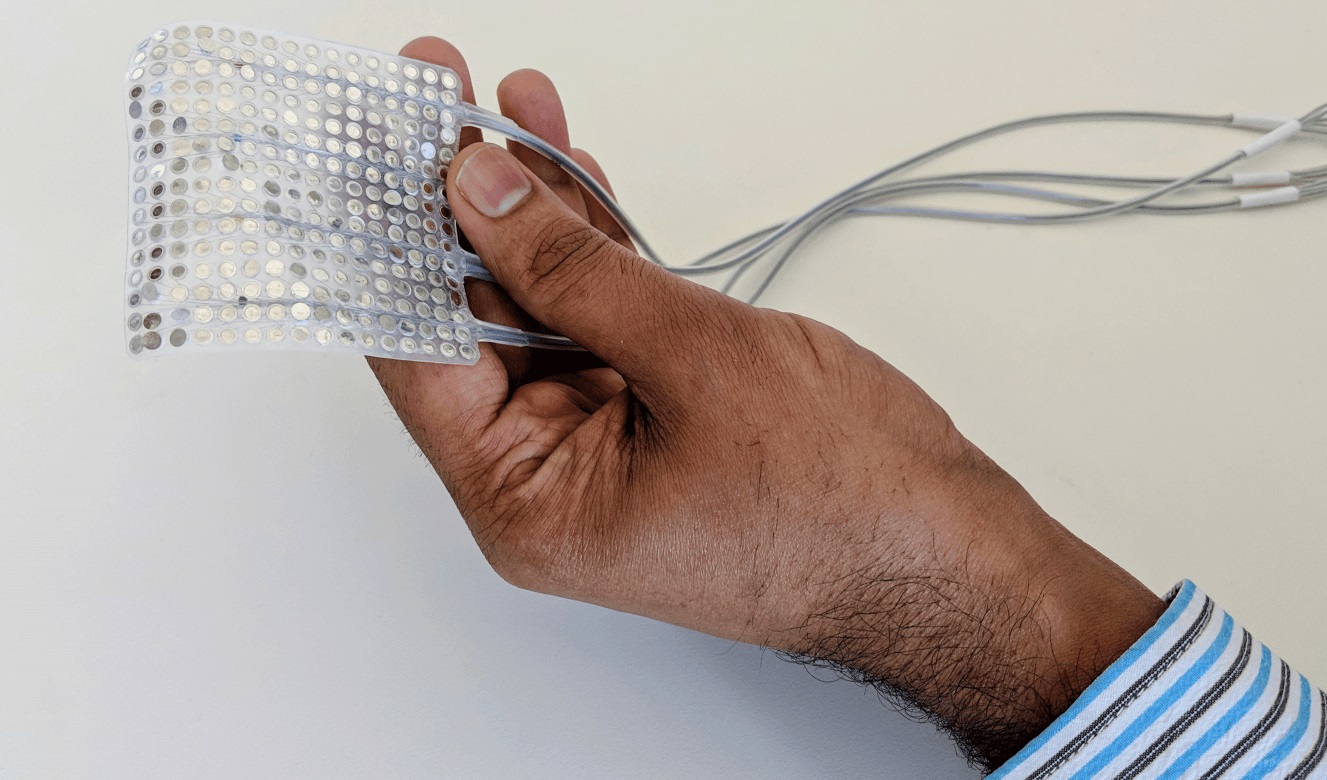
Led by speech scientist Gopala Anumanchipalli, the experiment involved subjects who had already had large electrode arrays implanted in their brains for a different medical procedure. The researchers had these lucky people read out several hundred sentences aloud while closely recording the signals detected by the electrodes.

The electrode array in question

See, it happens that the researchers know a certain pattern of brain activity that comes after you think of and arrange words (in cortical areas like Wernicke’s and Broca’s) and before the final signals are sent from the motor cortex to your tongue and mouth muscles. There’s a sort of intermediate signal between those that Anumanchipalli and his co-author, grad student Josh Chartier, previously characterized, and which they thought may work for the purposes of reconstructing speech.

Analyzing the audio directly let the team determine which muscles and movements would be involved when (this is pretty established science), and from this they built a sort of virtual model of the person’s vocal system.

They then mapped the brain activity detected during the session to that virtual model using a machine learning system, essentially allowing a recording of a brain to control a recording of a mouth. It’s important to understand that this isn’t turning abstract thoughts into words — it’s understanding the brain’s concrete instructions to the muscles of the face, and determining from those which words those movements would be forming. It’s brain reading, but it isn’t mind reading.

The resulting synthetic speech, while not exactly crystal clear, is certainly intelligible. And set up correctly, it could be capable of outputting 150 words per minute from a person who may otherwise be incapable of speech.

“We still have a ways to go to perfectly mimic spoken language,” said Chartier. “Still, the levels of accuracy we produced here would be an amazing improvement in real-time communication compared to what’s currently available.”

For comparison, a person so afflicted, for instance with a degenerative muscular disease, often has to speak by spelling out words one letter at a time with their gaze. Picture 5-10 words per minute, with other methods for more disabled individuals going even slower. It’s a miracle in a way that they can communicate at all, but this time-consuming and less than natural method is a far cry from the speed and expressiveness of real speech.

If a person was able to use this method, they would be far closer to ordinary speech, though perhaps at the cost of perfect accuracy. But it’s not a magic bullet.

The problem with this method is that it requires a great deal of carefully collected data from what amounts to a healthy speech system, from brain to tip of the tongue. For many people it’s no longer possible to collect this data, and for others the invasive method of collection will make it impossible for a doctor to recommend. And conditions that have prevented a person from ever talking prevent this method from working as well.

The good news is that it’s a start, and there are plenty of conditions it would work for, theoretically. And collecting that critical brain and speech recording data could be done preemptively in cases where a stroke or degeneration is considered a risk.

Apply to participate in the Hackathon at Disrupt San Francisco 2019

Great news for all you coders, hackers, developers and creative tech makers — our onsite Hackathon returns to Disrupt San Francisco 2019 on October 2-4. Applications to hack are open now and if you’re selected, you get to flex your mighty coding skills and go head-to-head against some of the world’s best developers to build something amazing. Even better, participating in the Hackathon doesn’t cost a thing, so hop to it and apply right here.

The Hackathon is a grueling, exhilarating, sleep-deprived experience — and a ton of fun. It puts your skills to the test, tries your endurance and fosters community. Don’t worry, we’ve got you covered in terms of food and drink. Pizza, beer and plenty of coffee will help keep you fueled and focused.

Here’s how the Disrupt SF 2019 Hackathon works. It takes place during the Disrupt conference in a dedicated section of Moscone Convention Center. Only 800 hackers will be accepted to have a day and a half to build projects with sponsored APIs, data sets and other tools.

There will be plenty of sponsors offering prizes (often a nice chunk of cash) to the teams that best address their specific challenges. On top of that, TechCrunch will award a $10,000 grand prize to the best overall hack project.

What kind of sponsored contests can you expect? We’ll announce this year’s sponsors and contests over the next few weeks, but you can get an idea of what’s coming from the sponsored contests, prizes and winners from last year’s Disrupt SF 2018 Hackathon.

Judging begins on the afternoon of day two. Our experts will review all completed projects in a science fair- style format and select 10 finalists. On day three, the 10 finalists each have two minutes to pitch their project on the Extra Crunch Stage. Check out the entire agenda on the Hackathon website.

After the judges confer, sponsor partners will announce the winner of their specific contests and, finally, TechCrunch will announce one overall Hackathon champion and winner of the $10,000 grand prize.

Need more reasons to apply? This is a great opportunity to meet and network with your peers, potential partners or employers. Plus, Hackathon participants receive free Innovator passes to Disrupt for that third day. Sweet.

Remember, it won’t cost you anything to apply to participate in the Hackathon, which takes place at Disrupt San Francisco 2019 on October 2-4 at Moscone North. Don’t miss out on this chance to display your prowess to a global developer community. Apply to the Hackathon today. We can’t wait to see what you create!

Is your company interested in sponsoring or exhibiting at Disrupt SF? Click here.

The Oscars won’t change their rules to exclude streaming

It looks like movies produced by Netflix and other streaming services will be able to compete for next year’s Academy Awards without any changes to eligibility.

After the Netflix Original film “Roma” was nominated for Best Picture at this year’s ceremony and ultimately took home the awards for Best Director, Best Foreign Language Film and Best Cinematography, the Academy’s Board of Directors was mulling possible rule changes.

The crux of the debate seems to be Netflix’s theatrical strategy. The company insisted for years that it was willing to release its movies in theaters, but it would not hold those titles back from the streaming service, which meant that most large chains were unwilling to screen them. Netflix finally eased up on this practice last year, with “Roma” (and a handful of other films) opening in theaters before they launched on Netflix, but with a much shorter theatrical window than is traditional.

Director Steven Spielberg was reportedly an advocate for changing the rules in a way that would have made it harder for Netflix movies to compete — perhaps by requiring that films play exclusively in theaters for four weeks.

Earlier this month, the Department of Justice weighed in, sending a letter to the Academy stating that if it makes eligibility changes that “eliminate competition without procompetitive justification, such conduct may raise antitrust concerns.”

Now the Academy has put out a press release summarizing rules changes voted on by its Board of Governors (like renaming the Foreign Language Film award to International Feature Film).

The release notes that the board voted not to change Rule Two, Eligibility, which describes the theatrical run needed to be eligible for an Oscar. It says that “a film must have a minimum seven-day theatrical run in a Los Angeles County commercial theater, with at least three screenings per day for paid admission” in order to be eligible — but the film can also be released on “nontheatrical media” at the same time.

“We support the theatrical experience as integral to the art of motion pictures, and this weighed heavily in our discussions,” said Academy President John Bailey in a statement. “Our rules currently require theatrical exhibition, and also allow for a broad selection of films to be submitted for Oscars consideration. We plan to further study the profound changes occurring in our industry and continue discussions with our members about these issues.”

Despite declines for the quarter, Tesla is bullish on its overall energy business

Even as its solar business declined in step with its overall earnings, Tesla is bullish on the prospects for the energy side of its business over the course of the year.

The energy business is an unheralded part of Tesla — overshadowed by its headline-grabbing (and much larger) auto exploits — that chief executive Elon Musk thinks will generate an increasing share of revenue for the company over time.

Revenues from its solar power and energy storage business fell by 13 percent from the fourth quarter 2018 and 21 percent from a year ago period, down to $324.7 million from $371.5 million in the fourth quarter of 2018 and $410 million in the year ago quarter.

Solar energy deployments fell from 73 megawatts to 47 megawatts from the fourth to the first quarter, the company said. Those figures were offset by a slight increase in solar deployments.

The company actually introduced a new financing and purchasing model for solar installations in the second quarter — saying in its shareholder letter that residential solar customers can buy directly from the Tesla website, in standardized capacity increments.

“We aim to put customers in a position of cash generation after deployment with only a $99 deposit upfront. That way, there should be no reason for anyone not to have solar generation on their roof,” Musk and chief financial officer Zachary Kirkhorn wrote in the shareholder letter.

Tesla’s battery storage business was hit as the company shifted units from energy storage to installation in its own vehicles.

“Energy storage production in the second half of 2018 was limited by cell production as we routed all available Gigafactory 1 cell capacity to supply Model 3,” the company wrote in its letter. “Some Gigafactory 1 cell production has been routed back to the energy storage business, enabling us to increase production in Q1 by roughly 30% compared to the previous quarter.”

And Musk thinks that the energy business will grow significantly over the course of the year. “We hope that growth rate will continue and battery storage will become a bigger and bigger percentage over time,” Musk said on an analyst call following the earnings release. Potentially, Tesla thinks its energy business could grow by as much as 300 percent, Musk said. 

Tesla reports $702 million loss in first quarter

Tesla reported Wednesday wider-than-expected loss of $702 million, or $4.10 a share, in the first quarter after disappointing delivery numbers, costs and pricing adjustments to its vehicles threw the automaker off of its profitability track.

The loss included $188 million of non-recurring charges. When adjusted for one-time losses, Tesla lost $494 million, or $2.90 a share, compared with a loss of $3.35 a share a year ago. Tesla reported that it also incurred $67 million due to a combination of restructuring and other non-recurring charges.

While analysts had anticipated a loss — an adjusted loss of $1.15 a share on sales of $5.4 billion for the quarter, according to Factset — actual losses stretched far beyond those expectations.

“This was one of the most complicated quarters” in Tesla’s history, CFO Zachary Kirkhorn noted during an earnings call Wednesday, noting the automaker’s push to deliver Model 3s overseas as well as several other activities.

Tesla and CEO Elon Musk warned earlier this month that it expected first-quarter profits to be negatively impacted by lower than expected delivery volumes and several pricing adjustments. This was the first earnings report since losing a federal tax credit (more specifically half of it) for its buyers on Jan. 1.

Tesla reported April 9 that it delivered 63,000 electric vehicles in the first quarter of the year, nearly a one-third drop from the previous quarter. Deliveries included about 50,900 Model 3 vehicles and 12,100 Model S and X SUVs.

Musk reiterated the delivery problems due to unforeseen challenges in the earnings call Wednesday, noting that a large number of vehicle deliveries has shifted to the second quarter.

“Everyone expected a first quarter loss for Tesla, but nobody expected it to be this big,” Karl Brauer, executive publisher at Kelley Blue Book and Autotrader said in an emailed statement. “What’s interesting is how there really isn’t a single, substantial factor driving this.”

Brauer pointed to a combination of smaller factors coming together, including the tac rebate loss, more competition and the “initial rush of Model 3 demand fully satiated”. And you have the increased level of Tesla alternatives. He also noted that these issues are going away. “This is the new normal for Tesla,” Brauer said.

The results reported Wednesday follow two consecutive quarters of profitability that were fueled by sales of the Model 3. Tesla reported a $139 million profit in the fourth quarter and in October posted its first profit after seven consecutive quarters of losses.

Tesla reported that its cash position decreased by $1.5 billion from the end of 2018 to $2.2 billion mainly due to the repayment of convertible notes, of which $188 million negatively impacted operating cash flow. Tesla paid off its $920 million convertible bond obligation in cash in March.

Here are a few of the highlights:

  • Tesla’s Q1 revenues were $4.5 billion, compared to $7.2 billion in the fourth quarter
  • Tesla’s Q1 operating cash flow less capital expenditures dropped to a loss to $920 million, compared to a positive $910 million in the fourth quarter

Tesla first-quarter earnings follows a series of announcements by the company, including changes to the drivetrain design on the Model S and X that will increase the range of the vehicles about about 10 percent. The newly equipped Model S will now have an EPA estimated range of 370 miles, while the Model X long range variant will be able to travel 325 miles on a single charge. The cars have the same 100 kwH battery packs.

Tesla also held an event centered on its efforts to develop autonomous vehicle technology and included insight and news around its custom-built computer chip, Musk’s plans to launch a robotaxi business in 2020 and a demo ride.

You might hate it, but Facebook Stories now has 500M users

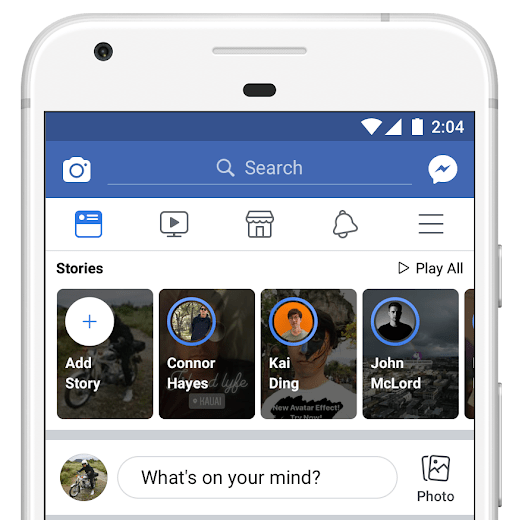
You might think it’s redundant with Instagram Stories, or just don’t want to see high school friends’ boring lives, but ephemeral Snapchat-style Stories now have 500 million daily users across Facebook and Messenger. WhatsApp’s Stories feature Status has 500 million dailies too, and Instagram hit that milestone three months ago. That’s impressive, because it means one-third of Facebook’s 1.56 billion daily users are posting or watching Stories each day, up from zero when Facebook launched the feature two years ago.

For reference, Stories inventor Snapchat has just 190 million total daily users.

Facebook Stories

CEO Mark Zuckerberg announced the new stats on today’s Facebook Q1 2019 earnings call, which showed it’s user growth rate had increased but it had to save $3 billion for a potential FTC fine over privacy practices.

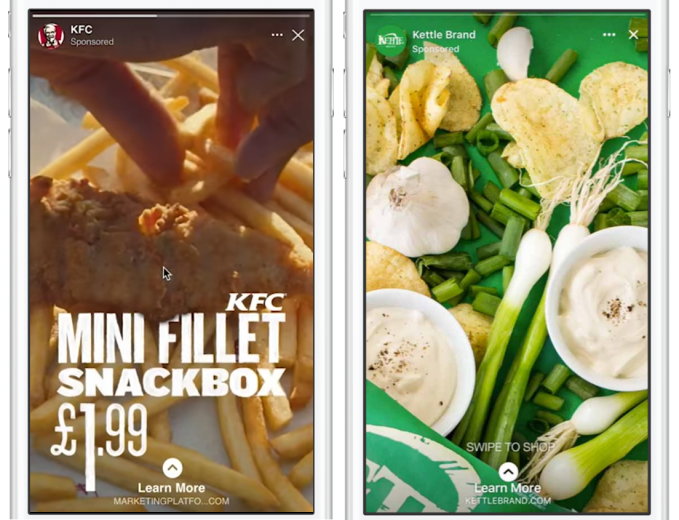
Facebook isn’t just using Stories to keep people engaged, but to squeeze more cash out of them. Today COO Sheryl Sandberg announced that 3 million advertisers have now bought Stories ads across Facebook’s family of apps. I’d expect Facebook to launch a Stories Ad Network soon so other apps can show Facebook’s vertical video ads and get a cut of the revenue.

Facebook’s aggressive move to clone Snapchat Stories not just in Instagram but everywhere might have pissed users off at first, but many of them have come around. If you give people a place to put their face at the top of their friends’ phones, they’ll fill it. And if someone dangles a window into the lives of people you know and people you wish you did, you’ll open that window regularly.

Samsung Galaxy Fold review: future shock

The Galaxy Fold has been the most polarizing product I can recall having reviewed. Everyone who saw it wanted to play with the long-promised smartphone paradigm shift. The results, on the other hand, were far more mixed.

If nothing else, the Fold has a remarkably high Q-Rating. Each person who saw me using the product had at least a vague idea of what it was all about. I honestly can’t remember the last time I’ve had that reaction with a non-iPhone device. That’s great from brand perspective. It means a lot of people are curious and potentially open to the notion that the Samsung Galaxy Fold is the future.

Of course, it also means there are a lot of people looking on if you fail.

In some ways, this past week with the Samsung Galaxy Fold has been an extremely public beta. A handful of samples were given out to reviewers. Most worked fine (mine included), but at least three failed. It’s what we in the industry call a “PR nightmare.” Or at least it would be for most companies.

Samsung’s weathered larger storms — most notably with the Galaxy Note 7 a few years back. Of course, that device made it much further along, ultimately resulting in two large-scale recalls. The nature of the two issues was also vastly different. A malfunctioning screen doesn’t put the user at bodily risk like an exploding battery. The optics on these things don’t get much worse than having your smartphone banned from planes.

As of this writing, the Fold is still set to go on sale, most likely this year. To be perfectly frank, the April 26 release date seemed overly optimistic well before the first reports of malfunctioning units. It’s never a great sign when a device is announced in February and is only made available for review a few weeks ahead of launch. It’s kind of like when a studio doesn’t let reviewers watch a film before release. It doesn’t necessarily mean it’s bad, but it’s something to keep an eye on.

That’s the thing. The Galaxy Fold is the kind of device you want badly to succeed. You want it to be great and you want Samsung to sell a billion because it’s a genuinely exciting product after a decade of phones that look mostly the same. There’s also the fact that Samsung has essentially been hyping this thing for eight years, since it debuted a flexible display at CES 2011.

In spite of that, however, the home stretch feels rushed. Samsung no doubt saw the writing on the wall, as companies like Huawei readied their own foldable. And while Royole beat the fold to market, Samsung still had a very good shot at the claim of first commercially viable foldable on the market, with a decade of Galaxy devices under its belt and hand-in-hand work with the Google team to create an Android UX that makes sense on a pair of very different screens.
[Source: iFixit]

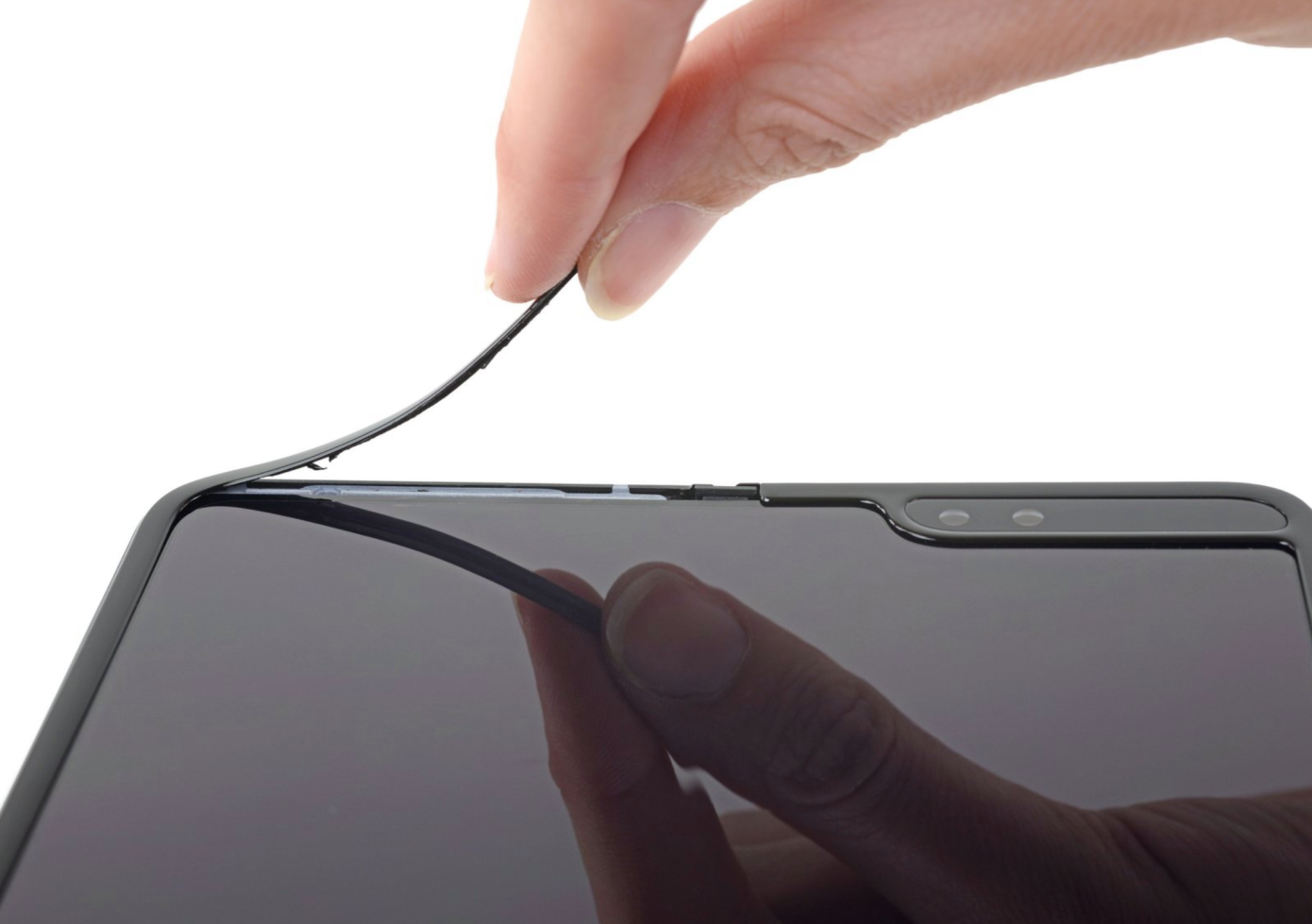
But this iFixit teardown speaks volumes. “Alarmingly” isn’t the kind of word you want/expect to hear about a company like Samsung, but there it is, followed directly by “fragile” — itself repeated five times over the course of the write-up. iFixit’s findings match up pretty closely with Samsung’s own reports:

  1. A fragile display means knocking it the wrong way can result in disaster.
  2. A gap in the hinges allows dirt and other particles to wedge themselves between the folding mechanism and screen.
  3. Don’t peel off the protective layer. I know it looks like you should, but this is probably the easiest way to wreck your $2,000 phone that doesn’t involve a firearm or blender.

What makes all of this doubly unfortunate is that Samsung has about as much experience as anyone making a rugged phone that works. I feel confident that the company will do just that in future generations, but unless the company can come back with definitive evidence that it’s overhauled the product ahead of launch, this is a difficult product to recommend.

Samsung knew the first-gen Galaxy Fold would be a hard sell, of course. The company was pretty transparent about the fact that the experimental form factor, coupled with the $1,980 price tag, meant the device will only appeal to a small segment of early adopters.

Even so, the company managed to sell out of preorders — though it didn’t say how large that initial run was. Nor are we sure how many users have canceled in the wake of this past week’s events. Certainly no one would blame them for doing so at this point.

But while the apocalyptic shit-posters among us will declare the death of the foldable before it was ever truly born, whatever doesn’t kill Samsung has only made it stronger. And this misfire could ultimately do that for both the company and the category, courtesy of its informal beta testing.

Rewind a mere week or so ago (seriously, it’s only been that long), when we finally got our hands on the Galaxy Fold. I was impressed. And I certainly wasn’t alone. Admittedly, there’s a bit of a glow that first time you see a device that’s seemingly been teased forever. The fact that it exists feels like a kind of victory in and of itself. But the Fold does an admirable job marrying Samsung’s hardware expertise with a new form factor. And more importantly, it’s real and works as advertised — well, mostly, at least.

The truth is, I’ve mostly enjoyed my time with the Galaxy Fold. And indeed, it’s been fun chronicling it on a (nearly) daily basis. There are some things the form factor is great for — like looking at Google Maps or propping it up to watch YouTube videos on the elliptical machine at the gym. There are others when the bulky form factor left me wanting to go back to my regular old smartphone — but those trade-offs are to be expected.

I both like the Fold’s design and understand the criticism. Samsung’s done a good job maintaining the Galaxy line’s iconic design language. The foldable looks right at home alongside the S and Note. That said, the rounded backing adds some bulk to the product. And while open, the device is thinner than an iPhone, when folded, it’s more than double the thickness, owing to a gap between the displays. It’s quite skinny in this mode, however, so it should slip nicely into all but the tightest pants pockets.

In practice, the folding mechanism might be the most impressive part of the product. The inside features several interlocking gears that allow the product to open and shut with ease and let users interact with the device at various states of unfold. I found myself using the device with it open at a 90-degree angle quite a bit, resting in my hand like an open book. The Fold features a pair of magnets on its edges, which let you close it with a satisfying snap. It’s weirdly therapeutic.

Really, the biggest strike against the device from a purely aesthetic standpoint is that it’s not the Mate X. Announced by Huawei a few days after the Fold’s big unveil, the device takes a decidedly more minimalist approach to the category. It’s an elegant design that features less device and more screen, and, honestly, the kind of thing I don’t think most of us expected until at least the second-generation product.

The gulf between the two devices is especially apparent when it comes to the front screen. The front of the screen is around two-fifths bezel, leaving room for a 4.6-inch display with an awkward aspect ratio. The Mate X, meanwhile, features a 6.6-inch front-facing AND 6.4-inch rear-facing display (not to mention the larger eight-inch internal display to the Fold’s 7.3).

There’s reason to recommend the Fold over the Mate X, as well. I can’t speak to the difference in user experience, having only briefly interacted with the Huawei, but the price point is a biggie. The Mate X starts at an even more absurd $2,600, thanks in part to the fact that it will only be available in a 5G version, adding another layer of niche.

That price, mind you, is converted from euros, because 1) The product was announced at MWC in Barcelona and 2) U.S. availability is likely to be a nonstarter again, as the company continues to struggle with U.S. regulators.

Of course, the Fold’s U.S. availability is also in limbo at the moment, albeit for very different reasons.

I ultimately spent little time interacting with the front screen. It’s good for checking notifications and the like, but attempting to type on that skinny screen is close to impossible, with shades of the new Palm device, which implements its own shortcuts to get around those shortcomings. The inside, meanwhile, takes a butterfly keyboard approach, so you can type with both thumbs while holding it open like a book.
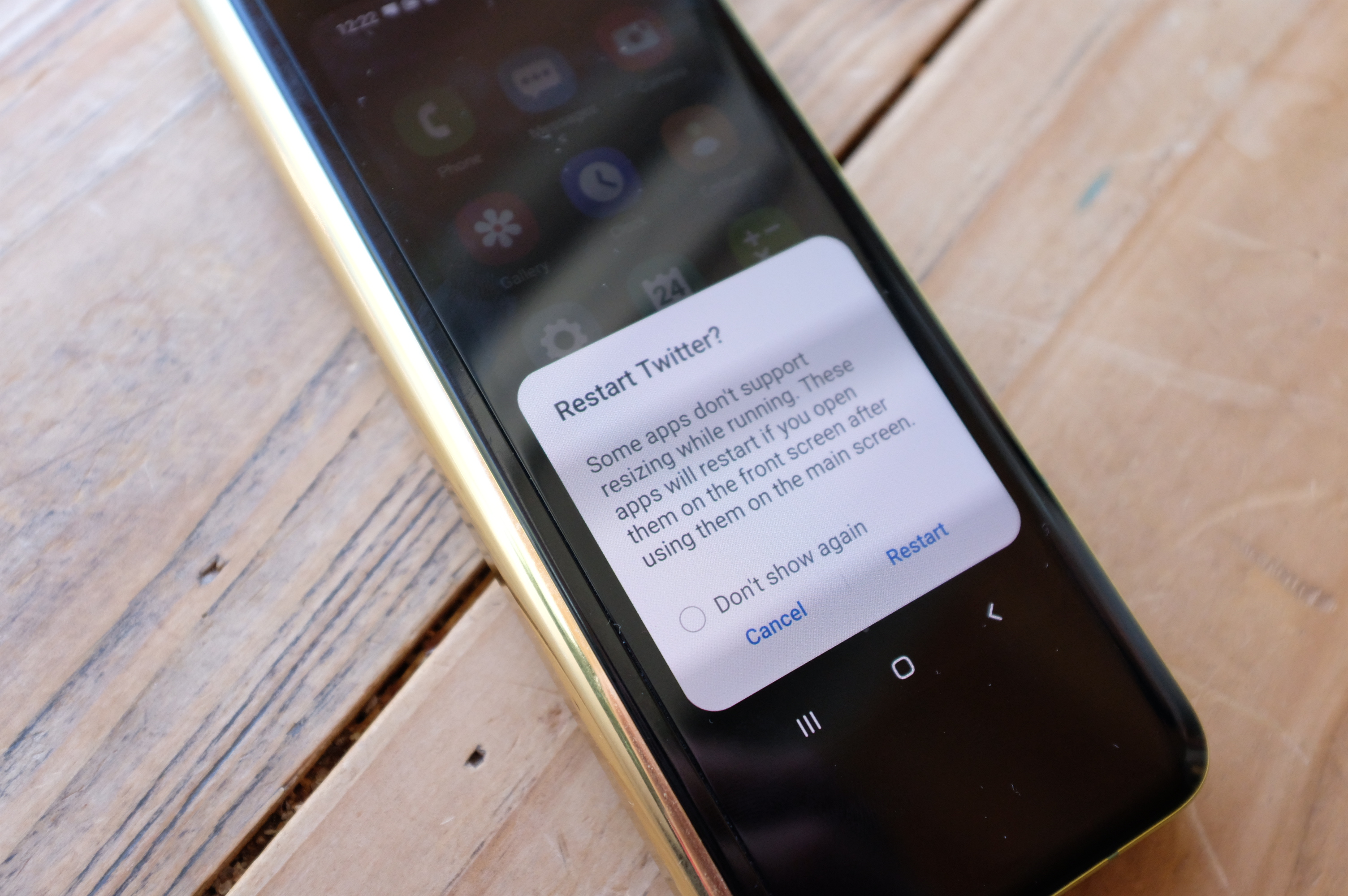
There’s also the issue of app optimization. A lot of this can be chalked up to an early version of a first-gen device. But as with every new device, the equation of how much developer time to invest is largely dependent on product adoption. If the Fold and future Fold’s aren’t a success, developers are going to be far less inclined to invest the hours.

This is most painfully obvious when it comes to App Continuity, one of the device’s primary selling points from a software perspective. When working as advertised, it makes a compelling case for the dual screens. Open something on the front and expand your canvas by unfolding the device. Google is among the companies that worked directly with Samsung to optimize apps this way, and it’s particularly handy with Maps. I used it a fair amount on my trip last week to Berkeley (shout out to the fine people at Pegasus Books on Shattuck).

When an app isn’t optimized, Samsung compels you to restart it, or else you get a nasty case of letterbox bars that retain the aspect ratio of the front screen. Continuity isn’t designed to work the other way, either — opening something on the large screen and then transferring to the front. That’s a bit trickier, as shutting the phone is designed to offer a kind of finality to that session, like hitting the power button to put the device to sleep.
I get that, and like many other pieces here, it will be interesting to see how people utilize it. Aside from the obvious hardware concerns, much of the work on the second-generation device will center around learnings from how users interact with this model. I know I surprised myself when I ended up using the 7.3-inch screen to snap photos. It felt silly — like those people who bring iPads to photograph events. But it’s ultimately a much better viewfinder than that measly 4.6-incher.

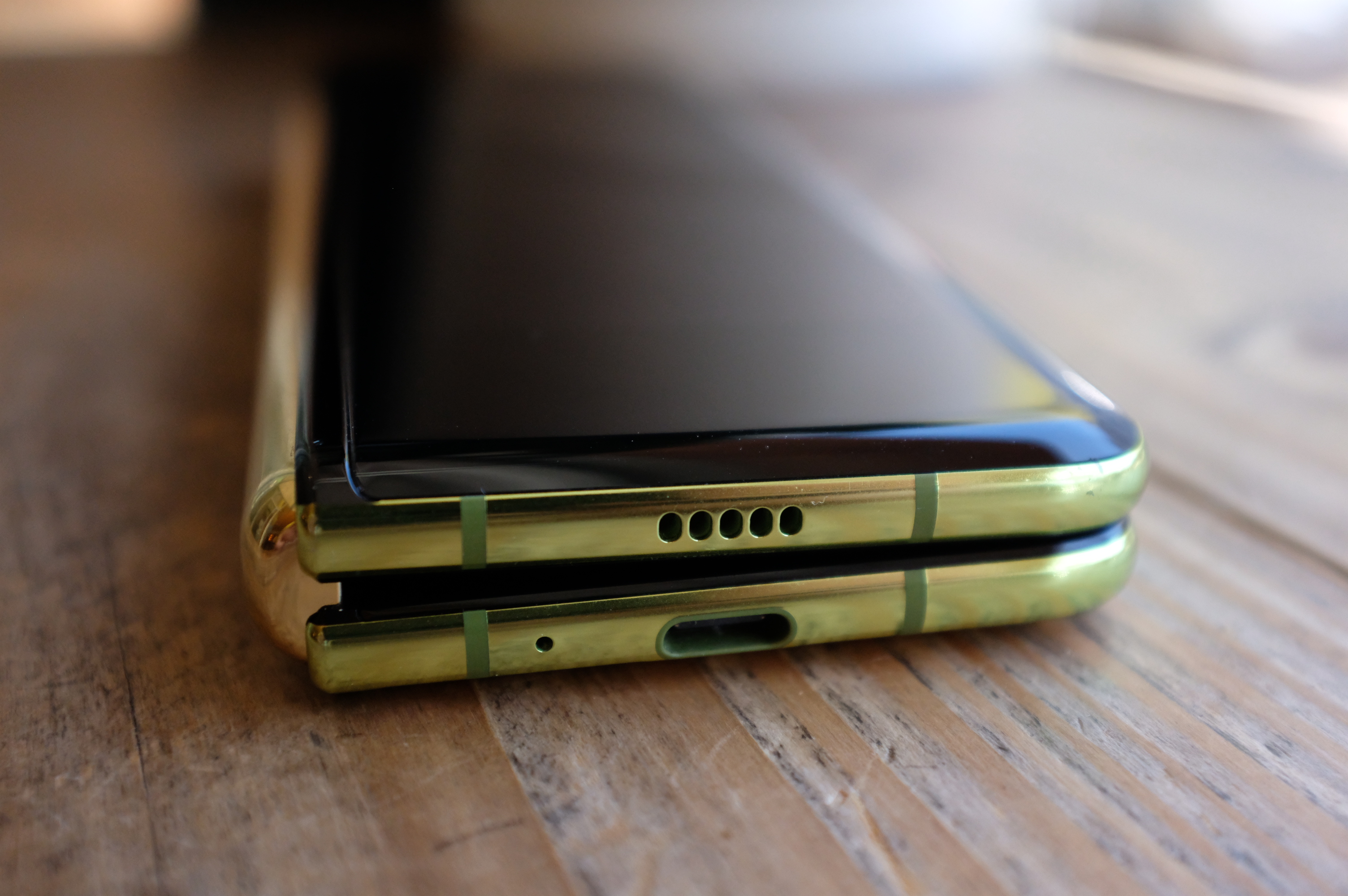
That’s really just the tip of the iceberg for the inside screen, of course. The size, which is somewhere between phablet and mini tablet, provides ample real estate that can still be held in one hand. It’s a great size for short videos. I’ve watched a lot of YouTube on this thing, though the speakers (a small series of holes on the upper and lower edges) leave a lot to be desired.
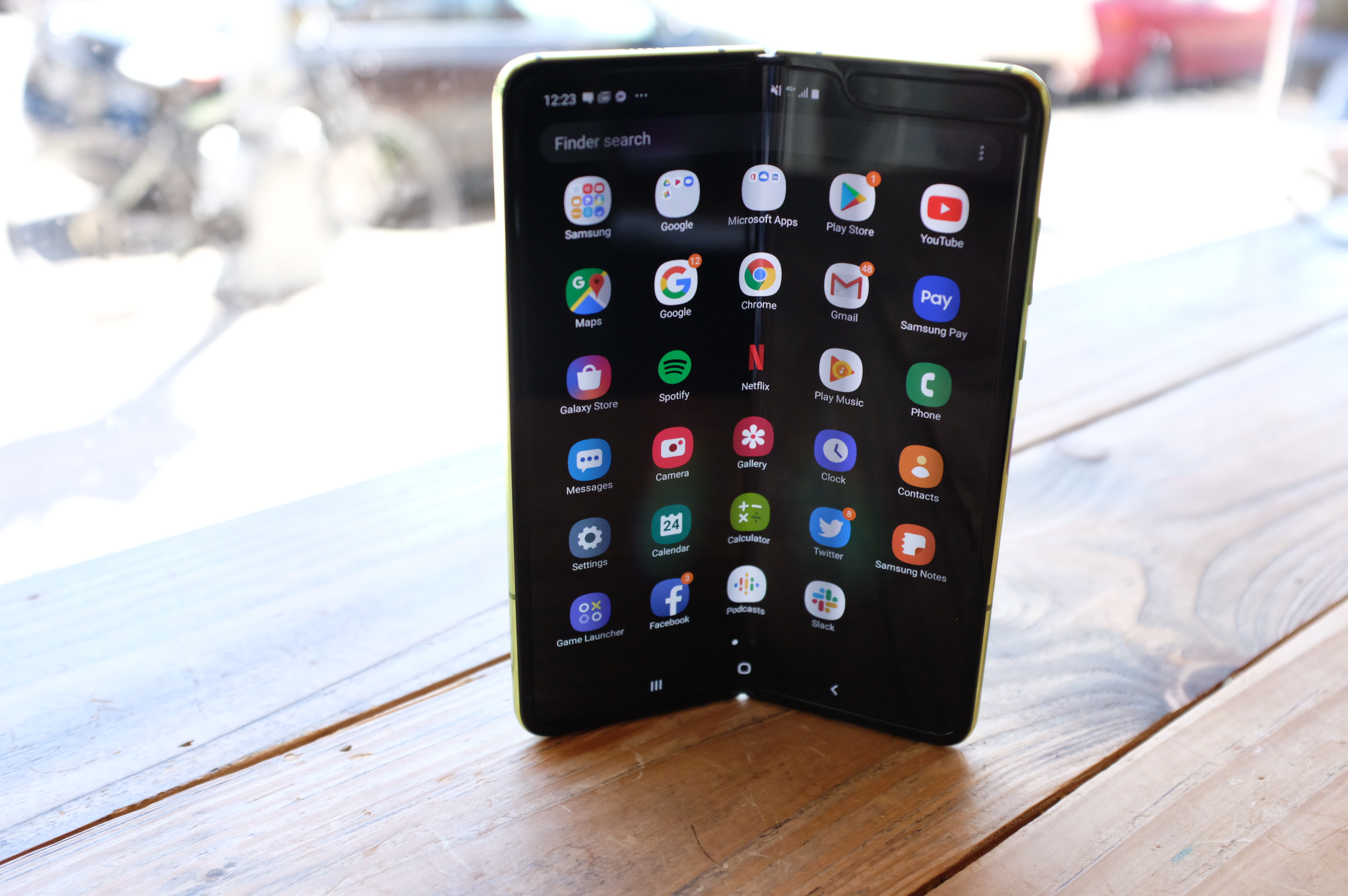
And the seam. I found myself uttering the phrase “it could be worse” a lot. Like so much of the general aesthetic (including the odd green-gold color of my Fold’s casing), it’s lighting-dependent. There are plenty of times when you don’t see it all, and other when the glare hits it and makes it look like a line right down the center.

I realized after snapping a couple of photos that it’s particularly apparent in many shots. That probably gives a false impression of its prominence. It sucks that there’s one at all, but it’s not a surprise, given the nature of the design. You mostly don’t notice it, until your finger swipes across it. And even then it’s subtle and totally not a dealbreaker, unlike, say, the massive gap that made the ZTE Axon M look like two phones pasted together.

I love the ability to stand the device up by having it open at a 90-degree angle, so I can watch videos while brushing my teeth. But this orientation blocks the bottom speakers, hampering the already iffy sound. Thankfully, your $1,980 will get you a pair of the excellent Galaxy Buds in box. It’s hard to imagine Apple bundling AirPods with the next iPhone, but I guess stranger things have happened, right?

Multi-Active Window is the other key software piece. It’s something that has been available on other Samsung devices and certainly makes sense here. Open an app, swipe left from the right side of the screen and a tray will open. From there, you can open up to three apps on the display. Once open, the windows feature a small tab at the top that lets you rearrange them.

It’s handy. I used it the most during those times I had a video playing on an exercise machine, so I didn’t have to close out of everything to check emails and Twitter. I’m a gym multi-tasker. I’m sorry, it’s just who I am now.
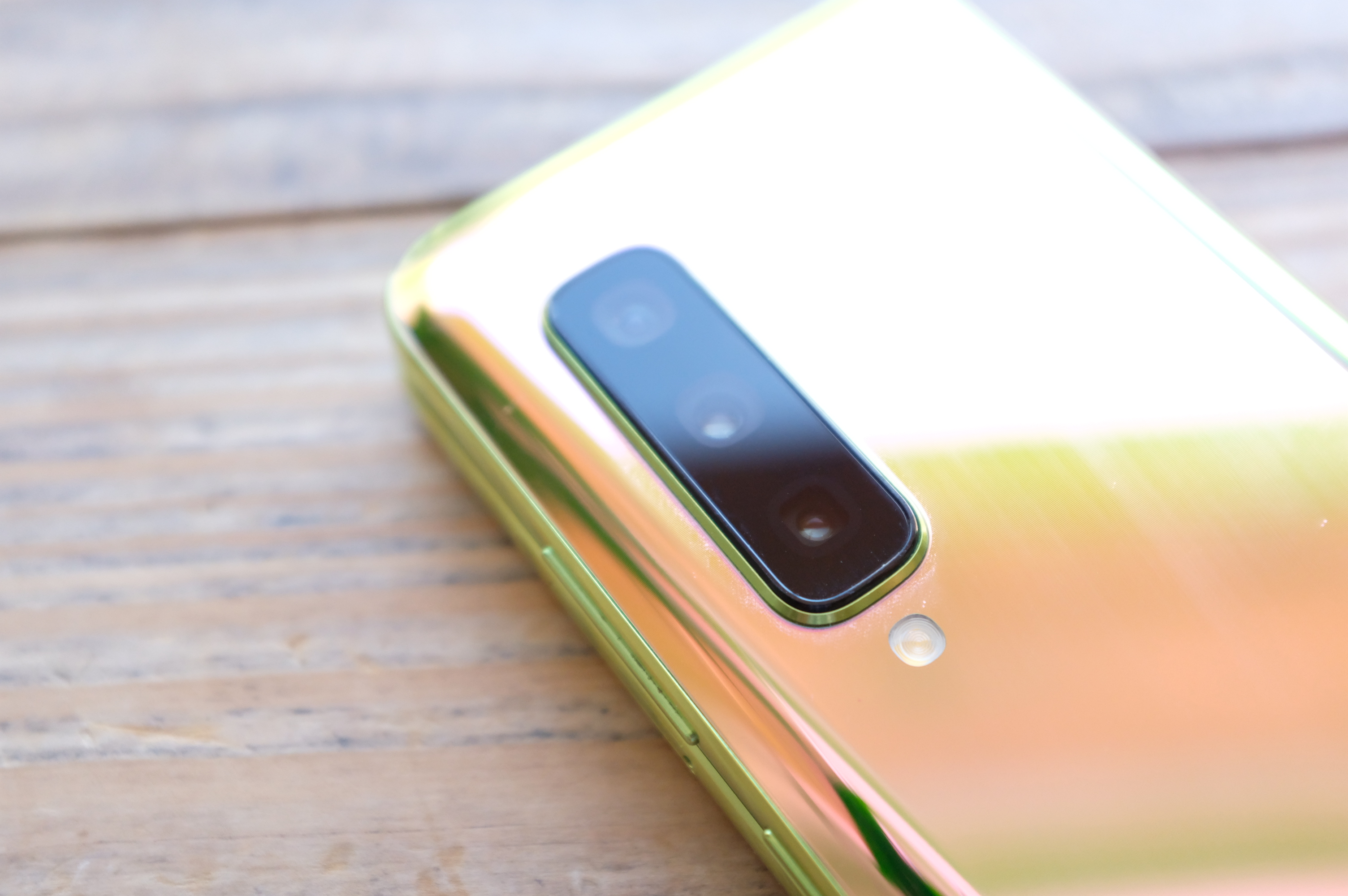
It worked quite well on the whole, courtesy of robust internals, including 12GB of RAM and a Snapdragon 855. The primary issue I ran into was how some of the apps maintained that half-screen format after I closed out and reopened. I’m sure some people will prefer that, and I’m honestly not sure what the ideal solution is there.

The Fold’s also got a beefy battery on board. Like Huawei’s, it’s split in two — one on either side of the fold. They work out to a beefy 4,380 mAh. That’s just slightly less than Huawei’s 4,500, but again, the Mate X is 5G by default — which means it’s going to burn through mAhs at a faster rate.

Ultimately, the Fold’s greatest strength is Samsung itself. I understand why you probably just did a double take there in the wake of the company’s latest hardware scandal, but the fact is that the company knows how to build phones. The Fold was very much built atop the foundation of the successful Galaxy line, even while it presents a curious little fork in the family tree.

That means a solid and well-thought-out user experience outside of the whole fold thing.

That list includes great cameras with excellent software features and clever tricks like the new Wireless PowerShare, which lets you fold up the phone and charge up those Galaxy Buds or another phone while it’s plugged in. For better or worse, it also includes Bixby. Our model was a European version that didn’t have the full version, but I think I’ve made my thoughts on the smart assistant pretty well known over the last couple of years.

The devoted Bixby button is very much here. And yes, I very much accidentally pressed it a whole bunch. The headphone jack, on the other hand, is conspicuously absent, which is no doubt a big driver behind the decision to include Galaxy Buds. The Fold is an anomaly in a number of ways, but it’s hard to shake the feeling that this might finally represent the beginning of the end for the port on Samsung’s premium devices.
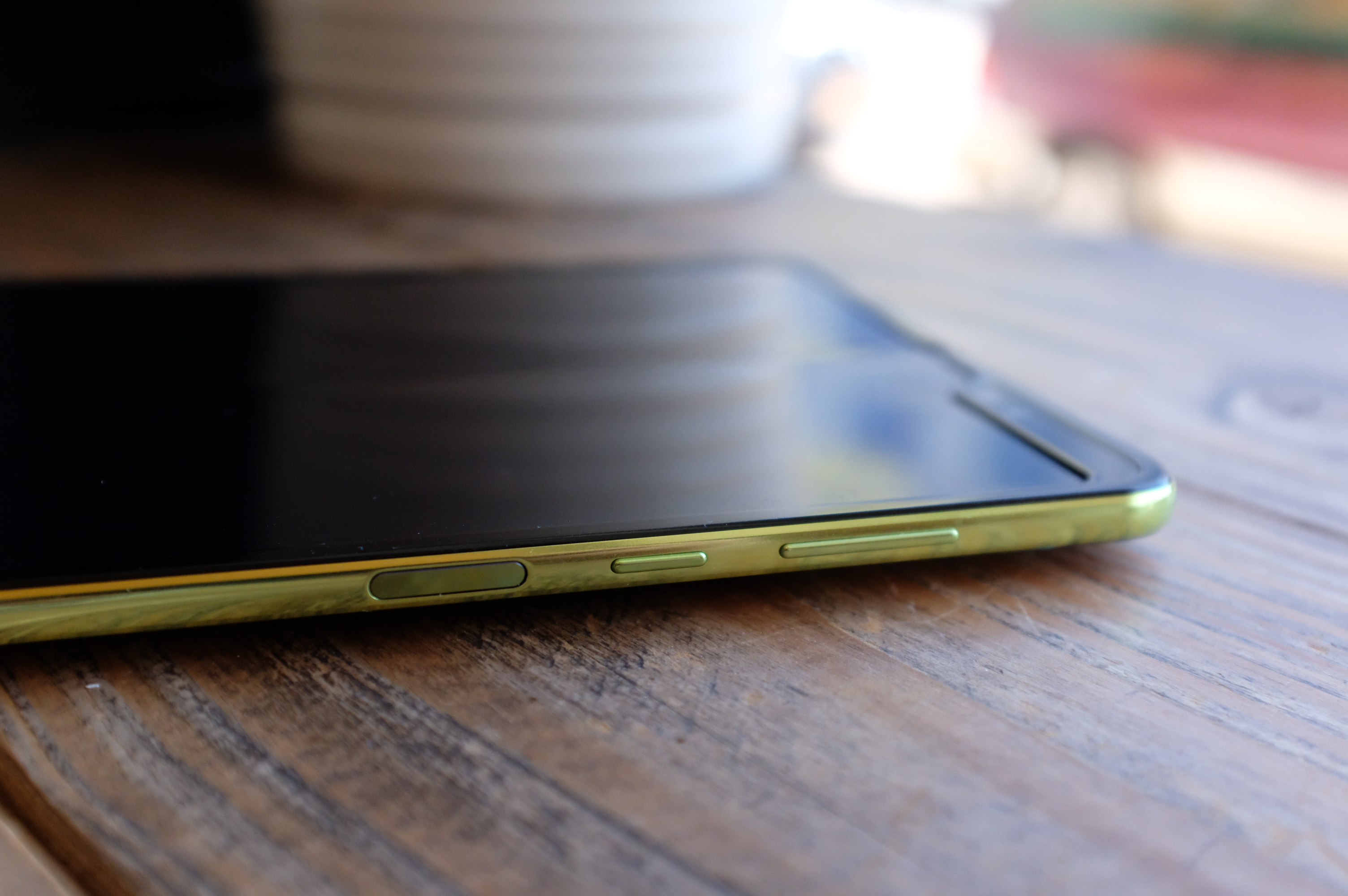
Also absent is the S Pen. The stylus began life on the Note line and has since branched out to other Samsung devices. I suspect the company would have had a tough time squeezing in space for it alongside the dual batteries, and maybe it’s saving something for future generations, but this does feel like the ideal screen size for that accessory.

I’m parting ways with the Fold this week, per Samsung’s instructions. Unlike other products, giving it up won’t feel that tough. There wasn’t a point in the past week when the Fold didn’t feel like overkill. There were, however, times when my iPhone XS screen felt downright tiny after switching back.

In many ways, the foldable phone still feels like the future, and the Fold feels like a stop along the way. There are a lot of first-gen issues that should be/should have been hammered out before mass producing this device. That said, there are certain aspects that can only really be figured out in real-world testing. Take the fact that Samsung subjected the device to 200,000 mechanical open and closes. That’s a lot, and probably more than the life of just about any of these devices, but people don’t open and close like machines. And when it comes to the screen, well, a little dirt is bound to get between the gears, both metaphorically and literally.

As I close this Galaxy Fold a final time, it seems safe to say that the device represents a potentially exciting future for a stagnant smartphone space. But that’s the thing about the future — it’s just not here yet.

Slack to extend collaboration to folks who don’t want to give up email

As Slack gathered with its growing customer base this week at the Frontiers Conference in San Francisco, it announced several enhancements to the product, including extending collaboration to folks who want to stick with email instead of hanging with their co-workers in Slack .

Some habits are tough to break, and using email as your file-sharing and collaboration tool is one of them. Email is great for certain types of communications, but it was never really designed to be a full-fledged communications tool. While a tool like Slack might not ever fully replace email, it is going after it hard.

But Andy Pflaum, director of project management at Slack, says rather than fight those folks, Slack decided to make it easier to include them, with a new email and calendar bridge that enables team members who might not have made the leap to Slack to continue to be kept in the loop.

Instead of opening Slack and seeing the thread, the message will come to these stragglers in their trusty old email inbox, just the way they like it. Earlier this month the company announced tighter integration between Slack and Outlook calendar and email (building on a similar integration with Gmail and Google Calendar), where emails and calendar entries can be shared inside Slack. Pflaum says that the company is trying to take that email and calendar bridge idea one step further.

The non-Slack users would get an email instead with the Slack thread. It bundles together multiple responses to a thread in which the person has been engaging in an email, so the recipient isn’t getting an email for every response, according to Pflaum.

The person can respond by clicking a Slack button in the email and having Slack open, or they can simply reply to the email and the response will go to Slack automatically. If they choose the former, it might be a sneaky way to get them used to using Slack instead of email, but Pflaum says that it is not necessarily the intent.

Slack is simply responding to a request by customers to have this ability because apparently there are a percentage of people who would prefer to continue working inside email. The ability to open Slack to reply will be available soon. The ability to reply to Slack with the Reply button will be available later this year.

Microsoft beats expectations with $30.6B in revenue as Azure’s growth continues

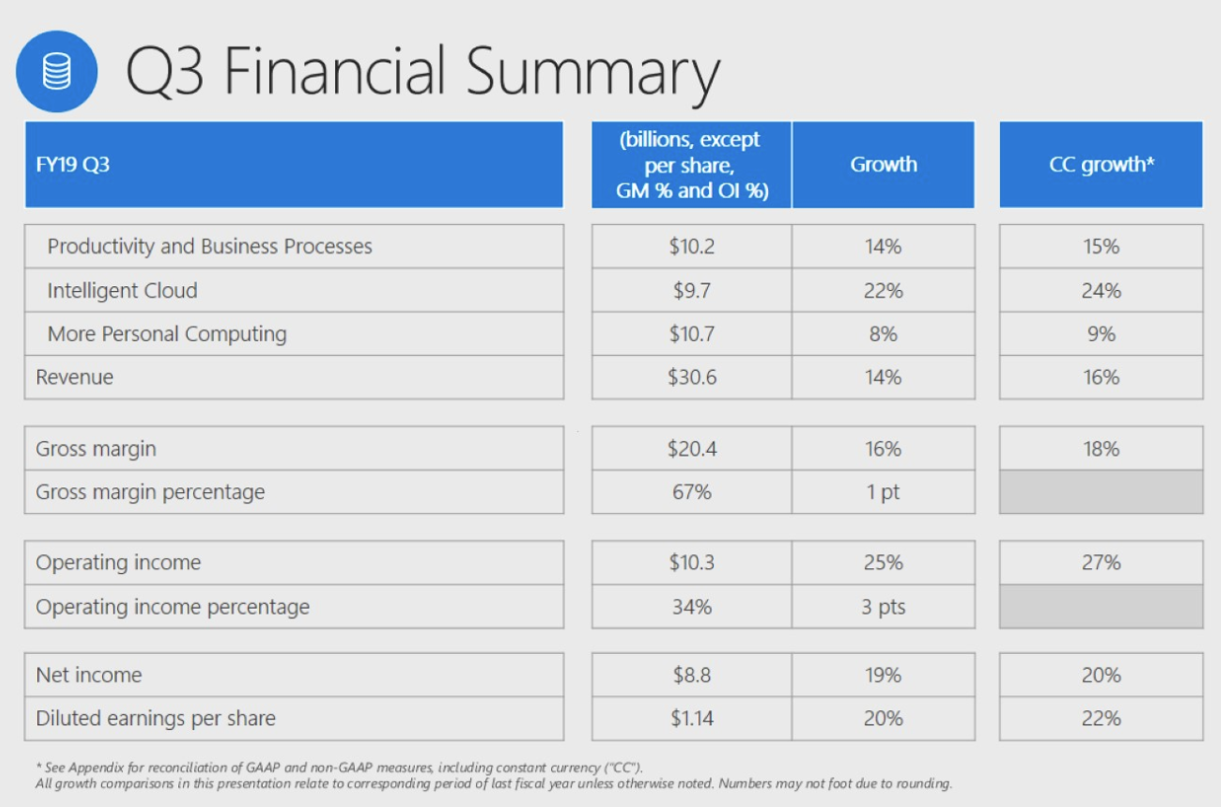
Microsoft reported its quarterly earnings for Q3 2019 today. Overall, Wall Street expected earnings of about $1 per share and revenue of $29.84 billion. The company handily beat this with revenue of $30.6 billion (up 14 percent from the year-ago quarter) and earnings per share of $1.14.

With Microsoft focusing heavily on its cloud business, with both Azure and its other cloud-based services, it’s no surprise that this is also what Wall Street really cares about. The expectation here, according to some analysts, was that the company’s overall commercial cloud business would hit a run rate of about $38.5 billion. Those analysts we’re off by only a tiny bit. Microsoft today reported that its commercial cloud run-rate hit $38.4 billion.

And indeed, Microsoft Azure had a pretty good quarter, with revenue growing 73 percent. That’s a bit lower than last quarter’s results, but only by a fraction, and shows that there is plenty of growth left for Microsoft’s cloud infrastructure business.

Azure’s growth slowed somewhat in recent quarters. In some ways, that’s to be expected, though. Microsoft’s cloud is now a massive business, and posting 100 percent growth when you have a run rate of almost $40 billion becomes a bit harder.

“Demand for our cloud offerings drove commercial cloud revenue to $9.6 billion this quarter, up 41 percent year-over-year,” said Amy Hood, executive vice president and chief financial officer of Microsoft. “We continue to drive growth in revenue and operating income with consistent execution from our sales teams and partners and targeted strategic investments.”

The company’s “intelligent cloud” segment, which includes Azure and other cloud- and server-based products, reported revenue of $9.7 billion, up 22 percent from the year-ago quarter.

Microsoft’s productivity applications also fared well, with total revenue up by 14 percent to $10.2 billion. Here, revenue from LinkedIn also increased by 27 percent and the company highlighted that LinkedIn sessions also increased 24 percent.

Other highlights of the report include an increase in Surface revenue of 21 percent, which was expected, given the number of new devices the company released in recent quarters.

“Leading organizations of every size in every industry trust the Microsoft cloud. We are accelerating our innovation across the cloud and edge so our customers can build the digital capability increasingly required to compete and grow,” said Satya Nadella, CEO of Microsoft.

For more financial details, you can find the full report here.

Facebook reserves $3B for FTC fine, but keeps growing with 2.38B users in Q1

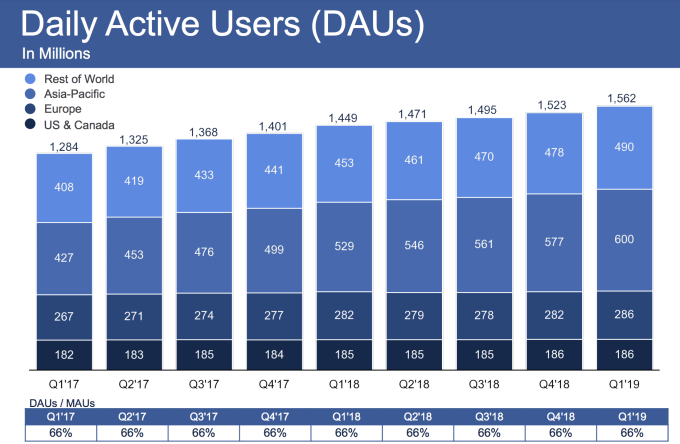
A massive penalty hangs over Facebook’s head, but it otherwise had a very strong Q1 earnings report. Facebook reached 2.38 billion monthly users, up 2.5 percent from 2.32 billion in Q4 2018 when it grew 2.2 percent, and it now has 1.56 billion daily active users, up 2.63 percent from 1.52 billion last quarter when it grew 2 percent. Facebook pulled in $15.08 in revenue, up 26 percent year-over-year compared to Refinitiv’s consensus estimates of $14.98 billion in revenue.

Facebook recorded earnings per share of $0.85 compared to estimates of $1.63 EPS. However, that’s because Facebook has set aside $3 billion to cover a potential FTC fine that it’s still resolving. Without that fine, it would have had an EPS of $1.89. Despite the set-aside, Facebook still earned $2.429 billion in profit, though that’s down from $4.988 a year ago and $6.8 billion in Q4 2018.

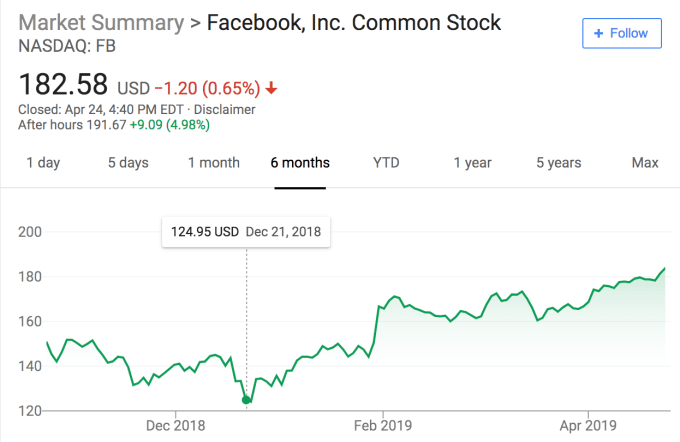
Facebook’s share price rose 8.3 percent to $197.84 after closing before earnings at $182.58, way up from its recent low of $124.06 in December. Wall Street seems to have already priced in the potential FTC fine. Facebook has agreed to strict oversight of how it handled user privacy in a 2011 deal with the FTC. It promised to not misrepresent its privacy practices or change privacy controls without user permission, and it’s now negotiating the fine for potentially breaking those terms.

Facebook wrote in its earnings release about the FTC fine that:

“In the first quarter of 2019, we reasonably estimated a probable loss and recorded an accrual of $3.0 billion in connection with the inquiry of the FTC into our platform and user data practices, which accrual is included in accrued expenses and other current liabilities on our condensed consolidated balance sheet. We estimate that the range of loss in this matter is $3.0 billion to $5.0 billion. The matter remains unresolved, and there can be no assurance as to the timing or the terms of any final outcome.”

It’s possible Facebook escapes with a lesser fine that would likely still dwarf Google’s $22.5 million penalty for violating an FTC privacy deal. But it also might have to drag down a future quarter of earnings if the fine ranges as high as $5 billion or larger. Though Facebook does have $45.2 billion in cash and securities on hand to pay that fine and make any necessary acquisitions. Facebook’s headcount grew 36% year-over-year to 37,773 as it staffs up its security team, but it still has a 22 percent operating margin.

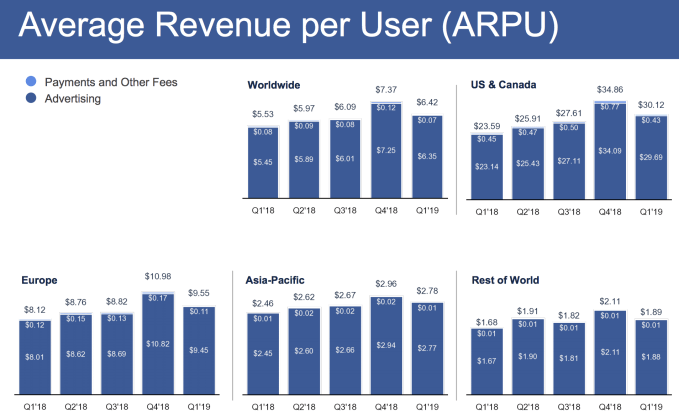
Facebook has managed to hold on to its 66 percent daily to monthly user ratio, showing people aren’t necessarily using it less despite all the backlash. It added 39 million daily users, compared to Snapchat’s addition of 4 million in Q1. But Facebook failed to grow past its 186 million daily user count in the US & Canada where it got stuck last quarter, but at least it added 4 million in its lucrative Europe market, plus it had atypically large gains in Asia-Pacific and the Rest Of World regions. As for monetization, Facebook made modest gains in average revenue per user across markets compared to Q3 2018 (excluding the holiday-laden Q4). Europe did especially well, growing ARPU 8.2 percent.

Zooming out, Facebook now has over 2.7 billion total mothly users across its family of Facebook, Messenger, Instagram, and WhatsApp, the same as last quarter. 2.1 billion people use at least one of those apps daily, up from 2 billion last quarter. Instagram Stories, WhatsApp Status, and Facebook Stories on Facebook and Messenger combined each now have 500 million daily users. Facebook also now has 3 million advertisers buying Stories ads across its apps, so the ephemeral format will likely start to contribute meaningful revenue soon.

Color From The Earnings Call

In March, Zuckerberg announced plans for a massive privacy-centric overhaul of Facebook to turn it from just a townsquare into also a “living room”. That means unifying its messaging apps with a backend that supports end-to-end encryption, and promoting ephemerality in content sharing and communication. That could help deter calls for regulation, make Facebook harder to break up, and help it stay ahead of competitors like Snapchat, but will also be a massive product and engineering undertaking.

Today, Zuckerberg focused on providing more details to this plan to expand privacy, encryption, impermanence, safety, interoperability, and secure data storage. He stressed that given people traditionally spend more time communicating and consuming content privately than publicly, strengthening Facebook’s “living room” could boost its business. Zuckerberg noted that since Facebook already doesn’t use messaging content for ad targeting and recent content is more useful for its business, encryption and impermanence shouldn’t be a big risk either. Refusing to store data in countries with poor records of privacy could lead to Facebook being banned there, which Zuckerberg admitted is a major business threat, but one it’s grappled with over content policies for years.

In fact, impermanence is already earning money for Facebook. It said that Instagram Stories was the greatest contributor of additional ad impressions this quarter. And while the Facebook and Instagram feeds are already jammed full of ads with little room for more, Facebook says there’s still room to significantly increase Instagram Stories ad load.

Another highlight of the call was Zuckerberg’s discussion of Facebook’s payments strategy. He confirmed that Facebook plans to build out ways for people to pay merchants through its messaging apps. “So I think that what we’re going to end up seeing is building out payments, which is going to end up being something that we do country by country . . . The goal is to have something where you could do discovery through the broader townsquare-like platforms like Instagram and Facebook, and then you can complete the transactions and follow up with businesses individually and have an ongoing relationship through Messenger and WhatsApp.”

This is the first earnings report of a full quarter following Facebook’s worst-ever security breach in September that impacted 50 million users, shaking confidence in the social network’s privacy and security. It’s also the first full quarter in which Facebook sold its own branded hardware — its Portal video chat device that was well received by critics except for the fact that it was made by Facebook.

Yet the defining story continues to be Facebook’s struggle with claims that its user research and developer platform efforts endangered user privacy and steamrolled competitors in search of growth. That includes TechCrunch’s big scoop that Facebook was paying teens to snoop on their data with a VPN app, which eventually led Facebook to shut down its Onavo user surveillance apps. The fact that Facebook isn’t losing massive numbers of users after years of sustained scandals is a testament to how deeply it’s woven itself into people’s lives.

NASA and FEMA are contingency planning for a potential asteroid armageddon

When it comes to planning for a potential asteroid strike on planet Earth, the U.S. National Aeronautics and Space Administration and Federal Emergency Management Agency don’t want to miss a thing.

Alongside international partners like the European Space Agency’s Space Situational Awareness-NEO Segment and the International Asteroid Warning Network (IAWN), NASA’s Planetary Defense Coordination Office will participate in a “tabletop exercise” that will simulate a scenario for how to respond to an asteroid on an impact trajectory with the Earth (it’s unclear whether Billy Bob Thornton, Bruce Willis, Ben Affleck or Liv Tyler will participate).

NASA and its partners have actually been on the lookout for potentially calamitous near-Earth objects (which are asteroids, comets or unidentified objects that come within 30 million miles of Earth) for more than 20 years.

The tabletop exercise is a simulation used in disaster management planning to help inform organizations that would be relevant to mobilization and response of important aspects of a possible disaster and identify ways to respond.

Participants in the “Armageddon” exercise (not its official name), will use a scenario developed by NASA’s Jet Propulsion Laboratory’s Center for NEO Studies (CNEOS).

“These exercises have really helped us in the planetary defense community to understand what our colleagues on the disaster management side need to know,” said Lindley Johnson, NASA’s Planetary Defense Officer, in a statement. “This exercise will help us develop more effective communications with each other and with our governments.”

Simulations like this are actually required by the government thanks to the National Near-Earth Object Preparedness Strategy and Action Plan.

The scenario these organizations are going to wrestle with involves the fictional identification of NEO that was identified on March 26, and that astronomers believe may be potentially hazardous to Earth. The scientists speculate that the asteroid could pose a 1 in 100 chance of hitting the Earth in 2027 (the 1 in 100 chance is actually the real threshold for initiating plans by the global community to respond to an asteroid strike).

From there, participants in the simulation will discuss potential preparations for reconnaissance and deflection missions — as well as planning to mitigate the potential impact from a strike.

“NASA and FEMA will continue to conduct periodic exercises with a continually widening community of U.S. government agencies and international partners,” said Johnson, in a statement. “They are a great way for us to learn how to work together and meet each other’s needs and the objectives laid out in the White House National NEO Preparedness Action Plan.”

This isn’t the first time NASA has joined a NEO impact exercise. So far, NASA has completed six impact exercises: three international exercises (in 2013, 2015, and 2017) and another three with FEMA (those included representatives from the Department of Defense and the State Department, as well).

“What emergency managers want to know is when, where and how an asteroid would impact, and the type and extent of damage that could occur,” said Leviticus Lewis of the Response Operations Division for FEMA.

NASA did not say whether it has put any contingency plans in place for an “Independence Day” scenario.

41% of voice assistant users have concerns about trust and privacy, report finds

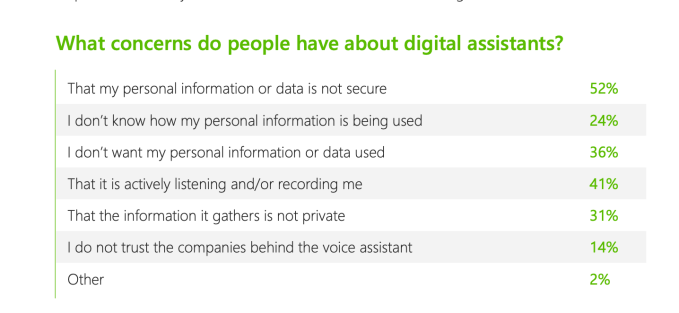
Forty-one percent of voice assistant users are concerned about trust, privacy and passive listening, according to a new report from Microsoft focused on consumer adoption of voice and digital assistants. And perhaps people should be concerned — all the major voice assistants, including those from Google, Amazon, Apple and Samsung, as well as Microsoft, employ humans who review the voice data collected from end users.

But people didn’t seem to know that was the case. So when Bloomberg recently reported on the global team at Amazon that reviews audio clips from commands spoken to Alexa, some backlash occurred. In addition to the discovery that our AI helpers also have a human connection, there were concerns over the type of data the Amazon employees and contractors were hearing — criminal activity and even assaults in a few cases, as well as the otherwise odd, funny or embarrassing things the smart speakers picked up.

Today, Bloomberg again delves into the potential user privacy violations by Amazon’s Alexa team.

The report said the team auditing Alexa commands has had access to location data and, in some cases, can find a customer’s home address. This is because the team has access to the latitude and longitude coordinates associated with a voice clip, which can be pasted into Google Maps to tie the clip to where it came from. Bloomberg said it wasn’t clear how many people have access to the system where the location information is stored.

This is precisely the kind of privacy violation that could impact user trust in the popular Echo speakers and other Alexa devices — and, by extent, other voice assistant platforms.

While some users may not have realized the extent of human involvement on Alexa’s backend, Microsoft’s study indicates an overall wariness around the potential for privacy violations and abuse of trust that could occur on these digital assistant platforms.

For example, 52 percent of those surveyed by Microsoft said they worried their personal information or data was not secure, and 24 percent said they don’t know how it’s being used. Thirty-six percent said they didn’t even want their personal information or data to be used at all.

These numbers indicate that the assistant platforms should offer all users the ability to easily and permanently opt out of the data collection practices — one click to say that their voice recording and private information will go nowhere, and will never be seen.

Forty-one percent of people also worried their voice assistant was actively listening or recording them, and 31 percent believed the information the assistant collected from them was not private.

Fourteen percent also said they didn’t trust the companies behind the voice assistant — meaning Amazon, Google and all the others.

“The onus is now on tech builders to respond, incorporate feedback and start building a foundation of trust,” the report warns. “It is up to today’s tech builders to create a secure conversational landscape where consumers feel safe.”

Though the study indicates people have worries about their personal information, it doesn’t necessarily mean people want to entirely shut off access to that data — some may want to offer their email and home address so Amazon can ship an item to their home, when they order it by voice, for instance. Other people may even opt into sharing more information if offered a tangible reward of some kind, the report also notes.

Despite all these worries, people largely said they performed tasks using voice instead of keyboards and touch screens. Even at this early stage, 57 percent said they would rather speak to a digital assistant; and 34 percent say they like to both type and speak, as needed.

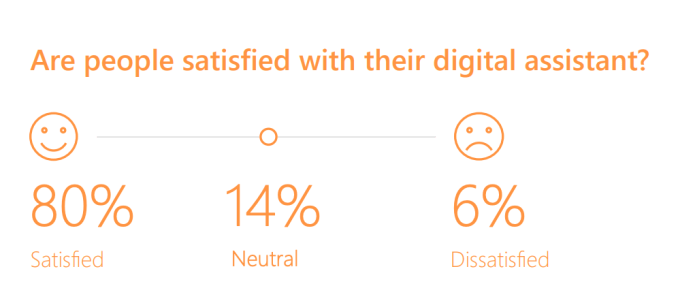
A majority — 80 percent — said they were “somewhat” or “very” satisfied with their digital assistants. More than 66 percent said they used digital assistants weekly, and 19 percent used them daily. (This refers to not just voice, but any digital assistant, we should note.)

These high satisfaction numbers mean digital and voice assistants are not likely going away, but the mistrust issues and potential for abuse could lead consumers to decrease their use — or even switch brands to one that offered more security in time.

Imagine, for example, if Amazon et al. failed to clamp down on employee access to data, as Apple launched a mass market voice device for the home, similar in functionality and pricing to a Google Home mini or Echo Dot. That could shift the voice landscape further down the road.

The full report, which also examines voice trends and adoption rates, is here.

Robotics VCs on what’s real, what’s coming, and what to keep in mind

Last week, at TechCrunch’s robotics event at UC Berkeley, we sat down with four VCs who are making a range of bets on robotics companies, from drone technologies to robots whose immediate applications aren’t yet clear. Featuring Peter Barrett of Playground Global, Helen Liang of FoundersX Ventures, Eric Migicovsky of Y Combinator and Andy Wheeler of GV (pictured above), we covered a lot of terrain (no pun intended), including whether last-mile delivery robots make sense and how much robots should be expected to do without human intervention.

We also discussed climate change and how it factors into their bets, and why the many private enterprises focused on creating fully automated vehicles may need to do much more to empower the cities in which they plan to operate. You can find excerpts of our talk below. And for access to the full transcript, become a member of Extra Crunch. Learn more and try it for free.


TC: How do you think about investing in the here and now, versus the future (which is complicated for VCs, given that venture funds need to produce returns within a ten-year window, typically):

PB: One of the challenges with investing in robotics is that robotics companies do tend to take a lot longer to mature than your average enterprise SaaS company. There are some classes of investments that we know the technology works; it’s just a question of commercializing it and bringing it to market, and Canvas [a Playground-backed company that makes autonomous warehouse carts and was just acquired by Amazon] did an extraordinary job of finding a market that existed and had technology in hand that would solve that problem.

There’s other stuff like the amazing work that the folks are doing at Agility [Robotics] with a biped that can operate for many hours in unstructured human environments that today is really, candidly, a research robot, and to reach its long-term aspirations, there’s a whole other set of technologies that we’ll need to develop as the company matures.

We think about blending the stuff that’s very impactful but is going to take a long time because it’s fundamentally a new science and technology that needs to be created, [with] immediate applications of technologies that are proven today, that we’re deploying against real markets.

AW: As for whether we try to build a portfolio where there are exits at different stages, generally, when I’m looking to invest in a robotics thing, I understand that the timeframes can be fairly long, and so what we’re looking for are things that really are going to be very large opportunities — that can generate billion-dollar-plus exits.

TC: A growing number of small last-mile delivery robots has attracted funding. Helen, your firm is an investor in one of these startups, Robby. What’s the appeal?

HL: We look at where we see a pain point in the market. During our team meetings on Fridays, we always use DoorDash. It feels awkward when we order a $100 meal, and the delivery person has driven a long way. We’ll give him a $15, but it’s still [tricky for that person] in terms of economics. If you have a central station for the food delivery, and robots can handle that last-mile delivery, we think that’s a more cost-effective approach.

Robby has partnered with PepsiCo [to delivering snacks to students attending the University of the Pacific in Stockton, Ca.] that makes it more like a vending machine, and we think that’s an interesting market, too. We’ll see how fast adoption will happen.

EM: YC is an investor in Robby as well, and we think of this as kind of the perfect example of how hackers can get into a fairly complex industry. When you look at some robotics and specifically autonomous vehicles, you see extremely large investments going into some of the some of the big players, but then at the same time, you see groups and hackers that are able to use off-the-shelf technology to solve real problems that affect businesses or people, and build services or products that that are valuable. We’ve seen this over and over.

You don’t have to be looking for a large VC investment to compete in the space. It is possible to stay frugal stay nimble and build something on a small scale to demonstrate that you found a problem that people are willing to pay money to solve. Then, if you’re interested, [you can] pursue larger VC investment or not. It’s kind of open right now.

TC: VCs we’ve talked with in the past have suggested that in robotics, they often see cool ideas for which there isn’t necessarily a market or big market need. Is this also your experience?

PB: This is a common pattern where there was some mechanism, some capability of the robot, some feat of dexterity or something [and founders think, ‘That’s really cool, I’m going to make a company out of it.’ But we think about it in terms of, what do you want from the robots? What’s the outcome that everybody agrees is worthwhile? And then, how do you find and build companies to achieve those goals?

One thing we’re struggling with right now is that there’s no real hardware or software platforms. You think about 10 years hence [and] the kinds of things we’ll be investing in, [and it’s] robotics applications that are aggregates of neural networks and some explicit software bound together in some form that can be delivered, so a large enterprise can use an application and not have everybody start from first principles. Because right now, when you built a robotics application, you make all the hardware, you make all the software. All the intellectual and actual capital [money] gets dissipated, building and rebuilding those same things. So robotics applications over time will be investable, much more like the way we invest in software, and that will allow smaller units of creativity to produce useful products.

TC: Andy, how long do you think it’s going to take until we get there?

AW: I think I think we’re making we’re making steady progress on that front. To your earlier question, this space has a lot of folks that are building technology a bit in search of a problem. That’s a common thing in startups generally. I would encourage everybody who’s looking to build a startup in the space is to really find a burning business problem. In the course of solving those [problems], people will build these platforms that Peter was talking about, and we’ll eventually get there in terms of [founders] just having to focus on the application layer.

TC: There are so many buckets: delivery robots, self-driving trucks. Both relate in ways to the overarching problem for our age, which is climate change. How much do you factor climate change into the investing decisions that you make?

PB: When we look at applications and robotics in agricultural, a lot of [our questions are] around how do you deal with a minimum carbon footprint, [and] how you replace workers who are missing. And dealing with climate change will be increasingly be a central thought in what we want from our robots. [After all] what we want from them is the ability to maintain or improve the lifestyles we have without further unwinding the environment.

TC: We talked backstage, and you think we are over-indexing on autonomy as the answer.

PB: When we think about autonomy, it’s not clear how autonomy helps cities. . . There are absolutely applications for autonomy, [including] on a farm or in a logistics environment. I think we still really don’t know how to do Level 5 [which is complete automation, requiring zero human assistance]. And I don’t think we know whether it’s exponentially hard or asymptotically. I think it’s decades before there’s any significant Level 5.

[In the meantime, if] we cared about safety, we’d install roundabouts or lower the blood alcohol limit and not try and make a sentient vehicle that drives on the road the way we do, right?

I’d much rather see having the city collaborate with the vehicles and instrument the city to collaborate with clever vehicles for the benefit of everybody who lives there. But that’s not Level 5 autonomy as the way we think of it

EM: It’s slightly interesting that autonomous vehicles, specifically the individual passenger car, evolved in America, because it’s one of the countries that has the least public transport per capita. And that that’s one of the things that the industry has to acknowledge — that there are other options that can be blended into the transport solutions for cities.

It seems like it might be happening because it’s something that an individual can take somewhat control over. You can’t own a bus, but you can own or [rent] a self-driving car.

PB: Or [an electric] scooter or a bike, right. The future of mobility is going to be a blending of all of these things. But not taking advantage of a logistics platform in a city means you’re kind of doing it the hard way, trying to make a robot to have all the human priors required to drive safely. And it’s just not clear that we know how to do that yet.

TC: Andy, GV is a big investor in Uber. What what’s your thinking? Does the city need to be a kind of central brain in order for these private enterprises to work effectively?

AW: I don’t think it’s a strict requirement at all. We’ve seen success with with self-driving trials where the city is not super involved from an infrastructure perspective, I do think it makes it a lot easier if that’s the case, though.