Yandex Self-Driving Group partners with GrubHub to bring robotic delivery to college campuses

Yandex Self-Driving Group, a unit of Yandex, the publicly-traded Russian tech giant, has announced a partnership with food delivery service GrubHub to be its multi-year robotic delivery provider across American college campuses. Yandex hopes to reach over 250 campuses over the course of this partnership, beginning with dozens of robots in the fall, according to a statement from Yandex Self-Driving CEO Dmitry Polishchuk.

Last September, Yandex’s self-driving unit spun out from a joint venture with Uber. In May this year, the company said it clocked a total 7 million autonomous miles, which was more than Waymo at the time. Yandex has been developing full-sized autonomous vehicle technology since 2017, which it’s tested in Tel Aviv, Israel and Ann Arbor, Michigan, as well as Innopolis, Russia via its robotaxi fleet. The company first began public deliveries on its six-wheeled, 150-pound robot, the Yandex.Rover, last April in Skolkovo, Russia, using the same self-driving technology stack as the company’s autonomous cars.

“The technology is definitely very complicated, but we can see that it has already reached the level when it can start being deployed either in form of delivery robots or robotaxi services in small towns or specific districts of big cities,” a spokesperson told TechCrunch. “We believe that in three to four years the technology will reach the level where the car can drive as safe and as efficient as an experienced human driver in rush hour in the center of cities like Moscow or New York.”

Yandex’s approach to commercialization is unique. Of all the companies developing autonomous technology for cars, Yandex is going to market with its robots first, “and it seems to be a pretty efficient way to do it,” said the spokesperson. “It took us two years to get from the idea of making a delivery robot in June 2018 to signing such a solid commercial contract,” she said.

The robots have already been tried and tested commercially in Russia via the food delivery platform Yandex.Eats and the express grocery delivery platform Yandex.Lavka. According to a statement by the company, Yandex.Rovers, which move at three to five miles per hour, can navigate pavements, pedestrian areas and crosswalks. They’re ideal for campus areas not accessible by car, and the service has already been fully integrated into the GrubHub app. From the user experience side of things, once the rover reaches its destination, the customer receives a push notification and comes outside to open the robot’s hatch through the app.


Yandex says its delivery robots can operate day or night, rain or snow, in controlled or uncontrolled pedestrian crossing scenarios. The rovers operate autonomously most of the time, but if they get into a complicated situation, like getting ridden by a drunk college student, they may send a request for remote assistance, according to a spokesperson for the company.

The company told TechCrunch it has not yet branded its robots to reflect the Grubhub partnership, so hopefully its goal of getting dozens of vehicles out this fall is not too much of a reach.

“Together with Yandex, we’re changing the way college students experience food delivery,” said Brian Madigan, vice president of corporate and campus partners at Grubhub, in a statement. “We’re excited to offer these cost-effective, scalable and quick food ordering and delivery capabilities to colleges and universities across the country that are looking to adapt to students’ unique dining needs. While college campuses are notoriously difficult for cars to navigate, specifically as it relates to food delivery, Yandex robots easily access parts of campuses that vehicles cannot — effectively removing a major hurdle universities face when implementing new technology.”

Now the question is, with a post-Covid fall semester around the corner, how many of those robots will make it back to Yandex after the frat boys decide the new hazing structure involves successfully stealing or vandalizing a robot?

Yandex said it also intends to continue developing its robotaxi service as it moves to commercialize more arms of the business and use its AV tech in a range of scenarios.

Nextdoor’s SPAC investor deck paints a picture of sizable scale and sticky users

The SPAC parade continues in this shortened week with news that community social network Nextdoor will go public via a blank-check company. The unicorn will merge with Khosla Ventures Acquisition Co. II, taking itself public and raising capital at the same time.

Per the former startup, the transaction with the Khosla-affiliated SPAC will generate gross proceeds of around $686 million, inclusive of a $270 million private investment in public equity, or PIPE, which is being funded by a collection of capital pools, some prior Nextdoor investors (including Tiger), Nextdoor CEO Sarah Friar and Khosla Ventures itself.

Notably, Khosla is not a listed investor in the company per Crunchbase or PitchBook, indicating that even SPACs formed by venture capital firms can hunt for deals outside their parent’s portfolio.

Per a Nextdoor release, the transaction will value the company at a “pro forma equity [valuation] of approximately $4.3 billion.” That’s a great price for the firm that was most recently valued at $2.17 billion in a late 2019-era Series H worth $170 million, per PitchBook data. Those funds were invested at a flat $2 billion pre-money valuation.

So, what will public investors get the chance to buy into at the new, higher price? To answer that we’ll have to turn to the company’s SPAC investor deck.

Our general observations are that while Nextdoor’s SPAC deck does have some regular annoyances, it offers a clear-eyed look at the company’s financial performance both in historical terms and in terms of what it might accomplish in the future. Our usual mockery of SPAC charts mostly doesn’t apply. Let’s begin.

Nextdoor’s SPAC pitch

We’ll proceed through the deck in its original slide order to better understand the company’s argument for its value today, as well as its future worth.

The company kicks off with a note that it has 27 million weekly active users (neighbors, in its own parlance), and claims users in around one in three U.S. households. The argument, then, is that Nextdoor has scale.

A few slides later, Nextdoor details its mission: “To cultivate a kinder world where everyone has a neighborhood they can rely on.” While accounts like @BestOfNextdoor might make this mission statement as coherent as ExxonMobil saying that its core purpose was, say, atmospheric carbon reduction, we have to take it seriously. The company wants to bring people together. It can’t control what they do from there, as we’ve all seen. But the fact that rude people on Nextdoor is a meme stems from the same scale that the company was just crowing about.

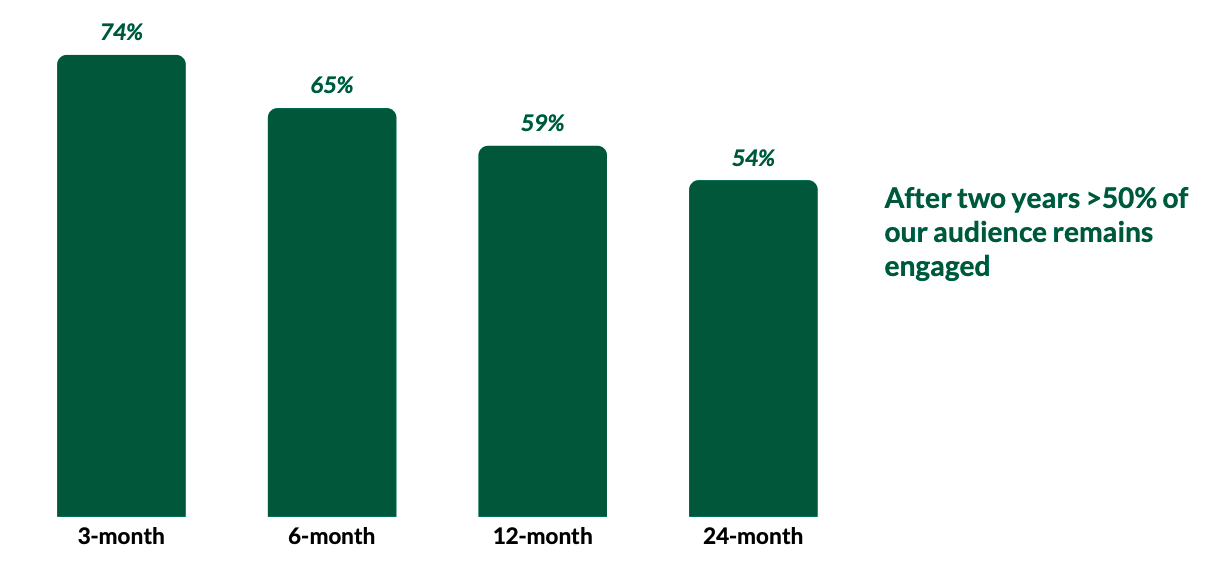
Underscoring its active user counts are Nextdoor’s retention figures. Here’s how it describes that metric:

Image Credits: Nextdoor SPAC investor deck

These are monthly active users, mind, not weekly active, the figure that the company cited up top. So, the metrics are looser here. And the company is counting users as active if they have “started a session or opened a content email over the trailing 30 days.” How conservative is that metric? We’ll leave that for you to decide.

The company’s argument for its value continues in the following slide, with Nextdoor noting that users become more active as more people use the service in a neighborhood. This feels obvious, though it is nice, we suppose, to see the company codify our expectations in data.

Nextdoor then argues that its user base is distinct from that of other social networks and that its users are about as active as those on Twitter, albeit less active than on the major U.S. social networks (Facebook, Snap, Instagram).

Why go through the exercise of sorting Nextdoor into a cabal of social networks? Well, here’s why:

Announcing the startups pitching at TC Early Stage

This Thursday and Friday, TechCrunch will host Early Stage – a virtual bootcamp for early stage founders. After the success of the spring event, on Friday, TC will feature 10 phenomenal early-stage startups to on the virtual stage. Hailing form around the States and the globe, founders will pitch on live, for five minutes, followed by an intense Q&A with our expert panel of judges.

The judges for this pitch-off will be Ben Sun (Primary Venture Partners), Doug Landis (Emergence Capital), Leah Solivan (Fuel Capital) and Shardul Shah (Index Ventures).  Unlike last time, there will be no final round. Each company will only have one chance to impress the judges and the audience!

Alright, alright. I know you want to see who made the cut. Join us on Friday, July 9th to watch the second ever TC Early Stage Pitch-Off. Let’s take a look:

Session 1: 9:00 a.m. – 9:50 a.m. PDT

Mi Terro (City of Industry, CA, USA) – “The world’s first advanced material company that partners with food companies and farmers to create home compostable, single-use plastic-alternative packaging materials made from plant-based agricultural waste – this is a first-of-its-kind approach.

Press Sports App (Atlanta, GA, USA) – A lifelong sports social network for athletes from all levels and sports. Their deeply engaged community is creating system of record starting at the amateur level that has never been built before.

Snowball Wealth (San Francisco, CA, USA) – Provides personalized guidance to pay off debt and build wealth for the 30M women+ in America with student debt. Snowball provides users with a free student loan plan, which helps users save an average of $6K. They’re expanding to include a financial roadmap that’s community-driven and personalized so women+ can build wealth even as they pay down their debt.

My Expat Taxes (Vienna, Austria) – MyExpatTaxes is the leading U.S. expat tax software that guides users through the tax filing process faster and more affordable than any other competitor in the industry. It automates international tax treaties and expat tax benefits, helping U.S. expats stay compliant and claim thousands of dollars in refunds.

Speeko (Chicago, Illinois, USA) – AI-powered feedback on your voice in areas like pace, fillers, inclusivity, conciseness, and enunciation. Based on your speaking style, you’re matched with interactive exercises, courses, and vocal warm-ups. It’s like a gym membership for your voice, where you build muscle memory for speaking clearly and confidently.

Session 2: 10:10 a.m. – 11:05 a.m. PDT

Universal Prequal (Marlboro, NJ, USA) – Helps construction companies effectively manage risk by enabling them to find and vet qualified project teams capable of doing the work. Instead of the paper-intensive, time-consuming, expensive approach that exists throughout the industry today, our solution is online, easy-to-use, and cost-effective. Customers will know us as the national resource for managing risk based on comprehensive, reliable construction information.

T2D2.ai (New York City, NY, USA) – Provides continuous AI and computer vision-driven monitoring of buildings, bridges and other infrastructural assets. The T2D2 portal and dashboard gives asset owners and managers a detailed picture of all visible damage conditions – rank ordered by severity and geo-tagged for location information, so they can focus preventative maintenance efforts and avoid higher downstream repair costs as well as potential safety issues.

Boomerang (Sao Paulo, Sao Paulo, Brazil) – A marketplace for consumer goods rental. We connect retailers, brands, and rental stores with customers that just want to use a product instead of owning it. For suppliers, Boomerang is a plug-and-play rental platform offering logistics, insurance, and online payments solution.

Stash Global (Wilmington, DE, USA) – Turned the most damaging cyber-attack of all, ransomware, into just another business problem that can be solved with the click of a button – without paying a cent (or cyber coin) of ransom. The No Ransom Ransomware Solution does it all: restores files; prevents access of frozen file content by attackers; eliminates ransom extortion.

Vyrill (San Francisco, CA, USA) – With the most powerful AI driven, in-video search, Vyrill is a fan video discovery, insights and content marketing platform enabling brand marketers to supercharge brand awareness and revenue with fan led content such as video reviews, unboxing, how-to videos and more. Vyrill is a Google for fan video and creators, capturing who, what, where and when –inside millions of videos.”

Winner Announcement: 11:30 a.m. PDT

Verizon demos THOR, its new vehicle for frontline rapid humanitarian response

The increasingly intense heats bearing down feverishly across the globe are accelerating the number, scale, and complexity of disasters worldwide. Just in the past few weeks, we have seen record heat in the United States Pacific Northwest that has led to hundreds of deaths — with more heat on the way.

Heat waves, wildfires, hurricanes, typhoons and many other types of weather-related disasters create huge challenges for infrastructure providers like energy utilities and telecoms, who have to keep uptime as close to 100% as possible for their customers even in the midst of some of the most challenging environments humans have ever witnessed.

To that end, Verizon (which, as a reminder, is the ultimate parent company for TechCrunch for now) announced today the first demo unit of what it dubs its THOR vehicle, for Tactical Humanitarian Operations Response. Designed on top of a Ford F650 pickup truck chassis, THOR is designed to provide highly mobile and resilient connectivity to frontline responders and citizens through wireless technologies like 5G Ultra Wideband and satellite uplinks.

Verizon’s THOR vehicle can deploy wireless technologies like 5G and satellite uplinks to rapidly deploy connectivity to frontline responders. Image Credits: Verizon

The company developed the prototype in partnership with the Department of Defense’s NavalX and the SoCal Tech Bridge, and unveiled the prototype last week at Marine Corps Air Station Miramar, just north of San Diego.

In addition to wireless connectivity, THOR can also potentially deploy a variety of drone capabilities. For instance, a vehicle could deploy a drone for search and rescue operations, or to help augment firefighters with intelligence on how a wildfire is developing over time.

As I discussed a few weeks ago, telcos like Verizon, AT&T and T-Mobile are increasing spending on a variety of resiliency initiatives, ranging from the rapid staging of mobile wireless equipment to novel solutions like AT&T’s FirstNet One, a dirigible capable of flying near a disaster zone to offer wireless services.

DisasterTech, as I have been dubbing it, has been gaining more attention of late from investors and companies both big and small as governments, the private sector, insurers, and individuals have to confront and respond to the intensifying nature of storms globally.

Twitter shares its ideas around new privacy features, including a way to hide your account from searches

Twitter today has shared a few more ideas it’s thinking about in terms of new features around conversation health and privacy. This includes a one-stop “privacy check-in” feature that would introduce Twitter’s newer conversation controls options to users, and others that would allow people to be more private on the service, or to more easily navigate between public and private tweets or their various accounts.

Of these, the privacy check-in feature would probably be of most use, as Twitter’s recent spurt of innovation has also made the service more complex. Over time, a centralized destination — like Google’s or Facebook’s Privacy Checkup where users can adjust their privacy controls — could become a valuable addition.

Privacy sets

We've found lots of people don't know about all the conversation control and discoverability settings available to them — so how about a check-in that lets you pick among various groups of settings depending on your needs?

(ID in replies) pic.twitter.com/q9En2Z2xQv

— Lena Emara (@LenaEmara) July 6, 2021

Twitter’s privacy check-in feature would walk users through a series of questions that help them think about how public or private they want to be on Twitter’s platform. For example, they could choose whether everyone can see their tweets or not, who’s allowed to send them direct messages, or who can tag them in photos.

Other new ideas under consideration include a tweak to the Compose screen to better highlight which account you’re posting from (and if it’s public), as well as another feature that would add reminders that appear when you reply to someone from a private account. The reminder would alert you that the account wouldn’t be able to see your response because your account is currently set to “protected.” It would also provide a tool to switch your tweets to public so you can participate in the conversation.

Replies

If you have a protected account and reply to someone who isn’t following you, you may not know they can’t see your reply. So I dropped in a reminder ??

And what do you think about making it easier to switch to Public if you DO want them to see your reply?

(ID in reply) pic.twitter.com/aOkZSJKYaQ

— Lena Emara (@LenaEmara) July 6, 2021

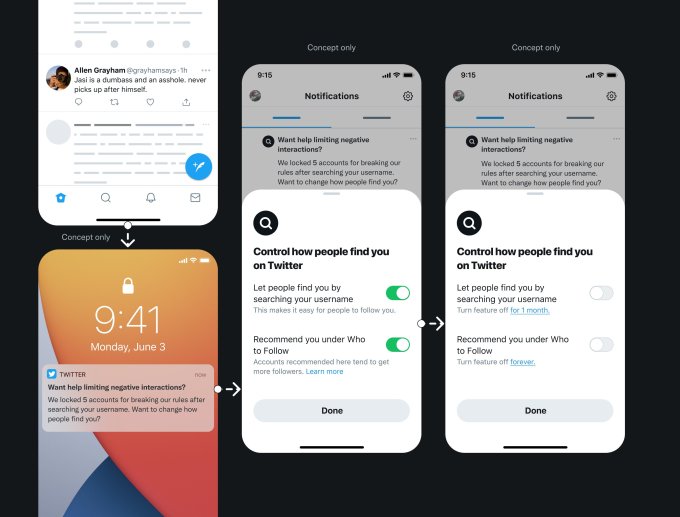
One of the more interesting concepts being considered, however, is related to your discoverability. Often, when someone is being harassed by a group, it begins to attract even more unwanted attention. While the user could report the trolls for abuse, it won’t immediately stop their attacks. To deal with this sort of troll brigade, some users set their account to private or delete their Twitter account altogether.

Twitter’s potential new feature would offer a third option: making your account hidden. Users could be alerted to the increase in negative attention their account was receiving through a push notification and then be pointed to new privacy controls that would let them disable the ability for other Twitter users to find them through search. One toggle would disable people from finding your account by searching for your username while another would disable the account from being recommended under the “Who To Follow” feature. You could also set time limits on how long you want these options disabled, in case you want to hide for a certain amount of time.

Twitter says these are, for now, just ideas — not features being built. It wants to hear from the Twitter user community what they think, and then weigh that feedback before going forward.

The company has been posting several other design concepts like this in recent days, including, just last week, a few new ideas about tweeting only to friends or using different personas, among other things. Earlier this month, the company also showed off concepts around a potential “unmention” feature that would let users untag themselves from others’ tweets.

As of yet, Twitter hasn’t made any decisions on which, if any, of its new concepts will be turned into real-world features. But they stand as another example of a company that’s been re-enegrized after years of stagnation to become more innovative, and at a much faster pace. Late last year, for example, Twitter launched its Stories product called Fleets to all users. It has since rolled out or is soon rolling out a number of significant new products, including its audio networking service Twitter Spaces, a crowd-sourced factchecker Birdwatch, a premium subscription called Twitter Blue, newsletters from Revue, a tip jar, and a creator subscription called Super Follow, which just opened applications.

What I learned the hard way from naming 30+ startups

Drew Beechler
Contributor

Drew Beechler is the director of marketing at High Alpha, a venture studio that creates and funds B2B SaaS companies.

There’s a lot wrapped up in a name: feelings, emotions, connotation, unconscious bias, personal history. It’s an identity — it gives something meaning and importance.

In leading marketing and brand at High Alpha, I think about naming quite a bit. As a venture studio, we co-found and launch five to 10 new software startups every year. It is my team’s responsibility to create and build out the brands for all the new companies we start, including everything from naming and domain acquisition to brand identity and websites. Over the past five years, we’ve named more than 30 software startups at High Alpha.

Over the past five years, we’ve named more than 30 software startups.

As a soon-to-be first-time parent, the idea of naming has taken on a whole new meaning and importance in my life. Even though I help name new companies for a living, I now fully understand the paralysis that often comes when faced with the task of deciding the name for someone or something that’s especially important to you.

Because of this, I’ve always tried to take an objective, pragmatic approach to naming a company with our CEOs and other startups. Naming is an incredibly difficult and nuanced process. It’s fraught with subjectiveness and personal preference. And to top it all off, most founders have zero (or very little) experience in naming.

The truth is that business names fall on a bell curve — you have a small number of outliers that actively contribute to your success and a small number of outliers that actively impair your ability to succeed. The vast majority, though, fall somewhere in the middle in their impact on your business.

So, how should a founder go about effectively naming their baby startup and not picking a name that will hurt them? I’m sharing my own criteria and lessons for how to go about naming your startup, how to evaluate a company name and what makes for a good company name.

Is the name ownable?

As a founder, one of the first criteria to look at is ownability and URL availability. Nowadays, you’ll be hard-pressed to find a name where the .com is still available. I oftentimes will look at .io, .co, get_______.com, or _____hq.com as my top alternatives to a .com, but I always still prefer if the .com is potentially attainable in the future. It may be parked by a domain investor or someone asking a ridiculous price, but that’s always better than an established business using your .com. If not, you will always be fighting a search battle with some other brand that owns your .com.

This goes much further than just the availability of the coveted .com domain, though. You should evaluate the competitiveness and search congestion around your branded keywords. A company named “Apple” or “Lumber” is going to have a really hard time competing for search placements, even if they don’t sell computers or building supplies. An established name and word is also going to come with existing connotations and previous experiences in your audience’s mind. You want a name free from as much baggage as possible so you can easily build your own connotations and memories.

Nobody wins as DoD finally pulls the plug on controversial $10B JEDI contract

After several years of fighting and jockeying for position by the biggest cloud infrastructure companies in the world, the Pentagon finally pulled the plug on the controversial winner-take-all, $10 billion JEDI contract today. In the end, nobody won.

“With the shifting technology environment, it has become clear that the JEDI cloud contract, which has long been delayed, no longer meets the requirements to fill the DoD’s capability gaps,” a Pentagon spokesperson stated.

The contract procurement process began in 2018 with a call for RFPs for a $10 billion, decade-long contract to handle the cloud infrastructure strategy for The Pentagon. Pentagon spokesperson Heather Babb told TechCrunch why they were going with the. single-winner approach: “Single award is advantageous because, among other things, it improves security, improves data accessibility and simplifies the Department’s ability to adopt and use cloud services,” she said at the time.

From the start though, companies objected to the single-winner approach, believing that the Pentagon would be better served with a multi-vendor approach. Some companies, particularly Oracle believed the procurement process was designed to favor Amazon.

In the end it came down to a pair of finalists — Amazon and Microsoft — and in the end Microsoft won. But Amazon believed that it had superior technology and only lost the deal because of direct interference by the previous president who had open disdain for then-CEO Jeff Bezos (who is also the owner of the Washington Post newspaper).

Amazon decided to fight the decision in court, and after months of delay, the Pentagon made the decision that it was time to move on. In a blog post, Microsoft took a swipe at Amazon for precipitating the delay.

“The 20 months since DoD selected Microsoft as its JEDI partner highlights issues that warrant the attention of policymakers: When one company can delay, for years, critical technology upgrades for those who defend our nation, the protest process needs reform. Amazon filed its protest in November 2019 and its case was expected to take at least another year to litigate and yield a decision, with potential appeals afterward,” Microsoft wrote in its blog post about the end of the deal.

But in a statement of its own, Amazon reiterated its belief that the process was not fairly executed. “We understand and agree with the DoD’s decision. Unfortunately, the contract award was not based on the merits of the proposals and instead was the result of outside influence that has no place in government procurement. Our commitment to supporting our nation’s military and ensuring that our warfighters and defense partners have access to the best technology at the best price is stronger than ever. We look forward to continuing to support the DoD’s modernization efforts and building solutions that help accomplish their critical missions,” a company spokesperson said.

It seems like a fitting end to a project that I felt was doomed from the beginning. From the moment the Pentagon announced this contract with the cutesy twist on the Star Wars name, the procurement process has taken more twists and turns than a TV soap.

In the beginning, there was a lot of sound and fury and it led to a lot of nothing. We move onto whatever cloud procurement process happens next.

Allozymes looks to upend chemical manufacturing with rapid enzyme engineering and $5M seed

Part of the complex process that turns raw materials into finished products like detergents, cosmetics and flavors relies on enzymes, which facilitate chemical transformations. But finding the right enzyme for a new or proposed drug or additive is a drawn out and almost random process — which Allozymes aims to change with a remarkable new system that could set a new standard in the industry, and has raised a $5 million seed round to commercialize.

Enzymes are chains of amino acids, the “building blocks of life” among the many things encoded in DNA. These large, complex molecules bind to other substances in a way that facilitates a chemical reaction, say turning sugars in a cell into a more usable form of energy.

One also finds enzymes in the world of manufacturing, where major companies have identified and isolated enzymes that perform valuable work like taking some cheap base ingredients and making them combine into a more useful form. Any company that sells or needs lots of any particular chemical that doesn’t appear abundantly in nature probably has enzymatic processes to aid in creating more of it.

But it’s not like there’s just an enzyme for everything. When you’re inventing new molecules from scratch, like a novel drug or flavoring, there’s no reason why there should be a naturally occurring enzyme that reacts with or creates it. No animal synthesizes allergy medicine in its cells, so companies must find or create new enzymes that do what’s needed. The problem is that enzymes are generally at least 100 units long, and there are 20 amino acids to choose from, meaning for even the simplest novel enzyme you’re looking at uncountably numerous variations.

By starting with known enzymes and systematically working through variations that seem intuitively like they might work, researchers have been able to find new and useful enzymes, but the process is complex and slow even when fully automated: at most a couple hundred a day, and that’s if you happen to have a top-of-the-line robotic lab.

So when Allozymes comes in with a claim that it can screen up to ten million per day, you can imagine the level of change that represents.

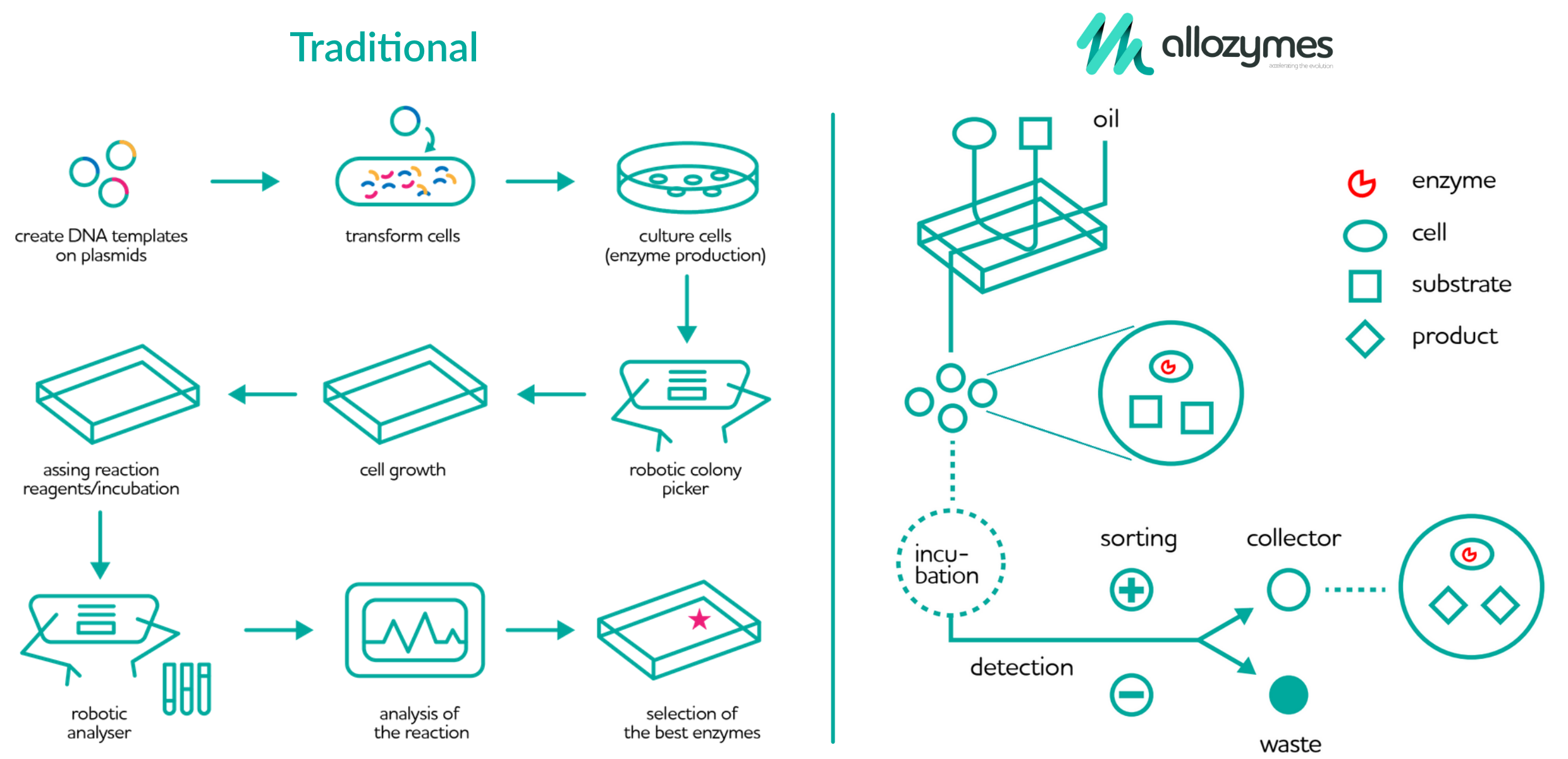
Illustration comparing the multiple steps of an enzyme testing process with the simpler Allozymes process.

Image Credits: Allozymes

Allozymes was founded by Peyman Salehian (CEO) and Akbar Vahidi (CTO), two Iranian chemical engineers who met while pursuing their PhDs at the National University of Singapore. The three years of research leading up to the commercial product also occurred at NUS, which holds the patent and exclusively licenses it to the company.

“The state of the art hasn’t changed in 20 years,” said Salehian. “When we talk with big pharma, they have whole departments for this, they have $2 million robots, and it still takes a year to get a new enzyme.”

The Allozymes platform will speed up the process by several orders of magnitude, while decreasing the cost by an order of magnitude, Salehian said. If these estimates bear out, it effectively trivializes the enzyme search and obsoletes billions in investments and infrastructure. Why pay more to get less?

Traditionally, enzymes are isolated and selected over a multi-step process that involves introducing DNA templates into cells, which are cultured to create the target enzymes, which once a certain growth state is achieved, are analyzed robotically. If there are promising results, you go down that road with more variations, otherwise you start again from the beginning. There’s a lot of picking and placing little dishes, waiting for enough cells to produce enough of the stuff, and so on.

The process, designed by Vahidi and other researchers at NUS, is fully contained with a benchtop device, and generates almost no waste. Instead of using culture dishes, the device puts the necessary cells, substrate, and other ingredients in a tiny droplet in a microfluidic system. The reactions occur inside this little drop, which is incubated, tracked, and eventually collected and tested in a fraction of the time a larger sample would take.

Animation showing droplets moving through a microfluidic system.

Allozymes isn’t selling the device, though. It’s enzyme engineering as a service, and for now their partners and customers seem content with that. Its primary service is cut-to-size, depending on the needs of the project. For instance, maybe a company has a working enzyme already and just wants a variant that’s easier to synthesize or less dependent on certain expensive additives. With a solid starting point and flexible goal that might be a project on the smaller side. Another company may be looking to completely replace hard chemistry processes in their manufacturing, know the start and the end of the process but need an enzyme to fill in the gaps; that might be a more wide ranging and expensive project.

Peyman Salehian, left, and Akbar Vahidi.

Vahidi explained that the goal is not to “democratize” enzyme engineering. It’s still expensive and large-scale enough that it will primarily be done by large companies, but now they can get a hundred thousand times more out of their R&D dollar. The speed and value put them above the competition, said Salehian, with companies like Codexis, Arzeda, and Ginkgo Bioworks also doing enzyme bioengineering but at lower rates and with different priorities.

Occasionally the company might strike a bargain to take part ownership of an IP or product, but that’s not really the business model, Salehian said. Some early work consisted of actually making the final compound, but ultimately the core product is expected to be the service. (Still, a million-dollar order is nothing to sneeze at.)

It may have occurred to you that in the process of doing a job, Allozymes might sort through hundreds of millions of enzymes. Rest assured, they are well aware of the value these may represent. The service transitions seamlessly into the inevitable data play.

“If you have a big data set that shows ‘if you change this amino acid this will be the function,’ you don’t even need to engineer it, you can eliminate it [i.e. from consideration]. You can even design enzymes if you know enough,” Salehian said.

The company’s recent $5 million seed round was led by Xora Innovation (from Temasek, Singapore’s sovereign fund), with participation from SOSV’s HAX, Entrepreneur First and TI Platform Management. Salehian explained that they planned to incorporate in the U.S. following interest from American venture firms, but Temasek’s early-stage investor convinced them to stay.

“Biotransformation is in huge demand on this side of the world,” Salehian said. “Chemical, agriculture, and food companies need to do it, but no platform company can deliver these services. So we tried to fill that gap.”

Single.Earth to link carbon credits to crypto token market, raises $7.9M from EQT Ventures

Here’s the theory: Instead of linking carbon and biodiversity credits to the sale of raw materials such as forests, which cause CO2, what if you linked them to crypto tokens, and thus kept these CO2-producing materials in the ground?

That’s the theory behind Single.Earth, which has now raised a $7.9 million seed funding round led by Swedish VC EQT Ventures to, in its own words, ‘tokenize nature’. Also participating in the round was existing investor Icebreaker, and Ragnar Sass and Martin Henk, founders of Pipedrive. The funding will be used to launch its marketplace for nature-backed MERIT tokens.

Single.Earth says its ‘nature-backed’ financial system will use using MERIT tokens. Given the market for carbon credits is estimated to be worth more than $50 billion by 2030 and crypto surpassed a $2 trillion market cap in 2021, their plan might just work.

It plans to build a ‘digital twin’ of nature that reveals how much any area of ecological significance in the world absorbs CO2 and retains biodiversity. Using environmental data such as satellite imagery, it aims to build global carbon models on which to base its token marketplace, generating profits through carbon compensations, ‘mining’ a new MERIT token for every 100 kg of CO2 sequestered in a specific forest or biodiverse area.

The MERIT tokens are then used to trade, compensate for a CO2 footprint, or contribute to climate goals (as the token is ‘used up’ and cannot be traded anymore). Companies, organisations, and eventually individuals will be able purchase these tokens and own fractional amounts of natural resources, rewarded with carbon and biodiversity offsets. The company says the market for carbon credits is estimated to be worth more than $50 billion by 2030.

Because of the traceability of blockchain and its link to a tradable token, payment to landowners would be immediate.

Single.Earth was co-founded in 2019 by CEO Merit Valdsalu and CTO Andrus Aaslaid. Valdsalu said: “Nature conservation is scalable, accessible, and makes sense financially; what’s more, it’s vital to engineer a systematic change.”

Sandra Malmberg, Venture Lead at EQT Ventures, added: “Oil was the new gold, data the new oil; now, nature is now the most precious and valuable resource of all. A company having a hectare of forest saved as a key metric to scale is a company we are thrilled to back. Disrupting the economy and financial markets with a new tradable and liquid asset class that has a positive impact on the environment is an irresistible investment.”


Max Q: Billionaire Blast-off Boys Club

Max Q is a weekly newsletter from TechCrunch all about space. Sign up here to receive it weekly on Mondays in your inbox.

It’s a space race of the most indulgent kind, plus there’s a new commercial launch enterprise in the games and another is prepping for production at a massive scale. Also, Starlink aims for the stars — ‘the stars’ in this case being not going bankrupt.

The billionaire bragging rights battle no one asked for

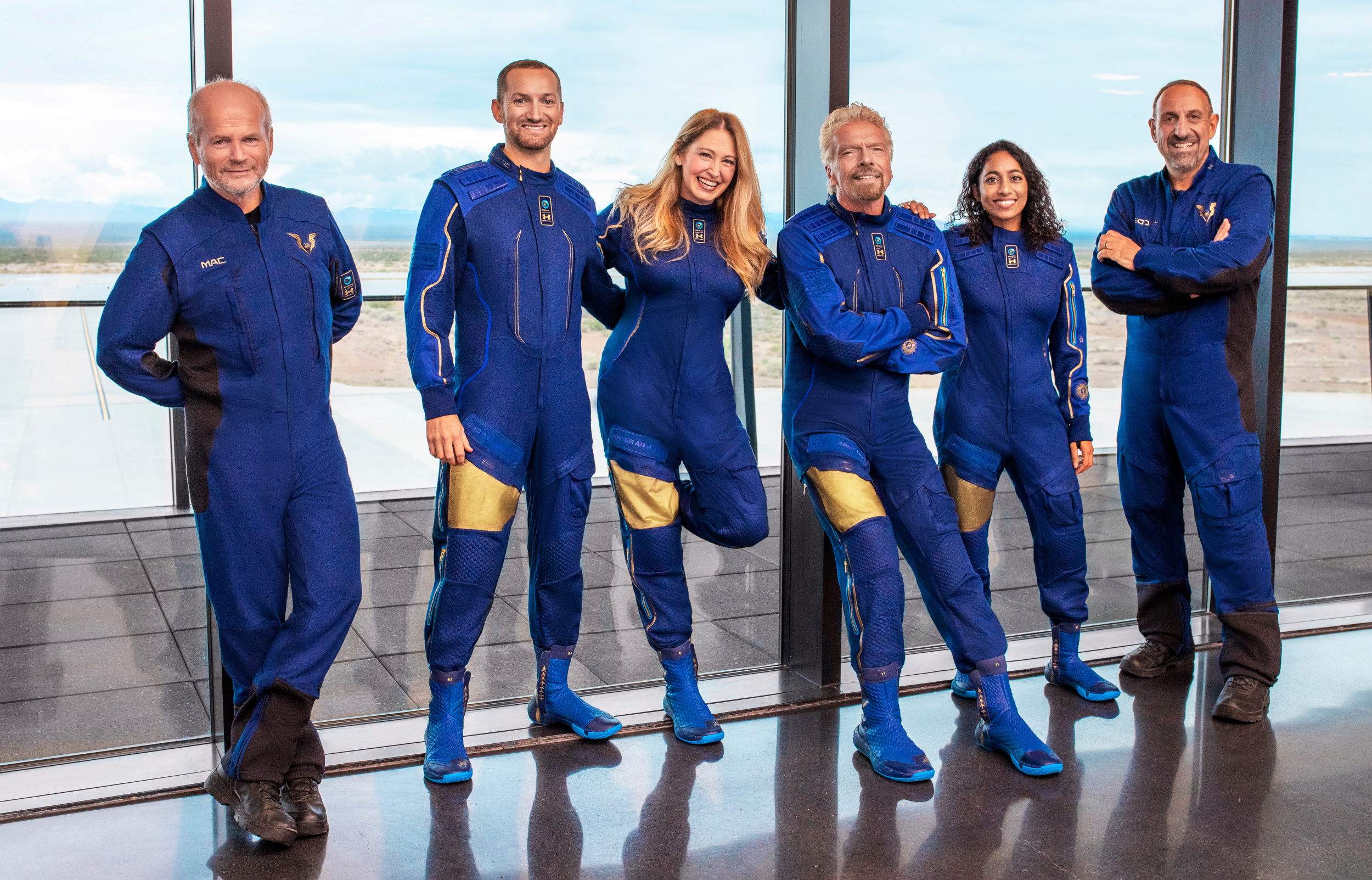
Richard Branson surprised absolutely no one by announcing last week that he’d be aboard the next Virgin Galactic to fly to low Earth orbit, which is set to take off on July 11, and be the space tourism company’s first to carry a full crew complement. Jeff Bezos is heading up in his company’s own phallic reusable rocket on July 20, which means if all goes to schedule, Branson will beat him by just over a week.

If you find you have a hard time mustering a lot of enthusiasm or really any feelings at all about these two grown man boys burning cash in a race to be the first billionaire to spend a couple minutes at an altitude technically considered ‘space’ by a more or less arbitrary definition, then congratulations: You should not care. No one should, and yet here we are, writing and reading about it in a newsletter.

These ‘events’ will be worth watching because of the technical achievements they represent for the companies involved, and the teams that worked hard on making sure either spacecraft is able to safely transport humans to space; the billionaires on board are mere chattel, weight and mass simulators that can provide a surprisingly good, but not altogether perfect, simulacrum of a human passenger.

Elon actually wins some rare kudos for not apparently giving much of a shit about this particular bro off.

SpaceX and Virgin Galactic deliver

SpaceX and Virgin Orbit have delivered payloads on behalf of paying customers this past week — par for the course for the former, but a novel experience for the latter. SpaceX sent up 85 satellites on behalf of customers during its second official rideshare mission, along with three of its own, and Virgin Orbit launched its first official commercial mission (after its successful demonstration launch earlier this year), carrying a number of small satellites including the first ever for the Netherlands military.

If Virgin Orbit succeeds in ramping its operations according to its plan, a week like this with multiple launches from a number of commercial launch providers capable of sending up small satellites might become a lot more common. Virgin Orbit joins SpaceX and Rocket Lab now as having the potential to fly on any given week, and others are hot on their heels, including Astra (which is now an officially publicly traded company) and Relativity.

Speaking of that last one, Relativity announced a new 1 million square foot factory that will house a lot of its massive 3D printers to ramp up production of its larger Terran R rocket. The company has yet to fly its Terran 1, the first of its 3D printed spacecraft, but that’s still on track to happen later this year.

SpaceX’s Starlink terminal costs over 2x what it costs

Image Credits: Starlink

Elon Musk virtually joined the MWC conference in Barcelona to talk about Starlink, and when asked what success for the bourgeoning global connectivity service would look like, he said that essentially they’ll be happy if it doesn’t go bankrupt. Then, if they can jump that hurdle, they’ll start thinking longer term.

He pointed out that everyone who has tried to do what Starlink is trying to do so far has gone bust, and admitted that the company has probably already sunk between $5 and $10 billion into its work on the constellation and service so far, with another $30 billion expected to be invested long-term. He also pointed out that the $500 terminal and modem kit customers need to buy to get connected actually costs SpaceX over $1,000 to produce, so it’s selling them at a significant loss for now.

Starlink could be a big source of ongoing revenue, and more consistent and predictable than the launch business, but it’s obviously going to take a long time to get there. Now it make sense why the company is launching Starlink satellites with such frequency, as it aims for global coverage, and the larger customer base that brings.

Box takes fight with activist investor public in SEC filing

The war between Box’s current leadership and activist shareholder Starboard took a new turn today with a detailed timeline outlining the two groups’ relationship, thanks to an SEC filing and companion press release. Box is pushing back against a slate of board candidates put forth by Starboard, which wants to shake up the company’s leadership and sell it.

The SEC filing details a lengthy series of phone calls, meetings and other communications between the technology company and Starboard, which has held a stake in Box greater than 5% since September of 2019. Since then shares of Box have risen by around $10 per share.

Today’s news is multi-faceted, but we’ve learned more concerning Starboard’s demands that Box sell itself; how strongly the investor wanted co-founder and CEO Aaron Levie to be fired; and that the company’s complaints about a KKR-led investment into Box that it used to repurchase its shares did not match its behavior, in that Starboard asked to participate in the transaction despite its public statements.

Activist investors, a bit like short-sellers, are either groups that you generally like or do not. In this case, however, we can learn quite a lot from the Box filing. Including the sheer amount of time and communication that it takes to manage such an investor from the perspective of one of its public-market investments.

What follows are key excerpts from Box’s SEC filing on the matter, starting with its early stake and early agreement with Starboard:

  • On September 3, 2019, representatives of Starboard contacted Mr. Levie to inform Mr. Levie that Starboard would be filing a
  • Schedule 13D with the SEC reporting a 7.5% ownership stake in the company.
  • On March 9, 2020, Mr. O’Driscoll and Ms. Barsamian had a call with representatives of Starboard to discuss entering into a settlement agreement with Starboard.
  • On March 22, 2020, the company and Starboard entered into an agreement[.]
    Also on March 23, 2020, Starboard reported beneficial ownership of 7.7% of the outstanding Class A common stock.

Then Box reported earnings, which Starboard appeared to praise:

  • On May 27, 2020, the company reported its fiscal first quarter results, noting a 13% increase in year-over-year revenue, a 900 basis point increase in year-over-year GAAP operating margin and a $36.4 million increase in year-over-year cash flow from operations. Peter Feld, a representative of Starboard, and Mr. Levie had an email conversation related to the company’s first quarter results in which Mr. Feld stated “you guys are on a good path…congrats to the team and keep it up.”
  • Also on May 29, 2020, Starboard reported that it had decreased its beneficial ownership to 6.0% of the outstanding Class A common stock.

The same pattern repeated during Box’s next earnings report:

  • On August 27, 2020, Mr. Levie, Mr. Smith and company IR discussed the company’s earnings release with Starboard. Starboard indicated it was pleased with the rate of margin expansion and where the company was heading. In an email exchange between Mr. Feld and Mr. Levie related to the company’s results, Mr. Feld stated that he was “thrilled to see the company breaking out and performing better both on the top and bottom line. Appreciate you guys working with us and accepting the counsel. Not everyone behaves that way and it is greatly appreciated. Shows your comfort as a leader and a willingness to adapt. Very impressive.”

Then Box reported its next quarter’s results, which was followed by a change in message from Starboard (emphasis TechCrunch):

  • On December 1, 2020, the company announced its fiscal third quarter results, noting an 11% increase in year-over-year revenue, an improvement of 2100 basis points in year-over-year GAAP operating margin and a $36 million increase in year-over-year cash flow from operations. The company also provided guidance regarding its fiscal fourth quarter results, noting that its revised revenue guidance was due to “lower professional services bookings than we noted previously, which creates a roughly $2 million headwind” and that the company was being “prudent in our growth expectations given the macroeconomic challenges that our customers are facing.” The revised guidance for revenue was 1.1% below analysts’ consensus estimates of $198.8 million.
  • On December 2, 2020, Box’s common stock declined approximately 9% from its prior close of $18.54 to $16.91. On December 2, 2020 and December 4, 2020, Mr. Levie, Mr. Smith and Box IR discussed the company’s earnings release with representatives of Starboard. Despite the prior support Mr. Feld communicated to the company, Starboard reversed course and demanded that the company explore a sale of the entire company or fire the company’s CEO, or otherwise face a proxy contest from Starboard. Mr. Feld further stated that the company should not turn down an offer from a third party to buy the entire company “in the low twenties” and that Starboard would be a seller at such a price.

Recall that Box shares are now in the mid-$26s. At the time, however, Box shares lost value (emphasis: TechCrunch)

  • On December 16, 2020, two weeks after earnings, the company’s stock price closed at $18.85, which was above where it was trading immediately prior to the announcement of the company’s fiscal third quarter results on December 1, 2020.
  • On January 11, 2021, Starboard disclosed that it had increased its beneficial ownership to 7.9% of the outstanding Class A common stock.
  • On January 15, 2021, Mr. Lazar and Ms. Barsamian had a call with representatives from Starboard. Mr. Feld expressed his view that, while the company’s Convertible Senior Notes were executed on favorable terms, he was not supportive of the transaction. He reiterated his demand that the company sell itself and indicated that if the company did not do so then it must replace its CEO or otherwise face a proxy contest from Starboard to replace the CEO.

Over the next few months, Box bought SignRequest, reported earnings, and engaged external parties to try to help it bolster shareholder value. Then the KKR deal came onto the table:

  • On March 31, 2021, the Strategy Committee met to discuss the status of the strategic review. At such time, the Strategy Committee was in receipt of a proposal from KKR pursuant to which KKR and certain partners would make an investment in the form of convertible preferred stock at an initial yield of 3%, which had been negotiated down from KKR’s proposal of 7% yield in its preliminary indication of interest in early March.

The deal was unanimously approved by Box’s board, and announced on April 8th, 2021. Starboard was not stoked about the transaction, however:

  • Later on April 8, 2021, Ms. Mayer and Mr. Lazar had a call with representatives of Starboard. Mr. Feld expressed Starboard’s strong displeasure with the results of the strategic review. During the conversation, Mr. Feld indicated that he would stop the fight immediately if Mr. Levie were replaced.
  • On April 14, 2021, Ms. Mayer, Mr. Lazar and Ms. Barsamian had a call with Mr. Feld. Despite his prior statements, Mr. Feld now indicated that Starboard was not willing to sell its shares of Class A common stock at $21 or $22 per share. Mr. Feld requested that the company release KKR from its obligation to vote in favor of the company as a gesture of good faith. Mr. Feld reiterated Starboard’s desire to replace Mr. Levie as CEO and indicated that he would like to join the Board of Directors if the company did so. Ms. Mayer offered Mr. Feld the opportunity to execute a non-disclosure agreement to receive more information about the strategic review process, which Mr. Feld immediately declined.

Box was like, all right, but Feld doesn’t get to be on the board:

  • On April 20, 2021, Ms. Mayer and Mr. Lazar had a call with representatives of Starboard. Mr. Feld stated that Starboard would not move forward with its planned director nominations if Starboard were offered the opportunity to participate in the KKR-Led Transaction and Mr. Feld were appointed to the Board of Directors. Mr. Feld reiterated that he was not willing to sign a non-disclosure agreement.
  • On April 27, 2021, Mr. Park had a discussion with Mr. Feld. During this conversation, Mr. Feld reiterated his desire for Starboard to participate as an investor in the KKR-Led Transaction.
  • On April 28, 2021, Ms. Mayer and Mr. Lazar informed Mr. Feld that the Board of Directors was amenable to allowing Starboard to participate in the KKR-Led Transaction but would not appoint Mr. Feld as a director. Mr. Feld indicated that there is no path to a settlement that doesn’t include appointing him to the Board of Directors.

And then Starboard initiated a proxy war.

What to make of all of this? That trying to shake up a company from the position of a minority stake is not impossible, with Starboard able to exercise influence on Box despite having a sub-10% ownership position. And that Box was not willing to put a person on the board that wanted to fire its CEO.

What’s slightly silly about all of this is that the fight is coming at a time when Box is doing better than it has in some time. Its profitability has improved greatly, and in its most recent quarter the company topped expectations and raised its forward financial guidance.

There were times in Box’s history when it may have deserved a whacking for poor performance, but now? It’s slightly weird. Also recall that Starboard has already made quite a lot of money on its Box stake, with the company’s value appreciating sharply since the investor bought in.

Most media coverage is surrounding the public criticism by Starboard of the KKR deal and its private demand to be let into the deal. That dynamic is easily explained: Starboard thought that the deal wouldn’t make it money, but later decided that it could. So it changed its tune; if you are expecting an investor to do anything but try to maximize returns, you are setting yourself up for disappointment.

A person close to the company told TechCrunch that the current situation should be a win-win for everyone involved, but Starboard is not seeing it that way. “If you’re a near term shareholder, [like Starboard] then the path Box has taken has already been better. And if you’re a long term shareholder, Box sees significantly more upside. […] So overwhelmingly, the company believes this is the best path for shareholders and it’s already been proven out to be that,” the person said.

Alan Pelz-Sharpe, founder and principal analyst at the Deep Analysis, who has been watching the content management space for many years, says the battle isn’t much of a surprise given that the two have been at odds pretty much from the start of the relationship.

“Like any activist investor Starboard is interested in a quick increase in shareholder values and a flip. Box is in it for the long run. Further, it seems that Starboard may have mistimed or miscalculated their moves, Box clearly was not as weak as they appeared to believe and Box has been doing well over the past year. Bringing in KKR was the start of a big fight back, and the proposed changes couldn’t make it any clearer that they are fed up with Starboard and ready to fight back hard,” Pelz-Sharpe said.

He added that publicly revealing details of the two companies’ interactions is a bit unusual, but he thinks it was appropriate here.

“Actually naming and shaming, detailing Starboard’s moves and seemingly contradictory statements, is unusual but it may be effective. Starboard won’t back down without a fight, but from an investor relations/PR perspective this looks bad for them and it may well be time to walk away. That being said, I wouldn’t bet on Starboard walking away, as Silicon Valley has a habit of moving forward when they should be walking back from increasingly damaging situations”

What comes next is a vote on Box’s board makeup, which should happen later this summer. Let’s see who wins.

It’s worth noting that we attempted to contact Starboard Value, but as of publication they had not gotten back to us. Box indicated that the press release and SEC filing speak for themselves.


Meet Super.mx, the Mexico City-based insurtech that raised $7.2M from VCs and unicorn execs

Super.mx, an insurtech startup based in Mexico City, has raised $7.2 million in a Series A round led by ALLVP.

Co-founded in 2019 by a trio of former insurance industry executives, Super.mx’s self-proclaimed mission is to design insurance for “the emerging Latin American middle class,” according to CEO Sebastian Villarreal.

“That means insurance that is easy to buy – it can be bought on a cell phone in minutes – and that pays quickly with no adjusters,” he said. The company has built its offering with proprietary models that are used both on the underwriting side to predict risk and on the claims side to make payments automatically. 

Goodwater Capital, Kairos Angels and Bridge Partners also participated in the Series A round in addition to angels such as Joe Schmidt IV, vice president of business development at insurtech Ethos and former investor at Accel and Kyle Nakatsuji, founder and CEO of auto insurance startup Clearcover (and also a former VC). Better Tomorrow Ventures led Super.mx’s $2.4 million seed round, which also saw capital from 500 Startups Mexico, Village Global, Anthemis and Broadhaven Ventures, among others.

Unlike most insurtech startups in Latin America, Villarreal emphasizes that Super.mx is neither an aggregator nor a carrier. Instead, it’s an MGA, or managing general agent.

“This lets us have a ‘best of both worlds’ approach,” Villarreal said. “We handle the entire user experience just like a direct to consumer carrier, but with the breadth of product choice offered by an aggregator.”

That product choice includes property, natural disasters and life insurance. The company soon plans to expand to also offer health insurance. 

The founding team brings a variety of insurance experience to the table. Villarreal previously co-founded Chicago-based Kin Insurance (which raised over $150 million in funding from the likes of Flourish Ventures, Commerce Ventures and QED Investors). He was also once head of auto product at Avant, a growth-stage company funded by General Atlantic and Tiger Global, among others.

With over two decades of insurance industry experience, Dario Luna once served as Mexico’s insurance regulator and helped develop Mexico’s disaster risk management strategy. Marco Ahedo has designed parametric insurance products for 19 Caribbean countries. He was also once a solvency expert for life and health insurance lines at MetLife, and has developed financial models for several P&C carriers.

Villarreal lived in the U.S. for a while before deciding to move back to Mexico, which he recognized was home to an “underinsurance problem.”

“That’s actually a very acute problem,” he said. “People in Latin America buy a lot less insurance than they do in the U.S., and people in Mexico, in particular, buy a lot less insurance than they do in other Latin countries.”

Some have blamed the lack of insurance coverage on the country’s culture but Super.mx operates under the belief that this notion is “total BS.”

“It’s not a cultural problem,” Villarreal said. “The problem is that the insurance products that exist in the market just suck. They’re super expensive. They’re really hard to buy, and they pay very little.”

Image Credits: Super.mx

So far, Super.mx has sold “thousands of policies” but is more focused now on increasing the number of products that it’s selling. The company started out by selling earthquake insurance before adding COVID insurance, and more recently, in April, it launched life insurance. Next, it’s going to offer property, renter’s and health insurance.

“It’s really a different strategy than what you would find in the U.S.,” Villarreal said. “In the U.S, when you look at insurtechs, it’s like everyone just does one thing, but here, it’s very different because when someone says ‘I want insurance,’ really what they’re saying is ‘Hey, something happened that makes me nervous that didn’t make me nervous before.’”

That something could be a new child, for example, that prompts a need for life insurance.

“What we’re trying to do is like Lemonade, Roots and Hippo or Kin all rolled into one,” he added. It’s a big, big play.”

Digital adoption in Mexico, and Latin America in general, has increased exponentially in recent years. The bigger hurdle for Super.mx, according to Villarreal, has less to do with technology and more to do with Mexicans getting over what he describes a “deep mistrust” based on bad experiences in the past.

“People are really distrustful and that’s a huge hurdle, but once you show them that you actually are different,” Villarreal told TechCrunch, “that you actually do things in a different way, you get this incredible emotional response.”

Eventually, Super.mx plans to outside of Mexico to other countries in Latin America.

ALLVP’s Federico Antoni said his Mexico City-based firm had been looking for a team building in this space “for years” before investing in Super.mx. The venture firm was impressed with the company’s technical knowledge and industry expertise. It was also drawn to their multi-product approach and “capacity to ship highly complex products to the market quickly” — both of which he believes are “unique” in the region.

Citing statistics from MAPFRE Economics, Antoni pointed out that globally, the insurance market has been growing over the last 10 years. During that time, Latin America expanded faster on average (4.4% vs. 2.4% worldwide), albeit with more volatility. Life insurance has been driving this growth, at 6.1%, over the period. 

“Insurtech may be even bigger than fintech. Also, harder,” he told TechCrunch via email. “We knew the team to unlock the market potential would need to be highly competent and highly disruptive.”

Antoni said he is also convinced that Insurtech is the “next frontier” in financial inclusion in Latin America especially as digitization continues to increase.

“Providing risk coverage to individuals and businesses in the region, brings financial stability to families and unlocks economic potential for SMEs,” he said. “Moreover, the insurance incumbents have been unable to address a growing and underserved market.”


Kill the standard privacy notice

Leif-Nissen Lundbæk
Contributor

Leif-Nissen Lundbæk is the co-founder and CEO of Xayn. He specializes in privacy-preserving AI.

Privacy is a word on everyone’s mind nowadays — even Big Tech is getting in on it. Most recently, Apple joined the user privacy movement with its App Tracking Transparency feature, a cornerstone of the iOS 14.5 software update. Earlier this year, Tim Cook even mentioned privacy in the same breath as the climate crisis and labeled it one of the top issues of the 21st century.

Apple’s solution is a strong move in the right direction and sends a powerful message, but is it enough? Ostensibly, it relies on users to get informed about how apps track them and, if they wish to, regulate or turn off the tracking. In the words of Soviet satirists Ilf and Petrov, “The cause of helping the drowning is in the drowning’s own hands.” It’s a system that, historically speaking, has not produced great results.

Today’s online consumer is drowning indeed — in the deluge of privacy policies, cookie pop-ups, and various web and app tracking permissions. New regulations just pile more privacy disclosures on, and businesses are mostly happy to oblige. They pass the information burden to the end user, whose only rational move is to accept blindly because reading through the heaps of information does not make sense rationally, economically or subjectively. To save that overburdened consumer, we have only one option: We have to kill the standard privacy notice.

A notice that goes unnoticed

Studies show that online consumers often struggle with standard-form notices. A majority of online users expect that if a company has published a document with the title “privacy notice” or “privacy policy” on its website, then it will not collect, analyze or share their personal information with third parties. At the same time, a similar majority of consumers have serious concerns about being tracked and targeted for intrusive advertising.

Online businesses and major platforms gear their privacy notices and other relevant data disclosures toward obtaining consent, not toward educating and explaining.

It’s a privacy double whammy. To get on the platform, users have to accept the privacy notice. By accepting it, they allow tracking and intrusive ads. If they actually read the privacy notice before accepting, that costs them valuable time and can be challenging and frustrating. If Facebook’s privacy policy is as hard to comprehend as German philosopher Immanuel Kant’s “Critique of Pure Reason,” we have a problem. In the end, the option to decline is merely a formality; not accepting the privacy policy means not getting access to the platform.

So, what use is the privacy notice in its current form? For companies, on the one hand, it legitimizes their data-processing practices. It’s usually a document created by lawyers, for lawyers without thinking one second about the interests of the real users. Safe in the knowledge that nobody reads such disclosures, some businesses not only deliberately fail to make the text understandable, they pack it with all kinds of silly or refreshingly honest content.

One company even claimed its users’ immortal souls and their right to eternal life. For consumers, on the other hand, the obligatory checkmark next to the privacy notice can be a nuisance — or it can lull them into a false sense of data security.

On the unlikely occasion that a privacy notice is so blatantly disagreeable that it pushes users away from one platform and toward an alternative, this is often not a real solution, either. Monetizing data has become the dominant business model online, and personal data ultimately flows toward the same Big Tech giants. Even if you’re not directly on their platforms, many of the platforms you are on work with Big Tech through plugins, buttons, cookies and the like. Resistance seems futile.

A regulatory framework from another time

If companies are deliberately producing opaque privacy notices that nobody reads, maybe lawmakers and regulators could intervene and help improve users’ data privacy? Historically, this has not been the case. In pre-digital times, lawmakers were responsible for a multitude of pre-contractual disclosure mandates that resulted in the heaps of paperwork that accompany leasing an apartment, buying a car, opening a bank account or taking out a mortgage.

When it comes to the digital realm, legislation has been reactive, not proactive, and it lags behind technological development considerably. It took the EU about two decades of Google and one decade of Facebook to come up with the General Data Protection Regulation, a comprehensive piece of legislation that still does not rein in rampant data collection practices. This is just a symptom of a larger problem: Today’s politicians and legislators do not understand the internet. How do you regulate something if you don’t know how it works?

Many lawmakers on both sides of the Atlantic often do not understand how tech companies operate and how they make their money with user data — or pretend not to understand for various reasons. Instead of tackling the issue themselves, legislators ask companies to inform the users directly, in whatever “clear and comprehensible” language they see fit. It’s part laissez-faire, part “I don’t care.”

Thanks to this attitude, we are fighting 21st-century challenges — such as online data privacy, profiling and digital identity theft — with the legal logic of Ancient Rome: consent. Not to knock Roman law, but Marcus Aurelius never had to read the iTunes Privacy Policy in full.

Online businesses and major platforms, therefore, gear their privacy notices and other relevant data disclosures toward obtaining consent, not toward educating and explaining. It keeps the data flowing and it makes for great PR when the opportunity for a token privacy gesture appears. Still, a growing number of users are waking up to the setup. It is time for a change.

A call to companies to do the right thing

We have seen that it’s difficult for users to understand all the “legalese,” and they have nowhere to go even if they did. We have also noted lawmakers’ inadequate knowledge and motivation to regulate tech properly. It is up to digital businesses themselves to act, now that growing numbers of online users are stating their discontent and frustration. If data privacy is one of our time’s greatest challenges, it requires concerted action. Just like countries around the world pledged to lower their carbon emissions, enterprises must also band together and commit to protecting their users’ privacy.

So, here’s a plea to tech companies large and small: Kill your standard privacy notices! Don’t write texts that almost no user understands to protect yourselves against potential legal claims so that you can continue collecting private user data. Instead, use privacy notices that are addressed to your users and that everybody can understand.

And don’t stop there — don’t only talk the talk but walk the walk: Develop products that do not rely on the collection and processing of personal data. Return to the internet’s open-source, protocol roots, and deliver value to your community, not to Big Tech and their advertisers. It is possible, it is profitable and it is rewarding.

Bentley reveals Flying Spur Hybrid, its latest in the push toward electric

Bentley Motors, the 102-year-old ultraluxury automaker under Volkswagen Group, revealed its newest hybrid model on Tuesday. The company says this latest iteration of the Flying Spur Hybrid is its most environmentally friendly vehicle yet.

This new model is part of Bentley’s Beyond100 plan to become a carbon-neutral organization with an entirely electrified range by 2023 and a totally electric lineup by 2030. That’s a tall order given the fact that the British company’s first all-electric vehicle is expected to come to market in 2025. So far, Bentley only has this hybrid and another, the Bentayga SUV.

Most major OEMs have made such commitments, with Ford, GM, Mercedes, Kia and Nissan already producing electric models. If automakers like Bentley want to reach their goals, their production of electric vehicles will need to increase exponentially, especially if they want to keep up with Tesla, which is currently owning the luxury EV market.

According to a statement released by the company, the new powertrain of the hybrid Flying Spur combines a 2.9 liter V6 engine with an electric motor. The engine achieves 410 HP and 550 Nm of torque up to 5,650 rpm, and the motor, which is located between the transmission and the engine, provides up to 134 HP and 400 Nm of torque. When combined, the Flying Spur delivers an additional 95 HP in comparison to the Bentayga hybrid.

The 14.1 kWh lithium ion battery charges in about two and a half hours. The Flying Spur can cover over 435 miles when fully fueled, and it can go from 0 to 60 mph in 4.1 seconds, which is nearly the same as the V8 version of the vehicle, at a top speed of 177 mph.

When in the drivers seat, customers can choose between three E modes to manage battery usage. The EV Drive mode is the default when the car is turned on. The hybrid mode relies on data from the car’s intelligent navigation system when the driver is following directions somewhere to predict usage of the different E-modes and engine coasting. The vehicle automatically switches to the right mode for each part of the journey depending on what’s more fuel efficient. For example, EV driving is best when in the city, but the car might engage the V6 engine more on the highway. The third E-mode, hold, balances power between the engine and the battery to conserve electric energy, holding onto it for later use. This mode is usually put in place when the driver selects Sport mode.

The Flying Spur’s infotainment screen shows energy flow, range, battery level and charging information. Bentley will deliver the hybrid with all the necessary charging cables and provides customers with a Bentley-branded wall box at no extra cost to store the at-home charge unit and cables.

Flying Spur Hybrid is available to order in most markets, but is currently not available in the E.U., U.K., Switzerland, Israel, Ukraine, Norway, Turkey and Vietnam, according to Bentley.

On the same day, Bentley also announced a partnership with single malt Scotch whisky manufacturer Macallan to “develop distinctive collaborations and further their vision of a more sustainable future,” according to a statement released by the company. A Bentley spokesperson said a new single malt whisky would be unveiled as part of the partnership, with “future products and experiences to follow in due course.”  So…high-end drinking and driving? One somewhat clearer outcome of the announcement is a commitment from the Macallan Estate to have a fully electric passenger vehicle fleet by 2025. In addition, this year, Macallan will order two hybrid Bentleys for the estate.

Update: This article has been updated to reflect new information from Bentley about the Macallan partnership.

Will Didi’s regulatory problems make it harder for Chinese startups to go public in the US?

Shares of Chinese ride-hailing business Didi are off 22% this morning after the company was hit by more regulatory activity over the holiday weekend. The recently public company traded as high as $18.01 per share since it held an IPO last week; today, shares of Didi are worth just $12.09, off around a third from their 52-week high.


The Exchange explores startups, markets and money.
Read it every morning on Extra Crunch or get The Exchange newsletter every Saturday.


The decline in value follows a review by a Chinese cybersecurity agency that led to Didi being unable to onboard new users, a decision that arrived as last week rolled to a close.

Over the weekend, Didi was hit with more regulatory action. This time, the Cyberspace Administration of China said, via an internet translation, that “after testing and verification, the ‘Didi Travel’ App [was found to have] serious violations of laws and regulations in collecting and using personal information,” which led the agency to command app stores “to remove the ‘Didi Travel’ app, and required [the company] to strictly follow the legal requirements and refer to relevant national standards to seriously rectify existing problems.”

Being yanked from relevant app stores was enough for Didi to alert investors that its mobile app “had the problem of collecting personal information in violation of relevant PRC laws and regulations.” Didi said that the change in its app availability “may have an adverse impact on its revenue in China.”

Understatement of the year, I reckon.

But there’s more going on than what Didi is enduring. As CNBC reported: