SEC hits failed Apple sapphire glass manufacturer with fraud charges

Way back in 2013, Apple spent a whopping $578 million on sapphire glass. The sum, spread out over four installments, was an advance to GT Advanced Technologies. Already in use on the company’s home buttons and camera, the plan was to implement the extremely hard material on a larger scale, replacing Gorilla Glass in the process.

The following year, however, GT exited the business. The company shut down its plants, sold off its furnaces and announced plans to settle its debt. Today, the U.S. Securities and Exchange Commission has hit the New Hampshire-based manufacturer and its former CEO with fraud charges.

The filing charges GT of misleading investors over its abilities to manufacture the material, along with misclassifying north of $300 million in debt to Apple. “To avoid recognizing the debt as current,” the SEC writes, “which would have had an immediate impact on its status as a going concern, GT took an unsupported, undisclosed position that Apple had breached part of the agreement, thus releasing GT from its performance obligations.”

The commission accuses the company’s then-CEO Thomas Gutierrez of falsifying GT’s abilities to hit its production targets on a 2014 earnings call and later offering up “unsupported sales projections.” Later that same year, the company filed for bankruptcy, only to exit and become a privately held company.

“GT and its CEO painted a rosy picture of the company’s performance and ability to obtain funding that was paramount to GT’s survival while they were aware of information that would have catastrophic consequences for the company,” the associate director of the SEC’s Division of Enforcement Anita B. Bandy said in a statement tied to the release. “We will continue to hold chief executives accountable when they breach their most fundamental duty to make full and truthful disclosures to investors.”

Apple was no doubt looking to GT as  away to differentiate iPhones from the sea of devices that rely on Corning’s technology. In the wake of GT’s failure to reach goals and eventual collapse, however, Gorilla Glass remains a mainstay on Apple’s phones.

‘The Key,’ a VR story about dreams and refugees, wins Storyscapes prize at Tribeca

“The Key,” a surreal story with a real-world political message, has won the Storyscapes award at this year’s Tribeca Film Festival

That’s the festival’s juried award for immersive art. It comes with a $10,000 cash prize, which the creators say will be donated to the Friends of Refugees organizations.

I had a chance to experience “The Key” for myself last week, and it’s a unique story, starting with an exploration of the nameless narrator’s dreams, before connecting to an explicit message about the plight of refugees. The core experience takes place in virtual reality, through an Oculus headset, but participants begin by entering a room-size installation and interacting with a live actor.

I’m being a bit vague about the story to preserve some of the surprise for New Yorkers who might still get a chance to try out “The Key” at the Tribeca Virtual Arcade (which is open until tomorrow, May 4).

And for those of you who won’t get that chance, director Celine Tricart said in a statement that “this award will help us find venues to showcase The Key around the United States and abroad, delivering this important message to the public.”

“The Key” is narrated by Alia Shawkat, and was produced by Gloria Bradbury and Lucid Dreams Productions, in partnership with the Oculus VR for Good Creators Lab and Friends of Refugees. It made its world premiere at Tribeca.

How Amazon’s HQ2 could disrupt government IT, for the worse

Giacomo Bagarella
Contributor

Giacomo Bagarella works for the Massachusetts Digital Service, where he leads projects to improve the way the state serves constituents. In his spare time, he thinks and writes about the impact of emerging technologies on society and national security. Follow him on Twitter @g_bagarella.

When Amazon entered markets like bookselling or groceries, its competition proved highly disruptive to incumbents. In November 2018, Amazon declared that it had selected northern Virginia as one of two locations for its new second headquarters, and four months later it announced that HQ2 would only proceed in the Virginia site. The Seattle company has grandly entered yet another market, that for science, technology, engineering, and math (STEM) talent in the metro Washington, D.C., area.

There, Amazon’s insatiable hunger for customers will turn into a voracious appetite for up to 50,000 highly paid new employees. One other employer is particularly ill-suited to compete: the federal government, with its centenary history alternating world-changing innovation and unbelievable stodginess, could emerge shriveled and unable to fulfill its mission. Such an outcome could have dramatic consequences for the nation’s security and public services for years to come.

HQ2 has the potential to drain tech talent away from the public sector, leaving federal, state, and local agencies unable to address all of today’s challenges. From protecting critical infrastructure from hostile hackers to providing driver’s licenses and business permits, all the way to managing regulations large and small, we all rely on the work done in the often-drab halls of government.

So, what can we expect in the competition for people between one of the world’s largest bureaucracies and one of the most dynamic companies?

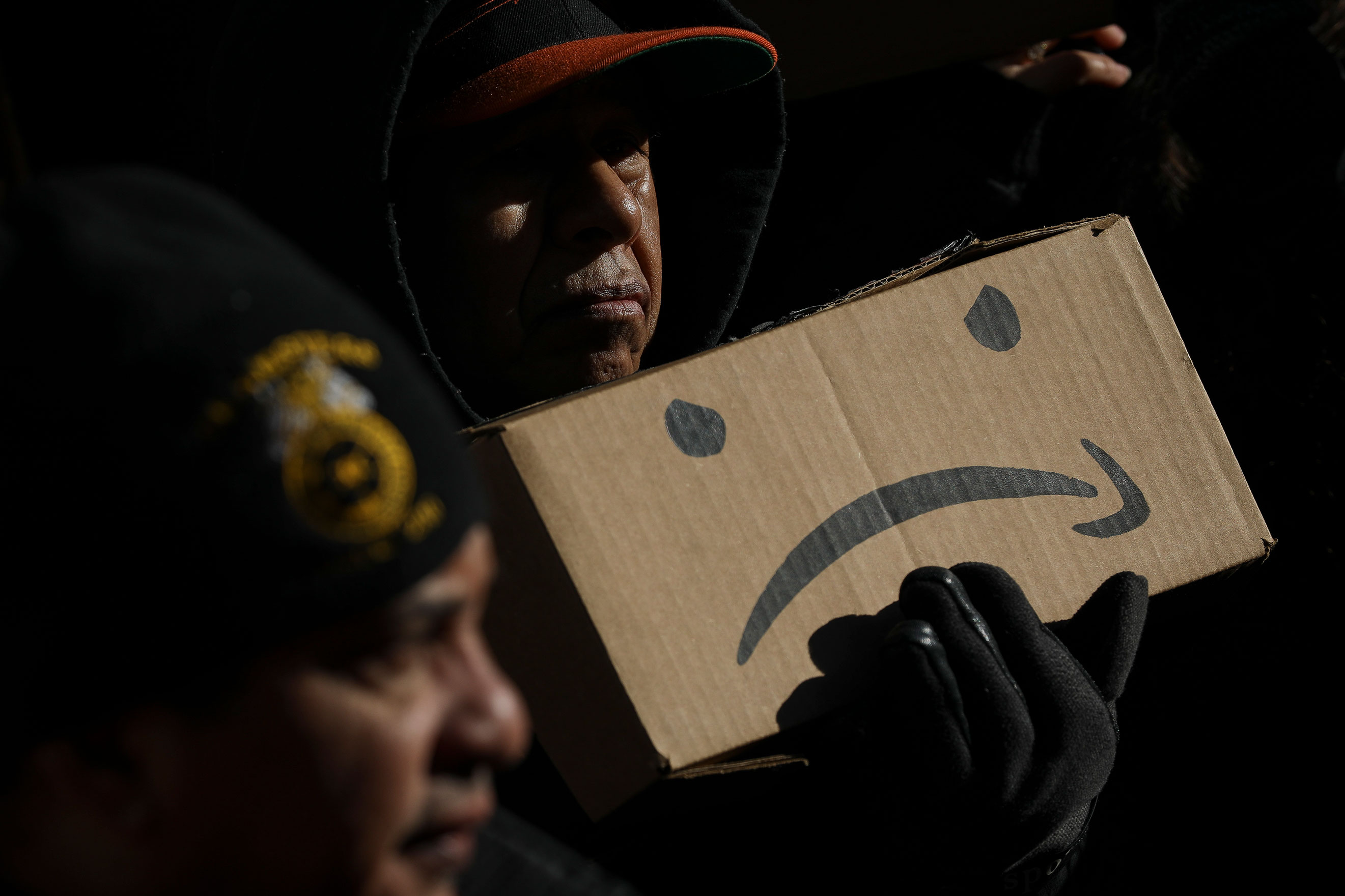
Anti-Amazon Protestors Rally At NYC City Hall Against Queens Second Headquarters

(Photo by Drew Angerer/Getty Images)

Playing catch-up

Today, competition for developers, data scientists, designers, and other skilled roles is intense. As government departments struggle to match the salaries, perks, and professional opportunities that the private sector offers, they cannot hire the in-house staff that they need to develop and run modern websites and applications, perform cutting-edge analytics, and maintain secure systems. Amazon did not create this problem, but it may worsen it.

Daily Crunch: Facebook bans far-right figures

The Daily Crunch is TechCrunch’s roundup of our biggest and most important stories. If you’d like to get this delivered to your inbox every day at around 9am Pacific, you can subscribe here.

1. Facebook bans a fresh batch of mostly far-right figures

The banned figures include Milo Yiannopoulos, Paul Joseph Watson, Laura Loomer, Paul Nehlen and Louis Farrakhan — plus, Facebook doubled down on banning Alex Jones.

The company said this is part of its policy to ban “individuals or organizations who promote or engage in violence and hate, regardless of ideology.”

2. Microsoft makes a push to simplify machine learning

Ahead of its Build conference, Microsoft today released a slew of new machine learning products and tweaks to some of its existing services. These range from no-code tools to hosted notebooks, with a number of new APIs and other services in-between.

3. YouTube confirms plans to make Originals available for free

Since last fall, YouTube has acknowledged that it’s moving toward an ad-supported model for its Originals. Last night, its chief business officer said all original programming moving forward will have a free window.

4. Why you don’t want Tumblr sold to exploitative Pornhub

The Wall Street Journal reports that TechCrunch parent company Verizon is considering selling Tumblr, and Pornhub VP Corey Price told BuzzFeed, “We’re extremely interested in acquiring the platform.”

5. Spotify spotted testing ‘Your Daily Drive,’ a personalized playlist that includes podcasts

This is the first Spotify playlist to mix music and podcasts, customized to users’ tastes.

6. Sonic the Hedgehog director says character is getting makeover after backlash

After the release of the film’s trailer, director Jeff Fowler tweeted, “The message is loud and clear… you aren’t happy with the design & you want changes. It’s going to happen.”

7. 3 key secrets to building extraordinary teams

For one thing, hire people before skills, because scrappiness and cultural fit matter more than intelligence and experience. (Extra Crunch membership required.)

When it comes to elections, Facebook moves slow, may still break things

This week, Facebook invited a small group of journalists — which didn’t include TechCrunch — to look at the “war room” it has set up in Dublin, Ireland, to help monitor its products for election-related content that violates its policies. (“Time and space constraints” limited the numbers, a spokesperson told us when he asked why we weren’t invited.)

Facebook announced it would be setting up this Dublin hub — which will bring together data scientists, researchers, legal and community team members, and others in the organization to tackle issues like fake news, hate speech and voter suppression — back in January. The company has said it has nearly 40 teams working on elections across its family of apps, without breaking out the number of staff it has dedicated to countering political disinformation. 

We have been told that there would be “no news items” during the closed tour — which, despite that, is “under embargo” until Sunday — beyond what Facebook and its executives discussed last Friday in a press conference about its European election preparations.

The tour looks to be a direct copy-paste of the one Facebook held to show off its US election “war room” last year, which it did invite us on. (In that case it was forced to claim it had not disbanded the room soon after heavily PR’ing its existence — saying the monitoring hub would be used again for future elections.)

We understand — via a non-Facebook source — that several broadcast journalists were among the invites to its Dublin “war room”. So expect to see a few gauzy inside views at the end of the weekend, as Facebook’s PR machine spins up a gear ahead of the vote to elect the next European Parliament later this month.

It’s clearly hoping shots of serious-looking Facebook employees crowded around banks of monitors will play well on camera and help influence public opinion that it’s delivering an even social media playing field for the EU parliament election. The European Commission is also keeping a close watch on how platforms handle political disinformation before a key vote.

But with the pan-EU elections set to start May 23, and a general election already held in Spain last month, we believe the lack of new developments to secure EU elections is very much to the company’s discredit.

The EU parliament elections are now a mere three weeks away, and there are a lot of unresolved questions and issues Facebook has yet to address. Yet we’re told the attending journalists were once again not allowed to put any questions to the fresh-faced Facebook employees staffing the “war room”.

Ahead of the looming batch of Sunday evening ‘war room tour’ news reports, which Facebook will be hoping contain its “five pillars of countering disinformation” talking points, we’ve compiled a run down of some key concerns and complications flowing from the company’s still highly centralized oversight of political campaigning on its platform — even as it seeks to gloss over how much dubious stuff keeps falling through the cracks.

Worthwhile counterpoints to another highly managed Facebook “election security” PR tour.

No overview of political ads in most EU markets

Since political disinformation created an existential nightmare for Facebook’s ad business with the revelations of Kremlin-backed propaganda targeting the 2016 US presidential election, the company has vowed to deliver transparency — via the launch of a searchable political ad archive for ads running across its products.

The Facebook Ad Library now shines a narrow beam of light into the murky world of political advertising. Before this, each Facebook user could only see the propaganda targeted specifically at them. Now, such ads stick around in its searchable repository for seven years. This is a major step up on total obscurity. (Obscurity that Facebook isn’t wholly keen to lift the lid on, we should add; Its political data releases to researchers so far haven’t gone back before 2017.)

However, in its current form, in the vast majority of markets, the Ad Library makes the user do all the leg work — running searches manually to try to understand and quantify how Facebook’s platform is being used to spread political messages intended to influence voters.

Facebook does also offer an Ad Library Report — a downloadable weekly summary of ads viewed and highest spending advertisers. But it only offers this in four countries globally right now: the US, India, Israel and the UK.

It has said it intends to ship an update to the reports in mid-May. But it’s not clear whether that will make them available in every EU country. (Mid-May would also be pretty late for elections that start May 23.)

So while the UK report makes clear that the new ‘Brexit Party’ is now a leading spender ahead of the EU election, what about the other 27 members of the bloc? Don’t they deserve an overview too?

A spokesperson we talked to about this week’s closed briefing said Facebook had no updates on expanding Ad Library Reports to more countries, in Europe or otherwise.

So, as it stands, the vast majority of EU citizens are missing out on meaningful reports that could help them understand which political advertisers are trying to reach them and how much they’re spending.

Which brings us to…

Facebook’s Ad Archive API is far too limited

In another positive step Facebook has launched an API for the ad archive that developers and researchers can use to query the data. However, as we reported earlier this week, many respected researchers have voiced disappointed with what it’s offering so far — saying the rate-limited API is not nearly open or accessible enough to get a complete picture of all ads running on its platform.

Following this criticism, Facebook’s director of product, Rob Leathern, tweeted a response, saying the API would improve. “With a new undertaking, we’re committed to feedback & want to improve in a privacy-safe way,” he wrote.

The question is when will researchers have a fit-for-purpose tool to understand how political propaganda is flowing over Facebook’s platform? Apparently not in time for the EU elections, either: We asked about this on Thursday and were pointed to Leathern’s tweets as the only update.

This issue is compounded by Facebook also restricting the ability of political transparency campaigners — such as the UK group WhoTargetsMe and US investigative journalism site ProPublica — to monitor ads via browser plug-ins, as the Guardian reported in January.

The net effect is that Facebook is making life hard for civil society groups and public interest researchers to study the flow of political messaging on its platform to try to quantify democratic impacts, and offering only a highly managed level of access to ad data that falls far short of the “political ads transparency” Facebook’s PR has been loudly trumpeting since 2017.

Ad loopholes remain ripe for exploiting

Facebook’s Ad Library includes data on political ads that were active on its platform but subsequently got pulled (made “inactive” in its parlance) because they broke its disclosure rules.

There are multiple examples of inactive ads for the Spanish far right party Vox visible in Facebook’s Ad Library that were pulled for running without the required disclaimer label, for example.

“After the ad started running, we determined that the ad was related to politics and issues of national importance and required the label. The ad was taken down,” runs the standard explainer Facebook offers if you click on the little ‘i’ next to an observation that “this ad ran without a disclaimer”.
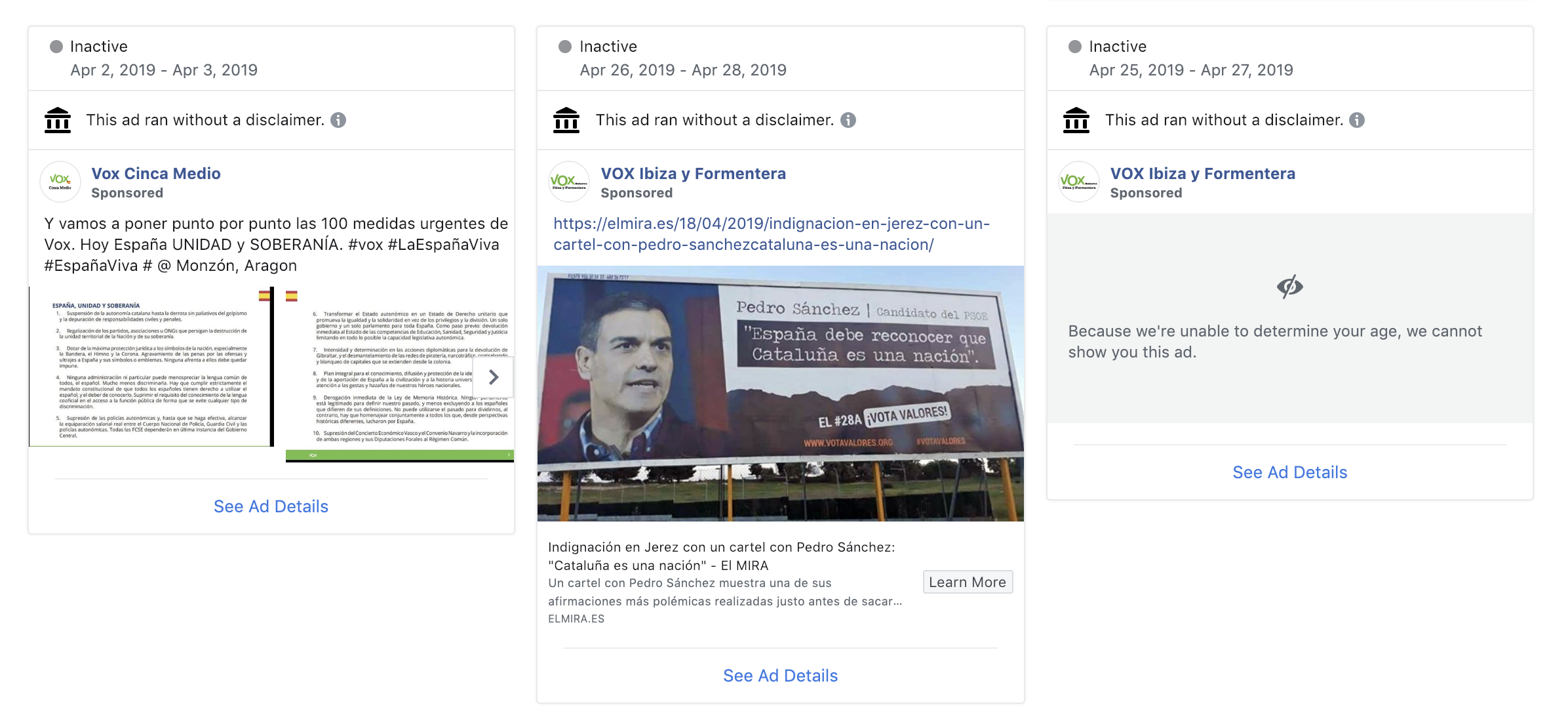
What is not at all clear is how quickly Facebook acted to removed rule-breaking political ads.

It is possible to click on each individual ad to get some additional details. Here Facebook provides a per ad breakdown of impressions; genders, ages, and regional locations of the people who saw the ad; and how much was spent on it.

But all those clicks don’t scale. So it’s not possible to get an overview of how effectively Facebook is handling political ad rule breakers. Unless, well, you literally go in clicking and counting on each and every ad…

There is then also the wider question of whether a political advertiser that is found to be systematically breaking Facebook rules should be allowed to keep running ads on its platform.

Because if Facebook does allow that to happen there’s a pretty obvious (and massive) workaround for its disclosure rules: Bad faith political advertisers could simply keep submitting fresh ads after the last batch got taken down.

We were, for instance, able to find inactive Vox ads taken down for lacking a disclaimer that had still been able to rack up thousands — and even tens of thousands — of impressions in the time they were still active.

Facebook needs to be much clearer about how it handles systematic rule breakers.

Definition of political issue ads is still opaque

Facebook currently requires that all political advertisers in the EU go through its authorization process in the country where ads are being delivered if they relate to the European Parliamentary elections, as a step to try and prevent foreign interference.

This means it asks political advertisers to submit documents and runs technical checks to confirm their identity and location. Though it noted, on last week’s call, that it cannot guarantee this ID system cannot be circumvented. (As it was last year when UK journalists were able to successfully place ads paid for by ‘Cambridge Analytica’.)

One other big potential workaround is the question of what is a political ad? And what is an issue ad?

Facebook says these types of ads on Facebook and Instagram in the EU “must now be clearly labeled, including a paid-for-by disclosure from the advertiser at the top of the ad” — so users can see who is paying for the ads and, if there’s a business or organization behind it, their contact details, plus some disclosure about who, if anyone, saw the ads.

But the big question is how is Facebook defining political and issue ads across Europe?

While political ads might seem fairly easy to categorize — assuming they’re attached to registered political parties and candidates, issues are a whole lot more subjective.

Currently Facebook defines issue ads as those relating to “any national legislative issue of public importance in any place where the ad is being run.” It says it worked with EU barometer, YouGov and other third parties to develop an initial list of key issues — examples for Europe include immigration, civil and social rights, political values, security and foreign policy, the economy and environmental politics — that it will “refine… over time.”

Again specifics on when and how that will be refined are not clear. Yet ads that Facebook does not deem political/issue ads will slip right under its radar. They won’t be included in the Ad Library; they won’t be searchable; but they will be able to influence Facebook users under the perfect cover of its commercial ad platform — as before.

So if any maliciously minded propaganda slips through Facebook’s net, because the company decides it’s a non-political issue, it will once again leave no auditable trace.

In recent years the company has also had a habit of announcing major takedowns of what it badges “fake accounts” ahead of major votes. But again voters have to take it on trust that Facebook is getting those judgement calls right.

Facebook continues to bar pan-EU campaigns

On the flip side of weeding out non-transparent political propaganda and/or political disinformation, Facebook is currently blocking the free flow of legal pan-EU political campaigning on its platform.

This issue first came to light several weeks ago, when it emerged that European officials had written to Nick Clegg (Facebook’s vice president of global affairs) to point out that its current rules — i.e. that require those campaigning via Facebook ads to have a registered office in the country where the ad is running — run counter to the pan-European nature of this particular election.

It means EU institutions are in the strange position of not being able to run Facebook ads for their own pan-EU election everywhere across the region. “This runs counter to the nature of EU institutions. By definition, our constituency is multinational and our target audience are in all EU countries and beyond,” the EU’s most senior civil servants pointed out in a letter to the company last month.

This issue impacts not just EU institutions and organizations advocating for particular policies and candidates across EU borders, but even NGOs wanting to run vanilla “get out the vote” campaigns Europe-wide — leading to a number to accuse Facebook of breaching their electoral rights and freedoms.

Facebook claimed last week that the ball is effectively in the regulators’ court on this issue — saying it’s open to making the changes but has to get their agreement to do so. A spokesperson confirmed to us that there is no update to that situation, either.

Of course the company may be trying to err on the side of caution, to prevent bad actors being able to interfere with the vote across Europe. But at what cost to democratic freedoms?

What about fake news spreading on WhatsApp?

Facebook’s ‘election security’ initiatives have focused on political and/or politically charged ads running across its products. But there’s no shortage of political disinformation flowing unchecked across its platforms as user uploaded ‘content’.

On the Facebook-owned messaging app WhatsApp, which is hugely popular in some European markets, the presence of end-to-end encryption further complicates this issue by providing a cloak for the spread of political propaganda that’s not being regulated by Facebook.

In a recent study of political messages spread via WhatsApp ahead of last month’s general election in Spain, the campaign group Avaaz dubbed it “social media’s dark web” — claiming the app had been “flooded with lies and hate”.

Posts range from fake news about Prime Minister Pedro Sánchez signing a secret deal for Catalan independence to conspiracy theories about migrants receiving big cash payouts, propaganda against gay people and an endless flood of hateful, sexist, racist memes and outright lies,” it wrote. 

Avaaz compiled this snapshot of politically charged messages and memes being shared on Spanish WhatsApp by co-opting 5,833 local members to forward election-related content that they deemed false, misleading or hateful.

It says it received a total of 2,461 submissions — which is of course just a tiny, tiny fraction of the stuff being shared in WhatsApp groups and chats. Which makes this app the elephant in Facebook’s election ‘war room’.

What exactly is a war room anyway?

Facebook has said its Dublin Elections Operation Center — to give it its official title — is “focused on the EU elections”, while also suggesting it will plug into a network of global teams “to better coordinate in real time across regions and with our headquarters in California [and] accelerate our rapid response times to fight bad actors and bad content”.

But we’re concerned Facebook is sending out mixed — and potentially misleading — messages about how its election-focused resources are being allocated.

Our (non-Facebook) source told us the 40-odd staffers in the Dublin hub during the press tour were simultaneously looking at the Indian elections. If that’s the case, it does not sound entirely “focused” on either the EU or India’s elections. 

Facebook’s eponymous platform has 2.375 billion monthly active users globally, with some 384 million MAUs in Europe. That’s more users than in the US (243M MAUs). Though Europe is Facebook’s second-biggest market in terms of revenues after the US. Last quarter, it pulled in $3.65BN in sales for Facebook (versus $7.3BN for the US) out of $15BN overall.

Apart from any kind of moral or legal pressure that Facebook might have for running a more responsible platform when it comes to supporting democratic processes, these numbers underscore the business imperative that it has to get this sorted out in Europe in a better way.

Having a “war room” may sound like a start, but unfortunately Facebook is presenting it as an end in itself. And its foot-dragging on all of the bigger issues that need tackling, in effect, means the war will continue to drag on.

How tech entrepreneurs think of Universal Basic Income

As tech has grown, policy debates have become an important pastime. Today’s tech industry aspires to replace human drivers with self-driving cars, secretaries with AI assistants, permanent jobs with gigs — and as a result, the human impact of tech has become an everyday conversation.

No other idea is as emblematic of this as Universal Basic Income, a policy that would distribute a monthly sum to every adult regardless of their income or employment status.

The conversation is widespread. Mark Zuckerberg and Elon Musk have said that UBI may be desirable or necessary. Y-Combinator Research and Facebook co-founder Chris Hughes are running basic income studies. Tech-friendly presidential hopefuls Bernie Sanders and Andrew Yang support the issue.

But should the average tech entrepreneur or investor support UBI? The answer is not entirely clear.

The good news is that the tech industry is deeply familiar with risk, which is an important component of arguments for UBI. The bad news: risk isn’t the whole story, and both positive and negative evidence for the policy are currently thin.

Image via H. Armstrong Roberts/ClassicStock/Getty Images

The role of risk

Entrepreneurs understand the risk component of UBI because it’s the same risk they take in starting companies. Many entrepreneurs start with savings or seed funding that reduce their downside risk — and it’s not hard for them to imagine that others lack these resources. A UBI could solve the issue.

Report: Sinclair to buy Disney’s 21 regional sports networks for $10B

TV broadcasting company Sinclair will buy 21st Century Fox’s 21 regional sports networks from Disney for $10 billion, according to a report from The Wall Street Journal. Sinclair was one of several bidding for the sports networks, which had also seen interest from Liberty Media, MLB and Big 3 Basketball LLC. Sinclair came out on top thanks to its mostly cash deal, according to a report last week from Fox Business, crediting unknown sources.

The earlier report also pegged the deal price of $10 billion.

Disney had come to own the regional sports networks by way of its $71.3 billion purchase of Fox, which closed in March. That acquisition gave it more movies, TV and IP, including film titles like “The Shape of Water,” “Avatar” and “Deadpool,” TV shows like “The Simpsons” and “Atlanta” and majority ownership of Hulu.

The company agreed to sell off the sports networks in order to win government approval for the Fox deal.

Separate from the new deal with Sinclair, Disney sold off the YES Network, the most prominent of the 22 regional sports networks it was looking to unload. The buying group, which included the New York Yankees, Amazon, as well as Sinclair, had agreed to pay $3.5 billion for the network, according to other media reports.

The WSJ confirmed this as well, noting the deal hadn’t been finalized.

The new agreement with Sinclair will see it acquiring other major sports networks, including channels in L.A. and Detroit.

The deal is expected to be announced today.

Google’s budget Pixel 3a XL pops up at an Ohio Best Buy

The Pixel 3a is arriving next week at Google I/O. That statement felt like all but a given before, and now that the handset is showing up at Ohio-area Best Buys, well, you can pretty much bank on it at this point.

Google’s budget take on its Pixel flagship is expected to take the stage during the May 7 keynote at Mountain View. Meantime, we’ve got another pretty good look at the thing courtesy of an Android Police reader who spotted boxes at a Springfield store.

The shots confirm Google’s strict adherence to silly color naming conventions, with the appearance of “Purple-ish” alongside “Just Black.” The former is a new color and looks to be about as subtle as you can get with a purple piece of electronics. Other side-of-the-box specs confirm what we’ve seen so far, including a 6-inch display on the XL version, coupled with 64GB of storage.

The handsets arrive just six or so months after the release of the Pixel 3. The company addressed the flagship device’s poor sales on this week’s earnings call, noting, among other things, that it had some hardware planned for I/O, marking a break from past years. It will be interesting to see how Google positions the product, as it continues to make software, AI and ML the focus of upgrades over hardware specs.

More info on what to expect next week in Mountain View can be found here.

Tesla bumps up its capital raise by $400 million, with Elon Musk taking an additional $15 million

Tesla is going to raise an additional $400 million in its latest sale of stock, with co-founder and chief executive Elon Musk committing to buy an additional $15 million in shares, according to a filing with the Securities and Exchange Commission.

The electric vehicle, energy storage and solar panel manufacturer said it will sell 3.1 million shares at $243 per share. The underwriters are jointly underwritten by Goldman Sachs and Citigroup . At the same time, the company said it would boost its convertible note offering by another $100 million.

Initially, Tesla was going to sell $2.3 billion in stock and warrants, but the new totals boost that number to $2.7 billion, with Elon Musk upping the ante of his own purchase as part of the revised deal.

The company said that Musk would boost his purchase from $10 million to $25 million as part of the sale of stock.

News of the increased share sale, revised just one day after Tesla announced that it would turn to capital markets to raise more cash, comes despite its report of a rocky first quarter, just one week ago.

Zachary Kirkhorn even called it “one of the most complicated quarters” in Tesla’s history.

Tesla lost $702 million in the first quarter of the year, but its challenges and cash constraints haven’t dimmed investor appetite for shares in the stock.


CBS says streaming services & Super Bowl helped it achieve record revenues in Q1

CBS credited its direct-to-consumer streaming services in helping it achieve double-digit revenue growth and record quarterly revenues in Q1, along with the gains that came from hosting Super Bowl LIII and those from affiliate revenue. The network said its over-the-top service for cord cutters, CBS All Access, combined with Showtime’s direct-consumer subscriptions, grew 71% year-over-year — its biggest quarter of growth ever.

Both services are continuing to grow in Q2, as well, thanks to “The Twilight Zone” on CBS All Access and “Billions” on Showtime, the company noted.

In addition, CBS is benefiting from other streamers’ needs for content. It spoke of gains from increasing sales of its content to providers like Amazon, Apple and Netflix, for example. The latter has just debuted “Dead to Me,” from CBS Television Studios, on its service. And CBS is producing “Diary of a Female President” for the Disney+ streaming service, which begins filming this summer.

The market’s appetite for over-the-top streaming TV services has helped CBS succeed in the cord-cutting era, thanks to its investment in streaming platforms and original content for subscribers, like “The Twilight Zone,” “The Good Fight,” “Star Trek: Discovery” and other shows.

However, the Super Bowl played a huge role in boosting subscriptions this quarter — the company even noted that CBS All Access had its “biggest quarter of [subscriber] growth ever.”

But CBS may be able to retain subscribers who joined for the Big Game with its other original programming, like “The Twilight Zone,” which was the most-watched original premiere, for instance.

It also touted upcoming new originals, including a dark comedy starring Lucy Liu called “Why Women Kill” from Desperate Housewives’ creator Mark Cherry; a true crime drama called “Interrogation”; and a brand-new “Star Trek” series starring Patrick Stewart.

CBS said it’s now working to take CBS All Access to more international customers. Having already launched in Canada and Australia, it’s coming next to Latin America and Western Europe.

In February, CBS said it had reached its goal of 8 million streaming subscribers two years early — a figure that included Showtime’s direct-to-consumer subscribers, as well. It said it was aiming to reach 25 million domestic subscribers by 2022, up from its early plan to reach 16 million by that time.

Earlier this week, Hulu announced it had topped 28 million customers, for comparison’s sake.

CBS didn’t update those numbers, but said the company still feels “very good” about achieving them.

What CBS can’t project, though, is how its growth may be impacted by the arrival of the other new streaming services coming to market in the months ahead, including Apple TV+, Disney+, the WarnerMedia streaming service and perhaps even Jeffrey Katzenberg’s mobile streaming service Quibi. As all will rely on subscriptions, consumers may end up having to pick-and-choose which ones to pay for — as few can afford to subscribe to all.

It did say that it believes Apple TV+ will help it to grow, however, because it will help distribute CBS content to more customers, and boost its own subscriptions as a result.

“Given our company’s strong programming pipeline and our early-mover advantage in direct-to-consumer, we feel very confident about CBS’ leadership position in a media landscape that values must-have content above all else,” noted Joe Ianniello, CBS president and acting CEO, in a statement. 

CBS reported earnings of $1.37 per share in Q1 on $4.2 billion in revenue. It was projected to earn $1.36 per share on $4.3 billion.

AWS opens up its managed blockchain as a service to everybody

After announcing that they were launching a managed blockchain service late last year, Amazon Web Services is now opening that service up for general availability.

It was only about five months ago that AWS chief executive Andy Jassy announced that the company was reversing course on its previous dismissal of blockchain technologies and laid out a new service it would develop on top of open source frameworks like Hyperledger Fabric and Ethereum.

“Customers want to use blockchain frameworks like Hyperledger Fabric and Ethereum to create blockchain networks so they can conduct business quickly, with an immutable record of transactions, but without the need for a centralized authority. However, they find these frameworks difficult to install, configure, and manage,” said Rahul Pathak, General Manager, Amazon Managed Blockchain at AWS, in a statement. “Amazon Managed Blockchain takes care of provisioning nodes, setting up the network, managing certificates and security, and scaling the network. Customers can now get a functioning blockchain network set up quickly and easily, so they can focus on application development instead of keeping a blockchain network up and running.”

Already companies like AT&T Business, Nestlé and the Singaporean investment market, the Singapore Exchange, have signed on to use the company’s services.

With the announcement, AWS joins other big enterprise players like Azure from Microsoft and IBM in the blockchain as a service game.

SoftBank Vision Fund says its team will balloon to a whopping 800 people in the next 24 months

SoftBank Vision Fund has its pedal to the metal in more ways than one. On stage at the Milken Institute Global Conference yesterday, the CEO of SoftBank Investment Advisors, Rajeev Misra, reportedly disclosed plans to double the size of the investment arm from 400 employees to 800 employees over the next 18 to 24 months.

That’s a lot of people  — especially considering that last September, one of its managing directors, Jeffrey Housenbold, told us that the organization employed 86 investors across offices in Tokyo, London, and San Carlos, Ca.

Then again, much has happened in the seven months since that sit-down. For one thing, SoftBank — which had been flying its managing directors back and forth to China to kick the tires on potential deals — decided to start assembling an investment team to be based in China and managed by Eric Chen, a former Hong Kong-based managing director at private equity firm Silver Lake who’d joined the firm in March of last year.

The firm also announced in November plans to open an office in Mumbai, India, where it has already amassed enormous stakes in some of the company’s highest-flying startups, including the hospitality group OYO and the digital payments company Paytm. Heading up that office: Sumer Juneja, who SoftBank poached from Norwest Venture Partners.

According to numerous Reuters’ reports last year, the Vision Fund was also planning to open an office in Saudi Arabia, home to its biggest backer – the sovereign wealth fund PIF —  which committed $45 billion to its debut fund and told Bloomberg in early October that it planned to commit $45 billion to a second massive Vision Fund.

It isn’t clear whether those plans remain in place. Shortly after Bloomberg ran that interview, the world learned that a dissident Saudi journalist, Jamal Khashoggi, went missing at Saudi Arabia’s embassy in Turkey days earlier and never left the building. As it became clearer that Khashoggi had been murdered — the CIA believes Saudi Arabia’s Crown Prince Mohammed bin Salman ordered the 59-year-old to be killed — SoftBank’s relationship with the country came under strain. Specifically, SoftBank CEO Masayoshi Son decided to steer clear of the kingdom’s major investment summit later in October, opting instead to meet with the prince privately on the eve of the event.

The move, timid as it may have seemed to the other business heads who expressed more outrage at the time, might have been construed otherwise by the prince. At the very least, the dynamic between the two seems to have shifted. In December, Saudi Arabia and another major Vision Fund backer — the government-backed fund of Abu Dhabi — rejected the Vision Fund’s planned $16 billion investment in the co-working startup WeWork, forcing Son to make a smaller investment in the New York-based outfit, in which it was already an investor. (SoftBank has still managed to funnel $10 billion altogether into WeWork, which disclosed yesterday that it confidentially filed to go public in December.)

SoftBank is meanwhile making other moves. Last month, it announced the launch of a $5 billion fund that it will invest in technology start-ups across Latin America.

Notably, the vehicle is not a part of the Vision Fund. Instead, it’s called the SoftBank Innovation Fund, and it’s being run by former Sprint CEO and Bolivian native Marcelo Claure. Still, in the swashbuckling fashion that has become a hallmark of SoftBank deals, the firm just today confirmed that its newest fund will participate in a $1 billion round of funding for the Colombian delivery app Rappi.

SoftBank Group Corp and and SoftBank Vision Fund are splitting the $1 billion investment evenly for now, but SoftBank reportedly plans to offer its stake in the company to its Latin America-focused fund.

Altogether, as of last month, the Vision Fund had invested “probably $70 billion or so,” Son told CNBC. He added that “we have banks who are wishing to support us for extending leverage because the value of our assets has grown.”

WeWork and Uber, the ride-share giant that has also filed to go public, are among the Vision Fund’s biggest investments to date.

Possibly, the companies’ upcoming IPOs emboldened Misra yesterday to announce the firm’s own growth plans.

According to Business Insider, Misra also said at the Milken event that SoftBank will begin raising its second Vision Fund in the next several months.

Whether or not it will include more funding from Saudi Arabia will be interesting to see, particularly given the continuing backlash against the prince, whose efforts to soften his country’s image have largely failed owing to the Saudi-led war in Yemen, continued beheadings in Saudi Arabia, and the kingdom’s arrests of women’s rights activists, among other things. Given the scale of SoftBank’s ambition, it seems likely.

It wouldn’t be alone in forgiving and forgetting. Last month, for example, several U.S. multinationals told Reuters they are moving ahead with projects in the largest Arab economy, including Dow Chemical and General Electric.

SoftBank makes a huge bet on Latin America

Rappi represents a new era for Latin American technology startups.

Based in Bogotá, Colombia, the on-demand delivery startup has taken the region by storm, attracting a record amount of venture capital funding in mere months. Today marks the beginning of a new round of explosive growth as SoftBank, the Japanese telecom giant and prolific Silicon Valley tech investor, has confirmed a $1 billion investment in the business.

The king-sized financing comes two months after SoftBank announced its Innovation Fund, a new pool of capital committed to spending billions on the growing tech ecosystem in Central and South America.

VC funding in Latin America catapulted to new heights in 2018. Startups located across Argentina, Brazil, Chile, Colombia and more have secured nearly $2.5 billion since the beginning of 2018, according to PitchBook, up from less than $1 billion invested in 2017.

SoftBank plans to transfer the Rappi investment to the Innovation Fund “upon the fund’s establishment,” according to a press release. For now, the SoftBank Group and affiliated Vision Fund will each invest $500 million in the company. Jeffrey Housenbold, a managing director at SoftBank responsible for investments in Brandless, Opendoor and DoorDash, will join Rappi’s board of directors.

“SoftBank’s vision of accelerating the technology revolution deeply resonated with our mission of improving how people live through digital payments and a super-app for everything consumers need,” Rappi co-founder Sebastian Mejia said in a statement. “We will continue to focus on building innovations for couriers, restaurants, retailers and start-ups that translate into new sources of growth.”

Mejia, Simón Borrero and Felipe Villamarin launched Rappi in 2015, graduating from the Y Combinator startup accelerator the following year. It didn’t take long for the business to capture the attention of American VCs, including the likes of Andreessen Horowitz, DST Global and Sequoia Capital .

The latest round, the largest ever for a Latin American tech startup, brings Rappi’s total raised to date to a whopping $1.2 billion. The company was valued at more than $1 billion last year with a $200 million financing.

Rappi is among few venture-backed “unicorns” based in Latin America. São Paulo-based Nubank, a fast-growing fintech startup, garnered a $4 billion valuation last year with a $180 million investment.

Rappi didn’t immediately respond to a request for comment.

YouTube sets a goal of having half of trending videos coming from its own site

YouTube wants to have half of the featured videos in its trending tab come from streams originating on the company’s own site going forward, according to the latest quarterly letter from chief executive Susan Wojcicki.

The letter, directed to YouTube’s users, is meant to help ease concerns the site’s biggest stars have over copyright challenges, advertising policies and video monetization — along with their shrinking presence on the site’s trending feature.

YouTube’s biggest contributors are worried that their footprint on the trending tab is shrinking as the company favors “safer” content coming from other, more traditional, media like repurposed television clips, movie trailers, and music videos.

It’s been a rough quarter for YouTube. The company had to deal with yet another child predator scandal, which prompted the company to completely shut down comment sections on most videos featuring minors. 

The Alphabet-owned video company was also forced to wrestle with its role in the spread of a global anti-vaccination campaign that has helped foster a resurgence in Measles cases around the world — creating a new epidemic in the U.S. of a disease that had been largely eradicated in the country.

Beyond monetizing anti-vaccination videos, YouTube’s role in the dissemination of videos taken by the white supremacist mass-murderer who killed scores of people in attacks on mosques in Christchurch, New Zealand has created a backlash against the company in capitals around the world.

Wojcicki addressed both incidents in the letter, writing:

In February, we announced the suspension of comments on most YouTube videos that feature minors. We did this to protect children from predatory comments (with the exception of a small number of channels that have the manpower needed to actively moderate their comments and take additional steps to protect children). We know how vital comments are to creators. I hear from creators every day how meaningful comments are for engaging with fans, getting feedback, and helping guide future videos. I also know this change impacted so many creators who we know are innocent—from professional creators to young people or their parents who are posting videos. But in the end, that was a trade-off we made because we feel protecting children on our platform should be the most important guiding principle.

The following month, we took unprecedented action in the wake of the Christchurch tragedy. Our teams immediately sprung into action to remove the violative content. To counter the enormous volume of uploaded videos showing violent imagery, we chose to temporarily break some of our processes and features. That meant a number of videos that didn’t actually violate community guidelines, including a small set of news and commentary, were swept up and kept off the platform (until appealed by its owners and reinstated). But given the stakes, it was another trade-off that we felt was necessary. And with the devastating Sri Lankan attacks, our teams worked around the clock to make sure we removed violative content. In both cases, our systems triggered authoritative news and limited the spread of any hate and misinformation.

Given those examples, the commitment that Wojcicki is making to ensure that half of the videos in the company’s trending tab come from YouTube itself seems… risky.

The company needs to do something, though. The talent on which it depends to bring in advertisers and an audience is very worried about a number of recent steps YouTube has taken.

From the perspective of YouTube’s top talent, the company is abandoning them even as regulators restrict the ways in which they’re able to make the videos that have defined the site throughout its history.

In Europe, meme culture is under attack by lawmakers who have passed legislation muddying the waters around what constitutes fair use — and YouTube’s users are worried that the company may start restricting the distribution of their videos on flimsy copyright claims.

“[We] are also still very concerned about Article 13 (now renamed Article 17) — a part of the Copyright directive that recently passed in the E.U.,” Wojcicki wrote. “While we support the rights of copyright holders—YouTube has deals with almost all the music companies and TV broadcasters today—we are concerned about the vague, untested requirements of the new directive. It could create serious limitations for what YouTube creators can upload. This risks lowering the revenue to traditional media and music companies from YouTube and potentially devastating the many European creators who have built their businesses on YouTube.”

In many ways the letter is just a continuation of themes that Wojcicki laid out in her first address to the company’s core user base.

It’s a pivotal moment for YouTube as public pressures mount for the company to take more responsibility for the videos it distributes and the users that make up the bulk of its creative community start chafing under their increasing constraints.

The company appears to be responding with a commitment to be more transparent going forward, but it’s going to be increasingly difficult for the company to navigate between the pressures of advertisers for “safe” videos and producers for greater creative freedoms — all with traditional media putting the company increasingly in its crosshairs and new players like TikTok commanding greater attention.