The annual developer conference kicks off at 10 am Pacific on May 7 in Mountain View, California.
Category: Tech news
hacking,system security,protection against hackers,tech-news,gadgets,gaming
This Programming Tool Makes It Easier for Apps to Work Anywhere
WebAssembly was created to build applications for browsers, but it’s increasingly finding a home in cloud computing centers.
How to Watch ‘Game of Thrones’ Online
From HBO Now to Hulu to good old-fashioned cable, you’ve got no shortage of ways to get your Winterfell fix.
Trump’s Bank Lawsuit Tops This Week’s Internet News Roundup
The president, his family, and company are trying to stop the banks from responding to congressional subpoenas.
Tesla Raises Money, Drones Get Certified, and More Car News This Week
Telsa says it will raise up to $2.7 billion in new capital, and Uber prepares for its IPO.
A glitch is breaking all Firefox extensions
Did you just open Firefox only to find all of your extensions disabled and/or otherwise not working?
You’re not alone, and it’s nothing you did.
Reports are pouring in of a glitch that has spontaneously disabled effectively all Firefox extensions.
Each extension is now being listed as a “legacy” extension, alongside a warning that it “could not be verified for use in Firefox and has been disabled”.
A ticket submitted to Mozilla’s Bugzilla bug tracker first hit at around 5:40 PM Pacific, and pins the sudden failure on a code signing certificate built into the browser that expired just after 5 PM (or midnight on May 4th in UTC time).
Because the glitch stems from an underlying certificate, re-installing extensions won’t help. Getting extensions back for everyone is going to require Mozilla to issue a patch.
Story developing…
Watch Rocket Lab launch its second orbital mission of 2019 late tonight
Fast-growing launch provider Rocket Lab is launching its second orbital payload of the year late tonight by our reckoning, early in the evening at the launch site in New Zealand. It will carry three experimental satellites to low Earth orbit, and you can watch it live.
The launch is Rocket Lab’s fifth orbital mission, and while it aims to eventually provide launches at a cadence of weeks, it’ll be some time before that’s possible — for now every couple months is what they can manage. But with $140 million in new funding, that should change pretty quickly.
The payloads going up tonight/tomorrow are:
- SPARC-1: The Space Plug and Play Architecture Research CubeSat is an Air Force Research Lab they’ve been working on with the Swedish for years now. It’s a new design for a 6U craft with a reconfigurable orbital radio transceiver, intended to “support live experimentation with different waveforms and protocols useful to communications missions.” Plus a camera for checking out the scene up there.
- Falcon ODE: This Orbital Debris Experiment will release two stainless steel ball bearings on known trajectories in space that will help calibrate ground-based debris-detection systems.
- Harbinger: A scary-sounding small satellite and the heaviest single micro-sat to be lofted by Rocket Lab’s electron launch vehicle so far. This one, also from the Air Force, uses a synthetic aperture radar to observe Earth regardless of illumination or cloud cover. It’s a demonstrator for rapid production techniques and standardized parts meant to accelerate deployment of new spacecraft.
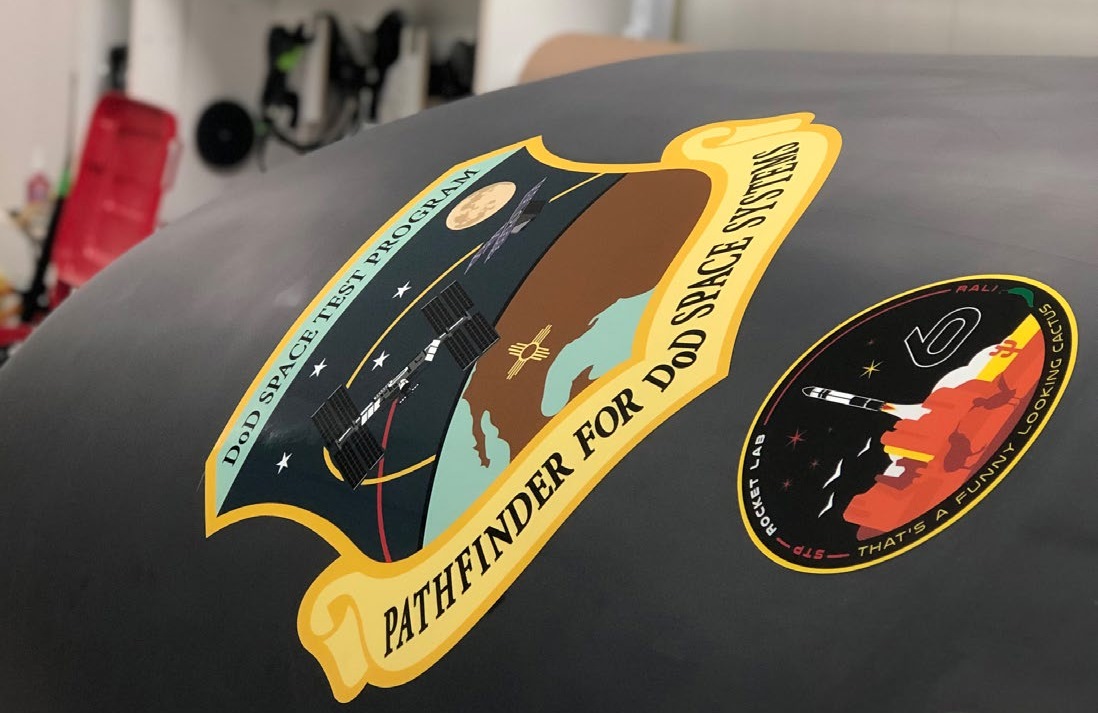
Fairing of the Falcon-ODE payload.
All told, its contents comprise 180 kilograms, or nearly 400 pounds, the heaviest load Electron has yet taken off with.
Lift-off is set for 6 PM local time in New Zealand, which corresponds to 11 PM Pacific time here in the U.S. If weather impinges on the opportunity, no worries — this launch window stays open for two weeks. You can watch the whole thing starting a few minutes before 11 at Rocket Lab’s website.
Launch readiness review is complete and we are green for tomorrow's launch of the STP-27RD mission from Launch Complex 1. The launch window opens at 06:00 UTC / 18:00 NZT, 4 May. Join us then for Electron's first night launch!
— Rocket Lab (@RocketLab) May 3, 2019

Security lapse exposed a Chinese smart city surveillance system
Smart cities are designed to make life easier for their residents: better traffic management by clearing routes, making sure the public transport is running on time and having cameras keeping a watchful eye from above.
But what happens when that data leaks? One such database was open for weeks for anyone to look inside.
Security researcher John Wethington found a smart city database accessible from a web browser without a password. He passed details of the database to TechCrunch in an effort to get the data secured.
The database was an Elasticsearch database, storing gigabytes of data — including facial recognition scans on hundreds of people over several months. The data was hosted by Chinese tech giant Alibaba. The customer, which Alibaba did not name, tapped into the tech giant’s artificial intelligence-powered cloud platform, known as City Brain.
“This is a database project created by a customer and hosted on the Alibaba Cloud platform,” said an Alibaba spokesperson. “Customers are always advised to protect their data by setting a secure password.”
“We have already informed the customer about this incident so they can immediately address the issue. As a public cloud provider, we do not have the right to access the content in the customer database,” the spokesperson added. The database was pulled offline shortly after TechCrunch reached out to Alibaba.
But while Alibaba may not have visibility into the system, we did.
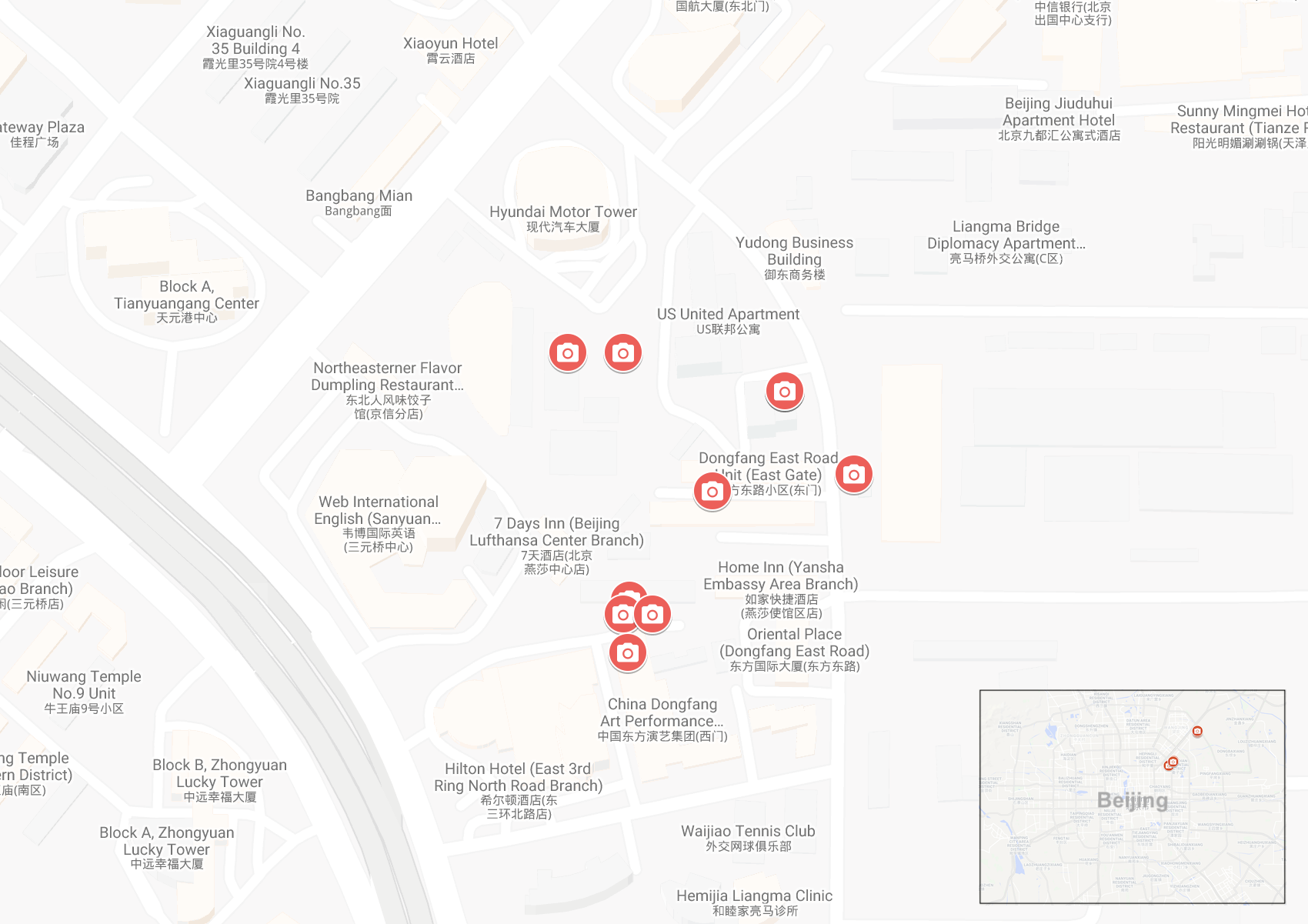
The location of the smart city’s many cameras in Beijing (Image: supplied)
While artificial intelligence-powered smart city technology provides insights into how a city is operating, the use of facial recognition and surveillance projects have come under heavy scrutiny from civil liberties advocates. Despite privacy concerns, smart city and surveillance systems are slowly making their way into other cities both in China and abroad, like Kuala Lumpur, and soon the West.
“It’s not difficult to imagine the potential for abuse that would exist if a platform like this were brought to the U.S. with no civilian and governmental regulations or oversight,” said Wethington. “While businesses cannot simply plug in to FBI data sets today it would not be hard for them to access other state or local criminal databases and begin to create their own profiles on customers or adversaries.”
We don’t know the customer of this leaky database, but its contents offered a rare insight into how a smart city system works.
The system monitors the residents around at least two small housing communities in eastern Beijing, the largest of which is Liangmaqiao, known as the city’s embassy district. The system is made up of several data collection points, including cameras designed to collect facial recognition data.
The exposed data contains enough information to pinpoint where people went, when and for how long, allowing anyone with access to the data — including police — to build up a picture of a person’s day-to-day life.
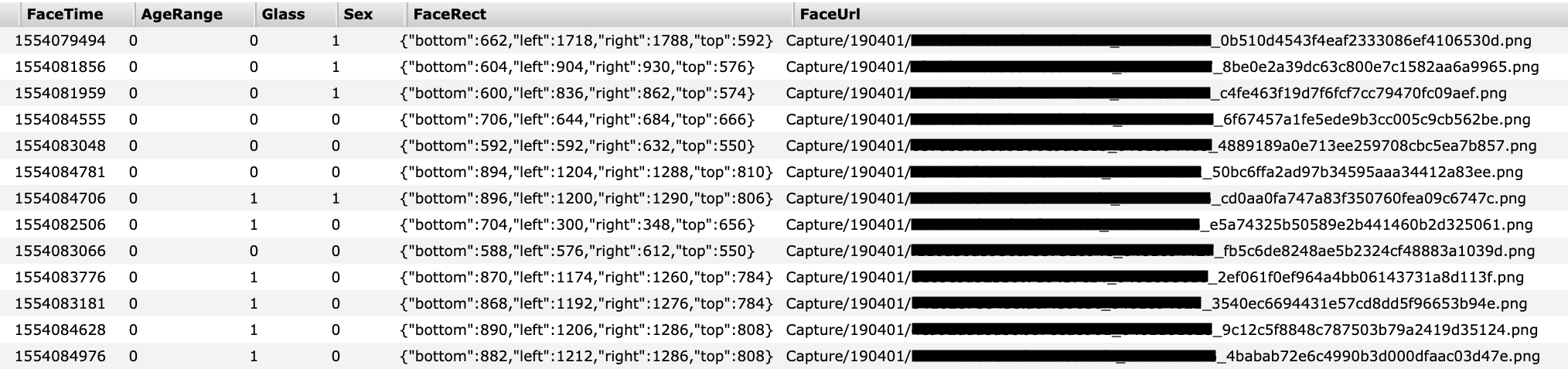
A portion of the database containing facial recognition scans (Image: supplied)
Alibaba provides technologies like City Brain to customers to understand the data they collect from various sources, including license plate readers, door access controls, smart things and internet-connected devices and facial recognition.
Using City Brain’s data-crunching back-end, the cameras can process various facial details, such as if a person’s eyes or mouth are open, if they’re wearing sunglasses, or a mask — common during periods of heavy smog — and if a person is smiling or even has a beard.
The database also contained a subject’s approximate age as well as an “attractive” score, according to the database fields.
But the capabilities of the system have a darker side, particularly given the complicated politics of China.
The system also uses its facial recognition systems to detect ethnicities and labels them — such as “??” for Han Chinese, the main ethnic group of China — and also “??” — or Uyghur Muslims, an ethnic minority under persecution by Beijing.
Where ethnicities can help police identify suspects in an area even if they don’t have a name to match, the data can be used for abuse.
The Chinese government has detained more than a million Uyghurs in internment camps in the past year, according to a United Nations human rights committee. It’s part of a massive crackdown by Beijing on the ethnic minority group. Just this week, details emerged of an app used by police to track Uyghur Muslims.
We also found that the customer’s system also pulls in data from the police and uses that information to detect people of interest or criminal suspects, suggesting it may be a government customer.

Facial recognition scans would match against police records in real time (Image: supplied)
Each time a person is detected, the database would trigger a “warning” noting the date, time, location and a corresponding note. Several records seen by TechCrunch include suspects’ names and their national identification card number.
“Key personnel alert by the public security bureau: “[name] [location]” – 177 camera detects key individual(s),” one translated record reads, courtesy of TechCrunch’s Rita Liao. (The named security bureau is China’s federal police department, the Ministry of Public Security.)
In other words, the record shows a camera at a certain point detected a person’s face whose information matched a police watchlist.
Many of the records associated with a watchlist flag would include the reason why, such as if a recognized person was a “drug addict” or “released from prison.”
The system is also programmed to alert the customer in the event of building access control issues, smoke alarms and equipment failures — such as when cameras go offline.
The customer’s system also has the capability to monitor for Wi-Fi-enabled devices, such as phones and computers, using sensors built by Chinese networking tech maker Renzixing and placed around the district. The database collects the dates and times that pass through its wireless network radius. Fields in the Wi-Fi-device logging table suggest the system can collect IMEI and IMSI numbers, used to uniquely identify a cellular user.
Although the customer’s smart city system was on a small scale with only a few dozen sensors, cameras and data collection points, the amount of data it collected in a short space of time was staggering.
In the past week alone, the database had grown in size — suggesting it’s still actively collecting data.
“The weaponization and abuse of A.I. is a very real threat to the privacy and security of every individual,” said Wethington. “We should carefully look at how this technology is already being abused by other countries and businesses before permitting them to be deployed here.”
It’s hard to know if facial recognition systems like this are good or bad. There’s no real line in the sand separating good uses from bad uses. Facial and object recognition systems can spot criminals on the run and detect weapons ahead of mass shootings. But some worry about the repercussions of being watched every day — even jaywalkers don’t get a free pass. The pervasiveness of these systems remain a privacy concern for civil liberties groups.
But as these systems develop and become more powerful and ubiquitous, companies might be better placed to first and foremost make sure its massive data banks don’t inadvertently leak.
Got a tip? You can send tips securely over Signal and WhatsApp to +1 646-755–8849. You can also send PGP email with the fingerprint: 4D0E 92F2 E36A EC51 DAAE 5D97 CB8C 15FA EB6C EEA5.
Why carriers keep your data longer
Your wireless carrier knows where you are as you read this on your phone — otherwise, it couldn’t connect your phone in the first place.
But your wireless carrier also has a memory. It knows where you took your phone in the last hour, the last week, the last month, the last year — and maybe even the last five years.
That gives it an enormous warehouse of data on your whereabouts that can help your wireless carrier fix coverage gaps while revealing much more. Depending on the density of cell sites around you at any one point, the location data triangulated from them can not only highlight your home and office, but also point to the bars you frequented, the houses at which you spent the night and the offices of therapists you visited.
Trump’s tariffs could knock Tesla’s Autopilot off course
The White House has refused to exempt the “brain” of Tesla’s Autopilot technology from punitive import tariffs, a decision that could delay or disrupt the company’s self-driving ambitions, TechCrunch has learned.
At a special “autonomy day” event last week, Tesla CEO Elon Musk unveiled advanced Autopilot 3.0 hardware, including a new custom chip intended to enable full self-driving (FSD) operation for all of its new vehicles. This hardware is now standard in all new Model 3, S and X vehicles. Customers pay an additional $6,000 for the software upgrade called FSD.
The self-driving hardware lives within the Autopilot ECU (or engine control unit), a module that Tesla describes as the “brain of the vehicle.” This module is assembled in Shanghai, China, by a company called Quanta Computer.
Tesla’s plans could be affected by a previously unreported decision last month by the White House not to grant the automaker an exemption from 25% tariffs. President Trump imposed these tariffs last year on a range of imports, including electronics, in an effort to reduce the U.S. trade deficit with China.
Tesla has suggested that the tariffs could force it to cease making its self-driving computers in China, thus delaying their introduction and even reducing vehicle safety.
“The imposed tariffs are forcing us to either source a new supplier, pass the cost increase to the end customer, or reduce operational costs within our internal operations, all having a reverse impact for what [we believe] to be the intention of the tariff,” the company wrote in an application to the United States Trade Representative (USTR) on November 16, requesting relief from the tariffs.
But on March 15, the USTR’s general counsel informed Tesla that it was denying the company’s request because it “concerns a product strategically important or related to ‘Made in China 2025’ or other Chinese industrial programs.” The USTR also rejected a retroactive exemption request for legacy Autopilot 2.5 hardware, for the same reason.
Made in China
Made In China 2025 is China’s strategic plan to move away from manufacturing to produce higher value goods, particularly in the areas of AI, electric vehicles and robotics. The White House sees the effort as a direct threat to U.S. domestic technology and automotive companies.
However, U.S. firms have long been among the largest beneficiaries of Chinese manufacturing expertise. Tesla’s Autopilot manufacturing partner in Shanghai, Quanta, has also worked with Apple, Amazon and Verizon.
“Tesla was unable to find a [U.S.] manufacturer with the requisite expertise to produce the Autopilot ECU 3.0 with the required specifications, at the volume requested and under the timelines necessary for Tesla’s continued growth,” the company wrote.
Tesla claimed that using Quanta would not help China reach a goal for 80 percent of domestic EV sales to come from Chinese companies by 2025. “To the contrary, if granted, the exclusion request would ensure that Tesla is able to maintain its technological and competitive advantage gained by manufacturing EVs and finished lithium-ion batteries in the United States,” it wrote.
Tesla also pointed out that more than 75 percent of the value of the new computer’s printed circuit board actually originates from outside of China. For instance, Tesla’s new cutting-edge neural network chips, which are a critical piece of Autopilot 3.0, are being made by Samsung in Austin, Texas.
The Tariff Effect
But the White House wasn’t buying it, and the USTR’s rejection is likely to hit Tesla hard. The company has already told investors that it could not guarantee hitting its gross margin targets on its cars, including the lowest-priced Model 3 variant.”
“These tariffs detract from our continuous growth and sustainability in a very difficult industry,” wrote Tesla.
Last week, the automaker posted a $702 million loss in the first quarter of 2019, on the back of lower than expected deliveries, and it just announced its intention to raise about $2.7 billion by selling a mix of debt and equity. The company originally said it intended to raise $2.3 billion in convertible notes and equity, then upped the total offering just a day later, according to regulatory filings.
Tesla is selling 3.1 million shares at a price of $243 per share through underwriters Goldman Sachs and Citigroup and boosted its convertible notes offering to $1.6 billion, according to filings. Musk is also doubling down on his own investment and now intends to buy up to 102,880 shares in stock worth $25 million.
With limited ability to increase prices or reduce costs, Tesla’s other option would be to relocate manufacturing to the United States. But that comes with its own difficulties, according to the company.
“Tesla’s decision to begin production [of the new Autopilot computer took] six months from development to production,” it wrote in its application. “With condensed timelines such as this, there is no leeway to test out a supplier that does not already have considerable experience … Choosing any other supplier would have delayed the program by 18 months with clean room setup, line validation, and staff training.”
Safety concerns
Even more critically, the company believes that such a move would also have safety implications: “Sourcing a new supplier increases the risk of poor part quality leading to possible quality issues that would impact the safety of our vehicles and the final product… We cannot risk our customers’ lives due to a defect from a supplier.”
The tariffs could even disrupt Tesla’s ongoing research into artificial intelligence, machine learning and computer vision, it fears.
“Tesla’s leadership position is contingent on our ability to deploy these advancements and components at volume, which we would be unable to do under the current tariff structure,” stated its application. Musk told investors yesterday that autonomy would eventually make Tesla a $500 billion company, a more than ten-fold increase to its valuation today.
Despite its strong wording to the USTR, Tesla has only mentioned the tariffs in investor filings in passing, where it focused on their impact on its bottom line: “Recently increased import duties on certain components used in our products that are sourced from China may increase our costs and negatively impact our operating results.”
Tesla declined to comment on this story.
Greg Linden is an economist at the University of California, Berkeley, specializing in the global supply chain for electronics. “For speed and high-volume, China is the place,” he told TechCrunch in a recent interview. “U.S. companies headed down the China road for board assembly about 25 years ago and never looked back. Component suppliers followed, and now China has a heft for high-volume electronics that no country can match.”
Linden has calculated that a U.S.-assembled Apple iPhone could add up to $40 per unit in cost, and estimates that building Autopilot 3.0 hardware in the U.S. would result in an increase of the same order of magnitude.
Lingering exemption requests
Tesla has several more tariff exemption requests outstanding with the U.S. government. A request to exempt the Model 3’s car computer, including its media control unit, connectivity board and advanced driver assistance system (ADAS) hardware, was filed at the end of December. Most recently, Tesla last week asked to be excluded from tariffs for specialized aluminum sheets from Japan, needed for lithium-ion battery cell manufacture at its Gigafactory in Sparks, Nevada.
But it is not all bad news for Musk on the trade front. Last July, The Boring Company requested relief from tariffs on Chinese-made tunneling machinery. It claimed that an inability to source tunnel boring machine parts from China would cost jobs and delay its proposed underground Loop transit system between Baltimore and Washington DC by up to two years.
On March 19, the USTR granted a retroactive exemption for imports of tunneling machinery.
Ironically, the autonomous electric vehicles intended for the Baltimore to DC Loop are based on Tesla cars that will likely rely on new Autopilot systems being built, at least for the moment, in China.
Dear Hollywood, here are 5 female founders to showcase instead of Elizabeth Holmes
Joseph Flaherty
Contributor
Contributor
Joe Flaherty is director of Content & Community at Founder Collective.
There’s a seemingly insatiable demand for Theranos content. John Carreyrou’s best-selling book, “Bad Blood,” has already inspired an HBO documentary, The Inventor; an ABC podcast called The Dropout, a prestige limited series starring SNL’s Kate McKinnon, was just announced; and Jennifer Lawrence is reportedly going to star in the feature film version of this tawdry “true crime meets tech” tale. That’s before getting started on the various and sundry cover stories and think pieces about her fraud.
I think it’s fair to say the Theranos story has been sufficiently well-documented, and I’m worried that this negative perception may be reinforced now that uBiome founder Jessica Richman has been placed on administrative leave. While it’s hard to pass on a chance to stoke startup schadenfreude, perhaps we could focus less on these rare, unrepresentative and dispiriting examples? Instead, Hollywood could put the spotlight on women who pioneered the bleeding edge of tech and actually produced billion-dollar successes. Here are a few candidates ready for their close-ups:
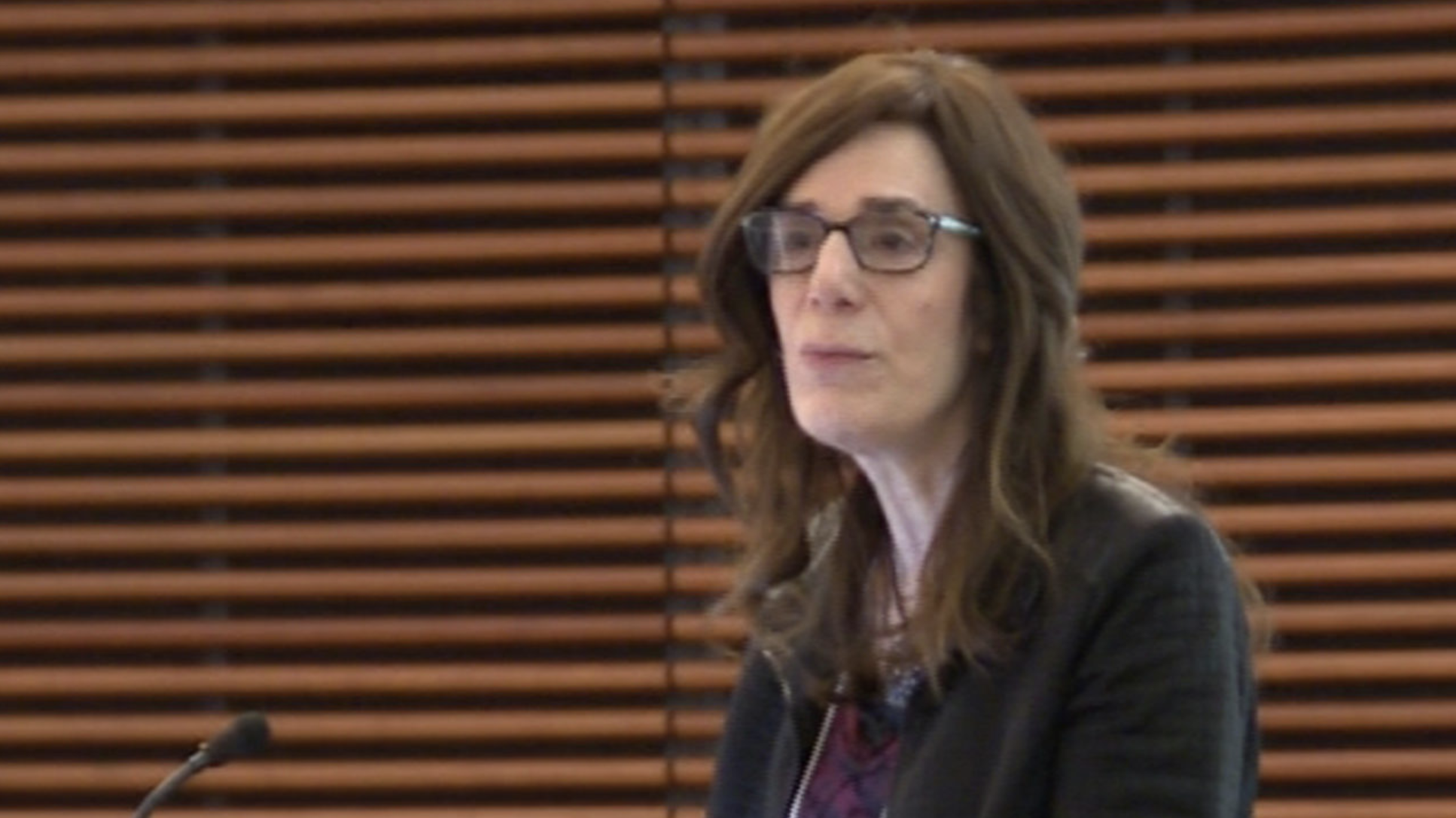
Judith Faulkner, founder and chief executive officer, Epic Systems
Judith Faulkner – Founder/CEO, Epic Systems
In the late 1970s, the picture of a working woman in Wisconsin was likely Laverne or Shirley. Little did anyone know that in the basement of a Victorian manse in Madison, the future of healthcare was being coded by Judith Faulkner, the founder and CEO of what would become Epic Systems. Epic is arguably the most impactful startup in the history of health software, and Faulkner was building medical scheduling software before most people could even picture a PC. Her efforts established the Electronic Medical Records market as we know it and today. Her company manages records for more than 200 million people, employs nearly 10,000 and generates around $2.7 billion per year in revenue — not bad for a math graduate who never raised any venture capital.
One might argue that the origins of medical software are too tepid to make for exciting TV, but something tells me the kind of CEO who hires Disney alums to design her corporate campus and dresses up like a wizard to address her employees might make for a compelling subject.

SANTA BARBARA, CA – FEBRUARY 09: Lynda Weinman speaks onstage (Photo by Rebecca Sapp/Getty Images for SBIFF)
Lynda Weinman – Founder/CEO, Lynda.com
Lynda Weinman might have the most esoteric path to becoming a billion-dollar entrepreneur in history. After getting a humanities degree from Evergreen College, where she was classmates with “Simpsons” creator Matt Groenig, Lynda opened a pair of punk rock fashion boutiques on LA’s Sunset Strip.
After those folded in the early 1980s, she taught herself enough computer graphics to become a freelance animator on movies like “Bill & Ted’s Excellent Adventure,” which in turn led to her becoming a teacher at the prestigious Art Center College of Design. Her academic pedigree provided the launching pad to write an influential textbook; that, in turn, gave her the star power to strike out on her own as one of the first web celebrities.
Keep in mind; this dramatic arc only covers the time before she started the eponymous Lynda.com, and bootstrapped it to a $1.5 billion exit in edtech — an industry most VCs and entrepreneurs fear to tread. In terms of material for a memoir, Hannah Horvath has nothing on Lynda Weinman.
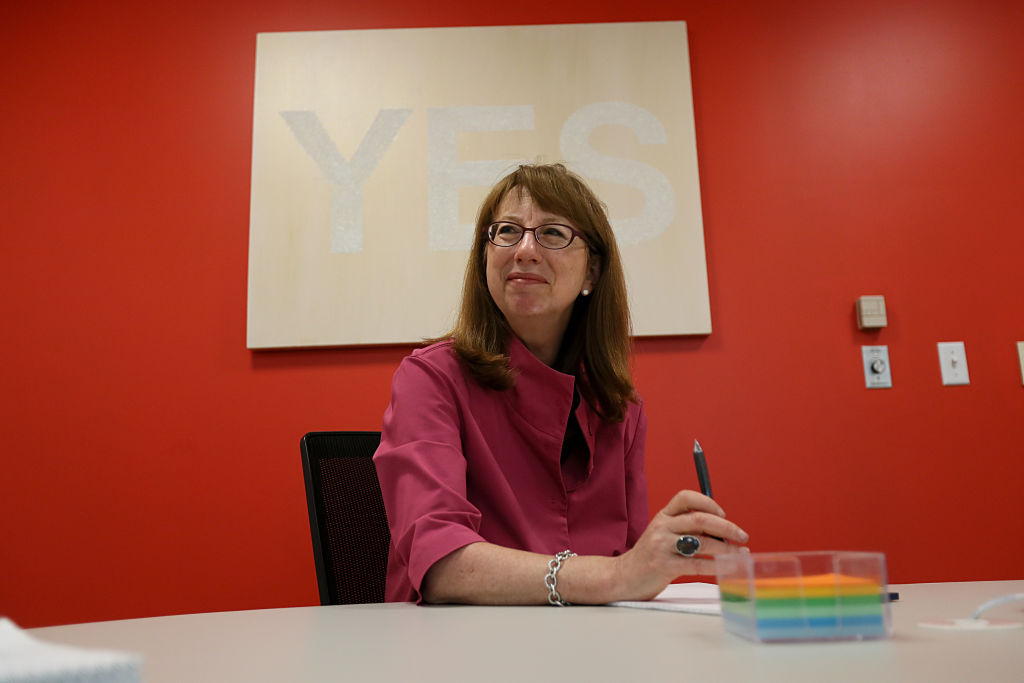
FRAMINGHAM, MA – MAY 30: Shira Goodman, former chief executive at Staples, poses for a portrait in Framingham, MA on May 30, 2017 (Photo by Suzanne Kreiter/The Boston Globe via Getty Images)
Shira Goodman – CEO, Staples.com
Shira Goodman has arguably done more for online shopping in the U.S. than anyone not named Bezos. She didn’t found Staples, but she did start and scale its “delivery business,” as she humbly calls it, to the point where it became the fourth largest e-commerce company in the U.S.
At a time when more nimble startups were disrupting big-box retailers, Shira did what few of her contemporaries could do — rapidly shifted a multi-billion-dollar legacy company in an ancient industry into the future, and eventually became CEO of the entire enterprise. She did this while also raising three children and supporting her husband when he decided to change careers and go to Rabbinical school. Sitcoms have been premised on less, and since two versions of “The Office” have captivated audiences, perhaps it’s time to provide the perspective from the CEO of Dunder-Mifflin HQ?
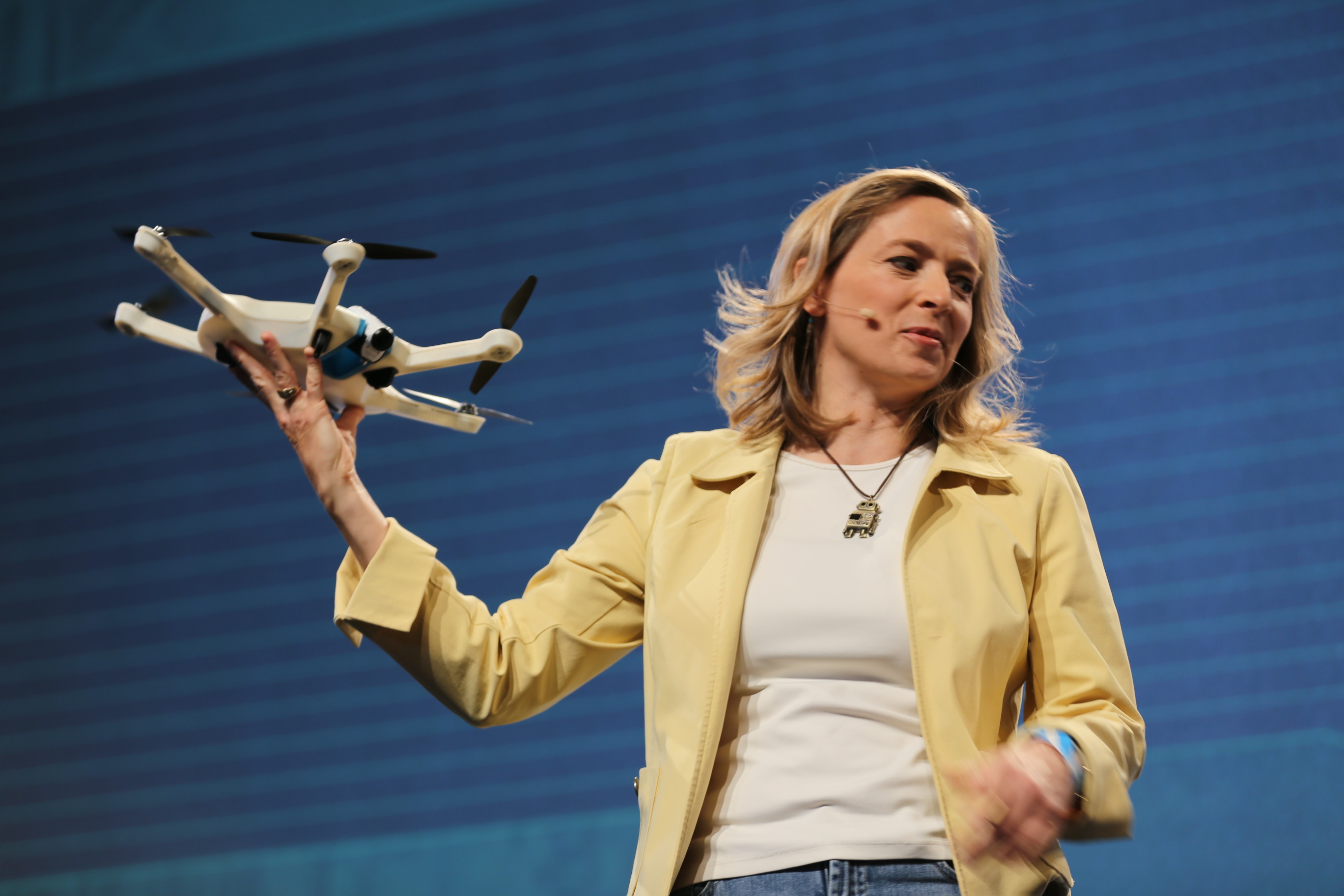
Helen Greiner, co-founder, iRobot
Helen Greiner – Co-founder, iRobot
From C. A. Rotwang in “Metropolis” to Tony Stark in the Marvel movies, there have been plenty of cinematic explorations of robot builders, but the story of iRobot co-founder Helen Greiner might be more interesting than anything yet committed to celluloid. As a recent grad from MIT, Greiner spent a substantial chunk of the 1990s applying her mechanical genius to everything from a mechatronic dinosaur for Disney to a store cleaning robot with the potential for mass destruction for SC Johnson.
Far from an ivory-tower academic, Grenier helped the government deploy search and rescue efforts at Ground Zero after 9/11 and cave-clearing ‘bots in Afghanistan, and the bomb-disposing Packbot she developed has saved the lives of thousands of service members. Grenier, at age 38, took her company public and made the Jetson’s vision of a robot housekeeper a reality in the form of the Roomba.

CAMBRIDGE, MA – MARCH 15: Kelsey Wirth, who has a grassroots organization called Mothers Out Front: Mobilizing For A Livable Climate (Photo by Essdras M Suarez/The Boston Globe via Getty Images)
Kelsey Wirth – Co-founder, Align Technologies
While the original startup bros were inflating the tech bubble in the late 1990s, Kelsey Wirth was pioneering 3D printing, which at the time was as fantastical as anything Theranos promised. Wirth’s story as the co-founder of Align Technology is especially compelling in the way it shares some surface similarities with Holmes’ narrative. Prominent skeptics of Invisalign cast doubts on the company in its early days, noting that the startup’s PR had outstripped its clinical validation. Wirth had to solve seemingly intractable technical challenges, including scanning misaligned incisors, developing algorithms to overcome underbites, pioneering new manufacturing process, convincing the FDA to clear the product and then selling it across the country — armed only with an English lit degree and an MBA. Despite the long odds of curing crossbites with software, Wirth started what has become a publicly traded business that is currently worth more than 20 billion dollars.
Most of these founders faced setbacks, including external obstacles and those of their own making. There were layoffs, bad deals and few of these stories had perfectly happy endings. Still, while a contemporary startup can earn plaudits for simply repackaging CBD and pushing it on Facebook, these entrepreneurs demonstrated a level of ambition rarely seen among modern upstarts.
The sensational focus on Elizabeth Holmes’ misdeeds steal focus from a group of landmark female entrepreneurs and waste a tremendous opportunity to inspire the next generation with heroic tales instead of fables of fabrication. None of these accounts have the black and white morality of the Theranos debacle, but these founders cleared hurdles both scientific and social. They flipped the script and made history; surely Hollywood can find some drama in that.
Thanks to Parul Singh, Elizabeth Condon and Alyssa Rosenzweig for reviewing drafts of this post.
Spotify’s leanback instant listening app Stations hits iOS
Spotify has launched its instant listening app Stations on iOS, but only in Australia for the time being. The release comes nearly a year and a half after the Stations app first arrived on the market, initially for Android users in Australia. Dubbed an “experiment,” the app allows users to jump right into streaming instead of having to curate their own playlists or stations, or save favorite music to their library.
Unlike Spotify’s flagship application, the Stations app presents users with a minimalist interface where available playlists are displayed with an oversized font. You can scroll up and down between the playlists to select one, instead of typing in a search box or searching through voice commands.
When launching Stations, music begins playing automatically — a feature that had some calling it a “Pandora copycat” at the time of launch, given that instant music playback is something that Spotify’s rival Pandora already supports.

Stations was largely designed for those who want a more radio-like experience that involves less manual input. Free users will hear ads, be able to thumbs up and down songs, but can’t skip tracks. Premium users who download Stations get unlimited skips and ad-free listening.
The Stations app today features a range of playlists by genre, decade, activity and more, but also becomes personalized to the end-user over time. You can also opt to create your own stations by selecting from favorite artists in an experience that’s reminiscent of the customization offered today by YouTube Music — right down to the rounded artist profile photos you tap on.


As you listen to music on Stations, you can thumbs up and down songs in order to have it create custom stations personalized to you — including a Discover Weekly playlist, Release Radar and a Favorites playlist.
Not much had been heard about Stations since its January 2018 debut. And its limited release — it never hit the U.S., for example — could have indicated it was an experiment that didn’t quite pan out.
But it now seems that’s not the case, given the new expansion to iOS.
By offering the app to more users, Spotify has the chance to learn and collect data from a larger and more representative group of people. Whether or not it takes any ideas from Stations to its main app remains to be seen.
The company declined to comment on its plans, when asked.
“At Spotify, we routinely conduct a number of tests in an effort to improve our user experience,” a spokesperson said. “Some of those tests end up paving the path for our broader user experience and others serve only as an important learning. We aren’t going to comment on specific tests at this time,” they added.
Stations is live now on iOS in Australia. More information on the app is on the (newly updated) Help site here.
Liam O’Connor, hired to help build Lyft’s bike and scooter business, has left after 7 months
The emerging business of offering bikes and scooters on demand has not always been very smooth, and today comes one of the latest bumps: TechCrunch has learned and confirmed that Liam O’Connor, an executive hired to help transportation company Lyft build its bike and scooter operations, has left after seven months with the newly-public company.
The change comes some two weeks after Lyft had to pull thousands of e-bikes off the roads in New York, San Francisco and Washington, DC due to faulty brakes. Lyft says that the move is not due to this, but to O’Connor deciding to take a job “close to his heart.”
“Yes, he’s taking on a new role that is close to his heart where he will be spending much of his time out of the country, and will remain a close advisor to Lyft,” a spokesperson said in a statement. “We’ve elevated an internal candidate who has been an outstanding product leader for the past two years and we’re excited to continue the progress we’ve made with Lyft Bikes and Scooters.”
We understand that O’Connor will be joining Zipline, the startup that delivers medicine by drone in Africa. He is being replaced by Dor Levi, who had been Lyft’s director of product for Marketplace, Shared Rides, Transit, and Bikes and Scooters (and had also spent some time at Uber in the middle of his years at Lyft) is the new head of the division, with John Zimmer — Lyft’s co-founder and president — also spending significant time on the operation.
O’Connor isn’t the only person who has recently left the business. Justine Lee, who was general counsel (leading on legal and regulatory) and VP of corporate development at Motivate, is leaving the company. Others include Lynn Fischer, who had been head of marketing and growth for Citi Bikes, left back in December, and Jelle Vastert, who had been recruited to help run the bike and scooter division but left after four months last year — from what we understand because of a change of heart about relocation (he’s based in The Netherlands).
Another significant personnel change in the bike and scooter division was that in March, some 50 people were let go.
There are clearly different reasons behind these various changes, but collectively the departures and some of the other events like the e-bikes getting pulled over technical problems underscore the challenges in forging into the new business area, and some of the instability that comes along with all that.
O’Connor was a high profile hire when he joined as chief procurement officer and head of the bike and scooter division in November 2018 — having held top supply positions at Tesla and before that Apple.
O’Connor’s joining Lyft ahead of its IPO was a signal of how the company planned to continue diversifying its business into different modes of transportation beyond private vehicles.
That diversification is seen as an essential step for highly capitalised transportation-on-demand businesses to take as a way of leveraging their scale and brand to reach a wider range of users and use-cases. (It’s a strategy that is also being followed by Uber.)
Lyft’s own efforts in diversifying into multi-modal transporation have seen some downs, but also some ups.
In terms of progress, the company has now integrated Citi Bike into the Lyft app and is planning to expand the bike sharing effort to more cities. And it recently won a bid to be the exclusive bikeshare provider in Chicago for the next nine years. In scooters, it’s now in 15 markets, showing steady progress on that front. From what we understand, Lyft is still very committed to growing that area of its business.
How German and US authorities took down the owners of darknet drug emporium Wall Street Market
The major darknet marketplace known as the Wall Street Market has been seized and its alleged operators arrested in a joint operation between European and U.S. authorities. Millions in cash, cryptocurrency and other assets were collected, and the market shut down. How investigators tied these anonymity-obsessed individuals to the illegal activities is instructive.
The three men accused of running Wall Street Market (WSM), one of the larger hidden service markets operating via the Tor network, are all German citizens: Tibo Lousee, Jonathan Kalla and Klaus-Martin Frost; several vendors from the market have also been charged, including one who sold meth on it by the kilogram.
The investigation has been ongoing since 2017, but was pushed to a crisis by the apparent attempt in April by WSM’s operators to execute an exit scam. By suddenly removing all the cryptocurrency held in escrow and otherwise stored under their authority, the alleged owners stood to gain some $11 million if they were able to convert the coins.
Until recently, Wall Street Market was a bustling bazaar for illegal goods, including dangerous drugs like fentanyl and physical items like fake documents. It had more than a million user accounts, some 5,400 vendors and tens of thousands of items available for purchase. It has grown as other darknet marketplaces have been cornered and shut down, driving users and sellers to a dwindling pool of smaller platforms.
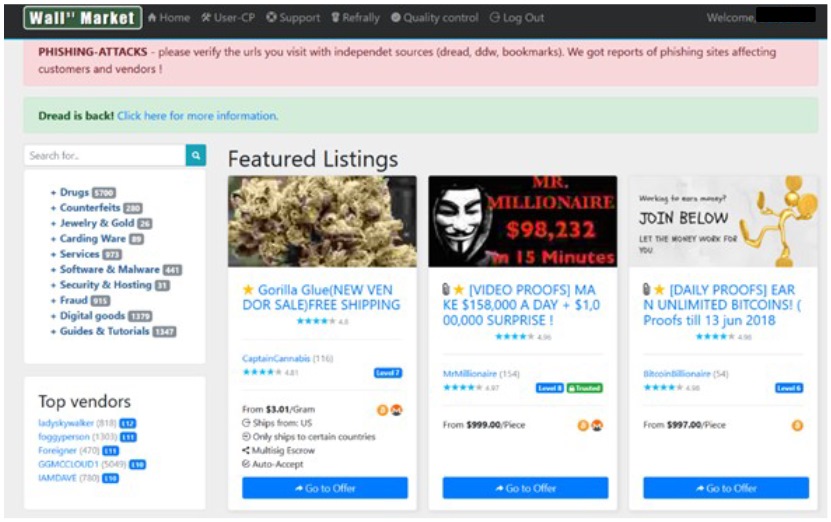 Whether the owners sought simply to parley this growth to a quick cash grab or whether they sensed the law about to knock down their door, the exit scam was undertaken on April 16.
This action prompted investigators in the U.S. and Germany, and Europol, to take action, as this exit scam marked not only an opportunity for investigators to gather and observe fresh evidence of the trio’s alleged crimes, but waiting much longer might let them go to ground and launder their virtual goods.
The DOJ complaint details the means by which the three administrators of the site were linked to it, despite their attempts to anonymize their access. It isn’t unprecedented stuff, but it’s always interesting to read through the step-by-step forensics that lead to charges, since it can be very difficult to tie real-world actors to virtual entities.
For Frost, it was an unstable VPN connection, plus some sleuthing by the German federal police, the Bundeskriminalamt or BKA:
The WSM administrators accessed the WSM infrastructure primarily through the use of two VPN service providers. On occasion, VPN Provider #1 connection would cease, but because that specific administrator continued to access the WSM infrastructure, that administrator’s access exposed the true IP address of the administrator
The individual utilizing the above-referenced IP address to connect to the WSM infrastructure used a device called a UMTS-stick (aka surfstick) [i.e. a dongle for mobile internet access]. This UMTS-stick was registered to a suspected fictitious name.
The BKA executed multiple surveillance measures to electronically locate the specific UMTS-stick. BKA’s surveillance team identified that, between February 5 and 7, 2019, the specific UMTS-stick was used at a residence of Lousee in Kleve, Northrhine-Westphalia (Germany), and his place of employment, an information technology company where Lousee is employed as a computer programmer. Lousee was later found in possession of a UMTS stick.
Some other circumstantial evidence also tied Lousee to the operation, such as similar login names, mentions of drugs and cryptocurrencies, and so on. (“Based on my training and experience as an investigator, I am aware that ‘420’ is a reference to marijuana,” writes the special agent who authored the complaint.)
Kalla’s VPN held strong, but the metadata betrayed him:
An IP address assigned to the home of this individual (the account for the IP address was registered in the name of the suspect’s mother) accessed VPN Provider #2 within similar rough time frames as administrator-only components of the WSM server infrastructure were accessed by VPN Provider #2.
Hardly a hole in one, but Kalla later admitted he was the user agent in question. This is a good example of how a VPN can and can’t protect you against government snooping. It may disguise your IP to certain systems, but anyone with a bird’s-eye view can see the obvious correlation between one connection and another. It won’t hold up in court on its own, but if the investigators are good it won’t have to.
Frost, the third administrator, required a more subtle approach, but ultimately it was again poor opsec; this time an unwise cross-contamination of his cryptographic and cryptocurrency accounts:
The PGP public key for [WSM administrative account] ‘TheOne’ is the same as the PGP public key for another moniker on [another hidden service] Hansa Market, ‘dudebuy.’ As described below, a financial transaction connected to a virtual currency wallet used by FROST was linked to ‘dudebuy.’
[The BKA] located the PGP public key for ‘TheOne’ in the WSM database, referred to as ‘Public Key 1’.
Public Key 1 was the PGP public key for ‘dudebuy.’ The ‘refund wallet’ for ‘dudebuy’ was Wallet 2.
Wallet 2 was a source of funds for a Bitcoin transaction… Records obtained from the Bitcoin Payment Processing Company revealed buyer information for that Bitcoin transaction as ‘Martin Frost,’ using the email address klaus-martin.frost@…
Essentially A is B, and B is C, so A is C. This little deductive trick is handy, but bitcoin wallets used by Frost were also identified through analysis by the U.S. Postal Inspection Service, which, if you didn’t know, has “a highly trained, skilled and committed cyber unit.”
The United States Postal Inspection Service learned, through its analysis of Blockchain transactions and information gleaned from the proprietary software described above, that the funds from Wallet 2 were first transferred to Wallet 1, and then “mixed” by a commercial service; mixing services is described above at paragraph 4.m. Through thorough analysis, the United States Postal Inspection Service was able to “de-mix” the flow of transactions, to eventually ascertain that the money from Wallets 1 and 2 ultimately paid FROST’s account at the Product Services Company.
Here the blockchain’s indelible record clearly worked against Frost. Wallet 1, by the way, handled thousands of bitcoins during its use in association with another darknet marketplace, German Plaza Market — which the three charged today also allegedly ran and shut down via an exit scam.
In addition to the administrators, some vendors and others associated with the site were charged. They were identified via more traditional means and their activities linked to the market in such a way that defense seems a lost cause. The record for a Brazilian man who operated as a dealer and as a sort of representative for WSM on Reddit and forums is an interesting study in the web of suggestive accounts and names that produce a damning, if circumstantial, depiction of a person’s associations and interests, from the banal to the criminal.
“The prosecution of these defendants shows that even the smallest mistake will allow us to figure out a cybercriminal’s true identity,” said U.S. Attorney McGregor W. Scott in the DOJ press release. “We are on the hunt for even the tiniest of breadcrumbs.”
Cases against the alleged criminals will be held in multiple locations and under multiple authorities — it’s safe to say this is just the beginning of a long, complicated process for everyone involved.
Uber co-founder Travis Kalanick may not be invited to ring opening bell
Despite Uber co-founder Travis Kalanick wanting to be part of the company going public, the company’s board is considering not letting Kalanick be there to ring the opening bell on May 10, Uber’s first day of trading, Axios reports. Kalanick also wants to bring his dad, The New York Times reports.
Additionally, Kalanick’s fellow co-founders Ryan Graves and Garrett Camp may not be allowed on the balcony to ring the bell.
Uber would not be where it is today without Kalanick, but him being there would surely be a reminder of Uber’s rocky past. Still, Benchmark partner Matt Cohler wants Kalanick and his co-founders to be there, according to Axios. Instead of joining Uber CEO Dara Khosrowshahi and other Uber executives on the balcony, Kalanick will only be able to be on the New York Stock Exchange floor with the company’s other board members.
Kalanick resigned from Uber in 2017 following pressure from shareholders to do so. That came shortly after Kalanick took a leave of absence following sexual harassment allegations from former Uber engineer Susan Fowler Rigetti.
I’ve reached out to Uber and will update this story if I hear back.