Startups Weekly: Venture capitalists are crazy for cannabis

Lately, my inbox has been chock-full of pitches for weed businesses.

A couple of years ago it was bitcoin/blockchain startups, then came scooters; now, it seems “CannTech” is hitting an all-time high thanks to support from venture capitalists. By the way, I didn’t make up the term CannTech, but it seems just as good as anything else, so I’m rolling with it.

According to data collected by PitchBook, VCs have put $1.2 billion in U.S.-based cannabis companies so far in 2019. That’s significantly more than last year’s record high of $836 million, and we aren’t even halfway through 2019.

At this rate, we can expect roughly $2.5 billion invested in CannTech in 2019, i.e. more capital invested in the space in a single year than has been funneled into the space in the last decade.

What’s going on? A few things. Of course, states are increasingly legalizing medical and/or recreational marijuana. That’s allowed companies like Eaze, a marijuana delivery company, to grow at unprecedented rates. The startup, for example, closed its Series C in December on $65 million and is already fundraising again, this time at a $500 million valuation.

In addition to legalization, VCs, and more importantly, limited partners, have woken up to the business opportunity of cannabis. Soon, gone will be the days of strict morality clauses that dissuaded VC firms from supporting startups focused on weed. The firms that were early to understand the space, like DCM Ventures or Snoop Dogg’s Casa Verde Capital, will reap the benefits.

Speaking of DCM, the firm put on a huge, first-of-its-kind summit this week focused on CannTech: “For three years I was struggling with a lot of pain issues,” DCM co-founder David Chao told the audience. “One day I was playing Xbox with Blake Krikorian [co-founder of Sling Media] and I said ‘you know Blake, I have this pain problem’ and he said, ‘oh, you should try pot.’ And I said ‘why should I do that? I haven’t smoked since college?’ “

Long story short, Chao can thank his friend Blake for making him aware of an exploding market, and he can thank DCM’s scrappy partner, Kyle Lui, for helping the firm score some major investments in the space, like Eaze.

“We were the first Sand Hill VCs to invest in cannabis and everyone started calling me saying ‘you’re crazy, why are you doing this?’ ” Lui said.

It’s still very early days in the CannTech space, but the market is expected to be worth as much as $80 billion by 2030. That can only mean interest will soar from here.

Want more TechCrunch newsletters? Sign up here.

Uber Begins First Day Of Trading At New York Stock Exchange

IPO corner

Uber: It was a disappointing debut, to say the least. The ride-hailing business (NYSE: UBER), previously valued at $72 billion by venture capitalists, priced its stock at $45 apiece for a valuation of $82.4 billion on Thursday. Then it began trading Friday morning at $42 apiece, only to close even lower at $41.57, down 7.6% from its IPO price.

Slack: Not a whole lot of news to share here yet, other than that the workplace messaging business will host its investor day on Monday. It’s invite-only, though Slack, like Spotify, will live-stream the event to the public. More details on that here.

Luckin Coffee: The Chinese upstart going after Starbucks is set to debut on the Nasdaq under the symbol “LK.” In a new filing, Luckin said it plans to sell 30 million shares at an initial range of $15-$17. That gives an estimated raise of $450 million to $510 million, but it could be bumped up if underwriters take up the additional allocation of 4.5 million shares. So, as a grand total, the listing could raise $586.5 million if the full offering is bought at the top of the range.

Lyft: Not an IPO update but the company did release its first-ever earnings report. Here’s the TL;DR: revenues of $776 million on losses of $1.14 billion, including $894 million of stock-based compensation and related payroll tax expenses. The company’s revenues surpassed Wall Street estimates of $740 million, while losses came in much higher as a result of IPO-related expenses.

Share price alone is no sign of value… @Uber trading at $44 ($45 IPO price)@Lyft trading at $53.8 ($74 IPO price)@Pinterest trading at $28.4 ($19 IPO price)@zoom_us trading at $77.5 ($36 IPO price)@pagerduty trading at $48.7 ($24 IPO price)

— Kate Clark (@KateClarkTweets) May 10, 2019

M&A

Harry’s razors are crappy, I’m told. Alas, the brand is worth $1.37 billion to Edgewell Personal Care, the company behind Schick and Banana Boat. Founded in 2013, Harry’s had raised about $375 million in venture capital funding. Edgewell says its $1.37 billion payment will break down to roughly 79% cash and 21% stock, giving Harry’s shareholders an 11% stake in Edgewell.

Big rounds

Small(er) rounds

Inspiration

Meet Beat Saber, an eight-person startup with no funding that’s turned into VR’s biggest success story. Venture capital isn’t always the answer, folks.

~Extra Crunch~

Our premium subscription service was loaded with A+ content this week. TechCrunch contributor Jon Evans wrote a piece titled “Against the Slacklash,” wherein he makes the case that Slack isn’t inherently bad. “Rather, the particular way in which you are misusing it epitomizes your company’s deeper problems.” Plus, Eric Peckham asked nine top VCs, including Cyan Banister and Charles Hudson, to share where they are putting their money when it comes to media, gaming and entertainment.

#Equitypod

If you enjoy this newsletter, be sure to check out TechCrunch’s venture capital-focused podcast, Equity. In this week’s episode, available here, Crunchbase News’ Alex Wilhelm, TechCrunch’s Connie Loizos and I chat with blogging pioneer and True Ventures partner Om Malik about the on-demand economy, Carta’s big raise and more.

Equity transcribed: Why Om Malik thinks ‘the VC subsidized life is over’

It’s time for another transcribed edition of Equity. This week for the regularly scheduled episode we had the whole crew pop into the San Francisco studio. Kate Clark, Connie Loizos and Alex Wilhelm were joined by Om Malik, former journalist and current VC at True Ventures.

They convened just after Uber priced, so they had a lot to dig into: The low price, would it pop and would the former CEO and co-founder Travis Kalanick be at the ringing of the bell in New York (he wasn’t).

But it wasn’t all Uber; they talked Carta, Cruise and Harry’s. Below is an excerpt. And come back soon for an emergency episode where Alex and Kate will go deeper on the Uber IPO. For access to the full transcription, become a member of Extra Crunch. Learn more and try it for free. 

Alex: Well, I want to go back to the price really quick because $82 billion is below the 90 we had heard after we’d heard the 120 back in October. So this is a dramatic downgrade in price, which I think as said Om said is actually pretty smart because they’ll have a nice pop and things will get better.

Connie: And also, when you look back, it never really matters that much. I mean, I feel like a couple of people have already pointed this out in the media today. But Google, Facebook, I mean, there’s been so many companies where their IPOs didn’t seem to even go very well. I just don’t think it really is going to matter in the long term what happens tomorrow.

Alex: Well, the difference though is Uber needs to raise a bunch of money to stay alive. I mean, Facebook when they went public had a relatively rough post IPO period, had $1 billion in trailing gap net income. They were fine. Their IPO wasn’t that important aside from the liquidity then. It wasn’t a fundraising metric. At this price, they are going to raise less money than they could’ve at a higher price, and they burn tons of it.

Kate: I think there are a lot of reasons why they probably did lower their targets, but I think one probably has to do with Lyft’s performance. So I think we should just quickly go over. Lyft did release their first earnings report this week, which was pretty interesting. The TL;DR is that they posted first quarter revenues of $776 million on losses of $1.14 billion, which did include 894 million of stock-based compensation related payroll tax expenses, which in other words, just major IPO expenses. So losses were huge, yes. The company’s revenues did surpass Wall Street estimates, which were 740 million. But of course, with all the IPO expenses, losses came in significantly higher.

India’s most popular services are becoming super apps

Truecaller, an app that helps users screen strangers and robocallers, will soon allow users in India, its largest market, to borrow up to a few hundred dollars.

The crediting option will be the fourth feature the nine-year-old app adds to its service in the last two years. So far it has added to the service the ability to text, record phone calls and mobile payment features, some of which are only available to users in India. Of the 140 million daily active users of Truecaller, 100 million live in India.

The story of the ever-growing ambition of Truecaller illustrates an interesting phase in India’s internet market that is seeing a number of companies mold their single-functioning app into multi-functioning so-called super apps.

Inspired by China

This may sound familiar. Truecaller and others are trying to replicate Tencent’s playbook. The Chinese tech giant’s WeChat, an app that began life as a messaging service, has become a one-stop solution for a range of features — gaming, payments, social commerce and publishing platform — in recent years.

WeChat has become such a dominant player in the Chinese internet ecosystem that it is effectively serving as an operating system and getting away with it. The service maintains its own “app store” that hosts mini apps. This has put it at odds with Apple, though the iPhone-maker has little choice but to make peace with it.

For all its dominance in China, WeChat has struggled to gain traction in India and elsewhere. But its model today is prominently on display in other markets. Grab and Go-Jek in Southeast Asian markets are best known for their ride-hailing services, but have begun to offer a range of other features, including food delivery, entertainment, digital payments, financial services and healthcare.

The proliferation of low-cost smartphones and mobile data in India, thanks in part to Google and Facebook, has helped tens of millions of Indians come online in recent years, with mobile the dominant platform. The number of internet users has already exceeded 500 million in India, up from some 350 million in mid-2015. According to some estimates, India may have north of 625 million users by year-end.

This has fueled the global image of India, which is both the fastest growing internet and smartphone market. Naturally, local apps in India, and those from international firms that operate here, are beginning to replicate WeChat’s model.
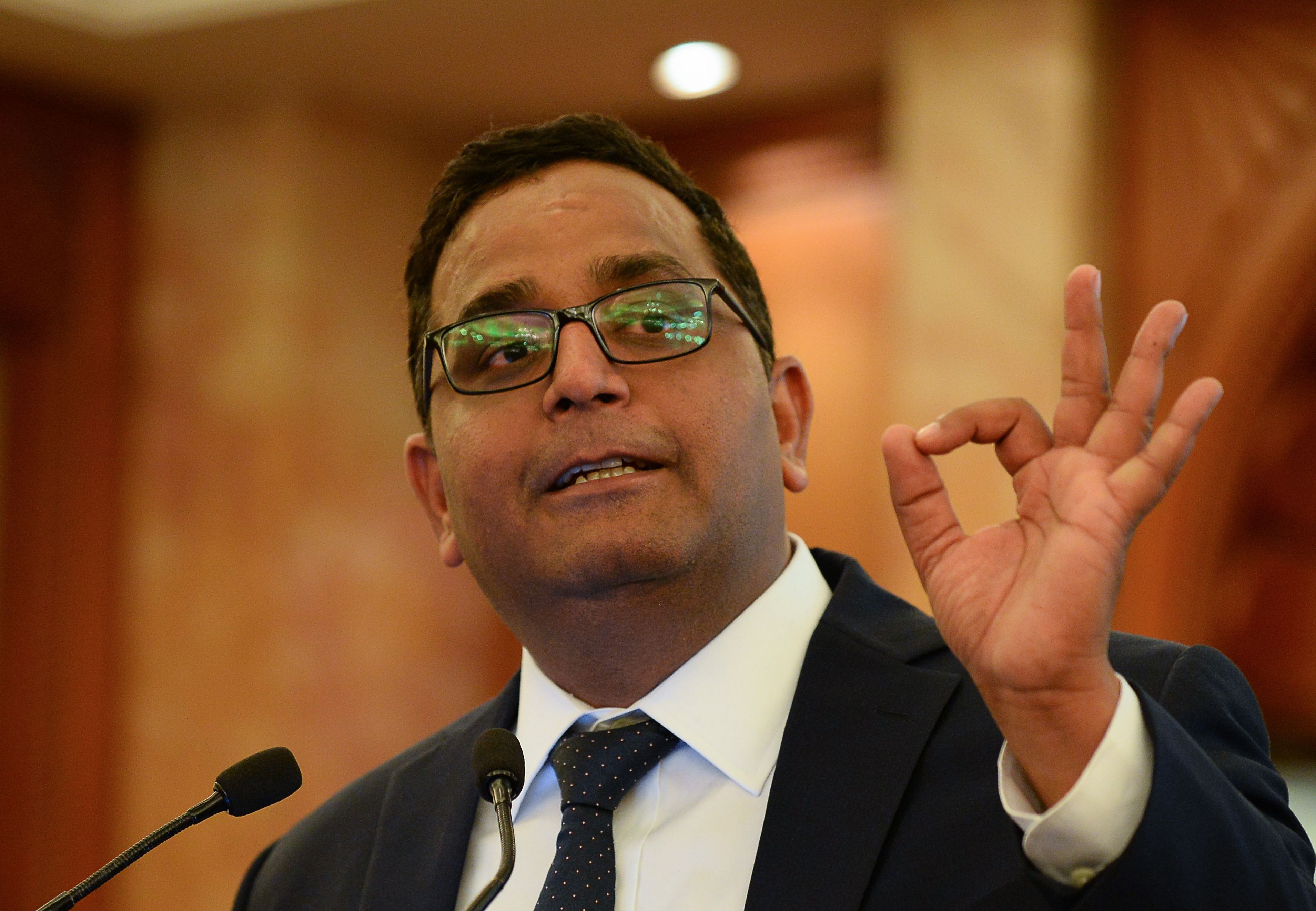
Founder and chief executive officer (CEO) of Paytm Vijay Shekhar Sharma speaks during the launch of Paytm payments Bank at a function in New Delhi on November 28, 2017 (AFP PHOTO / SAJJAD HUSSAIN)

Leading that pack is Paytm, the popular homegrown mobile wallet service that’s valued at $18 billion and has been heavily backed by Alibaba, the e-commerce giant that rivals Tencent and crucially missed the mobile messaging wave in China.

Commanding attention

In recent years, the Paytm app has taken a leaf from China with additions that include the ability to text merchants; book movie, flight and train tickets; and buy shoes, books and just about anything from its e-commerce arm Paytm Mall . It also has added a number of mini games to the app. The company said earlier this month that more than 30 million users are engaging with its games.

Why bother with diversifying your app’s offering? Well, for Vijay Shekhar Sharma, founder and CEO of Paytm, the question is why shouldn’t you? If your app serves a certain number of transactions (or engagements) in a day, you have a good shot at disrupting many businesses that generate fewer transactions, he told TechCrunch in an interview.

At the end of the day, companies want to garner as much attention of a user as they can, said Jayanth Kolla, founder and partner of research and advisory firm Convergence Catalyst.

“This is similar to how cable networks such as Fox and Star have built various channels with a wide range of programming to create enough hooks for users to stick around,” Kolla said.

“The agenda for these apps is to hold people’s attention and monopolize a user’s activities on their mobile devices,” he added, explaining that higher engagement in an app translates to higher revenue from advertising.

Paytm’s Sharma agrees. “Payment is the moat. You can offer a range of things including content, entertainment, lifestyle, commerce and financial services around it,” he told TechCrunch. “Now that’s a business model… payment itself can’t make you money.”

Big companies follow suit

Other businesses have taken note. Flipkart -owned payment app PhonePe, which claims to have 150 million active users, today hosts a number of mini apps. Some of those include services for ride-hailing service Ola, hotel booking service Oyo and travel booking service MakeMyTrip.
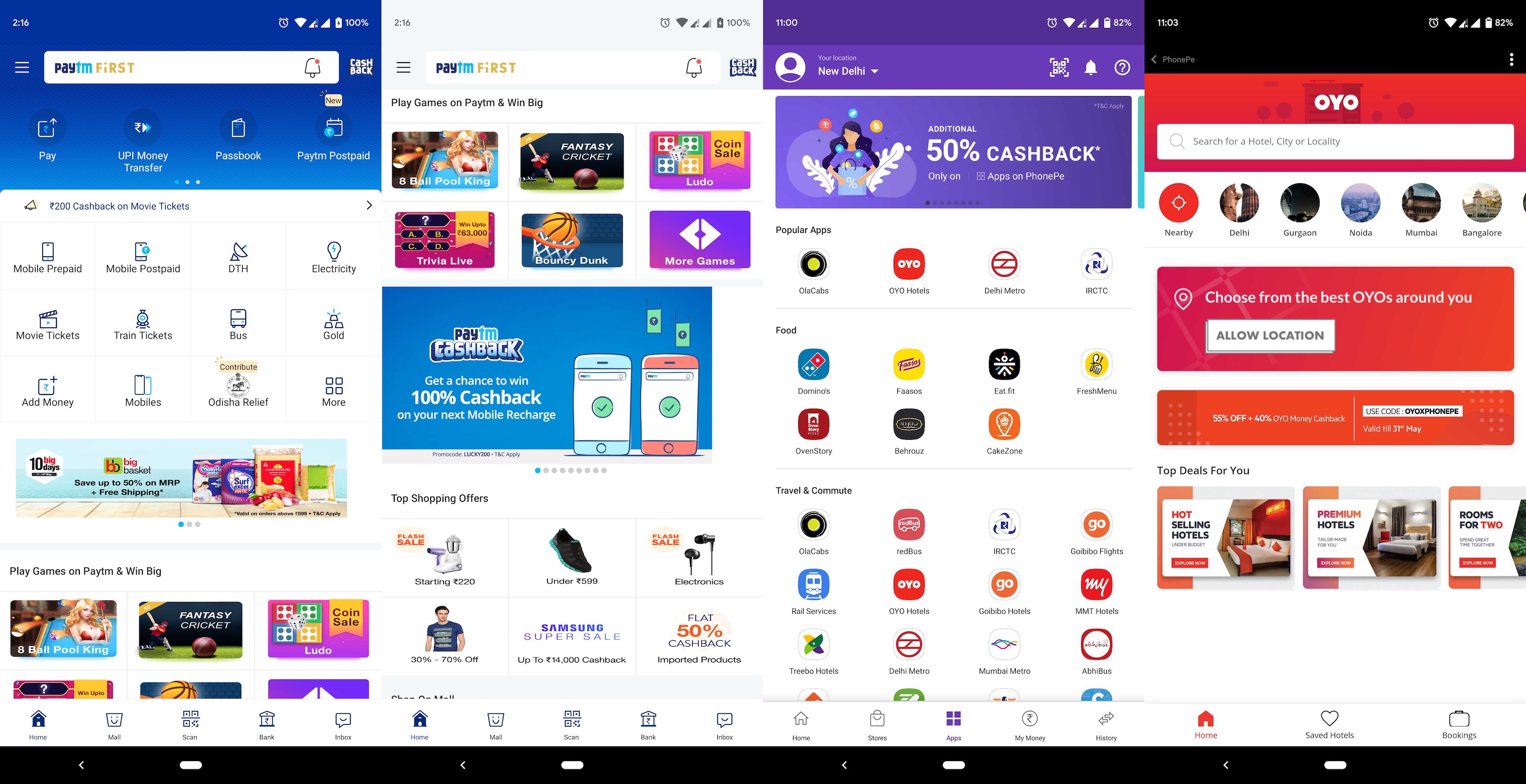
Paytm (the first two images from left) and PhonePe offer a range of services that are integrated into their payments apps

What works for PhonePe is that its core business — payments — has amassed enough users, Himanshu Gupta, former associate director of marketing and growth for WeChat in India, told TechCrunch. He added that unlike e-commerce giant Snapdeal, which attempted to offer similar offerings back in the day, PhonePe has tighter integration with other services, and is built using modern architecture that gives users almost native app experiences inside mini apps.

When you talk about strategy for Flipkart, the homegrown e-commerce giant acquired by Walmart last year for a cool $16 billion, chances are arch rival Amazon is also hatching similar plans, and that’s indeed the case for super apps.

In India, Amazon offers its customers a range of payment features such as the ability to pay phone bills and cable subscription through its Amazon Pay service. The company last year acquired Indian startup Tapzo, an app that offers integration with popular services such as Uber, Ola, Swiggy and Zomato, to boost Pay’s business in the nation.

Another U.S. giant, Microsoft, is also aboard the super train. The Redmond-based company has added a slew of new features to SMS Organizer, an app born out of its Microsoft Garage initiative in India. What began as a texting app that can screen spam messages and help users keep track of important SMSs recently partnered with education board CBSE in India to deliver exam results of 10th and 12th grade students.

This year, the SMS Organizer app added an option to track live train schedules through a partnership with Indian Railways, and there’s support for speech-to-text. It also offers personalized discount coupons from a range of companies, giving users an incentive to check the app more often.

Like in other markets, Google and Facebook hold a dominant position in India. More than 95% of smartphones sold in India run the Android operating system. There is no viable local — or otherwise — alternative to Search, Gmail and YouTube, which counts India as its fastest growing market. But Google hasn’t necessarily made any push to significantly expand the scope of any of its offerings in India.

India is the biggest market for WhatsApp, and Facebook’s marquee app too has more than 250 million users in the nation. WhatsApp launched a pilot payments program in India in early 2018, but is yet to get clearance from the government for a nationwide rollout. (It isn’t happening for at least another two months, a person familiar with the matter said.) In the meanwhile, Facebook appears to be hatching a WeChatization of Messenger, albeit that app is not so big in India.

Ride-hailing service Ola too, like Grab and Go-Jek, plans to add financial services such as credit to the platform this year, a source familiar with the company’s plans told TechCrunch.

“We have an abundance of data about our users. We know how much money they spend on rides, how often they frequent the city and how often they order from restaurants. It makes perfect sense to give them these valued-added features,” the person said. Ola has already branched out of transport after it acquired food delivery startup Foodpanda in late 2017, but it hasn’t yet made major waves in financial services despite giving its Ola Money service its own dedicated app.

The company positioned Ola Money as a super app, expanded its features through acquisition and tie ups with other players and offered discounts and cashbacks. But it remains behind Paytm, PhonePe and Google Pay, all of which are also offering discounts to customers.

Integrated entertainment

Super apps indeed come in all shapes and sizes, beyond core services like payment and transportation — the strategy is showing up in apps and services that entertain India’s internet population.

MX Player, a video playback app with more than 175 million users in India that was acquired by Times Internet for some $140 million last year, has big ambitions. Last year, it introduced a video streaming service to bolster its app to grow beyond merely being a repository. It has already commissioned the production of several original shows.

In recent months, it has also integrated Gaana, the largest local music streaming app that is also owned by Times Internet. Now its parent company, which rivals Google and Facebook on some fronts, is planning to add mini games to MX Player, a person familiar with the matter said, to give it additional reach and appeal.

Some of these apps, especially those that have amassed tens of millions of users, have a real shot at diversifying their offerings, analyst Kolla said. There is a bar of entry, though. A huge user base that engages with a product on a daily basis is a must for any company if it is to explore chasing the super app status, he added.

Indeed, there are examples of companies that had the vision to see the benefits of super apps but simply couldn’t muster the requisite user base. As mentioned, Snapdeal tried and failed at expanding its app’s offerings. Messaging service Hike, which was valued at more than $1 billion two years ago and includes WeChat parent Tencent among its investors, added games and other features to its app, but ultimately saw poor engagement. Its new strategy is the reverse: to break its app into multiple pieces.

“In 2019, we continue to double down on both social and content but we’re going to do it with an evolved approach. We’re going to do it across multiple apps. That means, in 2019 we’re going to go from building a super app that encompasses everything, to Multiple Apps solving one thing really well. Yes, we’re unbundling Hike,” Kavin Mittal, founder and CEO of Hike, wrote in an update published earlier this year.

It remains unclear how users are responding to the new features on their favorite apps. Some signs suggest, however, that at least some users are embracing the additional features. Truecaller said it is seeing tens of thousands of users try the payment feature for the first time each day. It’s also being used to send 3 billion texts a month.

And Reliance Jio, of course

Regardless, the race is still on, and there are big horses waiting to enter to add further competition.

Reliance Jio, a subsidiary of conglomerate Reliance Industry that is owned by India’s richest man, Mukesh Ambani, is planning to introduce a super app that will host more than 100 features, according to a person familiar with the matter. Local media first reported the development.

It will be fascinating to see how that works out. Reliance Jio, which almost single-handedly disrupted the telecom industry in India with its low-cost data plans and free voice calls, has amassed tens of millions of users on the bouquet of apps that it offers at no additional cost to Jio subscribers.

Beyond that diverse selection of homespun apps, Reliance has also taken an M&A-based approach to assemble the pieces of its super app strategy.

It bought music streaming service Saavn last year and quickly integrated it with its own music app JioMusic. Last month, it acquired Haptik, a startup that develops “conversational” platforms and virtual assistants, in a deal worth more than $100 million. It already has the user bases required. JioTV, an app that offers access to over 500 TV channels; and JioNews, an app that additionally offers hundreds of magazines and newspapers, routinely appear among the top apps in Google Play Store.

India’s super app revolution is in its early days, but the trend is surely one to keep an eye on as the country moves into its next chapter of internet usage.

These companies may smooth startups’ path to the public market — if they don’t kill each other first

This morning, the SEC approved as the U.S.’s 14th stock exchange Long Term Stock Exchange (LTSE), an outfit that was conceived in 2012 by “Lean Startup” author Eric Ries as a place where public market shareholders who hold onto their shares through thick and thin would be rewarded for their loyalty.

Ries thinks such rewards are important because he believes in public markets. Among other things, by establishing a common currency, being publicly traded enables companies to more easily acquire other companies. It enables employees to more freely sell their shares. It also allows retail investors to participate in the growth of tech companies — growth from which they’ve largely been shut out in recent years as the average time a company remains private has stretched to roughly 12 years.

Indeed, Ries’s biggest issue with public market shareholders is their focus on short-term results, citing it as the primary reason that startups remain privately held for so long. After all, it’s hard to innovate when you’re being sued over disappointing earnings.

Whether LTSE can usher in rules that encourage both companies and shareholders to focus on the longer term remains to be seen. LTSE has not received approval over any kind of listings standards. It hasn’t even submitted these yet.

While ideally, the exchange wants to welcome “values-based” companies that limit executive bonuses and grant more voting power to shareholders who hang on for the ride, Ries seems to recognize that he may have to settle for less owing to some pushback, including from the Council of Institutional Investors, a group of institutions that fear long-term voting could empower company insiders at the expense of other shareholders. During a call today, he told us that LTSE won’t necessarily give more voting power to shareholders. “These rewards could be voting or other things,” he said.

Certainly, Ries will benefit if LTSE takes off. While numerous reports today note that famed VC Marc Andreessen is one of LTSE’s financial backers, the biggest shareholder right now is Ries himself, who owns 30 percent of the for-profit company, according to government filings.

Other major shareholders include John Bautista, a cofounder of Long Term Stock Exchange who is also an attorney with the law firm Orrick; Founders Fund, which owns 14 percent of the company; Collaborative Fund, which owns 7.8 percent; and Obvious Ventures, which owns 6.7 percent. The company has raised roughly $19 million altogether to date.

Ries is hardly alone wanting companies to be able to go public sooner without worrying about activist investors. We’d written about the case for tenured voting in late 2017, noting then that concept has been around for decades.

But while it resonates with founders, few others have embraced the idea. Back in the 1980s, for example, U.S. stock exchanges determined that tenured voting was unnecessarily complicated and too hard to track. Bankers don’t like the idea because anything that looks different to the market is harder to sell.

Meanwhile, another Andreessen-backed startup to make headlines this week — Carta — seems like a bet that LTSE won’t realize its vision completely. The seven-year-old, San Francisco-based startup largely helps private company investors, founders, and employees manage their equity and ownership. But it just raised $300 million in Series E funding at a $1.7 billion valuation led by Andreessen Horowitz largely to become what Carta CEO Henry Ward describes as the world’s largest marketplace for private company shares.

Carta paints the evolution as a natural one given the needs of aging private companies, as well as the fact that so many startups and institutional investors use its platform already.

In fact, Ward, like Ries, talks about democratizing access to more of today’s up-and-coming companies on Carta’s platform. Still, Ries seems more interesting in getting shares into the hands of people who haven’t been able to access them in recent years; Carta seems more interested in more efficiently allowing startups and  institutional investors to trade shares amongst themselves, using Carta as a hub. (Carta also has exponentially more funding than LSTE, having raised $447 million altogether from VCs.)

Whether either company realizes its bold ambitions will take time to know. Much depends on external factors, like the macroeconomy, and whether outfits like SoftBank keeps showering privately held companies with funding.

In the meantime, it will be interesting to understand whether LTSE and Carta can together create a safer, smoother path for startups that are looking to go public. It’s certainly one plausible scenario.

Another is that the two wind up locked in a kind of battle for fast-growing startups, with Carta enticing them to stay private, while LTSE pushes for them to get onto its exchange — and out into the broader world.

We’d be curious to know what Andreessen Horowitz imagines will happen. We asked the firm earlier today; we’re still waiting on a response.

Facebook sues analytics firm Rankwave over data misuse

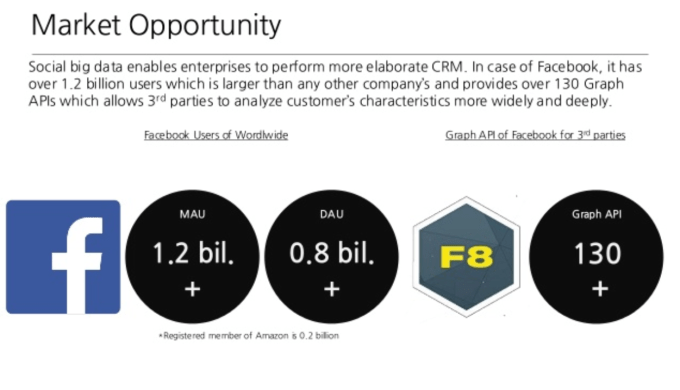
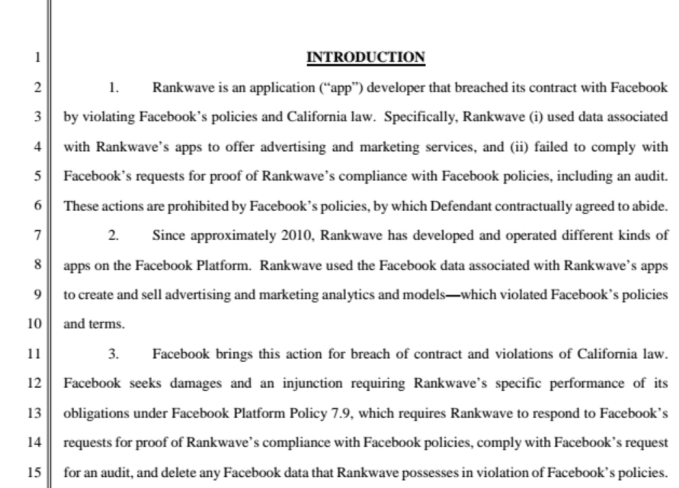
Facebook might have another Cambridge Analytica on its hands. In a late Friday news dump, Facebook revealed that today it filed a lawsuit alleging South Korean analytics firm Rankwave abused its developer platform’s data, and has refused to cooperate with a mandatory compliance audit and request to delete the data.

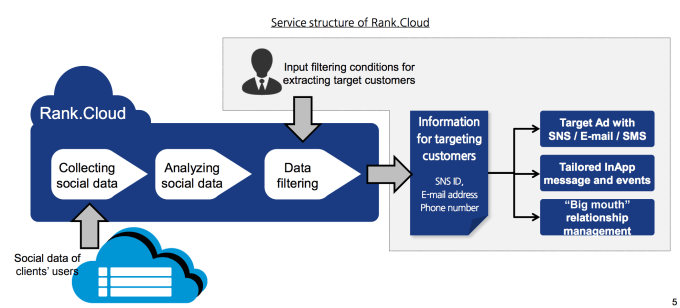
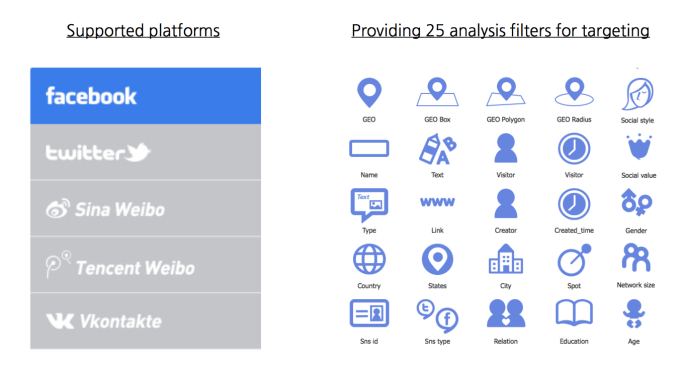
Facebook’s lawsuit centers around Rankwave offering to help businesses build a Facebook authorization step into their apps so they can pass all the user data to Rankwave, which then analyzes biographic and behavioral traits to supply user contact info and ad targeting assistance to the business. Rankwave also apparently misused data sucked in by its own consumer app for checking your social media “influencer score”. That app could pull data about your Facebook activity such as location checkins, determine that you’ve checked into a baseball stadium, and then Rankwave could help its clients target you with ads for baseball tickets.

The use of a seemingly fun app to slurp up user data and repurpose it for other business goals is strikingly similar to how Cambridge Analytica’s personality quiz app tempted millions of users to provide data about themselves and their friends.

Rankwave touts its Facebook data usage in this 2014 pitch deck

TechCrunch has attained a copy of the lawsuit that alleges that Rankwave misused Facebook data outside of the apps where it was collected, purposefully delayed responding to a cease-and-desist order, claimed it didn’t violate Facebook policy, lied about not using its apps since 2018 when they were accessed in April 2019, and then refused to comply with a mandatory audit of its data practices. Facebook Platform data is not supposed to be repurposed for other business goals, only for the developer to improve their app’s user experience.

“By filing the lawsuit, we are sending a message to developers that Facebook is serious about enforcing our policies, including requiring developers to cooperate with us during an investigation” Facebook’s director of platform enforcement and litigation Jessica Romero wrote. Facebook tells TechCrunch that “To date Rankwave has not participated in our investigation and we are trying to get more info from them to determine if there was any misuse of Pages data.” We’ve reached out to Rankwave for its response.

Cambridge Analytic-ish

Facebook’s lawsuit details that “Rankwave used the Facebook data associated with Rankwave’s apps to create and sell advertising and marketing analytics and models — which violated Facebook’s policies and terms” and that it “failed to comply with Facebook’s requests for proof of Rankwave’s compliance with Facebook policies, including an audit.” Rankwave apparently accessed data from over thirty apps, including those created by its clients.

Specifically, Facebook cites that its “Platform Policies largely restrict Developers from using Facebook data outside of the environment of the app, for any purpose other than enhancing the app users’ experience on the app.” But Rankwave allegedly used Facebook data outside those apps.

Rankwave describes how it extracts contact info and ad targeting data from Facebook data

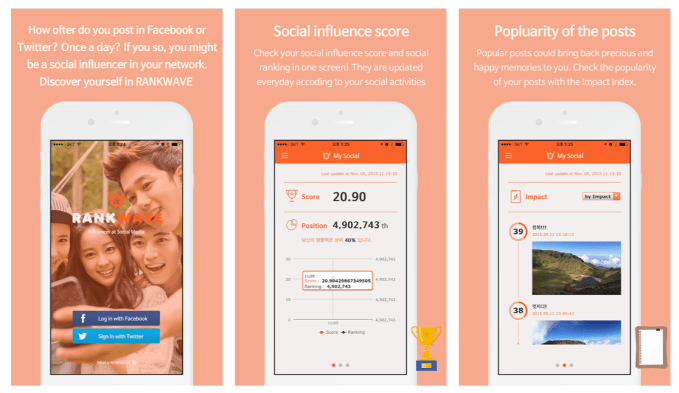
Facebook’s suit claims that “Rankwave’s B2B apps were installed and used by businesses to track and analyze activity on their Facebook Pages . . . Rankwave operated a consumer app called the ‘Rankwave App.’ This consumer app was designed to measure the app user’s popularity on Facebook by analyzing the level of interaction that other users had with the app user’s Facebook posts. On its website, Rankwave claimed that this app calculated a user’s ‘Social influence score’ by ‘evaluating your social activities’ and receiving ‘responses from your friends.’”

TechCrunch has found that Rankwave still offers an Android app that asks for you to login with Facebook so it can assess the popularity of your posts and give you a “Social Influencer Score”. Until 2015 when Facebook tightened its policies, this kind of app could ingest not only a user’s own data but that about their Facebook friends. As with Cambridge Analytica, this likely massively compounded Rankwave’s total data access.

Rankwave’s Android app asks for users’ Facebook data in exchange for providing them a Social Influencer Score

Facebook Delays Coming After Rankwave

Founded in 2012 by Sungwha Shim, Rankwave came into Facebook’s crosshairs in June 2018 after it was sold to a Korean entertainment company in May 2017. Facebook assesses that the value of its data at the time of the buyout was $9.8 million.

Worryingly, Facebook didn’t reach out to Rankwave until January 2019 for information proving it complied with the social network’s policies. After receiving no response, Facebook issued a cease-and-desist order in February, which Rankwave replied to seeking more time because it’s CTO had resigned, which Facebook calls “false representations”. Later that month, Rankwave denied violating Facebook’s policies but refused to provide proof. Facebook gave it more time to provide proof, but Rankwave didn’t respond. Facebook has now shut down Rankwave’s apps.

Rankwave claims to be able to extract a wide array of ad targeting data from Facebook data

Now Facebook is seeking money to cover the $9.8 million value of the data, additional monetary damages and legal fees, plus injunctive relief restraining Rankwave from accessing the Facebook Platform, requiring it to comply with Facebook’s audit, requiring that it delete all Facebook data.

The fact that Rankwave was openly promoting these services that blatantly violate Facebook’s policies casts further doubt on how the social network was policing its platform. And the six month delay between Facebook identifying a potential issue with Rankwave and it even reaching out for information, plus another several months before it blocked Rankwave’s app shows a failure to move swiftly to enforce its policies. These blunders might explain why Facebook buried the news by announcing it on a Friday afternoon when many reporters and readers have already signed off for the weekend.

For now there’s no evidence of wholesale transfer of Rankwave’s data to other parties or its misuse for especially nefarious purposes like influencing an election as with Cambridge Analytica. The lawsuit merely alleges data was wrongly harnessed to make money, which may not spur the same level of backlash. But the case further proves that Facebook was too busy growing itself thanks to the platform to properly safeguard it against abuse.

You can learn more about Rankwave’s analytics practices from this 2014 presentation.

Chelsea Manning released from jail as grand jury expires

Chelsea Manning walked free today for the first time after spending two months in Virginia’s Alexandria Detention Center for refusing to cooperate with a grand jury probing her relationship with WikiLeaks. Gizmodo first reported news that Manning left the facility today.

Manning was found to be in contempt of court, remaining in custody until the Eastern District of Virginia grand jury expired. Before her release, Manning was issued another subpoena for a second grand jury for Thursday May 16.

“Chelsea will continue to refuse to answer questions, and will use every available legal defense to prove to District Judge Trenga that she has just cause for her refusal to give testimony,” her legal team shared in a blog post.

** Feds released Chelsea a few hours ago after Grand Jury expired – @EDVAnews prosecutors subpoenaed her to appear a 2nd time for a different grand jury – but for same questions – on May 16th – official statement from her pending https://t.co/BkXDxnrLmZ

— Chelsea E. Manning (@xychelsea) May 10, 2019

Manning has consistently signaled her ongoing unwillingness to cooperate with the federal grand jury. That makes it entirely possible that she could be returned to custody at the detention center next week when she appears for her latest subpoena.

“I don’t have anything to contribute to this, or any other grand jury,” Manning said last month. “While I miss home, they can continue to hold me in jail, with all the harmful consequences that brings. I will not give up.”

Cisco open sources MindMeld conversational AI platform

Cisco announced today that it was open-sourcing the MindMeld conversation AI platform, making it available to anyone who wants to use it under the Apache 2.0 license.

MindMeld is the conversational AI company that Cisco bought in 2017. The company put the technology to use in Cisco Spark Assistant later that year to help bring voice commands to meeting hardware, which was just beginning to emerge at the time.

Today, there is a concerted effort to bring voice to enterprise use cases, and Cisco is offering the means for developers to do that with the MindMeld tool set. “Today, Cisco is taking a big step towards empowering developers with more comprehensive and practical tools for building conversational applications by open-sourcing the MindMeld Conversational AI Platform,” Cisco’s head of machine learning Karthik Raghunathan wrote in a blog post.

The company also wants to make it easier for developers to get going with the platform, so it is releasing the Conversational AI Playbook, a step-by-step guide book to help developers get started with conversation-driven applications. Cisco says this is about empowering developers, and that’s probably a big part of the reason.

But it would also be in Cisco’s best interest to have developers outside of Cisco working with and on this set of tools. By open-sourcing them, the hope is that a community of developers, whether Cisco customers or others, will begin using, testing and improving the tools; helping it to develop the platform faster and more broadly than it could, even inside an organization as large as Cisco.

Of course, just because they offer it doesn’t necessarily automatically mean the community of interested developers will emerge, but given the growing popularity of voice-enabled used cases, chances are some will give it a look. It will be up to Cisco to keep them engaged.

Cisco is making all of this available on its own DevNet platform starting today.

Final Fantasy VII Remake trailer shows redo of the classic in action

’90s kids will remember this. Final Fantasy VII, the game that busted JPRGs out of their niche and helped make the original PlayStation the must-have console of the generation, is, as we all know, being remade. But until today it wasn’t really clear just what “remade” actually meant.

The teaser trailer put online today is packed full of details, though of course they may change over the course of development. It’s exciting not just for fans of this game, but for those of us who prefer VI and are deeply interested in how that (superior) game might get remade. Or VIII or IX, honestly.

The trailer shows the usual suspects traversing the first main area of the game, Midgar. A mix of cutscenes and gameplay presents a game that looks to be more like Final Fantasy XV than anything else. This may be a bitter pill for some — while I doubt anyone really expected a perfect recreation of the original’s turn-based combat, XV has been roundly criticized for oversimplification of the franchise’s occasionally quite complex systems.

With a single button for “attack,” another for a special, and the rest of the commands relegated to a hidden menu, it looks a lot more like an action RPG than the original. A playable Barret suggests the ability to switch between characters either at will or when the story demands. But there’s nothing to imply the hidden depths of, say, XII’s programmatic combat or even XIII’s convoluted breakage system.

But dang does it look good. Aerith (not “Aeris” as some would have it) looks sweet, Cloud is stone-faced and genie-panted, and Barret is buff and gruff, all as detailed and realistic we have any right to expect. The city looks wonderfully rendered and clearly they’re not phoning in the effects.

It’s more than a little possible that the process for remaking VII is something that the company is considering for application to other titles (I can see going all the way back to IV), but with this game being the most obvious cash cow and test platform for it.

“More to come in June,” the video concludes.

Will we enter a gaming era rife with remakes preying on our nostalgia, sucking our wallets dry so we can experience a game for the 4th or 5th time, but with particle effects and streamlined menus? I hope so. Watch the full teaser below:

Delta is testing free Wi-Fi on flights this month

Delta says it plans to eventually offer free Wi-Fi on flights. The first step to achieving that goal, however, involves testing it on a handful of planes, beginning later this month. Starting May 13, the carrier will begin offering free service on 55 domestic flights per day.

The idea here is to test the strain on the system. Currently, the number of passengers who actually use the in-flight service is fairly low. Delta’s current provider Gogo says it’s around 12% of passengers across its various airline partners. Obviously that figure is going to jump pretty significantly if service is offered up for free.

“Testing will be key to getting this highly complex program right—this takes a lot more creativity, investment and planning to bring to life than a simple flip of a switch,” Delta’s director of Onboard Product told The Wall Street Journal.

But while installing and maintaining that service on planes certainly isn’t cheap, exorbitant prices stand out in a world where many businesses offer up access for free. Like luggage-check prices, Wi-Fi has become another indication of airlines looking to squeeze every last penny out of travelers.

In fact, JetBlue is currently the only major U.S. airline that offers free internet access to all passengers, but it relies on corporate sponsorships to offer the service. Delta hasn’t given a firm date on when its own passengers might gain free access on a larger scale.

With new raise, Unity could nearly double valuation to $6 billion

Unity Technologies, the company behind one of the world’s most popular game engines, could nearly double its reported valuation in a new round of funding.

The company has filed to raise up to $125 million in Series E funding according to a Delaware stock authorization filing uncovered by Prime Unicorn Index and reviewed by TechCrunch. If Unity closes the full authorized raise it will hold a valuation of $5.96 billion.

A Unity spokesperson confirmed the details of the document.

The SF company builds developer tools that allow game-makers to build titles and deploy them on consoles, mobile and PC. More than half of all new games are built using the platform. Customers pay for the platform per developer once their projects reach a certain scale.

Unity’s competitors include Fortnite-maker Epic Games, which has been able to rapidly acquire startups and game studios in the past two years fueled by the profits of their blockbuster hit.

Unity most recently closed $400 million in Series D funding led by Silver Lake, a “big chunk” of which went toward purchasing the shares of longtime employees and earlier investors. The round left the company’s valuation north of $3 billion. The company, founded in 2003, has raised more than $600 million to date.

The company’s previous backers include Sequoia, DFJ Growth and Silver Lake Partners.

Earlier this year, Cheddar reported that Unity was eyeing a 2020 IPO, though the company did not comment on the report.

Three ‘new rules’ worth considering for the internet

Daniel M. Gerstein
Contributor

Daniel M. Gerstein works at the nonprofit, nonpartisan RAND Corporation and is an adjunct professor at American University. He was the undersecretary (acting) and deputy undersecretary in the Science and Technology Directorate of the Department of Homeland Security from 2011-2014. Gerstein’s latest book, “The Story of Technology: How We Got Here and What the Future Holds,” will be published in August 2019.

In a recent commentary, Facebook’s Mark Zuckerberg argues for new internet regulation starting in four areas: harmful content, election integrity, privacy and data portability. He also advocates that government and regulators “need a more active role” in this process. This call to action should be welcome news as the importance of the internet to nearly all aspects of people’s daily lives seems indisputable. However, Zuckerberg’s new rules could be expanded, as part of the follow-on discussion he calls for, to include several other necessary areas: security-by-design, net worthiness and updated internet business models.

Security-by-design should be an equal priority with functionality for network connected devices, systems and services which comprise the Internet of Things (IoT). One estimate suggests that the number of connected devices will reach 125 billion by 2030, and will increase 50% annually in the next 15 years. Each component on the IoT represents a possible insecurity and point of entry into the system. The Department of Homeland Security has developed strategic principles for securing the IoT. The first principle is to “incorporate security at the design phase.” This seems highly prudent and very timely, given the anticipated growth of the internet.

Ensuring net worthiness — that is, that our internet systems meet appropriate and up to date standards — seems another essential issue, one that might be addressed under Zuckerberg’s call for enhanced privacy. Today’s internet is a hodge-podge of different generations of digital equipment, unclear standards for what constitutes internet privacy and growing awareness of the likely scenarios that could threaten networks and user’s personal information.

Recent cyber incidents and concerns have illustrated these shortfalls. One need only look at the Office of Personnel Management (OPM) hack that exposed the private information of more than 22 million government civilian employees to see how older methods for storing information, lack of network monitoring tools and insecure network credentials resulted in a massive data theft. Many networks, including some supporting government systems and hospitals, are still running Windows XP software from the early 2000s. One estimate is that 5.5% of the 1.5 billion devices running Microsoft Windows are running XP, which is now “well past its end-of-life.” In 2016, a distributed denial of service attack against the web security firm Dyn exposed critical vulnerabilities in the IoT that may also need to be addressed.

Updated business models may also be required to address internet vulnerabilities. The internet has its roots as an information-sharing platform. Over time, a vast array of information and services have been made available to internet users through companies such as Twitter, Google and Facebook. And these services have been made available for modest and, in some cases, no cost to the user.

Regulation is necessary, but normally occurs only once potential for harm becomes apparent.

This means that these companies are expending their own resources to collect data and make it available to users. To defray the costs and turn a profit, the companies have taken to selling advertisements and user information. In turn, this means that private information is being shared with third parties.

As the future of the internet unfolds, it might be worth considering what people would be willing to pay for access to traffic cameras to aid commutes, social media information concerning friends or upcoming events, streaming video entertainment and unlimited data on demand. In fact, the data that is available to users has likely been compiled using a mix of publicly available and private data. Failure to revise the current business model will likely only encourage more of the same concerns with internet security and privacy issues. Finding new business models — perhaps even a fee-for-service for some high-end services — that would support a vibrant internet, while allowing companies to be profitable, could be a worthy goal.

Finally, Zuckerberg’s call for government and regulators to have a more active role is imperative, but likely will continue to be a challenge. As seen in attempts at regulating technologies such as transportation safety, offshore oil drilling and drones, such regulation is necessary, but normally occurs only once potential for harm becomes apparent. The recent accidents involving the Boeing 737 Max 8 aircraft could be seen as one example of the importance of such government regulation and oversight.

Zuckerberg’s call to action suggests a pathway to move toward a new and improved internet. Of course, as Zuckerberg also highlights, his four areas would only be a start, and a broader discussion should be had as well. Incorporating security-by-design, net worthiness and updated business models could be part of this follow-on discussion.

Uber prices IPO at $45 per share, raises $8.1B

Uber has set its initial public offering at $45 per share, per reports, raising $8.1 billion in the process.

The price, which falls at the low end of Uber’s planned range, values Uber at $82.4 billion. Uber confirmed the price in a press release Thursday afternoon.

The pricing comes one day after drivers all over the world went on strike, with drivers in San Francisco protesting right outside the company’s headquarters.

Uber filed for its IPO last month, reporting 2018 revenues of $11.27 billion, net income of $997 million and adjusted EBITDA losses of $1.85 billion. Though, we knew this thanks to Uber’s previous disclosures of its financials.

But this is not the first time we’ve seen Uber’s financials. Over the last couple of years, Uber has willingly disclosed many of these numbers. Its last report as a private company came in February when Uber disclosed $3 billion in Q4 2018 revenue, with rising operating losses.

From ridesharing specifically, Uber’s revenues increased from $3.5 billion in 2016 to $9.2 billion in 2018, with gross bookings hitting $41.5 billion last year from ridesharing products.

Competitor Lyft filed its S-1 documents in March, showing nearly $1 billion in 2018 losses and revenues of $2.1 billion. It reported $8.1 billion in booking, covering 30.7 million riders and 1.9 million drivers. About a week later, Lyft set a range of $62 to $68 for its IPO, seeking to raise up to $2.1 billion. Since its debut on the Nasdaq, Lyft’s stock has suffered after skyrocketing nearly 10% on day one. Lyft is currently trading about 20% below its IPO.

Blue Origin launches ‘Club for the Future’ to inspire a new generation of space exploration

As part of his big reveal of Blue Origin’s new lunar lander, “Blue Moon,” Jeff Bezos announced Club for the Future, a new organization to inspire a new generation of space explorers and entrepreneurs.

The new organization, open to educators, parents and children in kindergarten through high school, seems designed to integrate educational lessons with Blue Origin missions.

“Club members’ ideas combined with a foundation of affordable, frequent, and reliable access to space, will help spark a future without limits,” reads the website’s exhortation to new members.” Dream. Experiment. Build. As we grow, look out for new activities, content, and opportunities to access space.”

The first project is to “receive a postcard from space.”

All participants need to do is draw or write a vision for the future of life in space on the blank side of a self-addressed, stamped postcard, and send it to “Club for the Future” at PO BOX 5759, KENT, WA 98064, U.S.A.

The first 10,000 postcards received before July 20, 2019 will be placed inside the Crew Capsule on a New Shepard flight, and then returned to senders with a stamped “flown to space” certification.

Blue Origin unveils its lunar lander, Blue Moon

Today at an intimate event in Washington, DC, Jeff Bezos took the wraps off some grand space plans. But that future, which includes trips to the lunar surface, isn’t much without the gear to get it there.

Among the more impressive unveils was Blue Moon, a new lunar lander. Bezos unveiled the vehicle, which was hidden behind a curtain for much of the event. “This is an incredible vehicle,” he told the crowd, “and it’s going to the Moon.” Powered by liquid hydrogen, the lander has an on-board system capable of navigating in space. It also utilizes gigabit internet to communicate back to Earth using a laser. 

Micro-satellites can also be strapped to the top of the rover and deployed in lunar orbit.

Blue Moon features an on-board lidar system capable of mapping lunar terrain, in order to choose the right landing site. According to Bezos, the system uses existing maps of the Moon’s surface to determine where to navigate relative to known landmarks. The vehicle features landing gear that’s stowed in an upward configuration and capable of landing on inclines up to 15 degrees. It’s capable of transporting 3.6-6.5 metric tons of payload, which includes humans and a rover, also unveiled onstage.

Bezos didn’t offer much in the way of specifics on the latter at the event, instead using the opportunity to lay out long-range plans for helping future generations deal with resource scarcities on Earth brought on by a rapidly increasing human population. As noted earlier, Bezos’s big unveil comes as the White House is making an aggressive push to kickstart a return to space travel.

Vice President Mike Pence recently discussed hopes for returning astronauts to the Moon by 2024, and President Trump has made several public statements about hopes for a landing on Mars during his presidency. While the administration will look at NASA first, they no doubt will also consider private space companies like Blue Origin and SpaceX to help achieve their goals through contracted work. Perhaps a joint appreciation of space travel will be enough for Trump and Bezos to at least temporarily put away longstanding differences — though that might be the biggest moonshot of all.

Bezos offered up a 2024 time frame for the lander, which handily dovetails with Pence’s stated goals.

Jeff Bezos aims Blue Origin at the Moon

Today at a packed event blocks from the White House, Jeff Bezos took the stage in front of select members of the media, executives, government officials and a gaggle of middle schoolers to reveal new details of his plan to get to the Moon by 2024

Blue Origin is going to send humans to space on New Shepard later this year and has unveiled a lunar lander, called “Blue Moon,” to access the resource-rich lunar surface, Bezos said.

Setting the stage with Neil Armstrong’s famous words as the first man to walk on the moon, Bezos took to the stage to explain his vision of answering a very simple question. Given the finite resources available to humanity, “where would a trillion humans live?”

It’s a vision that Bezos has articulated before.

For Bezos, the only impediment to this space utopia comes down to a mundane roadblock that the founder of Amazon knows all-too-well — the lack of logistics and infrastructure to drive down costs.

“My generation’s job is to build the infrastructure,” said Bezos. “We’re going to build the road to space.”

According to NASA and the U.S. government, that road is going to go through the Moon, which is one reason Bezos unveiled the lunar lander today.

U.S. Vice President Mike Pence in March called on NASA to use “any means necessary” to put American astronauts on a Moon-orbiting space station and eventually on the Moon’s South Pole by 2024.

But why the South Pole? Because of the ice.

Speaking at a National Space Council meeting, NASA Administrator Jim Bridenstine stated that NASA scientists estimate there are upwards of 1 trillion pounds of ice at the lunar poles. This estimate comes from data collected by the Indian Space Research Organization’s Chandrayaan-1 lunar orbiter, which detected the ice-hiding craters tilted away from the sun.

The ice is locked in these craters, unable to evaporate, as temperatures reportedly never rise above -250 degrees Fahrenheit in these spots. NASA hopes to use this ice to make rocket fuel.

“In this century, we’re going back to the Moon with new ambitions,” Pence said in March. “Not just to travel there, but also to mine oxygen from lunar rocks that will refuel our ships, to use nuclear power to extract water from the permanently shadowed craters of the south pole, and to fly on a new generation of spacecraft that will enable us to reach Mars in months, not years.”

Startups like Momentus are already building spacecraft that use alternative fuel sources (like oxygen) to propel their vessels.

Pence’s proclamation came after delays forced NASA to push back the first crewed mission to the Moon until 2028. NASA’s Space Launch System (SLS) has been in development for years amid delays and budget cuts.

Returning to the moon is set to be a pricey venture, and even more so given the updated target. NASA and the U.S. Office of Management and Budget calculated the cost, but have yet to reveal the price tag to the American public.

“Right now, [the cost estimate is] under review, and we can’t come up with a number,” Mark Sirangelo, special assistant to NASA Administrator Jim Bridenstine, said today during a hearing of the space and aeronautics subcommittee of the U.S. House of Representatives’ Science, Space, and Technology committee. “We’ve provided the information, and the discussions have been very positive and open, and as soon as those discussions are complete and OMB has approved the numbers, they’ll provide them to you.”

As Space.com reminds, returning to the Moon has been part of official U.S. policy since December 2017 after President Trump signed Space Policy Directive 1.

Though NASA has yet to reveal the detailed plan, the general timeline calls for crewed Moon landings in the late 2020s, paving the space road to Mars landings in the 2030s.

That’s where Blue Origin comes in.

In addition to the lunar lander, Blue Origin has two space vehicles in development. The New Shepard is a suborbital rocket designed for short-duration flight and not launching large satellites into orbit. That will be handled by the New Glenn, which is slated for a 2021 launch and will be able to ferry 45,000 kg of goods to low Earth orbit. Both rocket platforms are designed for reusability.

Last week the Blue Origin New Shepard completed its 11th mission after launching and landing while carrying 38 experiments into low Earth orbit. The New Shepard rockets to 100 kilometers, at which point the capsule detaches and continues upwards on its momentum. The tests (or eventually humans) onboard are exposed to several minutes of microgravity before the capsule descends back to Earth on three parachutes. The New Shepard rocket itself lands independently on its deployable struts.

It’s this launch platform Bezos intends to use in part for space tourism. Tickets could cost $200,000-$300,000 according to a Reuters report last year.

Meanwhile, SpaceX has taken a different path, designing and producing larger and larger rockets. The Falcon Heavy is the company’s current largest rocket and is capable of carrying 63,800 kg to low Earth orbit. SpaceX is also working on its next-generation launch platform, Starship, that is said to be able to lift more than 100,000 kg of goods to low Earth orbit. The first orbital fight for Starship is planned for 2020.

There is plenty of space for both companies and others. Startups like Rocket Lab, Virgin Galactic and Vector are also developing launch platforms intended to be used by commercial operations and government bodies. These startups have to compete with incumbents such as the Russian government and the United Launch Alliance, which is co-owned by Lockheed Martin and Boeing. And that’s just the rockets. Other startups are springing up to build different components, satellites, landers and telematic solutions needed for space travel.

“It’s time to go back to the Moon. This time to stay,” said Bezos.