Apple’s Voice Control improves accessibility OS-wide on all its devices

Apple is known for fluid, intuitive user interfaces, but none of that matters if you can’t click, tap, or drag because you don’t have a finger to do so with. For users with disabilities the company is doubling down on voice-based accessibility with the powerful new Voice Control feature on Macs and iOS (and iPadOS) devices.

Many devices already support rich dictation, and of course Apple’s phones and computers have used voice-based commands for years (I remember talking to my Quadra). But this is a big step forward that makes voice controls close to universal — and it all works offline.

The basic idea of Voice Control is that the user has both set commands and context-specific ones. Set commands are things like “Open Garage Band” or “File menu” or “Tap send.” And of course some intelligence has gone into making sure you’re actually saying the command and not writing it, like in that last sentence.

But that doesn’t work when you have an interface that pops up with lots of different buttons, fields, and labels. And even if every button or menu item could be called by name, it might be difficult or time-consuming to speak everything out loud.
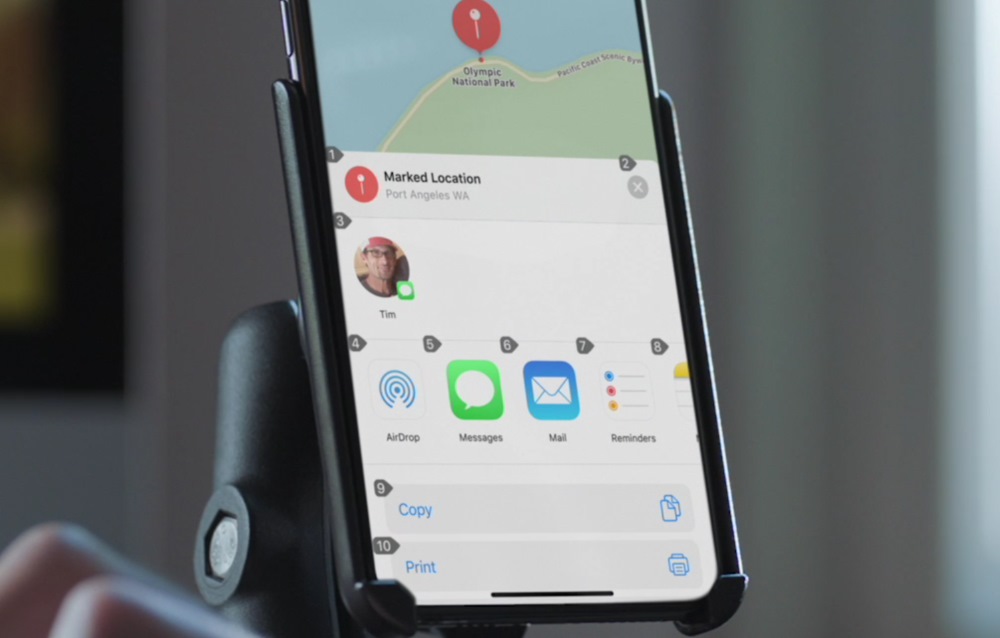
To fix this Apple simply attaches a number to every UI item in the foreground, which a user can show by saying “show numbers.” Then they can simply speak the number or modify it with another command, like “tap 22.” You can see a basic workflow below, though of course without the audio cues it loses a bit:

Remember that these numbers may be more easily referenced by someone with little or no vocal ability, and could in fact be selected from using a simpler input like a dial or blow tube. Gaze tracking is good but it has its limitations, and this is a good alternative.

For something like maps, where you could click anywhere, there’s a grid system for selecting where to zoom in or click. Just like Blade Runner! Other gestures like scrolling and dragging are likewise supported.

Dictation has been around for a bit but it’s been improved as well. You can select and replace entire phrases, like “Replace ‘be right back’ with ‘on my way.’ ” Other little improvements will be noted and appreciated by those who use the tool often.

All the voice processing is done offline, which makes it both quick and robust to things like signal problems or use in foreign countries where data might be hard to come by. And the intelligence built into Siri lets it recognize names and context-specific words that may not be part of the base vocabulary. Improved dictation means selecting emoji and adding dictionary items is a breeze.

Right now Voice Control is supported by all native apps, and third party apps that use Apple’s accessibility API should be able to take advantage of it easily. And even if they don’t do it specifically, numbers and grids should still work just fine, since all the OS needs to know are the locations of the UI items. These improvements should appear in accessibility options as soon as a device is updated to iOS 13 or Catalina.


GM and Fiat Chrysler are buying Tesla’s regulatory credits

One of the more opaque segments of Tesla’s business just became a little more transparent. Recent  filings show that GM and Fiat Chrysler have bought zero-emissions vehicle credits from Tesla, Bloomberg reported Monday.

Tesla’s ZEV credit program isn’t a secret. The company has brought in nearly $2 billion in revenue since 2010 when it started selling regulatory credits to automakers that needed to offset sales of polluting vehicles in the U.S. And it’s a revenue stream that has been either lauded or criticized for years now as analysts and the media debate whether this helps or hurts Tesla’s bottom line.

But little was known, until now, about who was doing the buying and why — beyond the assumed reason to offset sales of vehicles that produce tailpipe emissions.

Bloomberg found recent state filings in Delaware that reveal a little bit more about Tesla’s ZEV customers. GM and FCA both disclosed in separate filings in Delaware that they reached agreements to buy federal greenhouse gas credits, also known as ZEV credits, from Tesla. FCA has four separate filings that disclose agreements to buy credits from Tesla in 2016, 2018 and again this year.

Tesla declined to comment.

Meanwhile, GM’s first and only credit purchase has been more recent and with a specific mission in mind. GM already produces an all-electric vehicle, the Chevy Bolt, and until recently was making a plug-in hybrid, the Chevy Volt. These sales would seem to be more than enough to offset sales of its vehicles with tailpipe emissions.

And it has been. GM contends this is an insurance policy against future regulatory uncertainties.

“We do not need credits for compliance today, but purchasing credits is permitted under the regulations and is used as an insurance policy against future regulatory uncertainties,” a GM spokesperson said in an emailed comment.” The filing is a routine procedure that is used to protect interests in performance of contractual obligations.”

Typically, the ZEV credits have been purchased to meet California’s (and a handful of other states) stricter emissions regulations. GM’s comments seem to be aimed at protecting against federal regulations, even amidst efforts by the Trump administration to rolls back fuel economy and clean air standards that would presumably be friendlier to automakers.

But as Bloomberg and even Tesla’s own CFO Zachary Kirkhorn has noted, these ZEV credits stand to become a bigger part of Tesla’s business. A recent EPA report found that most large automakers used banked credits, along with technology improvements, to maintain compliance in model year 2017. Three large manufacturers achieved compliance based on the emission performance of their vehicles, without using additional banked credits, according to the EPA. The graph below, from the EPA’s report, shows how automakers have complied.

However, the EPA notes, 92% of those credits are set to expire at the end of 2021 if they’re not used. The EPA added that more than half of the current balance is held by three manufacturers, and the availability of these or future credits is inherently uncertain, suggesting a run on ZEV credits in the future.

iOS 13 will let you bypass the App Store download cap when on a cellular connection


Just a few days ago, Apple bumped up the limit on how big of an app you can download from the App Store while on a cellular connection, increasing it from 150MB to 200MB. As we noted at the time, it’s always seemed a bit silly that there was no way to acknowledge the file size and bypass the limit — to effectively say “Yeah, yeah, I know. Let me download it anyway.”

Looks like Apple agrees.

As spotted by 9to5Mac, iOS 13 (or, at least, the just-released developer beta version of iOS 13) gives you the option to download large apps over cellular should you choose to do so. Whether you’ve got the monthly bandwidth to spare or you just need a big ol’ monster app/update now (lack of WiFi be damned), iOS 13 seems much more willing to get out of your way.

A new screen in the settings menu reveals three options:

  • Always allow
  • Ask if over 200 MB
  • Ask first (prompting you to make sure you know you’re on a cell connection, even if the download is under 200 MB)

The prompt also offers to hold off a large download for now, automatically downloading it the next time you’re on WiFi.

iOS 13 shipped as a private developer beta today. The public beta is expected to roll out in July, with a full release sometime this fall.

Fitness startup Mirror nears $300M valuation with fresh funding

Today, Peloton is a bonafide success. The company, which sells $2,245 internet-connected exercise bikes, boasts a $4 billion valuation and a cult following.

That hasn’t always been the case. For years, Peloton battled for venture capital investment and struggled to attract buyers. Now that it’s proven the market for tech-enabled home exercise equipment and affiliated subscription products, a whole bunch of startups are chasing down the same customer segment.

Mirror, a New York-based company that sells $1,495 full-length mirrors that double as interactive home gyms, is closing in a round of funding expected to reach $36 million, sources and Delaware stock filings confirm, at a valuation just under $300 million. It’s unclear who has signed on to lead the round; we’ve heard a number of high-profile firms looked at Mirror’s books and passed. The company has previously raised a total of $38 million from Spark Capital, First Round Capital, Lerer Hippeau, BoxGroup and more.

Mirror declined to comment for this story.

Like Peloton, Mirror is sold for a hefty fee with a subscription to the service’s unlimited live and on-demand workouts that comes at an additional cost. The company hasn’t disclosed subscriber numbers, though The New York Times reported in February the business was selling $1 million worth of Mirrors — or some 650 units — per month.

The company has not only benefited from the Peloton effect, but also from a near-immediate interest from celebrities and influencers in its product. Kate Hudson, Alicia Keys, Reese Witherspoon, Jennifer Aniston and Gwyneth Paltrow are among the many celebrities to have publicly boasted about Mirror, undoubtedly boosting sales for the up-and-coming startup.

Venture capitalists were quick to show support for Mirror, too; in fact, the business attracted money at a $200 million valuation prior to launching its first product. Mirror began selling its sleek equipment, dubbed by The New York Times as “The Most Narcissistic Exercise Equipment Ever,” in September.

SAN FRANCISCO, CA – SEPTEMBER 06: Mirror Founder and CEO Brynn Putnam (L) and moderator Lucas Matney speak onstage during Day 2 of TechCrunch Disrupt SF 2018 at Moscone Center on September 6, 2018, in San Francisco, California. (Photo by Steve Jennings/Getty Images for TechCrunch)

The round comes amid a distinct boom in funding for fitness-related startups evidenced not only by Peloton’s mammoth valuation and hyped-over initial public offering expected soon but by the rapid uptick in small upstarts looking to capitalize on rising interest in fitness apps and equipment. In total, VCs bet some $2 billion on U.S. fitness startups in 2018, a record amount of funding for the space. So far this year, nearly $500 million has been allocated to the growing sector, per PitchBook, as entrepreneurs strive to bring the gym into the home.

Tonal, which sells personal exercise equipment that combines on-demand training with smart features, is among a small class of venture-backed fitness companies to have accumulated a large following. The company has raised $91.7 million in equity funding at a valuation of $185 million, according to PitchBook, from investors including L Catterton, Shasta Ventures, Mayfield and Sapphire Sport.

When it comes to early-stage efforts, there’s no shortage of recent fundraises. Last week, Livekick, which gives customers access to one-on-one personal training and yoga from their home, closed a $3 million seed round led by Firstime VC. Two weeks ago, fitness startup Future secured an $8.5 million round led by Kleiner Perkins’ Mamoon Hamid. For a $150 monthly fee, Future assigns personalized workout plans and a coach who tracks customers’ fitness activity through an Apple Watch. To keep users committed to their workout regimens, Future sends daily text messages with motivational feedback.

The AI-based personal training company Aaptiv, Plankk, which sells live fitness lessons led by Instagram stars, and audio coaching app Eastnine, have also recently launched.

Mirror was founded in late 2016 by Brynn Putnam, an entrepreneur behind Refine Method, a chain of boutique fitness studios located in New York. The former professional dancer spoke to TechCrunch’s Lucas Matney at Disrupt San Francisco in September about the future of the business.

“[We want] to enhance the human touch rather than to replace it,” Putnam said. “Our goal is not to be the next treadmill in your life, our goal is to be the next screen in your home,” Putnam said.

Ultimately, Putnam added, Mirror plans to scale beyond fitness content with potential extensions including physical therapy, fashion, beauty and education.

“We have the ability to create personalized premium content across a wide range of verticals, with fitness being our first vertical,” Putnam said.

Cookware startup Great Jones launches Potline, a text service for recipes and advice

Great Jones, a startup selling pots, pans and even an oven directly to consumers, is introducing a new way to get help in the kitchen.

Potline is a free text message service where anyone can ask for recipe ideas, or get advice when things are going wrong in the middle of the cooking process, or get tips on how to clean up afterwards. Great Jones co-founder Sierra Tishgart argued this is “a really natural extension” of the brand, particularly since the company has already been getting customer service queries that aren’t really about its cookware.

“It’s great to see someone write in to say, ‘Hey I’m cooking for my new girlfriend or boyfriend, and I want a roast chicken recipe,’” Tishgart said.

As for why it’s doing this via text message, she said, “We really want this to feel like that you are in the middle of making pasta and your sauce isn’t landing — how would you look for help there? I would text somebody. We really realized that is just the fastest, most immediate and natural form of communication.”

Great Jones Potline

Initially, Potline will be available from 4pm to 8pm Eastern time on Monday and Wednesday evenings. That’s only eight hours each week, but Tishgart said you’re going to be getting real-time feedback from an actual human being — namely Great Jones customer experience lead Gavy Scelzo.

“We don’t have a large team doing this,” Tishgart added. “This is very much an experiment for us. Gaby is answering the questions. We’re on our own text thread with seven of us in the office contributing, but it’s really going to be relying on Gaby’s expertise [and] a large database of recipes.”

Of course, if it’s successful, Potline could eventually expand to other days and times. Meanwhile, you can try it out for yourself by texting 1-814-BISCUIT.

Flash, the e-scooter startup from Delivery Hero founder, re-brands as ‘Circ’ and announces 1M rides

Flash, the micro-mobility startup from Delivery Hero and Team Europe founder Lukasz Gadowski, is re-branding today and disclosing that the e-scooter rental service has clocked up 1 million rides in just 4.5 months since launch.

This, the company claims, is a milestone passed quicker than any of its competitors, although Voi recently announced that it reached 2 million rides in less than 8 months, while I understand that Tier, which launched later than Voi, is on track to hit that same number any day now, if it hasn’t already. The takeaway: e-scooter rentals in Europe remains a hot and fast-growing market to be in.

Quietly launched in Zurich, Switzerland in mid-January this year, Berlin-based Circ says it has since expanded to 21 cities across 7 countries. The re-brand is in preparation for further international expansion, with Germany up next to coincide with new German regulations permitting e-scooter services.

With regards to the name change, I’m told the decision was both practical and more conceptual. When people think of “flash” they tend to think of lightning or comic book superheroes, while the word itself is intrinsically linked with connotations of speed. While newly named Circ has moved very fast to reach 1 million rides, riding fast is not what the company is about.

“We wanted a name that better reflects who we are and how seriously we take the responsibility of moving people. Circ is all about circles, connections and there is great symmetry with what we do, working with others to help people move around their city in a reliable, safe and enjoyable way,” a company spokesperson tells me.

Reading between the lines, it’s almost certain that the startup is also thinking about its brand beyond e-scooters alone. Gadowski has always described the company as a “micro-mobility” service that isn’t just concerned with scooters and one that wants to play an integral role within a city’s broader transportation system.

On that note, Circ says it has joined the Union Internationale des Transports Publics (UITP), the worldwide association for public transportation. It has also formed a partnership with Swiss public transport operator Swiss Federal Railways (Schweizerische Bundesbahnen, SBB).

“The comprehensive partnership entails the creation of designated parking spaces at key strategic locations in railway stations and explores digital integration as Circ and SBB introduce ways to create seamless mobility for rail and e-scooter users,” says Circ.

SpaceX Dragon capsule returns from Space Station resupply mission

SpaceX’s Dragon cargo capsule has made its way back from the International Space Station, completing the private launcher’s seventeenth resupply mission for the orbital research facility.

Commercial Resupply Services mission 17 (aka CRS-17 if you’re down to acronym) launched on May 4, its first backup window after an initial mission scrub. The Dragon’s cargo for this one included 5,500 lbs of both supplies for the astronauts, as well as materials used for ongoing experiments and research aboard the station.

Dragon spent about a month docked at the ISS while the crew unloaded its cargo, and then began its de-orbit burn earlier today before splashing down in the Pacific Ocean as planned Monday afternoon Pacific time.

You can check out a recap of the mission (complete with an infrared capture of the return of the Falcon 9 first-stage booster coming back in for a perfect landing on the drone landing ship Of ‘Course I Still Love You’ in the Pacific Ocean below.


Apple juices its AR capabilities with new tools

Augmented reality may not be an iOS feature consumers are dying to get their hands on, but Apple’s latest tools are going to make its long-shot dream of AR ubiquity a little bit easier for developers to build.

The company delivered some interesting updates to ARKit for the latest version and introduced a new framework for developers called RealityKit.

Apple’s moves with RealityKit could start to invade territory currently swept up by Unity and Unreal, which allow developers to build 3D content, but they understandably really weren’t built up with AR from the beginning. That makes integrations with how the real world functions a bit of a chore, the goal with RealityKit and RealityComposer is to make this relationship smoother.

The tools lets you set the scene, importing 3D assets and sound sources, while detailing how those objects will interact with user input and their environment. It’s all very custom-designed for iOS and can allow developers to test and demo AR scenes on an iPhone or iPad to get a real sense of how a finished product will look.

For ARKit 3, the big announcement is that the latest version supports real-time occlusion, a computer vision problem that is very very hard. Basically, it means the system has to keep an eye on where human figures begin and end so that digital content can be account for people wandering in front of them.

This is likely one of the hardest problems that Apple has tackled yet and judging by one of the onstage demos, it doesn’t look like it’s quite perfect yet and handling environmental object occlusion isn’t supported in this update.

Another addition to ARKit is full-body motion capture, something that probably builds on a lot of the same tech advances for occlusion. You can probably expect to see selfie filters on Instagram and Snapchat expand from the face to entire bodies with this new functionality.

RealityKit is in beta now and ARKit 3 is on the way in iOS 13.

Is your event strategy paying off? How to calculate your event ROI

Sarah Shewey
Contributor

Sarah Shewey is the Founder & CEO of Happily, a platform that rapidly assembles experiences for the fastest growing brands in the world with the largest network of freelance event producers. She is also the co-founder of TEDActive, the founder of EXP, a co-founder of The Margin, and the board president of dublab.

Events have increasingly become an important channel in the marketing mix, despite how notoriously “impossible” it is to measure the ROI, or return on investment. When people show up to your event, they are willingly giving you their attention for hours on end – not trying to avoid attention-grabbing ads.

A well produced experience provides a great way to reach outside of your existing networks, build a pipeline of new customers, transform existing customers into superfans, and position your brand as a thought leader. In 2017, only 7% of marketers said that events were their most important marketing channel. Last year, that number rose to 41% according to a survey done by Bizzabo.

As the founder of Happily, the largest network of event producers in the United States, I’ve had backstage access to thousands of events – some wildly successful like TED and others that didn’t ever get traction in building an engaged community.

What has defined the successful ones?

The experiential marketing industry has long struggled to measure success in a meaningful way. They propose all the same KPIs (key performance indicators), but rarely do those KPIs provide a benchmark to determine if an event is successful or give marketers the ability to tell what worked and what didn’t. They especially fall down when customers aren’t won until months after an event.

With iOS 13, Apple delivers new features to court users in India

Apple has finally listened to its small, but slowly growing user base in India. The iPhone-maker today announced a range of features in iOS 13 that are designed to appease users in the world’s second largest smartphone market.

First up, the company says its Siri voice assistant now offers all new and “more natural” Indian English male and female voices. It has also introduced a bilingual keyboard, featuring support for Hindi and English languages. The keyboard offers typing predictions in Devanagari Hindi that can suggest the next word as a user types and it learns from their typing over time.

Additionally, the keyboard in iOS 13 supports all of 22 Indian languages, with the inclusion of 15 new Indian language keyboards: Assamese, Bodo, Dogri, Kashmiri (Devanagari, Arabic), Konkani (Devanagari), Manipuri (Bangla, Meetei Mayek), Maithili, Nepali, Sanskrit, Santali (Devanagari, Ol Chiki), and Sindhi (Devanagari, Arabic).

The addition of these features comes as Apple cautiously grows more serious about India, where it holds about just 1% of the smartphone market share, according to research firm Counterpoint. Even as smartphone shipment is declining in much of the world, India has emerged as the fastest growing market for handsets in recent years. According to Counterpoint, more than 145 million smartphones shipped in India last year, up 10% year-over-year.

But users in India have long complained about Apple services not being fully optimized for local conditions. Siri, for instance, has so far offered limited functionalities in India, and many Apple services such as Apple Pay and Apple News are yet to launch in the nation.

The upcoming version of iOS, which will ship to a range of iPhone handsets later this year, also includes four new system fonts in Indian languages: Gurmukhi, Kannada, Odia, and Gujarati. These will “help deliver greater clarity and ease when reading in apps like Safari, typing in Messages and Mail, or swiping through Contacts,” the company said in a statement.

Additionally, there are 30 new document fonts for Indian languages Hindi, Marathi, Nepali, Sanskrit, Bengali, Assamese, Tamil, Telugu, Gujarati, Kannada, Gurmukhi, Malayalam, Odia, and Urdu.

Apple says iOS 13 will also enable improved video downloading option for patchy networks. It says users in India can now set an optimized time of the day in video streaming apps such as Hotstar and Netflix for downloading videos. Consumption of video apps is increasingly skyrocketing in India. Just last week, Alibaba said it was investing $100 million in its short video app called Vmate in the nation.

In recent months, Apple has also improved Apple Maps in India. Earlier this year, Apple Maps added support for turn-by-turn navigation, and enabled users to book a cab — from Ola or Uber — directly from within the maps app. The company has also been aggressively hiring people to expand its maps and other software teams in  the country, according to job postings on the its site.

Improvements to software aside, Apple has also been working to reduce the cost of iPhones in India, the single major factor for their poor sales in the country. Two years ago, Apple started to assemble the iPhone 7 handset in India. It plans to ramp up its local production in the coming weeks, a person familiar with the matter told TechCrunch.

As part of local government’s ‘Make in India’ program, phone vendors that assemble phones in the country are offered tax and other benefits. Ravi Shankar Prasad, an Indian minister who oversees law and justice, telecom, and electronics and IT departments, said at a press conference earlier today (local time) that Bharatiya Janata Party, the ruling party which was reelected last month, will work on expanding Make in India program as one of its top priorities.

Flash Sale! Buy a mobility startup package, get one for free at Disrupt SF

Check your calendars, mobility startup fans. It’s only five short weeks until TC Sessions: Mobility 2019 goes down in San Jose. Get ready to dive into the current state of mobility, challenge assumptions, put hyperbole in its place and help shape the future of these rapidly evolving technologies.

And if you want to expose your early-stage mobility startups to mobility’s brightest, most influential founders, technologists and investors, take advantage of this limited-time flash sale. When you buy a demo table at TC Sessions: Mobility you’ll get a free Startup Alley Exhibitor Package at Disrupt San Francisco 2019*. And guess what — in addition to a demo space, both events’ startup packages come with three attendee tickets!

This double-demo opportunity comes to a grinding halt on Friday, June 7 at 11:59 pm (PT) and is exclusively for early-stage mobility startups. Don’t miss your chance to showcase your company to thousands of attendees at Disrupt SF — at substantial savings. Seriously, this deal puts the “expo” in exposure.

As a demo table holder, you’ll also get to enjoy all the programming that it offers — we’re talking speakers, panels, workshops and demos that tackle mobility’s inherent challenges and promises. Our jam-packed agenda covers everything from autonomous vehicles and redefining urban mobility to powering electric cars and whether venture capital can drive it all — and then some. Here’s a quick peek at some of the presentations:

  • Autonomous Robotaxis vs. Shuttles — Karl Iagnemma, Alisyn Malek and Lia Theodosiou-Pisanelli represent some of the top minds trying to bring autonomous vehicle technology to the masses. They’ll debate which approaches makes the most sense and have the best chances for economic viability and which safety and security vulnerabilities and other challenges could throw them off track.
  • Rebuilding the Motor City — Ken Washington, Ford’s CTO and vice president of research and advanced engineering, will discuss how the historic automaker is rapidly changing its culture and processes while it prepares for an electric future.
  • Will Venture Capital Drive the Future of Mobility?  — Three leading early-stage investors, Michael Granoff, Ted Serbinski and Sarah Smith, will debate the uncertain future of mobility tech and whether VC dollars are enough to push the industry forward.

TC Sessions: Mobility 2019 takes place on July 10 in San Jose. Buy a demo table before Friday, June 7 at 11:59 pm (PT) to receive a 100% discount on a Startup Alley Exhibitor Package at Disrupt San Francisco 2019. Don’t miss this opportunity to double your exposure to influential movers and shakers. They might just rock your world.

*This is a limited-time offer and expires on June 7, 2019, at 11:59 pm (PT). Offer open only to early-stage, mobility startups with less than $3 million in funding. Offer cannot be combined with other discounts or promotions.

Distru, a maker of supply chain software for the cannabis industry, has raised $3 million led by Felicis

Distru, a nearly three-year-old, Oakland-based startup whose platform aims to help track cannabis through its seed-to-sale process, has raised $3 million in seed funding led by Felicis Ventures, with participation from Village Global, Global Founders Capital, and numerous notable angel investors, including Elad Gil, Katie Stanton, and Avichal Garg.

The deal is an interesting one for numerous reasons, including that it marks Felicis’s first investment in the cannabis space after many months spent looking at a wide array of related startups, says Niki Pezeshki, a principal with the firm. Indeed, though interest in cannabis-related products and services is growing among traditional venture firms as a growing number of states move to legalize and regulate marijuana, there’s lingering concern about what will happen and when at the federal level.

Distru is also entering into a space that tech investors can grok: it’s a software as a service company, one that just happens to give cannabis operators insight into their inventory and order management, their customer relationship management, and their logistics. Most important, Distru’s software helps them automate compliance with complicated and growing state regulations by integrating with Metrc, which is itself inventory tracing software that’s being used by a growing number of states to record the inventory and movement of cannabis and cannabis products through the commercial supply chain. (We wrote about six-year-old Metrc last year when it raised $50 million in funding, including from Casa Verde Capital and Tiger Global Management.)

Not last, Distru’s team, headed by founder and CEO Blaine Hatab, comes from the tech world, even while most are in the formative stages of their careers. Hatab has spent much of his post-collegiate career as a software developer, as has his cofounder, Blake Gentry, who joined forced with Hatab after leaving a developer role with the startup Opendoor to create his own company, Actualyze, which merged with Distru last fall. A third cofounder, Johnny Ji, who further serves as Distru’s chief technical officer, was most recently a JavaScript instructor. Altogether, says Hatab, the team is made up of just nine employees who work remotely, though with its new funding, Distru plans to fill five more roles imminently.

In the meantime, it seems to pick picking up momentum despite its scale. Among its customers are major cannabis producers and distributors Humboldt Farms and CannaCraft. More, though it has competitors, including nine-year-old, Denver-based, venture-backed MJ Freeway, Hatab says it’s growing steadily based solely on word of mouth. Perhaps most compelling to Felicis and its other backers, the company has been operating in the black for some time. Says Hatab, “I think [our investors] were surprised by how profitable we were.”

And it has a lot of room to grow, no pun intended. Distru operates in California alone today, but Hatab says it plans to follow Metrc into the other markets where it operates today, including Colorado, Oregon, Alaska, Maryland, Michigan, Ohio, Massachusetts, Montana, Nevada and Louisiana.