Daily Crunch: Google’s not making any more tablets

The Daily Crunch is TechCrunch’s roundup of our biggest and most important stories. If you’d like to get this delivered to your inbox every day at around 9am Pacific, you can subscribe here.

1. Google says it’s not making any more tablets

“For Google’s first-party hardware efforts, we’ll be focusing on Chrome OS laptops and will continue to support Pixel Slate,” the company said in statement.

Google SVP Rick Osterloh took to Twitter to emphasize that while Google’s hardware team will be “solely focused on building laptops moving forward,” the company will still be working with partners on Android and Chrome OS tablets.

2. Slack’s value rockets as stock closes up 48.5% in public debut

At the close of trading yesterday, Slack’s market cap sat well above $20 billion, or nearly 3 times its most recent private valuation of $7 billion.

3. One of NASA’s robotic astronaut helpers just flew on its own in space for the first time

The robot — called “Bumble” and one of a series of Astrobee robots that NASA developed to work along with astronauts on the ISS — is the first ever to fly on its own in space.

4. Samsung exec says the Galaxy Fold is ‘ready to hit the market’

Just last week, Huawei noted that it was holding off on its own Mate X release. But Samsung, at least, may finally be ready to unleash its foldable on the world, two months after the planned release.

5. Meet your new chief of staff: An AI chatbot

Mailbox’s founders are back with their second act: An AI-enabled assistant called Navigator meant to help teams work and communicate more efficiently.

6. Terry Gou resigns as Foxconn’s chairman to run for president of Taiwan

Gou, who founded Foxconn 45 years ago and is also its biggest shareholder, will remain on the company’s board.

7. A chat with Niantic CEO John Hanke on the launch of Harry Potter: Wizards Unite

Built in collaboration with WB Games, Wizards Unite is a reimagining of Pokémon GO’s real-world, location-based gaming concept through the lens of JK Rowling’s Harry Potter universe. (Extra Crunch membership required.)

Slack and Zoom are flying high; they’re also being chased already by upstarts

Two of the highest-flying now-public enterprise companies of the year — Slack and Zoom — are different in many ways, besides the fact that one is focused on workplace messaging while the other is centered around video conferencing.

Slack began life as a very different startup, while Zoom founder Eric Yuan knew from the outset that he wanted to take on his former employer, WebEx. Slack raised a lot of money from many sources before hitting the public market — roughly $1.4 billion over 10 rounds. Zoom raised just $160 million across five rounds, including a $100 million Series D round funded entirely by Sequoia. The two also approached their public offerings differently. Slack chose a direct listing that didn’t raise new money for the company; Zoom chose a traditional IPO, raising half a billion dollars in funding for its coffers just ahead of its first day of trading.

Still, the two companies also have much in common. Both took on incumbents (WebEx and email, respectively). Both are rooted in workplace collaboration and, as such, have some of the same competitors, including Microsoft Teams. Another shared quality, notes Zoom investor Gordon Ritter of Emergence Capital Partners: both are “powered by viral end-user adoption, which is not the case for every SaaS company.” (Slack largely grows within a company, starting with one team; Zoom grows internally and externally, given the nature of video conferencing across companies.)

What the two may also have in common: potentially fewer days at the top of the heap than some of their predecessors. The reason, as says longtime VC Greg Gretsch, who co-founded Jackson Square Ventures in 2011, is the “intensity of new competition is on a completely different level today from what it was 15 or 20 years ago.”

Ritter, who co-founded Emergence in 2002 and has backed Box, Yammer and Veeva Systems, where he remains board chair, echoes the sentiment. The “cycle time of incumbents having their day in the sun is getting shorter and shorter,” he notes.

It’s happening broadly to Fortune 500 companies, whose average lifespan is now less than 20 years, compared with 60 years in the 1950s. But now, even still fast-growing companies like Zoom and Slack, which “have amazing futures,” says Ritter, will likely have startups nipping at their heels very soon.

Craig Hanson, a general partner and co-founder of NextWorld Capital in San Francisco, explains it this way: “In the current environment, with all the entrepreneurs and capital looking for the next great idea, each startup success story immediately blooms an entire field of new startups chasing after them.”

It’s almost possible to time it, says Hanson. “Once a startup raises a big growth round or has an impressive exit, in two to three quarters, you’ll see rounds of funding for similar new companies. This happens in both consumer and enterprise tech. VCs may regret missing out on the first company that just raised big and hope that there’s room for another one, or some great IPO or acquisition may spark a newfound passion for a space they overlooked before or that they thought was too hard until someone proved them wrong.”

Consider the many failed video conferencing startups to precede Zoom, including long-forgotten outfits like TeamSlide, LiveMeeting and Vyew. Indeed, Eric Yuan’s startup was anything but a sure thing, But once a space has been validated by the kind of success that Zoom enjoys, it makes it easier for other founders to raise money. This might partly explain why, in April, a nearly five-year-old, Boston-based startup named Owl Labs landed $15 million in Series B funding for its video conference camera with 360-degree capabilities. Another web conferencing startup, Highfive, based in Redwood City, Calif., drummed up $32 million last year, including from Lightspeed Venture Partners and Andreessen Horowitz.

“It’s easier to explain what they want to do [if they can say] ‘We’re like Twilio for ____,’” says Hanson, adding that as recently as 2016, “you’d have maybe two to three startups going after a space and chasing the incumbents. Now there will be 10 startups, and the incumbents were themselves startups just a handful of years earlier.”

The trend isn’t limited to recently public companies, says Gretsch. In his view, “success for many companies and sectors is declared long before the first IPO, and with that perceived success comes a wave of me-too competitors.”

It goes “hand in hand with the explosion of seed rounds over the last 10 years, which itself has been largely driven by how little it really costs for a company to get a finished product into customers hands,” he says.

In fact, Gretsch isn’t so sure the trend is a new one. Nevertheless, because the sheer number of startups that receive funding is now “off the charts,” it’s changing the game for consumer and enterprise companies alike.

“Any company that’s enjoying success has to remain paranoid and not ever settle for resting on their laurels,” says Gretsch. Today, it just happens to be “more true than it was 23 years ago, when [famed Intel CEO] Andy Grove used it for the title of his book.”

That famous best-seller? “Only the Paranoid Survive.”

Apply to Startup Battlefield for a shot at TC fame and fortune

What would a $100,000 cash infusion do for your early-stage startup? Don’t just imagine it. Apply to compete in Startup Battlefield at Disrupt San Francisco 2019 on October 2-4.

Our premier pitch competition has launched hundreds of startups on an exponential success trajectory, attracts massive media and investor attention and, yeah, it offers a fat $100K prize — equity free. But listen up founders, the application deadline expires on June 25th at 11:59 p.m. (PT). Don’t miss your shot at TC fame and fortune. Fill out an application to Startup Battlefield today.

You literally have nothing to lose. Any early-stage startup — from any country, in any vertical — is eligible, and it doesn’t cost anything to apply or to compete. TechCrunch doesn’t charge any fees or take any equity, either. We’re nice that way.

You’ll have plenty of time to prepare and plenty of sage advice from expert TechCrunch editors. Yup, all competing teams receive extensive, free pitch coaching. You’ll be rarin’ to go when you step on the Disrupt Main stage to deliver your six-minute pitch and live demo to a panel of top VC and tech judges.

We expect more than 10,000 attendees at our flagship Disrupt SF event, and the wildly popular Startup Battlefield always draws a huge audience. We’re talking thousands of spectators, including hundreds of media outlets, investors and tech influencers. These are the very people who could potentially take your company — whether you win the Battle or not — to the next level and beyond. Not to mention the international live stream to get the entire world’s attention.

Want more perks? We’ve got ’em. Battlefield startups get up to four free conference passes, access to TC’s investor-startup matching program and can exhibit for free in Startup Alley for all three days of Disrupt. Plus, you receive backstage access, invitations to VIP events and free passes to all future TechCrunch events.

Then there’s the Startup Battlefield alumni community — 857 companies strong and counting. Your startup will join an awesome group that includes Fitbit, Vurb, Dropbox, Get Around, Cloudflare, Mint and more. Alumni companies have collectively raised $8.9 billion and produced 110 successful IPOs or acquisitions.

Startup Battlefield takes place at Disrupt San Francisco 2019 on October 2-4, and your shot at $100,000 ends when the application deadline expires on June 25th at 11:59 p.m. (PT). Don’t miss all the opportunity. Apply right here, and we’ll see you in San Francisco!

‘Harry Potter: Wizards Unite’ reaches 400K downloads, $300K in consumer spend in UK and US

Harry Potter: Wizards Unite, the highly anticipated new mobile game from Pokémon GO makers Niantic and Warner Brothers’ games division, is off to a good start, but it’s not breaking Pokémon GO records. According to preliminary estimates from Sensor Tower, the new game has been installed some 400,000 times in its first 24 hours in its launch markets of the U.S. and U.K. — where the game arrived ahead of schedule on Thursday. Gross player spending in these markets hit around $300,000 across both iOS and Android during this time.

This is not the full picture, however.

The game was also available in Australia and New Zealand during a pre-launch beta trial of sorts, and is only now rolling out to worldwide users on a country-by-country basis. During its beta test period, Sensor Tower estimates the game grossed around $80,000.

But in the same number of days, Pokémon GO grossed $1.6 million in those two markets.

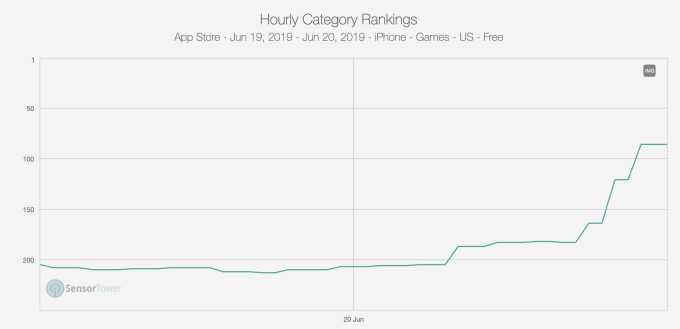
Following its U.S. launch, it took Harry Potter: Wizards Unite around 15 hours to reach the No.1 position on the iOS App Store. This ascension is also going a bit slower than Pokémon GO did when it arrived. That game was an immediate hit, debuting at No. 1 on its launch day of July 6, 2016. It was then installed 7.5 million times in the U.S. during its first 24 hours. And it didn’t reach the U.K. until seven days later.

In its first 24 hours, Pokémon GO became the No. 1 app by revenue in the U.S., as well. The new Harry Potter title is ranked No. 102 overall for iPhone revenue and No. 62 among top grossing games, Sensor Tower says. It’s also No. 48 for U.K. revenue. (It’s not yet ranked on Google Play.)

App Annie hasn’t yet put out numbers related to Harry Potter: Wizards Unite’s revenue, but the company tells us it hit No. 1 in the U.S. for downloads as of 12 AM on June 21, 2019. And for consumer spending, App Annie says the game broke into the top 100 grossing games by hitting No. 63 as of 7:00 AM June 21 on iPhone in the U.S.

The new game’s lesser demand compared with Pokémon GO could be attributed to a number of factors. Pokémon GO was hugely anticipated, had a massive fan base ready to download and was one of the first compelling use cases of AR in gaming.

Harry Potter’s fan base is active as well, but they’ve also had other games to play before now.

For example, Jam City has a Harry Potter: Hogwarts Mystery game that’s been getting a huge boost since yesterday’s news of the new Niantic title. That points to a case of mistaken identity or perhaps clever App Store SEO… or both.

It’s also worth noting the App Store itself has changed in the years since Pokémon GO’s launch.

In September 2017, Apple introduced its brand-new App Store that took the emphasis off its Top Charts as a means of discovery, and instead features apps in editorial “stories” on its Today tab. Within the dedicated apps and games section, the revamped App Store points users to editorial collections, with Top Charts only found upon scrolling down the page quite a bit.

We’ve heard from some developers that these changes reduced their downloads, as getting into the Top Charts doesn’t drive numbers like it used to. They said getting into the Today tab’s feature editorial doesn’t send as many installs, either. But this is all anecdotal — and of course, Apple doesn’t talk about numbers like this. Further investigation is needed.

In any event, the two app store intelligence firms — App Annie and Sensor Tower — both predict big numbers for the new Harry Potter title over time.

Sensor Tower estimates the game will pull in $400 million to $500 million in revenue in its first year. However, the firm notes that Harry Potter isn’t as popular in Asia — a market that delivers Pokémon GO over 40% of its revenue.

App Annie, meanwhile, predicts the game will hit $100 million in consumer spend in its first 30 days. (Pokémon GO hit this milestone in two weeks.)

“Pokémon GO shattered mobile gaming records, clearing $100 million in its first two weeks and becoming the fastest game to reach $1 billion in consumer spend,” noted App Annie. “While we don’t expect it to surpass Pokémon GO’s launch, Harry Potter: Wizards Unite is set to clear $100 million in its first 30 days — which is no small feat.”

‘This is Your Life in Silicon Valley’: Nomiku Founder CEO Lisa Fetterman on why Silicon Valley doesn’t care about female founders

Welcome to this week’s transcribed edition of This is Your Life in Silicon Valley. We’re running an experiment for Extra Crunch members that puts This is Your Life in Silicon Valley in words – so you can read from wherever you are.

This is your Life in Silicon Valley was originally started by Sunil Rajaraman and Jascha Kaykas-Wolff in 2018. Rajaraman is a serial entrepreneur and writer (Co-Founded Scripted.com, and is currently an EIR at Foundation Capital), Kaykas-Wolff is the current CMO at Mozilla and ran marketing at BitTorrent. Rajaraman and Kaykas-Wolff started the podcast after a series of blog posts that Sunil wrote for The Bold Italic went viral.

The goal of the podcast is to cover issues at the intersection of technology and culture – sharing a different perspective of life in the Bay Area. Their guests include entrepreneurs like Sam Lessin, journalists like Kara Swisher and Mike Isaac, politicians like Mayor Libby Schaaf and local business owners like David White of Flour + Water.

This week’s edition of This is Your Life in Silicon Valley features Lisa Fetterman – the Founder/CEO of Nomiku (a Y Combinator alum). Lisa talks extensively about why Silicon Valley does not care about female founders, and proposes a solution to the problem.

If you are interested in diving deep into the diversity problem in technology, this episode is for you.

For access to the full transcription, become a member of Extra Crunch. Learn more and try it for free. 

Rajaraman: Welcome to season three of This is Your Life in Silicon Valley. A podcast about the Bay Area, technology and culture. I’m your host Sunil Rajaraman and I’m joined by my co-host Jascha Kaykas-Wolff.

Kaykas-Wolff: So, now I got a straw poll for you. Are you ready?

Rajaraman: I’m ready.

Prices increase tonight on passes to Disrupt SF 2019

This is it, the final day the super-early-bird is hanging out at TechCrunch dispensing serious savings on passes to Disrupt San Francisco 2019. Once the clock ticks onto 11:59 p.m. (PT) tonight, the bird flies off to parts unknown. The known part? Ticket prices go up.

Disrupt events provide outstanding ROI at any price. But seriously folks, why pay more? Prices start at $145 and, depending on the pass you buy, you can save up to $1,800. Buy your pass today — before the deadline hits.

One more thing about money. We, like most startuppers, are seriously budget-conscious, so we’ve created a payment plan option that lets you spread your payments over time. Simply select that option during checkout.

On to the main event. San Francisco — the home of the startup culture and spirit, and TC’s flagship Disrupt conference. More than 10,000 attendees — founders, investors, engineers, makers designers, students and 400 media outlets — will settle in for three jam-packed wild and woolly days of startup goodness.

The TechCrunch Hackathon is back in full force, with 800 participants raring to build something new out of nothing in 24 hours. They’ll compete to create working solutions to real-world challenges put forth by an array of sponsors. Each challenge offers its own cash and prizes, and TechCrunch will also award one team a $10,000 cash prize for the best overall hack.

Don’t miss the Startup Battlefield, with its hefty $100,000 cash prize. If you think your early-stage startup has what it takes to step onto the Main Stage and compete against some of the best, get moving now and apply. The deadline expires on June 25th at 11:59 p.m. (PT). Apply right now!

There’s more than one way to step into the Disrupt spotlight. Apply to be in our TC Top Picks program. Up to five early-stage startups will be selected to represent each of these categories: AI/Machine Learning, Biotech/Healthtech, Blockchain, Fintech, Mobility, Privacy/Security, Retail/E-commerce, Robotics/IoT/Hardware, SaaS and Social Impact & Education.

If selected, you’ll receive a free Startup Alley Exhibitor Package and an interview with a TechCrunch editor on the Showcase Stage.

There’s so much more to Disrupt — a heady lineup of speakers, Q&A Sessions, workshops, demos, world-class networking and CrunchMatch to help make connecting easier than ever. What are you waiting for?

The clock is ticking on super-early-bird savings to Disrupt San Francisco 2019 on October 2-4. The deadline expires tonight at precisely 11:59 p.m. (PT). Be kind to your bottom line and buy your pass to Disrupt right now.

Is your company interested in sponsoring or exhibiting at Disrupt San Francisco 2019? Contact our sponsorship sales team by filling out this form.

LTE flaws let hackers ‘easily’ spoof presidential alerts

Security vulnerabilities in LTE can allow hackers to “easily” spoof presidential alerts sent to mobile phones in the event of a national emergency.

Using off-the-shelf equipment and open-source software, a working exploit made it possible to send a simulated alert to every phone in a 50,000-seat football stadium with little effort, with the potential of causing “cascades of panic,” said researchers at the University of Colorado Boulder in a paper out this week.

Their attack worked in nine out of 10 tests, they said.

Last year the Federal Emergency Management Agency sent out the first “presidential alert” test using the Wireless Emergency Alert (WEA) system. It was part of an effort to test the new state-of-the-art system to allow any president to send out a message to the bulk of the U.S. population in the event of a disaster or civil emergency.

But the system — which also sends out weather warnings and AMBER alerts — isn’t perfect. Last year amid tensions between the U.S. and North Korea, an erroneous alert warned residents of Hawaii of an inbound ballistic missile threat. The message mistakenly said the alert was “not a drill.”

Although no system is completely secure, many of the issues over the years have been as a result of human error. But the researchers said the LTE network used to transmit the broadcast message is the biggest weak spot.

Because the system uses LTE to send the message and not a traditional text message, each cell tower blasts out an alert on a specific channel to all devices in range. A false alert can be sent to every device in range if that channel is identified.

Making matters worse, there’s no way for devices to verify the authenticity of received alerts.

The researchers said fixing the vulnerabilities would “require a large collaborative effort between carriers, government stakeholders and cell phone manufacturers.” They added that adding digital signatures to each broadcast alert is not a “magic solution,” but would make it far more difficult to send spoofed messages.

A similar vulnerability in LTE was discovered last year, allowing researchers to not only send emergency alerts but also eavesdrop on a victim’s text messages and track their location.

TechCrunch is back in New York next week!

TechCrunch is headed back to NYC to find the next wave of early-stage startups tackling big ideas! Last time we held an event in New York it was 2017, so we are overdue for a visit. Hear about what TechCrunch has been up to — Startup Battlefield, Extra Crunch and more.

This is your chance to hang out with the TC crew. You can meet Managing Editor Jordan Crook, Head of Startup Battlefield Neesha A. Tambe, Battlefield Host Anthony Ha, Hardware Editor Brian Heater and more. Startup founders, investors, angels and startup community leaders can join to learn more about TechCrunch’s Startup Battlefield. RSVP below as space is filling up fast. Founders will learn how to apply for Battlefield with a killer application, and investors will learn how to refer companies in their portfolio.

Startup Battlefield is TechCrunch’s renowned startup launch competition. The Startup Battlefield alumni community composes almost 857 companies that have raised over $8.9 billion USD, and produced over 110 successful exits and IPOs.


2019 TechCrunch New York Meet and Greets

The Yard

Herald Square, New York, New York

June 25th, Tuesday

Host: The Yard Coworking Space – Herald Square
Time: 5:00pm – 6:15pm
RSVP

*For questions, please email [email protected]

Nowports raises $5.3 million to become Latin America’s digital shipping answer to Flexport

Nowports, a developer of software and services to track freight shipments from ports to destinations across Latin America, has aims to become the regional answer to Flexport’s billion-dollar digital shipping business.

Almost 54 million containers are imported and exported from Latin America each year, and nearly half of them are either delayed or lost due to mismanagement.

Nowports is pitching shippers on its digital management software to keep track of each container, and has signed on a number of leading venture capital firms to fulfill its mission.

The Monterrey, Mexico-based company raised $5.3 million in its seed round of financing. The round was led by Base10 and Monashees, with participation from Y Combinator and additional investors like Broadhaven, Soma Capital, Partech, Tekton and Paul Buchheit.

“In Nowports we saw a very strong combination: well prepared and ambitious team using technology to help thousands of customers to improve their importing and exporting processes. By adding efficiency, reliability, and transparency to change a multi-billion dollar industry, Nowports has been able to attract many clients that saw significant improvements in their daily routines by using the solution” said Caio Bolognesi, general partner from Monashees, in a statement.

The company said it would use the money to expand into new markets, grow its team and integrate with more companies involved in the (very fragmented) Latin American logistics industry. It’s a market that needs a range of better logistics technologies.

“Even though over 90% of the world’s trade is carried by sea, the most cost-effective way to move goods en masse, there has yet to be a solution that’s able to connect suppliers, customs brokers, carriers and transportation companies to provide an efficient and reliable service,” said Maximiliano Casal, founder and chief executive of Nowports, in a statement. “This is why we launched Nowports, combining our 10 years of industry expertise to fill this void and are currently working with over 40 customers in the region and growing.”

The company now has offices in Chile and Uruguay, and is planning to expand to Brazil, Colombia and Peru.

“With platforms, algorithms with AI and integrations, our platform allows companies to take control of their shipments and plan and predict the best timing to move the freight based on the needs of their own company,” said Alfonso De Los Rios, founder and CTO of Nowports.

As the company looks to expand, it has a strategic road map it can follow in the growth of Flexport, the Silicon Valley startup that has become a billion-dollar business by applying technology to the outdated shipping industry.

The two co-founders of Nowports met at a program at Stanford University, with De Los Rios hailing from a family with deep ties to the shipping industry. He and Casal linked up and the two began plotting a way to make the deeply inefficient industry more modern and transparent. To familiarize himself with the market for which he’d be developing a technology, Casal worked in a freight forwarder in Kansas City that had been operating for more than 30 years.

In all, freight providers are getting paid nearly $40 billion per year to move freight into Latin America.

“Alfonso and Max are the ideal founders we look to invest in as they are industry experts and passionate about evolving the industry using technology and automation,” said Adeyemi Ajao, general partner from Base10. “We are proud to be investors in Nowports alongside our friends at Monashees and look forward to watching the company’s continued growth.”

YouTube confirms a test where the comments are hidden by default

YouTube’s comments section has a bad reputation. It’s even been called “the worst on the internet,” and a reflection of YouTube’s overall toxic culture, where creators are rewarded for outrageous behavior — whether that’s tormenting and exploiting their children, filming footage of a suicide victim, promoting dangerous “miracle cures” or sharing conspiracies, to name a few high-profile examples. Now, the company is considering a design change that hides the comments by default.

The website XDA Developers first spotted the test on Android devices in India.

Today, YouTube’s comments don’t have a prominent position on its mobile app. On both iOS and Android devices, the YouTube video itself appears at the top of the screen, followed by engagement buttons for sharing, liking, disliking, downloading and saving the video. Below that are recommendations from YouTube’s algorithm in a section titled “Up Next.” If you actually want to visit the comments, you have to scroll all the way to the bottom of the page.

In the test, the comments have been removed from this bottom section of the page entirely.

Instead, they’ve been relocated to a new section that users can only view after clicking a button.

The new Comments button is found between the Thumbs Down and Share buttons, right below the video.

It’s unclear if this change will reduce or increase user engagement with comments, or if engagement will remain flat — something that YouTube likely wants to find out, too.

On the one hand, comments are hidden unless the user manually taps on the button to reveal them — users won’t happen upon them by scrolling down. On the other hand, putting the comments button behind a click at the top of the page instead of forcing users to scroll could make them easier to access.

As XDA Developers reports, when you’ve loaded up this new Comments section, you can pull to refresh the page to see the newly added comments appear. To exit, you tap the “X” button at the top of the window to close the section.

While it reported the test was underway in Android devices in India, we’ve confirmed it’s also appearing on iOS and is not limited to a particular region. That means it’s something YouTube wants to test on a broader scale, rather than a feature it’s considering for a localized version of its app for Indian users.

The change comes at a time when YouTube’s comments section has been discovered to be more than just the home to bullying, abuse, arguments and other unhelpful content, but also a tool that was exploited by pedophiles. A ring of pedophiles had communicated through the comments to share videos and timestamps with one another.

YouTube reacted then by disabling comments on videos with kids. More recently, it’s been considering moving kids content to a separate app. (Unfortunately, it will never consider the appropriateness of having built a platform where young children can be put on public display for the whole world to see.)

A YouTube spokesperson confirmed the Comments test, in a statement, but downplayed its importance by referring to it as one of many small experiments the company is running.

“We’re always experimenting with ways to help people more easily find, watch, share and interact with the videos that matter most to them,” the spokesperson told TechCrunch. “We are testing a few different options on how to display comments on the watch page. This is one of many small experiments we run all the time on YouTube, and we’ll consider rolling features out more broadly based on feedback on these experiments.”

Three years after moving off AWS, Dropbox infrastructure continues to evolve

Conventional wisdom would suggest that you close your data centers and move to the cloud, not the other way around, but in 2016 Dropbox undertook the opposite journey. It (mostly) ended its long-time relationship with AWS and built its own data centers.

Of course, that same conventional wisdom would say, it’s going to get prohibitively expensive and more complicated to keep this up. But Dropbox still believes it made the right decision and has found innovative ways to keep costs down.

Akhil Gupta, VP of Engineering at Dropbox, says that when Dropbox decided to build its own data centers, it realized that as a massive file storage service, it needed control over certain aspects of the underlying hardware that was difficult for AWS to provide, especially in 2016 when Dropbox began making the transition.

“Public cloud by design is trying to work with multiple workloads, customers and use cases and it has to optimize for the lowest common denominator. When you have the scale of Dropbox, it was entirely possible to do what we did,” Gupta explained.

Alone again, naturally

One of the key challenges of trying to manage your own data centers, or build a private cloud where you still act like a cloud company in a private context, is that it’s difficult to innovate and scale the way the public cloud companies do, especially AWS. Dropbox looked at the landscape and decided it would be better off doing just that, and Gupta says even with a small team — the original team was just 30 people — it’s been able to keep innovating.

Early-bird pricing ends tonight for TC Sessions: Mobility 2019

The robotaxi’s blowin’ its horn and zooming autonomously down the home stretch. At 11:59 p.m. (PT) on June 21 — that’s tonight, people — we hit the brakes on early-bird pricing for TC Sessions: Mobility 2019. Don’t miss your chance to join us in San Jose, Calif. on July 10 and save a smooth $100. Get your ticket now.

Innovations across multiple technologies — AI, robotics, electric batteries, digital platforms and manufacturing — are transforming mobility and transportation. Join the leading experts, technologists, founders and investors as they discuss the promise, hype and challenges within this nascent revolution.

More than 1,000 attendees are expected for a program-packed day of speakers, panel discussions, workshops and demos. How packed? Here’s the day’s agenda, plus a sample of just some of the presentations we have lined up:

  • Delivering the Future: We’ll talk to Dave Ferguson, co-founder of Nuro, about the self-driving car company’s focused approach to groceries, food and retail goods.
  • Intel’s $15 Billion Bet: Intel bought Mobileye two years ago. As co-founder and CEO Amnon Shashua moves toward launching an autonomous vehicle platform in 2021, we’ll speak with him about his overall vision, Mobileye’s future business pursuits and an update on the AV program.
  • Scooter Wars: Scooters have taken over cities, and there’s no end in sight. Three leaders on the front lines of this battleground — Scoot’s Katie DeWitt, Tony Ho of Segway-Ninebot and JUMP’s Nick Foley — will discuss what’s next for scooters, shared-model sustainability, unit economics and more.

This TC Session is a stellar networking opportunity, and you’ll have extra help cutting through the noise to make the right connections. We’re talking CrunchMatch, TechCrunch’s free business match-making platform. Easily search for like-minded attendees, send and schedule meetings and make the most of your limited time. Learn how CrunchMatch works here.

Don’t miss your chance to connect with the leading minds and makers of your community at TC Sessions: Mobility 2019 on July 10, in San Jose, Calif. And don’t miss your chance to save $100. Buy your early-bird ticket now before the clock runs out tonight at 11:59 p.m. (PT).

Is your company interested in sponsoring or exhibiting at TC Sessions: Mobility? Contact our sponsorship sales team by filling out this form.

Space startup Wyvern wants to make data about Earth’s health much more accessible

The private space industry is seeing a revolution driven by cube satellites, which are affordable, lightweight satellites that are much easier than traditional satellites to design, build and launch. It’s paving the way for new businesses like Wyvern, an Alberta-based startup that provides a very specific service that wouldn’t even have been possible to offer a decade ago: Relatively low-cost access to hyperspectral imaging taken from low-Earth orbit, which is a method for capturing image data of Earth across many more bands than we’re able to see with our eyes or traditional optics.

Wyvern’s founding team, including CEO Chris Robson, CTO Kristen Cote, CSO Callie Lissinna and VP of Engineering/COO Kurtis Broda, had experience building satellites through their schooling, including working on building the first-ever satellite in space designed and built in Alberta, Ex-Alta 1. They’ve also developed their own proprietary optical technology to develop the kind of imagery that will best serve the needs of the clients they’re pursuing. Their first target market, for instance, are farmers, who will be able to log into the commercial version of their product and get up-to-date hyperspectral imaging data of their fields, which can help them optimize yield, detect changes in soil makeup (which will tell them if they have too little nitrogen) or even help them spot invasive plants and insects.

“We’re doing all sorts of things that directly affect the bottom line of farmers,” explained Robson in an interview. “If you can detect them, and you can quantify them, and the farmers can make decisions on how to act and ultimately how to increase the bottom line. A lot of those things you can’t do with multi-spectral [imaging] right now, for example, you can’t speciate with multi-spectral, so you can’t detect invasive species.”

Multi-spectral imaging, in contrast to hyperspectral imaging, measures light on average in between three to 15 bands, while hyperspectral can manage as many as hundreds of adjoining or neighboring bands, which is why it can do more specialist things like identifying the species of animals on the ground in an observed area from a satellite’s perspective.

Hyperspectral imaging is already a proven technology in use around the world for exactly these purposes, but the main way it’s captured is via drone airplanes, which Robson says is much more costly and less efficient than using CubeSats in orbit.

“Drone airplanes are really expensive, and with us, we’re able to provide it for 10 times less than a lot of these drones currently in use,” he said.

Wyvern’s business model will focus on owning and operating the satellites; providing access to the data, it caters to customers in a way that’s easy for anyone to access and use.

“Our key differentiator is the fact that we allow access to actual actionable information,” Robson said. “Which means that if you want to order imagery, you do it through a web browser, instead of calling somebody up and waiting one to three days to get a price on it, and to find out whether they could even do what you’re asking.”

Robson says that it’s only even become possible and affordable to do this because of advances in optics (“Our optical system allows us to basically put what should be a big satellite into the form factor of a small one without breaking the laws of physics,” Robson told me), small satellites, data storage and monitoring stations, and privatized launches making space accessible through hitching a ride on a launch alongside other clients.

Wyvern will also occupy its own, underserved niche providing this highly specialized info, first to agricultural clients, and then expanding to five other verticals, including forestry, water quality monitoring, environmental monitoring and defense. This isn’t something other more generalist satellite imaging providers like Planet Labs will likely be interested in pursuing, Robson said, because it’s an entirely different kind of business with entirely different equipment, clientele and needs. Eventually, Wyvern hopes to be able to open more broadly access to the data it’s gathering.

“You have the right to access [information regarding] the health of the Earth regardless of who you are, what government you’re under, what country you’re a part of or where you are in the world,” he said. “You have the right to see how other humans are treating the Earth, and to see how you’re treating the Earth and how your country is behaving. But you also have the right to take care of the Earth, because we’re super predators. We’re the most intelligent species. We are; we have the responsibility of being stewards of the Earth. And part of that, though, is being able to add almost omniscience of what’s going on in the Earth in the same way that we understand what’s going on in our bodies. That’s what we want for people.”

Right now, Wyvern is very early on the trajectory of making this happen — they’re working on their first round of funding, and have been speaking to potential customers and getting their initial product validation work finalized. But with actual experience building and launching satellites, and a demonstrated appetite for what they want to build, it seems like they’re off to a promising start.

Facebook and eBay told to tackle trade in fake reviews

Facebook and eBay have been warned by the U.K.’s Competition and Markets Authority (CMA) to do more to tackle the sale of fake reviews on their platforms.

Fake reviews are illegal under U.K. consumer protection law.

The CMA said today it has found “troubling evidence” of a “thriving marketplace for fake and misleading online reviews.” Though it also writes that it does not believe the platforms themselves are intentionally allowing such content to appear on their sites.

The regulator says it crawled content on eBay and Facebook between November 2018 and June 2019 — finding more than 100 eBay listings offering fake reviews for sale during that time.

Over the same period it also identified 26 Facebook groups where people offered to write fake reviews or where businesses recruited people to write fake and misleading reviews on popular shopping and review sites.

The CMA cites estimates that more than three-quarters of U.K. internet users consider online reviews before making a purchase decision — with “billions” of pounds’ worth of people’s spending being influenced by such content. So the incentives driving a market to trade reviews for money is clear.

Commenting in a statement, the CMA’s CEO, Andrea Coscelli, said: “We want Facebook and eBay to conduct an urgent review of their sites to prevent fake and misleading online reviews from being bought and sold.”

“Lots of us rely on reviews when shopping online to decide what to buy. It is important that people are able to trust that reviews are genuine, rather than something someone has been paid to write,” he added. “Fake reviews mean that people might make the wrong choice and end up with a product or service that’s not right for them. They’re also unfair to businesses who do the right thing.”

The regulator says that after it wrote to eBay and Facebook to inform them of its findings they have both “indicated that they will cooperate.”

Facebook also told the CMA that “most” of the 26 groups it identified have now been removed.

The regulator says he expects the sites to put measures in place to ensure all the identified content is removed — and stop it from reappearing.

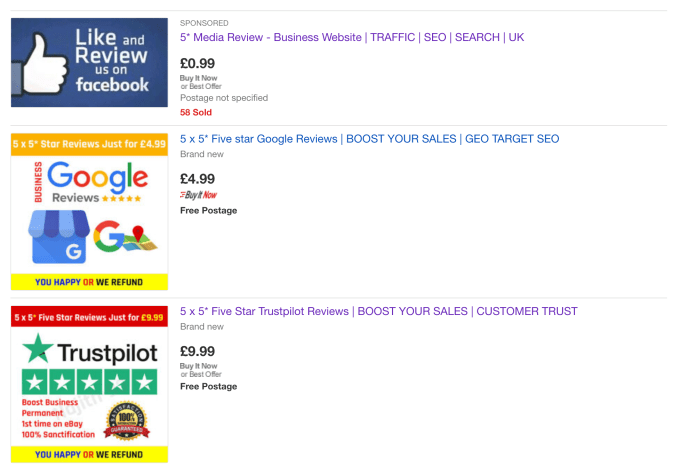
At the time of writing, a search of ebay.co.uk for “reviews” returned sellers offering five-star media reviews, five-star Google reviews and five-star Trustpilot reviews as the top three results — one of which was also a sponsored post:

Additional eBay listings included one offering “1/2/3/4/5 Star Freeindex Customer Service Review for business,” priced at £10 and sold by a U.K.-based seller who has been an eBay member since Feb 2011; one five-star review “on Google” that the seller touts with the line, “Boost your business and get new Customers” — at a cost of £2.69; one “100% positive FAST” review for £1; and five five-star reviews on Google priced at £15 — offered by a seller apparently based in Portugal who has been an eBay member since March 2014.

A search of U.K. Facebook groups returned multiple examples of closed groups where sellers appear to be soliciting reviews, either in exchange for goods and/or payment…


Reached for a response to the CMA’s call for measures to be put in place to tackle the illegal trade in fake reviews, Facebook sent us the following statement — attributed to a spokesperson:

Fraudulent activity is not allowed on Facebook, including the trading of fake reviews. We have removed 24 of the 26 groups and pages that the CMA reported to us yesterday and had already removed a number of them prior to the CMA flagging them to us. We know there is more to do which is why we’ve tripled the size of our safety and security team to 30,000 and continue to invest in technology to help proactively prevent abuse of our platform.

An eBay spokesperson also told us:

We have zero tolerance for fake or misleading reviews. We have informed the CMA that all of the sellers they identified have been suspended. The listings have been removed. Listings such as these are strictly against our policy on illegal activity and we will act where our rules are broken. We welcome the report from the CMA and will work closely with them in reviewing its findings.