YouTube lands on Fire TV and Amazon Prime Video arrives on Chromecast, Android TV

It’s nice when people can come together and work through their differences to make it easier to watch stuff. That’s exactly what happened today, when the long-standing detente between Google and Amazon over streaming video services came to an end, with YouTube arriving on Fire TV and Prime Video making its way to Chromecast and Android TV.

Amazon’s second-generation Fire TV Stick, their Fire TV Stick 4K, the Fire TV Cube, Fire TV Stick Basic Edition and Fire TV Edition smart TVs made by partner OEMs will all get support for the official YouTube app globally starting today, and Amazon intends to extend support to even more of its hardware in the future. YouTube TV and YouTube Kids will also come to Amazon Fire TV devices later this year.

On the Google side, both its own Chromecast devices, as well as partner TVs and hardware that support Chromecast built-in, or that run Android TV, will gain support broadly for Prime Video. Plus, any Chromecast Ultra owners will also get access to Prime Video’s 4,000-title library normally reserved for Prime members, at no additional cost, as part of the new tie-up between the two companies.

Prime has been available on some Android TV devices to date, but it’s expanding to a much broader selection of those smart TVs and streaming boxes from today.

This has been a long time coming — several years in fact, with the most recent spat between the two coming as a result of Amazon’s implementation of YouTube on the Echo Show. Then, in May, the companies announced they’d reached an agreement to put the feud behind them in the interest of consumers, which is what resulted in this cross-platform launch today.

Let the streams flow!

Cloosiv gives local coffee shops a mobile ordering experience on par with the mega chains

Starbucks’ mobile ordering app has proven wildly popular for the company, with reports indicating that it had more users than the likes of Apple Pay or Google Pay last year. The convenience is just too alluring. When you’re late for work and forgot to eat, being able to order up a drink and a sandwich with a tap or two and have it ready for pick up by the time you pass the store seems sort of like magic.

But how can smaller coffee shops compete? Building and maintaining an app of your own is a massive endeavor — and that’s before you start trying to convince customers to install yet another app.

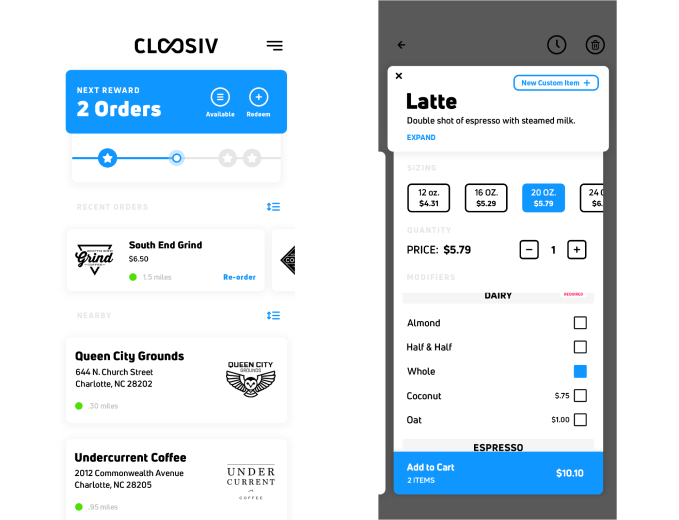
Cloosiv is aiming to take that simplified, tap-of-a-button mobile ordering approach and make it work for local coffee shops by bringing them all to one place. It highlights the nearby coffee shops that are part of the service, presents their menus and lets you tweak your drink to your liking before sending your order on its way. Tipping is handled through the app, and there’s a built-in rewards system to encourage people to keep coming back.

Cloosiv’s network of coffee shops isn’t huge yet; it’s up and running at just a couple of locations in San Francisco right now, and a quick glance at the in-app location map pins the nationwide total at a little shy of 200. The more that number grows, though, the more the concept makes sense. It becomes an everyone-versus-the-giant sort of thing.

cloosiv ordering

As with Starbucks’ mobile ordering app, Cloosiv encourages users to pre-load money into a built-in wallet — the idea being that pre-loading means fewer credit card charges, which cuts back on processing fees for everyone. Unlike the big competition, however, users can make a one-off purchase without pre-loading the funds. There’s a 40 cent fee tacked onto those charges to cover processing, but the option is there.

I gave the app a spin in San Francisco last week, and it worked exactly as promised. I found a coffee shop (Coffee Mission) near BART, punched in my order as the train approached, and my drink was waiting for me by the time I made it out of the station.

cloosiv merchant

Cloosiv’s Merchant app

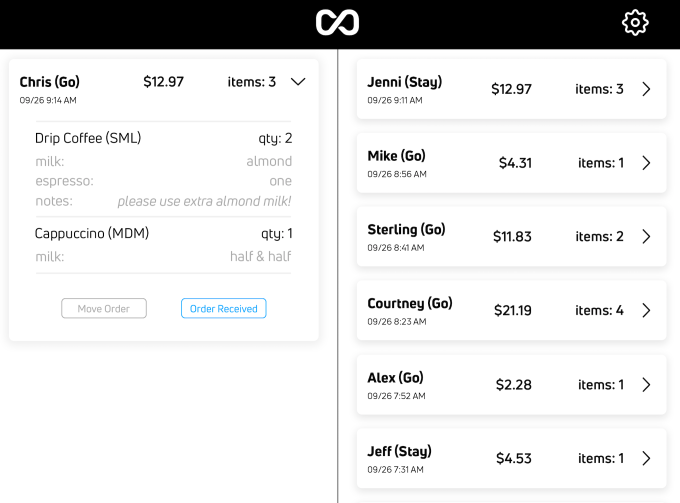
As many (most?) coffee shops already have a tablet on the counter acting as the point of sales terminal, Cloosiv is focusing on integrating into what’s already in place. When an order comes in today, a sound plays as a notification banner drops down from the top of the screen; when an employee taps the banner, they’re bumped over to Cloosiv’s Merchant app where they can acknowledge orders or mark them as complete.

The next step for the company is tying all of this directly into the merchant apps that coffee shops are already using — they’re focusing on Square first, with plans to tie into things like Clover and Micros.

Cloosiv charges vendors a percentage of each sale, with that percentage going down as the number of orders goes up. The first 50 orders each month, for example, are charged a 12% fee; after 150 orders, that fee drops to 8%.

Cloosiv founder Tim Griffin tells me they’ve processed more than 35,000 orders so far, making up over $250,000 in revenue for the coffee shops they work with. He estimates that orders and gross volume are both growing by about 40% monthly. The company recently closed a small round with investors, including Lachy Groom (previously head of Issuing at Stripe) and Laura Behrens Wu (CEO of Shippo), and is part of Y Combinator’s Summer 2019 class.

Bosch launches cloud-connected battery management to extend the life of EV batteries

Bosch is bringing to market a new cloud-connected software service to manage and monitor the battery life of electric vehicles.

“Bosch is connecting electric-vehicle batteries with the cloud. Its data-based services mean we can substantially improve batteries’ performance and extend their service life,” said Dr. Markus Heyn, member of the board of management of Robert Bosch GmbH, in a statement.

The new connectivity will enable companies to remotely monitor and manage battery status to reduce wear and tear on the batteries by up to 20%, according to Bosch .

By gathering real-time data from batteries on the speed at which they’re charging; the number of charge cycles they’ve undergone; stress from rapid acceleration and deceleration; and ambient temperature, Bosch can optimize recharging and prompt drivers with updates on how to extend their battery life, according to the company.

The first customer for this new cloud-connected service is the Chinese ride-hailing giant, DiDi, which will deploy a fleet of Bosch’s software-enabled electric vehicles in Xiamen.

The tools are not only prescriptive, but predictive, allowing fleet operators to determine when a battery might wear out and provide optimal information on when to replace aging batteries to ensure the best performance from a vehicle, Bosch said in a statement.

“Powerful batteries with long service live will make electromobility more viable,” said Heyn, in a statement.

Bosch sees three advantages in these insights. They’re able to reduce the aging of batteries, improve maintenance and repair times and, by managing the recharging process, can ensure that batteries don’t permanently lose performance and capacity.

Bunq lets you track and settle up group expenses

Fintech startup Bunq is announcing a handful of new features today, such as a way to track group expenses without creating a joint account, a web app and better Siri integration.

If you usually track vacation expenses and group expenses from your phone, chances are you’ve been using two different products — a mobile app like Splitwise to track group expenses with your friends, and a peer-to-peer payment app to settle up balances.

Bunq is essentially bundling these two features with Slice Groups for owners of the Bunq Travel Card. Given that the Bunq app already lists all your transactions, adding transactions to a group is easier than with your average group payment tracking app.

After adding other people to your Slice Group, each person can add expenses to the group. You get a list of your most recent Bunq transactions and you can add them to a group. You also can add manual transactions in case you paid for something using cash, for instance.

This is just a group accounting feature. When you add a transaction to a Slice Group, your money remains in your account. But you can see who has a positive balance and who has a negative balance.

When you settle up a group, people who owe money get a push notification. They can then tap on the notification and send money from their Bunq account to your friends’ Bunq accounts.

This feature will work particularly well for groups of people who all use the Bunq Travel Card. But it doesn’t fundamentally change how you manage your money with groups.

Bunq now has two tiers of users. Free users get a travel card with an account that they can top up. Paid users get a full-fledged bank account with banking information.

Multiple paid users can already create joint accounts with their roommates or partner. You can then associate your Bunq card with a joint account and spend money from that joint account directly.

So if you have a Bunq Travel Card, Slice Groups are for you. If you have a Bunq bank account, joint accounts are for you.

Revolut doesn’t try to reinvent the wheel, either, as you can only split individual card transactions with other users. It could take a while to settle all transactions after a long vacation. Revolut also lets you create Group Vaults. Those are sub-accounts to put some money aside and invite other people to contribute. But only the admin can withdraw and spend money from those vaults.

N26 has promised Shared Spaces so that you can create sub-accounts and share them with other people. But the feature isn’t live yet.

Lydia’s take on group expenses works more like Bunq’s joint accounts. You can create sub-accounts and share those accounts with other people. Everyone can then top up that account and attach a payment method, such as a payment card or a virtual card in Apple Pay or Google Pay. You also can move expenses from one sub-account to another. When you’re back from vacation, you can associate your card with your personal Lydia account again.

In addition to Slice Groups, Bunq is launching a web interface to access your bank account. It works a bit like WhatsApp’s web app. You scan a QR code with your phone and you can then control the mobile app from a desktop web browser.

Bunq should also work better with Siri. You can now send money using your voice or change card settings. Finally, the startup has also made improvements to its business accounts with a few new features. For instance, you can now automatically put money aside to pay back VAT later down the road.

bunq update 11

Spoiler warning! This neural network spots dangerous reviews before you read them

It’s hard to avoid spoilers on the internet these days — even if you’re careful, a random tweet or recommended news item could lay to waste your plan to watch that season finale a day late or catch a movie after the crowds have subsided. But soon an AI agent may do the spoiler-spotting for you, and flag spoilerific reviews and content before you even have a chance to look.

SpoilerNet is the creation of a team at UC San Diego, composed perhaps of people who tried waiting a week to see Infinity War and got snapped for their troubles. Never again!

They assembled a database of more than a million reviews from Amazon-owned reading community Goodreads, where it is the convention to note spoilers in any reviews, essentially line by line. As a user of the site I’m thankful for this capability, and the researchers were too — because nowhere else is there a corpus of written reviews in which whatever constitutes a “spoiler” has been meticulously labeled by a conscientious community.

(Well, sort of conscientious. As the researchers note: “we observe that in reality only a few users utilize this feature.”)

At any rate, such labeled data is these days basically food for what are generally referred to as AI systems: neural networks of various types that “learn” the qualities that define a specific image, object, or in this case spoilers. The team fed the 1.3 million Goodreads reviews into the system, letting it observe and record the differences between ordinary sentences and ones with spoilers in them.

Perhaps writers of reviews tend to begin sentences with plot details in a certain way — “Later it is revealed…” — or maybe spoilery sentences tend to lack evaluative words like “great” or “complex.” Who knows? Only the network.

Once its training was complete, the agent was set loose on a separate set of sentences (from both Goodreads and mind-boggling timesink TV Tropes), which it was able to label as “spoiler” or “non-spoiler” with up to 92 percent accuracy. Earlier attempts to computationally predict whether a sentence has spoilers in it haven’t fare so well; one paper by Chiang et al. last year broke new ground, but is limited by its dataset and approach, which allow it to consider only the sentence in front of it.

“We also model the dependency and coherence among sentences within the same review document, so that the high-level semantics can be incorporated,” lead author of the SpoilerNet paper, Mengting Wan, told TechCrunch in an email. This allows for a more complete understanding of a paragraph or review, though of course it is also necessarily a more complex problem.

But the more complex model is a natural result from richer data, he wrote:

Such a model design indeed benefits from the new large-scale review dataset we collected for this work, which includes complete review documents, sentence-level spoiler tags, and other meta-data. To our knowledge, the public dataset (released in 2013) before this work only involves a few thousand single-sentence comments rather than complete review documents. For research communities, such a dataset also facilitates the possibility of analyzing real-world review spoilers in details as well as developing modern ‘data-hungry’ deep learning models in this domain.

This approach is still new, and the more complex approach has its drawbacks. For instance, the model occasionally mistakes a sentence as having spoilers if other spoiler-ish sentence are adjacent; and its understanding of individual sentences is not quite good enough to understand when certain words really indicate spoilers or not. You and I know that “this kills Darth Vader” is a spoiler, while “this kills the suspense” isn’t, but a computer model may have trouble telling the difference.

Wan told me that the system should be able to run in real time on a user’s computer, though of course training it would be a much bigger job. That opens up the possibility of a browser plugin or app that reads reviews ahead of you and hides anything it deems risky. Though Amazon is indirectly associated with the research (co-author Rishabh Misra works there) Wan said there was no plan as yet to commercialize or otherwise apply the tech.

No doubt it would be a useful tool for Amazon and its subsidiaries and sub-businesses to be able to automatically mark spoilers in reviews and other content. But until the new model is implemented (and really until it is a bit better) we’ll have to stick to the old-fashioned method of avoiding all contact with the world until we’ve seen the movie or show in question.

The team from UCSD will be presenting their work at the Association for Computational Linguistics conference in Italy later this month; you can read the full paper here — but beware of spoilers. Seriously.

AT&T’s new streaming service HBO Max arrives in 2020, will be the exclusive home of ‘Friends’

AT&T’s acquisition of HBO goes beyond just offering premium TV programming — the company revealed on Tuesday that it’s going to call its new WarnerMedia streaming service HBO Max, and that this will launch next spring, with more than 10,000 hours of content available to subscribers.

It’ll have Friends, dear readers, which is all that matters in the modern streaming wars, where, weirdly, services compete for dominion over a couple of decade-plus-old TV shows, including The Office and this highly unrelatable 90s NBC sitcom.

HBO Max won’t offer exclusively HBO content, as you can probably tell by the availability of Friends, but The Wall Street Journal reports that the naming is meant to indicate how important HBO as a TV brand is to consumers. In other words, they’re going to make the most of that purchase, even if it dilutes the actual HBO brand in the process. It’s beginning to become much more clear why HBO CEO Richard Plepler resigned in February.

The new service enters a teeming field of competitors, including Amazon Prime Video, Hulu, Netflix and many more I can’t even remember off the top of my head. It’s also not launching until after Apple puts live its own Apple TV+ service, and Disney+ comes online in November and, per the WSJ, it’ll cost “slightly more” than HBO’s currently $14.99 per month pricing for Go alone.

AT&T is spending on content, however, including the high purchase price for Friends’ rights, as well as development deals with a number of top talents from the film and television industry, including Reese Witherspoon, Greg Berlanti and more. Future CW shows will also reside on HBO Max instead of on Netflix, which is bad news for my habit of bingeing subpar DC superhero TV, including Arrow and The Flash.

IBM closes Red Hat acquisition for $34 billion

We’ve known it was coming since late last year, but now it’s final: IBM has wrapped up its $34 billion acquisition of Red Hat, completing what is one of the largest tech acquisitions of all time.

IBM originally announced its intent to acquire the Linux developer in October of last year. The U.S. Department of Justice gave its stamp of approval in May, and the last big potential roadblock was removed when the EU gave its unconditional approval at the end of June.

IBM says that Red Hat will stay under the watch of CEO Jim Whitehurst, with Whitehurst joining IBM’s senior management and reporting directly to IBM CEO Ginni Rometty.

Production of the Volkswagen Beetle officially comes to an end

The Volkswagen Beetle is taking a bow, after its return and restyle in 2011 (and earlier rebirth in 1997 — the one with the built-in flower vase). The last of the most recent generation of Beetles has already come off the production line, and will be put on display at the Volkswagen museum in Puebla near the plant that produced it.

Volkswagen’s 2011 Beetle redesign did away with much of the hippy throw-back appeal of the 1998 model year New Beetle, though it kept many of its curves and vaguely bug-like look that earned it its name to begin with. The U.S. run of the original Beetle ended in 1979, so it was nearly 20 years before it got its second life — and it’s been 21 years now that both revised versions have been on sale.

Last year, VW announced its intent to end production of the car in 2019, so it’s not catching anyone by surprise. As for whether a resurrection is in the cards down the road, the jury’s still out — VW didn’t rule out the possibility when it announced the end of the line, but it also didn’t commit to anything. Meanwhile, the automaker is refocusing many of its efforts to its new electric vehicle platform, which will provide the basis for its I.D. line of vehicles.

Today’s been a day for oddball things that nevertheless had ardent fans coming to an end. Bye bye, little Beetle.

After selling Auris for $3.4 billion to J&J, CEO Frederic Moll and lead investor Ajay Royan come to Disrupt

Frederic Moll has to be one of the most successful inventors and entrepreneurs who is not yet a household name.

Moll’s successes include the 22-year-old, publicly traded Intuitive Surgical, a robotic surgical systems manufacturer now worth around $61.4 billion, and Hansen Medical, a company that developed tools to manipulate catheters.

Most recently, the serial medical device entrepreneur sold Auris, a manufacturer of advanced surgical robots that was sold earlier this year to Johnson & Johnson in a $3.4 billion deal that also holds the possibility of an additional $2.35 billion in payouts.

More significant than the money, though, are the changes that technologies like Auris presage for the medical profession.

“With Auris, we realized there aren’t going to be enough surgeons to address the needs of the additional 5 billion people who are going to be on earth, and everyone deserves equally good healthcare, and you’ve got to find a way to deliver that with technology. So, what is the equivalent of cell phones for surgery?” said Ajay Royan, the co-founder of Mithril Capital and an investor in the company, in an interview with Fortune earlier this year. “It sounds crazy, but what is the iPhone of surgery, where you can deliver an insanely sophisticated platform but be able to operate it in a very intuitive and simple fashion? That was the thesis behind Auris; it was not an instrument that we were funding, we were funding a platform and a way of training people in surgery.”

Royan, who co-founded Mithril Capital with Peter Thiel back in 2014, saw in Auris a startup that epitomized his firm’s approach to investments. It led Mithril to back the company and paved the way for what looks like a $700 million windfall for the fund.

Mithril closed its second fund with $850 million roughly two years ago and has been methodically investing in a wide range of companies that include the intelligence data mining company Palantir, along with big swings in robotics companies around the world.

Mithril invested $140 million into a Singapore and Gurugram-based startup, GreyOrange, and the Miami-based dental surgical robotics company, Neocis.

Expect to hear updates on investment in robotics, disruptions in the medical device world and much, much more at Disrupt SF in October when these two titans take the stage.

Disrupt SF runs October 2 – October 4 at the Moscone Center in San Francisco. Tickets are available here.

Daily Crunch: Instagram fights bullying

The Daily Crunch is TechCrunch’s roundup of our biggest and most important stories. If you’d like to get this delivered to your inbox every day at around 9am Pacific, you can subscribe here.

1. New Instagram features flag potentially offensive comments, allow you to quietly ‘restrict’ users

Instagram seems to be trying to find ways to limit bad behavior without outright blocking posts or banning users.

The first feature is supposed to use artificial intelligence to flag comments that “may be considered offensive,” then gives those users the option to “undo” their comments before posting. The second addition is the ability to “restrict” users looking at your account — which is less obvious than outright blocking someone.

2. Apple stops selling the 12-inch MacBook, a computer you either loved or were confused by

Apple officially stopped selling the 12-inch MacBook today, a computer that hasn’t had an update since June 2017 and that is also maybe one of the most contentious Macs in Apple’s lineup.

3. The sinkhole that saved the internet

An in-depth look at the “kill switch” preventing future WannaCry outbreaks.

closeup of landline telephone

4. FCC proposal would let it punish international robocallers

While the FCC and Congress hammer out new rules to (hopefully) banish robocalls forever, there are some short-term solutions that can help in the meantime — and one may arrive in just a few weeks.

5. Spotify Lite for Android gets an official launch in 36 countries

The app is designed to work on patchy or weak internet connections and, at just 10MB, it is small enough to cater to lower-end devices that have limited storage or older phones.

6. A vulnerability in Zoom’s Mac client could allow websites to turn on cameras without permission

In a Medium post, security researcher Jason Leitschuh detailed the vulnerability, writing that it may remain an issue even if users have uninstalled the Mac client.

7. Meituan, Alibaba and the new landscape of ride-hailing in China

The government is tightening rules around vehicle and driver accreditation, leading to a widescale driver shortage. Meanwhile, established carmakers, including BMW and state-owned Shouqi, are entering the fray. (Extra Crunch membership required.)

Amazon seeks FCC approval to launch over three thousand broadband satellites

Amazon previously revealed its Project Kuiper plan to establish a constellation of broadband internet satellites in low-Earth orbit, but now we know a bit more about the specifics of its plan thanks to an FCC filing first reported by GeekWire. The filing seeks permission from the U.S. communications regulator to launch a total of 3,236 communications satellites to provide the backbone of its network.

The satellite network will offer more reliable access and broadband-speed connectivity to many of the existing 3.8 billion people globally, and 21.3 million Americans that don’t currently enjoy any access to ground-based broadband, Amazon claims in the new filing. In addition to underserved consumers in rural areas, Amazon will also use the network to offer “mobile broadband connectivity services for aircraft, maritime vessels and land vehicles,” the filing also notes.

Others are attempting to serve the same need in the same way, including SpaceX, which is looking to launch a network of nearly 12,000 broadband satellites for its Starlink network. Starlink satellites are already in orbit, including 57, once you take out the three with which SpaceX lost contact post-launch.

There’s already been considerable blow-back against SpaceX because of the impact its satellites are having on astronomers’ views of the night sky, and many in space research and industrial development are concerned about debris and crowding in the low-Earth orbit area in which satellites providing broadband connectivity will operate.

The Raspberry Pi 4 doesn’t work with all USB-C cables

The Raspberry Pi 4 is a great little beast, but Tyler Ward identified a flaw in the USB Type-C connector. The Raspberry Pi Foundation confirmed to TechRepublic that the design flaw is real, and that your Raspberry Pi 4 might not work with all USB-C cables.

It’s not really a dealbreaker, but you can expect a future board revision with a proper implementation of the USB-C protocol. But if you find yourself scratching your head and you don’t understand why your Raspberry Pi is not powering up, now you know why.

The Raspberry Pi Foundation has released the schematics of the board. And there’s a missing CC resistor that let sophisticated chargers negotiate current with the device.

Given that USB-C is a complicated connector, some cables are electronically marked, which means that they have an integrated chip to support a wide range of devices.

For instance, you can use a MacBook Pro charger with plenty of USB-C devices. The charger just figures out how much power it needs to deliver.

But the Raspberry Pi 4 doesn’t support electronically marked cables, such as Apple’s USB-C cables or Google’s Pixel 3 cables. The device is incorrectly identified as an audio adapter accessory.

Fortunately, it doesn’t damage the Raspberry Pi 4 and it doesn’t create any fire hazard. The device just doesn’t power up.

"I expect this will be fixed in a future board revision, but for now users will need to apply one of the suggested workarounds. It's surprising this didn't show up in our (quite extensive) field testing program,” Raspberry Pi Foundation founder Eben Upton told TechRepublic.

A simple workaround is to buy a non e-marked cable or charger. The Raspberry Pi Foundation is selling an $8 USB-C charger for instance. In my testing, it has been working fine for the past couple of weeks.