As FTC cracks down, data ethics is now a strategic business weapon

Daniel Wu
Contributor

Dan Wu is a privacy counsel and legal engineer at Immuta. He holds a JD from Harvard University, and is a PhD candidate for Social Policy and Sociology at The Harvard Kennedy School.

Five billion dollars. That’s the apparent size of Facebook’s latest fine for violating data privacy. 

While many believe the sum is simply a slap on the wrist for a behemoth like Facebook, it’s still the largest amount the Federal Trade Commission has ever levied on a technology company. 

Facebook is clearly still reeling from Cambridge Analytica, after which trust in the company dropped 51%, searches for “delete Facebook” reached 5-year highs, and Facebook’s stock dropped 20%.

While incumbents like Facebook are struggling with their data, startups in highly-regulated, “Third Wave” industries can take advantage by using a data strategy one would least expect: ethics. Beyond complying with regulations, startups that embrace ethics look out for their customers’ best interests, cultivate long-term trust — and avoid billion dollar fines. 

To weave ethics into the very fabric of their business strategies and tech systems, startups should adopt “agile” data governance systems. Often combining law and technology, these systems will become a key weapon of data-centric Third Wave startups to beat incumbents in their field. 

Established, highly-regulated incumbents often use slow and unsystematic data compliance workflows, operated manually by armies of lawyers and technology personnel. Agile data governance systems, in contrast, simplify both these workflows and the use of cutting-edge privacy tools, allowing resource-poor startups both to protect their customers better and to improve their services.

In fact, 47% of customers are willing to switch to startups that protect their sensitive data better. Yet 80% of customers highly value more convenience and better service. 

By using agile data governance, startups can balance protection and improvement. Ultimately, they gain a strategic advantage by obtaining more data, cultivating more loyalty, and being more resilient to inevitable data mishaps. 

Agile data governance helps startups obtain more data — and create more value 

With agile data governance, startups can address their critical weakness: data scarcity. Customers share more data with startups that make data collection a feature, not a burdensome part of the user experience. Agile data governance systems simplify compliance with this data practice. 

Take Ally Bank, which the Ponemon Institute rated as one of the most privacy-protecting banks. In 2017, Ally’s deposits base grew 16%, while those of incumbents declined 4%.

One key principle to its ethical data strategy: minimizing data collection and use. Ally’s customers obtain services through a personalized website, rarely filling out long surveys. When data is requested, it’s done in small doses on the site — and always results in immediate value, such as viewing transactions. 

This is on purpose. Ally’s Chief Marketing Officer publicly calls the industry-mantra of “more data” dangerous to brands and consumers alike.

A critical tool to minimize data use is to use advanced data privacy tools like differential privacy. A favorite of organizations like Apple, differential privacy limits your data analysts’ access to summaries of data, such as averages. And by injecting noise into those summaries, differential privacy creates provable guarantees of privacy and prevents scenarios where malicious parties can reverse-engineer sensitive data. But because differential privacy uses summaries, instead of completely masking the data, companies can still draw meaning from it and improve their services. 

With tools like differential privacy, organizations move beyond governance patterns where data analysts either gain unrestricted access to sensitive data (think: Uber’s controversial “god view”) or face multiple barriers to data access. Instead, startups can use differential privacy to share and pool data safely, helping them overcome data scarcity. The most agile data governance systems allow startups to use differential privacy without code and the large engineering teams that only incumbents can afford.

Ultimately, better data means better predictions — and happier customers.

Agile data governance cultivates customer loyalty

According to Deloitte, 80% of consumers are more loyal to companies they believe protect their data. Yet far fewer leaders at established, incumbent companies — the respondents of the same survey — believed this to be true. Customers care more about their data than the leaders at incumbent companies think. 

This knowledge gap is an opportunity for startups. 

Furthermore, big enterprise companies — themselves customers of many startups — say data compliance risks prevent them from working with startups. And rightly so. Over 80% of data incidents are actually caused by errors from insiders, like third party vendors who mishandle sensitive data by sharing it with inappropriate parties. Yet over 68% of companies do not have good systems to prevent these types of errors. In fact, Facebook’s Cambridge Analytica firestorm — and resulting $5 billion fine — was sparked by third party inappropriately sharing personal data with a political consulting firm without user consent. 

As a result, many companies — both startups and incumbents — are holding a ticking time bomb of customer attrition. 

Agile data governance defuses these risks by simplifying the ethical data practices of understanding, controlling, and monitoring data at all times. With such practices, startups can prevent and correct the mishandling of sensitive data quickly.

Cognoa is a good example of a Third Wave healthcare startup adopting these three practices at a rapid pace. First, it understands where all of its sensitive health data lies by connecting all of its databases. Second, Cognoa can control all connected data sources at once from one point by using a single access-and-control layer, as opposed to relying on data silos. When this happens, employees and third parties can only access and share the sensitive data sources they’re supposed to. Finally, data queries are always monitored, allowing Cognoa to produce audit reports frequently and catch problems before they escalate out of control. 

With tools that simplify these three practices, even low-resourced startups can make sure sensitive data is tightly controlled at all times to prevent data incidents. Because key workflows are simplified, these same startups can maintain the speed of their data analytics by sharing data safely with the right parties. With better and safer data sharing across functions, startups can develop the insight necessary to cultivate a loyal fan base for the long-term.

Agile data governance can help startups survive inevitable data incidents

In 2018, Panera mistakenly shared 37 million customer records on its website and took 8 months to respond. Panera’s data incident is a taste of what’s to come: Gartner predicts that 50% of business ethics violations will stem from data incidents like these. In the era of “Big Data,” billion dollar incumbents without agile data governance will likely continue to violate data ethics. 

Given the inevitability of such incidents, startups that adopt agile data governance will likely be the most resilient companies of the future. 

Case in point: Harvard Business Review reports that the stock prices of companies without strong data governance practices drop 150% more than companies that do adopt strong practices. Despite this difference, only 10% of Fortune 500 companies actually employ the data transparency principle identified in the report. Practices include clearly disclosing data practices and giving users control over their privacy settings. 

Sure, data incidents are becoming more common. But that doesn’t mean startups don’t suffer from them. In fact, up to 60% of startups fold after a cyber attack. 

Startups can learn from WebMD, which Deloitte named as one standout in applying data transparency. With a readable privacy policy, customers know how data will be used, helping customers feel comfortable about sharing their data. More informed about the company’s practices, customers are surprised less by incidents. Surprises, BCG found, can reduce consumer spending by one-third. On a self-service platform on WebMD’s site, customers can control their privacy settings and how to share their data, further cultivating trust. 

Self-service tools like WebMD’s are part of agile data governance. These tools allow startups to simplify manual processes, like responding to customer requests to control their data. Instead, startups can focus on safely delivering value to their customers. 

Get ahead of the curve

For so long, the public seemed to care less about their data. 

That’s changing. Senior executives at major companies have been publicly interrogated for not taking data governance seriously. Some, like Facebook and Apple, are even claiming to lead with privacy. Ultimately, data privacy risks significantly rise in Third Wave industries where errors can alter access to key basic needs, such as healthcare, housing, and transportation.

While many incumbents have well-resourced legal and compliance departments, agile data governance goes beyond the “risk mitigation” missions of those functions. Agile governance means that time-consuming and error-prone workflows are streamlined so that companies serve their customers more quickly and safely.

Case in point: even after being advised by an army of lawyers, Zuckerberg’s 30,000-word Senate testimony about Cambridge Analytica included “ethics” only once, and it excluded “data governance” completely.

And even if companies do have legal departments, most don’t make their commitment to governance clear. Less than 15% of consumers say they know which companies protect their data the best. Startups can take advantage of this knowledge gap by adopting agile data governance and educate their customers about how to protect themselves in the risky world of the Third Wave.

Some incumbents may always be safe. But those in highly-regulated Third Wave industries, such as automotive, healthcare, and telecom should be worried; customers trust these incumbents the least. Startups that adopt agile data governance, however, will be trusted the most, and the time to act is now. 

Archinaut snags $73 million in NASA funding to 3D-print giant spacecraft parts in orbit

A project to 3D-print bulky components in space rather than bring them up there has collected a $73.7 million contract from NASA to demonstrate the technique in space. Archinaut, a mission now several years in development from Made In Space, could launch as soon as 2022.

The problem at hand is this: If you want a spacecraft to have solar arrays 60 feet long, you need to bring 60 feet of structure for those arrays to attach to — they can’t just flap around like ribbons. But where do you stash a 60-foot pole, or two 30-foot ones, or even 10 six-foot ones when you only have a few cubic feet of space to put them in? It gets real complicated real fast to take items with even a single large dimension into space.

Archinaut’s solution is simple. Why not just take the material for that long component into space and print it out on the spot? There’s no more compact way to keep the material than as a brick of solid matter.

Naturally this extends (so to speak) to more than simply rods and poles — sheets of large materials for things like light sails, complex interlocking structures on which other components could be mounted… there are plenty of things too big to take into space in one piece, but which could be made of smaller ones if necessary. Here’s one made for attaching instruments at a large fixed distance from a central craft:

optimast3Made in Space already has contracts in place with NASA, and has demonstrated 3D printing of parts aboard the International Space Station. It has also shown that it can print stuff in an artificial vacuum more or less equivalent to a space environment.

The demonstrator mission, Archinaut One, would launch aboard a Rocket Lab Electron launch vehicle no earlier than 2022, and after achieving a stable orbit, begin extruding a pair of beams that will eventually extend out 32 feet. Attached to these beams will be flexible solar arrays that unfurl at the same rate, attached to the rigid structures of the beams. When they’re finished, a robotic arm will lock them in place and do other housekeeping.

You can see it all happen in this unfortunately not particularly exciting video:

Once finished, this pair of 32-foot solar arrays would theoretically generate some five times the power that a spacecraft that size would normally pull in. Because spacecraft are almost without exception power-starved systems, having more watts to use or store for the orbital equivalent of a rainy day would certainly be welcome.

In another print, the robot arm could rearrange parts, snap on connectors and perform other tasks to create more complex structures like the ones in the concept art up top. That’s still well in the future, however — the current demonstrator mission will focus on the beam-and-array thing, though the team will certainly learn a lot about how to accomplish other builds in the process.

Naturally in-space manufacturing is a big concern for a country that plans to establish a permanent presence on and around the Moon. It’s a lot easier to make something there than make a quarter-million-mile delivery. You can keep up with Archinaut and Made In Space’s other projects along the space-printing line at the company’s blog.

These robo-ants can work together in swarms to navigate tricky terrain

While the agility of a Spot or Atlas robot is something to behold, there’s a special merit reserved for tiny, simple robots that work not as a versatile individual but as an adaptable group. These “tribots” are built on the model of ants, and like them can work together to overcome obstacles with teamwork.

Developed by EPFL and Osaka University, tribots are tiny, light and simple, moving more like inchworms than ants, but able to fling themselves up and forward if necessary. The bots themselves and the system they make up are modeled on trap-jaw ants, which alternate between crawling and jumping, and work (as do most other ants) in fluid roles like explorer, worker and leader. Each robot is not itself very intelligent, but they are controlled as a collective that deploys their abilities intelligently.

In this case a team of tribots might be expected to get from one end of a piece of complex terrain to another. An explorer could move ahead, sensing obstacles and relaying their locations and dimensions to the rest of the team. The leader can then assign worker units to head over to try to push the obstacles out of the way. If that doesn’t work, an explorer can try hopping over it — and if successful, it can relay its telemetry to the others so they can do the same thing.

fly tribot fly

Fly, tribot, fly!

It’s all done quite slowly at this point — you’ll notice that in the video, much of the action is happening at 16x speed. But rapidity isn’t the idea here; similar to Squishy Robotics’ creations, it’s more about adaptability and simplicity of deployment.

The little bots weigh only 10 grams each, and are easily mass-produced, as they’re basically PCBs with some mechanical bits and grip points attached — “a quasi-two-dimensional metamaterial sandwich,” according to the paper. If they only cost (say) a buck each, you could drop dozens or hundreds on a target area and over an hour or two they could characterize it, take measurements and look for radiation or heat hot spots, and so on.

If they moved a little faster, the same logic and a modified design could let a set of robots emerge in a kitchen or dining room to find and collect crumbs or scoot plates into place. (Ray Bradbury called them “electric mice” or something in “There will come soft rains,” one of my favorite stories of his. I’m always on the lookout for them.)

Swarm-based bots have the advantage of not failing catastrophically when something goes wrong — when a robot fails, the collective persists, and it can be replaced as easily as a part.

“Since they can be manufactured and deployed in large numbers, having some ‘casualties’ would not affect the success of the mission,” noted EPFL’s Jamie Paik, who co-designed the robots. “With their unique collective intelligence, our tiny robots can demonstrate better adaptability to unknown environments; therefore, for certain missions, they would outperform larger, more powerful robots.”

It raises the question, in fact, of whether the sub-robots themselves constitute a sort of uber-robot? (This is more of a philosophical question, raised first in the case of the Constructicons and Devastator. Transformers was ahead of its time in many ways.)

The robots are still in prototype form, but even as they are, constitute a major advance over other “collective” type robot systems. The team documents their advances in a paper published in the journal Nature.

Facebook reportedly gets a $5 billion slap on the wrist from the FTC

The U.S. Federal Trade Commission has reportedly agreed to end its latest probe into Facebook‘s privacy problems with a $5 billion payout.

According to The Wall Street Journal, the 3-2, party-line vote by FTC commissioners was carried by the Republican majority and will be moved to the Justice Department’s civil division to be finalized.

A $5 billion payout seems like a significant sum, but Facebook had already set aside $3 billion to cover the cost of the settlement and the company could likely make up the figure in less than a quarter of revenue (the company’s revenue for the last fiscal quarter was roughly $15 billion). Indeed, Facebook said in April that it expected to pay up to $5 billion to end the government’s probe.

The settlement will also include government restrictions on how Facebook treats user privacy, according to the Journal.

We have reached out to the FTC and Facebook for comment and will update this story when we hear back.

Ultimately, the partisan divide which held up the settlement broke down with Republican members of the commission overriding Democratic concerns for greater oversight of the social media giant.

Lawmakers have been calling consistently for greater regulatory oversight of Facebook — and even a legislative push to break up the company — since the revelation of the company’s mishandling of the private data of millions of Facebook users during the run up to the 2016 presidential election, which wound up being collected improperly by Cambridge Analytica.

Specifically the FTC was examining whether the data breach violated a 2012 consent decree which saw Facebook committing to engage in better privacy protection of user data.

Facebook’s woes didn’t end with Cambridge Analytica . The company has since been on the receiving end of a number of exposes around the use and abuse of its customers’ information and comes as calls to break up the big tech companies have only grown louder.

The settlement could also be a way for the company to buy its way out of more strict oversight as it faces investigations into its potentially anti-competitive business practices and inquiries into its launch of a new cryptocurrency — Libra — which is being touted as an electronic currency for Facebook users largely divorced from governmental monetary policy.

Potential sanctions proposed by lawmakers for the FTC were reported to include the possibility of elevating privacy oversight to the company’s board of directors and potentially the deletion of tracking data; restricting certain information collection; limiting ad targeting; and restricting the flow of user data among different Facebook business units.

Minimum investment for EB-5 investor green card expected to more than double

While not a startup visa, the EB-5 investor green card offers many entrepreneurs a path to a green card by investing money and creating jobs in the U.S. Under the EB-5 program, an entrepreneur’s family is also eligible for green cards.

Imminent regulatory changes to the EB-5 program are expected to make obtaining an EB-5 green card a whole lot more expensive. The minimum investment is anticipated to more than double to $1.35 million from the current $500,000. And with individuals from India expected to face a backlog for EB-5 green cards shortly, the opportunity to obtain an EB-5 green card at a relatively low cost and in a timely manner is closing.

With so much late-stage money available, why are tech companies going public now?

Ajay Chopra
Contributor

Ajay Chopra co-founded Pinnacle Systems in his living room and grew it to a multi-billion dollar public company before becoming a venture capitalist with Trinity Ventures.

Ringing the Nasdaq market bell was the thrill of a lifetime — both when I did it as a founder and also vicariously as a VC via my incredible founders who have taken their companies public. There’s nothing like seeing the baby you nurtured mature into a multibillion-dollar public entity.

But times have changed. The dramatic influx of late-stage venture capital is enabling companies to slow walk their public offerings. In addition, the accumulation of mountains of cash by strategic buyers and the rise of private equity buy-out firms are making other forms of exits viable options.

Case in point: The number of publicly listed companies has dropped 52%, but entrepreneurship momentum hasn’t slowed; it has actually accelerated. Many of the companies that are finally going public this year are doing so several years after they could have — and would have — in years past. When Uber went public this year, its valuation was so large that it would have registered as 280 on this year’s Fortune 500 list. TransferWise prolonged any move to the public markets through a secondary sale that allowed them to stay private while more than doubling their valuation.

IPOs aren’t for everyone or every company — or indeed for most companies. According to PitchBook, only 3% of venture-backed companies in the last decade eventually went public. Most startups that don’t go public never had the option to do so. However, some founders who could IPO are actively choosing to delay IPOs due to the many challenges of managing a public company.

What’s best for one company isn’t necessarily what’s best for another.

For starters, employee moods shift with the stock price. I once had an employee mad at me for not telling him to sell when I knew we were going to have a weak quarter. That would have been illegal! Also, IPOs come with a burden of public scrutiny; the administrative hassles take up precious time, and 90-day reporting cycles often conflict with long-term strategic planning. In addition, many public investors are only interested in short-term moves; plus, there’s the related risk of activist investors upending the company’s long-term strategy in pursuit of their own short-term goals.

Despite the challenges, going public is still important for many high-growth companies. Here’s why:

  • IPOs make it easier to compete for talent. Public stock offers clearly valued, tangible cash value to candidates and employees who are either weighing competitive offers or who need to be retained. While private companies can provide one-off private liquidity events via secondary sales, public companies have a far greater ability to engage and retain valued team members though the continuous, orderly disbursement of stock-based compensation.
  • IPOs can facilitate a company’s ability to make acquisitions, as well as facilitate strategic partnerships. After going public, my company used its public equity to make 16 acquisitions, which in part helped to fuel our growth from a few hundred million to a multibillion-dollar valuation. Even though private companies can make acquisitions with stock, it’s far easier to do a deal with tradable public currency. It’s also easier to enter into important strategic partnerships because prospective partners have easily accessible information about the company’s business and financial position.
  • IPOs are a big milestone and mark of achievement for the entire team. IPOs boost employee morale and job satisfaction. Employees who help shepherd their company from its early stages through IPO feel accomplishment and camaraderie, and achieving this milestone contributes measurably to corporate culture. They are not bad for employees’ and founders’ pocketbooks, either!
  • Operating under the watchful eye of Wall Street is cumbersome but makes a company resilient. As complicated as it is to manage a public company, public scrutiny often makes companies more disciplined on execution, which helps them build more predictable businesses. This discipline and transparency can drive long-term success — which in turn accrues to the benefit of its customers, partners, stockholders and employees.
  • The tech IPO window is open right now. Stock markets track the boom and bust cycles of the economy. The so-called “IPO window” for tech stocks can close as surely as it’s open right now. Many companies are planning to “get out” while this window is open. IPO windows can sometimes close for several years, so floating your stock when the window is open is an important consideration. In addition, due to the decline in number of publicly listed companies over the last decade, there is a pent-up demand for fast-growing tech IPOs, as demonstrated by the positive reception that Beyond Meat, CrowdStrike and Zoom received from public investors.

For those founders with their eye on the IPO ball, here’s my advice:

  • Raise plenty of money. Right now, VC dollars are plentiful, and the cost of capital is cheap. However, if you have access to plentiful capital, so do your worthy competitors; you don’t want be disadvantaged relative to them. Use this capital wisely and keep some in reserve just in case the markets turn. My company had to abort its IPO just days before we embarked on our IPO “road show” when the markets turned. We had to survive on the cash we had in the bank for a full two years before we successfully went public.
  • Consider vertical integration. A lot of the businesses going public today or on track to do so in the next few years have adopted business models that encompass every element of the user experience and allow companies to capture a large share of the value stack. We’re especially seeing this in capital-intensive verticals like Katerra in construction and Opendoor in housing (each valued at about $4 billion). We Company (WeWork), expected to IPO this year at a rumored $47 billion valuation, has vertically integrated every element of physical workspaces. Extraordinarily capital intensive, this type of vertical integration creates tremendous value and deep competitive moats. Importantly, these businesses only can be built in environments such as now, where plenty of capital is available with reasonable dilution.
  • Consider broadening your product capabilities. With plenty of cash on hand and your company sitting at a nice revenue multiple, it may be wise to consider broadening your offering while you are still private; both via investment in internal development resources and by acquiring companies with complementary products but less significant market traction. This is particularly relevant for enterprise companies where the cost of customer acquisition is high. With a broader product offering, you can sell more to existing customers, amortizing your acquisition costs and hopefully improving retention with a more complete product offering.
  • Scale as quickly as possible. Because capital is available so cheaply, the IPO-bound companies that win have become the companies that grow quickly, leveraging capital to capture market share faster than their competitors. Uber and WeWork are examples of companies that have used access to capital to scale so quickly that they’ve been able to capture market share from their numerous less-endowed competitors.
  • Review the capabilities of your team and your board for public market scrutiny. Unlike some people who believe that the company needs to bring in an “IPO team” to go public, my experience is that most founders and senior managers are perfectly capable of growing into the public market executive role. They just need to be aware of the rules and regulations, and they need to be advised to use proper judgement. Even so, you may find that you need to “beef up” your team in a few areas such as finance and bring in seasoned executives in other areas such as investor relations. The right board structure for a public company is equally important. Adding board talent with public company experience — particularly in audit oversight and governance areas — is highly recommended.

Every company charts its own path to success, so what’s best for one company isn’t necessarily what’s best for another. I personally wouldn’t trade my experience of going public for the world, and I believe that the talented founders taking their companies public this year feel the same way. What’s great about today’s market environment is that going public — or not — is a choice that lies squarely where it should: in the hands of founders.

Bird has ‘positive unit economics’ with its custom scooter model, CEO says

Bird has positive unit economics, CEO Travis VanderZanden said Friday in a fiery response to a report from The Information that the scooter startup was seeking $300 million in new funding, had lost nearly $100 million and saw its revenue shrink to about $15 million.

VanderZanden did not disclose Bird’s revenue. However, in a series of tweets the CEO argued that the company was making money on every ride.

Bird makes $1.27 on every ride on its Bird Zero scooters, which accounts for more than 75% of its fleet, VanderZanden said.

That figure is notable — and yet it doesn’t provide the whole picture. Based on one of the images VanderZanden tweeted, it seems that figure is based on a period of four weeks in the summer, when scooter ridership is likely higher.

He also tweeted that the company’s run rate is four times higher from this time last year. Though, the chart he tweeted was missing the Y axis.

D THWepXUAA0GeB 1

Bird Zero, its custom scooter model that is designed to be more durable and therefore last longer, first launched in October.

In May, Bird unveiled the Bird One, which features a battery designed to last twice as long, cover a longer range and last more than 4x longer in the shared space.

3/ Bird is now making $1.27 on every ride on the Bird Zero scooters, which is over 75% of our fleet. Yes, this includes charging, repair, all other local ops, and the cost of the vehicle (depreciation). pic.twitter.com/hTN6LkaBeG

— Travis VanderZanden (@travisv) July 12, 2019

VanderZanden pushed back on other elements of The Information’s report, noting that the $100 million figure “was a one-time accounting write-off from old retail scooters b/c our original depreciation window was too long.”

Behold, the mid-engine 2020 C8 Corvette’s steering wheel

The new 2020 C8 Corvette won’t be revealed for six more days. But to hold us over, Chevrolet is showing off the steering wheel of the eighth-generation vehicle.

The photo, which Chevy teased Friday, is just the steering wheel. But there are hints and insights that even this single photo provides. For one, this new generation is unlike any of its predecessors.

The leathered-wrapped steering wheel has the Corvette crossed flags logo as the centerpiece with two spokes. Controls are integrated into the wheel. The steering wheel has a squared-off shape with a rather large opening, which suggests that designers wanted to provide a proper view to a large digital cluster. (We’ll find out July 18.)

corvette eighth gen steering wheel

The steering wheel of the eighth generation of the Corvette C8.

Chevy also posted photos of all the previous generations of the Corvette steering wheels. Here’s a photo of the seventh generation, which had a flat-bottom design and was in model years 2014 to 2019.

corvette seventh gen steering wheel

Corvette will make its debut at 7:30 p.m. PT July 18 in Orange County, California. But it will also be live-streamed. The stream will include Corvette video footage, a hosted pre-show and the reveal presentation, the company has said.

Here’s the 411 on the Next Generation #Corvette. There's only one way to keep up with it: https://t.co/d5nlLQjYgU pic.twitter.com/Jf5l0ixiof

— Chevrolet (@chevrolet) April 11, 2019

This Corvette is hotly anticipated because it’s, well, a Corvette. But it’s also because this one will have a mid-mounted engine — which has been rumored and speculated about for decades.

Following the reveal, this new-generation Corvette will go on a U.S. roadshow, visiting some 125 dealerships. The tour will include vehicle specialists and numerous interactive displays, and customizable parts such as seats, wheels and accessories will be on display.

Watch Katee Sackhoff deal with space bugs in the trailer for Netflix’s ‘Another Life’

Netflix has a new sci-fi series coming in hot on July 25, and it’s got Battlestar Galactica’s Katee Sackhoff in the lead role, with Selma Blair and Justin Chatwin supporting. The show focuses on Sackhoff’s Captain Niko Breckenridge and her crew of space explorers as they track down the origins of a mysterious alien artifact that finds its way to Earth.

Sounds like this will be quite the galaxy-spanning affair, with Chatwin playing Sackhoff’s husband, who stays back on Earth and tries to make contact with the alien through the artifact directly. It’s not super clear what else is going to happen from this trailer, but it looks like there’s some space-future nightclub activity, spaceship misadventures, subterranean alien bugs and more.

This is pretty much precisely my jam, so I’m not sure if Netflix’s programming algorithm is over indexing on my viewing history or what, but it’s nice that this one is dropping soon so we won’t have to wait long to see what it’s like.

Twitch continues to dominate live streaming with its second-biggest quarter to date

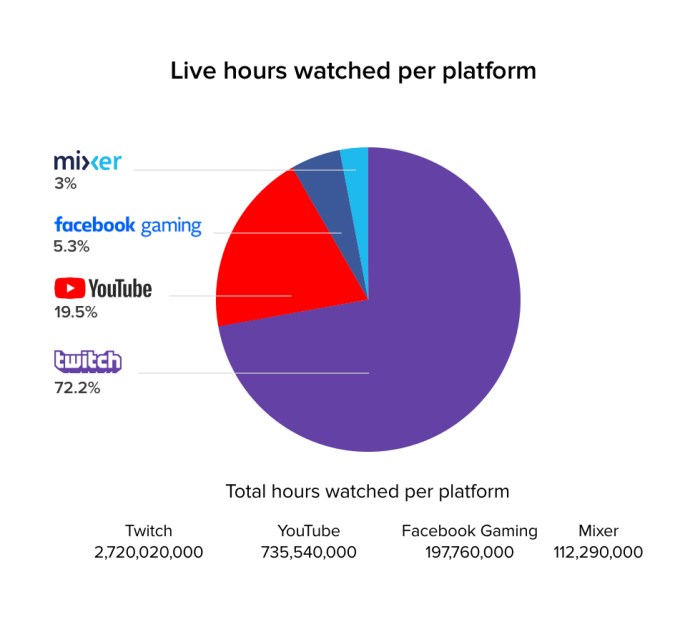
Twitch continues to lead rivals including, YouTube Live, Facebook Gaming and Microsoft’s Mixer, when it comes to live-streaming video. Despite experiencing its first decline in hours watched in Q2 2019, the Amazon-owned game-streaming site still had its second-biggest quarter to date, with more than 70% of the hours watched during the quarter.

According to a new report from StreamElements, Twitch viewers live-streamed a total of 2.72+ billion hours in Q2 — or 72.2% of all live hours watched — compared with 735.54 million hours on YouTube Live (19.5%), 197.76 million on Facebook Gaming (5.3%) and just 112.29 million hours (3%) on Mixer.

Page 4

Combined, the total hours watched across all four platforms was 3.77 billion in Q2.

While none of Twitch’s rivals are nearly catching up, YouTube Live did have a good month in May, breaking its own record with 284 million hours watched. Overall, YouTube Live’s hours watched improved in Q2 as a result, while Twitch saw a slight decline.

Facebook Gaming is also gaining steam. It’s now the third-biggest live-streaming platform, having passed Microsoft Mixer.

Page 3

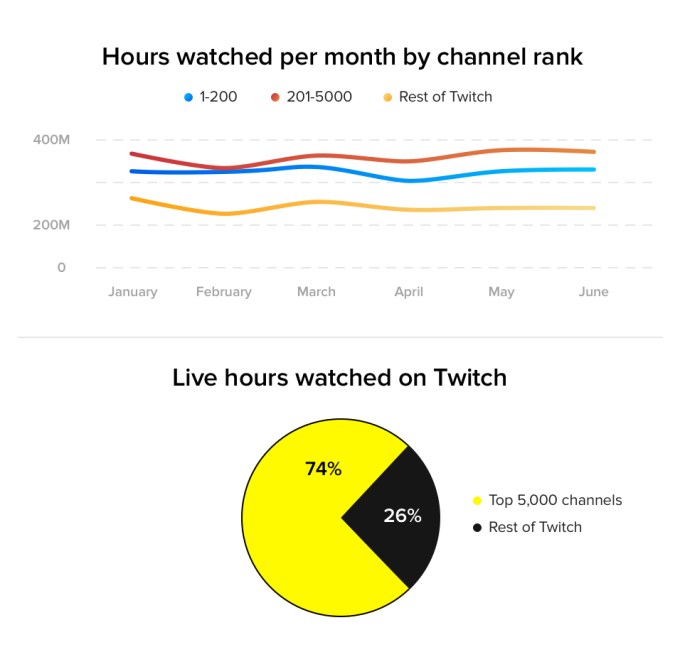
Despite its traction, Twitch doesn’t have much of a long tail when it comes to stream viewership. That’s a problem it has faced for some time, as newcomers complained they spent years broadcasting to no one in hopes of gaining a fan base, with little success. Twitch has tried to remedy this problem with various educational efforts as well as product features like Raids and Squad Streams, for example.

However, the new report finds that the majority (almost 75%) of Twitch’s viewership still comes from people tuning in to the top 5,000 channels. Out of the 2.7 billion hours watched in Q2, these top 5,000 channels drove 2 billion of those hours watched.

Page 5

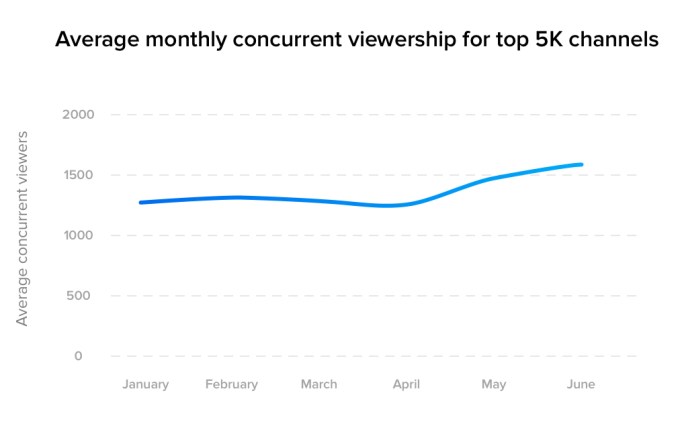
In addition, the average concurrent viewership (viewers watching at the same time) of the top 5,000 channels increased by 12% in Q2 2019, compared with Q1. The top 200 channels have the highest concurrent viewership with 10,590 people watching together, on average.

Page 6

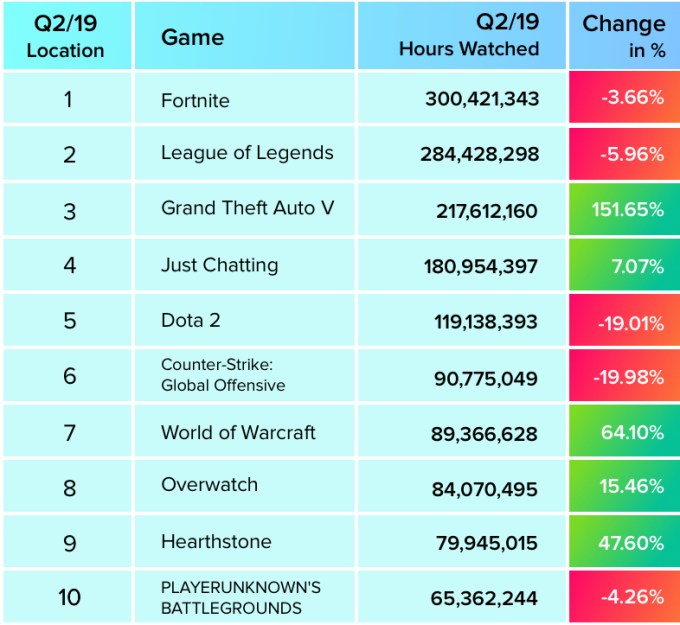
Also in the quarter, viewership of top titles like Fortnite, League of Legends, Dota 2 and Counter-Strike: Global Offensive declined, while vlogging — aka “Just Chatting” — grew, along with other titles.

Page 8

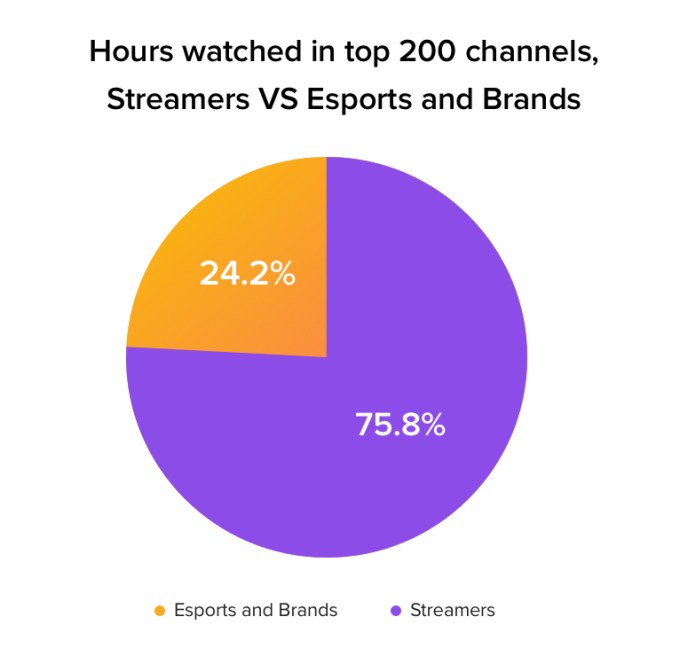
Esports, meanwhile, still draws big numbers, but represents only a small slice of the overall pie.

page 9

The full report, which takes a look at other trends, including which streamers are gaining and losing popularity, is available here.

Digging into the Roblox growth strategy

Could Roblox create a new entertainment and communication category, something it calls “human co-experience”?

When it was a small startup, few observers would have believed in that future. But after 15 years — as told in the origin story of our Roblox EC-1 — the company has accumulated 90 million users and a new $150 million venture funding war chest. It has captured the imagination of America’s youth, and become a startup darling in the entertainment space.

But what, exactly, is human co-experience? Well, it can’t be described precisely — because it’s still an emerging category. “It’s almost like that fable where the nine blind men are touching and describing an elephant.

Everyone has a slightly different view,” says co-founder and CEO Dave Baszucki. In Roblox’s view, co-experience means immersive environments where users play, explore, talk, hang out, and create an identity that’s as thoroughly fleshed out (if not as fleshy) as their offline, real life.

But the next decade at Roblox will also be its most challenging time yet, as it seeks to expand from 90 million users to, potentially, a billion or more. To do so, it needs to pull off two coups.

First, it needs to expand the age range of its players beyond its current tween and teen audience. Second, it must win the international market. Accomplishing both of these will be a puzzle with many moving parts.

What Roblox is today

Lineup All 1

One thing Roblox has done very well is appeal to kids within a certain age range. The company says that a majority of all 9-to-12-year-old children in the United States are on its platform.

Within that youthful segment, Roblox has arguably already created the human co-experience category. Many games are more cooperative than competitive, or have goals that are unclear or don’t seem to matter much. One of Roblox’s most popular games, for instance, is MeepCity, where players can run around and chat in virtual environments like a high school without necessarily interacting with the game mechanics at all.

What else separates these environments from what you can see today on, say, the App Store or Steam? A few characteristics seem common.

For one, the environments look rough. One Robloxian put the company’s relaxed attitude toward looks as “not over-indexing on visual fidelity.”

Roblox games also ignore the design principles now espoused by nearly every game company. Tutorials are infrequent, user interfaces are unpolished, and one gets the sense that KPIs like retention and engagement are not being carefully measured.

That’s similar to how games on platforms like Facebook and the App Store started out, so it seems reasonable to say Roblox is just in a similarly early stage. It is — but it’s also competing directly with mobile games that are more rigorously designed. Over half of its players are on smartphones, where they could have chosen a free game that looks more polished, like Fortnite or Clash of Clans.

The more accurate explanation of why Roblox draws big player numbers is that there’s a gap in the kids entertainment market. So far, only Roblox fills that gap, despite its various shortcomings.

“The amount of unstructured, undirected play has been declining for decades. [Kids] have much more homework, and structured activities like theater after school.

One of the big unmet needs we solve is to give kids a place to have imagination,” explains Craig Donato, Roblox’s chief business officer. “If you play the experiences on our platform, you’re not playing to win. You go into these worlds with people you know and share an experience.”

Games like The Sims tried to do the same, but eventually faded in the children’s demo. Roblox’s trick has been continued growth: it provides kids with an endless array of games that unlock their imagination. But just like we don’t expect adults to have fun with Barbie dolls, it’s unlikely most adults would enjoy Roblox games.

Of course, it would be easy to point at Roblox and laugh off its ambitions to win over people of all ages. That laughter would also be short-sighted.

As David Sze, the Greylock Partners investor who led Roblox’s most recent round, pointed out: “When we invested in Facebook there was a huge amount of pushback that nobody would use it outside college.” Companies that have won over one demographic have a good chance of winning others.

Roblox has also proven its ability to evolve. At one time, the platform’s players were 90 percent male. Now, that’s down to about 60 percent. Roblox now has far more girls playing than the typical game platform.

Evolving to new demographics

TrickBot malware learns how to spam, ensnares 250M email addresses

Old bot, new tricks.

TrickBot, a financially motivated malware in wide circulation, has been observed infecting victims’ computers to steal email passwords and address books to spread malicious emails from their compromised email accounts.

The TrickBot malware was first spotted in 2016 but has since developed new capabilities and techniques to spread and invade computers in an effort to grab passwords and credentials — eventually with an eye on stealing money. It’s highly adaptable and modular, allowing its creators to add new components. In the past few months it was adapted for tax season to try to steal tax documents for making fraudulent returns. More recently the malware gained cookie-stealing capabilities, allowing attackers to log in as their victims without needing their passwords.

With these new spamming capabilities, the malware — which researchers are calling “TrickBooster” — sends malicious emails from a victim’s account, then removes the sent messages from both the outbox and the sent items folders to avoid detection.

Researchers at cybersecurity firm Deep Instinct, who found the servers running the malware spamming campaign, say they have evidence that the malware has collected more than 250 million email addresses to date. Aside from the massive amounts of Gmail, Yahoo and Hotmail accounts, the researchers say several U.S. government departments and other foreign governments — like the U.K. and Canada — had emails and credentials collected by the malware.

“Based on the organizations affected it makes a lot of sense to get as widely spread as possible and harvest as many emails as possible,” Guy Caspi, chief executive of Deep Instinct, told TechCrunch. “If I were to land on an end point in the U.S. State Department, I would try to spread as much as I can and collect any address or credential possible.”

If a victim’s computer is already infected with TrickBot, it can download the certificate-signed TrickBooster component, which sends lists of the victim’s email addresses and address books back to the main server, then begins its spamming, operating from the victim’s computer.

The malware uses a forged certificate to sign the component to help evade detection, said Caspi. Many of the certificates were issued in the name of legitimate businesses with no need to sign code, like heating or plumbing firms, he said.

The researchers first spotted TrickBooster on June 25 and it was reported to the issuing certificate authorities a week later, which revoked the certificates, making it more difficult for the malware to operate.

After identifying the command and control servers, the researchers obtained and downloaded the 250 million cache of emails. Caspi said the server was unprotected but “hard to access and communicate with” due to connectivity issues.

The researchers described TrickBooster as a “powerful addition to TrickBot’s vast arsenal of tools,” given its ability to move stealthily and evade detection by most antimalware vendors, they said.

Another state is looking at propelling people through tubes at 670 mph

Another state — this time North Carolina — has been enticed by the idea of hyperloop, the futuristic and still theoretical transit platform that will shuttle people and packages at speeds of up to 670 miles per hour between cities.

Virgin Hyperloop One and North Carolina’s Regional Transportation Alliance announced Friday the beginning of “an exploration” into using hyperloop to connect the state’s research triangle of Raleigh, Durham and Chapel Hill.

There is still a long way to go before hyperloop or this particular route that Virgin Hyperloop One is exploring  becomes a reality. Theoretically, if this one were built, it would take less than 10 minutes to travel between Raleigh and Durham or Chapel Hill, according to a pre-feasibility study carried out by AECOM. That would be a lynchpin for the area, which is home to some of the country’s top companies, universities and healthcare centers.

How this plays out is now in the hands of the North Carolina Department of Transportation. But based on comments at an event Friday, the state agency is not only interested in the research triangle; it also plans to look at expanding on the original idea and investigate a line that would connect to Charlotte and Washington, D.C.

The process from here on out will be a slow one. While state agencies investigate the feasibility of building hyperloop, Virgin Hyperloop One (VHO) is working on certifying the technology to carry humans. That certification process, which currently doesn’t exist, will likely take years. VHO aims to be certified by 2023 and have one of its hyperloop platforms in place by 2029.

The announcement follows a few milestones for VHO, including a recent demonstration in Washington, D.C. and the funding of NETT, or the Non traditional & Emerging Transportation Technologies Council, which will research and fund hyperloop nationally.

VHO raised $172 million in May. The company also has a new CEO — Jay Walder, who ran bike-sharing operator Motivate. Walder took over at VHO in November.

Sir Richard Branson, who stepped down as chairman in October, has been replaced with Sultan Ahmed bin Sulayem, chairman and CEO of the United Arab Emirates shipping and logistics company DP World.

DP World is the company’s largest investor. DP World first invested in the company in 2016. The two companies launched a logistics joint venture in 2018 to develop hyperloop transport for cargo.

Judge dismisses Oracle lawsuit over $10B Pentagon JEDI cloud contract

Oracle has been complaining about the procurement process around the Pentagon’s $10 billion, decade-long JEDI cloud contract, even before the DoD opened requests for proposals last year. It went so far as to file a lawsuit in December, claiming a potential conflict of interest on the part of a procurement team member. Today, that case was dismissed in federal court.

In dismissing the case, Federal Claims Court Senior Judge Eric Bruggink ruled that the company had failed to prove a conflict in the procurement process, something the DOD’s own internal audits found in two separate investigations. Judge Bruggink ultimately agreed with the DoD’s findings:

We conclude as well that the contracting officer’s findings that an organizational conflict of interest does not exist and that individual conflicts of interest did not impact the procurement, were not arbitrary, capricious, an abuse of discretion, or otherwise not in accordance with law. Plaintiff’s motion for judgment on the administrative record is therefore denied.

The company previously had filed a failed protest with the Government Accountability Office (GAO), which also ruled that the procurement process was fair and didn’t favor any particular vendor. Oracle had claimed that the process was designed to favor cloud market leader AWS.

It’s worth noting that the employee in question was a former AWS employee. AWS joined the lawsuit as part of the legal process, stating at the time in the legal motion, “Oracle’s Complaint specifically alleges conflicts of interest involving AWS. Thus, AWS has direct and substantial economic interests at stake in this case, and its disposition clearly could impair those interests.”

Today’s ruling opens the door for the announcement of a winner of the $10 billion contract, as early as next month. The DoD previously announced that it had chosen Microsoft and Amazon as the two finalists for the winner-take-all bid.

Wear Your Voice centers marginalized communities with a little help from Mark Cuban

It’s hard to feel seen, heard and represented as a person of color in today’s current media landscape. Ravneet Vohra (pictured above), founder and CEO of Wear Your Voice, is changing that.

Wear Your Voice is an intersectional feminist multimedia platform that aims to center marginalized communities, including those who are queer, trans, non-binary, female, black, brown, Asian, Indigenous or some combination of those identities. The site features stories on race, identity, body politics, culture, health and, of course, news and politics.

“Wear Your Voice was born out of my own story growing up as a South Asian woman in a mainly white community and not feeling seen or heard,” Vohra told TechCrunch. “Not just within the community I was in, but also in multimedia. Out of my pain, I made it my power and launched Wear Your Voice.”

Vohra bootstrapped WYV for the first five years, hit a rough patch in 2018, but survived because “our audience saved us,” she said.

“That’s when you know you’re destined to stay,” Vohra said. “Because nothing speaks louder than the support of people on the internet saying, ‘No, you are integral to our safety. You provide a safe space.’ So people started throwing money at us.”

But Vohra and WYV were still in survival mode. The company needed more than simply enough money to survive. It needed money to thrive.

“It’s been an interesting journey,” she said. “I’ve tried the VC route and the angel route, and I always felt like the door was getting closed in my face because we weren’t centering white people.”

Wear Your Voice didn’t receive its first bit of outside funding until investor and Dallas Mavericks owner Mark Cuban came along. Vohra said she later “stumbled upon Mark, and that was a really defining moment.”

To date, Cuban is the company’s sole outside investor.

“With him coming on board, I now have a clearer, more defined role,” she said. “I’m now moving away from a survival mode into being able to do my job.”

With a recent influx of capital from Cuban, Wear Your Voice is building out its team, improving on its technology and forming partnerships  — most recently a paid partnership with Planned Parenthood.

“My investment in Wear Your Voice was based on many factors, but the ultimate deciding factor was the high level of content they publish and the community it serves,” Cuban said in a statement. “Saying that, WYV doesn’t just serve underrepresented communities of color, it is also a place for the rest of us to listen and learn.”

Earlier this month, WYV partnered with Planned Parenthood for the Summer of Sex campaign. The campaign aims to center the experiences of lesbian, gay, bisexual, transgender, queer, intersex, asexual and other sexualities, sexes and genders (LGBTQIA+) and black, Indigenous, and people of color (BIPOC).

Sex is something that cannot be singularly defined, and yet so many continually attempt to define it through rigid hetero and cisnormative understandings. With this campaign, we are igniting and continuing important conversations about sex — from sex positivity, sexual health, and sexual liberation to purity culture’s effects on people of color, especially queer and trans folks. From desirability politics — how racism, misogyny, fatphobia, ableism, and more impact how we think about sex, attraction, humanity, and certain people’s prescribed roles — to masturbation and sex toys. From STI stigma and sex education to debunking myths about the clitoris and de-centering the penis and penetration in our understandings of sex and pleasure. We want to explore the myriad of ways QTBIPOC experience sex and the things surrounding it.

To achieve this, WYV is producing a number of articles, essays and interviews around the topic of sex.

“This is huge,” Vohra told me. “It’s a big deal for me because this explores sex through the QTBIPOC lens.”

Down the road, expect to see more partnerships with brands and corporations, Vohra said.

“There are so many other campaigns in the pipeline,” Vohra said. “We are also looking for more investment so I can continue to grow and really shake up the status quo of how normal digital media companies are operated and show them how to do it better.”