We scrolled until our eyes burned to bring you the best Prime Day deals on fitness watches, Instant Pots, and more.
Category: Tech news
hacking,system security,protection against hackers,tech-news,gadgets,gaming
Computing pioneer and LGBT icon Alan Turing will grace the £50 note in 2021
Alan Turing, one of the pioneering figures in modern computing, and also a tragic one in LGBT history, will soon appear on the U.K.’s £50 note. He was selected from a shortlist of scientists and bright minds so distinguished that it must have made the decision rather difficult.
The nomination process for who would appear on the new note was open to the public, with the limitation this time that those nominated were British scientists of some form or another. Hundreds of thousands of votes and nearly a thousand names were submitted, and ultimately the list was winnowed down to the following dozen (well, 14, with two pairs; descriptions taken from the Bank of England’s summary):
- Mary Anning (1799-1847) – a self-taught palaeontologist known around the world for the fossil discoveries she made in her hometown of Lyme Regis.
- Paul Adrien Maurice Dirac (1902-1984) – whose research revolutionised our understanding of the universe’s smallest matter.
- Rosalind Franklin (1920-1958) – who drove the discovery of DNA’s structure, a critical breakthrough in our understanding of the biology of life.
- Stephen Hawking (1942-2018) – who made outstanding contributions to our understanding of gravity, space and time.
- William (1738-1822) and Caroline Herschel (1750-1848) – a brother and sister astronomy team devoted to uncovering the secrets of the universe.
- Dorothy Crowfoot Hodgkin (1910-1994) – whose research using x-ray crystallography delivered ground-breaking discoveries which shaped modern science and helped save lives.
- Ada Lovelace (1815-1852) and Charles Babbage (1791-1871) – visionaries who imagined the computer age.
- James Clerk Maxwell (1831-1879) – who made discoveries which laid the foundations for technological innovations which have transformed our way of life.
- Srinivasa Ramanujan (1887-1920) – whose incredible talent for numbers helped transform modern mathematics.
- Ernest Rutherford (1871-1937) – who uncovered the properties of radiation, revealed the secrets of the atom and laid the foundations for nuclear physics.
- Frederick Sanger (1918-2013) – whose pioneering research laid the foundations for our understanding of genetics.
- Alan Turing (1912-1954) – whose work on early computers, code-breaking achievements and visionary ideas about machine intelligence made him one of the most influential thinkers of the 20th century.
Some of the best intellectual company conceivable, to be quite honest. Each of these people was enormously influential in their respective field, although, as usual, some didn’t get the credit they deserved while living.
Turing was of course an example of this. His work on codebreaking during World War II (alongside his many colleagues at Bletchley Park and beyond, naturally) contributed hugely to the Allied war effort by allowing them to secretly read Axis communications thought to be rendered unreadable by the ingenious Enigma system.
Part of that work, and Turing’s papers on general computing theory written at the time, laid the foundation for many of the concepts that underpin computational systems today. The modern computer is a collaboration among many people in many countries over several decades, but Turing was among the vanguard in theory and execution.
Unfortunately, not only was much of his work required to be kept secret for decades afterwards, limiting the knowledge of his accomplishments to a select few, but after the war he was later persecuted by the British government for being a gay man.
Charged with indecent acts, he was subjected to mandatory chemical “treatment” for his sexuality: humiliating and unjust compensation for a man who saved thousands, perhaps millions, of lives and helped create the defining technology of the 20th century in the process. He was found dead in his apartment, having apparently committed suicide, on June 7, 1954.
He was officially pardoned in 2014 after years of consideration and outcry, especially following both the increasing visibility and action of LGBTQIA figures in the present and a resurgence of interest in Turing and his collaborators’ contributions to the history of computing and the war effort.
Even with such an extraordinary story, it must have been difficult to pick Turing out from the crowd of luminaries nominated alongside him. You can check out some of the people and thought behind the decision in this video put out by the Bank of England:
The note itself isn’t finalized, but it will resemble the top image. It uses the most famous image of Turing, and will feature notes from his papers and notebooks, a picture of the Automatic Computing Engine (an early digital computer), a quote and signature, and more. Should be a handsome little bill. You’ll see it in circulation starting in 2021.
Why commerce companies are the advertising players to watch in a privacy-centric world
Justin Choi
Contributor
Contributor
Justin Choi is the founder and CEO of Nativo, which empowers brands and publishers through its advanced platform for content.
More posts by this contributor
The unchecked digital land grab for consumers’ personal data that has been going on for more than a decade is coming to an end, and the dominoes have begun to fall when it comes to the regulation of consumer privacy and data security.
We’re witnessing the beginning of a sweeping upheaval in how companies are allowed to obtain, process, manage, use and sell consumer data, and the implications for the digital ad competitive landscape are massive.
On the backdrop of evolving privacy expectations and requirements, we’re seeing the rise of a new class of digital advertising player: consumer-facing apps and commerce platforms. These commerce companies are emerging as the most likely beneficiaries of this new regulatory privacy landscape — and we’re not just talking about e-commerce giants like Amazon.
Traditional commerce companies like eBay, Target and Walmart have publicly spoken about advertising as a major focus area for growth, but even companies like Starbucks and Uber have an edge in consumer data consent and, thus, an edge over incumbent media players in the fight for ad revenues.
Tectonic regulatory shifts

Image via Getty Images / alashi
By now, most executives, investors and entrepreneurs are aware of the growing acronym soup of privacy regulation, the two most prominent ingredients being the GDPR (General Data Protection Regulation) and the CCPA (California Consumer Privacy Act).
UK-based women’s networking and private club, AllBright, raises $18.8 million as it expands into the US
AllBright, the London-based women’s membership club backed by private real estate investment firm Cain International, has raised $18.8 million to expand into the U.S.
The company’s new round was led by Cain International and was designed to take AllBright into three U.S. locations — Los Angeles, New York and Washington, DC.
The company said that the new facilities would be opening in the coming months.
Coupled with the launch of a new networking application called AllBright Connect and the company’s AllBright Magazine, the women’s networking organization is on a full-on media blitz.
Other investors in the round include Allan Leighton, who serves as the company’s non-executive chairman; Gail Mandel, who acquired Love Home Swap (a company founded by AllBright’s co-founder Debbie Wosskow); Stephanie Daily Smith, a former finance director to Hillary Clinton; and Darren Throop, the founder, president and chief executive of Entertainment One.
A spokesperson for the company said that the new financing would value the company at roughly $100 million.
The club’s current members include actors, members of the House of Lords and other fancy pants, high-falutin folks from the worlds of politics, business and entertainment.
The club’s first American location will be in West Hollywood, and is slated to open in September 2019. The largest club, in Mayfair, has five floors and boasts more than 12,000 square feet and features rooftop terraces, a dedicated space for coaching and mentoring, a small restaurant and a bar.
Amazon Prime Day 2019: The Best Kindle Is Only $60
We’re big fans of Amazon’s Kindles, and all three are on sale for Prime Day: Standard, Paperwhite, and Oasis. They’re as cheap as we’ve seen them.
Paige details first AI pathology tech with clinical-grade accuracy in new research paper
Researchers associated with Memorial Sloan Kettering Cancer Center and medical tech and computational pathology startup Paige have published a new article in the peer-reviewed medical journal Nature Medicine detailing its artificial intelligence-based detection system for identifying prostate cancer, skin cancer and breast cancer, which the company says achieves “near-perfect accuracy.” The tech described in the article, which employs deep learning trained on a data set of almost 45,000 slide images taken from more than 15,000 patients spanning 44 countries, is novel in that it can eschew the need to curate data sets for training first, which greatly decreases cost and time required to build accurate AI-based diagnostic tools.
Last February, Paige announced $25 million in Series A funding and a partnership with Memorial Sloan Kettering Center (MSK) to gain access to one of the largest single repositories of pathology slides in the world. MSK is also home to the lab of Dr. Thomas Fuchs, Paige’s co-founder and chief scientific officer, and possibly the world’s foremost authority in computational pathology.
Paige’s approach uses much larger data sets than are typically employed in AI-based diagnostics, but without the tight curation that focuses other efforts much more narrowly on specific types of cancer diagnostics. The result, according to the company, is not only better performance, but also a resulting system that is much more generally applicable.
Next up for Paige is to commercialize its technology, which is something it’s already pursuing. The work described in the article published in Nature Medicine has already been employed in technology currently under review by the FDA, albeit for a different final application than the ones described in the study published by the magazine.
Dish’s AirTV launches an $80 streaming stick for accessing Sling TV, Netflix & broadcast channels
Dish is expanding its hardware lineup today with the launch of a new 4K streaming stick, the AirTV Mini, designed to make it easier for cord cutters to access from one user interface its live TV service Sling TV, plus Netflix and over-the-air channels. The Android TV-powered device is meant to complement an existing setup that already includes an OTA digital antenna and an AirTV Wi-Fi-enabled network tuner, the company says.
For a limited time, new and existing Sling TV customers can get the latter two items for free — an AirTV Wi-Fi-enabled network tuner and an indoor antenna — by prepaying for three months of Sling TV’s service.
In addition, the AirTV Mini also includes support for 2×2 802.11AC Wi-Fi, a lost remote finder feature, support for Google Assistant and Google Play, as well as support for VP94K decoding, which allows you to watch YouTube or Netflix content in 4K.
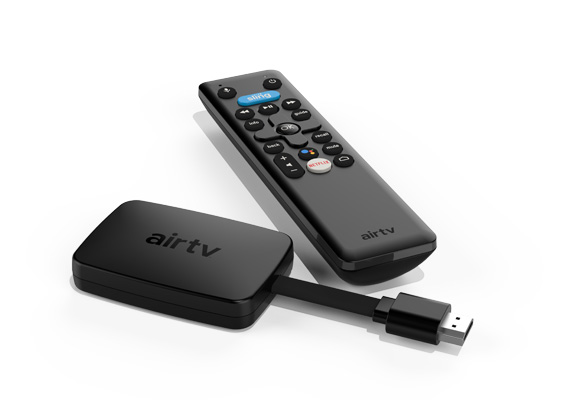
The company has been offering streaming devices for a couple of years. Dish first unveiled its AirTV Player, a 4K media streamer set-top box, at CES 2017. In 2018, it expanded its hardware lineup to include a new device, just called the AirTV, a networked TV tuner that streams local programming via Wi-Fi.
Despite the new AirTV Mini’s streaming stick form factor, it’s not meant to compete with rival streaming sticks like the low-cost Amazon Fire TV Stick, Roku streaming stick or Chromecast in terms of price. Instead, it’s a $79.99 alternative to the $119.99 AirTV Player bundle — perhaps for someone who doesn’t care for the sort of Playskool-inspired design of the original streaming box, but still wants over-the-air channels, 4K support and easy access to Sling TV and Netflix.
The remote for the Mini is improved as well, in a more typical shade of black instead of the AirTV Player’s white and blue design. It’s also a more standard length and width than the stubby and seemingly childish AirTV Player remote. And it still has dedicated buttons for Sling TV, Netflix and Google Assistant.
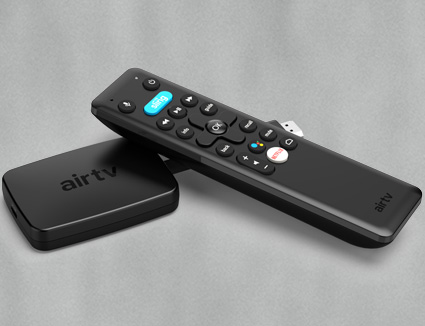
Through the remote, users can issue voice commands to control their TV experience. For example, you can use voice search to find favorite shows and movies, or say things like “go to guide,” “show me my DVR” or “rewind 10 seconds.”
“The AirTV brand is committed to making local TV relevant and easily accessible to streamers,” said Mitch Weinraub, director of product development for AirTV, in a statement. “The AirTV Mini is a powerhouse streaming stick with more memory and a faster processor than anything else in the category. When combined with the AirTV network tuner and the Sling TV app, the Mini delivers a superior streaming experience, especially for Slingers who want premium features in a small package at an affordable price.”
The audience for this sort of product — or any AirTV device, for that matter — is fairly niche. While there’s certainly some demand for access to over-the-air programming among cord cutters, there are other solutions that don’t lock you into Sling TV, specifically.
For instance, you can easily switch to your connected antenna from a Roku TV or you could buy the (currently $179.99) Fire TV Recast, which offers a Fire TV interface plus access to stream and record from live TV with its built-in DVR. Neither the AirTV Mini nor the AirTV tuner come bundled with a DVR — you have to provide your own, and plug it into the tuner.
Overall, the solution makes sense for DIY’ers who also subscribe to Sling TV and prefer a Google Assistant-powered experience instead of Alexa.
Blackstone is acquiring mobile ad company Vungle
Private equity firm Blackstone just announced that it has reached an agreement to acquire mobile advertising company Vungle.
The companies aren’t disclosing the financial terms, but as part of the transaction, Vungle has also reached a settlement with founder Zain Jaffer, who filed a wrongful termination lawsuit against the company earlier this year.
(Update: Multiple sources with knowledge of the deal said that the acquisition price was around — or north of — $750 million. One of those sources also said it was an all-cash transaction.)
“As a best-in-class performance marketing platform, Vungle represents a key growth engine for the mobile app ecosystem,” said Blackstone principal Sachin Bavishi in a statement. “Our investment will help deliver on the company’s tremendous growth potential and we look forward to partnering with management to extend Vungle’s strength across mobile gaming and other performance brands.”
Meanwhile, CEO Rick Tallman said the deal will allow the company to “further accelerate Vungle’s mission to be the trusted guide for growth and engagement, transforming how users discover and experience mobile apps.”
Vungle was founded back in 2011, and, according to the acquisition release, it’s currently working with 60,000 mobile apps worldwide, serving more than 4 billion video views per month and working with publishers like Rovio, Zynga, Pandora, Microsoft and Scopely.
Jaffer led Vungle as CEO until October 2017, when he was arrested on charges including performing a lewd act upon a child and assault with a deadly weapon. The charges were ultimately dropped, with the San Mateo County District Attorney’s office stating that it did “not believe that there was any sexual conduct by Mr. Jaffer that evening,” while “the injuries were the result of Mr. Jaffer being in a state of unconsciousness caused by prescription medication.”
In his lawsuit, Jaffer alleged that after the charges were dropped, “Vungle unfairly and unlawfully sought to destroy my career, blocked my efforts to sell my own shares or transfer shares to family members, and tried to prevent me from purchasing shares in the Company.”
In a statement today, Jaffer said, he is “pleased with the terms of the settlement, which are confidential.” He also commented on the acquisition:
It is extremely gratifying for me to see our early vision, execution and the hard work of so many talented people rewarded like this. From Day 1, Vungle has been at the forefront of the changing advertising landscape. Today, companies of all sizes, and in all industries, are utilizing in-app video ads as an integral part of their customer acquisition strategies.
The acquisition is expected to close later this year. According to Crunchbase, Vungle previously raised more than $25 million from Crosslink Capital, Thomvest Ventures, Seven Peaks Ventures, GV, AOL Ventures, Uncork Capital, 500 Startups and Angelpad, where the startup was incubated. (AOL Ventures was backed by TechCrunch’s parent company AOL, a.k.a. Oath, a.k.a. Verizon Media.)
On Prime Day, Amazon workers and immigrants’ rights organizations are protesting
On the start of Amazon’s biggest sales event of the year, Amazon workers and activists are taking to the streets today in protest of the retail giant. Protests are planned for San Francisco, Minnesota, New York, Seattle and other locations across Europe.
The biggest employee-led demonstration is happening in Shakopee, Minn., where Amazon warehouse workers are protesting the working conditions, pay, benefits and general culture.
“These workers, primarily Muslim, East African immigrants, want humane working targets to reduce injuries, full-time instead of temporary working status, and fair opportunities for promotions,” a group of Amazon employees advocating for climate justice wrote on Medium a couple of days ago. “These FC workers reached out to us, Amazon Employees for Climate Justice (AECJ), asking for support.”
This is not the first time warehouse workers in Minnesota have organized. In March, workers went on strike for three hours to call for better working conditions. Last year, those same workers demanded more time for prayer and smaller workloads while fasting during Ramadan.
“Amazon workers are sending a powerful message to Jeff Bezos this Prime Day: It’s time to stop putting profits ahead of people,” United Food and Commercial Workers International Union President Marc Perrone said in a statement today. “With the recent move to one-day Prime shipping, Amazon workers are being forced to meet impossible demands at increasingly unsafe speeds.”
Amazon, however, says its critics are “conjuring misinformation to work in their favor,” an Amazon spokesperson said. Amazon says it already offers the things unions are asking for. Last October, Amazon raised the minimum wage for all warehouse workers to $15 an hour for its U.S.-based workers, but many said that was not enough.
“We can only conclude that the people who plan to attend events today are simply not informed,” the spokesperson said. “As a company, we work hard to provide a safe, quality working environment for the 250,000 hourly employees across Amazon’s U.S. facilities.”
The spokesperson went on to describe how its associates are core to its operation and how they regularly encourage friends and family to apply for roles.
“We encourage anyone to compare our pay, benefits, and workplace to other major employers across the country,” the spokesperson said.
In San Francisco, organizers from Bay Resistance, San Francisco Rising and Jobs with Justice protested outside one of Amazon’s offices in the city to demand Amazon end its relationship with Immigration and Customs Enforcement. The group is also urging Amazon to stop promoting its facial recognition technology, Rekognition, to law enforcement agencies and ICE.
The aim was to protest and deliver a petition with 270,000 signatures on it demanding that Amazon cut its ties with ICE, which has been conducting raids across the country. While some gathered for the protest, the organizers said they were unable to deliver the petition because Amazon would not let them into its office.
“As we’ve said many times and continue to believe strongly, companies and government organizations need to use existing and new technology responsibly and lawfully,” the Amazon spokesperson said. “There is clearly a need for more clarity from governments on what is acceptable use of AI and ramifications for its misuse, and we’ve provided a proposed legislative framework for this. We remain eager for the government to provide this additional clarity and legislation, and will continue to offer our ideas and specific suggestions.”
To stand in solidarity with Amazon workers, some activists are asking the masses to boycott Amazon, which means no Amazon.com, Amazon Prime Video, Whole Foods, Kindle, Audible, Book Depository, Twitch, IMDb, AWS, Goodreads and Comixology.
*This story has been updated with reporting from the protest in San Francisco.
Quibi comedy from Thomas Lennon will focus on tech entrepreneur who takes over a winery
Yet-to-launch streaming media startup Quibi has been keeping up a slate of announcements at a fever pace, and its latest is a show that sounds potentially relevant to TechCrunch’s audience. The series, which will be created, written, executive produced by and star Reno 911! alum Thomas Lennon, will follow a Silicon Valley entrepreneur who turns away from tech and tries to turn around a different kind of business — a failing California winery and vineyard.
Described by Quibi as a “workplace comedy,” the show will follow lead Lennon’s “rag-tag” team of winery employees, and apparently none of them are very good at this particular task.
Lennon’s track record indicates that this should be worth checking out at least. From his work on the excellent cop workplace comedy Reno 911! to his ongoing roles in Archer, Bob’s Burgers and Drunk History, he has a strong track record of demonstrating great comedy chops, along with multiple supporting movie roles.
Meanwhile, Quibi is really pouring the gas on its series announcements leading up to its target launch date of April 6, 2020. In the last couple of weeks alone, it’s announced a twist on a superhero series directed by Bourne Identity director Doug Liman, a Varsity Blues adaptation series, a WWE-created docu-series focused on women wrestlers and more.
The need-to-know takeaways from VidCon 2019
VidCon, the annual summit in Anaheim, CA for social media stars and their fans to meet each other drew over 75,000 attendees over last week and this past weekend. A small subset of those where entertainment and tech executives convening to share best practices and strike deals.
Of the wide range of topics discussed in the industry-only sessions and casual conversation, five trends stuck out to me as takeaways for Extra Crunch members: the prominence of TikTok, the strong presence of Chinese tech companies in general, the contemplation of deep fakes, curiosity around virtual influencers, and the widespread interest in developing consumer product startups around top content creators.
Newer platforms take center stage
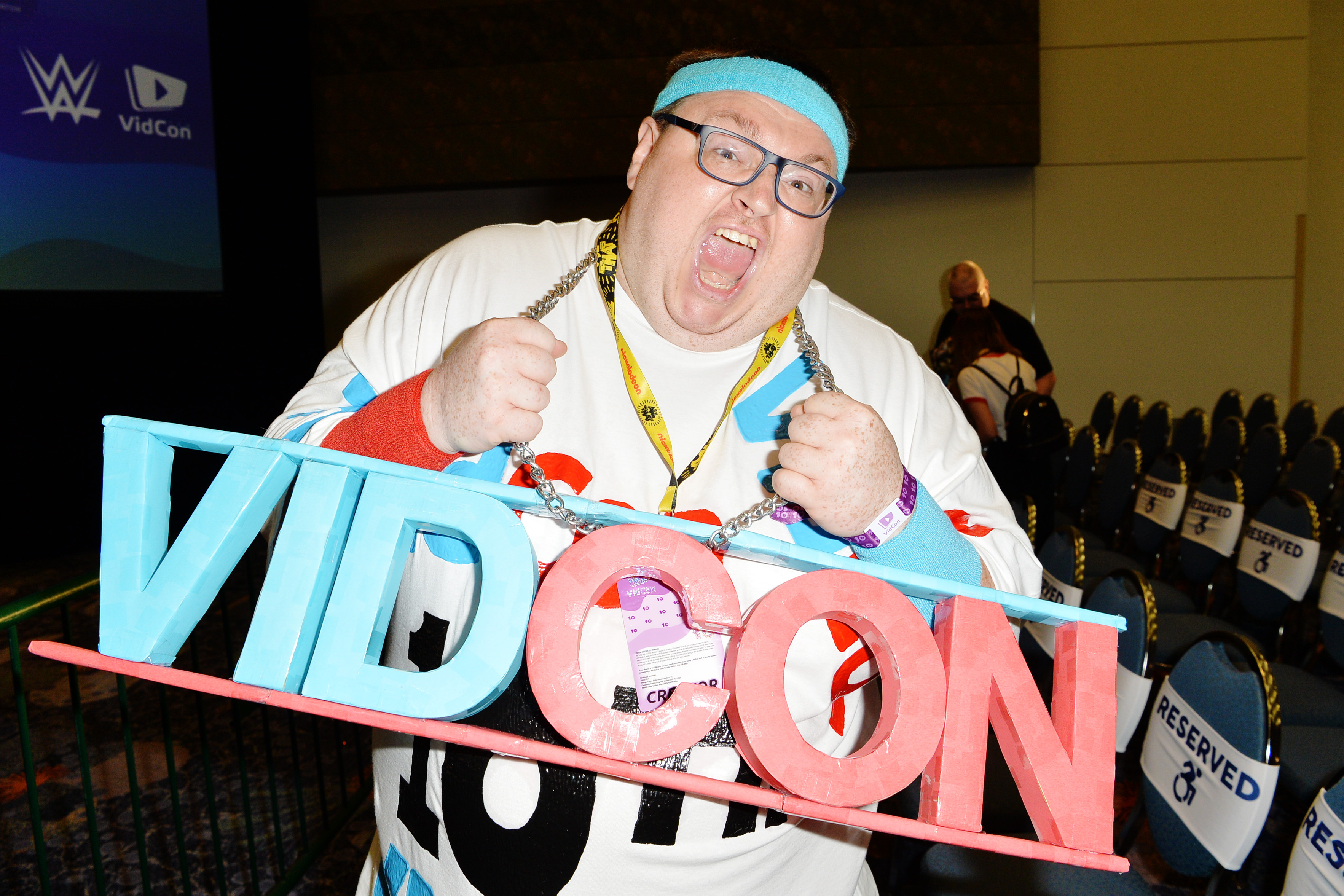
Photo by Jerod Harris/Getty Images
TikTok, the Chinese social video app (owned by Bytedance) that exploded onto the US market this past year, was the biggest conversation topic. Executives and talent managers were curious to see where it will go over the next year more than they were convinced that it is changing the industry in any fundamental way.
TikTok influencers were a major presence on the stages and taking selfies with fans on the conference floor. I overheard tweens saying “there are so many TikTokers here” throughout the conference. Meanwhile, TikTok’s US GM Vanessa Pappas held a session where she argued the app’s focus on building community among people who don’t already know each other (rather than being centered on your existing friendships) is a fundamental differentiator.
Kathleen Grace, CEO of production company New Form, noted that Tik Tok’s emphasis on visuals and music instead of spoken or written word makes it distinctly democratic in convening users across countries on equal footing.
Esports was also a big presence across the conference floor with teens lined up to compete at numerous simultaneous competitions. Twitch’s Mike Aragon and Jana Werner outlined Twitch’s expansion in content verticals adjacent to gaming like anime, sports, news, and “creative content’ as the first chapter in expanding the format of interactive live-streams across all verticals. They also emphasized the diversity of revenue streams Twitch enables creators to leverage: ads, tipping, monthly patronage, Twitch Prime, and Bounty Board (which connects brands and live streamers).
Daily Crunch: Uber sets diversity goals
The Daily Crunch is TechCrunch’s roundup of our biggest and most important stories. If you’d like to get this delivered to your inbox every day at around 9am Pacific, you can subscribe here.
1. Uber finally sets diversity, inclusion and equity goals
While Uber is still predominantly white and Asian, the company has made notable headway in the representation of black and Latinx people among its employees.
As for those goals, Uber says that in the next three years, it aims to increase the percentage of women at levels L5 and higher (i.e. manager and above) to 35%, and increase the percentage of underrepresented employees at levels L4 and higher to 14%.
2. Waze now shows road toll prices along your driving route
With Waze, you can find out the amount you’ll need to pay — sourced from its community of user-drivers, rather than direct from the official toll road operators.
3. Customer data management company Amperity raises $50M
Amperity says that in 2018, its annual recurring revenue grew 355% year-over-year. Although the startup only launched in 2016, it’s already signed up an impressive roster of customers, like Starbucks, Gap Inc., TGI Fridays and Planet Fitness.
4. Don’t blame flawed Silicon Valley for the rot of Wall Street and Washington
Jon Evans looks at the “techlash,” arguing that people are particularly angry at the tech industry because they view it as the last engine of power that actually might change.
5. Serena Williams, Mark Cuban invest $3M in Mahmee, a digital support network for new moms
The real issue, according to Mahmee co-founder Melissa Hanna, is that “the data is fragmented.” She says this is why she built a network to get new moms the support they need — from their community, other moms and medical providers.
6. With $34B Red Hat deal closed, IBM needs to execute now
The deal, which was announced in October, was expected to take a year to clear all of the regulatory hurdles, but U.S. and EU regulators moved surprisingly quickly. For IBM, the future starts now. (Extra Crunch membership required.)
7. This week’s TechCrunch podcasts
On Equity, the team offers an overview of the last two quarters of IPOs. Meanwhile, Original Content reviews the underwhelming Netflix thriller “Point Blank.”
Report: Amazon Prime Day 2019 will push US e-commerce sales to over $2 billion
A report from Adobe’s analytics arm predicts Amazon’s Prime Day 2019 sales event, which began today, to have another sizable impact on the U.S. e-commerce market. The company expects a revenue lift for top retailers — those with over $1 billion in online sales — to reach 79% this year, up from the 60% lift they saw during Prime Day 2018. And it says that Prime Day will become the third time outside the holiday season that U.S. e-commerce spending will top $2 billion, as it previously did on Labor Day 2018 and Memorial Day 2019.
“We attribute this growth in sales to the fact that the big e-commerce competitors have become better at reaping the benefits of this artificial holiday,” said Taylor Schreiner, principal analyst at Adobe Digital Insights (ADI). “After all, they’ve now had almost five years of practice in converting Prime Day traffic.”
The $2 billion figure includes Amazon, Adobe says, but is limited to U.S. e-commerce sales.
However, Prime Day itself now runs across a number of international markets, including, for the first time, the United Arab Emirates, alongside the U.K., Spain, Singapore, Netherlands, Mexico, Luxembourg, Japan, Italy, India, Germany, France, China, Canada, Belgium, Austria and Australia.
Top Amazon rivals like Walmart, Target, eBay, Best Buy and others are running their own sales today, as are many e-commerce retailers. In fact, an earlier report from RetailMeNot predicted that this year, 250 retailers will compete with Amazon on Prime Day. That’s up from 194 last year and up from just seven on the first Prime Day in 2015.
EBay, in particular, went a little dirty with its counter-sale, calling it a “Crash Sale” — a reference to how Amazon.com tanked on Prime Day 2018.
But that branding has paid off — according to the latest from website monitoring firm Catchpoint, Amazon has not had stability issues as of yet. The firm has been tracking Amazon’s desktop and mobile websites since 3 AM ET today, and as of 10 AM ET reports no problems. It even found that the average website load times are just as fast as last week when there was no sale.
That either speaks to big improvements to site stability to address last year’s issues, or perhaps a decline in consumer interest in Prime Day 2019 — perhaps because one of Prime Day 2018’s top-sellers, the Echo Dot, had a huge price cut before Prime Day began, to $24.99. (Now it’s $22 for Prime Day.) We won’t know until the reports roll in later in the day, and after the sales event wraps.
Twitter.com launches its big redesign with simpler navigation and more features
Twitter’s website is getting a major overhaul. The company has been testing a new version of its desktop website since the beginning of the year, and today the final product is rolling out to the public. The upgraded experience simplifies navigation with a new — and fairly large — left-hand sidebar that directs you to all of Twitter’s key sections, including Notifications, Direct Messages, Explore, Bookmarks, Lists and more. The site also features an expanded, more inbox-like Direct Messages screen where you can view and respond to conversations in one place; plus easy profile switching, support for more themes, advanced search and other features.
The popular dark modes, Dim and the very black Lights Out mode, are now supported along with more ways to personalize Twitter through different themes and color options.
But the most noticeable change is the organization and layout of the Twitter home screen itself.
Below: the old Twitter.com
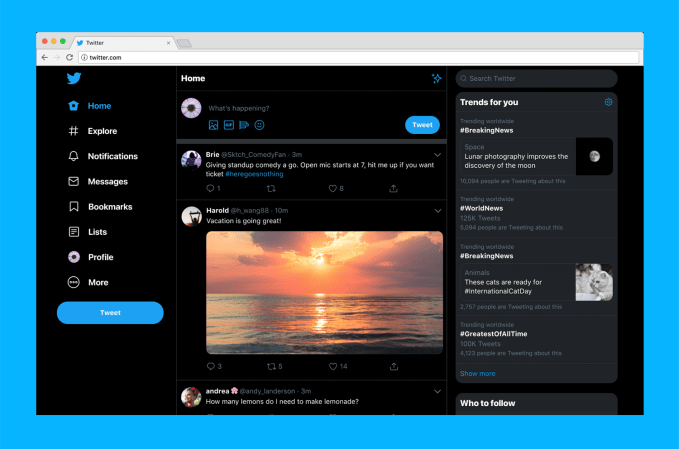
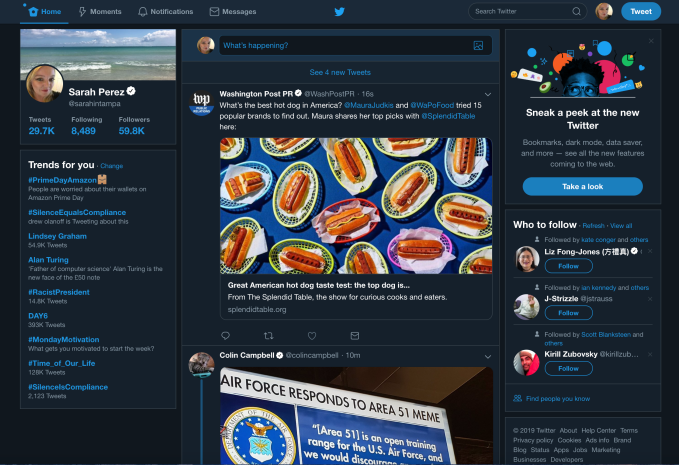 Below: the new Twitter.com
The update is designed to make it easier to move around Twitter. Before, you’d have to click on your Profile icon to access features like Lists, Themes, Settings and other options. Meanwhile, getting to Moments was available both in this Profile drop-down menu and in the main Twitter navigation at the top of the screen, next to Notifications and Messages.
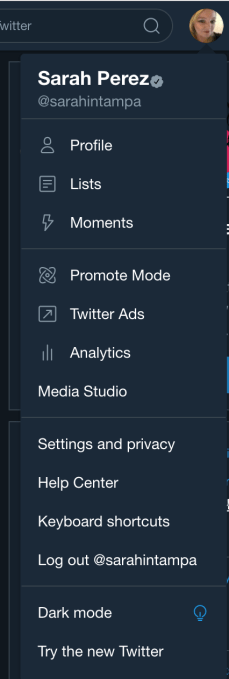
Now, Moments is being downgraded to the “More” menu in the redesign — as seen in a test running earlier this summer — and Explore instead gets the top billing. As on mobile, Explore will direct users to more live videos and personalized local moments, says Twitter. This is also where you’ll find Top Trends, while Personalized Trends will be featured on the right-hand sidebar on the home screen (see above).
In addition, Twitter finally brought the more than year-old Bookmarks feature to the desktop’s main navigation.
With the update, the new navigation menu includes: Home, Explore, Notifications, Messages, Bookmarks, Lists, Profile and More — the latter, a menu where you’ll find things like Moments, Twitter’s ad tools, Settings and other features.
The new Compose feature has been slightly tweaked as well, with options to include a photo, GIF, poll or emoji now all in the bottom left — with the emoji button now swapping in for the location button, following Twitter’s decision to make sharing precise location less of a priority, given its lack of use.
Though the new home screen is arguably better-organized, the navigation text itself and the amount of screen real estate it takes up is overly large.
This detracts somewhat from the main content — the tweets themselves — because your eye is naturally drawn to the oversize navigation labels at first, not the posts flowing in the timeline. This also can be a jarring change to get used to for longtime Twitter.com users. (Good thing there’s a new Mac desktop app on the way.)
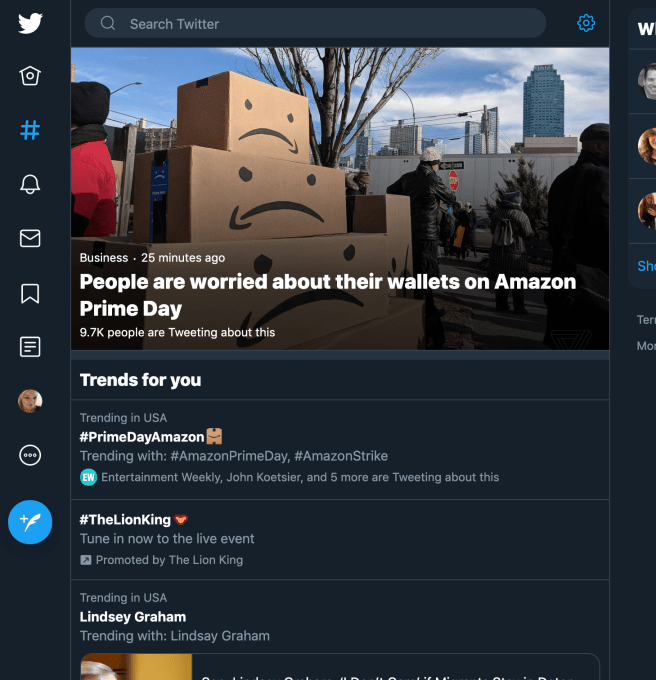
If you really can’t stand the navigation labels’ size, you can make the webpage smaller, which then hides the text labels of the navigation items, leaving only their icons. This, unfortunately, isn’t all that useful if you like to keep Twitter open in a tab alongside all your other tabs. It works better if you pop out Twitter.com into its own window.
The navigation changes were likely a design choice Twitter made, in part, to simplify the use of its product by more casual users and newcomers.
The company has struggled with user growth throughout its history, even changing how it reports metrics to paint a better picture of its business. Now, you’d have to be almost completely web illiterate to not find your way around the new Twitter.com. But only time will tell what effect this has on growing its user base.
Not all the changes will be as controversial as the new layout, though.
For example, the now double-paned Direct Message section is more welcome as it makes using Messages feel more like the real inbox it often is — with the message list on the left and conversations on the right.
Search got an update, as well, which puts tabs for moving between “Top,” “Latest,” “People,” “Photos” and “Videos” at the top of the screen, with Advanced Search Filters to the right.
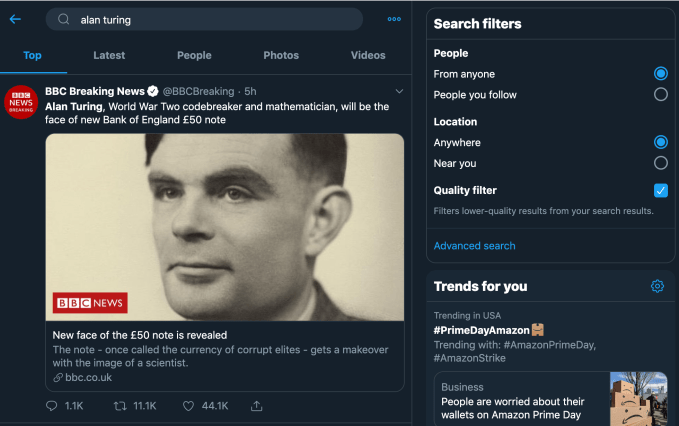
And for those with multiple Twitter accounts, you can now switch between them from the main navigation. That’s helpful.
Twitter’s tests of the updated design had been rolling out to more people throughout the year — it even tried two different versions for a time. Throughout this process, the company incorporated some of the user feedback it received. For example, the changes to the Messaging screen and the high priority given to Bookmarks were among the requests Twitter addressed.
But generally speaking, Twitter was aiming to deliver a more consistent, seamless experience across both the phone and the web platforms with this update, a company spokesperson told us.
There’s some bad news for old-school Twitter.com users — as of this public launch of the redesign, there’s no option for going back to the legacy experience, as there was during the testing period.
Twitter says the upgraded look will begin rolling out globally starting today.
The Inside Story of Twitter’s New Redesign
The social network launched a complete visual overhaul of its website Monday. But will a fresh design be enough to save Twitter?