Instagram will now warn you before your account gets deleted, offer in-app appeals

Instagram this morning announced several changes to its moderation policy, the most significant of which is that it will now warn users if their account could become disabled before that actually takes place. This change goes to address a longstanding issue where users would launch Instagram only to find that their account had been shut down without any warning.

While it’s one thing for Instagram to disable accounts for violating its stated guidelines, the service’s automated systems haven’t always gotten things right. The company has come under fire before for banning innocuous photos, like those of mothers breastfeeding their children, for example, or art. (Or, you know, Madonna.)

Now the company says it will introduce a new notification process that will warn users if their account is at risk of becoming disabled. The notification will also allow them to appeal the deleted content in some cases.

For now, users will be able to appeal moderation decisions around Instagram’s nudity and pornography policies, as well as its bullying and harassment, hate speech, drug sales and counter-terrorism policies. Over time, Instagram will expand the appeal capabilities to more categories.

The change means users won’t be caught off guard by Instagram’s enforcement actions. Plus, they’ll be given a chance to appeal a decision directly in the app, instead of only through the Help Center as before.
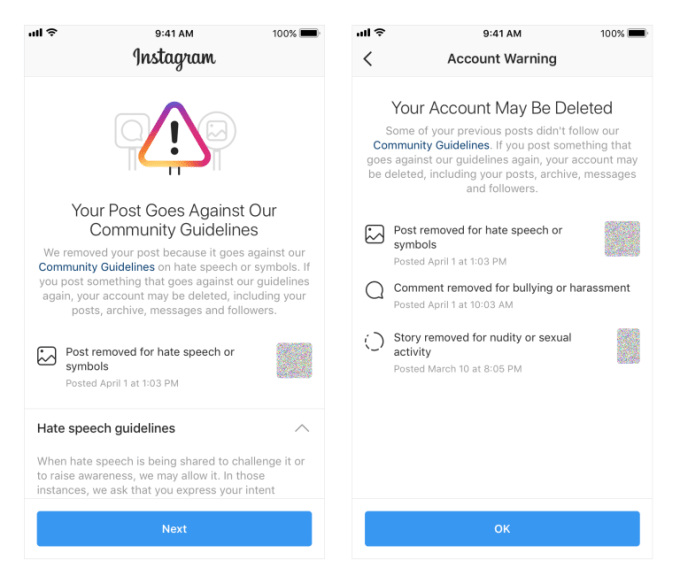
Disable Thresholds 2 up EN

In addition, Instagram says it will increase its enforcement of bad actors.

Previously, it could remove accounts that had a certain percentage of content in violation of its policies. But now it also will be able to remove accounts that have a certain number of violations within a window of time.

“Similarly to how policies are enforced on Facebook, this change will allow us to enforce our policies more consistently and hold people accountable for what they post on Instagram,” the company says in its announcement.

The changes follow a recent threat of a class-action lawsuit against the photo-sharing network led by the Adult Performers Actors Guild. The organization claimed Instagram was banning the adult performers’ accounts, even when there was no nudity being shown.

“It appears that the accounts were terminated merely because of their status as an adult performer,” James Felton, the Adult Performers Actors Guild legal counsel, told The Guardian in June. “Efforts to learn the reasons behind the termination have been futile,” he said, adding that the Guild was considering legal action.

The Electronic Frontier Foundation (EFF) also this year launched an anti-censorship campaign, TOSSed Out, which aimed to highlight how social media companies unevenly enforce their terms of service. As part of its efforts, the EFF examined the content moderation policies of 16 platforms and app stores, including Facebook, Twitter, the Apple App Store and Instagram.

It found that only four companies — Facebook, Reddit, Apple and GitHub — had committed to actually informing users when their content was censored as to which community guideline violation or legal request had led to that action.

“Providing an appeals process is great for users, but its utility is undermined by the fact that users can’t count on companies to tell them when or why their content is taken down,” said Gennie Gebhart, EFF associate director of research, at the time of the report. “Notifying people when their content has been removed or censored is a challenge when your users number in the millions or billions, but social media platforms should be making investments to provide meaningful notice.”

Instagram’s policy change focused on cracking down on repeat offenders is rolling out now, while the ability to appeal decisions directly within the app will arrive in the coming months.

How US national security agencies hold the internet hostage

Team Telecom, a shadowy US national security unit tasked with protecting America’s telecommunications systems, is delaying plans by Google, Facebook and other tech companies for the next generation of international fiber optic cables.

Team Telecom comprises representatives from the departments of Defense, Homeland Security, and Justice (including the FBI), who assess foreign investments in American telecom infrastructure, with a focus on cybersecurity and surveillance vulnerabilities.

Team Telecom works at a notoriously sluggish pace, taking over seven years to decide that letting China Mobile operate in the US would “raise substantial and serious national security and law enforcement risks,” for instance. And while Team Telecom is working, applications are stalled at the FCC.

The on-going delays to submarine cable projects, which can cost nearly half a billion dollars each, come with significant financial impacts. They also cede advantage to connectivity projects that have not attracted Team Telecom’s attention – such as the nascent internet satellite mega-constellations from SpaceX, OneWeb and Amazon .

Team Telecom’s investigations have long been a source of tension within Silicon Valley. Google’s subsidiary GU Holdings Inc has been building a network of international submarine fiber-optic cables for over a decade. Every cable that lands on US soil is subject to Team Telecom review, and each one has faced delays and restrictions.

Daily Crunch: Netflix has a rough quarter

The Daily Crunch is TechCrunch’s roundup of our biggest and most important stories. If you’d like to get this delivered to your inbox every day at around 9am Pacific, you can subscribe here.

1. Netflix reports net subscriber loss in the US, misses global subscriber growth predictions

Netflix’s price hikes might finally be convincing some consumers to unsubscribe. The company reported net growth of 2.7 million subscribers worldwide, but it actually added 2.83 million new subscribers internationally while losing around 130,000 in the United States.

Growth was lower than expected across the board, but it underperformed more noticeably in regions where it introduced a price hike.

2. FaceApp gets federal attention as Sen. Schumer raises alarm on data use

In a letter to the heads of the FBI and FTC, the senator wrote, “FaceApp’s location in Russia raises questions regarding how and when the company provides access to the data of U.S. citizens to third parties, including potentially foreign governments.”

3. Facebook’s regulation dodge: Let us, or China will

The company’s top executives have each claimed that if the U.S. limits Facebook’s size, blocks its acquisitions or bans its cryptocurrency, Chinese companies without these restrictions will win abroad.

4. On a growth tear, work trip SaaS TravelPerk adds $60M to its Series C

TravelPerk now has more than 2,000 customers for its business travel booking platform.

5. Slack resets user passwords after 2015 data breach

Slack will reset the passwords of users it believes are affected by the historical data breach. The company says this does not apply to “the approximately 99% who joined Slack after March 2015” or those who changed their password since.

6. Google teams up with Apollo 11 astronaut to celebrate the 50th anniversary of the Moon landing

To mark the event, Google teamed up with NASA and Michael Collins — the astronaut who piloted the command module while Neil Armstrong and Buzz Aldrin descended to the Moon.

7. Learn how to change banking one dollar at a time at Disrupt SF

Chime CEO Chris Britt, a16z partner Angela Strange and Omer Ismail of Goldman Sachs are all coming to Disrupt to discuss how banks and payments will change in the future.

The climate is our biggest threat. Carl Pope is fighting to change our fate

Michael Bloomberg is an unrepentant capitalist who, as he says in his 2017 book A Climate of Hope, is “not exactly your stereotypical environmentalist.” Yet over the past decade, Bloomberg has become arguably the biggest environmental philanthropist in the world — especially given the $500 million investment Bloomberg announced last month that he would soon make in rapidly moving the U.S. “Beyond Carbon,” off both coal and natural gas and to a “100% clean energy economy.” How did this happen?

It turns out one of the biggest factors in Bloomberg’s green transformation has been his friendship with Carl Pope, the longtime former head of the Sierra Club, whom Bloomberg first met about a decade ago, as Mayor of New York.

Carl Pope Headshot

Pope is not exactly a household name, but nonetheless at this point can probably be called one of the most influential environmental activists in history. He wears a leather jacket and a weathered-looking sweater on the cover of Climate of Hope alongside Bloomberg’s suit, tie, and flag pin.

The two co-authored the book — and not just in the sense that Pope ghost-wrote Bloomberg’s opinions, as happens regularly when busy political and cultural celebrities take on a lesser-known co-author for some glamour project they may barely even read. A Climate of Hope is an extended dialogue between Bloomberg and Pope, with the two alternating chapters throughout and at times even disagreeing on potentially important issues.

What there’s no disagreement on, however, is that Pope “convinced” his co-author to dive into massive environmental spending (a feat accomplished in part by showing the health-conscious Bloomberg the numbers on how lethal coal can be).

Pope is no stranger to controversy — perhaps unsurprising for a nonprofit leader who has raised money well into the nine figures. He’s a “pragmatist,” as he says many times in the interview below, which depending on who you ask either means compromise to the point of being compromised, or simply that he has a knack for actually getting things done where others merely talk.

His legacy has previously been associated with taking money from natural gas executives in a fundraising bid some saw as necessary and others called ethically tainted; with overlooking people’s polluting individual choices to buy large cars and even bigger homes; and with “looking forward to an active partnership” with Republican leaders when it was obvious they weren’t completely on board with key tenets of the environmental movement.

But Pope has also been equally or better known for pushing the Clinton/Gore administration to be better on emissions; preventing neoliberal environmentalists from adopting a nativist stance on immigration; championing a more diverse and inclusive environmental movement; and now, of course, with potentially ending the use of carbon fuel in America.

Despite 30+ years in the public eye, Carl Pope is a relatively private person who doesn’t seem to like to talk much about himself. So for starters below, I wanted to see if I could figure out what makes him tick.

Because if we could get into the heads of people who persuade billionaires to act against their short-term economic interests, with the bigger human picture in mind, maybe we could do it more often.

Then our conversation moved on to NASA, Ro Khanna, Tesla, AOC and the Green New Deal, and more. And in a soon to come follow up piece, I’ll talk with Pope about the details of the Beyond Carbon plan, including how he was able to persuade Bloomberg to take it on, and some areas of controversy that could arise as the $500 million is distributed.

All of this, after all, is part of what it means to think about the ethics of technology — Pope and Bloomberg’s work, love it or not, is certainly an attempt to reform or transform some of the most influential technologies human hands have ever touched.

How do we motivate people of all backgrounds and means to help make changes for the greener? How do we know what the right changes are to make? How do we grapple with the ethical dilemmas involved and the compromises that can seem to be required?

(Oh and by the way: in the weeks since I spoke with Pope, I have mostly been skipping big evening meals and eating more healthily in the afternoon. So at least there’s that!)

Carl Mike

Greg Epstein: I have enjoyed discovering you as —  I would even say as a historical figure, though important parts of your story are yet to be told.

I’d like to hear a bit about the key developments in your life that gave you the ethical perspective that you have.

Carl Pope: I can tell you some things about my childhood and my formation. Which particular ingredients formed my ethical perspective, I’m not sure I’ll be able to tell you, but I’ll tell you some things [that might] help.

Blue Origin CEO Bob Smith joins Disrupt SF to talk about bringing the Moon within reach

Private spaceflight company Blue Origin has its sights set on the Moon, and in May unveiled a new lander to help it get there. This October, Blue Origin CEO Bob Smith will join us onstage at Disrupt SF 2019 to talk about how the company plans to get to the Moon, and beyond — and what the opportunities are for private space companies once it does.

Smith and the Jeff Bezos -backed Blue Origin have been busy with more than just building lunar landers: It has been testing the company’s New Shepard spacecraft since 2015 and through this year, when it plans to perform its first crewed mission. To date, its tests have largely been successful and are a strong indicator that it’s well-positioned among the various companies hoping to return the U.S. to crewed launches.

That’s a key milestone in Blue Origin’s goal of getting to the Moon by 2024, which is the timeline the company declared in May. But their plan isn’t strictly about human achievement or scientific discovery — it’s about business, and establishing a permanent presence in space to provide access to resources and help humanity expand beyond its finite, Earth-bound constraints.

We’ll talk to Smith about what it means to go from today’s launches to low Earth orbit to making the trip to the Moon in just five short years, and what Blue Origin believes the commercial spaceflight industry will look like once we’ve gotten there and established a permanent commercial presence.

Blue sky opportunity is old news — Smith will help us suss out what the blue space opportunity is for the next generation of entrepreneurs.

Disrupt SF runs October 2 to October 4 at the Moscone Center in San Francisco. Tickets are available at an early-bird rate here.

Pokémon GO battles will soon be less tappy, more Fruit Ninja-y

At the end of last year, Pokémon GO finally got a player-versus-player battling system. While it was a very much welcomed addition, it has always seemed a bit… monotonous. It just requires so… much… tapping.

You repeatedly tap the screen to make your Pokémon attack, simultaneously building up its “Charge” move with each tap. Once it’s time to unleash the charge, you tap a button on screen to fire off the move, then tap as fast as you can to make that move more powerful. Tap! Tap! Tap! Taptaptaptaptaptap. Repeat until the battle is over. It’s a great thumb workout, but it arguably wasn’t very much fun.

In a tweet this afternoon, Niantic announced that they’re changing things up. The core mechanics of the battle system will remain the same, but charge attacks will now be less about tapping quickly, and more about accurate swiping. Once you’ve fired off your charge move, you’ll swipe your finger across a trail of icons falling across your screen. The more you collect before time runs out, the more powerful your attack will be.

go battle small

You can see a quick demo of the new charge system in the video below beginning around 13 seconds in. (The first 13 seconds, meanwhile, demonstrate an overhauled appraisal system for helping you figure out your particular Pokémon’s unique stats):

Trainers, two feature revamps are coming to Pokémon GO! We are rolling out an updated appraisal system to give you more detailed information on your Pokémon's stats, and will soon be updating the Charged Attack mechanic in Trainer Battles. Watch for a preview! pic.twitter.com/0MaIjrxx8f

— Niantic Support (@NianticHelp) July 15, 2019

These changes to battle mechanics are bound to be at least a little divisive because… well, they’re changes. Some people will love’m, some people will always prefer the old tap-tap-tap charge mechanics, and others will keep yelling that the game should just use the same turn-by-turn battle system found in the main Pokémon series.

At first glance, though, I like this new concept. It reminds me a bit of glyph hacking in Niantic’s first game, Ingress, or the spell casting mechanics in its most recent title, Harry Potter: Wizards Unite. Swiping up icons seems just a pinch more entertaining than furiously bashing at the screen, without really messing with the underlying battle mechanics. At the very least, my thumb appreciates the change.

Curve, the ‘over-the-top’ banking platform, raises $55M at a $250M valuation

Curve, the London-based “over-the-top banking platform,” has raised $55 million in new funding. The startup lets you consolidate all of your bank cards into a single Curve card and app to make it easier to manage your spending and access other benefits.

Curve’s Series B round is led by Gauss Ventures, the U.S.-based fintech investor, alongside Creditease, IDC Ventures and previous backer Outward VC (formerly Investec’s INVC fund). A number of other early investors, including Santander InnoVentures, Breega, Seedcamp and Speedinvest also followed on.

The new round of funding values Curve at $250 million (or one-quarter unicorn, so to speak), and will be used by the company to continue adding more features to its platform and for further European expansion. The company claims 500,000 users and says it is on track to reach 1 million by the end of the year.

Curve is currently available in 31 countries across Europe, with around 30% of its customer base coming from outside the U.K. “We [have] identified a few countries where the organic pull is fantastic, and we are about to double down on them,” Curve founder and CEO Shachar Bialick tells me.

Like a plethora of fintech startups, Curve is building a platform that essentially turns your mobile phone into a financial control centre that re-bundles disparate financial products or functionality to offer a single app to help you manage “all things money.”

However, rather than building a new current account — as is the case with the challenger banks such as Monzo, Starling and Revolut — Curve’s “attack vector” is a card and app that lets you connect all of your other debit and credit cards (sans Amex) so you only ever have to carry a single card.

Once you’ve added your cards to Curve, you use the app to switch from which underlying debit or credit cards you wish the Curve Mastercard to spend, and can track and see a single and consolidated view of your spending regardless of which card was charged (and therefore which of your bank accounts the money was pulled from).

In other words, Curve isn’t asking to replace your existing bank accounts but is pitched as a cloud-based platform that runs “over-the-top” of existing banking and payments infrastructure. Historically, the over-the-top terminology has been used to describe the way video streaming services such as Netflix run “over-the-top” of existing broadband infrastructure.

“For Curve to succeed in its mission of bringing banking to the cloud, we need [to continue] to build the product; tiny experiences that together create a whole new offering,” Bialick continues. “Our money is everywhere and the job of connecting it all together to one seamless experience requires many resources, and especially many talented people. The latest Series B will enable Curve to re-bundle more of your money: experiences such as Curve Send (peer-to-peer payments), and Curve Credit (post transaction installments for any payment, anywhere).”

Curve Cash in App 1Alongside Curve’s all-your-cards-in-one functionality, the Curve app lets you lock your Curve card at a touch of a button, provides instant spend notifications, “zero FX fees” when spending abroad or in a foreign currency and the ability to switch payment sources retroactively. The latter is dubbed “Go Back in Time” and means if you make a purchase via Curve that gets charged to a card other than the one you intended, you have two weeks to change your mind.

More recently, Curve has re-vamped its cashback feature in a bid to draw in more customers for the premium versions of the Curve card. With the new Curve Cash programme, customers get 1% instant cash back on top of any existing rewards cards that they have plugged into the app, potentially earning customers double rewards on purchases. You simply pick from the list of retailers supported for cashback — you are allowed to choose between three and six retailers, depending on which Curve plan you are on — and then get 1% cashback for any purchases made at those stores.

Bialick claims that Curve’s over-the-top model is also producing higher engagement than many challenger banks, with customers spending on average £1,500 per month through the Curve platform. (As an imperfect reference point, challenger bank Monzo says that around 30% of its users top up their account by £1,000 or more per month). I’m also told that 15% of Curve’s users have added a challenger bank card to their Curve account, which also makes for an intriguing and even more nuanced comparison.

And whilst Curve is arguably trying to define a new market category — at least here in the West — and therefore isn’t the easiest of products to explain, Bialick says that existing Curve customers are the startup’s biggest advocates.

“There isn’t just one thing that pulls customers to Curve, there are as many pulls as [there are] the number of ‘money jobs’ one has. All your cards in one, fee-free spending abroad, ‘Go Back In Time,’ to name a few, all attract and retain our customer base. Indeed, awareness and brand building is key, especially amongst all the noise, but that’s where our customers are proving invaluable, telling their friends about Curve, which drives most of our adoption with 2,000 plus new accounts per day.”

To win in this new category of banking, Bialick says the company needs to steadfastly stick to its mission to reduce the number of steps it takes to carry out everyday money-related tasks. “The winners will be the companies… [that] create the most seamless experience, removing as much friction between the customer and their money.”

What to expect from tomorrow’s antitrust hearing featuring big tech

Tomorrow, representatives from Facebook, Google, Amazon and Apple will testify before Congress in the second hearing organized as part of the House Judiciary Committee’s antitrust investigation into the world’s largest technology companies.

While the first hearing focused on the ways technology companies busted the traditional news business, this one promises to look at the “impact of market power of online platforms on innovation and entrepreneurship,” according to the committee.

Unlike the previous hearing, which featured representatives from media outlets and industry trade organizations attacking or defending the ways in which online advertising had gutted the news business, this latest outing led by Rhode Island Democratic Rep. David Cicilline will have actual tech company execs on hand to answer congressional queries.

One section of the testimony will feature Google’s economic policy head, Adam Cohen; Amazon’s associate general counsel, Nate Sutton; Facebook’s global head of policy, Matt Perault; and Kyle Andeer, Apple’s chief compliance officer.

Others expected to appear include Tim Wu, the Columbia Law professor who’s been an outspoken critic of technology consolidation and an advocate for more stringent antitrust oversight of tech companies, and Maureen Ohlhausen, a partner at Baker Botts and the former acting chairman of the Federal Trade Commission in charge of its antitrust actions.

Wu and his views sort of encapsulate much of the thinking from critics of these companies’ current dominance in the market.

“I would love, in fact, if a serious Facebook challenger took down Facebook, and I would stop calling for any antitrust action. It’s just when you become suspicious that the barriers have gotten strong enough that a company could survive, then maybe we need to have antitrust law loosened up, get things moving, and provide for the market cycle to take its place. Now eventually it will happen, but we can’t wait for 50 years,” Wu told the American Enterprise Institute in an interview earlier this year.

“It’s also possible that history would suggest that a company like Facebook, and perhaps Amazon, will soon try to get government on their side to defend themselves against competition. I don’t know what it will look like, but maybe Facebook agrees to some kind of privacy law, which for some reason is very hard for new entrants to adhere to. Amazon may try and instantiate itself as basically the national e-commerce monopolist, kind of like a Bell-regulated monopoly. That’s a next natural step, especially as a big star, to become less competitive. And so before that happens, I think we give the antitrust law its turn.”

Policy watchers can expect market criticisms of the big technology platforms to come from a few different angles (each company has different, slightly overlapping, issues that policymakers find worrisome).

For Alphabet, criticism stems primarily from the company’s dominance in online search and the ad networks it controls through its ownership of DoubleClick and AdMob (along with its ownership of YouTube’s wildly popular video platform). At Amazon, it’s the ways in which Jeff Bezos’e-commerce behemoth hoovers up sales information  and uses it to inform pricing and potentially anticompetitive practices that stymie the development of new e-commerce players by promoting its own brands and products.

For Facebook, it’s the dominance of the company’s social media platforms (including Instagram and the messaging service WhatsApp) that are a cause for concern — as is its unwillingness to open its social graph for other startups. The company also elicits howls from consumer advocates for its abysmal ability to protect user privacy and data.

Finally, Apple’s control over the entire ecosystem it pitches to consumers — and the pricing policies it enforces that some critics have called extortive are cause for concern among the political class.

These competitive concerns also play out against the outsized ambitions that these technology companies have in other areas. Facebook is trying to make an end run around the existing global financial system through the launch of its Libra cryptocurrency; Alphabet, Amazon and Facebook all have designs to dominate the development of artificial intelligence in open markets; and then there’s the work these companies are conducting in areas as diverse as healthcare, mobility technologies and even space travel and high-speed networking.

With so many interests in so many areas and core businesses generating so much money, it’s easy to conflate a broader unease with these companies’ ambitions and the core anti-competitive arguments that are worthy of discussion.

For this hearing — and indeed the Congressional investigation to be successful — the focus should be less on the global ambitions of these technology companies and more on the practices they’ve enacted to stifle competition.

Facebook snags former Vine GM to run product for its new experimental app division, NPE Team

Is Facebook preparing to launch a serious competitor to TikTok? If so, the company just picked up some key talent to make that happen. Last week, Facebook announced plans for a new division, called the NPE Team, which will build experimental consumer-focused apps where it will try different ideas and features, then see how people react. Now, Facebook has picked up former Vine GM Jason Toff to join the NPE Team as a product management director.

Now that we've moved to CA, I suppose it's a good time to share what I'm up to next! In two weeks, I'll be joining Facebook as a PM Director starting up a new initiative under the recently formed NPE team (https://t.co/HzK6Bjqzqx)

Jason Toff (@jasontoff) July 15, 2019

Toff’s experience also includes time spent at Google, most notably as a product lead for YouTube before exiting to Vine in 2014. At the short-form video app maker, Toff worked as head of Product for a year, then became Vine’s general manager.

Vine, of course, was later snatched up by Twitter — and there, Toff moved up to director of Product Management before boomeranging back to Google, where his initial focus was on AR and VR projects.

Most recently, Toff worked as a partner at Google’s Area 120, Google’s in-house incubator where employees work on experimental projects.

That’s not all that different from what Facebook appears to have in store with its own NPE Team ambitions. Similar to Area 120 or Microsoft Garage, for example, the NPE Team plans to deliver apps that will “change very rapidly” in response to consumer feedback. It also will be quick to close down experiments that aren’t useful to people in fairly short order.

That’s not how Facebook itself operates. Its more experimental apps have had longer runs, as the company used them to gain feedback to inform its larger projects. For example, its photo-sharing app Moments ran from 2015 through early 2019, and its TrueCaller-like app Hello for emerging markets ran for several years, despite fairly limited adoption.

Facebook has also tried and failed with a number of other offshoots over the past decade, like Facebook Paper, Notify, a Snapchat clone called Lifestage and others, as well as those it picked up through acquisitions, then later shut down like tbh or Moves. It also previously ran an internal incubator of sorts called Facebook Creative Labs, which birthed now-failed projects like Slingshot, Riff and Rooms.

Many of these efforts were fairly high-profile at launch, which made their eventual shut down more problematic for Facebook’s image. With the NPE Team — as with Area 120 or Microsoft Garage — there’s a layer of separation between the test apps and the larger company. Many of the apps that the NPE Team puts out will bomb, and that’s the point — it wants to get the failures out of the way faster so others can find success.

While Toff can’t yet say what he’ll be working on at Facebook, there’s a lot of speculation that the NPE Team will try to come up with some sort of answer to TikTok, the Beijing-based short-form video app that sucked up Musical.ly in 2018 and now is a Gen Z social networking hit, with some 500 million-plus monthly users. Toff’s background with Vine could certainly be helpful if that were the case.

Facebook, of course, already tried to get a TikTok clone off the ground with Lasso, but the experiment didn’t take off and the app lead, Brady Voss, left Facebook soon after its launch.

Toff says he’s hiring for the NPE Team, including both UX designers and engineers.

I can't talk project specifics but can share that I'll be HIRING. I'm looking to assemble a diverse and mighty 2-pizza dream team full of creative can-doers, so if you're a UX designer or engineer (or both) and thrive in zero-to-one environments, HMU!

— Jason Toff (@jasontoff) July 15, 2019

SpaceX and NASA detail cause of Dragon test failure, crewed flight this year looks ‘increasingly difficult’

SpaceX held a press conference on Monday to discuss the results of a months-long investigation conducted by itself and NASA into an anomaly that took place during a static fire test in April. The investigation found that the “anomaly” that occurred during the test was the result of oxidizer mixing with the helium component of the SuperDraco rocket engine propellant system at very high pressure.

On April 20, SpaceX held an abort engine test for a prototype of its Crew Dragon vehicle (which had been flown previously for the uncrewed ISS mission). Crew Dragon is designed to be the first crew-carrying SpaceX spacecraft, and is undergoing a number of tests to prove to NASA its flight-readiness. After the first few tests proved successful, the test encountered a failure that was instantly visible, with an unexpected explosion that produced a plume of fire visible for miles around the testing site at its Landing Zone 1 facility in Cape Canaveral, Fla.

SpaceX VP of Build & Flight Reliability Hans Koenigsmann and NASA Commercial Crew Program Manager Kathy Lueders took members of the media through the results of their joint investigation into the cause of this anomaly. Koenigsmann explained there were identifying burn marks around a check valve in the system that’s meant to separate the oxidizer and fuel components under pressure. These check valves contain a spring that can be opened to allow flow in the direction you want the propellant components to go, but in this case a “leaky” check valve resulted in a “slug,” composed of high-pressure oxidizer, striking a titanium component that caused a very violent reaction.

Both Lueders and Koenigsmann noted that it was in many ways “a gift” that this happened during a ground test because there were many high-speed cameras to capture the incident, and it was relatively easy to comb the site and recover components to best figure out the cause of the anomaly. Koenigsmann also noted that while the team is confident in sharing these results, they are actually only approximately 80% through the investigation and there is about 20% left to do in terms of figuring out additional details, mostly around the physics involved.

Koenigsmann said that SpaceX is already implementing a crucial hardware fix for this, which is to replace the check valve with a burst valve. A burst valve completely separates the oxidizer and fuel from any pressurization liquid, which will mitigate this issue and definitely “make Crew Dragon a safer vehicle,” he said.

So far this year, SpaceX has succeeded in launching an uncrewed version of its Crew Dragon 2 spacecraft to the ISS during a mission in March, and had planned to run the first crewed test mission this July, with a mission duration of two weeks. That definitely won’t occur on that timeline, and now ongoing production of Crew Dragon craft will bump back the designated machines one generation, meaning the intended Crew Dragon 1 craft meant for crewed mission flight is now Test 2, and so on.

Asked repeatedly about timeliness, neither Koenigsmann nor Lueders would offer anything concrete, but both expressed some skepticism about managing a launch by end of year, without dismissing the possibility outright.

“There’s always the chance that we’re gonna fly crew on a SpaceX vehicle this year,” Lueders said, but continued that “right now” NASA is paying attention to all the ongoing testing of various systems and “all those things need to occur before we’re gonna be confident that the system can safely fly our crew. I hope it’s this year.”

Koenigsmann noted that this is an issue he’s fairly confident can be addressed in parallel with other things that need to be addressed with Crew Dragon before crewed flight. “I don’t think it’s impossible, but it’s getting increasingly difficult, too,” he said, when asked directly about a crewed Dragon launch occurring before the end of 2019.

Lueders ended by expressing appreciation for SpaceX’s openness with NASA and its astronauts throughout this process, and Koenigsmann reinforced the superiority of the burst valve versus the check valve it’s replacing for this application.